
Paternity Action Attorneys in Humble, Texas: How to Establish Paternity and Protect Your Rights

The call usually starts the same way. A father in Humble tells me he has been helping raise his child for years, but now the relationship with the mother has broken down and he’s being told he has no say in major decisions. Or a mother explains that the man she believes is the father has suddenly reappeared after years of absence, claiming parental rights while contributing little financial support. Families searching for Paternity Action Attorneys in Humble Texas are often asking the same underlying question: what rights does a parent actually have before paternity is legally established, and how does that affect a child’s future?
That legal question reaches much further than most people realize. Establishing paternity is not simply about putting a name on a birth certificate. It determines who has legal rights to seek custody and visitation, who may be ordered to pay child support, who can make important decisions for a child, and whether a child can access benefits such as health insurance, inheritance rights, Social Security survivor benefits, and family medical history. In many cases, the legal uncertainty surrounding parentage creates instability that affects every aspect of a family’s life.
I’m Bryan Fagan. My firm represents parents throughout Humble, Kingwood, Atascocita, and the greater Houston area, and few areas of Texas family law create more confusion than paternity actions. People often assume biology automatically creates legal rights. Texas law is rarely that simple. A father may be biologically related to a child yet lack enforceable rights. A presumed father may have legal responsibilities even when he is not the biological parent. An acknowledgment signed years ago may not provide the protections a parent thinks it does. Understanding these distinctions can dramatically change the outcome of a case.
One father I’ll call David came to our office convinced he had done everything right. He attended doctor’s appointments, provided financial support, and maintained a close relationship with his child. When conflict arose with the mother, however, he discovered that his assumptions about his legal status did not match reality. The problem wasn’t his commitment as a parent. The problem was that key legal issues had never been formally addressed. Like many parents, he learned that the gap between being a parent in everyday life and being recognized as a parent under Texas law can be much larger than expected.
In this guide, we’ll examine how paternity is established under Texas law, the rights and benefits children gain when parentage is legally confirmed, how Texas courts evaluate custody and support issues after paternity is established, and why legal stability often plays an important role in a child’s overall well-being. Most importantly, we’ll discuss how parents can protect both their rights and their children’s futures by addressing paternity issues before small problems become much larger ones.
The Quick Version
In Texas, you establish paternity one of two ways: both parents sign an Acknowledgment of Paternity (AOP) under Texas Family Code §160.301, or a court issues an order — often after genetic testing under §160.502. Once paternity is legal, you still need a custody and support order to have enforceable rights. Establishing fatherhood and getting a parenting order are two separate steps.
Key Takeaways
- Signing the birth certificate is not enough by itself. Legal paternity in Texas comes from a signed Acknowledgment of Paternity or a court order — not the certificate alone.
- Establishing paternity and getting custody are two different cases. Being the legal father gives you standing; it does not give you a visitation schedule until a court orders one.
- There are deadlines that can end your case. When a child already has a presumed father, a challenge generally must be filed before the child’s fourth birthday under §160.607.
- Paternity can be ordered back support. A court can order retroactive child support once paternity is established, sometimes years back.
- The Attorney General route is free but limited. The Texas OAG establishes paternity and support but does not litigate your custody and visitation. That is where most contested fights actually happen.
- A signed AOP can be rescinded — briefly. You generally have 60 days to rescind an Acknowledgment of Paternity under §160.307 before it becomes much harder to undo.

Your Family’s Future Starts Here
Don’t navigate your legal journey alone. Schedule a consultation now and get the clarity and support you deserve.
Our Humble Texas family lawyers and attorneys for wills advise our clients of the immediate aftermath as well as the long-term effects of divorce-related issues, such as the following:
Trust us to help you with your Family Law Attorneys in Humble, Texas. Call 281-817-1827 or contact us online today to schedule a free consultation with your Family Law Attorney in Humble, Texas.
What a Paternity Action Is Under Texas Law

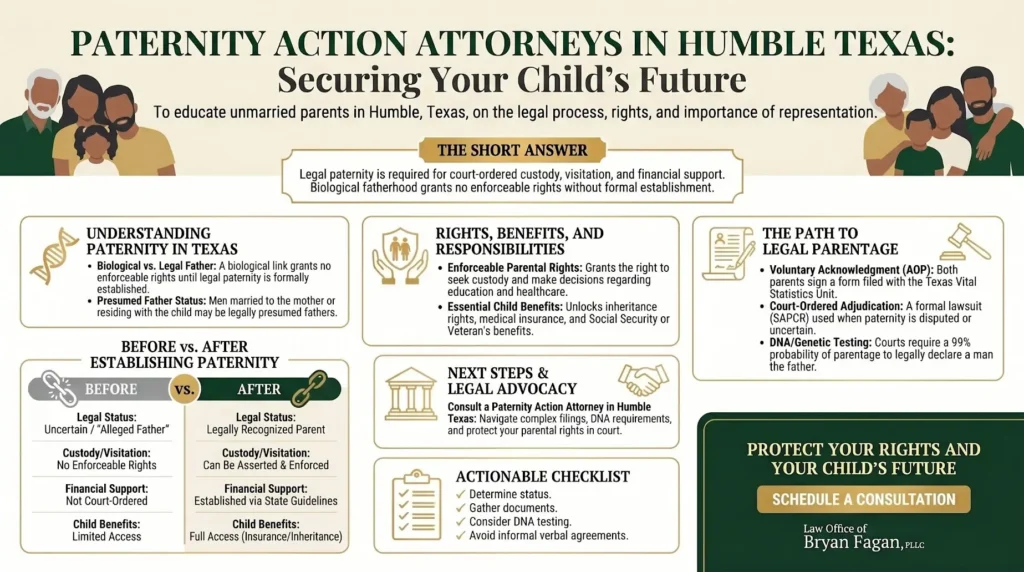
A paternity action is the legal process used to establish the father-child relationship when legal parentage has not already been determined. For families working with Paternity Action Attorneys in Humble Texas, establishing paternity is often the first step toward securing parental rights, custody, visitation, child support, and long-term legal protections for both parent and child.
Texas paternity laws are governed by Chapter 160 of the Texas Family Code. Under §160.201, legal fatherhood may be established through a presumed father relationship, a valid Acknowledgment of Paternity, a court order, adoption, or certain assisted reproduction circumstances. For most unmarried parents, the process involves either signing an Acknowledgment of Paternity or obtaining a court order through the Harris County family courts.
Why does this matter? Until paternity is legally established, an unmarried father generally has no enforceable right to custody or visitation, and a mother may have difficulty pursuing formal child support. Establishing paternity in Texas creates the legal foundation for parental rights, child support obligations, inheritance rights, healthcare benefits, and custody after paternity is established. Families who are focused on protecting their children’s future often address parentage issues alongside other long-term planning matters, including working with a Humble retirement planning lawyer to help safeguard their family’s financial future.
In straightforward situations, parents may be able to establish legal fatherhood through a voluntary acknowledgment. In more complex cases involving disputed parentage, presumed fathers, contested custody issues, or DNA testing for paternity, court involvement is often necessary. Because missed deadlines and misunderstandings can affect parental rights in Texas, understanding your options early can help protect both your rights and your child’s future.
What I Tell Clients
Establishing paternity is not just a paperwork formality. It is the legal foundation for your relationship with your child — and the foundation for child support, health insurance, Social Security benefits, and inheritance rights. Get it right at the start and the rest becomes far easier to fight for.
How to Establish Paternity in Texas: The Two Paths
For families working with Paternity Action Attorneys in Humble Texas, establishing legal fatherhood usually happens in one of two ways: through a voluntary agreement between the parents or through a court order. The right path depends on whether both parents agree about parentage and whether related issues involving custody, visitation, or child support need to be resolved.
In straightforward situations, parents can establish paternity by signing an Acknowledgment of Paternity (AOP) under Texas Family Code §160.301. This document may be completed at the hospital after a child’s birth or later through an authorized agency. Once filed with the Texas Vital Statistics Unit, the AOP has the same legal effect as a court order establishing parentage. For parents who agree, this is often the fastest and least expensive way to establish paternity in Texas.
In more complex cases, a court proceeding may be necessary. When paternity is disputed, a presumed father exists under Texas Family Code §160.204, or one parent refuses to cooperate, a Suit to Adjudicate Parentage can be filed. The court may order DNA testing for paternity under §160.502 and ultimately determine legal fatherhood based on the evidence presented. This process is common in the Harris County family courts and often serves as the starting point for resolving custody, visitation, and child support issues.
The reason the process matters is simple: legal fatherhood in Texas is about far more than a name on a birth certificate. Establishing paternity creates the foundation for parental rights, financial support, healthcare benefits, inheritance rights, and custody after paternity is established. It can also become especially important when a family’s circumstances involve child welfare investigations or concerns about a child’s safety. In those situations, understanding the role of a Humble CPS defense lawyer may help parents better understand how parentage rights and child-protection proceedings can intersect.
Where paternity is disputed or parental rights are contested, delays can create significant legal and financial consequences. Understanding which path fits your situation—and taking action before deadlines become an issue—can help protect both your rights and your child’s future.
Strategy Note
If you are an unmarried father, do not sign an AOP without also planning for a custody and visitation order. I have seen too many fathers sign at the hospital, assume they’re protected, and then discover months later they have legal fatherhood but no court-ordered access to their child. File for both at once.
How Texas Establishes Legal Fatherhood
Listen to Our Texas Family Law Podcast
Prefer listening? In this episode, we discuss gestational vs. traditional surrogacy in Texas, including how legal parentage is determined, key differences between each arrangement, and what families should know before moving forward.
Does Signing the Birth Certificate Establish Paternity in Texas?
One of the most common misconceptions we hear from parents working with Paternity Action Attorneys in Humble Texas is that signing a birth certificate automatically establishes legal fatherhood in Texas. It does not. While a birth certificate is an important record, it is not the legal document that creates parental rights or responsibilities under Texas paternity laws.
For unmarried parents, legal paternity is typically established through an Acknowledgment of Paternity (AOP) under Texas Family Code §§160.301–160.308 or through a court order. The birth certificate may reflect that acknowledgment, but the certificate itself is not what creates the legal parent-child relationship. That distinction becomes important when questions arise about custody, visitation, child support and paternity, or a father’s rights in Texas.
In straightforward situations, parents often sign an AOP shortly after a child’s birth and move forward without issue. In more complex cases, however, parents discover years later that no valid acknowledgment was ever filed or that additional court orders are needed to establish enforceable rights. A father may see his name on the birth certificate and assume he has automatic rights to possession and decision-making, only to learn that custody after paternity is established requires separate court orders addressing conservatorship and visitation under Texas Family Code §153.134.
This misunderstanding can create significant problems when parental rights are contested. Without legally established paternity, a father may have difficulty enforcing visitation rights or participating in important decisions affecting the child. Likewise, a mother may face challenges obtaining court-ordered support. Much like families benefit from proactive planning through services such as incapacity planning in Humble, addressing parentage issues early can help prevent uncertainty and protect a child’s long-term stability.
If your situation involves disputed parentage, questions about legal fatherhood, or concerns regarding parental rights and visitation, understanding the difference between a birth certificate, an Acknowledgment of Paternity, and a court order can help you avoid costly mistakes and make informed decisions about your family’s future.
Warning
If you signed an Acknowledgment of Paternity and now have real doubt about whether you are the biological father, the 60-day rescission window under §160.307 is short and unforgiving. After it closes, undoing an AOP requires proving fraud, duress, or material mistake of fact — a much steeper climb. Do not wait to get advice.
How Much Does It Cost to Establish Paternity in Texas?

One of the first questions families ask Paternity Action Attorneys in Humble Texas is how much it will cost to establish legal fatherhood. The answer depends largely on whether the matter is cooperative or contested. In straightforward situations where both parents agree and sign an Acknowledgment of Paternity (AOP), the process can be completed with little to no cost. Under Texas Family Code §160.306, there is no filing fee for a properly executed AOP.
Costs typically increase when disagreements arise over parentage, custody, visitation, or child support and paternity issues. A contested case may involve court filing fees, DNA testing for paternity under Texas Family Code §160.502, and attorney’s fees. In many cases, the largest expense is not proving parentage itself but resolving related disputes involving parental rights in Texas, conservatorship, and financial support. For that reason, the complexity of the case—not simply the paternity question—often drives the overall cost.
In straightforward situations, parents can often establish paternity in Texas through cooperation and avoid lengthy court proceedings. In more complex cases involving a presumed father under §160.204, disputed parentage, or competing claims regarding custody after paternity is established, legal strategy becomes increasingly important. Parents who wait too long to address these issues may also encounter deadlines under Texas Family Code §160.607, which limits certain challenges involving presumed fathers.
Another common misconception is that signing paperwork alone resolves every issue. While a valid AOP can establish legal fatherhood in Texas, it does not automatically create enforceable custody or visitation orders. Parents who want a deeper understanding of how the process works can learn more about an Acknowledgment of Paternity in Texas. Understanding the difference between establishing parentage and securing enforceable parental rights can help families avoid costly mistakes and make informed decisions about their future.
If your case involves agreed parentage, the process may be relatively simple and affordable. If paternity is disputed, parental rights are contested, or significant custody and support issues are involved, the costs—and the stakes—are often much higher. Understanding where your case falls on that spectrum can help you determine the level of legal guidance that best protects both your rights and your child’s future.
Ready to turn “I think I have rights” into a court order you can enforce?
Schedule a Legal Strategy SessionDeadlines and the Presumed-Father Trap
The most dangerous deadline in Texas paternity law is the four-year limit to challenge a presumed father. Under Texas Family Code §160.607, a proceeding to adjudicate the parentage of a child who already has a presumed father generally must be filed before the child’s fourth birthday — with narrow exceptions.
Here’s how people get caught. A child is born during a marriage, so the husband is the presumed father under §160.204 — even if everyone privately knows another man is the biological father. If nobody acts before the child turns four, the law can lock in the presumed father permanently. The biological father can lose the chance to establish his rights, and the presumed father can be stuck with support obligations for a child that isn’t his. Both outcomes are avoidable if you act early.
Texas Paternity Qualifier
Are the child’s parents married to each other, or were they at the time of birth?
Texas Paternity Qualifier
Is there any dispute about whether the husband is the biological father?
Texas Paternity Qualifier
Has an Acknowledgment of Paternity (AOP) been signed and filed?
Texas Paternity Qualifier
Is the child currently younger than 4 years old?
Texas Paternity Qualifier
What do you want to come out of this, beyond confirming who the father is?
Texas Paternity Qualifier
Does the other parent agree to cooperate, or is the Attorney General already involved?
Your Situation
You’re in a strong position to establish paternity cleanly.
Based on your answers, your path looks straightforward — but “straightforward” in paternity still means making sure fatherhood, custody, and support are all locked into an enforceable order, not left half-done. A short strategy session confirms you’re not leaving rights on the table.
Most clients hear back within 5 minutes during business hours (8 AM–10 PM CT, 7 days a week).
Your Situation
You likely need a court order — and an attorney in your corner.
When the other parent won’t cooperate, paternity is disputed, or the Attorney General is involved, a voluntary acknowledgment usually isn’t enough. You’ll likely need a parentage suit to compel testing and to win the custody and support terms you actually want. This is exactly the kind of case where having your own attorney changes the outcome.
Most clients hear back within 5 minutes during business hours (8 AM–10 PM CT, 7 days a week).
“In paternity, the calendar is often the opponent. The fourth birthday closes doors that no amount of money reopens.”
Contested Paternity and Genetic Testing
When parties dispute who the father is, a Texas court will order genetic testing on the request of a party under §160.502. A result showing at least a 99% probability of paternity, paired with the required paternity index, identifies the man as the father under Texas law.
But contested paternity is rarely only about the test. It’s about what comes next: custody, the visitation schedule, child support amount, and sometimes retroactive support back to the child’s birth. This is where having a paternity attorney changes the outcome. The OAG can confirm biology; it does not fight for your parenting time. The genetic result opens the door — the parenting order is what you actually live with.
The Numbers That Matter
How Paternity Cases Work in Harris County and Nearby

For families in Humble, Kingwood, and Atascocita, a paternity suit is filed in Harris County, where the case is heard in one of the county’s family district courts. The court process is the same statewide, but local filing procedures, court schedules, and associate-judge dockets differ by county and affect how fast your case moves.
If you live just north or east of Humble, watch the county line. Cases tied to New Caney, Porter, or Conroe fall in Montgomery County; parts of the area touch Galveston and Brazoria counties as well. Each county has its own family courts and standing orders. Filing in the right county — and knowing that court’s local rules — prevents delays that can push a case out by months. My firm handles paternity matters across Harris, Montgomery, Fort Bend, Galveston, and Brazoria counties.
Attorney General vs. Private Paternity Attorney
The Texas Office of the Attorney General will establish paternity and set child support for free — but it does not represent you, and it does not litigate custody or visitation. A private paternity attorney represents your interests and resolves paternity, custody, support, and visitation in one coordinated case.
The distinction is simple but costly to miss: the OAG’s client is the State and the child’s right to support, not you. If all you need is to confirm paternity and open a support order, the OAG works. If you are a father who wants real parenting time, a mother facing a custody dispute, or anyone where the other side has a lawyer, you need your own attorney. The OAG will not ask the court for your weekends with your child. Only you, or your lawyer, can do that.
What to Do If You’re Dealing With a Paternity Question
Want this checklist turned into a real plan for your case?
Schedule a Legal Strategy SessionWhat I Tell Every Client Who Calls About Paternity
After handling paternity cases throughout Harris County for years, I’ve learned that paternity often seems simple at first glance. Many parents believe they only need to sign a document or complete a DNA test. What they quickly discover is that legal fatherhood in Texas is closely connected to custody, visitation, child support, parental rights, and important legal deadlines. The decisions made early in a case often shape what options remain available later.
Families who work with Paternity Action Attorneys in Humble Texas are often surprised by how quickly delays can create problems. Texas paternity laws include important deadlines, including the four-year challenge period that may apply to presumed fathers under Texas Family Code §160.607 and the limited timeframe for rescinding an Acknowledgment of Paternity. Waiting can also increase potential retroactive child support obligations and make custody disputes more difficult to resolve. In straightforward situations, parents may be able to establish paternity in Texas through cooperation and move forward efficiently. In more complex cases involving disputed parentage, custody after paternity is established, or contested parental rights in Texas, having a clear legal strategy becomes increasingly important.
One of the biggest mistakes parents make is assuming that legal issues will resolve themselves over time. They rarely do. Where paternity is disputed, courts often evaluate credibility, parental involvement, cooperation between the parties, and the overall stability of the child’s environment when making decisions that affect the parent-child relationship. When parental rights are contested, the outcome can affect everything from visitation schedules to child support and paternity obligations for years to come. Parents who understand their rights early are generally in a stronger position than those who wait until a crisis develops.
If your case involves a voluntary acknowledgment, the path forward may be relatively straightforward. If it involves disputed parentage, DNA testing for paternity, child support enforcement, or disagreements regarding custody and visitation, the stakes are often much higher. Understanding how these issues connect can help you make informed decisions and avoid costly mistakes. For parents dealing with unpaid support after paternity has been established, learning about the process of enforcing a delinquent Texas child support order can provide valuable insight into protecting your child’s financial future.
The goal is not simply to establish legal fatherhood. The goal is to create clarity, protect your rights, and build a stable foundation that allows your child to move forward with the support and security they deserve.
Establish your rights before a deadline does it for you.
Same-week availability. Most clients hear back within 5 minutes during business hours.
Schedule a Legal Strategy SessionConclusion:
Paternity cases are rarely just about determining who a child’s legal father is. They are about creating certainty where uncertainty exists, protecting relationships that matter, and establishing a framework that allows children and parents to move forward with confidence. Whether you are seeking to establish parental rights, secure child support, resolve custody concerns, or protect your child’s access to important benefits, taking action sooner rather than later can make a meaningful difference. Families searching for Paternity Action Attorneys in Humble Texas are often looking for more than legal answers—they are looking for clarity, stability, and a path forward.
In straightforward situations, establishing paternity may involve little more than completing the proper legal paperwork and ensuring all requirements are met. In more complex cases, disputes over custody, visitation, child support, presumed father issues, genetic testing, or parental decision-making authority can significantly affect the outcome. If your case involves contested parentage, questions about a child’s best interests, or concerns about protecting your long-term relationship with your child, having experienced legal guidance can help you make informed decisions. At The Law Office of Bryan Fagan, PLLC, our goal is to help families understand their options, protect what matters most, and move forward with greater peace of mind, confidence, and control over their future.
Questions My Clients Ask About Establishing Paternity
A father can voluntarily establish paternity any time by signing an Acknowledgment of Paternity. The hard deadline is on the other side: if a child already has a presumed father, a suit to adjudicate parentage generally must be filed before the child’s fourth birthday under §160.607. There are limited exceptions — for example, where the presumed father and mother never lived together or had relations during the probable time of conception. If there’s any chance a presumed-father deadline applies to your situation, treat it as urgent.
Not on its own. Legal paternity comes from a valid Acknowledgment of Paternity or a court order, not the birth certificate. Unmarried parents usually sign the AOP at the hospital at the same time the certificate is completed, which is why people confuse the two. If you signed your name on a certificate but no AOP was ever filed, your legal status may be far less secure than you think — and worth confirming with an attorney.
A voluntary Acknowledgment of Paternity is free — no filing fee under §160.306. A contested court case adds filing fees of roughly $300 to $400, genetic testing of roughly $100 to $500, and attorney’s fees that scale with how contested custody and support become. The paternity question itself is rarely the expensive part; the custody and support fight around it is.
Texas paternity is governed by Chapter 160 of the Family Code, the Uniform Parentage Act. Recent legislative attention has focused on protections around acknowledgments signed by minors and on tolling certain challenge periods, and the Legislature revisits the Family Code each odd-numbered session. Because the specifics change, I verify the current statute at the time of every case rather than rely on a version from a prior year. If you’ve read about a change, bring it to your session and we’ll check it against the current code together.
Not once a parentage suit is filed. When a party requests genetic testing in a court proceeding, the court will generally order the child and relevant individuals to submit to testing under §160.502. Refusing a court order has consequences. Outside of a court case, there’s no way to compel a test — which is exactly why filing the suit is often the necessary first move.
Within 60 days, yes — an AOP can be rescinded under §160.307. After that window, undoing it requires going to court and proving fraud, duress, or a material mistake of fact under §160.308, and there are time limits there too. If you signed under pressure or based on information you now doubt, the clock is already running. Don’t wait to get advice.
Establishing paternity gives a father legal standing — the right to ask a court for custody and visitation — but it does not by itself create a parenting schedule. You need a separate court order setting conservatorship, possession, and access. This is the single most common misunderstanding I see: legal fatherhood and an enforceable visitation order are two different things, and you want both handled together.
Yes. Once paternity is established, a Texas court can order retroactive child support — support owed for the period before the order was entered. The amount depends on factors the court weighs, including the father’s past earnings and prior support provided. This is one reason fathers should not delay: the longer paternity goes unresolved, the larger a potential retroactive award can grow.
Humble, Kingwood, and Atascocita are in Harris County, so a paternity suit is filed in the Harris County family district courts. If your situation crosses into New Caney, Porter, or Conroe, that’s Montgomery County, and the case is filed there instead. Filing in the correct county matters — the wrong venue causes delays. We handle filings across Harris, Montgomery, Fort Bend, Galveston, and Brazoria counties.
Often, yes. The OAG establishes paternity and sets child support, but it does not represent you and does not handle custody or visitation. If you want parenting time, if custody is disputed, or if the other parent has counsel, you need your own attorney to protect your interests. The OAG’s involvement confirms biology and support — it does not fight for your relationship with your child.
Have a question I didn’t answer here? Bring it to a strategy session.
Schedule a Legal Strategy Session