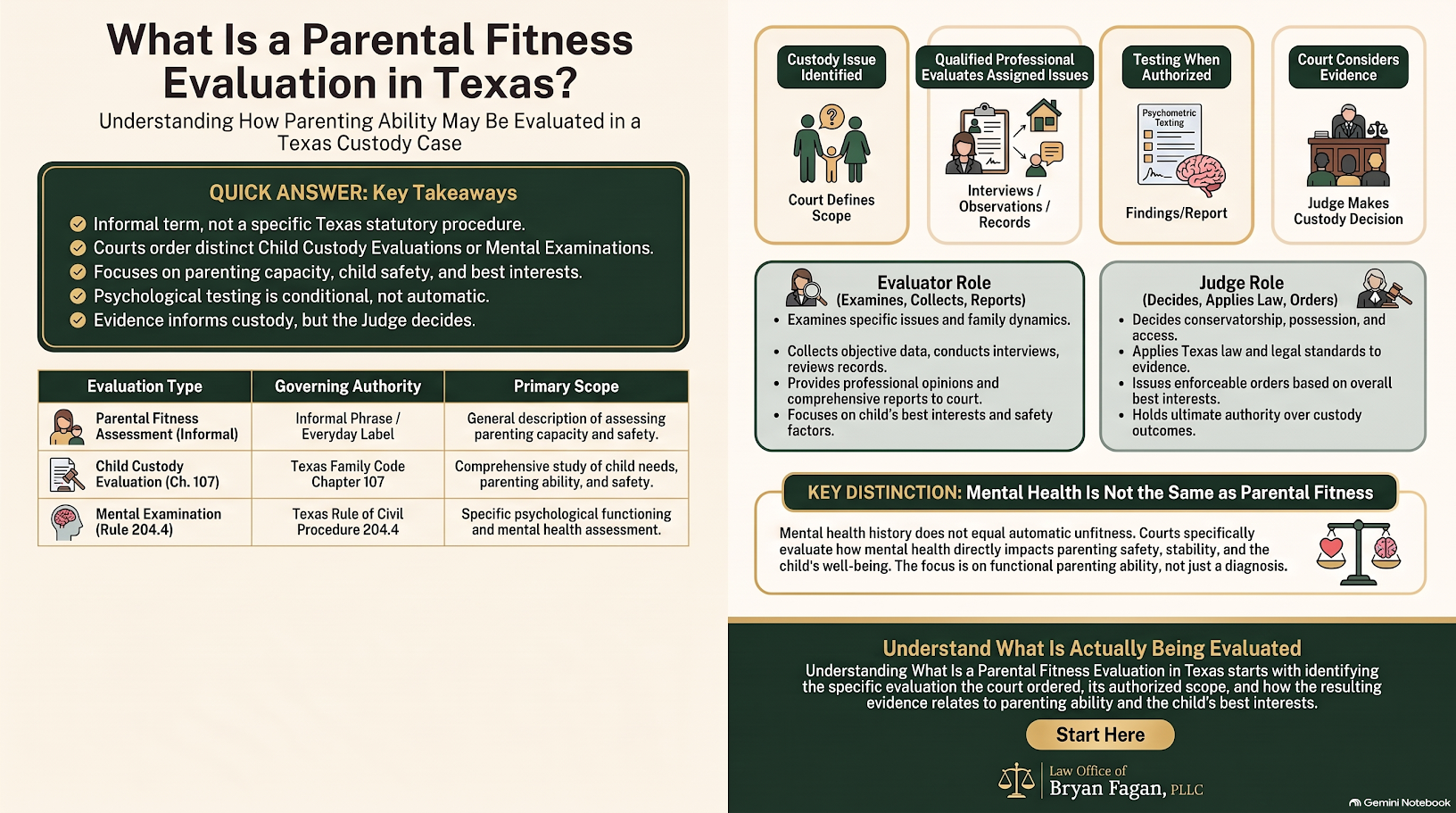
Being told you will be evaluated as a parent can sound like a test you might fail. It can make ordinary family life feel suddenly exposed: the rushed school mornings, the forgotten homework folder, the tense co-parenting messages, or the child whose grades have slipped since the divorce began. If you searched What Is a Parental Fitness Evaluation in Texas, the short answer is that the phrase is an everyday label, not the formal name the Texas Family Code gives the process. In custody cases, Texas law generally refers to a child custody evaluation, and the court’s focus is not parental perfection. The focus is the child’s best interest.
At The Law Office of Bryan Fagan, PLLC, we help Texas parents understand these procedures with clarity instead of fear. Led by Bryan Joseph Fagan, a South Texas College of Law graduate and recognized authority on Texas divorce and custody law, our Houston-based family law firm is built around educating families and protecting futures. Under Texas Family Code §153.002, the best interest of the child is the primary consideration in custody decisions. That means a court may look at safety, stability, emotional needs, parenting routines, and sometimes how divorce is affecting a child’s school performance.
This article explains what people usually mean by a parental fitness evaluation, how it differs from a child custody evaluation or a Rule 204.4 mental examination, and why academic stability can matter in a Texas custody case. If your family is facing this process, you do not need panic or guesswork. You need plain-language guidance, a clear understanding of the law, and a path toward protecting your child’s well-being with confidence.
Key Takeaways
- Not the statutory name. The Family Code calls the court-ordered custody process a child custody evaluation.
- Information for the court. A custody evaluation provides information, opinions and recommendations to the court on conservatorship, possession, access and other best-interest issues.
- No score in the statute. The basic elements are interviews, observations, records and an assessment of each parent-child relationship.
- Testing is conditional. Psychometric testing is an additional element, used only if the court orders it or the evaluator determines it is necessary.
- A separate examination. A court may order a mental examination under Rule 204.4, but that examination does not by itself satisfy the requirements for a custody evaluation.
Quick Answer
Is there a parental fitness evaluation in Texas? Not by that name. The Family Code calls the court-ordered process a child custody evaluation, which gives the court information on conservatorship, possession, access and other best-interest issues. Psychological testing is not automatic; it is used only if ordered or found necessary. A Rule 204.4 mental examination is not, by itself, a custody evaluation.
What People Mean by the Phrase, at a Glance
The phrase can point to different procedures. Each row names what Texas law actually calls it and the condition that controls whether it happens.
| What people may mean | What Texas law calls it | Governing authority | Who orders or conducts it | What it assesses | Owner page |
|---|---|---|---|---|---|
| A court-ordered look at the family in a custody case | Child custody evaluation | Family Code §107.101; §107.109(c) | Ordered by the court in a contested case; conducted by a child custody evaluator | Information, opinions and recommendations on conservatorship, possession, access and other best-interest issues, built on seven basic elements | This page: custody evaluation |
| A psychological test | Psychometric testing within a custody evaluation | Family Code §107.109(d)(6); §107.110 | Conditional — only if ordered by the court or determined necessary by the evaluator, and only by an evaluator licensed and trained for the specific tests, or a designated licensed psychologist | The tests the evaluator selects based on the issues raised in the suit | This page: testing |
| A psychological evaluation ordered by the judge | Mental examination | Tex. R. Civ. P. 204.4; Family Code §107.1025 | The court, on its own initiative or on a party’s motion, appoints a psychologist or psychiatrist | Appropriate mental examinations of the children or other parties; not, by itself, a custody evaluation | This page: examination |
| An inspection of the home | Evaluation of the residence, an additional element | Family Code §107.109(d)(3) | Conditional — only if the court orders it | The residence of each party seeking conservatorship, possession or access | Home visits are covered separately |
| A “parental fitness assessment” or “parenting capacity evaluation” | No separate procedure under either name | The Chapter 107 and Rule 204.4 provisions cited here | Depends on what the court’s order requires | Read the order to determine whether it calls for a child custody evaluation, particular testing or a separate mental examination | This page: the term |
What Is a Parental Fitness Evaluation in Texas?

How Long Does a Child Custody Evaluation Take in Texas often depends first on what the court actually ordered. A parent may hear the phrase “parental fitness evaluation,” but Texas law usually describes the process as a child custody evaluation under Texas Family Code §107.101. That statute defines it as a court-ordered process in a contested case that gives the court information, opinions, recommendations, and answers about conservatorship, possession, access, or another issue affecting the child’s best interest.
That definition matters because the timeline is tied to the scope of the order. In straightforward custody evaluations, the process may move more quickly if the evaluator can schedule parent interviews, child interviews, observations, and record review without delay. In more complex cases, the evaluation can take longer if the order includes psychological testing, a home visit, collateral interviews, school records, medical records, criminal history, CPS history, or concerns about mental health, substance use, abuse, or neglect. When custody concerns overlap with criminal allegations or safety issues, parents may also find it helpful to understand how family law disputes can intersect with true crime and criminal-law concerns.
A custody evaluation is not a license, certificate, or final finding that a parent is fit or unfit. It is information gathered for the court, the parties, their attorneys, and anyone else the court designates. Under Texas Family Code §153.002, the court’s focus remains the child’s best interest, which is why the evaluator’s work often looks at parenting routines, safety, stability, the parent-child relationship, and the child’s needs over time.
The practical takeaway is simple: the more the evaluator must investigate, the longer the evaluation may take. If one parent delays interviews, withholds records, disputes school or medical information, or refuses to cooperate, the timeline can stretch. If the court order is narrow and both parents participate promptly, the evaluator may be able to complete the required steps and prepare the report more efficiently.
A label, not a legal category
When someone says parental fitness evaluation, ask which procedure they mean: a child custody evaluation, psychometric testing inside one, or a separate Rule 204.4 mental examination. Each has its own authority and its own conditions.
Does Texas Law Use the Term?
Not in the provisions that govern these procedures. Sections 107.101, 107.109, 107.110 and 107.1025 of the Family Code and Rule 204.4 describe a child custody evaluation, psychometric testing and a mental examination. None of them calls the process a parental fitness evaluation.
That is why the words matter less than the order. The court’s order and the governing provision tell you which procedure applies and what it covers.
Is It a Child Custody Evaluation?
That is the closest match, and its contents are set by statute. Under Section 107.109, the basic elements of a child custody evaluation are:
- ›a personal interview of each party seeking conservatorship, possession or access;
- ›developmentally appropriate interviews of each child who is at least four years old;
- ›observation of each child with each party, subject to the statute’s exceptions;
- ›an observation and, where the statute provides, an interview of other children living full-time in a residence that is the subject of the evaluation;
- ›information from relevant collateral sources, including school, health and criminal history records;
- ›consideration of criminal history and any abuse or neglect contacts for each person residing in a residence subject to the evaluation; and
- ›an assessment of the relationship between each child and each party seeking possession or access.
The statute describes information-gathering and an assessment of relationships. It does not describe a score or a pass-or-fail result. How the evaluation is carried out, step by step, is covered in our guide to how a Texas child custody evaluation works.
Does Every Evaluation Include Psychological Testing?

Psychological testing can make a custody evaluation take longer, but it is not included in every case. For parents asking How Long Does a Child Custody Evaluation Take in Texas, this is one of the first details to check in the court’s order. Under Texas Family Code §107.109, psychometric testing is an additional element, not one of the basic required steps. Texas Family Code §107.110 also requires the testing to be ordered by the court or determined necessary by the evaluator, and the person administering and interpreting the test must have the proper license, training, and forensic experience.
In straightforward custody evaluations, the timeline may focus on interviews, observations, collateral sources, and record review. In more complex cases, psychological testing can add time because the evaluator must select the appropriate test, schedule the testing, wait for results, interpret the findings, and decide how the information fits into the larger custody evaluation. If the evaluator believes testing is needed but does not have the specialized training to conduct it, the evaluator may designate a licensed psychologist and ask the court for additional orders.
The key point is that testing should match the issues in the case. A dispute about school routines or exchange times may not require the same process as a case involving mental health allegations, safety concerns, substance use, or questions about a parent’s ability to meet a child’s needs. Parents familiar with other court-related evaluations may notice some overlap in structure, and this guide to the guardianship evaluation process in Texas offers a helpful comparison for how Texas courts may use evaluations to gather information before making serious decisions.
The practical takeaway is simple: psychological testing can extend the custody evaluation timeline when it is ordered or found necessary, but it is not automatic. Parents should read the order closely, ask what testing is included, and keep records organized so the evaluator has the information needed to complete the report without unnecessary delay.
Is It a Court-Ordered Psychological Examination?
Sometimes the phrase refers to a separate mental examination, which is a different procedure. Under Rule 204.4 of the Texas Rules of Civil Procedure, in cases arising under Titles II or V of the Family Code, the court may, on its own initiative or on a party’s motion, appoint one or more psychologists or psychiatrists to make appropriate mental examinations of the children who are the subject of the suit or of any other parties.
That examination does not replace a custody evaluation. Under Section 107.1025, a Rule 204.4 mental examination does not by itself satisfy the requirements for a child custody evaluation, although it may be included in the evaluation report and relied on to the extent the evaluator considers appropriate. More on these examinations is in our guide to court-ordered psychological examinations in custody cases.
What Does a Texas Court Actually Decide?
The court decides conservatorship, possession and access; an evaluation informs that decision. The statute describes a custody evaluation as providing information, opinions and recommendations to the court, not as deciding the case.
An evaluator’s opinion also has statutory limits. Under Section 107.109, an evaluator may not offer an opinion on conservatorship, possession or access unless each basic element and each ordered additional element has been completed, or the failure is satisfactorily explained. How a court weighs the evidence it receives is covered in what a court weighs in the evidence.
Where to Go Next

The best next step is to read the court order first, because the order usually controls the timeline, scope, and required steps of the evaluation. For parents asking How Long Does a Child Custody Evaluation Take in Texas, the answer often starts with three questions: what procedure did the judge order, what legal authority does the order cite, and what additional elements are included?
Start by identifying whether the order names a child custody evaluation under Chapter 107 of the Texas Family Code or a mental examination under Rule 204.4 of the Texas Rules of Civil Procedure. Then check whether the order includes psychological testing, a residence evaluation, collateral interviews, school records, medical records, or other specific tasks. Each added step can affect scheduling, report preparation, and how long the process takes.
In straightforward custody evaluations, parents can use the waiting period to organize records, confirm interview dates, review school and medical information, and avoid unnecessary conflict. In more complex cases, especially when abuse, neglect, substance use, mental health concerns, or evaluator delays are involved, it may help to know the red flags to watch for in a Texas custody evaluation before the report is issued. That kind of preparation can help a parent respond thoughtfully instead of reacting late.
For related questions, parents may also want to review resources on preparing for an evaluation, understanding the custody evaluation report, home visits in a custody evaluation, and court-ordered psychological examinations and testing. The goal is not to rush the process; it is to use the time wisely, understand what the evaluator must complete, and stay focused on the child’s best interest.
Legal Resources
Legal research note: This page was checked against Texas Family Code Chapters 107 and 153, including Sections 107.101, 107.109, 107.110 and 107.1025, and Texas Rule of Civil Procedure 204.4. The authorities and terminology search were last checked on September 28, 2026.
- Texas Family Code Chapter 107 — the official compilation published by the Texas Legislature, including every Family Code section cited on this page. Official text.
- Texas Family Code Chapter 153 — conservatorship, possession and access. Official text.
- Texas Family Code §107.101 — definition of a child custody evaluation. A readable reproduction, not the Legislature’s official text.
- Texas Family Code §107.109 — basic and additional elements of a child custody evaluation. A readable reproduction.
- Texas Family Code §107.110 — psychometric testing: when it may be used and by whom. A readable reproduction.
- Texas Family Code §107.1025 — effect of a Rule 204.4 mental examination. A readable reproduction.
- Texas Rule of Civil Procedure 204.4 — mental examinations in cases under Family Code Titles II and V. Current official compilation.
About the Author
Bryan Fagan
Founder, Law Office of Bryan Fagan, PLLC
Texas Divorce & Family Law Attorney · Licensed in Texas Since 2012
Bryan Fagan founded the Law Office of Bryan Fagan, PLLC in 2012. His work includes Texas family-law strategy, firmwide leadership, team-based case planning, and client education designed to help families understand their legal options and make informed decisions.
Juris Doctor, South Texas College of Law, 2011 · Licensed by the State Bar of Texas May 4, 2012 · Bar No. 24080889
Conclusion:
Understanding How Long Does a Child Custody Evaluation Take in Texas helps parents see the process with more patience and less panic. A custody evaluation is not usually finished on one fixed schedule; it depends on the court’s order, the evaluator’s availability, the records involved, the number of interviews, whether testing or home visits are included, and how quickly both parents cooperate. In straightforward situations, the next step may be reviewing the order, gathering school and medical records, and keeping communication organized while the evaluator completes the required work.
In more complex cases, especially those involving mental health concerns, substance abuse allegations, school instability, safety issues, or a disputed report, the timeline may be longer and the strategy may need to be more focused. Parents can use the waiting period productively by learning methods for working with a child custody evaluator and by avoiding actions that make the process harder. If the case involves serious accusations or a child who is already struggling emotionally or academically, the right attorney fit matters.
The Law Office of Bryan Fagan, PLLC helps Texas families understand custody evaluations, protect what matters most, and move forward with greater control and peace of mind. If an evaluation has been requested or ordered in your custody case, speaking with a family law attorney can help you understand the likely timeline, prepare for each step, and identify the level of support your situation requires.
About the Author
Bryan Fagan
Founder, Law Office of Bryan Fagan, PLLC
Texas Divorce & Family Law Attorney · Licensed in Texas Since 2012
Bryan Fagan founded the Law Office of Bryan Fagan, PLLC in 2012. His work includes Texas family-law strategy, firmwide leadership, team-based case planning, and client education designed to help families understand their legal options and make informed decisions.
Juris Doctor, South Texas College of Law, 2011 · Licensed by the State Bar of Texas May 4, 2012 · Bar No. 24080889
About the Law Office of Bryan Fagan, PLLC
The Law Office of Bryan Fagan, PLLC helps Texas families understand and navigate family-law issues involving divorce, child custody, possession and access, and related matters. Founded by Bryan Fagan in 2012, the firm combines legal representation with education designed to give families clearer information about their options and the decisions ahead.
This page provides general information about what a parental fitness evaluation may mean in Texas. It is not legal advice, and reading it does not create an attorney-client relationship. Which evaluation applies, and what it covers, depends on the court’s orders and the facts of the individual case.
Frequently Asked Questions
A child custody evaluation under Section 107.101 is the closest statutory match. It is ordered by a court in a contested case and gives the court information, opinions and recommendations on conservatorship, possession, access and other issues affecting the child’s best interest. The Family Code does not call it a parental fitness evaluation.
Not necessarily. Under Sections 107.109(d)(6) and 107.110, psychometric testing is an additional element used only if the court orders it or the evaluator determines it is necessary, and only by an evaluator licensed and trained for the specific tests, or by a licensed psychologist the evaluator designates.
Not as a separate category in the Texas provisions discussed here. Either phrase may be used informally, so the controlling question is what the court’s order requires and which legal authority it cites. An order may call for a child custody evaluation under Chapter 107, testing within one, or a separate mental examination under Rule 204.4.
Rule 204.4 allows the court, on its own initiative or on a party’s motion, to appoint a psychologist or psychiatrist to examine the children or other parties. Under Section 107.1025, that examination does not by itself satisfy the requirements for a child custody evaluation.
Not in the statute. Section 107.109 describes interviews, observations, collateral records and an assessment of each parent-child relationship. The evaluation provides information, opinions and recommendations to the court; it does not produce a score, a grade or a certificate of fitness for either parent.
No. The statute describes the evaluation as providing information, opinions and recommendations to the court. Decisions on conservatorship, possession and access belong to the court, and the evaluator’s opinion is limited if required elements were not completed or satisfactorily explained.