
Ever notice how a child’s school week can tell you what the adults are trying not to say out loud? Missed homework, late arrivals, quiet car rides, forgotten backpacks, or a sudden drop in grades can all signal that divorce or custody conflict is spilling into a child’s daily life. In Texas, Parental Rights in Texas are not just legal words in a court order; they affect who talks to teachers, who sees school records, who makes education decisions, who handles counseling, and how much stability a child feels between two homes.
At The Law Office of Bryan Fagan, PLLC, our mission is educating families and protecting futures. Led by Bryan Joseph Fagan, a South Texas College of Law graduate and recognized authority on Texas divorce and custody law, our Houston-based family law firm helps parents understand how Texas custody laws connect to real-life parenting problems. Texas Family Code §153.002 makes the child’s best interest the court’s primary concern, and §153.134 requires joint conservatorship orders to address education, routines, and the rights and duties of each parent. That means academic stability is not a side issue. It can be part of the custody picture.
In this article, you will learn how Texas courts consider school continuity, how parenting plans and child support can support a child’s academic success, and what parents can do when the other parent blocks school access, records, communication, or decision-making. More importantly, you will see how the right legal guidance can simplify a confusing season and help your family move forward with greater clarity, peace of mind, and confidence.
Key Takeaways
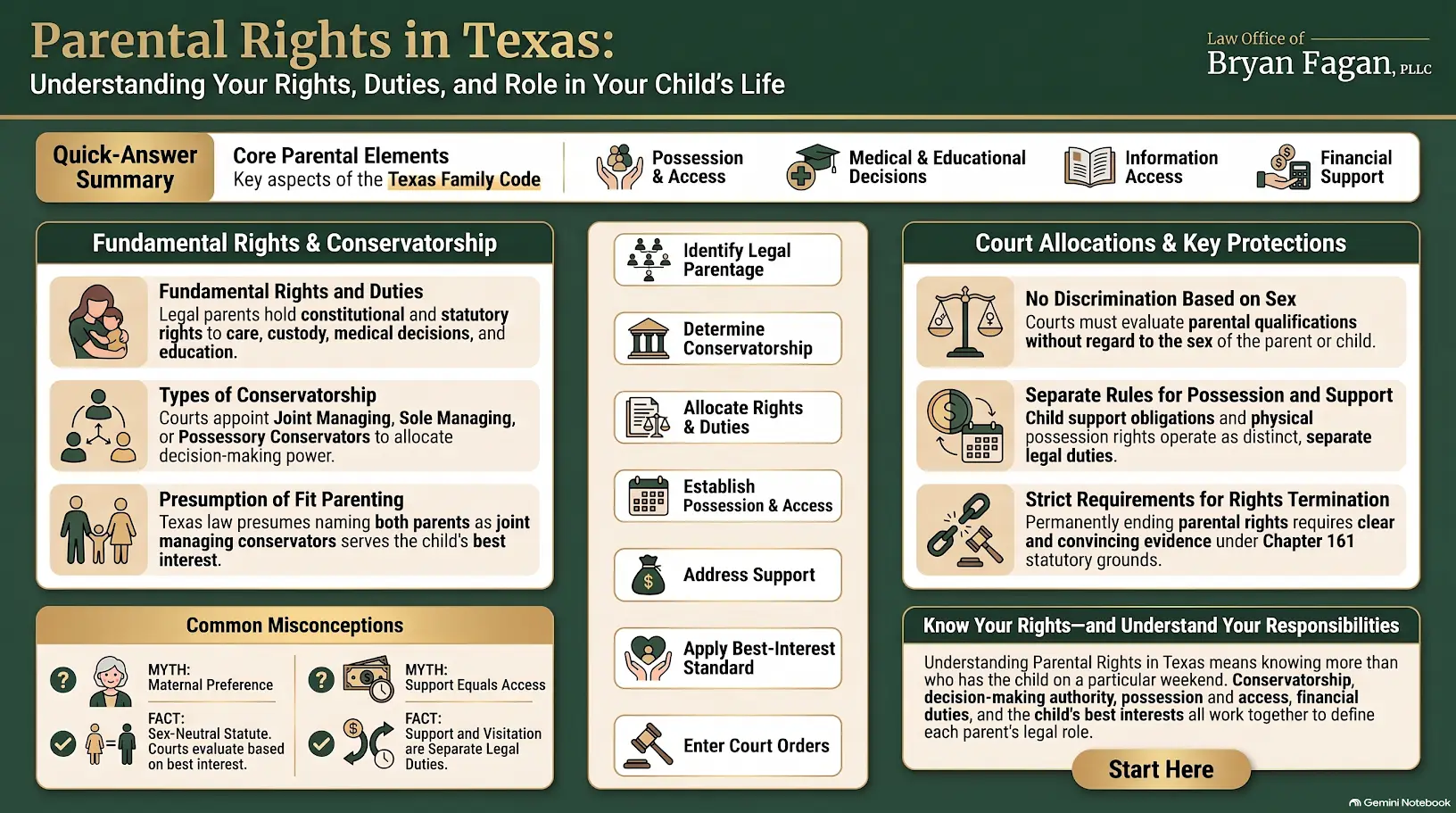
- Twelve listed rights and duties. Section 151.001(a) sets them out, and each is subject to a court order.
- Parentage comes first. The rights belong to a legal parent, established under Section 160.201.
- Orders divide, they do not erase. A conservatorship order specifies how each right is exercised and which rights a parent keeps at all times.
- Sex is not a factor. Section 153.003 bars courts from deciding conservatorship by the sex of the party or the child.
- Termination takes a court order. Chapter 161 requires findings by clear and convincing evidence, including the child’s best interest.
Quick Answer
Article I, Section 37 of the Texas Constitution affirms a parent’s responsibility to nurture and protect a child and the corresponding fundamental right to exercise care, custody, and control. Texas Family Code Section 151.001 lists twelve specific rights and duties. Those rights belong to a legal parent, and a conservatorship order determines how they are allocated or limited in a particular case.
Does the Texas Constitution Protect Parental Rights?

Yes. Parental Rights in Texas are expressly recognized in Article I, Section 37 of the Texas Constitution, which affirms a parent’s responsibility to nurture and protect a child and the fundamental right to exercise care, custody, and control. That includes decisions about a child’s upbringing, but it does not mean every custody dispute is decided by the Constitution alone.
The Constitution gives the broad protection. The Texas Family Code explains how those rights work in real cases, including conservatorship, possession, education decisions, medical decision-making, and limits ordered by a court. In straightforward custody situations, a fit legal parent generally has a protected role in raising the child. In more complex disputes, the court still looks at the child’s best interest, the signed order, and whether rights are independent, joint, exclusive, limited, or subject to modification.
Texas courts recognized strong parental protections even before Section 37. In In re C.J.C., the Supreme Court of Texas held that when a fit parent objects to a nonparent seeking conservatorship or access, courts must apply the presumption that the fit parent acts in the child’s best interest. That case matters most in nonparent claims, but it does not make parental rights absolute or decide ordinary disagreements between two legal parents.
That distinction matters when school records, counseling, medical care, possession time, or decision-making are disputed. The next step usually depends on the custody order, the Family Code, and the facts affecting the child. When expert opinions or custody evaluations become part of the dispute, parents should also understand child custody evaluator qualifications in Texas before relying on a report or challenging one.
What Are Parental Rights in Texas?
They are the rights and duties Texas Family Code Section 151.001 gives a parent of a child. Since September 1, 2025, Section 151.001(a) has listed twelve items; that year’s amendment added the right to designate the child’s school and enroll the child. Each row below is one item, with the conservatorship provision that shows how an order can allocate it.
| Right or duty | What it means | Authority | Can a court order change it? |
|---|---|---|---|
| Possession, moral and religious training, and residence | The right to have physical possession of the child, to direct the child’s moral and religious training, and to designate the child’s residence | §151.001(a)(1) | Yes. A sole managing conservator holds the exclusive right to designate the primary residence (§153.132(1)); a joint managing conservatorship order designates which conservator has it (§153.134(b)(1)). |
| Care, control, protection and discipline | The duty of care, control, protection, and reasonable discipline of the child | §151.001(a)(2) | Yes. Unless an order limits it, each parent conservator has this duty during that parent’s possession (§153.074(1)). |
| Support | The duty to support the child, including clothing, food, shelter, medical and dental care, and education | §151.001(a)(3) | Yes. A court may order a parent who is not appointed a conservator to perform parental duties, including paying child support (§153.075). |
| The child’s estate | Unless a guardian of the child’s estate has been appointed, the duty to manage the child’s estate, including acting as the child’s agent when a government requires the child’s action | §151.001(a)(4) | Yes. A sole managing conservator holds the agent right exclusively (§153.132(10)); each parent conservator may manage an estate the parent or the parent’s family created, unless limited (§153.073(a)(9)). |
| Services and earnings | The right to the child’s services and earnings, subject to an exception the statute cross-references | §151.001(a)(5) | Yes. A sole managing conservator holds it exclusively (§153.132(9)). |
| Consent to marriage, enlistment and treatment | The right to consent to the child’s marriage, enlistment in the U.S. armed forces, medical and dental care, and psychiatric, psychological, and surgical treatment | §151.001(a)(6) | Yes. A sole managing conservator holds the exclusive consent rights for invasive procedures, psychiatric and psychological treatment, marriage and enlistment (§153.132(2), (3), (6)); emergency consent stays with each parent conservator unless limited (§153.073(a)(8)). |
| Legal representation | The right to represent the child in legal action and to make other decisions of substantial legal significance concerning the child | §151.001(a)(7) | Yes. A sole managing conservator holds it exclusively (§153.132(5)). |
| Support payments | The right to receive and give receipt for payments for the child’s support and to hold or disburse funds for the child’s benefit | §151.001(a)(8) | Yes. A sole managing conservator holds the right to receive periodic support payments exclusively (§153.132(4)). |
| Inheritance | The right to inherit from and through the child | §151.001(a)(9) | Yes. Like every listed right, it is subject to a court order affecting the rights and duties (§151.001(d)(1)). |
| Education decisions | The right to make decisions concerning the child’s education | §151.001(a)(10) | Yes. A sole managing conservator holds it exclusively (§153.132(7)). |
| School designation and enrollment | The right to designate the school the child will attend and to enroll the child, subject to any eligibility or admissions requirements | §151.001(a)(11) | Yes. A sole managing conservator holds it exclusively (§153.132(8)). |
| Any other right or duty by law | Any other right or duty existing between a parent and child by virtue of law | §151.001(a)(12) | Yes. In a joint managing conservatorship, the order allocates every remaining Chapter 151 right and duty independently, jointly, or exclusively (§153.134(b)(4)). |
Which Parental Rights Apply to You?
- 1. Confirm legal parentage. Determine whether the person is a legal parent under Chapter 160.
- 2. Read the signed order. Identify which rights are independent, joint, exclusive or limited.
- 3. Match the disputed right to the law. Compare the order with the applicable provisions in Chapters 151 and 153.
Not sure how your court order divides parental rights?
Texas law identifies parental rights and duties, but a custody order may allocate, limit or condition how particular rights are exercised. Bring the complete signed order to a consultation so a Texas family-law attorney can help you understand what it says and how it applies to your circumstances.
Do Parents Have These Rights Without a Custody Order?

Yes. Parental Rights in Texas begin with legal parentage, not with a custody order. Texas Family Code §151.001(a) gives a parent rights and duties such as care, control, protection, support, education decisions, medical decisions, and possession of the child. A court order is not what creates those basic parent-child rights, but it can control how those rights are exercised.
That distinction matters in everyday life. In straightforward custody situations, both legal parents may have rights before a formal order exists, but disagreement can quickly create problems over school enrollment, medical care, counseling, pickup schedules, or access to records. Once a court signs an order, the order becomes the roadmap for who has independent, joint, or exclusive authority over specific decisions.
Texas Family Code §151.001(d) also makes parental rights subject to certain legal documents and court actions. That includes a court order affecting the parent-child relationship, an affidavit of relinquishment of parental rights, or an affidavit designating another person or agency to act as managing conservator. In more complex parental-rights disputes, those documents can change who has practical authority even though the starting point is legal parentage.
If no custody order exists, parents should be careful about relying on informal agreements alone. A signed order can clarify conservatorship, possession and access, child support, school decision-making, and medical authority. For a deeper explanation of how conservatorship works in Texas family law cases, see this guide on conservatorship in Texas.
Who Counts as a Parent Under Texas Law?
Legal parentage comes first because Parental Rights in Texas belong to a parent, not simply to someone who has acted like a parent or helped raise a child. Texas Family Code §151.001 gives rights and duties to a parent of a child, so the first question is whether Texas law recognizes the person as a legal parent.
Under Texas Family Code §160.201, the mother-child relationship may be established by giving birth to the child, adoption, or a court adjudication of maternity. The father-child relationship may be established through an unrebutted presumption of paternity, a valid acknowledgment of paternity, a court adjudication, adoption, or certain assisted reproduction circumstances recognized by law.
This distinction matters in real life. In straightforward parentage situations, both parents may already be legally recognized, and the main issue is how a custody order divides decision-making, possession, school access, medical authority, and support. In more complex parental-rights disputes, an unmarried father, alleged father, adoptive parent, or nonparent may need a court order before exercising custody rights in Texas.
Once legal parentage is established, the next question is what rights apply and whether a court order limits, divides, or expands them. For a broader discussion of parent rights and duties, see this guide on the rights and duties of Texas parents.
How Does a Court Order Divide Parental Rights?
A Texas custody order divides parental rights by saying which parent may exercise each right independently, jointly, or exclusively. In plain English, Parental Rights in Texas are not always “all or nothing.” A parent may share some decisions, make other decisions alone, and need the other parent’s agreement for certain major issues.
Texas Family Code §153.071 requires the court to specify each parent’s rights and duties when parents are appointed conservators. Some rights may be independent, meaning either parent can act without asking the other first. Some may be joint, meaning both parents must agree. Others may be exclusive, meaning one parent has the final authority over that issue, such as the child’s primary residence, certain medical decisions, or school-related decisions.
The child’s best interest controls the structure of the order under Texas Family Code §153.002. In straightforward custody situations, both parents may be named joint managing conservators, but that does not automatically mean equal time or equal decision-making. Texas Family Code §153.135 makes clear that joint managing conservatorship does not require a 50/50 possession schedule.
In more complex parental-rights disputes, the court may appoint one parent as sole managing conservator or limit a parent’s rights if the facts support it. Under Texas Family Code §153.131, the law generally favors appointing a parent as managing conservator unless doing so would significantly impair the child’s physical health or emotional development. A history of family violence can also affect whether joint managing conservatorship is appropriate. For more background, see this guide on parental rights and responsibilities in Texas.
What Rights Does Every Parent Conservator Keep?

A parent conservator usually keeps two groups of rights: rights that apply at all times and rights that apply during that parent’s possession period. Under Texas Family Code §153.073, Parental Rights in Texas generally include access to important information about the child’s health, education, and welfare unless a court order limits those rights.
At all times, a parent conservator usually has the right to receive information from the other conservator, review medical and school records, consult with doctors and school officials, attend school activities, be listed as an emergency contact, and consent to emergency medical treatment. These rights matter in everyday parenting. They affect whether a parent can talk to a teacher, review a report card, speak with a counselor, or respond quickly if the child is hurt.
Texas Family Code §153.074 adds rights and duties during that parent’s possession time. During possession, the parent usually has the duty of care, control, protection, and reasonable discipline. The parent may also support the child, consent to noninvasive medical and dental care, and direct the child’s moral and religious training unless the order says otherwise.
A possessory conservator also keeps these Subchapter B rights and duties unless the court limits them under Texas Family Code §153.192. In straightforward custody situations, this means a non-primary parent may still have meaningful rights to information, school involvement, emergency contact status, and day-to-day care during possession. In more complex parental-rights disputes, the signed order controls, so parents should review the exact language carefully. For a practical breakdown, see this guide on rights and duties in a Texas custody order.
Do Mothers Have More Rights Than Fathers in Texas?
No. Section 151.001 gives its rights and duties to “a parent,” and Section 153.003 requires a court to consider the parties’ qualifications without regard to marital status or the sex of the party or the child. That rule applies when a court decides who will be a sole or joint managing conservator and sets the terms of conservatorship, possession and access. What differs between mothers and fathers is how legal parentage is established, which Section 160.201 sets out separately.
Can a Court Limit Parental Rights?
Yes. Parental Rights in Texas can be limited when a judge finds that the restriction is necessary to protect the child’s best interest. Texas Family Code §153.072 allows a court to limit a parent conservator’s rights and duties if the court makes a written finding that the limitation is in the child’s best interest.
That can happen in straightforward custody situations where one right needs clarification, such as who makes school decisions or how parents share medical information. It can also happen in more complex parental-rights disputes involving family violence, abuse, neglect, substance use, unsafe exchanges, or serious conflict that affects the child’s emotional or physical safety. Texas Family Code §153.004 requires courts to consider evidence of family violence or abuse when making conservatorship and possession decisions.
A court may also restrict possession or access, but Texas Family Code §153.193 says the restriction cannot go further than what is required to protect the child’s best interest. In plain English, the court should not limit a parent more than necessary. The order should be tied to the facts, the risk to the child, and the specific protection the child needs.
Constitutional protection does not prevent every restriction. In In re J.J.R.S., the Supreme Court of Texas upheld a severe access restriction because the trial court could reasonably conclude, based on that record, that the restriction was needed for the children’s best interest. If one parent may need exclusive authority or stronger protections, parents can learn more about how that works in a sole managing conservator case.
Can Parental Rights Be Terminated?
Only by a court order under Chapter 161. Under Section 161.001(b), a court may order termination of the parent-child relationship if it finds by clear and convincing evidence both a statutory ground and that termination is in the child’s best interest. Termination is not automatic. This page does not cover the grounds or the process; termination, Child Protective Services cases and grandparents’ rights each have their own pages.
Legal Resources
Legal research note: This page was checked against Texas Family Code Sections 151.001, 153.002, 153.003, 153.004, 153.071, 153.072, 153.073, 153.074, 153.075, 153.131, 153.132, 153.134, 153.135, 153.192, 153.193, 160.201 and 161.001(b); Article I, Section 37 of the Texas Constitution; and the Supreme Court of Texas opinions in In re C.J.C. and In re J.J.R.S. The authorities were last checked on October 2, 2026.
- Texas Family Code Chapter 151 — official text of the rights and duties of a parent, including Section 151.001. Official text.
- Texas Family Code Chapter 153 — official text on conservatorship, possession and access, including the rights of parent conservators. Official text.
- Texas Family Code Chapter 160 — official text of the Uniform Parentage Act, including how the parent-child relationship is established. Official text.
- Texas Family Code Chapter 161 — official text on termination of the parent-child relationship, listed here only as a short route; this page does not cover termination. Official text.
- Texas Constitution, Article I, Section 37 — official text as compiled by the Texas Legislative Council, including Section 37 (added November 4, 2025). Official text.
- In re C.J.C., 603 S.W.3d 804 (Tex. 2020) — official Supreme Court of Texas opinion applying the fit-parent presumption when a nonparent sought conservatorship or access over a fit managing conservator’s objection.
- In re J.J.R.S., 627 S.W.3d 211 (Tex. 2021) — official Supreme Court of Texas opinion addressing a record-supported restriction on parental access under Section 153.193; the constitutional challenge to the temporary order was not decided.
- Texas State Law Library: Child Custody & Support guide — a reader resource with links to the statutes and related guides; not controlling authority.
Meet Kimberly P. Washington
Attorney Routing
Kimberly P. Washington
Senior Managing Attorney
Kimberly Washington has been with the Law Office of Bryan Fagan, PLLC since 2015 and provides senior legal leadership in Texas family-law matters, including divorce, child custody, and mediation. When the question is how an order divides parental rights, the signed order itself is where she will start.
Licensed by the State Bar of Texas since 2008 · Juris Doctor, Thurgood Marshall School of Law
Conclusion:
Understanding Parental Rights in Texas is really about understanding what your child needs next: stability, access to both parents when appropriate, clear decision-making, and a plan that protects school, health, routines, and peace of mind. In straightforward situations, a parent may simply need help reading an order, confirming school-access rights, or understanding how conservatorship affects daily parenting. In more complex cases, the right strategy may involve enforcement, modification, emergency protections, disputed education decisions, unmarried-father rights, or limits on a parent’s access.
If your case involves blocked school records, denied possession, conflict over medical or counseling decisions, relocation, safety concerns, or a child whose grades and behavior are changing during divorce, it is worth getting guidance before the problem hardens into a pattern. The Law Office of Bryan Fagan, PLLC helps Texas families sort the facts, understand the law, and choose the right level of legal support for the situation. That is how parents regain control, protect what matters most, and move forward with more clarity and confidence.
About the Author
Bryan Fagan
Founder, Law Office of Bryan Fagan, PLLC
Texas Divorce & Family Law Attorney · Licensed in Texas Since 2012
Bryan Fagan founded the Law Office of Bryan Fagan, PLLC in 2012. His work includes Texas family-law strategy, firmwide leadership, team-based case planning, and client education designed to help families understand their legal options and make informed decisions.
Juris Doctor, South Texas College of Law, 2011 · Licensed by the State Bar of Texas May 4, 2012 · Bar No. 24080889
About the Law Office of Bryan Fagan, PLLC
The Law Office of Bryan Fagan, PLLC helps Texas families understand and navigate family-law issues involving divorce, child custody, possession and access, and related matters. Founded by Bryan Fagan in 2012, the firm combines legal representation with education designed to give families clearer information about their options and the decisions ahead.
This page provides general information about the rights and duties Texas law gives a parent. It is not legal advice, and reading it does not create an attorney-client relationship. Which rights a particular parent may exercise depends on legal parentage, any court order, the governing statutes and the individual facts.
Frequently Asked Questions
Section 151.001(a) lists them: physical possession, moral and religious training and the child’s residence; care, control, protection and reasonable discipline; support; managing the child’s estate; the child’s services and earnings; consent to marriage, enlistment and treatment; legal representation; support payments; inheritance; education decisions; school designation; and any other right or duty existing by law.
No. Section 151.001 gives its rights and duties to “a parent,” and Section 153.003 requires a court deciding conservatorship, possession and access to consider the parties’ qualifications without regard to the sex of the party or the child. What differs is how legal parentage is established, which Section 160.201 sets out separately for mothers and fathers.
The rights in Section 151.001 belong to a legal parent. Under Section 160.201(b), the father-child relationship is established by an unrebutted presumption of paternity, an effective acknowledgment of paternity, an adjudication, adoption, or consent to assisted reproduction by his wife. Once that relationship is established, he holds the Section 151.001 rights and duties, subject to court orders.
Yes. A parent who is not the managing conservator may be appointed a possessory conservator. Under Section 153.192(a), that parent has the rights and duties in Subchapter B of Chapter 153 unless an order limits them, including the Section 153.073 rights a parent conservator keeps at all times, plus any right the order expressly grants.
Not automatically. Termination of the parent-child relationship requires a court order. Under Section 161.001(b), the court must find by clear and convincing evidence both a statutory ground and that termination is in the child’s best interest. This page does not list the grounds or any time periods; termination is covered on our separate termination page.
Read the order’s conservatorship provisions. Section 153.071 requires the court to specify which rights each parent exercises independently, which by joint agreement, and which exclusively by one parent, and Section 153.073(b) requires the order to specify the rights a parent retains at all times. Those terms control how your Section 151.001 rights are exercised.
Questions about protecting or enforcing your parental rights?
The next step depends on legal parentage, the current order and the specific right involved. The Law Office of Bryan Fagan, PLLC can review those documents and explain the available Texas family-law process without promising a particular result.