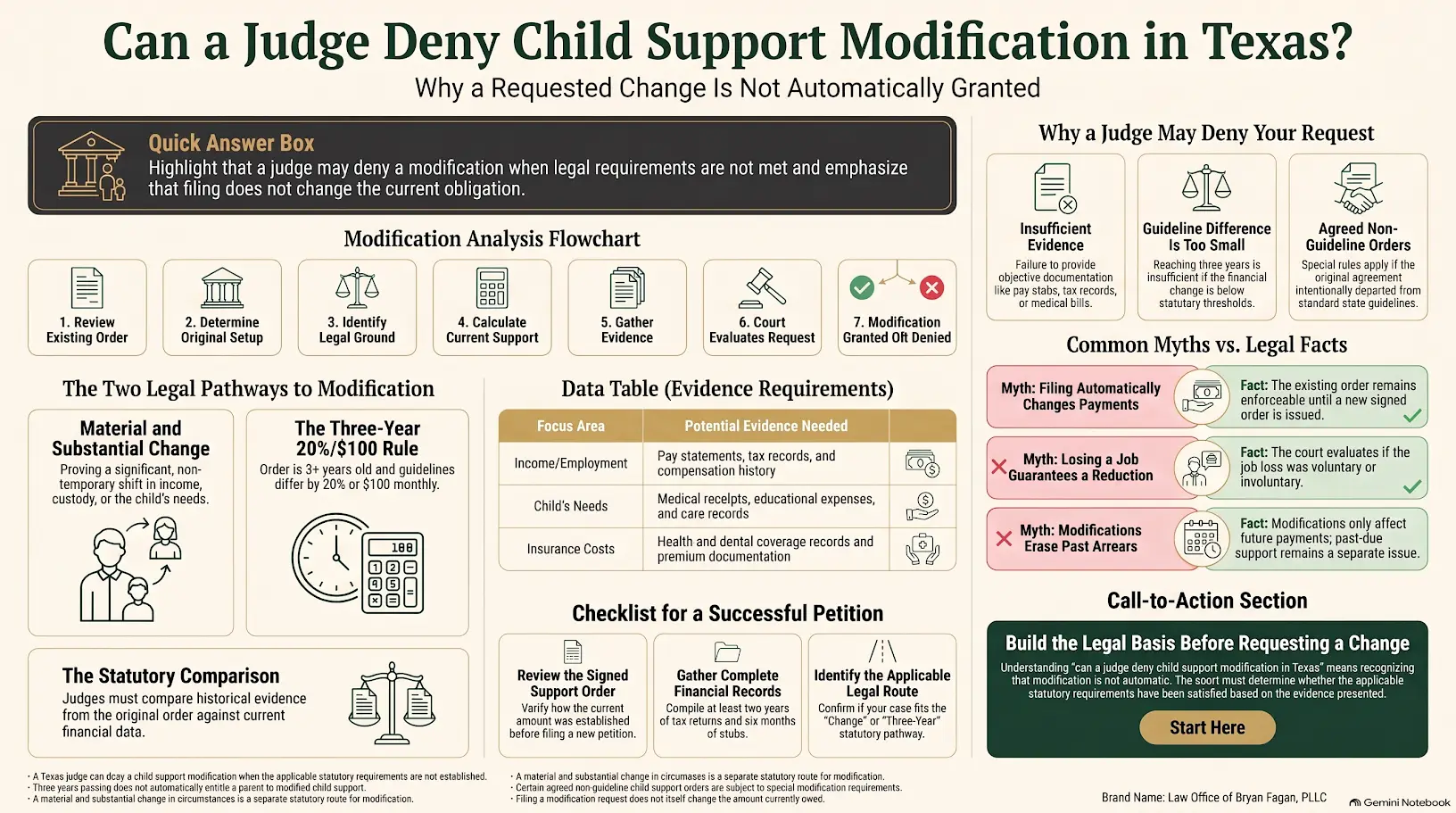
A parent loses a longtime job, watches the severance run out, and assumes the child-support order will be reduced once the judge hears what happened. But Can a Judge Deny Child Support Modification in Texas even when the family’s circumstances have clearly changed? Yes. Texas appellate courts have reversed modification orders and rendered judgment denying relief because showing that life changed is not the same as proving the legal requirements for modification.
Under Texas Family Code §156.401, the parent requesting relief must establish an available statutory ground. That may require proof of a material and substantial change since the current order was rendered or last modified. In other cases, relief may be available after three years when the support amount calculated under current guidelines differs from the existing order by at least 20 percent or $100. The court must compare the right earlier circumstances with reliable evidence of the situation today. A compelling story without that comparison may not be enough.
This article explains why a request may be refused, what evidence the court is actually comparing, which changes Texas law does not treat as sufficient, and what remains enforceable when the answer is no. It also addresses reduced income, agreed non-guideline orders, medical and dental support, retroactivity, and the practical steps parents can take before filing.
The Law Office of Bryan Fagan, PLLC is led by Bryan Joseph Fagan, a South Texas College of Law graduate and recognized authority on Texas divorce and custody law. From Houston, our firm helps families across Texas understand difficult legal rules without losing sight of the people affected by them. Our mission is educating families and protecting futures through compassionate counsel and practical solutions. If you are facing uncertainty about support, the discussion ahead can help you replace assumptions with clarity and move forward with greater confidence and peace of mind.
Key Takeaways
- The requesting party carries the burden. The court does not assume a change occurred because one is alleged.
- A comparison needs both ends. Evidence of today alone leaves nothing to compare it against.
- Hardship is not the test. The question is whether circumstances differ from those at the comparison point, not whether they are difficult.
- Having a ground is not proving one. Statutory eligibility and evidentiary sufficiency are different questions.
- A denial leaves the existing order intact. Its terms continue exactly as they were.
Quick Answer
Can a judge deny a child support modification in Texas? Yes. The party asking for the change carries the burden, and the court compares the circumstances that existed when the current order was made with the circumstances now. Where the record does not establish both sides of that comparison, the request can be refused and the existing order stays in force.
When Can a Judge Deny a Modification?

Can a Judge Deny Child Support Modification in Texas even when a parent’s income, expenses, or family circumstances have changed? Yes. The parent requesting relief must prove an available statutory ground with reliable evidence. A difficult change may explain why the case was filed, but it does not automatically establish that the existing support order should be altered.
Texas Family Code §156.401 generally provides two routes to modification. The requesting party may prove a material and substantial change since the controlling order was rendered or last modified, or may rely on the three-year route when the current guideline amount differs from the existing obligation by at least 20 percent or $100 per month. When the existing amount resulted from an agreement that departed from the guidelines, however, the three-year route generally does not apply.
A court may deny modification when the record does not establish both the earlier circumstances and the situation today. Other problems may include a temporary or voluntary income reduction, incomplete self-employment records, unsupported child-related expenses, an incorrect guideline calculation, or evidence that does not relate to the relief requested. Texas law also excludes certain arguments, including using voluntary payments above the existing order as a reason to increase support.
The legal meaning of a denied family-law request is specific to the governing order, evidence, and Texas Family Code. Readers researching a separate use of the word “denied” in a travel context can review our guide to understanding involuntary denied boarding.
Who Carries the Burden?
The party seeking the change does. In In re C.C.J. and C.M.J., the Dallas Court of Appeals stated that the movant has the burden to show the required material and substantial change in circumstances since the entry of the previous order.
That allocation decides more cases than it appears to. It means a court faced with an incomplete record does not fill the gap in favor of the person who asked.
Why the Earlier Circumstances Matter
A material and substantial change is a comparison, and a comparison needs two points. In re C.C.J. holds that a trial court must examine and compare the circumstances of the parents and any children at the time of the initial order with the circumstances existing when modification is sought, and that the record must contain both historical and current evidence. Without both sets of data, the court has nothing to compare.
In C.C.J. the court reversed an increase in child support and rendered judgment denying the modification. The record held evidence of the mother’s and the children’s expenses at the time of the hearing, and none of their circumstances at the time of the divorce.
The limit on this
A denial does not disturb the existing order. Its amount, its medical and dental provisions and its other terms continue exactly as before, and the obligation continues to accrue. A refusal is not a ruling that the order was wrong; it is a ruling that the case for changing it was not made.
Each Alleged Change Is Tested Separately

Can a Judge Deny Child Support Modification in Texas when several parts of the family’s financial life have changed? Yes. A court may examine each alleged development separately, and a collection of facts does not automatically establish a material and substantial change. The parent requesting modification must connect reliable evidence to a statutory ground and to the specific relief requested.
In London v. London, the court separately considered a domicile restriction, the obligee’s improved income, savings converted into home equity, an investment, and voluntary payments above the ordered amount. None established the required change. After comparing the children’s needs at the time of divorce with their needs when modification was requested, the appellate court reversed the increase and rendered judgment that the modification claim take nothing.
The voluntary payments failed for an additional reason. Texas Family Code §156.403 provides that support voluntarily paid above the existing order does not supply a basis for increasing the ordered amount. Other provisions likewise remove certain arguments from the modification analysis, as explained in our guide to the grounds for child support modification in Texas.
The meaning of a denial depends on the legal setting. Readers researching a separate travel-related issue can review our guide to denied boarding under Texas state law.
When an Income Change Is Not Enough
Where a parent files because earnings have changed, that change is not self-proving. The question is not whether income moved but whether the record establishes what it was at the comparison point, what it is now, and that the difference meets the statutory standard.
Trammell v. Trammell shows the other outcome and why. There the evidence was uncontroverted: the obligor’s income had fallen from roughly $802,000 to $255,000 since an agreed decree set support well above the guidelines, he had exhausted a line of credit and owed about $365,000, and nothing suggested the decline was voluntary. The court of appeals affirmed the reduction. The difference between that case and a denial is not the size of the change; it is that the record supported both ends of the comparison.
Having a Ground Is Not the Same as Proving One
Two questions get run together, and separating them explains a great deal. The first is whether the situation is one Texas law recognizes as a basis for modification. The second is whether the evidence establishes it. A request can pass the first and fail the second, which is exactly what happened in C.C.J. and London.
Which situations qualify is covered in our guide to the grounds for child support modification in Texas, and what a record needs to establish is covered in our guide to evidence for a Texas child support modification.
Can a Request Lead to a Fee Award?

Can a Judge Deny Child Support Modification in Texas and order the requesting party to pay the other side’s attorney’s fees? In limited circumstances, yes. Under Texas Family Code §156.005, the court must make an express finding that the modification suit was filed frivolously or was designed to harass another party before applying that provision. If the court makes the required finding, it must assess reasonable and necessary attorney’s fees and court costs against the offending party.
In Kelsall v. Haisten, the First Court of Appeals explained that a frivolous suit generally lacks a reasonable basis in law or fact. The court evaluates the information available to the filing party and the circumstances that existed when the pleading was filed. Pleadings are presumed to be filed in good faith, so the party seeking fees must present evidence sufficient to overcome that presumption.
Kelsall involved a conservatorship modification rather than a request to change child support, but it interpreted the filing rule that applies generally to modification suits. A parent does not become liable under §156.005 merely because the court denies the requested change. A failure to prove a material and substantial change is different from filing a case without a reasonable legal or factual basis or using litigation to harass the other party.
A denied modification request should also not be confused with whether a court can refuse to end a marriage. Readers with that separate question can review our guide addressing whether a divorce can be denied in Texas.
Common Misconceptions
| What people believe | Where that goes wrong |
|---|---|
| “Something changed, so the order changes.” | The change has to be the kind the statute recognizes and it has to be established on the evidence. Both parts can fail independently. |
| “The judge can see my situation now.” | Current circumstances alone give the court nothing to compare. The record needs the earlier circumstances too. |
| “I’ve been paying more, so the order should reflect it.” | Section 156.403 provides that a history of support voluntarily provided in excess of the order does not constitute cause to increase it. |
| “A denial means the order was wrong.” | It means the case for changing the order was not made. The existing order continues on its own terms. |
| “If it is denied, I will have to pay their fees.” | Section 156.005 applies where a suit was filed frivolously or to harass. A denial is not by itself such a finding. |
Where to Go Next
If the question is whether a situation qualifies at all, start with the grounds for child support modification in Texas. For when an order can be revisited, see how often child support can be modified in Texas. For what happens after a case is filed, see the Texas child support modification process. For how an amount is worked out, see our Texas child support modification calculation resource.
Legal Resources
The Chapter 156 provisions and the opinions described here were read in full against current Texas legislative and court materials. Chapter 156 has been amended repeatedly, so current text should be confirmed before it is relied on, and how any provision applies depends on the facts of the individual case.
- Texas Family Code Chapter 156 — §156.401 when an order may be modified, §156.403 voluntary excess payments, §156.005 frivolous filing, and §156.401(b) the reach of a changed amount.
- In the Interest of C.C.J. and C.M.J., No. 05-07-00216-CV (Tex. App.—Dallas Feb. 14, 2008) — the comparison requirement and the movant’s burden; increase reversed and judgment rendered denying modification. Decided under an earlier version of §156.401(a)(1).
- London v. London, 192 S.W.3d 6 (Tex. App.—Houston [14th Dist.] 2005, pet. denied) — each alleged change tested separately; §156.403 applied; reversed and rendered. Rehearing overruled in 2006, which accounts for the conflicting dates in later citations.
- Trammell v. Trammell, 485 S.W.3d 571 (Tex. App.—Houston [1st Dist.] 2016) — a reduction affirmed where uncontroverted evidence established both ends of the comparison.
- Kelsall v. Haisten, 564 S.W.3d 157 (Tex. App.—Houston [1st Dist.] 2018, no pet.) — §156.005 attorney’s fees; frivolous means lacking a reasonable basis in law or fact, judged on the circumstances existing when the pleading was filed. A conservatorship case, cited for that generally applicable standard.
- In the Interest of S.L.R., B.L.R. & K.L.R., No. 12-26-00052-CV (Tex. App.—Tyler Aug. 19, 2026) (mem. op.) — retroactive modification is permitted within the §156.401(b) range but is not required; setting the effective date is within the trial court’s discretion.
Attorney Routing
Kimberly P. Washington
Senior Managing Attorney
Kimberly Washington has been with the Law Office of Bryan Fagan, PLLC since 2015 and provides senior legal leadership in Texas family-law matters, including divorce, child custody, and mediation. What a court will be comparing, and whether the record reaches both ends of that comparison, is one of the first questions a support modification raises.
Licensed by the State Bar of Texas since 2008 · Juris Doctor, Thurgood Marshall School of Law
Conclusion:
Can a Judge Deny Child Support Modification in Texas even when a parent believes the current amount is no longer fair? Yes. The outcome often depends on whether the request uses the correct statutory route, compares the right earlier and current circumstances, and supports the requested change with reliable evidence. Reviewing those issues before filing can replace uncertainty with a clearer understanding of what the court can—and cannot—change.
In straightforward situations, the controlling order, current income records, and an accurate guideline calculation may provide the starting point for evaluating relief. In more complex cases, self-employment income, disputed earning capacity, an agreed non-guideline order, medical or dental support, arrears, or enforcement claims may require senior-level review. If several of those issues overlap, Senior Managing Attorney Kimberly P. Washington can help assess how the facts fit together and what level of representation the case may require.
Child support and visitation remain separate legal issues, so a dispute over support does not automatically change a parent’s court-ordered possession rights. Parents facing safety or compliance concerns can review our guide explaining when visitation may be denied to a noncustodial parent in Texas. To discuss a possible support modification, call The Law Office of Bryan Fagan, PLLC at 281-810-9760 or schedule a free consultation and bring the current order and records showing what has changed.
About the Author
Bryan Fagan
Founder, Law Office of Bryan Fagan, PLLC
Texas Divorce & Family Law Attorney · Licensed in Texas Since 2012
Bryan Fagan founded the Law Office of Bryan Fagan, PLLC in 2012. His work includes Texas family-law strategy, firmwide leadership, team-based case planning, and client education designed to help families understand their legal options and make informed decisions.
Juris Doctor, South Texas College of Law, 2011 · Licensed by the State Bar of Texas May 4, 2012 · Bar No. 24080889
About the Law Office of Bryan Fagan, PLLC
The Law Office of Bryan Fagan, PLLC helps Texas families understand and navigate family-law issues involving divorce, child custody, possession and access, and related matters. Founded by Bryan Fagan in 2012, the firm combines legal representation with education designed to give families clearer information about their options and the decisions ahead.
Frequently Asked Questions
Yes. Section 156.401 provides when an order may be modified, not that it must be. Where the requirements are not established on the evidence, the request can be refused.
Because the record does not show what the circumstances were at the earlier order, because the evidence does not establish the change alleged, or because a provision of the Family Code says the matter relied on does not count.
The party seeking the modification. In re C.C.J. states that the movant has the burden to show the required change since the entry of the previous order.
No. A change in earnings may be relevant, but the record still has to establish the earlier circumstances, the current ones, and that the difference meets the statutory standard.
It stays in force on its existing terms, and the obligation continues to accrue. A denial does not alter the order or excuse anything owed under it.
No. Section 156.401(b) sets the earliest point a changed amount can reach, and a court is not required to reach back that far. In In re S.L.R. an effective date set later than service was affirmed as within the court’s discretion. Our guide to how often child support can be modified in Texas sets out that rule.