Picture this: It’s a Sunday afternoon in Houston. You’re sorting through bills at the kitchen table while your kids argue over who gets the last slice of pizza. Life after divorce isn’t easy, but you’ve been making it work—until you open a letter from the court and realize the child support order doesn’t match reality. Maybe your income was miscalculated, maybe the judge overlooked critical details, or maybe it just feels plain unfair. You take a deep breath, wondering if there’s anything you can do to fix it. That’s where Appealing Child Support Decisions Texas comes in.
At The Law Office of Bryan Fagan, PLLC, we’ve helped countless parents in situations just like yours—hardworking moms and dads who want fairness, not a financial tug-of-war. Appealing a child support decision isn’t about rehashing the past; it’s about making sure the system gets it right. Whether a procedural error, missing evidence, or a simple misunderstanding caused the issue, an appeal gives you the chance to correct it and move forward with confidence.
In this article, you’ll learn how the appeals process works, what deadlines matter most, and the legal insights most parents don’t know about challenging child support rulings in Texas. You’ll also hear real-world examples of families who turned tough situations around—and practical steps you can take right now to protect your finances and your peace of mind.
So take a deep breath and settle in. This isn’t just another legal article—it’s your guide to turning frustration into action, and uncertainty into clarity, with a team that understands both the law and the lives behind it.
Key Takeaways
- Valid grounds for appealing a child support order in Texas include legal misapplications, procedural errors, and incorrect information used in the ruling.
- The appeals process is initiated by filing a Notice of Appeal within strict deadlines, and the outcome depends on legal analysis of the existing record, without new evidence.
- Professional legal representation is crucial in navigating the appeals process, ensuring deadlines are met and compelling arguments are made to improve the chances of a favorable outcome.

Your Family’s Future Starts Here
Don’t navigate your legal journey alone. Schedule a consultation now and get the clarity and support you deserve.
Valid Reasons for Appealing a Child Support Order
When it comes to Appealing Child Support Decisions Texas, understanding your legal rights under the Texas Family Code can make all the difference. An appeal isn’t about starting over—it’s about correcting legal or procedural mistakes that unfairly influenced your child support ruling. Under Texas Family Code §§ 154.125(a-1) and 156.401, courts must apply strict guidelines when calculating child support. If those rules were misapplied, if the judge used inaccurate income data, or if key evidence like tax records or childcare expenses was excluded, you may have solid grounds for appeal.
Procedural mistakes are another common reason for appeal. These include situations where a judge showed bias before all evidence was presented, made contradictory findings, or admitted irrelevant information that affected the fairness of the outcome. The key to success lies in proving that the error significantly changed the decision—not just that you disagree with it. When appealing, your attorney will focus on identifying legal missteps and ensuring the appellate court reviews how the law was applied, rather than rearguing facts from trial.
In some cases, a modification may be more appropriate than an appeal, especially when your financial circumstances or your child’s needs have changed. Texas Family Code § 156.401 allows parents to request a modification instead of an appeal when the issue stems from new conditions rather than a legal error. Understanding which option fits your situation best can save time, stress, and money. For deeper insight, explore The Truth About Your Chances of Winning a Divorce Appeal in Texas.
At The Law Office of Bryan Fagan, PLLC, our family law team blends compassion with precision to protect your rights and your child’s future. We help parents correct unfair rulings, navigate complex legal processes, and make informed decisions that promote stability and fairness. For additional guidance on your options, visit our Texas Child Support Resource and let our team help you take the next step toward a more balanced outcome.

The Appeals Process in Texas Family Law
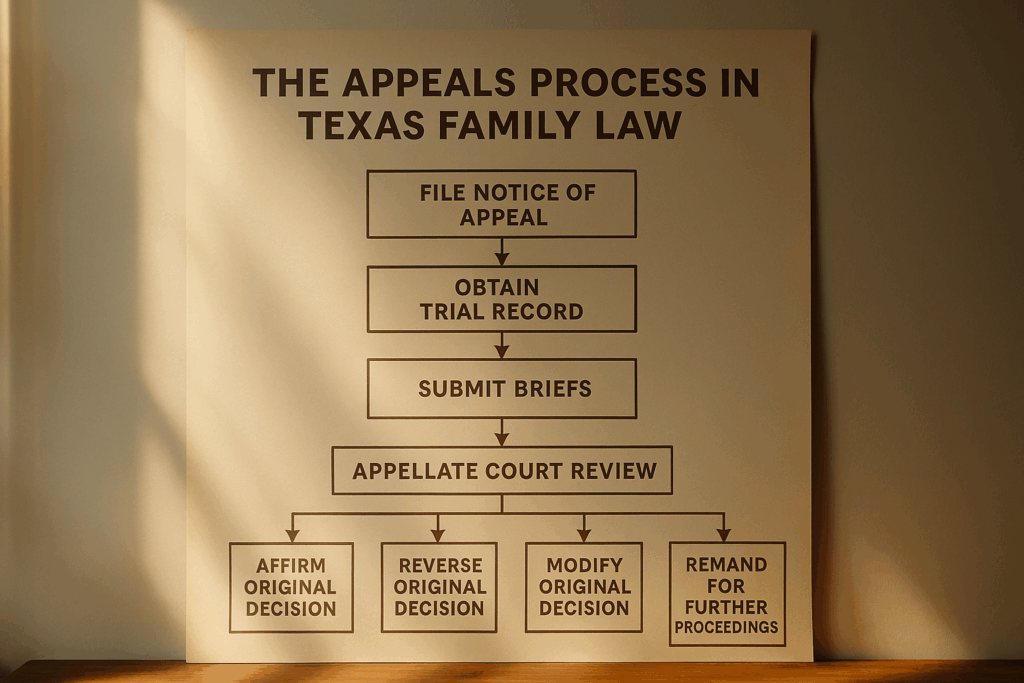
The process of Appealing Child Support Decisions Texas begins with filing a Notice of Appeal—a formal document that notifies both the trial court and the opposing party that you intend to challenge the ruling. Under Texas Family Code §§ 154.125(a-1) and 156.401, this step must occur within a strict timeframe, typically 30 days after the final judgment is signed. Once filed, the next step involves securing the official trial record, including all transcripts, exhibits, and court filings. This record is the foundation of your appeal, as Texas appellate courts review only what occurred at trial—they do not consider new evidence or testimony.
Both sides then submit appellate briefs. The appellant’s brief explains why the original ruling should be reversed, modified, or remanded based on legal error, while the appellee’s brief argues to uphold the trial court’s decision. The appellate court’s role is to determine whether the trial judge correctly applied Texas law, not to reweigh evidence or reconsider witness credibility. Depending on its findings, the court may affirm the decision, reverse it entirely, modify the order, or send the case back for further proceedings.
Because the appellate process is highly technical, professional representation is critical. A skilled Texas family law attorney ensures every procedural rule is followed, deadlines are met, and arguments are presented persuasively. The Texas Family Code § 109.001 also allows the court to issue temporary orders during the appeal to protect the child’s welfare and maintain financial stability. Parents should continue making child support payments during this time to prevent arrears or enforcement actions under Texas Family Code § 157.162.
For a closer look at how appellate courts handle family law matters and the opportunities a second review can provide, see Child Custody Appeals in Texas: A Second Chance. At The Law Office of Bryan Fagan, PLLC, our attorneys bring clarity and confidence to the appeals process—protecting your rights, your financial security, and your family’s future. To learn more about how we guide parents through complex support matters, visit our Texas Child Support Resource.
Deadlines for Filing an Appeal
Timing is critical when appealing a child support order. Parents must file a Notice of Appeal within 30 days after the court signs the final child support order. If a motion for a new trial is filed, this period can extend to 90 days after the judgment is signed. Missing these deadlines can result in the dismissal of your appeal, highlighting the importance of adhering to these timelines.
Recognize that a memorandum ruling can sometimes be treated as a final judgment. Failing to acknowledge this can lead to missing the appeal deadline. Therefore, staying vigilant about the date and deadlines is crucial to ensure your appeal is hearing and considered.
What Happens During an Appellate Review?
The appeals court evaluates whether the trial court applied the law correctly based on the existing record during an appellate review. This process does not involve new evidence or witness testimonies but focuses on identifying legal errors from the original trial. The appellate court reviews the official record, including transcripts, exhibits, and the judge’s written findings.
If the appellate court finds significant mistakes, it can reverse or modify the original ruling or remand the case for further proceedings. The court’s decision depends on its findings regarding the trial court’s application of the law and procedural correctness. In some cases, the appellate court may affirm the original decision, leaving the child support order unchanged.
A successful appeal results in the trial court modifying or issuing a new child support order consistent with the appellate court’s ruling, ensuring that the final order accurately reflects the correct application of the law and the evidence presented during the original trial, including any relevant court orders.
Alternatives to Appealing a Child Support Order
While Appealing Child Support Decisions Texas can be an effective way to correct legal or procedural mistakes, it isn’t always the most practical path. In many cases, a modification of the existing child support order may offer a faster, more flexible, and less adversarial solution. Under Texas Family Code § 156.401, either parent may request a modification when there has been a “material and substantial change” in circumstances—such as a significant shift in income, employment, or the child’s financial needs. This route often provides relief without the time and expense of an appeal.
When both parents agree on the adjustments, they can pursue an uncontested modification. This cooperative approach allows changes to be made efficiently and keeps the focus on the child’s well-being rather than conflict. Alternatively, the Child Support Review Process through the Texas Office of the Attorney General enables parents to negotiate updates to child support orders outside of court. This method is particularly useful when the issue is logistical rather than legal, such as recalculating support after a change in medical insurance or childcare costs.
Filing a modification petition requires clear, detailed documentation—such as recent pay stubs, tax returns, or proof of changes in the child’s needs—to demonstrate that circumstances have substantially shifted since the last order. The petition must be filed in the same county where the original order was issued, as required under Texas Family Code § 155.201. Exploring these alternatives can save time, reduce legal expenses, and help preserve cooperative co-parenting relationships.
To better understand when a modification makes more sense than an appeal, explore Appealing a Family Court Decision in Texas for deeper insights into how appeals differ from other post-judgment remedies. The family law attorneys at The Law Office of Bryan Fagan, PLLC, are dedicated to helping Texas parents make informed, confident decisions—whether through appeal, modification, or mediation—to protect their rights and their children’s futures. For additional guidance, visit our Texas Child Support Resource to learn more about your legal options.

Importance of Legal Representation in the Appeals Process
Attempting Appealing Child Support Decisions Texas without experienced legal representation can be overwhelming—and in many cases, it can jeopardize your chance of success. The appellate process in family law is technical and unforgiving, governed by strict deadlines and detailed procedural requirements outlined in the Texas Rules of Appellate Procedure and Texas Family Code § 109.002. A single missed filing date or improperly drafted brief can result in your appeal being dismissed before it’s even reviewed. That’s why working with a seasoned appellate attorney is critical to protecting your rights and your financial future.
An experienced Texas family law appeals attorney begins by assessing whether your case meets the legal standards for appeal. They identify valid grounds—such as errors of law, misapplication of Texas Family Code §§ 154.125(a-1) or 156.401, or improper handling of evidence—and ensure all filings meet the procedural timelines required by the courts. From preparing the appellate record to crafting persuasive arguments grounded in precedent, your attorney’s role is to build a legally sound and compelling case that gives you the best possible opportunity for reversal or modification.
Representation in appeals goes far beyond paperwork. Skilled attorneys act as your voice in a system that can feel intimidating and complex, translating legal language into clear strategies and helping you avoid common pitfalls. They also understand when to request temporary orders under Texas Family Code § 109.001 to preserve financial stability during the appeal, ensuring that your family’s needs are protected while the process unfolds.
If you’ve recently received an unfavorable ruling and are wondering what comes next, the article We Lost the Divorce—Now What? Perfecting the Appeal offers valuable insights into the next steps and how to strengthen your appellate position. The legal team at The Law Office of Bryan Fagan, PLLC, combines deep appellate experience with compassion and precision, helping Texas families correct errors and move toward fairer outcomes. To learn more about protecting your rights through appeal or modification, visit our Texas Child Support Resource.

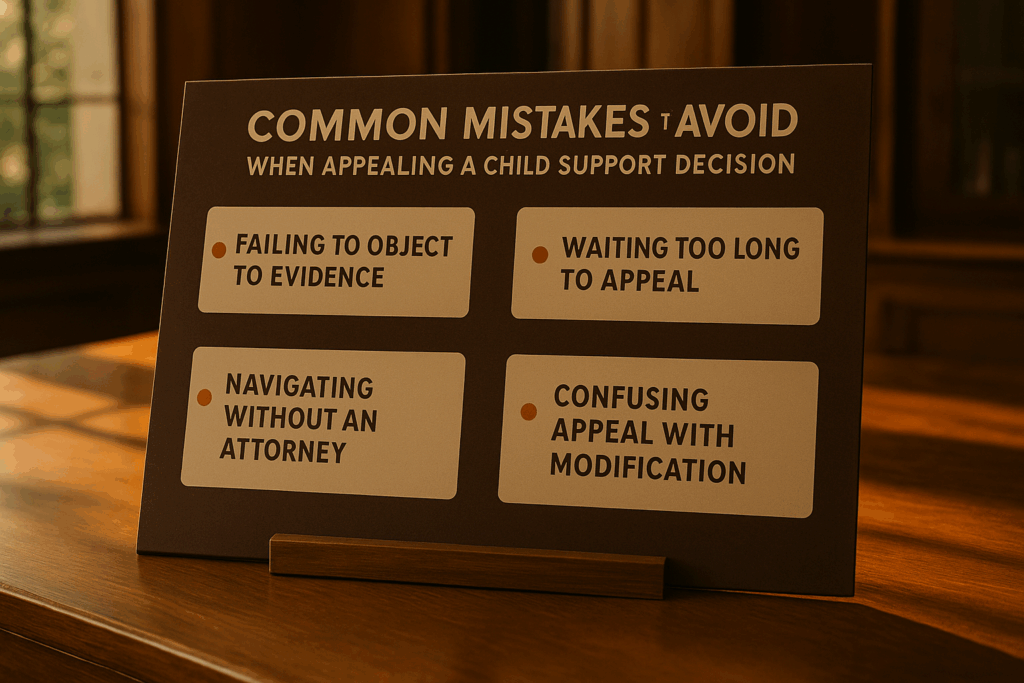
Common Mistakes to Avoid When Appealing a Child Support Decision
One of the most common pitfalls in Appealing Child Support Decisions Texas is failing to object to evidence during the original hearing. Under Texas Family Code § 109.002, appellate courts review only the record created at trial. If you did not raise objections or preserve issues for the record, those arguments may be lost on appeal. Similarly, misunderstanding the difference between an appeal and a modification can lead parents down the wrong legal path—an appeal corrects legal errors made by the court, while a modification under Texas Family Code § 156.401 addresses substantial changes in circumstances after the order was issued.
Timing is another critical factor. Appeals must typically be filed within 30 days of the final judgment (or 90 days if a motion for new trial is filed). Missing this deadline almost always means losing the right to appeal. Trying to navigate this process alone—without legal representation—can be overwhelming and risky. Appeals require precise compliance with procedural rules, detailed written arguments, and an understanding of how appellate judges interpret legal errors under Texas law.
An experienced family law appellate attorney ensures that every procedural safeguard is followed, every argument is preserved, and every filing meets the strict requirements of the Texas Rules of Appellate Procedure. They can also advise when an alternative, such as a modification or settlement, may better serve your goals. Avoiding common mistakes—like missing deadlines, failing to preserve evidence, or filing the wrong type of post-judgment motion—can dramatically improve your chances of obtaining a fair outcome.
For deeper insight into correcting legal errors after a trial, see Can You Appeal the Division of Property Outcome? to understand how appellate strategies apply across Texas family law cases. The attorneys at The Law Office of Bryan Fagan, PLLC, combine legal precision with compassion to help parents and families navigate complex appeals successfully. To learn more about how our team can help protect your financial future and your child’s stability, visit our Texas Child Support Resource.
How the Law Office of Bryan Fagan PLLC Can Help
At The Law Office of Bryan Fagan, PLLC, we know that Appealing Child Support Decisions Texas is about more than challenging numbers—it’s about protecting your financial security and your child’s future. Our firm provides personalized legal strategies designed to fit each family’s unique situation. Whether you’re questioning how a judge applied the law, disputing miscalculated income, or seeking relief from an unfair ruling, our attorneys have the knowledge and experience to guide you through every step of the appellate process.
Under the Texas Family Code §§ 154.125(a-1) and 156.401, parents have the right to request a modification or appeal when child support orders are based on legal errors, misapplied guidelines, or significant changes in circumstances. Our legal team thoroughly reviews court transcripts, financial evidence, and procedural records to identify where mistakes occurred and how they can be corrected through appeal. We ensure that every filing meets the strict procedural standards set by Texas appellate courts—helping clients pursue justice with clarity and confidence.
Beyond handling appeals, our attorneys also assist clients in maintaining financial stability during ongoing proceedings. We understand that these situations often carry emotional and practical challenges, so we work to ensure that your rights—and your child’s best interests—are protected throughout the process. Our mission is rooted in education, compassion, and advocacy, ensuring that every client has both a strong legal strategy and a clear understanding of their options.
For more information about your rights and options under Texas law, explore our comprehensive Texas Child Support Resource. The family law professionals at The Law Office of Bryan Fagan, PLLC, stand ready to help you navigate the complexities of the Texas Family Code, correct legal errors, and achieve a fair, sustainable outcome for your family’s future.
Conclusion:
Life after a child support ruling can feel like you’re constantly trying to balance everything—finances, parenting, and your own peace of mind—all while keeping the family moving forward. But if that court order doesn’t reflect the truth of your situation, you don’t have to accept it as the final word. Appealing isn’t about starting a fight; it’s about standing up for fairness, stability, and your family’s future.
At The Law Office of Bryan Fagan, PLLC, we believe every parent deserves a legal process that truly listens and gets it right. Our team has guided countless Texas families through appeals, helping them correct errors, ease financial pressure, and reclaim a sense of control over their lives. Whether you’re considering an appeal or just exploring your options, the most important step is reaching out early—before deadlines close and opportunities fade.
So if you’re staring at that court order and wondering, “Can this really be fixed?”—the answer might be yes, and you don’t have to figure it out alone. Let’s talk about your story, your rights, and the future you want for your family. Because sometimes the next chapter of your life starts not with a new beginning, but with the courage to challenge what wasn’t fair in the first place.
Texas Child Support Appeals – Frequently Asked Questions
Yes. You can appeal a final child support order by filing a Notice of Appeal—usually within 30 days of the date the judge signs the order (or 90 days if a motion for new trial is filed). Appeals challenge legal or procedural mistakes in the existing court record. They don’t allow new evidence, but they can correct errors like income miscalculations or the misapplication of Texas Family Code guidelines.
It depends. Most appeals succeed when there’s a clear legal or procedural error—such as the court using the wrong income figures or misinterpreting the law. Because family law judges have wide discretion, success often hinges on how well the issue was preserved at trial and how precisely it’s argued on appeal.
The most common mistake is failing to document and preserve the record for appeal. Parents sometimes focus so much on the emotion of the case that they forget to object properly or provide evidence that can be reviewed later. Other mistakes include violating temporary orders, speaking negatively about the other parent in front of the child, or missing filing deadlines.
Yes. You can appeal a child support decision made by a Texas district court, and you can also request judicial review of administrative decisions made by the Office of the Attorney General. If your concern is about a change in circumstances (like income or your child’s needs) rather than a legal error, filing for a modification might be the better option.
It varies widely. Your chances improve if your attorney can show the trial court made a legal error—such as misapplying Texas Family Code §154.125 when calculating guideline support or failing to consider admissible evidence. The stronger and clearer the error, the better the odds.
As of September 1, 2025, Texas Family Code §154.125(a-1) raises the child support guideline cap from $9,200 to $11,700 per month in net resources. This means higher-income parents could owe more under the guideline formula, though judges can still deviate based on the child’s specific needs.
Good reasons include legal or procedural errors—like miscalculating income, excluding key financial evidence, or applying the wrong legal standard. Appeals address mistakes the judge made during trial, not new evidence that wasn’t presented.
There’s no universal percentage, but family law appeals tend to have modest success rates because of the trial court’s discretion. However, appeals focused on clear, documented legal errors—especially involving financial calculations—tend to fare better.
The strongest grounds usually include:
Miscalculated child support based on incorrect income or net resources
Ignored or improperly admitted evidence
A decision not supported by the trial record
An abuse of discretion that goes against the child’s best interests