

It started with a raise and a smile. After years of late nights and hard work, Alex finally got the promotion he’d been chasing. But as the excitement settled, reality hit—what did this mean for his child support order? His ex sent a polite-but-pointed text (“Congrats on the raise!”), and suddenly that bigger paycheck didn’t feel so simple anymore. That’s the moment many parents find themselves Googling Revising Texas Child Support After Salary Increase—and realizing this isn’t just about numbers, it’s about fairness, family, and doing the right thing.
At The Law Office of Bryan Fagan, PLLC, we see this story play out all the time. Life changes—new jobs, better pay, maybe even a relocation—and with it comes the responsibility to make sure your child support reflects your new reality. Texas law gives parents a clear path to modify child support after a salary increase, but there’s more to it than filing a few forms. It’s about timing, documentation, and understanding how the court views “material and substantial changes” in your financial world.
In this post, we’ll walk you through what happens when your income jumps, how to tell if a modification is necessary, and what the process looks like in Texas family courts. You’ll also learn practical steps to protect yourself—and your family—from future disputes, along with real examples from our Houston legal team. Whether you’re the parent paying or receiving support, this guide will help you make smart, informed choices that keep things fair and transparent as life (and income) evolve.
Key Takeaways
- Child support modifications in Texas are necessary when significant financial circumstances change, such as a 20% income increase or shifts in the child’s needs.
- Texas law mandates a review of child support orders every three years, ensuring that payments remain fair and relevant based on current situations.
- Proactively managing child support modifications and maintaining open communication can prevent disputes and ensure children’s financial needs are met adequately.

Your Family’s Future Starts Here
Don’t navigate your legal journey alone. Schedule a consultation now and get the clarity and support you deserve.
When a Child Support Modification is Necessary
Child support modification is often necessary when financial circumstances or a child’s needs change significantly. Revising Texas Child Support After Salary Increase is one of the most common reasons parents revisit existing orders. Under Texas Family Code §§ 156.401 and 154.062, child support must fairly reflect both parents’ current financial situation and the child’s needs. When one parent experiences a notable salary increase, the law provides a clear process for reviewing and adjusting support to ensure continued fairness.
A material and substantial change—the legal threshold for modification—can include a significant rise in the paying parent’s income, new medical or educational expenses for the child, or a change in custody arrangements. The court evaluates whether the increase is stable and ongoing, rather than temporary, before revising the order. This ensures the child benefits appropriately from a parent’s financial growth without creating undue hardship for either party.
Texas courts allow modifications whenever substantial changes can be proven and also permit a routine review every three years if there is at least a 20% or $100 difference between the current amount and what the guidelines require, as noted in § 156.401(a-1). Staying proactive about these reviews prevents enforcement issues or penalties that may arise under Chapter 157 of the Texas Family Code for non-compliance with updated obligations.
At The Law Office of Bryan Fagan, PLLC, our attorneys guide Texas parents through each step of the modification process—from filing requests and collecting financial documentation to appearing in court. We ensure every petition aligns with the latest Family Code provisions and accurately reflects your family’s needs. For insights into how increased income and asset growth can influence both property division and support, explore Property and Child Support for the Texas Entrepreneur.
For more guidance on maintaining fair and up-to-date child support orders, visit our Texas Child Support Resource. Revising your support order after a salary increase isn’t just about legal compliance—it’s about ensuring your child’s future remains secure, supported, and in step with life’s changes.

Significant Income Increase
A significant increase in the obligor’s income is one of the most common reasons for requesting a child support modification. In Texas, a meaningful change in income is generally defined as an increase of at least 20% or resulting in at least a $100 difference in monthly obligations. This threshold ensures that modifications address substantial, not temporary or marginal, changes.
Consider a scenario where a parent’s annual income rises from $60,000 to $90,000. This substantial increase justifies a modification request since it significantly alters the financial landscape. Child support payments must keep pace with these income change to maintain fairness and adequately meet the child’s needs.
Parents should provide accurate financial documentation, such as tax returns and pay stubs, to support their modification request.
Three-Year Review Rule
In addition to modifications triggered by significant income changes, Texas law also mandates a review of child support orders every three years. This three-year review rule ensures that child support payments are regularly reassessed to reflect any significant changes in circumstances. If it has been three years or more since the last modification, and there is at least a 20% or $100 difference in the current support amount, a review and potential modification are required.
This rule ensures child support orders remain fair and relevant over time. Key points include:
- To pursue a review, the original support amount must have been court-ordered.
- The three year rule review process serves as a safety net.
- It ensures that child support orders remain appropriate and equitable, even if parents do not proactively request modifications. A court order is essential for this process.
How Higher Income Affects Child Support Orders
Higher income levels can significantly affect existing child support obligations in Texas. Revising Texas Child Support After Salary Increase is often necessary because Texas applies a percentage-based formula tied to a parent’s net monthly income under Texas Family Code §154.062. The standard guideline percentages—20% for one child, 25% for two, and 30% for three—apply up to the statutory income cap, which increased on September 1, 2025, from $9,200 to $11,700 as noted in §154.125(a-1). When a parent’s salary rises above this threshold, the court may review and modify the existing order to ensure that child support remains equitable and that the child benefits appropriately from the parent’s improved financial circumstances.
The purpose of this framework is to maintain fairness and balance. As a parent’s income grows, the Texas Family Code ensures that child support reflects both the parent’s capacity to contribute and the child’s evolving needs. This avoids situations where outdated orders fail to support the child adequately or, conversely, create unnecessary financial strain. Courts consider all forms of income—such as bonuses, commissions, and investment returns—when recalculating support, ensuring a complete and accurate assessment of a parent’s financial picture.
When income exceeds the guideline cap, Texas courts have discretion to order additional support if a child’s proven needs justify it under §154.126. This flexibility is designed to protect children’s welfare while recognizing the realities of higher-income households. These adjustments help maintain consistent living standards across both households, supporting the child’s emotional and financial stability after a parent’s career or income change.
At The Law Office of Bryan Fagan, PLLC, our experienced team helps parents across Texas navigate these complex modifications with clarity and compassion. We ensure every case reflects current legal standards and is supported by accurate documentation. For additional insight into how life changes—like promotions, new business ventures, or divorce—can impact your family’s financial plans, visit The Impact of Divorce on Beneficiaries in Your Texas Will or explore our Texas Child Support Resource.

Calculating New Child Support Amounts
Calculating new child support amounts involves a detailed process that factors in the parent’s net monthly income and the number of children being supported. Texas courts use a formula that assesses net resources, including wages, self-employment income, interest, dividends, and rental income, minus specific deductions like taxes. The aim is to ensure that original child support obligations are fair and reflect the parent’s true financial capacity, which includes a child support calculation.
For parents with multiple children, a set percentage of their income is allocated for child support, which varies depending on the number of additional children. When income exceeds a certain cap, the court has the discretion to order additional support if justified by the child’s needs. This structured approach ensures that child support payments are consistent and fair, adapting to changes in the parent’s financial situation.
Texas Family Code Guidelines
The Texas Family Code provides detailed Texas child support guidelines for calculating child support, ensuring that payments are fair and based on the parent’s financial situation. Chapter 156 of the Texas Family Code outlines the laws for modifying child support, while Chapter 154 details how net resources are assessed, including wages, self-employment income, and other sources of income, minus allowable deductions.
Net monthly income is calculated based on various income sources, excluding taxes and certain allowable deductions. Factors influencing the calculation include:
- Each parent’s income, including the noncustodial parent’s income
- The number of children
- Time spent with children
- Special needs
- Existing court orders
- The need to support other children.
These child support guidelines ensure child support payments are fair and adequately meet the child’s needs.
Example Calculation
To illustrate how a salary increase affects child support payments, consider a parent with a net monthly income of $5,000 supporting two children. Initially, this parent would pay $1,250 per month, following the standard 25% guideline. However, if their salary increases significantly, the new calculation might adjust the child support amount to $1,100 per month, reflecting the updated financial situation.
This example demonstrates the impact of income changes on child support obligations, highlighting the importance of accurate financial documentation and adherence to the Texas Family Code guidelines. Recalculating child support payments promptly after significant income changes ensures fairness and adequately meets the child’s needs.
Steps to Modify Child Support After a Salary Increase
When a parent’s income increases significantly, taking the proper legal steps to update child support is essential. Revising Texas Child Support After Salary Increase ensures that payments reflect current financial realities while keeping the child’s best interests at the center of every decision. Under Texas Family Code §156.401, either parent can request a modification when there’s a material and substantial change in financial circumstances. A salary increase is one of the most common triggers for such a review, and Texas law allows modifications to be made whenever the evidence supports that change.
The first step is to file a formal Request for Review with the Office of the Attorney General’s Child Support Division or, in some cases, directly with the court that issued the existing order. This process begins the official reassessment of your child support obligations. Courts will require current documentation—such as pay stubs, tax returns, and employment verification—to determine whether the modification is appropriate under the updated income level. These steps ensure compliance with Texas Family Code §154.062, which defines “net resources” used to calculate child support.
Throughout the process, communication plays a key role. When parents stay open and cooperative, child support modifications can be handled efficiently and with less emotional strain. Maintaining transparency about income changes not only builds trust but also prevents potential enforcement issues later on. Texas courts encourage collaboration wherever possible, focusing on what serves the child’s stability and long-term welfare.
At The Law Office of Bryan Fagan, PLLC, our family law professionals help parents take these steps with confidence, ensuring every modification request meets legal standards and reflects the latest updates to the Texas Family Code. We guide clients through every stage of the review, from filing to final order, while prioritizing fairness and clarity. For deeper insight into how income changes and business growth affect family finances, visit Property and Child Support for the Texas Entrepreneur. You can also explore our Texas Child Support Resource for additional guidance on keeping your support arrangement accurate, balanced, and future-focused.
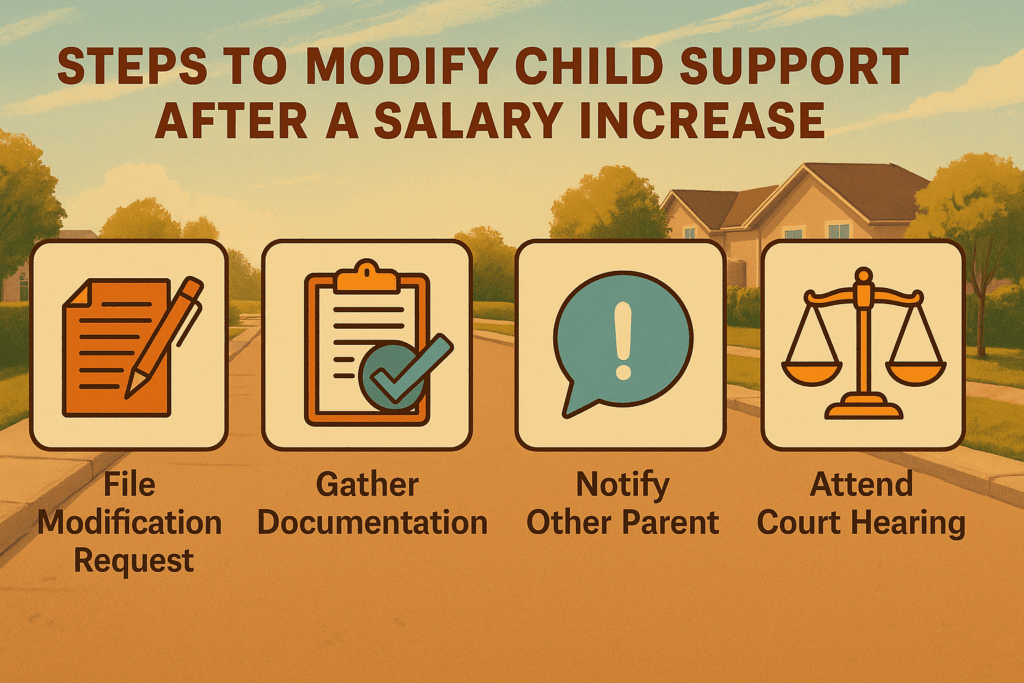
Filing a Modification Request
To modify a child support order in Texas, the process must follow specific legal procedures to ensure fairness, compliance, and enforceability. Revising Texas Child Support After Salary Increase begins with filing a formal motion in the same court that issued the original order, as required under Texas Family Code §156.401. This section allows either parent to request a modification when there has been a material and substantial change in circumstances—such as a significant salary increase, job promotion, or shift in employment status.
After filing the motion, parents must submit a petition to modify child support along with complete and accurate financial documentation. This includes recent pay stubs, tax returns, and any evidence of bonuses, commissions, or other income sources defined as “net resources” under §154.062 of the Texas Family Code. Providing this information upfront helps the court evaluate the case efficiently and ensures that any new support calculation reflects the parent’s current financial situation.
Whenever possible, discussing the modification with the other parent before filing can reduce tension and encourage a cooperative resolution. Open communication may prevent disputes and allow both parties to focus on what matters most—the child’s well-being. Filing one modification request at a time also prevents procedural delays and ensures the case moves smoothly through the Texas family court system.
At The Law Office of Bryan Fagan, PLLC, our experienced attorneys guide parents through every stage of the modification process, helping them understand their rights and obligations under the latest Texas Family Code updates—including the 2025 increase in the guideline income cap to $11,700 per month under §154.125(a-1). We believe that proactive legal support can make a meaningful difference in maintaining family stability and financial fairness. To learn more about how to update your child support order and protect your family’s future, visit Child Support in Texas or explore our Texas Child Support Resource.
Required Documentation
Accurate and comprehensive documentation is crucial for a successful child support modification request. Key documents include:
- Pay stubs
- Tax returns
- Termination letters These help provide an accurate picture of the parent’s financial status. Allowable deductions factored into the calculation of child support amounts include:
- Healthcare costs
- Work-related expenses
- Payments made to other children.
Additional supporting documents may include evidence of any changed financial circumstances, ensuring that the modification request is well-supported and reflects the parent’s current financial situation. Having the necessary documentation ready can streamline the process and facilitate timely adjustments to child support payments.
Legal Assistance for Child Support Modifications
Navigating the process of Revising Texas Child Support After Salary Increase can feel overwhelming without experienced legal guidance. The Texas Family Code—specifically §156.401—allows either parent to request a modification when there has been a material and substantial change in circumstances, such as a significant salary increase or change in employment. However, successfully updating a child support order requires careful compliance with procedural rules, financial documentation, and accurate application of the guidelines outlined in §154.062, which defines how “net resources” are calculated for child support purposes.
Working with a knowledgeable Texas family law attorney helps ensure that every requirement is met and that your case is presented clearly and effectively to the court. A skilled attorney will help you gather the necessary financial records, prepare a compelling modification petition, and ensure the updated support order aligns with the latest state guidelines—including the 2025 adjustment to the child support cap under §154.125(a-1), which increased from $9,200 to $11,700 per month. This ensures fairness while protecting both the child’s best interests and the parent’s financial rights.
Legal representation also protects parents from common pitfalls such as incomplete filings, missed deadlines, or misunderstanding how income changes affect existing obligations. For example, a noncustodial parent who fails to modify support after a salary increase could face enforcement actions under Chapter 157 of the Texas Family Code, including wage garnishment or contempt proceedings. Having an attorney manage your modification helps you stay compliant and prevents these costly and stressful outcomes.
At The Law Office of Bryan Fagan, PLLC, our family law team provides hands-on guidance to parents throughout Texas who need to update their child support orders after income changes. We approach every case with both legal precision and compassion, ensuring our clients understand their options and obligations under Texas law. To learn more about how modification orders work in your area, visit Divorce Decree Modifications in the Design District, or explore our Texas Child Support Resource for additional guidance on maintaining compliance while protecting your family’s future.

Potential Consequences of Not Updating Child Support
Failing to update child support after a substantial income increase can create serious legal and financial challenges. Revising Texas Child Support After Salary Increase is not only about fairness—it’s about staying compliant with Texas law. Under Texas Family Code §156.401, either parent can request a modification when a material and substantial change occurs, such as a raise, promotion, or new employment that significantly alters income. When a parent fails to disclose or adjust support after a salary increase, the court may issue enforcement actions or penalties under Chapter 157 of the Texas Family Code, which governs contempt proceedings and arrears collection.
Updating your child support order promptly ensures that payments accurately reflect your financial capacity and your child’s needs. It also helps prevent back payments or interest from accumulating—issues that can quickly escalate if ignored. The Texas Family Code, particularly §154.062, defines “net resources” used to calculate child support, including salary, bonuses, commissions, and other income sources. By keeping your order current, you avoid costly legal disputes and maintain compliance with the most recent statutory updates, including the 2025 increase to the guideline income cap under §154.125(a-1), which now stands at $11,700 per month.
Beyond compliance, timely modifications promote stability and trust between co-parents. When both parties communicate openly about income changes, they reduce the risk of future litigation and demonstrate shared responsibility for the child’s well-being. Proactively managing support obligations shows good faith and reinforces the principle that both parents contribute fairly according to their financial ability.
At The Law Office of Bryan Fagan, PLLC, our attorneys help parents across Texas navigate these sensitive transitions with clarity and compassion. We work to ensure that updated support orders align with your circumstances and the latest legal standards. For a deeper understanding of how business growth and financial changes affect family obligations, explore Property and Child Support for the Texas Entrepreneur. To learn more about maintaining compliance and protecting your family’s future, visit our Texas Child Support Resource.

Options for Requesting a Review
Parents have several options for requesting a review of child support orders. The Child Support Review Process (CSRP) allows for modifications without hiring an attorney, making it more accessible for many parents. If both parents agree during the CSRP, the modification can happen without seeing a court process.
Custodial parents can submit a Request for Review form to the attorney general’s office Child Support Division, where income changes will be verified, and the guideline formula applied to determine if a modification is justified. Alternatively, parents can seek help from a private family law attorney or a child support review specialist to navigate the review process.
Importance of Being Proactive
Proactively revising child support is vital for protecting both parties and ensuring payments remain fair and adequate. Discussing modification requests and informal agreements before filing can foster cooperation and prevent disputes.
The primary goal in modifying child support is the child’s well-being, ensuring their needs are met regardless of changes in parental income. By addressing changes promptly and collaboratively, parents can maintain a fair and supportive environment for their children.
Conclusion:
Life has a way of moving fast—new jobs, bigger paychecks, and new responsibilities that come right along with them. Revising your child support after a salary increase isn’t about adding more paperwork to your to-do list; it’s about keeping things fair and making sure your financial picture reflects where you are now, not where you were years ago. When handled the right way, these updates can actually bring more peace of mind to everyone involved.
At The Law Office of Bryan Fagan, PLLC, we’ve walked countless Texas parents through this very process—helping them understand their rights, protect their futures, and keep family dynamics stable as life changes. Our job isn’t just to interpret the law; it’s to make sure your decisions today set your family up for success tomorrow.
If you’ve recently had a raise, a promotion, or a big life change, consider it an opportunity—not a burden—to get your support order right. A quick conversation with an experienced Texas family law attorney can make the entire process smoother, clearer, and far less stressful.
And if you’re still on the fence, just ask yourself: would you rather tackle a legal issue when it’s small and manageable—or when it’s turned into a full-blown storm? We’re here to help you choose the calm before the chaos.
Frequently Asked Questions About Revising Texas Child Support After a Salary Increase
It can. If your income change is substantial—or meets the Texas Family Code’s 20% or $100 guideline difference—the court can modify your child support order. The goal is to ensure support reflects current income and the child’s actual needs.
No. Small or short-term raises don’t usually trigger a change. Texas courts only consider revising support when there’s a material and substantial increase in income, or during the routine three-year review if the amount differs enough from state guidelines.
You can request a modification any time a major financial or life change occurs—such as a raise, job loss, or new medical needs. Separately, Texas allows a review every three years if the difference meets the 20% or $100 guideline threshold.
Usually, yes. If your new job significantly boosts your income, the court may recalculate payments under guideline percentages. The change ensures your child benefits from your increased financial stability.
It isn’t automatic. You (or the other parent) must file for a modification when circumstances change or after three years if the current amount no longer aligns with Texas guidelines.
No. Texas calculates child support based on the paying parent’s income only—not a new spouse’s. However, if that spouse’s financial support reduces your ex’s expenses significantly, the court might consider that context.
No. Your spouse’s income is separate. Child support is based on your individual net resources. Still, if someone attempts to hide income through a spouse or shared account, the court can step in to ensure fairness.
Letting anger or conflict guide your actions. Judges look for parents who stay child-focused, cooperative, and consistent. Ignoring court orders, bad-mouthing the other parent, or venting online are quick ways to lose credibility
Fees vary depending on complexity and location. Simple, uncontested modifications might range from about $750 to $3,500, while contested cases can cost more. Expect hourly rates between $250–$500 for experienced Texas family law attorneys.