Feeling your child pull away because of your ex-partner’s influence is one of the most painful experiences a parent can face. The sense of helplessness and hurt can be overwhelming, especially when you suspect your co-parent is intentionally poisoning your relationship. If this is your reality, please know you are not powerless. Navigating this difficult path requires more than just suspicion; it demands a clear strategy and solid evidence to protect your child and your parental rights in a Texas family court.
What Is Parental Alienation and How Is It Viewed in Texas?

Parental alienation occurs when one parent deliberately manipulates a child into rejecting, fearing, or resenting the other parent without a valid reason. This isn’t just a single angry comment made in a moment of frustration. It is a systematic pattern of psychological manipulation designed to sever the bond you share with your child. The alienating parent may constantly badmouth you, fabricate stories about your past, or actively interfere with your time together, all to make your child see you as the enemy.
The Texas “Best Interest of the Child” Standard
While you won’t find “parental alienation” explicitly defined as a crime in the Texas Family Code, courts view these destructive behaviors through the most critical lens in any custody case: the “best interest of the child” standard. As outlined in Texas Family Code § 153.002, every judicial decision regarding a child must prioritize their physical and emotional well-being above all else.
It is universally understood that a parent who intentionally destroys their child’s relationship with the other parent is not acting in that child’s best interest. A judge will look for a pattern of behavior that:
- Undermines Your Authority: Encouraging the child to be disrespectful or to ignore your rules.
- Blocks Your Time: Consistently interfering with your court-ordered visitation or cutting off phone and video calls.
- Creates Loyalty Battles: Making your child feel they must “pick a side” or feel guilty for enjoying their time with you.
- Shares Inappropriate Details: Discussing court proceedings, child support, or other adult matters with the child to cast you in a negative light.
At its core, the court’s primary duty is to protect your child’s emotional and psychological health. When one parent’s actions actively harm the child’s ability to have a healthy relationship with both parents, a judge will take decisive action.
How Judges View Alienation Claims
Texas family court judges are experienced in handling high-conflict cases. They are skilled at distinguishing between true alienation, a child’s temporary anger, or legitimate safety concerns. They do not take these claims lightly and will require more than just your word against your ex-partner’s.
While not a criminal offense, a finding of parental alienation can have severe consequences in family court. Are you wondering if parental alienation is against the law in Texas? In a custody case, the repercussions can include modifying custody orders, ordering therapeutic intervention, or implementing other legal protections for the child.
Pinpointing and Recording Alienating Behaviors
To prove parental alienation, you must shift your focus from the emotional pain to the factual evidence. This means becoming a meticulous record-keeper, documenting every instance of behavior that undermines your relationship with your child. Your goal is to build a clear, objective timeline that presents a judge with an undeniable pattern of conduct, not just a few isolated incidents.
This can feel overwhelming when you are already dealing with the emotional toll of the situation, but it is the absolute foundation of a successful legal strategy.
What Alienating Behaviors Look Like in Texas Family Court
Parental alienation is rarely a single, dramatic event. It is typically a slow, methodical campaign of subtle manipulation and overt actions. Recognizing these behaviors is the first step. Texas law promotes the idea that both parents should encourage a healthy relationship between the child and the other parent; these behaviors do the opposite.
Here are the key behaviors that family courts frequently see:
- Bad-Mouthing and Constant Criticism: This includes negative comments about you, your new partner, your family, or your job made in front of your child. It can be as direct as calling you “irresponsible” or as subtle as a sigh of frustration every time your name is mentioned.
- Running Interference with Communication or Visits: This is a classic sign. It ranges from blocking your calls and “forgetting” to pass on messages to consistently scheduling conflicting activities during your court-ordered possession time.
- Sharing Adult Information: The other parent may discuss sensitive topics like child support payments, the details of your divorce, or legal strategies with your child. This places an immense burden on your child and implicitly frames you as the source of the family’s problems.
- Forcing the Child to Choose Sides: This destructive tactic creates a loyalty bind. The alienating parent might say things like, “If you loved me, you wouldn’t want to go to your mom’s house,” making the child feel guilty for showing you affection.
If these scenarios sound familiar, you are not alone. These situations are far more common than many people realize. Research indicates that a significant number of divorced parents face these exact behaviors. For example, one study found that 59.1% of divorced parents reported experiencing specific parental alienating behaviors when presented with a detailed checklist.
These statistics confirm that what you are going through is a recognized and unfortunately common challenge. You can explore the full research on parental alienation prevalence to learn more.
The Power of Meticulous Documentation
A vague claim like, “He’s always turning my daughter against me,” will not be persuasive in court. However, presenting a detailed log showing 37 documented instances of visitation interference over the past six months tells a powerful, factual story. Your documentation must be objective, consistent, and detailed.
A simple spreadsheet or a dedicated journal can be your most valuable tool. The goal is to transform your personal experiences into concrete evidence.
A Practical Guide To Documenting Alienating Behaviors
Here is a straightforward table to help you track common alienating behaviors. The key is to connect the real-life event to a specific, actionable way to capture it for the court.
| Alienating Behavior | What It Looks Like In Real Life | How To Document It Effectively |
|---|---|---|
| Constant Criticism | “Your mom is just lazy, that’s why she doesn’t have a new car like I do.” | Log the date, time, and the exact quote. Note if your child repeated it to you and who else was present. Save any texts or emails with similar disparaging language. |
| Visitation Interference | Your ex “spontaneously” schedules a birthday party for your child’s friend during your designated weekend. | Take a screenshot of the invitation or text message. Log your conversation where you pointed out the conflict. Note the date and time of the missed visit. |
| Erasing Your Presence | Your child tells you, “Dad said you never even came to my school plays.” You have photos proving you were there. | Keep a digital folder of photos from events you attended. Log your child’s comment, the date they said it, and your calm, factual response to them. |
| False Allegations | The other parent tells your child you “don’t care about their grades” after you had to miss one parent-teacher conference for an unavoidable work trip. | Keep emails with the teacher explaining your absence. Log the date your child made the comment and save any related texts where you discussed the conference with your ex ahead of time. |
This log will become your most crucial piece of evidence. It transforms subjective feelings into objective data that your attorney can use to build a compelling argument centered on your child’s best interest.
Key Takeaway: The strength of your documentation lies in its detail and consistency. A single incident can be dismissed as a misunderstanding, but a well-documented pattern of behavior is nearly impossible for a court to ignore.
Every entry you make strengthens your position and paints a clearer picture of the emotional harm being inflicted. It is meticulous work, but it is the work that can win your case.
Gathering Concrete Evidence For Your Case
While your detailed log is the foundation, its true power is realized when supported by concrete, impartial evidence. Think of your log as the narrative and this supporting evidence as the indisputable facts that make your story tangible for the court. Proving parental alienation requires moving beyond personal accounts to present a collection of proof that clearly illustrates the emotional harm your child is suffering.
This process involves identifying key evidence, documenting it methodically, and analyzing its impact—a crucial workflow for building a strong, persuasive case.
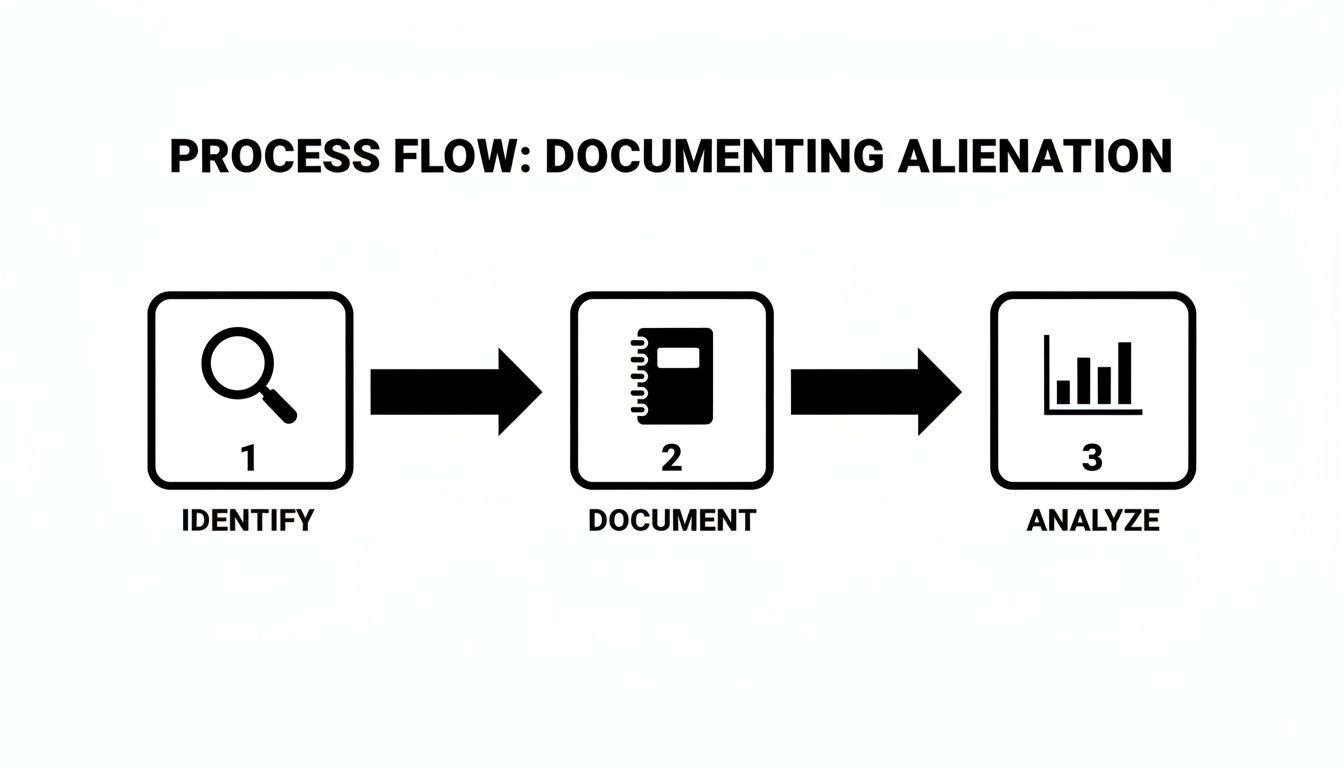
This diagram breaks the process down perfectly. First, you identify alienating behaviors as they occur. Next, you meticulously document each instance. Finally, you analyze how this evidence demonstrates a pattern of harm impacting your child.
Harnessing Digital Communications
So much of our communication today leaves a digital trail that can be incredibly revealing in court. Text messages, emails, and social media posts often provide a direct window into the other parent’s intentions and actions. The value of this evidence is that it is often in the alienating parent’s own words, making it difficult to dispute.
- Text Messages: Save screenshots of any texts where the other parent makes disparaging remarks about you, interferes with your parenting time, or admits to discussing adult legal matters with your child. Ensure the date and time are clearly visible.
- Emails: Emails can provide a more detailed record of conversations. Archive any messages that show a pattern of uncooperative behavior, false accusations, or attempts to exclude you from your child’s school or medical life.
- Social Media: Public posts or even private messages can sometimes reveal the other parent’s negative attitude toward you or show them contradicting something they told you or the court.
Preserving this evidence correctly is vital. When collecting digital communications, it’s important to be aware of the understanding challenges in digital forensics for evidence to ensure its authenticity and admissibility in a Texas court. A simple screenshot may not be enough. An attorney can guide you on the best methods for preservation, as you don’t want your hard work dismissed on a technicality.
The Power of Third-Party Testimony
Sometimes, the most powerful evidence comes from neutral third parties who have no personal stake in your custody dispute. These individuals can offer objective observations about changes in your child’s behavior or events they have personally witnessed. Their testimony corroborates your claims and shows the judge that your concerns are not just one parent’s word against the other.
Consider the people who interact with your child regularly and can speak to their well-being:
- Teachers and School Counselors: They are invaluable witnesses who can testify about a sudden drop in grades, behavioral changes at school, or troubling statements your child has made.
- Coaches and Extracurricular Leaders: They may have observed the other parent speaking negatively about you or noticed your child’s sudden desire to quit an activity they once loved sharing with you.
- Therapists and Pediatricians: A child’s therapist can provide professional insight into their emotional state, while a doctor might note physical symptoms of anxiety or stress related to visitation exchanges.
- Family Friends and Relatives: While potentially seen as biased, trusted friends or family can testify to specific alienating comments they overheard or concerning behaviors they witnessed firsthand.
Your attorney is the best person to help identify the most credible witnesses and can formally request their testimony through a subpoena if necessary.
A teacher’s testimony about a child suddenly becoming withdrawn and anxious after weekends with one parent can be incredibly impactful. It provides a professional, unbiased perspective that directly links the alienating environment to the child’s emotional distress.
Leveraging Official Records and Documentation
Official records add a factual, data-driven layer to your case that is difficult to dispute. These documents create a timeline and show the tangible consequences of the alienation, connecting the other parent’s behavior to a real-world negative impact on your child’s life.
Focus on collecting documents that tell a story of decline or disruption:
- School Records: Report cards showing a sudden drop in academic performance are a powerful indicator of emotional turmoil. Attendance records can prove if the other parent has been pulling the child out of school without your consent.
- Medical and Therapy Records: If your child has developed anxiety, depression, or other stress-related conditions, medical records provide proof. A therapist’s notes can offer a professional assessment of the psychological impact of the family dynamic.
- Communication Logs from Parenting Apps: If you use a court-ordered app like OurFamilyWizard, the entire communication history is logged and admissible, making it perfect for proving non-cooperation or abusive language.
Gathering this evidence requires diligence and organization. Keep everything in a secure place and share it all with your attorney. Each piece—a single text message or a semester of report cards—is a building block in constructing a case that protects your child’s best interest.
The Role Of Expert Witnesses And Evaluations
Even with meticulous documentation, a parental alienation case can feel like your word against your ex-partner’s. In these challenging situations, a court often needs an objective, professional voice to cut through the emotional conflict. This is where expert witnesses and formal evaluations become some of the most powerful tools at your disposal.
These experts are not advocates for either parent. Their sole duty is to the court, providing an unbiased, professional opinion on what is truly in your child’s best interest. Their involvement adds a layer of scientific credibility to your claims that a judge cannot easily ignore.
Understanding Custody Evaluations in Texas
When allegations of parental alienation are serious and well-documented, a judge may order a child custody evaluation as permitted under Texas Family Code § 107.103. This is an in-depth investigation into your family’s dynamics, conducted by a qualified mental health professional, such as a psychologist or licensed clinical social worker.
The evaluator’s process is thorough and typically includes:
- Interviews: The expert will meet with both parents, your child, and other significant people in the child’s life, like stepparents or grandparents.
- Observations: The evaluator will observe how you and the other parent interact with your child, both together and separately, to see the relationships in action.
- Psychological Testing: Both parents, and sometimes the child, may undergo standardized psychological tests to identify personality traits or other issues contributing to the conflict.
- Reviewing Your Evidence: The expert will review all collected records—school reports, medical files, communication logs, and any other evidence you provide.
Understanding the types of child custody evaluations and the detailed process can help demystify the experience. Upon completion, the expert submits a comprehensive report to the court with their findings and recommendations for custody.
The Amicus Attorney or Guardian Ad Litem
In particularly high-conflict cases, a court may appoint an amicus attorney or a guardian ad litem (GAL). While their roles differ slightly, their primary purpose is the same: to act as the court’s eyes and ears and represent the child’s best interests.
An amicus attorney is a lawyer who serves as an independent fact-finder for the court. They will interview everyone involved—parents, the child, teachers, counselors—and review all evidence. They then make direct recommendations to the judge about the custody arrangement that would best serve the child’s emotional and physical well-being. Their opinion carries significant weight.
An expert’s report can be the turning point in a parental alienation case. It provides the court with a neutral, data-driven analysis of the family dynamic, connecting the alienating behaviors directly to the emotional harm experienced by the child.
This professional validation is critical because it draws a clear line between one parent’s specific actions and the negative impact on the child. Research has shown that the frequency and type of alienating behaviors are directly linked to the severity of the effect on a child. This scientific connection is precisely why expert evaluations are so persuasive.
How Your Attorney Works with Experts
Your family law attorney acts as your guide through this process. They will help you prepare for interviews with the evaluator, ensuring you can present your side of the story clearly and factually. Your attorney will also organize all the evidence you’ve collected and provide it to the expert, ensuring they have a complete picture from the start.
If the expert’s report is favorable, your attorney will know how to emphasize its key findings in court. If the report is not what you hoped for, a skilled attorney can challenge its conclusions through cross-examination. Having the right lawyer to work alongside these court-appointed professionals is essential to making sure your story is heard and understood.
Presenting Your Case and Seeking Legal Remedies in Court

After months of documenting every text, email, and heartbreaking comment, the courtroom is where your diligence can finally make a difference. This is your opportunity to present a clear, compelling narrative to the judge, demonstrating not just what has been happening, but why the court’s intervention is critical for your child’s well-being.
This isn’t about “winning”; it’s about protecting your child’s right to a healthy relationship with both parents. Every piece of evidence should tie the alienating parent’s behavior back to the “best interest of the child” standard in the Texas Family Code.
Structuring Your Argument for Court
A powerful presentation requires a clear narrative. Your attorney will weave every text message, teacher’s note, and expert observation into a cohesive timeline that reveals a distinct and escalating pattern of alienation. By writing effective legal briefs, a skilled family law attorney transforms raw data into a legal argument that is easy for a judge to follow and act upon.
The strategy is to move from general complaints to specific, provable facts. Instead of saying, “She constantly bad-mouths me,” your lawyer will present a methodical case: “Your Honor, on May 15th, the mother sent this text calling the father ‘unreliable.’ Then, on May 22nd, the child’s teacher testified that she overheard the child telling a classmate that his dad is ‘unreliable.'” This approach turns your experience into undeniable evidence.
Seeking Specific Legal Remedies in Texas
Proving alienation is only half the journey. You must ask the judge for specific, concrete solutions to stop the behavior and begin the healing process. Texas judges have several powerful tools at their disposal.
Your attorney may ask for one or more of the following remedies:
- Modification of Custody: In severe cases, the most direct solution is to ask the court to modify the custody order. This could mean changing the primary conservator or granting you the exclusive right to make decisions about the child’s therapy.
- Court-Ordered Reunification Therapy: This specialized therapy is designed to methodically repair a damaged parent-child bond. A judge can order all parties to participate, creating a structured path toward healing.
- Appointment of a Parenting Coordinator or Facilitator: Under Texas Family Code Chapter 153, Subchapter K, the court can appoint a neutral professional to help parents resolve conflicts and follow the possession order, acting as a referee to prevent interference.
- Enforcement and Contempt Actions: If the other parent blatantly violates the possession schedule, you can file an enforcement action. If found in contempt of court, they could face fines or even jail time for repeated offenses.
- Injunctions and Restraining Orders: The court can issue specific orders (injunctions) that prohibit the other parent from making disparaging remarks about you in front of the child or interfering with your communications.
A judge’s top priority is to stop the emotional harm to the child. The remedies you request should be framed as direct solutions that serve this purpose by re-establishing stability and promoting a healthy relationship with both parents.
Countering Common Defenses
Be prepared for the other parent to defend their actions. A good attorney will anticipate these defenses and have your evidence organized to refute them.
Common arguments include:
- The Child’s Own Preference: The alienating parent may claim the child genuinely doesn’t want to see you. Your logs, photos from before the alienation started, and expert testimony are crucial for showing that this “preference” is a product of manipulation.
- Legitimate Estrangement: They might argue that the child is distant because of something you did. Your evidence of a previously loving relationship and your consistent efforts to stay involved will be your best counter-argument.
- Denial and Minimization: Expect the other parent to deny everything or claim you are overreacting. Your detailed records, witness statements, and saved communications are the objective proof needed to dismantle these claims.
Common Questions About Parental Alienation Cases
Facing a parental alienation case can be an isolating and confusing experience, filled with uncertainty. Getting clear answers to your questions can provide a sense of control and confidence as you move forward. Here are some of the most common questions we hear from clients in your situation.
How Long Does a Parental Alienation Case Typically Take?
There is no one-size-fits-all answer. The timeline depends entirely on the specifics of your case, such as the level of conflict and whether the court orders a full custody evaluation. A straightforward modification might be resolved in a few months, but a high-conflict case involving expert witnesses could take a year or more to reach a final resolution.
Will My Child Have to Testify in Court?
This is a major concern for most parents, and rightly so. The good news is that it is extremely rare for a child to be forced to testify in open court in Texas. Judges work hard to shield children from the conflict.
It is more likely that a judge will speak with a child in their private office, or “chambers.” Under Texas Family Code § 153.009, a judge may choose to interview a child who is 12 years of age or older. This is not formal testimony but a conversation to understand the child’s wishes without the stress of a courtroom. The decision to conduct this interview is entirely at the judge’s discretion.
How Can a Judge Tell the Difference Between Alienation and Normal Anger?
Family court judges have extensive experience with high-conflict custody cases and are skilled at spotting the differences between a child who is temporarily angry and one who is being manipulated. They look for specific patterns. A key indicator is the source and logic of the child’s complaints. An alienated child often parrots adult phrases and gives reasons for their rejection that are illogical for a child their age.
A judge looks for a consistent pattern of behavior that goes far beyond typical parent-child disagreements. They will weigh witness testimony, expert reports, and your documented evidence to determine if one parent’s behavior is the root cause of the broken relationship.
Can the Damage from Alienation Be Healed?
Yes, it absolutely can be, but it requires professional help and a strong commitment. The primary tool courts use is reunification therapy, a specialized form of counseling designed to rebuild the bond between a child and the targeted parent. This therapy provides a safe, structured environment for you and your child to reconnect. Its success, however, often depends on the court stopping the alienating parent’s behavior. This is why obtaining the right court orders is so critical to the healing process.
If you need help navigating divorce, custody, or estate planning in Texas, contact The Law Office of Bryan Fagan, PLLC today for a free consultation for tailored guidance.