
Facing a divorce can be one of life’s most difficult transitions—but understanding your rights under Texas law can make it less overwhelming. One of the first and most pressing questions we hear from clients is, “How long is this actually going to take?”
The absolute fastest a Texas divorce can be finalized is just over 60 days. This timeline is dictated by a mandatory waiting period and typically only applies to the most straightforward, completely uncontested cases where both spouses agree on every single issue from the very beginning.
For most families, especially when children or complex property are involved, the process can realistically stretch from several months to over a year. Understanding the factors that shape this timeline is the first step toward regaining a sense of control.
Your Texas Divorce Timeline: What to Realistically Expect
We understand. When you are contemplating the end of a marriage, you need clarity and a path forward. In Texas, a divorce timeline isn’t a one-size-fits-all answer; it is shaped by your family’s unique circumstances, the level of cooperation between you and your spouse, and the complexity of the life you built together.
The legal journey officially begins the moment one spouse files an Original Petition for Divorce with the court. This action starts the clock, but it doesn’t mean things move quickly. The single most important factor to understand is the state-mandated waiting period.

The Mandatory 60-Day Waiting Period
Under the Texas Family Code § 6.702, a judge cannot legally finalize a divorce until at least 60 days have passed from the date the petition was filed. This is often called a “cooling-off period.” The legislature intended this time to give couples a chance to reflect and potentially reconcile. At a minimum, it prevents rash decisions made in the heat of an argument.
It is critical to view this 60-day period as the absolute minimum. Very few divorces, even amicable ones, are finalized on day 61. It’s better to think of it as the starting line, not the finish line.
The actual time it takes will boil down to a few key variables:
- Agreement vs. Disagreement: An uncontested divorce, where you and your spouse agree on all terms, will always be the fastest path.
- Complexity of Assets: Dividing a simple bank account is straightforward; valuing and dividing a family business, retirement accounts, or multiple properties requires significantly more time.
- Presence of Children: Any case involving children—determining custody, visitation schedules, and child support—naturally requires more detailed negotiations and specific court orders to protect their best interests.
Getting a handle on these foundational elements is key. Every divorce carves its own path, but knowing the map makes the entire journey less overwhelming.
The Uncontested Divorce: Your Fastest Path Forward
When you’re facing the emotional reality of a divorce, the last thing you want is a long, drawn-out court battle. An uncontested divorce offers a much faster and more peaceful way to move forward, but it hinges on one critical element—total agreement.

An uncontested divorce means you and your spouse have already worked through and agreed on every single issue. This includes the division of all community property and debts, decisions on child custody and visitation (a Parenting Plan), and any terms for child support or spousal support.
Because there are no disputes to litigate, you can avoid the lengthy and expensive court battles that drag contested cases out for months or even years.
What the Uncontested Process Looks Like in Texas
The path for an uncontested divorce is refreshingly direct. It begins when one spouse files an Original Petition for Divorce. This act officially starts the clock on Texas’s mandatory 60-day waiting period.
This “cooling-off period,” required by Texas Family Code § 6.702, ensures couples have adequate time for reflection. A divorce cannot be finalized for at least two months after the initial filing, no matter how much you agree. Once those 60 days have passed and your signed settlement documents are ready, you can finalize the divorce.
Example Scenario: Imagine a couple, Sarah and John. They do not have children, co-own a house, and each has a retirement account. They sit down and agree on how to divide everything fairly. They file their petition and wait out the 60 days. They then present their Agreed Final Decree of Divorce to a judge, who reviews the document, confirms they both consent to the terms, and signs the order. Their divorce is finalized in just over two months.
The Agreed Final Decree of Divorce is the cornerstone of your uncontested case. It is a detailed legal document spelling out every term of your settlement, from who gets the family home to how holidays will be shared if you have children. A judge’s signature makes it a legally binding court order.
Why Legal Guidance Still Matters
Even in the most cooperative divorces, having an experienced attorney review your final agreement is crucial. An attorney ensures the language in your decree is legally sound, your rights are fully protected, and there are no ambiguous terms that could lead to future conflict.
This single step provides invaluable peace of mind and helps secure your financial future. Uncontested divorces can often be finalized shortly after the 60-day mark, making them a world away from the months or years a contested case can demand. Many uncontested divorces in Texas are completed within 90 days of filing. This cooperative approach saves time and dramatically reduces the emotional and financial toll on your entire family.
Why Contested Divorces Take Longer
While an uncontested divorce follows a predictable path, a contested divorce is a different journey. When you and your spouse cannot agree on one or more fundamental issues, the timeline naturally extends. This doesn’t mean your divorce is destined for a courtroom battle, but it does mean certain legal steps are now essential to protect your rights and achieve a fair resolution.
A divorce becomes “contested” the moment a significant disagreement arises. These disputes are the primary reason a divorce timeline shifts from a couple of months to a year or more.
Common Areas of Disagreement
The issues that most often prolong a divorce are deeply personal and tied to your family’s future. Resolving them requires time for negotiation, information gathering, and legal strategy.
- Child Custody and Visitation: Determining a parenting plan is often the most emotionally charged aspect of a divorce. Conflicts can arise over who will have the exclusive right to determine the child’s residence, how decisions about the child’s education and health will be made, and how to create a possession schedule that is in the child’s best interest.
- Complex Property Division: Under the Texas Family Code, all community property must be divided in a “just and right” manner. This becomes complicated when valuing and dividing assets like a family-owned business, retirement accounts (like 401(k)s or pensions), or real estate holdings.
- Spousal Support (Alimony): A request for spousal maintenance can become a major point of contention. This often leads to detailed analysis of one spouse’s financial need, the other’s ability to pay, and the standard of living established during the marriage.
Each of these issues adds layers of complexity that must be carefully unraveled, which is why a contested divorce takes longer.
Real-World Scenarios Causing Delays
To understand how these issues affect your timeline, consider these common scenarios.
Example Scenario 1: A couple, Maria and David, cannot agree on the family home. Maria wants to remain in the home to provide stability for the children, but David argues that selling it and splitting the proceeds is the only fair solution. To resolve this, they will need financial analyses, a property appraisal, and careful negotiation—all of which take time.
Example Scenario 2: One spouse owns a small business. The other spouse disputes the valuation of that business. This often requires hiring a forensic accountant to review financial records and provide an expert opinion, a process that can add months to the timeline. In other situations, challenging personalities can prolong disputes. Understanding how to navigate issues like living with a narcissist can be critical, as high-conflict dynamics add emotional strain and stretch legal battles even further.
The core of a contested divorce isn’t the fight itself but the process required to resolve disagreements. Legal tools like discovery and mediation are not roadblocks; they are structured procedures designed to bring clarity and fairness to complex situations.
Key Stages That Add Time
When you cannot agree, the court system provides a framework to help you reach a resolution. This framework involves specific legal stages that are crucial for a fair process but inherently take time.
Two of the most significant stages are discovery and mediation. Discovery is the formal process of gathering information from your spouse, which may involve requesting financial documents or asking questions under oath in a deposition. Mediation is a required step in most Texas counties, where a neutral third-party mediator helps you and your spouse negotiate a settlement.
These stages ensure both parties have all the information needed to make informed decisions and provide a real chance to settle your case without a full trial. While they add to the overall timeline, they are invaluable for protecting your interests and often prevent a longer, more expensive court battle.
When you and your spouse cannot agree, the path forward becomes more structured. A contested divorce is the legal framework designed to bring fairness and resolution when you can’t reach an agreement on your own. Understanding this roadmap can replace uncertainty with a sense of control.
This formal process ensures both sides have an opportunity to gather information, present their case, and work toward a just outcome. It is designed to be thorough, which is why a contested divorce timeline is longer than an uncontested one.
Stage 1: Filing the Petition and Serving Your Spouse
Every Texas divorce begins the same way. One spouse, the Petitioner, files an Original Petition for Divorce with the court. This legal document opens the case and outlines what the Petitioner is asking the court to order regarding property, children, and other matters.
Once filed, the other spouse, the Respondent, must be formally notified. This is called “service of process.” From that moment, the Respondent typically has around 20 days to file a formal Answer with the court. This initial stage usually takes a few weeks and sets the legal foundation for the case.
Stage 2: The Discovery Phase
Discovery is the formal information-gathering stage of your divorce. This is where both sides exchange financial records, documents, and other crucial information to ensure everyone has a complete and accurate picture of the marital estate.
Common discovery tools include:
- Requests for Production: Formal requests for documents like bank statements, tax returns, property deeds, and retirement account information.
- Interrogatories: Written questions that the other party is required to answer under oath.
- Depositions: Out-of-court testimony where one spouse answers questions from the other’s attorney, under oath, with a court reporter transcribing everything.
This phase is often the longest part of a contested divorce and can last for several months, depending on the complexity of your finances and the level of cooperation.
Stage 3: Temporary Orders Hearings
Life doesn’t pause during a divorce. Bills must be paid, and children need a stable routine. A Temporary Orders Hearing is where a judge establishes ground rules that will remain in place until the divorce is final.
These orders can address critical issues, such as:
- Who will live in the family home temporarily.
- A temporary custody and visitation schedule for the children.
- Temporary child support and spousal support.
- Injunctions to prevent one spouse from selling assets or draining bank accounts.
Securing temporary orders brings much-needed stability to your family during a period of transition.
Stage 4: Mediation
In the vast majority of Texas counties, you must attend mediation before you can go to a final trial. Mediation is a confidential meeting where you, your spouse, and your attorneys meet with a neutral third-party mediator. The mediator’s role is to facilitate a productive conversation and guide you toward a mutually agreeable settlement.
Mediation is incredibly effective. Most contested divorces in Texas are settled during mediation, saving both parties the stress, time, and expense of a full trial.
This step is vital because it gives you control over the final outcome, rather than leaving every decision in a judge’s hands.
Stage 5: Trial
If mediation does not result in a full agreement, the final step is trial. Here, both sides present evidence, call witnesses, and make legal arguments to a judge. The judge then makes the final, binding decisions on all unresolved issues. Trial is the most time-consuming and expensive part of the process, which is why it is always viewed as a last resort. For a more detailed look, you can explore our overview of the steps in a Texas divorce.
This infographic illustrates the key areas—child custody, property, and support—that often create delays.
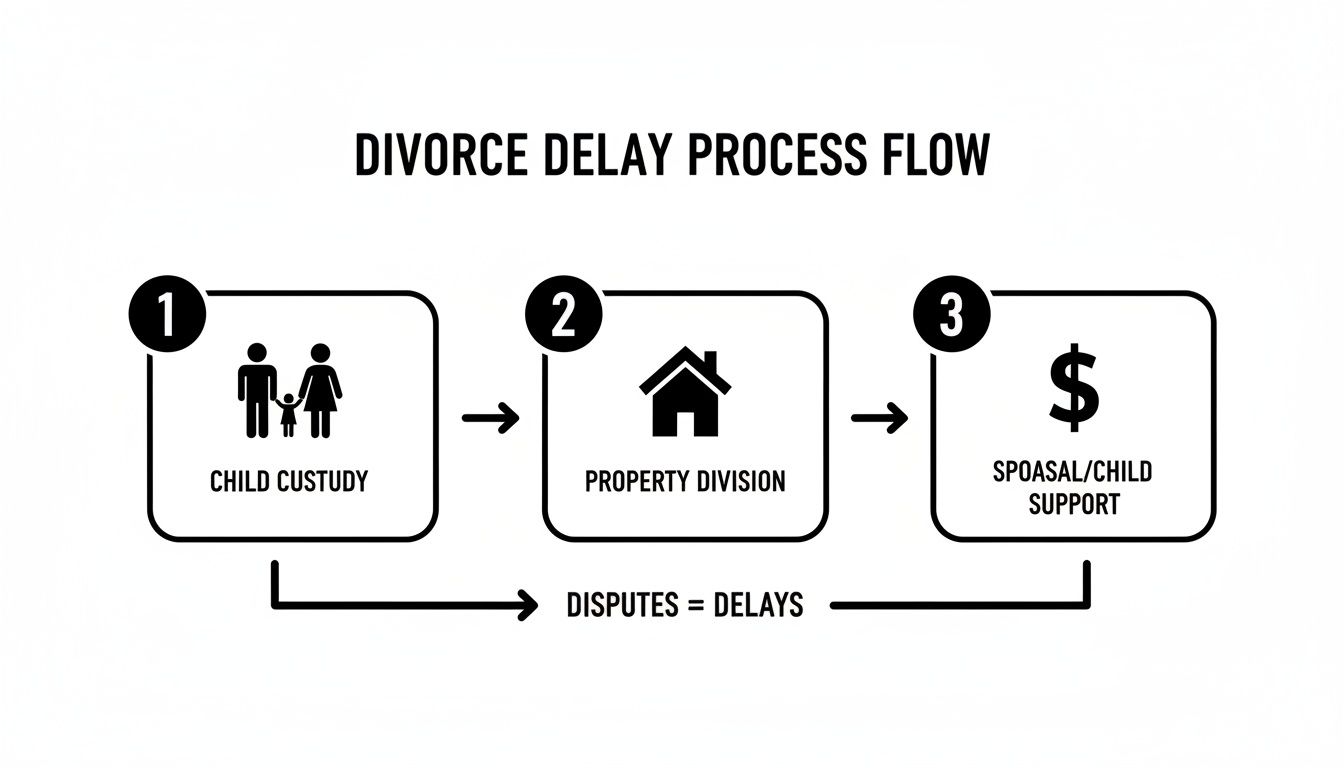
As the chart highlights, disagreements in any of these core areas can significantly extend the timeline. In Texas, contested cases involving difficult custody disputes or complex asset division typically take anywhere from 9 to 15 months to resolve.
Practical Steps to Help Speed Up Your Divorce
While you cannot control every aspect of your divorce timeline, you have more power than you might realize. Taking proactive, organized steps can smooth the process, reduce frustrating delays, and empower you to move forward with clarity.

These practical actions can minimize friction, save money on legal fees, and lower your stress levels, helping shorten the answer to “how long does a divorce take” in your specific situation.
Be Prepared with Your Financial Documents
One of the most time-consuming parts of a divorce is the discovery phase. You can get a significant head start by gathering key financial documents before the process even begins. Having everything organized and ready to go prevents delays and demonstrates that you are prepared to negotiate in good faith.
Start by creating a file with these essential documents:
- Income Information: Recent pay stubs and W-2s for both you and your spouse.
- Tax Returns: At least the last two to three years of federal income tax returns.
- Bank Statements: Statements for all checking, savings, and investment accounts from the past year.
- Property Deeds: Deeds for any real estate you own.
- Debt Information: Statements for mortgages, car loans, credit cards, and other outstanding debts.
Embrace a Business-Like Mindset
Divorce is deeply emotional, but approaching the negotiations with a practical, business-like mindset can prevent unnecessary conflict. This means separating the emotional decision to end the marriage from the financial decisions needed to start your new life. It keeps conversations focused on solutions, not past grievances.
An experienced family law attorney can be your greatest asset here. We act as a professional buffer, handling communication and negotiations to keep the process productive and prevent emotional reactions from derailing progress.
This approach is about channeling your energy toward a constructive outcome. Focus on what is fair and workable for your future, not on settling old scores.
Be Open to Compromise
In a contested divorce, refusing to compromise on every issue is a surefire way to prolong the timeline and increase legal fees. It is helpful to identify what matters most to you and where you might have some flexibility. Is keeping the family home your top priority, or is securing a larger portion of the retirement accounts more important for your long-term stability?
Knowing your non-negotiables allows you to compromise on less critical issues, which often builds goodwill and encourages your spouse to do the same. This give-and-take is the foundation of any successful settlement. Uncontested divorces can conclude in as little as 60 days, but contested cases often stretch 6-12 months. The emotional toll is significant, especially in custody battles, but mediation offers a faster path, with about 70% of cases resolving before trial. You can discover more insights about these divorce statistics and how cooperation helps. By being willing to negotiate, you can steer your case toward a much faster resolution.
Common Questions About Texas Divorce Timelines
Even with a clear understanding of the process, it’s normal to have specific questions about your situation. Getting straightforward answers can help you feel more confident and in control.
Here is some practical guidance on the questions we hear most often from our clients.
Does It Matter Who Files for Divorce First in Texas?
Legally, there is no inherent advantage in being the Petitioner (the one who files) versus the Respondent (the one who responds). A judge will not decide property division or child custody based on who initiated the case.
From a practical standpoint, however, there are minor considerations. The Petitioner pays the initial court filing fee and, in a trial, presents their case first. Filing first can also set the initial pace and tone for the divorce, providing a small sense of control over the proceedings.
Can We Get Divorced in Texas If We Were Married Elsewhere?
Yes. Where you were married has no bearing on where you can file for divorce. What matters is residency.
To file for divorce in Texas, the Texas Family Code requires that at least one spouse has:
- Lived in Texas for at least the last six months.
- Lived in the specific county where you plan to file for at least the last 90 days.
As long as you meet these residency requirements, you can file your divorce petition in a Texas court, regardless of where your marriage took place.
What Is a Default Divorce and Is It Faster?
A default divorce occurs when one spouse files and properly serves the other with the lawsuit, but the other spouse never files a formal response or appears in court. Because there is no negotiation, this process can be faster than a contested divorce.
However, faster is not always better. In a default judgment, the judge makes final decisions based only on the evidence presented by the filing spouse. This can easily result in a one-sided outcome that is not fair to the non-responding party. It is always in your best interest for both spouses to participate to ensure the final decree is just and equitable.
While a default judgment can finalize a divorce quickly, it often comes at the cost of fairness. A truly equitable resolution requires both parties to have their voices heard and their rights protected.
How Do Court Backlogs Affect My Divorce Timeline?
Court dockets in major metropolitan areas can be congested, which may cause delays in scheduling hearings or trial dates. A backed-up court calendar is an external factor that can unfortunately extend your divorce timeline.
This is where an experienced local attorney provides significant value. A lawyer familiar with the local court system can manage deadlines and proactively keep your case moving forward. More importantly, we can utilize powerful alternatives like mediation to help you reach a settlement, often allowing you to bypass the need for a court date and minimize the impact of court backlogs.
If you need help navigating divorce, custody, or estate planning in Texas, contact The Law Office of Bryan Fagan today for a free consultation.