
Divorce can be one of life’s most difficult transitions—but understanding your rights under Texas law can make it less overwhelming. When people start asking, "how much is spousal support in Texas," they quickly learn there's no single magic number. Instead, Texas law provides a clear framework, capping any court-ordered payments at the lesser of $5,000 per month or 20% of the paying spouse's average monthly gross income.
Your First Questions About Spousal Support in Texas
While those legal caps provide a ceiling, the final amount you might receive—or pay—is rarely that straightforward. A judge's decision hinges on the unique, specific facts of your life and your marriage. Getting a handle on the complete picture is the first step toward finding some clarity during this challenging time.
Think of this guide as your roadmap. We’ll walk you through every piece of the spousal support puzzle, from proving you're eligible in the first place to understanding how a court lands on its final decision. Our goal is to empower you with the knowledge you need to plan for your financial future.
What Is Spousal Maintenance?
In Texas, the official term a court uses for this type of support is spousal maintenance. It’s designed to be temporary financial assistance for a spouse who doesn't have enough property or income to meet their "minimum reasonable needs" after the divorce is final. It isn't meant to be a permanent paycheck or a way to punish one spouse. It's a bridge. The goal is to give the receiving spouse some breathing room while they get the training or find the job needed to stand on their own two feet.
The core purpose of spousal maintenance in Texas is rehabilitative. It's designed to give a lower-earning spouse a fair chance to get back on their feet financially after the marriage ends.
Key Factors That Influence the Amount
Several critical elements come into play when a judge has to decide on a final support figure. It’s essential to understand these, as they form the foundation of any potential award.
- Length of the Marriage: To even be eligible, the marriage typically needs to have lasted at least 10 years. The duration of the marriage also directly influences how long payments can continue.
- Financial Need vs. Ability to Pay: The court will perform a careful balancing act, weighing the requesting spouse's proven financial needs against the other spouse's ability to provide that support.
- Earning Potential: A judge looks at the whole person—considering the education, age, health, and work history of both spouses to determine what each is capable of earning now and in the future.
If you're trying to sort out the differences between court-ordered support and private agreements between spouses, you might find our article explaining spousal support, spousal maintenance, and alimony in Texas helpful.
Understanding Your Eligibility for Spousal Maintenance
Before we even get to the numbers, we have to tackle the first and most important question: are you even eligible for spousal maintenance in Texas? Many people assume support is a given, especially if one spouse stayed home to raise the children. That’s a common and costly misconception.
The reality is that Texas law sets a very specific, and high, bar for eligibility. You can’t just ask for it; you have to prove you meet one of the strict legal pathways. Understanding these rules is the critical first step in building a case for the financial stability you need to move forward.
The 10-Year Marriage Rule
The most common way to qualify for spousal maintenance hinges on the length of your marriage. Under the Texas Family Code, a judge can consider awarding support if you can show two things are true:
- You were married for 10 years or longer.
- You lack the ability to earn enough income to provide for your “minimum reasonable needs.”
But that’s not all. The court will also want to see that you’ve been trying your best to earn an income or get the skills you need to support yourself while the divorce is pending. This diligence requirement gets to the heart of Texas law: spousal maintenance is seen as a temporary bridge to self-sufficiency, not a permanent arrangement.
A Common Scenario For Eligibility
Think of a spouse who put their career on hold 15 years ago to manage the household and raise the children, allowing the other spouse to climb the corporate ladder. Now, facing divorce, they have a massive gap in their resume and skills that are no longer current.
This is a classic example of who spousal maintenance is designed for. They clearly meet the 10-year marriage rule. The next step would be to show the court that, despite their best efforts, they can't land a job that covers basic living expenses like a mortgage, utilities, and groceries.
This decision tree gives you a visual guide to the main paths for establishing eligibility in Texas.
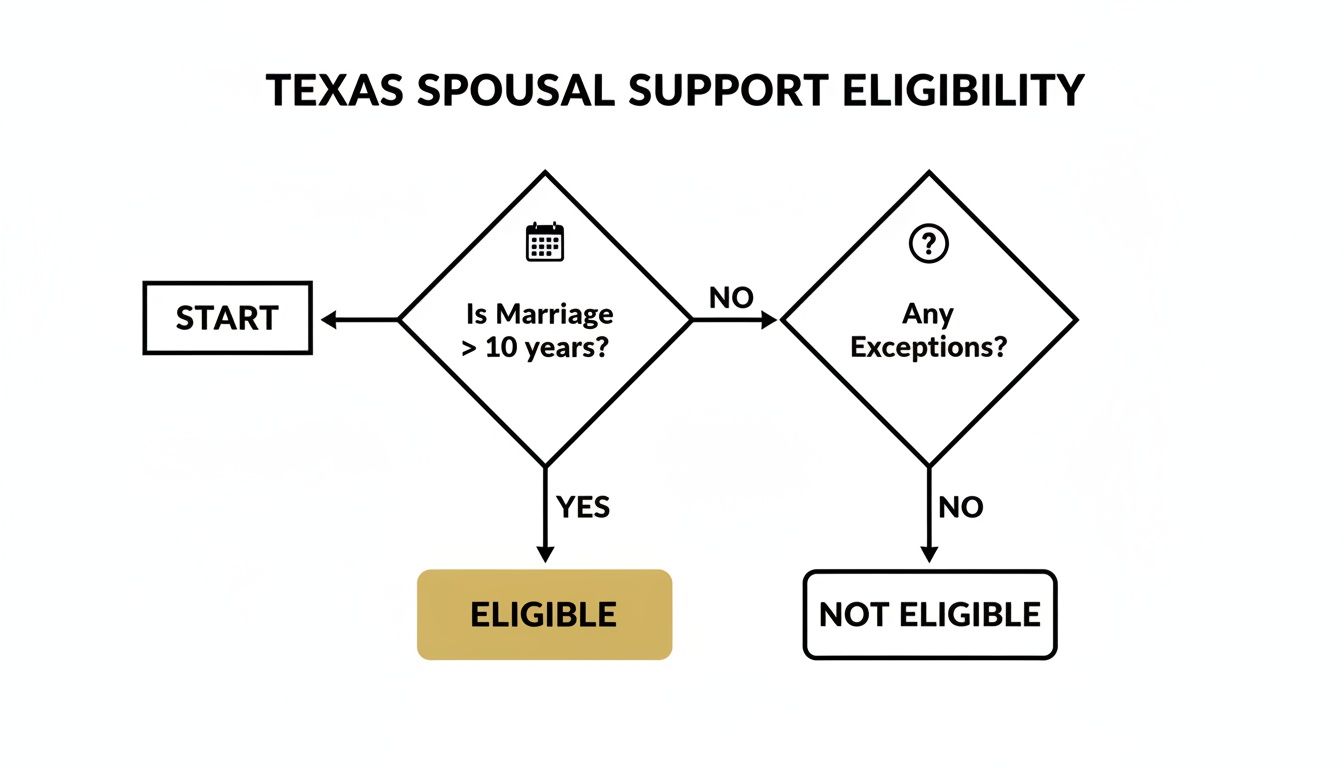
As you can see, the 10-year rule is the main road, but it’s not the only one.
Important Exceptions to the 10-Year Rule
Texas law understands that life doesn't always fit into a neat, 10-year box. There are crucial exceptions for spouses who are unable to support themselves due to specific, serious circumstances, regardless of how long they were married.
You may still be eligible for maintenance if you can't provide for your minimum reasonable needs and one of the following situations applies to you:
- Family Violence: Your spouse committed an act of family violence against you or your child within two years of filing for divorce (or during the divorce proceedings).
- Incapacitating Disability: You have a physical or mental disability that is so severe it prevents you from earning enough to live on.
- Care of a Disabled Child: You are the primary caregiver for a child of the marriage (of any age) who has a disability requiring such substantial care that it keeps you from working.
These exceptions create a safety net for situations where a spouse's inability to work isn't tied to the length of the marriage but to other significant life challenges.
If you’re wondering about post-divorce orders, our article on whether spousal maintenance can be ordered after a divorce offers a detailed explanation.
Calculating the Maximum Spousal Support Payment
Once you’ve cleared the hurdle of eligibility for spousal maintenance, the next question on everyone’s mind is, "How much can I actually get?" This is where a lot of uncertainty can creep in, but thankfully, Texas law provides a very clear, firm cap.
Knowing this upper limit is crucial for both the paying and receiving spouse. It helps set realistic financial expectations from the very beginning.

The Texas Family Code lays out a straightforward, two-part rule to calculate the absolute maximum amount of court-ordered spousal maintenance. A judge simply cannot award an amount that goes over the lesser of these two figures:
- $5,000 per month
- 20% of the paying spouse's average monthly gross income
This dual-cap system creates a hard ceiling on any maintenance award. Let's break down exactly how it works in the real world.
Understanding the "Lesser Of" Rule
That little phrase, "the lesser of," is the key to the whole calculation. It means the court must figure out 20% of the paying spouse's gross monthly income and then compare that number to the $5,000 statutory limit. The maximum possible award will always be whichever of those two numbers is smaller.
For example, imagine the higher-earning spouse brings in $15,000 in gross income each month. The math is simple: $15,000 x 0.20 = $3,000.
Since $3,000 is less than the $5,000 cap, the absolute most a judge could order in spousal maintenance here is $3,000 per month. This rule keeps the support obligation proportional to the paying spouse's income, especially at lower and middle-income levels.
When the $5,000 Statutory Cap Kicks In
So, what happens with a higher income? Let's say the paying spouse earns $30,000 a month. The 20% calculation looks very different now. In this case, $30,000 x 0.20 = $6,000.
But the law still requires the court to award the "lesser of" the two figures. Because $5,000 is less than $6,000, the $5,000 statutory cap takes over. The absolute maximum maintenance award is $5,000 per month, no matter how much higher the paying spouse's income goes.
This dual-limitation system is a core part of Texas spousal support law. It creates a predictable ceiling that applies regardless of how high a spouse's earnings climb, which is vital for financial planning during a divorce.
To see how this plays out at different income levels, the table below illustrates where the 20% rule applies versus where the $5,000 cap takes over.
Texas Spousal Maintenance Cap Examples
| Payor's Gross Monthly Income | 20% of Gross Income | Statutory Cap ($5,000) | Maximum Possible Monthly Maintenance |
|---|---|---|---|
| $10,000 | $2,000 | $5,000 | $2,000 |
| $20,000 | $4,000 | $5,000 | $4,000 |
| $25,000 | $5,000 | $5,000 | $5,000 |
| $40,000 | $8,000 | $5,000 | $5,000 |
As you can see, the $25,000 monthly income mark is the tipping point. Below that, the 20% rule dictates the maximum award. At or above that amount, the $5,000 statutory cap will always be the limit.
It is absolutely critical to remember that this calculation only sets the maximum possible award. The final amount a judge orders could be—and often is—lower than this ceiling. The judge's next job is to look at a long list of statutory factors to decide the actual amount and duration of the payments, which we'll dive into in the next section.
How Judges Determine the Final Support Amount and Duration
Just because you meet the eligibility rules and know the statutory payment caps doesn't mean you automatically get a check. The final amount and duration of spousal maintenance aren't decided by a simple formula. Instead, a judge must carefully weigh a long list of factors laid out in the Texas Family Code. This is where the specific facts of your marriage become the most important part of the puzzle.
Think of it less like a math problem and more like a balancing act. The judge’s goal is to land on an order that feels “just and right” after looking at the complete picture of your life together.

Key Factors the Court Will Consider
Under Texas Family Code § 8.052, a judge has to consider "all relevant factors," including a specific list meant to guide their decision. These factors make sure the final order is tailored to your family's reality, not a one-size-fits-all solution.
Let's break down the most significant ones:
- Financial Resources of Each Spouse: The court starts by looking at the property and money each spouse will have after the divorce is final, including their separate property. When you're untangling finances, big decisions like selling a house during divorce can have a major impact on this part of the calculation.
- Education and Employment Skills: A judge will compare the education, job skills, and work history of both spouses. Someone with a recent MBA has a very different earning potential than a spouse who has been out of the workforce for 20 years to raise a family.
- Time Needed for Self-Sufficiency: The court also looks at how long it would realistically take the requesting spouse to get the education or training needed to earn enough to support themselves.
Contributions, Health, and Misconduct
Beyond the raw numbers, a judge digs deeper into the marriage itself to figure out what is truly fair. This means looking at both the good and the bad.
- Contributions as a Homemaker: The law specifically recognizes the value of a spouse's work managing the household and raising children. This non-financial contribution directly enabled the other spouse to build their career, and courts give that real weight.
- Age, Health, and Emotional Condition: The requesting spouse's age and physical and emotional health are critical. A spouse with a chronic illness that limits their ability to work is in a completely different boat than a healthy spouse of the same age.
- Marital Misconduct: A judge can consider bad acts by either spouse, like adultery, cruelty, or wasting community money. Proof of misconduct can absolutely influence the amount and duration of a maintenance award, sometimes pushing a judge to award more money or for a longer time than they otherwise would.
Imagine two couples, both with 15-year marriages and similar incomes. In one divorce, both spouses are healthy and employed. In the other, one spouse has a disability and was the victim of documented marital cruelty. The spousal support outcomes will almost certainly be worlds apart because the judge has to weigh these critical factors.
Connecting Factors to the Duration of Payments
These factors don't just set the monthly payment; they also directly influence how long those payments will last. Texas law puts strict caps on the duration of spousal maintenance, and those limits are tied directly to how long you were married.
- 5 Years of Support: For marriages lasting at least 10 years but less than 20 years.
- 7 Years of Support: For marriages lasting 20 years but less than 30 years.
- 10 Years of Support: For marriages lasting 30 years or more.
A judge uses all the factors we've discussed to decide where within these maximum timeframes your award should fall. The goal is always to provide a temporary, rehabilitative bridge to financial independence—not a permanent paycheck.
What a Typical Spousal Support Award Looks Like in Texas
One of the biggest disconnects in Texas divorce cases happens between what the law allows for spousal maintenance and what a judge actually orders. The law sets a clear ceiling: the lesser of $5,000 a month or 20% of the paying spouse's average gross income. But in reality, the final number is almost always much lower.
This is where legal theory crashes into real-world courtroom practice. Managing your financial expectations from the start is one of the most important things you can do to navigate your divorce successfully.
The numbers tell a crucial story. While national alimony statistics from 2026 show an average payment of around $1,680 per month, the average in Texas is noticeably lower, hovering closer to $1,200 monthly. This isn't an accident. It reflects the unique and limited purpose of spousal support in this state. If you want to dive deeper into the data, you can explore how understanding alimony statistics helps set realistic expectations for your own case.
This gap between the maximum allowed and the typical award often catches people by surprise. So, why is the average so far below the statutory cap? It all comes down to the core philosophy behind spousal maintenance in Texas.
The Focus on “Minimum Reasonable Needs”
A Texas judge’s primary goal is not to equalize incomes or preserve the lifestyle you had during the marriage. Instead, the court is focused on a much more limited and practical goal: making sure the receiving spouse can cover their “minimum reasonable needs.”
This term is intentionally flexible, but it generally refers to the basic costs of living. Think of it as a bare-bones survival budget. This typically includes:
- Housing (rent or mortgage payment)
- Utilities (water, electricity, gas)
- Food
- Transportation (a car payment, gas, and insurance)
- Necessary medical expenses and health insurance
A judge will expect the spouse asking for support to present a detailed budget proving what these essential needs actually cost. The court’s job is then to award just enough to fill the gap between what that spouse can earn on their own and what it costs to cover those basic needs.
Spousal maintenance is designed as a rehabilitative tool, not a lottery ticket. Its purpose is to provide a temporary safety net, giving a spouse the time and resources needed to get back on their feet, re-enter the workforce, or upgrade their skills to become self-sufficient.
A Sobering but Essential Perspective
This rehabilitative mindset is exactly why the average award is closer to $1,200 than $5,000. The court isn't trying to fund a comfortable lifestyle; it’s trying to prevent financial destitution while encouraging the receiving spouse to become self-supporting as quickly as possible.
Internalizing this from the beginning is one of the most powerful things you can do to prepare for your financial future. It allows you to plan realistically, whether you're the one expecting to receive support or the one who might be ordered to pay it. This perspective helps shift the focus from what might be possible under the law to what is probable in a Texas courtroom.
How to Modify or End Spousal Support Payments
A common question we hear is whether a spousal maintenance order is permanent. The answer is no. A divorce decree isn't the final word on support. Life happens, and Texas law gets that. Circumstances can, and often do, change for both spouses long after the divorce is finalized.
Think of a court order for spousal support as a snapshot in time, not a life sentence. Under the right conditions, those payments can be adjusted or even stopped completely. Knowing how and when this can happen is key to managing your financial future, whether you're the one paying or the one receiving support.
Modifying Payments Due to a Material and Substantial Change
If you want to change a court-ordered spousal maintenance payment, you can’t just ask the judge because you feel it’s unfair. You have to prove there has been a “material and substantial change” in either spouse's circumstances. This is the legal yardstick a judge uses to decide whether to increase, decrease, or terminate the payments.
So, what does “material and substantial” actually mean? The law doesn’t have a rigid definition, which allows for flexibility. It generally refers to significant, often unforeseen, life events that throw the original financial balance out of whack.
- For the paying spouse: An involuntary job loss, a major pay cut, or a serious illness that prevents them from working could all qualify. It has to be something significant and usually out of their control.
- For the receiving spouse: Getting a big promotion with a hefty raise, receiving a large inheritance, or landing a new job that allows them to fully support themselves could all justify reducing or stopping the payments.
Keep in mind, a minor bump or dip in income probably won't be enough. The change has to be significant enough to make the original order no longer fair or appropriate.
Automatic Termination of Spousal Support
While changing support usually means going back to court, Texas law also has a few built-in "off switches." Certain events will automatically terminate the obligation to pay court-ordered spousal maintenance, no new court order needed.
According to Chapter 8 of the Texas Family Code, the payments stop cold if:
- Either the paying or receiving spouse dies. The obligation doesn't pass to the paying spouse's estate, and the right to receive it doesn't pass to the recipient's heirs.
- The receiving spouse remarries. The support obligation ends automatically on the date of the new marriage.
- The receiving spouse cohabitates with a romantic partner. This is a big one. It means the recipient starts living permanently with another person in a "dating or romantic relationship" on a continuing basis.
The cohabitation rule is absolutely critical to understand. If the paying spouse can prove the recipient is living with a new romantic partner, a judge must terminate the spousal maintenance order. The paying spouse's obligation to make payments ends right then and there.
These automatic-end events are essential for both sides to know. For a deeper dive, you can learn more about how spousal maintenance can be terminated or modified in Texas in our related article. This knowledge helps clarify your long-term rights and ensures you aren't paying—or depending on—support that is no longer legally required.
Frequently Asked Questions About Texas Spousal Support
Even after reading a comprehensive guide, it’s normal to have specific questions about how all this applies to your life. We get it. Every family's situation is different, and you need direct answers to the questions keeping you up at night.
This section tackles some of the most common concerns and myths we hear from clients every day. Our goal is to cut through the legal jargon and give you the clarity you need to move forward.
Can I get spousal support if my marriage was less than 10 years?
Most people believe a 10-year marriage is a hard-and-fast rule for getting court-ordered spousal maintenance in Texas. While that’s the general baseline, many are surprised to learn the law includes critical exceptions for when that rule would be unjust.
You might still qualify for spousal maintenance in a shorter marriage if one of these situations applies to you:
- Family Violence: Your spouse committed an act of family violence against you or your child, and it happened within two years of filing for divorce or while the divorce was pending.
- Disability: You have an incapacitating physical or mental disability that keeps you from earning enough to meet your basic, reasonable needs.
- Caring for a Disabled Child: You are the primary caregiver for a child of the marriage who has a disability requiring so much personal care that it prevents you from holding a job.
Is spousal support taxable in Texas?
This is a huge financial question, and the answer changed significantly a few years ago. For any divorce finalized after December 31, 2018, the tax rules are completely different than they used to be.
Under the federal Tax Cuts and Jobs Act of 2017, the law is now very clear:
- Spousal support payments are not tax-deductible for the person who pays them.
- The payments are not considered taxable income for the person who receives them.
This is a massive shift that dramatically impacts negotiations. Both spouses have to understand the true, post-tax value of any support agreement before signing on the dotted line.
What is the difference between alimony and spousal maintenance?
People throw these terms around like they mean the same thing, but in Texas law, they are worlds apart. Confusing them can have serious consequences for your financial future.
“Spousal Maintenance” is the official term for court-ordered support. It's strictly governed by the Texas Family Code, which means it comes with tough eligibility rules, caps on how much can be paid, and firm limits on how long payments last. Enforcement is handled directly through the family court system.
On the other hand, “Contractual Alimony” is something spouses agree to on their own as part of a private contract in their divorce settlement. This type of support is far more flexible—it isn’t tied to the state’s rigid eligibility requirements or payment caps. The trade-off? It’s enforced like any other contract, which means if your ex stops paying, you have to file a civil lawsuit for breach of contract, not a simple enforcement action in family court. That difference can change everything when it comes to getting the money you are owed.
If you need help navigating divorce, custody, or estate planning in Texas, contact The Law Office of Bryan Fagan today for a free consultation.