
A few years after divorce, many people find themselves in a bind. The schedule that once worked no longer fits a child's school routine. Support was set when one parent had a different job. A move across town has turned exchanges into a weekly source of stress. If that's where you are, the problem usually isn't that anyone failed. It's that life kept moving.
Texas law recognizes that reality. A final decree is meant to create stability, but it isn't always meant to stay frozen forever. When important circumstances have changed, a court can modify parts of the order so it better reflects your family's current situation. That can involve child custody, visitation, child support, and in some situations, spousal maintenance.
For many families, divorce modification texas issues arise long after the hardest part of the divorce is over. And that's normal. Texas divorce patterns have shifted over time. The state's divorce rate is 2.1 per 1,000 residents, down from 5.5 per 1,000 in 1990, according to Texas divorce and custody statistics. Fewer divorces doesn't mean fewer post-divorce problems. It often means families are dealing with new needs later, after jobs change, children grow, and finances shift.
Life Changes and So Can Your Divorce Decree
A decree can look complete on the day it's signed and still become outdated later.
A parent might take a new job with a different schedule. A child who once did well with frequent exchanges may start struggling once middle school activities increase. Support may have been manageable when income was steady, but not after a layoff or a move to lower-paying work. These aren't unusual situations. They're the kinds of changes Texas courts see often in modification cases.

The most helpful way to view a modification is as a legal adjustment, not a personal failure. When an order no longer fits the facts on the ground, asking the court to update it can be the responsible move. In many cases, it protects the child, reduces conflict, and gives both parents clearer expectations.
Common situations that lead people back to court
Some patterns come up again and again:
- Work and income changes that affect child support or availability for parenting time
- Relocation issues when a move disrupts school, transportation, or access
- A child's changing needs involving academics, health care, or activities
- Persistent schedule problems when the original possession terms are no longer realistic
A modification works best when it solves a practical problem the current order no longer handles well.
The key point is simple. You are not automatically stuck with an order that no longer works. But you do need to use the proper legal process. Informal side agreements often create more trouble than they solve, especially when one parent later changes position.
The Legal Standard for a Texas Divorce Modification
Texas courts do not change orders just because one parent wants something different. The court needs a legal reason. For most post-divorce changes involving children, the standard comes from Texas Family Code § 156.101. The moving party must show a material and substantial change in circumstances, and for custody-related requests, the change must also be in the child's best interest.
In plain English, that means the facts have changed in a meaningful way since the last order was signed. Minor inconvenience usually isn't enough. A real shift in finances, parenting arrangements, health, schooling, or daily logistics may be.
What material and substantial change usually means
The phrase sounds technical, but judges are looking for something grounded in real life. A parent's reduced income can matter. A child's medical needs can matter. A long-running schedule that no longer reflects who cares for the child can matter. What doesn't work well is a complaint built on frustration alone, without records or a clear before-and-after story.
If substance use or mental health treatment is part of the family situation, it's also important to separate stigma from legal proof. Courts focus on safety, stability, compliance with orders, and the child's best interest. For readers dealing with treatment issues alongside court obligations, Tru Dallas Detox legal treatment guidance gives practical context on handling legal requirements while seeking care.
Modification standards in Texas family law
| Type of Order | Primary Legal Standard | Common Examples |
|---|---|---|
| Child custody or conservatorship | Material and substantial change, plus best interest of the child under Texas Family Code § 156.101 | A parent's work schedule changes, a child's needs evolve, one parent seeks a different primary arrangement |
| Child support | Material and substantial change, or eligibility under the three-year review rule recognized in Texas modification practice | Income drops, job loss, new lower-paying employment, increased child-related expenses |
| Spousal maintenance | The party asking for change must show facts supporting modification under the governing order and Texas Family Code maintenance principles | Serious illness, inability to work, or another major change affecting ability to pay or need |
What usually works and what usually does not
A strong modification request usually has three features:
- A clear change since the last order
- Documents that prove it
- A practical request the judge can enforce
A weak request often asks for broad relief without tying it to specific facts. “This schedule is hard” is not nearly as persuasive as school attendance records, a work schedule, messages about missed exchanges, or medical records showing new needs.
Practical rule: Before filing, compare life at the time of the last order with life now. If you can't explain that difference clearly in a few sentences, the court may struggle to see it too.
Applying for a Modification of Specific Orders
A parent gets a new job in Houston with overnight shifts. The current possession schedule was workable before, but now school drop-offs are missed, exchanges are tense, and the child is arriving late to class. Another parent loses steady income after a layoff and cannot keep up with the support amount in the decree. These are the kinds of facts that lead people back to court. The right request depends on the order you need to change and the proof you can put in front of a judge.
Child custody and visitation
Custody and visitation modifications rise or fall on details. Judges want to see how the proposed change would affect the child's routine, stability, school performance, medical care, and relationship with each parent. A parent's frustration matters far less than a clear plan supported by records.
Relocation cases show this clearly. A judge will usually focus on practical questions. Who gets the child ready for school now? How far is the move? What will the weekday schedule look like? Can the parents still handle exchanges without constant conflict? The stronger case usually includes calendars, school records, travel details, and a possession proposal the court can enter as a workable order.
Older children may have opinions about where they want to live. That can matter. It does not decide the case by itself. The court still looks at maturity, consistency, and whether the requested change serves the child's best interest.
Child support
Support cases are often more document-driven than custody disputes. If income changed, the court will expect reliable proof of what you earned before, what you earn now, and whether the change is temporary or likely to continue. If the order has been in place for several years, guideline support may also need to be reviewed against current numbers.
This is one area where clients sometimes hurt their own case by filing too early. A short dip in overtime or one slow month for a self-employed parent may not carry much weight. A sustained reduction in income, a job loss, or added health insurance and medical costs usually gives the court something concrete to evaluate.
Useful records often include:
- Recent pay stubs
- Tax returns
- Proof of health insurance costs
- Evidence of unemployment or job change
- Child-related medical or educational records if relevant
If you're dealing specifically with support proof, this guide to required evidence for Texas child support modifications is a practical companion to the court process.
An agreed support modification is usually faster and less expensive if both parents are working from accurate financial information. A contested case takes longer and often turns on whether the court believes the income evidence is complete.
Spousal maintenance
Spousal maintenance usually gets closer scrutiny because the original order was already based on need and ability to pay. To modify it, the party asking for the change should be ready to show a real shift in circumstances tied to those same issues. Common examples include serious illness, disability, job loss with lasting impact, or a meaningful change in the receiving spouse's financial need.
The wording of the existing decree matters here more than many people expect. Some orders leave little room for argument. Others create openings that are easy to miss if you do not compare the current facts to the exact terms of the order. A careful review before filing can save time, fees, and a weak request. This overview of the legal process for modifying spousal support in Texas can help you identify the issues to raise.
Judges tend to respond best to modification requests that are specific, supported by documents, and realistic to enforce. A focused request usually has more force than a long list of complaints.
The Modification Process from Start to Finish
A typical case starts after a real-life problem has already been building for months. A parent gets transferred to another city. A child's school issues keep getting worse under the current schedule. One spouse loses income and can no longer keep up with the support terms in the decree. At that point, the question is no longer whether life changed. The question is how to ask the court for a change in a way the judge can approve.
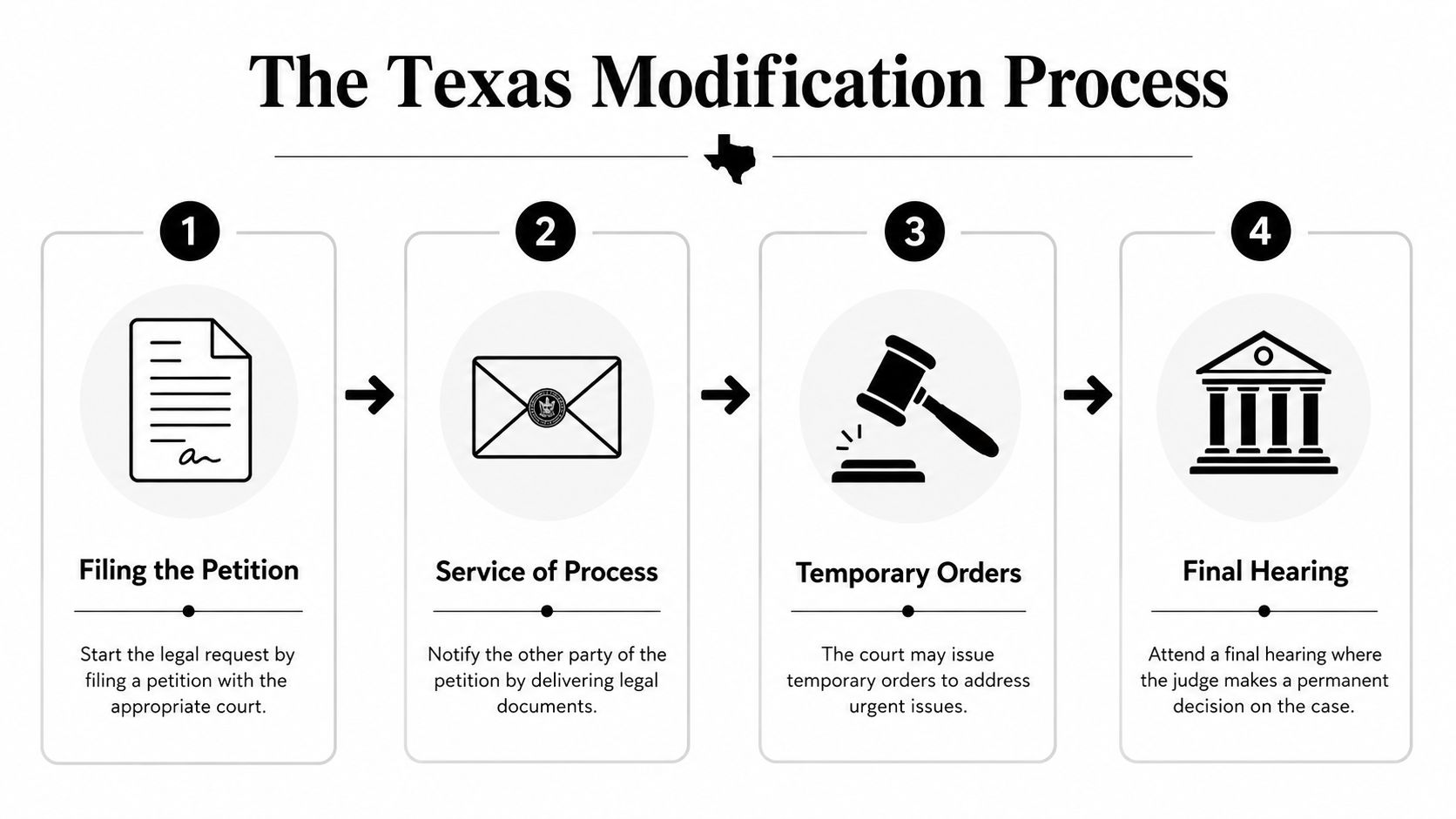
Filing the case
The process usually begins with a petition filed in the same court that signed the current order. In child-related cases, that is often a Petition to Modify the Parent-Child Relationship. The petition needs to do two jobs. It must explain what has materially changed, and it must tell the court exactly what new order you want.
Specific requests are easier to defend. If a parent wants a new exchange schedule, the petition should say what schedule works and why. If the issue is support, the request should tie the change to actual income, expenses, or needs. Vague filings create room for the other side to argue that nothing concrete is being requested.
For a broader explanation of how these cases are framed, this overview of what a divorce modification in Texas involves is a useful starting point.
Service and response
After filing, the other party must receive formal notice unless the case is fully agreed and service is waived properly. This step sounds routine, but mistakes here cause avoidable delay. I have seen otherwise solid cases lose momentum because service was handled late, served at the wrong address, or waived incorrectly.
The responding party then has a deadline to file an answer. Once both sides are officially in the case, the court can move the matter toward temporary orders, mediation, or a final hearing, depending on the county and the urgency of the issues.
Temporary orders can stabilize the situation
Some families can wait for a final result. Some cannot.
If the current order is causing immediate harm, a request for temporary orders may be appropriate. That can include temporary child support, a temporary possession schedule, temporary geographic restrictions, or other short-term relief while the case is pending. Judges usually want focused requests here. They are looking for a present problem that needs management now, not a preview of every complaint that may come up later.
This stage also helps clarify whether the case is likely to settle. In many modification cases, the actual disagreement is narrower than the initial filings suggest.
Agreed cases and contested cases follow different paths
An agreed modification is usually the shortest route. If both sides exchange accurate information early, lawyers can often draft revised orders without expensive motion practice or extensive discovery. The savings are not just financial. Agreed cases also reduce the strain that comes from fighting over parenting details or income records.
A contested case takes more work. One side may dispute whether circumstances changed. The disagreement may center on numbers, credibility, or whether the requested change serves the child's best interest. That difference matters because the strategy changes with it. In an agreed case, the focus is clean paperwork and enforceable language. In a contested case, the focus shifts to proof, witness preparation, and narrowing the dispute before the judge ever hears testimony.
Mediation often decides whether the case settles
Most Texas modification cases go to mediation before trial. Mediation gives both sides a structured chance to test proposals, compare risk, and decide whether settlement makes more sense than a hearing. Many cases resolve there, especially when both sides arrive with organized documents and a realistic sense of what the court is likely to do.
Preparation matters more than people expect. A party who walks into mediation with pay records, school records, calendars, and a workable proposal usually has more influence than a party who arrives with general complaints.
A few habits improve the chances of a productive mediation:
- Bring documents that support each request
- Decide in advance what you must keep and where you can compromise
- Keep the discussion tied to the child's routine, finances, or other measurable facts
- Expect negotiation, not total victory
Discovery and final hearing
If mediation does not produce a full agreement, the case moves into discovery and hearing preparation. Discovery can include requests for documents, written questions, subpoenas, and depositions when needed. In practice, this is often where the strength of each side's position becomes clear.
By the time of the final hearing, the judge is usually deciding a practical question. Does the evidence show enough change to justify modifying the existing order, and is the requested fix reasonable? The parties who do best are usually the ones who stay organized, answer direct questions directly, and offer a proposal the court can effectively enforce.
That is the full path. The shortest cases are the ones prepared well enough to settle early. The longest and most expensive cases are usually the ones filed before the facts, documents, and goals are fully thought through.
Gathering Evidence for a Successful Modification
A modification case is won or lost on proof. Judges hear competing stories every day. The side with a cleaner record usually has the stronger position.

What persuasive evidence actually looks like
Good evidence does more than support a claim. It tells a timeline the court can trust.
For support issues, that often means pay stubs, tax records, termination paperwork, or proof of a new position at different pay. For parenting disputes, it may include school attendance records, report cards, medical records, calendars showing who had the child, and text or email exchanges that confirm the routine that developed.
Some of the most persuasive exhibits are the least dramatic. A string of calm, dated messages can carry more weight than a long accusation. A school record can settle an argument that two parents have fought about for months.
Agreed cases and contested cases are different worlds
The path you choose matters. Verified data states that agreed modifications are approved over 95% of the time, while contested cases succeed about 50% to 60% of the time even with strong evidence, according to this Texas modification success-rate discussion.
That doesn't mean contested cases shouldn't be filed. Many should. It does mean you should be realistic. If the other parent is likely to oppose the request, the quality of your documentation becomes central.
If you want the court to believe the order should change, show the judge what changed, when it changed, and how the current order no longer fits.
The same verified guidance notes that proof a primary parent voluntarily relinquished care for six months or more can carry significant evidentiary weight in the right case. That's one reason lawyers often tell clients to preserve texts, emails, school contacts, and appointment records. They help establish who handled day-to-day parenting.
A short video can also help you think through the proof question from a practical angle:
Evidence mistakes that hurt good cases
Several problems show up often:
- Relying on memory instead of saved documents
- Submitting disorganized records that don't tell a sequence
- Focusing on old divorce grievances instead of current changes
- Using informal agreements that were never reduced to a signed court order
For clients who need help organizing records and framing a modification request, the Law Office of Bryan Fagan, PLLC handles petitions, responses, and evidence preparation in Texas family courts. Whether you work with counsel or prepare for early consultation, the most useful step is to gather records before conflict hardens.
Understanding Timelines Costs and Likely Outcomes
People usually want a straight answer about how long this will take and what it will cost. The honest answer is that timing depends heavily on whether the case is agreed or contested.
Timeline expectations
Verified guidance from Kimbrough Legal on Texas decree modification timing states there is typically a 60-day waiting period after filing before a final hearing can occur, although that can be waived in an agreed case. The same verified material states an uncontested, e-filed modification can be processed in under 90 days, while a contested case can take 12 to 18 months to reach trial.

That difference changes everything. An agreed update often moves briskly because the court mainly needs a proper filing, compliant paperwork, and an order the judge can sign. A contested case involves scheduling, negotiation, evidence exchange, mediation, and hearing preparation.
Cost trade-offs
The total expense of a modification usually comes from several moving parts:
- Court filing and service costs
- Mediation fees
- Attorney time if the case is contested
- Work missed to gather records, attend mediation, or appear in court
The biggest cost driver is conflict. If both parties agree on the core change, the process is typically faster, simpler, and less expensive. If they disagree on whether any change is justified, costs rise because the case requires more preparation and more court involvement.
Likely outcomes
A realistic outcome depends on two questions. First, can you prove a legally significant change? Second, does your requested solution fit the facts? Courts are most receptive to modifications that are specific, documented, and workable over time.
If your case is strong but narrow, that's often a good sign. Narrow requests usually give judges a cleaner path to relief than sweeping attempts to rewrite the entire post-divorce arrangement.
Frequently Asked Questions About Texas Modifications
Can we just agree between ourselves and skip court
You can agree informally, but informal agreements are risky. Until a judge signs a new order, the old order usually remains enforceable. If the other parent changes course later, the court will generally look to the signed order, not the side agreement.
Do I have to keep following the current order while the case is pending
Yes. In most situations, you must continue following the existing order until the court signs a modification or enters temporary orders that change it. Stopping support or changing possession on your own can damage your case.
What if the other parent moved out of Texas
A move doesn't automatically end the Texas court's authority. Interstate issues can become more complex, especially in custody cases, but the original Texas order still matters. Jurisdiction should be reviewed carefully before filing or responding.
Can I modify property division after divorce
Property division is treated differently from child-related orders. Many post-divorce modification cases focus on custody, visitation, support, and maintenance. If your concern is property language in the decree, the correct legal path may be different from a standard modification case.
Is mediation worth trying if things are tense
Usually, yes. High-conflict cases often benefit from a structured setting where each side can evaluate risk and possible compromise without a trial. Mediation is often where practical resolutions happen, even after months of disagreement.
If you need help navigating divorce, custody, or estate planning in Texas, contact Law Office of Bryan Fagan, PLLC today for a free consultation. A focused review of your current order, the changes in your life, and the evidence available can clarify whether a Texas modification is likely to succeed and what next step makes the most sense for your family.