
Divorce often starts with the same fear. You're not only worried about ending a marriage. You're worried about losing control of your schedule, your finances, your relationship with your children, and your privacy.
Many Texas clients come in expecting a courtroom fight because that's the version of divorce they've seen before. They picture hearings, accusations, and months of waiting for a judge to decide intensely personal issues. In many cases, that isn't the only path.
Mediation gives many families a quieter and more deliberate option. Instead of handing every major decision to the court, spouses work through the hard issues with a neutral mediator and their attorneys. That shift matters, especially when children are involved and the family has to keep functioning after the divorce is over.
A common scenario goes like this. One spouse is ready to file. The other is anxious, defensive, and already expecting the worst. Both are bracing for a legal war before the case has even taken shape.
That mindset usually makes everything harder. It increases conflict around possession schedules, property division, and day-to-day communication. When children are involved, the pressure multiplies. Nearly half of Texas divorces involve children under 18, which is one reason less adversarial methods can be so important for preserving workable co-parenting relationships, as noted in Texas divorce data and family trends.
Mediation changes the tone. It doesn't erase disagreement, but it gives disagreement structure. Instead of arguing through motions and court settings, you address the issues in a private setting built for negotiation.
For parents, that can be the difference between a plan that only exists on paper and one they can realistically live with. Tools outside the legal process can help too. If you're already thinking ahead to school pickups, holidays, and exchanges, this coparenting calendars guide is a practical resource for organizing life after separation.
Mediation works best when both spouses want a resolution more than they want a fight.
What Exactly Is Divorce Mediation in Texas?
Divorce mediation in Texas is a structured settlement process. A neutral third party helps spouses negotiate issues like property division, parenting terms, child support, and sometimes spousal maintenance. The mediator does not act as the judge and does not impose a ruling.
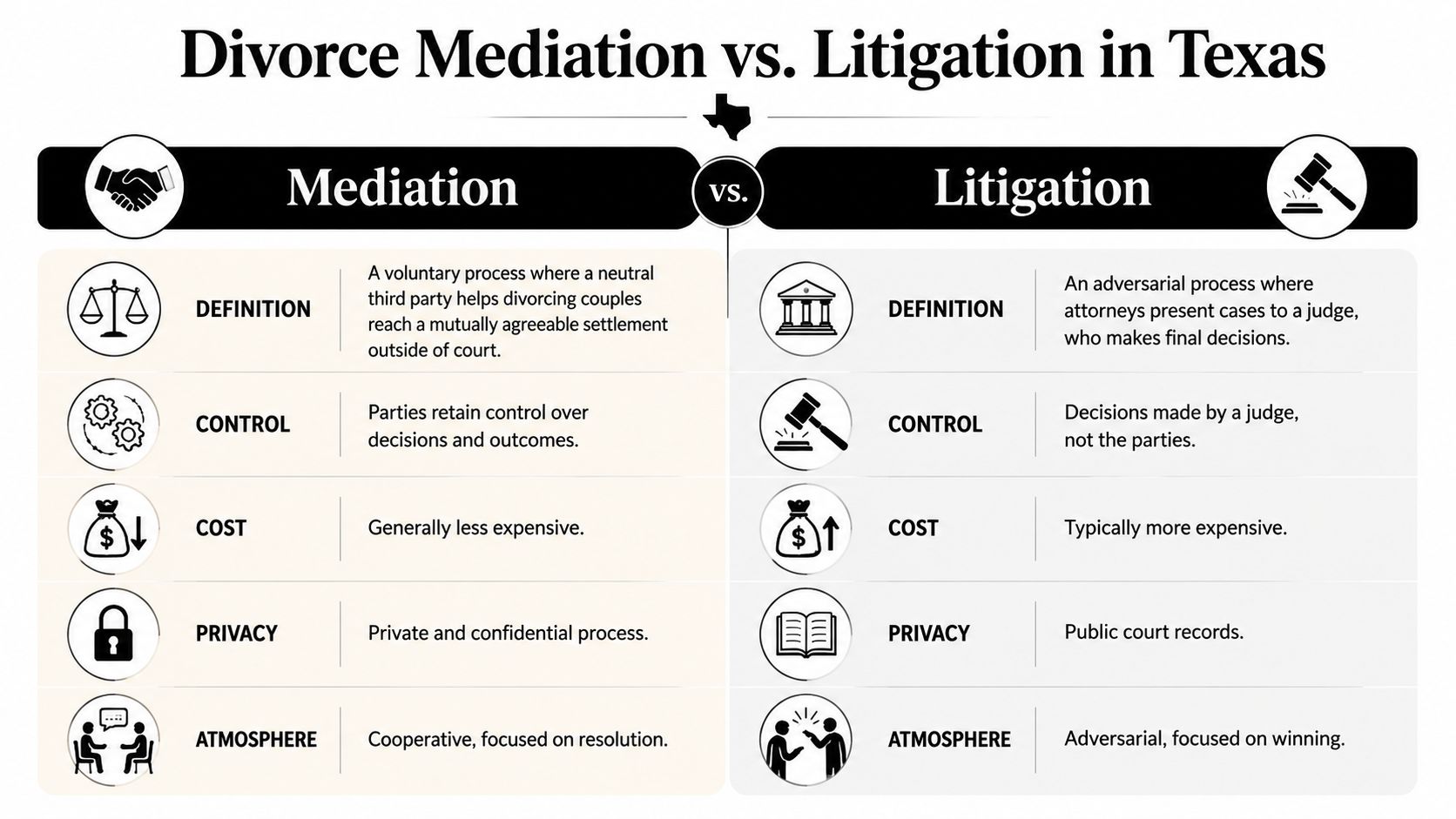
That distinction matters. In litigation, the court decides unresolved issues. In mediation, the parties keep decision-making authority unless they reach an impasse.
How mediation enters a Texas divorce case
Texas law recognizes mediation as a regular part of family court practice. Under Texas Family Code § 6.602, judges can send a divorce case to mediation at any point in the litigation process, from before temporary hearings to right before trial, as explained in this discussion of Texas court-ordered mediation timing.
That means there are two basic ways mediation starts:
Voluntarily
Spouses decide to mediate on their own, often before conflict escalates.By court order
The judge requires mediation as part of moving the case toward resolution.
This flexibility creates strategic choices. Early mediation can help a couple avoid spending time and money fighting over issues that may be resolved privately. Mid-case mediation can be useful after each side has more information. Late-stage mediation often happens when trial is approaching and both spouses want to avoid the uncertainty of a courtroom result.
How mediation differs from collaborative divorce and litigation
People often group these options together, but they are not the same.
- Mediation uses a neutral mediator to help the parties settle.
- Litigation relies on motions, hearings, discovery, and, if needed, a judge's final decision.
- Collaborative divorce is also settlement-focused, but it uses a distinct process and participation structure.
If your case includes business ownership, a complicated asset picture, or a dispute over parenting arrangements, mediation can still work. The key isn't whether the case is simple. The key is whether the process is being used strategically, with the right information and the right professionals at the table.
Practical rule: Mediation is not the absence of legal strategy. It is legal strategy in a private setting.
The Texas Divorce Mediation Process Step by Step
Most clients feel better about mediation once they know what the day looks like. The process is usually far less dramatic than people expect, but it still requires preparation and patience.

Step one: choose the right mediator
Not every mediator is the right fit for every divorce. Some are especially effective with custody disputes. Others are better suited for property-heavy cases, business interests, or high-conflict personalities.
Your attorney should help evaluate fit, not just availability. A mediator's style matters. Some are facilitative and patient. Others are more evaluative and direct. If you'd like a fuller breakdown of what happens behind the scenes, this guide on how mediation works in Texas divorce cases is a useful starting point.
Step two: exchange the information that matters
Mediation works when both sides negotiate from a real understanding of the facts. That usually means gathering core financial records, identifying separate and community property issues, and clarifying what temporary routines already exist for the children.
If one spouse owns a business, controls most of the accounts, or manages family finances, this stage becomes even more important. Hidden confusion is often more damaging than open disagreement.
A productive mediation file often includes:
- Financial records: tax returns, bank statements, retirement account information, debt summaries, and payroll documents.
- Property materials: deeds, mortgage statements, vehicle information, and records tied to investment or business interests.
- Parenting details: school schedules, medical needs, activity calendars, and any current possession routine.
Step three: start with joint discussion or separate rooms
Some mediations begin with everyone in one room. Others begin with immediate separation into private caucuses. Both approaches are normal.
In caucus-style mediation, the mediator moves between rooms and carries offers, concerns, and counterproposals back and forth. That setup often helps when emotions are high or communication has broken down.
Here's a short overview if you want to see the process described visually:
Step four: negotiate issue by issue
Good mediation usually doesn't resolve everything in a single sweep. It moves issue by issue.
A common order looks like this:
- Parenting and possession
- Child-related financial issues
- Division of major assets and debts
- Final clean-up terms
That order can change depending on the case. In some divorces, resolving a parenting dispute first opens the door to agreement on property. In others, financial certainty reduces tension and makes custody talks more realistic.
Step five: reduce the agreement to writing
If the parties reach a full or partial resolution, the settlement terms are drafted before anyone leaves. This part should never be rushed. A vague agreement causes problems later.
The mediator facilitates. Your attorney protects your interests by checking whether the language matches the deal you intended to make.
The Legal Power of a Mediated Settlement Agreement
A successful mediation does not end with a handshake. It ends with a Mediated Settlement Agreement, often called an MSA. In Texas, that document can carry real legal force when it satisfies the statutory requirements.
What makes an MSA binding
For an MSA to be legally binding in Texas, it must state that it is not subject to revocation, be signed by both spouses, and be signed by their attorneys if the attorneys were present during execution, as described in TexasLawHelp's explanation of mediation and divorce. The governing statutes are Texas Family Code § 6.602 and, in cases involving children, § 153.0071.
That requirement about revocation is not a technical footnote. It is one of the reasons mediation can produce durable outcomes. If the agreement is drafted properly, it becomes the blueprint for the final divorce decree.
Why this matters in real cases
Many people worry that mediation is “less official” than court. In practice, a properly executed MSA is often one of the strongest settlement tools in Texas family law.
That is especially important when negotiations cover:
- Custom possession schedules that don't fit a one-size-fits-all model
- Detailed property terms for retirement accounts, real estate, or reimbursements
- Business-related provisions tied to records, buyouts, or operational control
A strong MSA does two things at once. It settles the dispute and narrows the opportunity for second thoughts to become new litigation.
Where clients still need caution
Binding does not mean careless. The terms still need to be specific, lawful, and workable. If language is sloppy, the decree-drafting phase can become harder than it should be.
This is one reason experienced legal review matters during mediation itself, not only afterward. The goal is not just reaching a deal. The goal is reaching a deal that can be implemented without creating fresh conflict.
Comparing the Benefits and Costs of Mediation vs Litigation
Individuals evaluating divorce mediation texas often ask practical questions. How much will this cost? How public will it be? How much control will I keep?
The clearest starting point is cost. The average cost of divorce mediation in Texas ranges from $3,000 to $4,000 per person, while a contested divorce that goes to trial can cost tens of thousands, according to this discussion of Texas divorce mediation costs.
Mediation vs. Litigation at a Glance
| Factor | Divorce Mediation | Court Litigation |
|---|---|---|
| Decision-making | Spouses negotiate the outcome with help from a neutral mediator | A judge decides unresolved issues |
| Privacy | Private and confidential setting | Court filings and proceedings are more exposed |
| Cost | Average range of $3,000 to $4,000 per person in Texas | Can reach tens of thousands in a contested trial |
| Pace | Often moves according to the parties' readiness and preparation | Moves according to court calendars, hearings, and procedural deadlines |
| Tone | Settlement-focused | Adversarial by design |
| Flexibility | Allows tailored solutions | Limited by what the court can order |
Why timing changes the cost-benefit analysis
The timing of mediation influences negotiating positions. Early mediation can prevent expenses from compounding before they start. Mid-case mediation can be useful once each spouse has enough information to negotiate seriously. Late mediation may still work, but by then the parties have often already spent heavily on conflict.
If you want a deeper look at the trade-offs, this article on the cost-benefit analysis of mediation in Texas divorce cases is worth reviewing.
What mediation does better and what it doesn't
Mediation is usually the stronger option when both spouses can negotiate in good faith and the case needs privacy, flexibility, or a more stable co-parenting outcome. Litigation is often necessary when one spouse refuses to disclose information, ignores deadlines, or uses intimidation as a tactic.
That isn't a contradiction. It's how real family law works. The best process is the one that fits the facts you're dealing with, not the one that sounds the calmest on paper.
How to Prepare for a Successful Mediation
Preparation often determines whether mediation becomes productive or frustrating. The strongest sessions usually involve clients who know their documents, know their priorities, and understand where they have room to compromise.

Build your file before the session
Start with documents. Don't rely on memory if the issues involve accounts, debts, reimbursements, or property acquired during the marriage.
A practical preparation list includes:
- Income and tax records: recent tax returns, pay stubs, bonus information, and self-employment records if applicable.
- Asset records: statements for checking, savings, retirement, brokerage, and any property interests.
- Debt information: credit card balances, loans, and other liabilities that need allocation.
- Children's information: school routines, extracurricular schedules, medical details, and transportation realities.
For a more detailed planning worksheet, review this Texas divorce mediation checklist.
Know your priorities before offers start moving
Clients sometimes enter mediation knowing what they don't want, but not what they need. That creates drift.
Separate your issues into three categories:
Non-negotiables
These are terms you must protect.Preferred outcomes
These matter, but there may be more than one acceptable version.Tradeable items
These can be exchanged to resolve higher-priority issues.
Bring a written priority list. Mediation moves faster than people expect, and fatigue can blur judgment late in the day.
Prepare for strategy, not just compromise
Compromise is part of mediation, but blind compromise is not the goal. If your divorce involves a business, professional practice, unusual compensation structure, or separate property claims, preparation should include professional input and a clear negotiation plan.
In some cases, parties choose a mediator with financial experience or use neutral experts to help frame issues. The Law Office of Bryan Fagan, PLLC handles mediation matters in Texas involving divorce, custody, and property disputes, including cases where business ownership or complex asset division requires tighter preparation before the session begins.
Common Pitfalls That Can Derail a Mediation
Mediation can fail for reasons that have little to do with the legal merits of the case. More often, it stalls because someone enters the room unprepared, emotionally flooded, or determined to punish instead of solve.
One common mistake is negotiating from anger. Anger can be understandable, but it is expensive. It pushes people to reject workable terms because the other side proposed them.
Problems that show up in the room
The patterns below cause real trouble:
- Incomplete financial disclosure: if one spouse withholds records or gives vague answers, trust collapses and settlement becomes harder.
- Decision fatigue: late in the day, people become tempted to agree just to end the process.
- Power imbalance: one spouse may dominate because they controlled the money, the records, or the relationship dynamic.
- Position-based bargaining: repeating “I'm not moving” usually creates deadlock, not a negotiating advantage.
What usually works better
A productive strategy is to stay anchored to facts, not emotion. If something feels unfair, identify why in concrete terms. Is the valuation unsupported? Is the schedule unrealistic? Is the debt allocation uneven?
Another useful shift is pacing. Not every issue must be resolved instantly. Partial progress can still be valuable if it narrows the remaining disputes and protects you from making a rushed decision that you'll regret later.
If a proposal sounds acceptable only because you're exhausted, it probably needs another look.
Frequently Asked Questions About Divorce Mediation in Texas
Can mediation work in a high-net-worth divorce?
Yes, often it can. In high-net-worth Texas divorces, mediation is reported as successful in 85% of cases when neutral financial experts such as forensic accountants are involved, and those professionals can reduce disputes over business valuation by 40%, according to this discussion of alternative divorce methods in Texas high-asset cases. The key is using a process that matches the complexity of the estate.
What if we settle only part of the case?
That still helps. A partial agreement can narrow the issues that remain for the court and reduce the time spent litigating. In practice, even limited progress can improve the path forward.
Do I still need a lawyer if I'm mediating?
In most contested divorces, yes. The mediator is neutral. Your attorney advises you on risk, reviews proposals, and helps make sure the final language reflects the actual agreement.
Is mediation a good option if children are involved?
Often, yes, especially when parents need a plan they can live with after the case ends. Mediation allows more room for customized parenting solutions than a rigid winner-loser fight in court.
What if the other spouse won't be reasonable?
Mediation may still be worth attempting, but reasonableness matters. If someone refuses to disclose information, uses intimidation, or treats mediation as a delay tactic, litigation tools may be necessary to move the case forward.
If you need help navigating divorce, custody, or estate planning in Texas, contact Law Office of Bryan Fagan, PLLC today for a free consultation.