
A contested divorce in Texas usually takes 6 to 12 months from filing to final decree. If your case involves child custody disputes, complex property division, or a crowded court docket, it can take 18 to 24 months or longer.
If you are reading this during a difficult conversation, after being served papers, or while attempting to determine how to protect your children and finances, that range likely feels unsettling. That is normal. Individuals rarely need a perfect prediction. They require a realistic map, a clear sense of what happens next, and practical ways to avoid preventable delay.
A contested divorce texas timeline isn't one long blur. It usually moves through a series of identifiable stages. Some parts move quickly. Some feel slow because the court, the other side, or the financial facts need time to catch up. Knowing which is which helps you make better decisions and lowers the panic that comes from not knowing what the process is doing.
Mapping Your Journey Through a Contested Texas Divorce
You file for divorce expecting the process to start moving. Then the questions hit all at once. Who stays in the house. How are bills paid. What happens with the children next week. How long can this drag on if your spouse refuses to cooperate.
That pressure is real, and it helps to view a contested divorce as a series of phases with different goals, deadlines, and risks. The legal minimum waiting period in Texas matters, but it rarely reflects how long a highly disputed case takes to finish. Cases slow down for specific reasons. Property has to be traced. financial records have to be produced. Parenting disputes often require temporary schedules, evaluations, or court intervention before anyone can talk seriously about settlement.
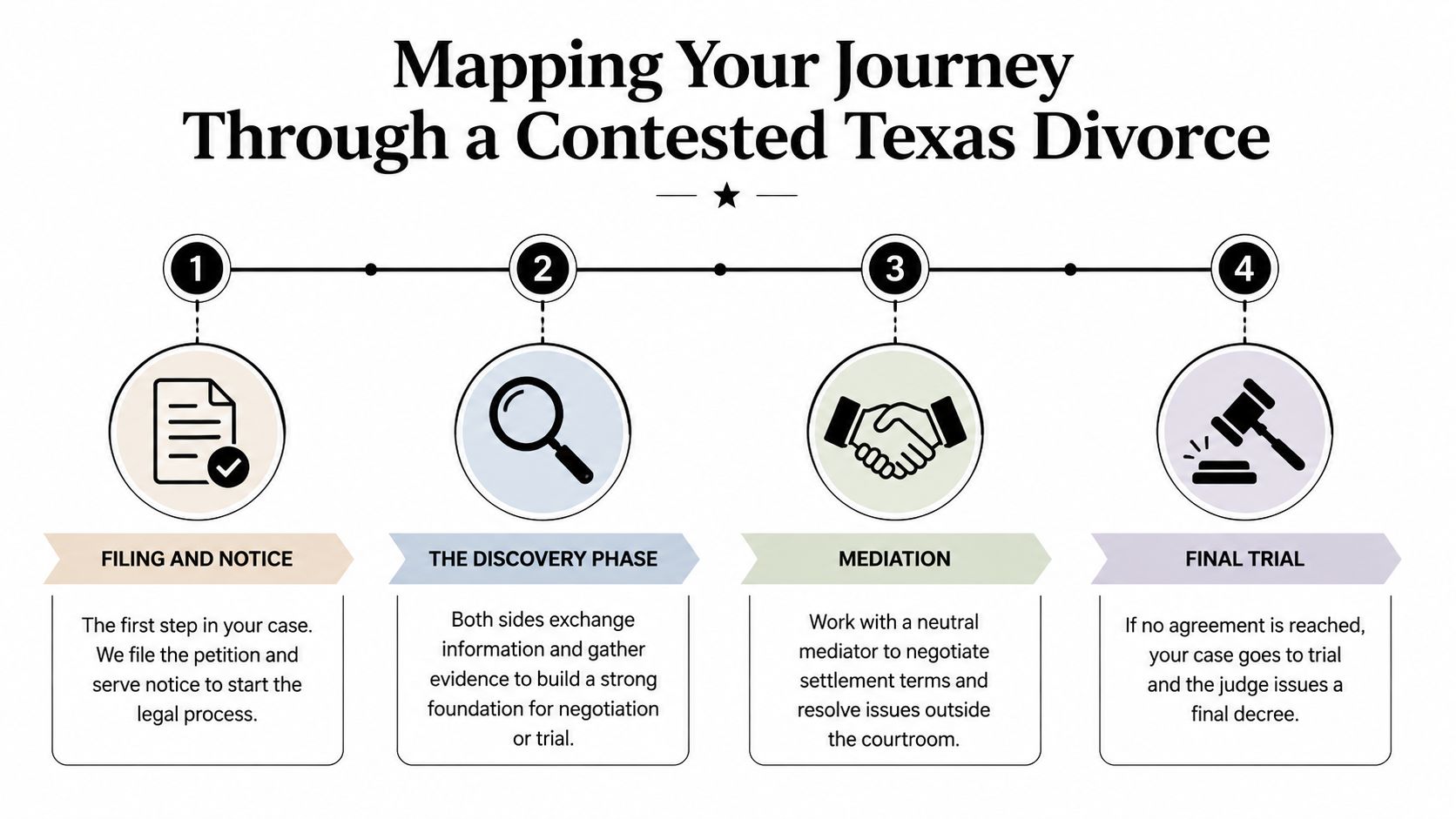
The four stages most clients move through
- Filing and notice. One spouse files the Original Petition for Divorce, and the other spouse is formally notified.
- Discovery. Both sides exchange information and documents so the facts are on the table.
- Mediation. The parties try to resolve disputed issues through structured negotiation.
- Trial. If settlement fails, a judge decides the unresolved issues.
The timeline usually depends less on the label "contested" and more on what is being fought about and how each side handles the case. A disagreement over one parenting provision may be resolved in months. A case involving a family business, separate property claims, hidden accounts, reimbursement issues, or a spouse who ignores deadlines can take much longer. Court congestion also matters, especially in larger counties.
This is also where clients can save time by being strategic early. Organized financial documents, realistic goals for temporary orders, prompt responses to discovery, and a willingness to mediate with good information in hand all reduce preventable delay. By contrast, informal side deals, incomplete disclosures, and angry text-message negotiations usually make the case slower and more expensive. One section of this article focuses specifically on those delay points and what you can do about them before they become expensive problems.
A lot of anxiety at the beginning centers on debt. Clients often ask whether a credit card balance, tax obligation, or personal loan will be treated as one spouse's problem or part of the marital estate. If that is one of your concerns, this overview on understanding debt in marriage is a helpful starting point.
If you want a broader overview of contested divorce in Texas, that resource pairs well with the phase-by-phase timeline below.
Phase 1 The First 90 Days Filing Service and Temporary Orders
The opening phase usually feels the most chaotic. It's new, personal, and urgent. You may still be living together, trying to manage children, or wondering whether bills will be paid next month. The law has a structure for that.
Filing starts the case
A divorce begins when one spouse files an Original Petition for Divorce with the court. In Texas, the divorce can't be finalized until at least 61 days after filing because of the state's mandatory 60-day waiting period. That waiting period begins on the filing date of the petition under the timeline discussion cited earlier in the article. It is a legal minimum, not a realistic expectation for a contested case.
After filing, the other spouse must be served unless service is waived. Service formally gives notice of the lawsuit and starts the clock for a response. If your spouse is angry, avoiding service, or suddenly cooperative and asking you to "just work it out privately," don't assume the paperwork can wait. Early process mistakes often create problems later.
Temporary orders create stability
For many families, the most important event in the first stretch of the case is the temporary orders hearing. Texas courts can enter temporary orders to govern the parties while the divorce is pending. Depending on the facts, those orders may address:
- Who stays in the house
- A temporary parenting schedule
- Temporary child support
- Use of bank accounts or payment of household bills
- Restrictions on selling property or hiding assets
Texas Family Code § 6.502 authorizes temporary orders designed to preserve property and protect the parties during the case. In practical terms, that means the court can set rules before the final decree is signed.
Consider a common example. One parent moves out, the children need consistency, and nobody agrees on who pays the mortgage or when the kids will be exchanged. Temporary orders don't solve the whole divorce, but they can stop daily life from becoming unmanageable.
Practical rule: If you need structure around children, finances, or the home, ask about temporary orders early instead of waiting for conflict to get worse.
These early rulings also shape each party's position. A temporary possession schedule can become the framework the court keeps following. Temporary financial orders can expose whether one party is being candid about income and expenses. If you want a closer look at what this hearing involves, review what happens at a Texas divorce temporary orders hearing.
What works in this phase
A few habits help immediately:
- Gather records fast. Tax returns, pay stubs, account statements, insurance information, and mortgage documents matter early.
- Keep communication brief. Text fights become exhibits.
- Define your immediate goals. Stability for the children and protection of finances usually matter more than winning every argument in month one.
What doesn't work is delay, informal side deals, or assuming the court will sort things out later without a paper trail.
Phase 2 The Discovery Process Uncovering the Facts
Discovery is where contested divorce stops being driven by assumptions and starts being driven by evidence. It is also where many timelines stretch.
Under the Texas discovery timeline described here, the discovery phase typically spans 3 to 8 months and is a primary bottleneck in contested divorce cases. That source also notes that non-cooperation can create 30 to 60 day delays per motion hearing, and 70% of extensions stem from incomplete disclosures. For anxious clients, that explains a lot of what feels like "nothing is happening." Often, something is happening. The lawyers are trying to force accurate information into the case.

What discovery usually includes
Discovery in Texas divorce cases is governed by Texas Rules of Civil Procedure 190 through 215. The tools are formal, and each serves a different purpose.
| Discovery tool | What it does | Why it matters |
|---|---|---|
| Interrogatories | Written questions one party must answer under oath | Helps identify accounts, property claims, and factual positions |
| Requests for production | Demands for documents such as bank statements, tax returns, and business records | Shows what exists on paper, not just what someone says |
| Requests for disclosure | Basic required information about claims, defenses, and witnesses | Clarifies the issues and evidence in dispute |
| Depositions | Sworn testimony taken before trial | Lets attorneys test credibility and pin down facts |
When clients hear "discovery," they often think only of paperwork. In reality, discovery is about control. The spouse who controls information often controls the pace of the case until the court steps in.
Why this phase causes delay
Some delays are normal. Financial institutions need time. Records need to be reviewed. Separate property claims may require tracing. But many delays are avoidable.
Common examples include:
- Partial disclosures that force repeated follow-up requests
- Missing business records when one spouse owns or manages a company
- Late document dumps just before a hearing or mediation
- Motions to compel when a party refuses to answer properly
If one spouse says, "I already gave them enough," but the records don't show income clearly, discovery isn't done. If someone insists a brokerage account is separate property without documentation, discovery isn't done. If a business owner mixes personal and company expenses, discovery gets more complicated fast.
In contested divorce, patience matters, but passive waiting doesn't. Good discovery is active, organized, and documented.
How clients can help their own case
Clients have more influence over this phase than they think. You can't force the other side to cooperate, but you can avoid becoming part of the problem.
- Answer your lawyer's document requests completely. Half-finished production invites the same scrutiny you're frustrated about receiving.
- Organize financial records by topic. Income, debt, real estate, retirement, and business records should be separated so review doesn't stall.
- Flag unusual transactions. Large withdrawals, transfers to relatives, cash payments, and account closures need context.
- Tell your lawyer about hidden issues early. If you suspect a second account, side business, or unreported compensation, waiting only makes the case harder.
For a deeper explanation of how this stage works, see the discovery phase of divorce.
Understanding and Mitigating Common Timeline Delays
A contested divorce usually slows down for predictable reasons. In my experience, the longest cases are rarely the result of one bad court date. They stretch because the property is harder to value, the parenting issues are harder to resolve, or one spouse refuses to participate in good faith.
That distinction matters. Some delays protect you from an unfair result. Others waste time, increase fees, and create pressure to settle on bad terms. A strong case strategy separates the two early.
Complex assets can add months for legitimate reasons
Cases involving a closely held business, executive compensation, multiple real estate holdings, oil and gas interests, deferred bonuses, or separate-property tracing take longer because the evidence takes longer to build. The court cannot divide what has not been identified, valued, and documented with enough precision to hold up under challenge.
According to this discussion of complex Dallas-area contested divorces, business ownership and substantial investment holdings often extend the case significantly while lawyers, appraisers, and forensic accountants sort out value and characterization issues.
That extra time is often justified. If a business is undervalued, if community funds were used to improve separate property, or if an account was mislabeled, a rushed resolution can be expensive to live with after the decree is signed.
Delay also comes from human behavior
Other timeline problems have less to do with complexity and more to do with conduct. A spouse may ignore deadlines, produce partial records, cancel mediation preparation, change positions repeatedly, or turn a parenting disagreement into a series of emergency disputes.
Those patterns create drag in several ways at once. Lawyers spend more time forcing basic compliance. Hearings get added. Settlement discussions become less productive because no one trusts the information on the table.
Texas Family Code § 7.001 requires the court to divide community property in a manner the court considers just and right. That gives the judge flexibility, but it also means disorganized evidence and shifting stories can cost both time and credibility.
What clients can do to reduce avoidable delay
Clients cannot control the court's docket or the other side's attitude. They can do a great deal to keep their own case from slipping.
- Identify complexity early. If there is a business, unusual compensation, inherited property, or a reimbursement claim, raise it at the start instead of hoping it stays small.
- Get documents into usable form. Sending 800 mixed files with unclear names slows review. Group records by asset, account, and year.
- Decide what matters. Fighting over every piece of furniture can distract from issues with lasting financial or parenting consequences.
- Respond quickly to lawyer requests. Delays often begin inside the file before they ever reach the courthouse.
- Keep a consistent position. A clear, realistic settlement goal usually shortens the case more than a series of emotional reaction offers.
One more point deserves honesty. Trying to save money by postponing appraisals, tracing work, or document collection often increases cost later. What looks like delay prevention at the beginning can turn into emergency hearings, failed mediation, or trial preparation under avoidable pressure.
Phase 3 Mediation and Settlement Negotiations
You have exchanged documents, answered questions, and spent months dealing with uncertainty. Then mediation gets scheduled, often for a full day, and many clients ask the same thing: can one meeting really change the direction of a contested divorce?
Often, yes.

By this stage, each side usually knows enough about the facts to make a real cost-benefit decision. Mediation puts that decision in front of both parties at once. Instead of arguing through letters, hearings, and deadlines, the spouses and their lawyers work with a neutral mediator to see whether they can reach terms they can live with.
For many Texas families, this is the first time the case shifts from pure conflict to problem-solving.
What mediation actually looks like
Mediation usually involves both spouses, their lawyers, and a neutral mediator. In many cases, the parties stay in separate rooms while the mediator moves between them with offers, questions, and candid feedback about risk.
The process is private, structured, and focused. It can cover nearly every disputed issue in the divorce, including:
- Parenting terms such as possession schedules, holiday divisions, exchange logistics, and decision-making rights
- Property division involving the house, retirement accounts, debts, business interests, reimbursements, and personal property
- Support issues when child support, spousal maintenance, or contractual support is disputed
- Settlement language so the final deal is specific enough to enforce and hard to misread later
A well-run mediation is not a casual conversation. It is a negotiation with documents, proposals, pressure points, and deadlines.
You also do not lose any rights by attending. You are choosing whether an agreed result is better than asking a judge, who has limited time and imperfect information, to make those decisions for you.
Why settlement can be the smarter outcome
Clients sometimes come to mediation wanting vindication. What usually serves them better is a clear comparison between two paths.
A negotiated settlement gives the parties more control over details that matter in daily life. Parents can set exchange times that fit school and work. Spouses can decide how to handle refinance deadlines, sale preparation for the home, pickup of personal property, and tax filing issues with more precision than many trial rulings provide.
That control has value.
Trial remains the right option in some cases, especially where one spouse is hiding assets, refusing reasonable parenting terms, or using delay as a tactic. But trial is expensive, public, and tied to a crowded court docket. Mediation lets clients measure those trade-offs in real time.
Settlement is often the most controlled way to reduce risk, control cost, and protect what matters most.
What helps mediation succeed
Good mediation results usually start before anyone walks into the conference room. Cases settle more often when the parties have current account balances, a usable inventory, clear proposals, and realistic priorities.
From a lawyer's side, preparation usually includes identifying the few issues that drive the case. A dispute about the house may really be a cash-flow problem. A custody fight may narrow once pickup times, school choice, or communication rules are addressed with enough detail. That is where practical strategy matters.
Clients help themselves when they do three things well. They separate the issue that hurts emotionally from the issue that matters legally. They stay flexible on items with low long-term value. They hold firm where the financial or parenting consequences are serious.
A short video can help if you're trying to understand how the process feels in real terms:
When mediation stalls or only resolves part of the case
Some mediations end with a full agreement signed that day. Others produce a partial settlement, a follow-up proposal, or a clearer picture of what will need to be tried.
Partial progress still matters. If the parties settle property division but leave one conservatorship issue for the court, the trial is narrower and preparation is more focused. If they resolve parenting terms but disagree on a business valuation, the remaining fight is smaller and easier to present.
That can save substantial time and expense.
Sometimes mediation fails because the case is not ready. An appraisal is missing. A business has not been valued. Retirement division language has not been drafted. Sometimes it fails because one party is still negotiating from anger instead of evidence. In those situations, the value of mediation is diagnostic. It shows where the core issue is, and that helps shape the next step.
A failed mediation also does not mean the case is doomed for trial. Many contested divorces settle later, after more information comes in or after one side sees more clearly how a judge is likely to view the dispute.
Phase 4 Trial and The Final Decree of Divorce
If settlement doesn't happen, the case goes to trial. For many clients, this is the most intimidating part of the contested divorce texas timeline. It helps to know that trial is formal, but it isn't mysterious.

What happens in the courtroom
A divorce trial may be before the judge, and in some circumstances certain issues may involve a jury. The structure is usually straightforward:
- Opening statements. Each side explains what it believes the evidence will show.
- Presentation of evidence. Documents, financial records, photographs, and other exhibits are offered.
- Witness testimony. Parties, experts, and other witnesses testify under oath.
- Cross-examination. Each side tests the other side's evidence.
- Closing arguments. Lawyers explain why the law and facts support their requested outcome.
Texas Family Code § 6.706 addresses the court's authority to render a divorce decree, and the final written order becomes the controlling document at the end of the case. The judge's oral statements can matter, but the Final Decree of Divorce is what everyone ultimately has to follow.
What trial does well and what it doesn't
Trial is useful when one party refuses to be reasonable, hides information, or demands terms the law won't support. It is the mechanism that forces a final decision.
But trial has trade-offs:
- The judge decides if the parties cannot
- The rules of evidence apply
- The outcome is narrower than many clients expect
- The emotional cost is real, especially when children are involved
For parents, one of the hardest moments is hearing personal family details discussed in a formal setting by people who don't live your life. That's one reason careful preparation matters so much. Credibility, consistency, and documentation carry weight.
What the final decree covers
The Final Decree of Divorce is the legally binding order that ends the marriage and states the final rulings. Depending on the case, it may address:
- Property division
- Debt allocation
- Conservatorship and possession
- Child support
- Spousal maintenance
- Injunctions or transfer deadlines
The decree is not just paperwork closing the case. It is the operating manual for your post-divorce life.
Before a decree is signed, it should be reviewed carefully. Deadlines, account names, legal descriptions, turnover language, and parenting details all matter. Small drafting problems can create major enforcement problems later.
Life After Divorce Post-Judgment Actions
A signed decree ends the divorce, but it doesn't guarantee smooth compliance. Two post-judgment paths matter most: enforcement and appeal.
Enforcement when someone doesn't comply
Enforcement applies when a party violates the decree. Common examples include failing to pay ordered support, refusing to transfer property, or ignoring possession terms. In those situations, the remedy is not to argue informally for months. It is usually to file an enforcement action asking the court to compel compliance.
The decree has to be specific enough to enforce. That's one reason careful drafting at the end of the case matters so much.
Appeals when a legal error is claimed
An appeal is different. It isn't a second chance to present the same frustrations because you dislike the result. Appeals focus on whether the trial court made a legal error that affected the judgment. They involve strict deadlines and a high legal standard, so they require prompt review with counsel.
For parents, the legal process is only one layer of recovery. Children also need emotional stability, predictable routines, and reassurance that the divorce isn't their fault. This article on supporting a child's emotional safety during divorce is a helpful non-legal resource for families trying to protect their children during the transition.
If you need help navigating divorce, custody, or estate planning in Texas, contact Law Office of Bryan Fagan, PLLC today for a free consultation. A contested divorce can feel uncertain, but clear strategy, steady communication, and careful preparation can make the process far more manageable.