
Divorce can be one of life's hardest transitions. If you're reading this, you may already know the marriage is ending, but you still want the process to stay respectful, private, and manageable. That's where understanding uncontested divorce texas requirements can make a real difference.
In a first consultation, many people tell me the same thing: “We're not fighting. We just want to do this correctly.” That's a good starting point. Texas does allow many couples to move through divorce by agreement, but only if they meet specific legal requirements and document everything clearly. The process is often more workable than people expect once the rules are explained in plain language.
What an Uncontested Divorce Really Means in Texas
An uncontested divorce in Texas means more than agreeing that the marriage should end. It means both spouses agree on all material issues that must appear in the final paperwork.
That includes questions like who keeps which property, who pays which debts, what happens with the children, whether support will be paid, and how the final decree will read. If even one major issue remains unresolved, the case is no longer uncontested.

Agreement means complete agreement
People often confuse an amicable divorce with an uncontested divorce. They're not always the same.
You might be speaking politely and still disagree about the house. You might both want a peaceful outcome and still have different ideas about parenting time. In either situation, the case may need negotiation, mediation, or court involvement before it can be finalized.
A simple way to think about it is this:
- You agree on ending the marriage: that alone is not enough.
- You agree on every term of the divorce: that is what makes the divorce uncontested.
- You can sign the final paperwork willingly: that's what allows the court to treat the case as agreed.
Practical rule: If you can't put the agreement in writing on every issue, you probably don't have an uncontested divorce yet.
How it differs from a contested divorce
In a contested divorce, the court has to resolve disputes the spouses could not settle themselves. That usually means more hearings, more deadlines, and more emotional strain.
In an uncontested case, the judge's role is much narrower. The court still reviews the paperwork, but the spouses do the hard work of reaching agreement first. That usually reduces conflict and gives both people more control over the outcome.
Here's a common example. A couple agrees they'll sell the home and split the proceeds, each will keep the vehicle they drive, and they've already worked out a parenting schedule that fits the children's school routine. That may be a good candidate for an uncontested divorce. But if one spouse later says, “I want half of your retirement, and I'm not signing until I get it,” the case has become contested unless that issue is resolved.
The most useful first question is not “Do we get along?” It's “Can we make a full written agreement that covers everything the court requires?”
Meeting the Foundational Eligibility Requirements
Before a Texas court can grant a divorce, the case has to satisfy basic legal requirements. These rules matter because they determine whether the court has authority to hear your case at all.
For many, there are two threshold questions. First, do you meet the residency requirement under Texas Family Code § 6.301? Second, what legal ground are you using for the divorce?
Residency comes first
Texas requires a connection to both the state and the county where the case is filed. Under Texas Family Code § 6.301, at least one spouse must have lived in Texas for the required state period and in the filing county for the required county period before filing.
If you're unsure whether you qualify, review this guide on Texas residency requirements for divorce filing eligibility.
The reason for this rule is straightforward. Courts need jurisdiction. If you file too early or in the wrong county, you can lose time and money fixing a case that should not have been filed there in the first place.
A common point of confusion involves recent moves. If you just relocated to Texas or moved from one Texas county to another, don't assume you can file immediately. It's worth confirming the timing before preparing any forms.
Most uncontested divorces use no-fault grounds
In many agreed divorces, the ground used is insupportability under Texas Family Code § 6.001. In plain language, that means the marriage can no longer continue because of conflict or discord, and there's no reasonable expectation of reconciliation.
You do not need to prove wrongdoing to use that ground. That's one reason it fits many uncontested cases. It allows the court to end the marriage without turning the process into a blame exercise.
When a couple wants a calm legal process, no-fault grounds often help keep the focus on resolution instead of accusation.
A quick self-check
Before going further, ask yourself these questions:
- Residence: Has at least one spouse lived in Texas long enough, and in the filing county long enough, to satisfy Texas Family Code § 6.301?
- Grounds: Are you planning to file on insupportability under Texas Family Code § 6.001, rather than building the case around fault allegations?
- Practical readiness: Do you have the basic information needed to prepare court forms accurately, including addresses, dates, and a full picture of property and debts?
If the answer to any of those questions is uncertain, slow down. An agreed divorce works best when the foundation is solid.
The Heart of Agreement What You Must Decide Together
Most of the primary work in an uncontested divorce happens before anyone walks into court. The paperwork only reflects the agreement. It doesn't create it.
Texas courts expect the final decree to address the important legal and financial parts of your marriage. For most couples, that means agreement in three main areas: property and debt division, issues involving children, and any request for spousal maintenance.
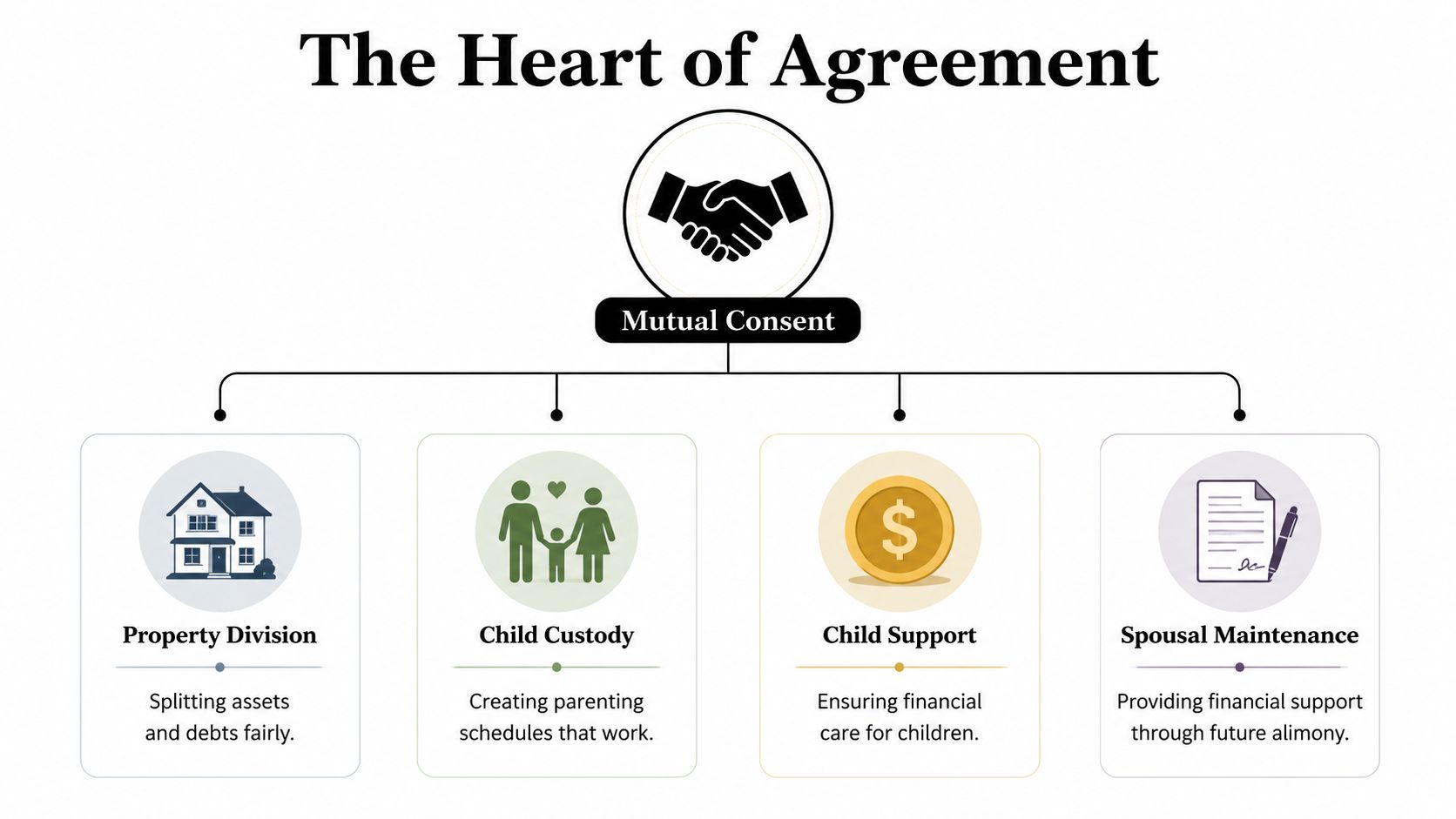
Property and debt division
Texas is a community property state, and courts use a “just and right” standard rather than an automatic equal split, as explained in this discussion of Texas community property and the just and right standard.
That point matters because many spouses assume uncontested means simple math. It doesn't. Even when two people agree, they still need to identify what belongs to the community estate, what may be separate property, and who will take responsibility for each debt.
For example, one spouse might keep the house while the other keeps a larger share of retirement funds. Another couple may agree that each keeps the bank account already in his or her name, but that only works if both understand whether those funds are community or separate and whether the division is intended to be final.
A strong agreement usually addresses:
- Real estate: Who keeps the home, whether it will be sold, and who handles mortgage obligations until that happens.
- Retirement assets: Whether accounts such as pensions, IRAs, or workplace plans will be divided and whether additional transfer documents may be needed.
- Debts: Credit cards, personal loans, tax debt, and vehicle notes should be assigned clearly so there's no guessing later.
Children require detailed planning
If you and your spouse have children, an uncontested divorce still requires careful decisions. Good intentions are not enough by themselves.
Parents usually need to address conservatorship, possession and access, child support, health insurance, and practical matters like exchange times and holiday schedules. If your agreement is vague, that uncertainty can create conflict after the divorce even if everyone feels cooperative now.
A useful example is school pickup. Saying “we'll work it out later” may feel harmless during the divorce. A few months later, that same phrase can turn into repeated arguments about who picks up the children on early release days, who handles extracurricular events, or what happens when one parent travels.
Children do better when parents create an agreement that is calm, specific, and realistic enough to follow on an ordinary weekday.
Spousal maintenance and other financial support
Not every uncontested divorce involves spousal maintenance, but if it does, the terms should be spelled out carefully. The agreement should reflect whether maintenance will be paid, for how long, and under what conditions it ends.
Some couples also choose a property division that reduces the need for support. For instance, one spouse may take more liquid assets in exchange for little or no maintenance. That can work well if both spouses fully understand the long-term effect.
The key is clarity. A court can approve a well-drafted agreement. A court cannot fix confusion that the decree itself creates.
The Texas Uncontested Divorce Process Step by Step
Once you know you qualify and have reached full agreement, the process becomes procedural. That doesn't mean every step is easy, but it does mean there's a path you can follow.
If you want a broader overview of filings and early case decisions, this guide on how to file for divorce in Texas is a helpful companion.

Filing the original petition
The case usually begins when one spouse files the Original Petition for Divorce with the district court in the proper county. That spouse becomes the petitioner. The other becomes the respondent.
The petition starts the lawsuit, but it does not finalize anything. Think of it as opening the court file and asking the judge for authority to dissolve the marriage.
Handling notice to the other spouse
After filing, the other spouse must be notified properly. In many agreed cases, the respondent signs a Waiver of Service instead of being formally served by a process server or sheriff.
This step often reduces stress. It can also help couples avoid the unnecessary tension that sometimes comes from formal service at home or work. Even so, the waiver has to be prepared and signed correctly.
The waiting period is real
Texas imposes a mandatory 60-day waiting period beginning when the divorce petition is filed, and even an amicable uncontested divorce cannot be finalized before that period ends, according to this explanation of the Texas 60-day divorce waiting period.
Many people find this frustrating at first. But the purpose is not to punish you. The law treats divorce as a major legal and personal decision, and the waiting period gives spouses time for reflection, correction of paperwork, and final review of their agreement.
During that window, it's smart to:
- Review the decree carefully: Make sure names, dates, property descriptions, and parenting terms are accurate.
- Check financial disclosures: Confirm nothing important was omitted.
- Make final revisions by agreement: It's much easier to fix drafting issues before the judge signs the decree.
Here's a short video that walks through practical divorce filing issues in Texas:
Final decree and county filing details
The Final Decree of Divorce is the document that states who gets what and what each party must do after divorce. In an uncontested case, both spouses usually sign it before the prove-up.
One practical problem that catches many people off guard is filing procedure. Texas has 254 counties, and county-specific electronic filing systems can create document rejections when filers miss local formatting or procedural requirements, as noted in this discussion of county-specific e-filing issues in Texas divorce cases.
That means a couple may have a perfectly good agreement and still face delay because the wrong version of a document was uploaded, a required local form was missed, or the county's portal rules weren't followed.
The legal agreement and the filing mechanics are two different jobs. Both have to be done correctly.
Common Mistakes That Can Derail Your Agreed Divorce
Most agreed divorces don't fall apart because the spouses suddenly start arguing. They run into trouble because the details were never handled precisely.
I've seen versions of the same story many times. A spouse downloads forms from a generic website, changes a few names, and assumes the packet will work in Texas. Or a couple reaches a handshake agreement about “splitting everything fairly,” but nobody lists the retirement account, the credit card debt, or the truck loan in the decree.
The form looked fine until the clerk rejected it
A common scenario goes like this. Someone prepares the paperwork carefully, submits it, and then learns the county's filing system rejected the documents.
That problem isn't rare in practice because counties can have different procedural expectations, and with 254 counties in Texas, local e-filing requirements can create costly delays when formatting or filing steps are missed, as discussed in the earlier linked county e-filing resource.
The frustration is understandable. You thought the hard part was reaching agreement with your spouse. Then the process stalls over technical filing requirements.
Friendly agreements still need legal precision
Another problem appears when spouses rely on broad language. “She keeps her retirement.” “He pays the debt.” “We'll sell the house later.” Those phrases may reflect genuine agreement, but they often aren't precise enough for a final decree.
Consider a couple with one house, two cars, and several joint credit accounts. If the decree doesn't clearly assign title transfers, debt responsibility, and deadlines, both spouses may leave the divorce believing they have a deal while the written order says less than they think it says.
Verbal understandings won't protect you later
An uncontested divorce still ends in a court order. Courts enforce written orders, not hallway promises.
Watch for these avoidable mistakes:
- Using non-Texas forms: A form that worked somewhere else may not match Texas procedure or local court expectations.
- Leaving out assets or debts: If it matters financially, it should be addressed in writing.
- Treating retirement or real estate as simple: These assets often need careful wording and, in some cases, additional documents.
- Skipping review of the decree: Once signed, fixing errors is harder than preventing them.
This is one place where targeted legal help can be worthwhile even for cooperative couples. Some people choose limited-scope help, such as document drafting or review. Others use full representation for an agreed case. The right level of help depends on how much complexity sits beneath the surface.
Estimating the Costs and Timeline of an Uncontested Divorce
Cost and timing matter. When people ask how long an agreed divorce will take, the honest answer is that part of the timeline is legal and part of it is practical.
The legal floor is set by the waiting period discussed earlier. The practical timeline depends on how quickly both spouses gather information, settle the details, sign documents, and correct any filing issues. For a fuller discussion, see this article on how much an uncontested divorce may cost in Texas.
Estimated Costs for an Uncontested Divorce in Texas 2026
Because county fees, service choices, and attorney involvement vary, it's safer to think in categories instead of pretending there is one universal number.
| Expense Item | Typical Cost Range |
|---|---|
| Court filing fees | Varies by county |
| Service of process | Varies if formal service is needed |
| Waiver of Service approach | Usually lower than formal service, but document preparation may still be needed |
| DIY document preparation | Lower upfront cost, higher risk of correction costs if paperwork is incomplete |
| Attorney document review | Moderate cost depending on complexity |
| Full uncontested representation | Higher than DIY, but often useful when property, children, or drafting issues need careful handling |
A practical point many people miss is taxes. If your divorce involves retirement funds, sale of a home, support questions, or division of business-related records, it may help to speak with Tax Accountants before finalizing the decree so the agreement matches your broader financial picture.
What affects the timeline
Instead of focusing only on the shortest possible finish date, look at the issues that tend to move a case faster or slower:
- How complete the agreement is: If you're still debating debt division or parenting details, the timeline stretches.
- How organized your documents are: Missing statements and unclear asset lists slow drafting.
- How smoothly filing goes: Clerk rejections and county portal issues can add delay.
- How much legal help you use: Some couples work efficiently with limited review. Others prefer a firm such as Law Office of Bryan Fagan, PLLC for preparation or review of the petition, decree, and closing documents in an agreed case.
Your Uncontested Divorce Checklist and Getting Help
When you're under stress, a checklist can bring the process back into focus. An uncontested divorce isn't about doing everything at once. It's about doing the right things in the right order.
A practical checklist
- Confirm eligibility: Make sure your filing county and Texas residency satisfy Texas Family Code § 6.301.
- Choose the legal ground: Many agreed divorces rely on insupportability under Texas Family Code § 6.001.
- Reach full agreement: Property, debts, children, and support all need a complete written resolution.
- Prepare the petition carefully: Filing opens the case, but it has to be accurate from the start.
- Handle notice properly: A waiver can be useful in agreed cases if it is drafted and signed correctly.
- Use the waiting period wisely: Review every term, every date, and every description in the final paperwork.
- Draft a precise final decree: The decree should say exactly what each spouse must do.
- Check local filing rules: County procedures can delay an otherwise smooth case.
- Keep copies of signed orders: You may need them for title changes, account updates, and future reference.
Steady guidance matters
Even when both spouses are cooperative, divorce is still a major legal event. It affects your finances, your parenting plan, your property rights, and your peace of mind. Getting through it well often comes down to understanding the rules, slowing down where precision matters, and asking for help before a preventable mistake becomes expensive.
If you need help navigating divorce, custody, or estate planning in Texas, contact The Law Office of Bryan Fagan today for a free consultation.
If you want personalized guidance on an agreed divorce, property division, parenting terms, or filing requirements in your county, schedule a free consultation with Law Office of Bryan Fagan, PLLC. A Texas family law attorney can help you review your options, prepare the right documents, and move forward with clarity.