
Divorce can be one of life’s most difficult transitions—but understanding your rights and options under Texas law can make it less overwhelming. If you and your spouse are able to work together, an uncontested divorce offers a more predictable and affordable path forward. While every situation is unique, a fully attorney-guided uncontested divorce in Texas typically costs between $2,000 and $6,000, covering everything from initial filing to the final court approval.
The most significant factor in managing your divorce costs is your ability to reach a complete agreement with your spouse. This cooperation is what allows you to avoid the expensive and emotionally draining court battles that define a contested divorce.
The True Cost of an Uncontested Divorce in Texas
When you are facing divorce, financial questions are often the first to arise. You are not just ending a marriage; you are untangling your financial lives and planning for two separate futures. The good news is that by choosing an uncontested path, you can significantly lower both the financial and emotional costs of this process.
Think of it this way: an uncontested divorce is like taking the express lane on a toll road. A contested divorce is hitting every bit of rush-hour traffic. Both routes get you to your destination, but one is significantly faster, cheaper, and less frustrating.

Understanding the Key Cost Components
To truly understand what an uncontested divorce costs, it’s important to know what you are paying for. The final price tag isn't just one number; it's a combination of a few key expenses. Because you and your spouse have already agreed on the major issues—like how to divide property and handle child custody—the legal process becomes much more streamlined.
This cooperation is why an uncontested divorce is far more affordable than a contested case, which can easily escalate to $10,000-$50,000 or more. It is a preferred option for couples who seek an efficient and predictable resolution.
The main expenses you will encounter in an uncontested divorce include:
- Court Filing Fees: These are the mandatory fees charged by every Texas county to officially begin your divorce case with the court.
- Attorney Fees: This covers the legal expertise needed to draft your divorce decree correctly, ensure your rights are protected, and guide you through the Texas legal system from start to finish.
- Miscellaneous Costs: This is a catch-all for smaller but necessary expenses, such as paying a process server, obtaining certified copies of your final decree, or other administrative needs.
At The Law Office of Bryan Fagan, PLLC, we believe in transparent pricing. For many of our clients with uncontested cases, we offer a flat-fee service. This allows you to know the full cost upfront, with no hidden fees or surprise bills down the road.
To give you a clearer picture of how these costs add up, the table below breaks down the typical expenses you can expect.
Estimated Cost Breakdown for a Texas Uncontested Divorce in 2026
This table provides a quick look at the potential costs, showing low-end, average, and high-end estimates for different parts of an uncontested divorce.
| Expense Category | Low-End Estimate | Average Cost | High-End Estimate (with minor complexities) |
|---|---|---|---|
| Court Filing & Service Fees | $350 | $450 | $600 |
| Flat-Fee Attorney Services | $2,000 | $3,500 | $5,000 |
| Mediation (if needed for one issue) | $0 | $750 | $1,500 |
| Specialized Services (QDRO, etc.) | $0 | $500 | $1,000+ |
| Total Estimated Cost | ~$2,350 | ~$5,200 | ~$8,100+ |
While this overview provides a general financial map, every divorce is unique. For a deeper dive, you can learn more about the costs associated with a divorce in Texas in our detailed article. The key takeaway is that your final cost will depend on your specific circumstances and how smoothly you and your spouse can finalize your agreements.
What an Uncontested Divorce Really Means in Texas
When people hear the term "uncontested divorce," they often picture a couple who gets along and simply wants to part ways amicably. While that is an excellent foundation, the legal definition in Texas is much more specific.
An uncontested divorce is not just about avoiding arguments. It means you and your spouse have reached a complete and total agreement on every single issue required to end your marriage under the Texas Family Code. There can be zero unresolved items left for a judge to decide.
Think of it this way: you and your spouse are co-presenting a finished solution to the court. You have already done all the hard work of negotiating and are now asking the judge to legally ratify the terms you created together.
The Foundation of 100% Agreement
The absolute cornerstone of an uncontested divorce is 100% agreement on every issue. This is not an exaggeration. Even one single point of disagreement—such as who gets the family dog or how to divide a credit card bill—can shift your case into contested territory, changing the entire process and its associated costs.
To be truly uncontested, your agreement must cover all relevant matters, including:
- Property and Debt Division: How will you divide the house, cars, retirement accounts, and furniture? Who is responsible for the mortgage, credit card balances, and car loans? This must be in accordance with the Texas Family Code's principles of a "just and right" division.
- Child Custody and Visitation: Who will be designated the primary parent to determine the child's residence? What will the possession schedule look like for the other parent, including holidays and summer breaks?
- Child Support and Medical Support: How much child support will be paid each month, consistent with Texas guidelines? Who will be responsible for providing health insurance for the children?
- Spousal Maintenance: Will one spouse pay the other spousal support (alimony)? If so, you must agree on the exact amount and duration.
If there is any "we'll figure that out later" on any of these topics, you do not have an uncontested divorce. Reaching this complete consensus is the most critical factor in keeping your divorce costs low and the timeline short.
Formalizing Your Decisions in the Final Decree
All of your agreements are documented in one of the most important legal documents you will ever sign: the Agreed Final Decree of Divorce. This is not a simple form you can download online; it is a comprehensive, legally binding court order that dictates the terms of your post-marriage life.
The decree must be incredibly detailed, spelling out everything from who receives which bank account to the exact dates and times for holiday child exchanges.
As required by the Texas Family Code, the final decree must resolve all issues between the parties. A well-drafted decree is your shield against future conflict. It provides clarity and legal authority, preventing one party from later claiming, "That's not what we agreed to."
Once a judge signs your decree, your private agreements become an enforceable court order. A poorly drafted document can be rejected by the court or, worse, leave you vulnerable to expensive legal battles down the road to clarify or enforce its terms. This is why having an experienced attorney draft your decree is a wise investment, ensuring your decisions are protected and your divorce is truly final.
Deconstructing the Core Costs of Divorce
When you are planning the budget for an uncontested divorce, the cost primarily boils down to two categories: court fees and attorney fees. While every divorce is different, these two items form the foundation of your expenses. Understanding what they cover is the first step toward moving forward with financial confidence.
Think of it this way: court fees are the non-negotiable price of admission to get your case started. Attorney fees are your investment in ensuring the process is handled smoothly, correctly, and without costly future surprises.

Court Filing Fees: The Price of Entry
The very first official cost in any Texas divorce is the court filing fee. This is a mandatory administrative fee paid directly to the district clerk in your county. It is what gets your case officially opened, assigned a cause number, and placed on the court's docket. You simply cannot start a divorce without paying it.
These fees are set at the county level, so they vary slightly depending on where you file. In major metropolitan areas like Harris, Dallas, Tarrant, and Travis counties, you can expect these fees to be between $250 and $350. This initial payment covers the court's administrative work, but it does not pay for a judge's time, legal advice, or the drafting of your divorce documents.
For individuals facing genuine financial hardship, Texas law offers a path to waive these fees. You can file a Statement of Inability to Afford Payment of Court Costs. If a judge approves this statement, you may be able to proceed with your case without paying the initial filing fee.
Attorney Fees: An Investment in Certainty
While court fees get your case in the door, attorney fees ensure it is completed correctly and efficiently. In an uncontested divorce, the goal is to achieve an accurate and final resolution without conflict. That is why our firm, like many others, often utilizes a flat-fee model for these cases.
A flat fee provides complete cost transparency from the start. Instead of worrying about hourly billing, you pay one set price for a clearly defined scope of services. This approach offers peace of mind and allows you to budget properly, knowing there will not be any financial surprises.
The concept is simple: you are investing in a comprehensive package designed to guide you from filing the initial petition to receiving your final, signed decree from the judge.
A flat-fee uncontested divorce isn’t just about paying for documents; it's an investment in a legally sound resolution. It ensures every detail is addressed, protecting you from costly errors and future legal challenges.
At The Law Office of Bryan Fagan, PLLC, our flat-fee service for uncontested divorces is designed to be all-inclusive. Our service typically covers:
- Drafting the Original Petition for Divorce: This is the official legal document that initiates your case.
- Preparing the Waiver of Service: This document allows your spouse to voluntarily accept the divorce papers without being formally "served," saving both time and money.
- Drafting the Agreed Final Decree of Divorce: This is the most critical document. We meticulously draft it to detail all your agreements on property, debt, and—if applicable—your children, ensuring compliance with the Texas Family Code.
- Communication and Guidance: Our team remains available to answer your questions and provide practical guidance at each step of the process.
- Finalizing the Divorce: We ensure all documents are correctly filed with the court and presented to the judge for a final signature.
Filing fees are just the starting point, with the roughly $300 fee in major Texas cities like Houston and Dallas-Fort Worth being fairly standard. When you add an attorney to ensure everything is done right, uncontested divorces typically involve $2,000 to $6,000 in total fees to cover drafting agreements and handling court matters. You can explore more about national divorce cost trends to see how Texas compares.
Hidden Expenses That Can Impact Your Final Cost
Even when you and your spouse have agreed on everything, the final bill for an uncontested divorce can sometimes include more than just court fees and attorney costs. Starting on the same page is the best way to keep costs down, but it is wise to be aware of other variable expenses that might arise.
Being prepared for these potential costs helps you build a realistic budget and avoids surprises later on. Think of them as calling in a specialist to handle specific details. Not every divorce will require them, but knowing they exist is part of a smart financial plan. These costs usually come into play when dealing with specific types of assets or when a little help is needed to get across the finish line.
Mediation for Finalizing Details
It happens often: a couple agrees on 99% of their issues but gets stuck on one or two final points. For example, you may have the house and retirement funds sorted out but cannot agree on who keeps the newer car. This is exactly where a professional mediator becomes your best asset.
Instead of letting one disagreement derail your amicable process and push you into expensive litigation, mediation offers a focused and much more affordable solution. A neutral third-party mediator facilitates the conversation, helping you both find a compromise. The cost of a half-day or full-day mediation session is almost always significantly less than fighting over even a single issue in court.
Appraisals for Valuing Assets
When you have significant assets in your marital estate, you cannot just estimate their value. To divide property fairly, you must know precisely what it is worth. This is especially true for items that do not have an obvious price tag, such as:
- Real Estate: You will likely need a professional real estate appraiser to determine the fair market value of your family home or other properties.
- A Family Business: Valuing a business is a complex process that often requires a forensic accountant or a business valuation expert.
- Pensions or Unique Investments: You may need financial specialists to calculate the present-day value of future pension payouts.
These appraisal fees are an extra cost, but they are a critical investment. They ensure the property division in your final decree is fair and based on concrete numbers, which protects both of you in the long run.
The financial impact of divorce extends far beyond legal fees, particularly for those with shared real estate. For Texans keeping a home, knowing how to actively reduce property taxes in Texas can be a crucial strategy to manage post-divorce expenses.
Qualified Domestic Relations Orders (QDROs)
If you and your spouse plan to divide a retirement account like a 401(k) or a pension, your Final Decree of Divorce alone is not enough to complete the transfer. Federal law requires a separate, highly technical court order called a Qualified Domestic Relations Order (QDRO).
A QDRO is a specific directive to the retirement plan administrator, instructing them on how to divide the account and transfer funds to the other spouse. Attempting to move this money without a properly drafted QDRO could trigger substantial tax penalties and early withdrawal fees.
Drafting a QDRO requires specific legal and financial expertise, and there is an additional cost for its preparation. If retirement assets are part of your divorce, budgeting for this essential service is a must. Understanding these potential extra steps is a key part of learning about the ideas to help pay for your Texas divorce.
How Different Family Scenarios Affect Divorce Costs
The total cost of an uncontested divorce is not a single, fixed number—it is a direct reflection of your unique family situation. Every family has a different story, and factors like your assets, debts, and whether you have children will shape the final expense.
To give you a realistic idea of what to expect, it is helpful to look at a few common scenarios we see in our practice. By seeing how these details play out in relatable examples, you can get a much clearer picture of where your own circumstances might fit.
Scenario 1: The Simple Separation
Consider a young couple, married for three years with no children. They rent an apartment, maintain separate bank accounts, and share a credit card with a small balance. Their only other debts are two car loans. Because they both agree on how to handle the minor debt and their personal property, their divorce is straightforward.
This is the simplest type of uncontested divorce. With no children, there is no need to negotiate custody schedules, visitation, or child support. Without real estate or complex investments, dividing property is a clean and simple process.
- Practical Guidance: Their primary tasks are to list their few assets and debts and agree on who takes what. An attorney then drafts a simple decree reflecting this agreement.
- Estimated Total Cost: For this type of case, the total cost typically lands on the lowest end of the spectrum, somewhere between $2,500 and $3,500.
This scenario demonstrates how simplicity keeps costs down. The fewer issues that need to be addressed in the legal paperwork, the quicker and more affordable the divorce becomes.
Scenario 2: The Family-Focused Divorce
Now, let's picture a couple married for 12 years with two school-aged children, 8 and 10. They own a home with a mortgage, share a joint savings account, and one spouse has a 401(k). They have already discussed and agreed on a possession schedule for the kids that is in their best interest and have a plan for splitting the equity in their home.
This situation is more complex because children and significant assets are involved. The Final Decree of Divorce must include very specific language for custody and child support that aligns with the Texas Family Code. Additionally, dividing the 401(k) requires a separate court order to avoid major tax penalties.
Below is an infographic that highlights some of the 'hidden' costs that often come up when assets like retirement accounts or real estate are involved.
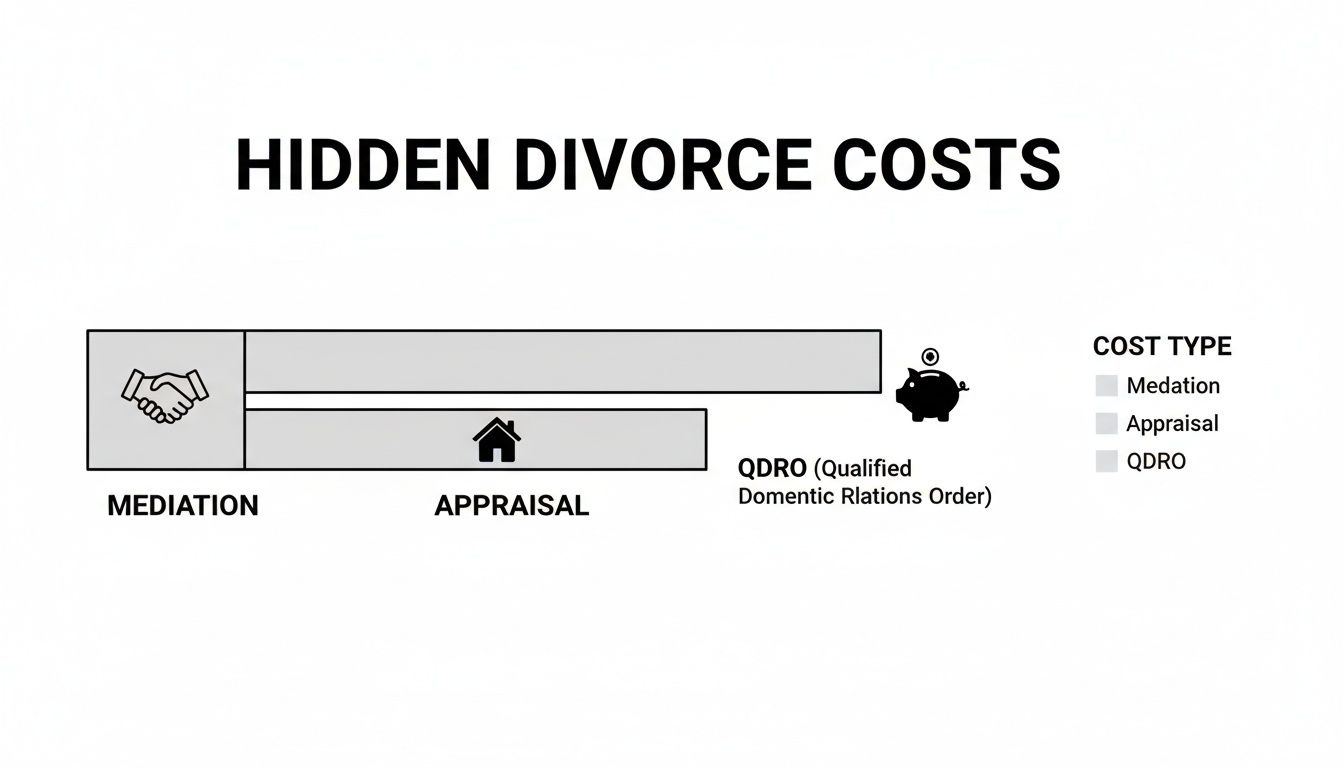
As you can see, services like mediation to finalize small details, property appraisals, and QDROs for retirement accounts are common and necessary additions.
- Practical Guidance: This couple would need to formalize their custody agreement, calculate child support based on state guidelines, and hire an attorney to draft the decree and the necessary Qualified Domestic Relations Order (QDRO) to divide the 401(k).
- Estimated Total Cost: This uncontested divorce would likely range from $4,000 to $6,500, reflecting the additional legal work needed to correctly address children's issues and retirement assets.
Scenario 3: The Executive Split
Finally, imagine a couple married for over 20 years. Their children are grown, so custody is not an issue. However, their financial picture is complex: they own a primary residence, a vacation property, several investment accounts, and one spouse owns a small business.
Even if they agree in principle to a 50/50 split, the real work lies in accurately determining the value of that 50%. This is where it becomes essential to bring in outside experts to ensure the division is fair.
In high-asset cases, agreement is only half the battle. The other half is accurate valuation. Without professional appraisals, you risk an unfair division that could cost you tens of thousands of dollars in the long run.
The costs for this type of uncontested divorce are higher due to the specialized services required:
- Real Estate Appraisals: To determine the true fair market value of both properties.
- Business Valuation: A forensic accountant is often needed to assess the business's actual worth.
- Financial Analysis: To properly value and divide the various investment portfolios.
National data confirms that while DIY options look cheap, attorney-assisted cases provide critical oversight. One survey found that while a DIY divorce might cost around $1,170, an uncontested divorce with an attorney averages between $4,000 and $10,400 when even minor issues arise, ensuring all assets are handled properly. You can read more about how divorce costs vary nationally to see these trends.
- Practical Guidance: This couple's attorney would coordinate with appraisers and accountants to gather the necessary financial data before drafting a highly detailed decree that specifies the division of each asset.
- Estimated Total Cost: The total bill could easily fall between $8,000 to $15,000 or more, even though the divorce is completely amicable and uncontested.
To help put it all together, the table below summarizes how these different levels of complexity translate into real-world costs.
Uncontested Divorce Cost Scenarios in Texas
This table illustrates how total costs can vary based on the complexity of the divorce, even when it remains uncontested.
| Scenario | Description | Estimated Total Cost Range |
|---|---|---|
| Simple Separation | No children, minimal shared property (renting, no real estate), and simple debt. | $2,500 – $3,500 |
| Family-Focused Divorce | Minor children, a family home, and a retirement account (like a 401k). | $4,000 – $6,500 |
| Executive Split | No minor children, but complex assets like multiple properties, a business, or investments. | $8,000 – $15,000+ |
As these scenarios show, the answer to "how much does an uncontested divorce cost?" truly depends on the specifics of your life. The more complex your financial and family situation, the more you should budget to ensure a smooth, fair, and legally sound resolution.
The Hidden Cost of a DIY Divorce
When you are facing the cost of an uncontested divorce, the do-it-yourself (DIY) route can seem like a tempting way to save money. Online forms and DIY kits promise a quick and cheap solution, and the appeal is understandable. However, what appears to be a bargain upfront can quickly become one of the most expensive mistakes you can make.
The reality is that a DIY divorce is a minefield of hidden financial risks. The legal language in a Final Decree of Divorce must be incredibly precise. A small error, a single overlooked detail, or an ambiguous phrase can be enough for a judge to reject your decree. When that happens, you are forced to start over—and pay new court fees.
The Dangers of an Unenforceable Decree
Even more concerning is the risk of a judge signing a decree that is full of legal loopholes. You might leave the courthouse believing your divorce is final, only to discover years later that your agreement is unclear, invalid, or unenforceable.
Fixing that kind of legal mess is far more complicated and costly than getting it right the first time. Some of the most common DIY divorce mistakes that turn into nightmares include:
- Overlooked Assets and Debts: Forgetting to formally assign a single credit card debt or failing to use the correct language to divide a 401(k) can leave you responsible for significant financial liabilities.
- Incorrect Child Support Calculations: A simple miscalculation or omitting mandatory legal language can mean you pay or receive the wrong amount for years. Correcting that retroactively is incredibly difficult.
- Unenforceable Property Division: Using vague descriptions for how property will be divided can spark future court battles when one person decides not to follow the "agreement."
These errors do not simply disappear. They become legal loose ends that can unravel your financial life long after you thought your divorce was behind you.
An Attorney as Your Quality Assurance
Think of an experienced family law attorney as quality assurance for your future. In an uncontested case, our role is not to create conflict but to prevent it from ever happening. We ensure your agreement is not only fair but also fully compliant with the Texas Family Code and legally airtight. The fee you pay is an investment in certainty.
A properly drafted decree, reviewed and finalized by a legal professional, is your best protection against future disputes. It transforms your private agreements into a clear, binding, and enforceable court order that stands the test of time.
At The Law Office of Bryan Fagan, PLLC, we see our job as helping you close this chapter of your life correctly and completely, so you do not have to look back. We work to ensure your rights are protected, your assets are divided properly, and your final decree is a rock-solid document you can rely on. This investment is what protects you from the staggering hidden costs of a DIY divorce and makes sure your uncontested case is truly final.
Your Questions About Uncontested Divorce Costs Answered
Even when you and your spouse agree on everything, the divorce process itself can still feel a little confusing. We get a lot of the same questions from clients who are starting an uncontested divorce, so we’ve put together some clear answers to help you know what to expect.
How Long Does an Uncontested Divorce Take in Texas?
Even if you and your spouse have every detail sorted out on day one, Texas law imposes a mandatory 60-day waiting period. This is a legal "cooling-off" period that starts the day after the Original Petition for Divorce is filed with the court.
Because of this rule, the absolute fastest an uncontested divorce can be finalized is 61 days. In practice, most cases take a bit longer. A more typical timeline is between 90 to 120 days to allow enough time for drafting the final decree, getting both spouses to sign off, and scheduling the final, brief court appearance.
Can My Spouse and I Use the Same Lawyer?
This is one of the most common questions we hear, and the answer is an unequivocal no. Under Texas legal ethics rules, a single attorney is prohibited from representing both parties in a divorce. This creates a conflict of interest—an attorney cannot offer loyal, unbiased advice to two people whose legal interests are technically adverse.
One spouse can hire an attorney to handle the drafting and filing, and the other spouse can choose to review and sign the documents without their own lawyer. However, it is vital to remember that the attorney only represents the person who hired them.
It is crucial to understand that even in an amicable divorce, your legal interests are not identical to your spouse's. An attorney can only be loyal to one party.
What Happens If We Disagree After Starting the Process?
It is not unusual for a new disagreement to arise after an uncontested divorce is already in motion. If you and your spouse hit an issue you cannot resolve together, the case must pivot from an uncontested divorce to a contested one.
This change has an immediate impact on the cost. The flat-fee structure for the uncontested case will end, and your attorney will need to switch to hourly billing to manage the new conflict, negotiations, or potential court hearings. This is precisely why reaching 100% agreement before you file is the single best way to control how much your uncontested divorce will ultimately cost.
If you need help navigating divorce, custody, or estate planning in Texas, contact The Law Office of Bryan Fagan, PLLC today for a free consultation.


