
Getting notice of a custody hearing can make everything else disappear for a moment. Your mind usually goes straight to the same fears. Where will my child live? How much time will I have? What do I say to the judge? What if I freeze up?
Most parents who search for what happens at a custody hearing in Texas aren't looking for abstract legal theory. They want to know what the courthouse day feels like, what the judge is deciding, and how to avoid making a painful situation worse. That's the right instinct. In Texas family court, preparation matters because these hearings are often more focused, and sometimes shorter, than people expect.
A first hearing often starts before you ever enter the courtroom. You've read the papers three times, slept badly, and replayed every disagreement with the other parent in your head. By the time you arrive at court, you may feel like your whole relationship with your child is hanging on a few minutes.
That feeling is real. It's also why clear expectations help.
A Texas custody hearing usually isn't a chance to unload every frustration from the relationship. It's a legal proceeding about your child's care, routine, safety, and stability. Judges are listening for facts they can use to make workable orders. They want to know who handles school issues, medical needs, exchanges, communication, and day-to-day parenting without constant disruption.
Most parents feel pressure to tell the judge everything. The stronger approach is to tell the judge what matters most for the child.
If you understand that from the beginning, the process becomes less mysterious. You stop thinking in terms of “winning the story” and start thinking in terms of proving a parenting plan.
The Legal Foundation of Texas Custody Hearings
By the time a custody hearing starts, many parents are prepared to talk about everything that went wrong in the relationship. Texas law asks a narrower question. The court is deciding conservatorship, possession and access, and any related rights and duties based on the child's best interest.
That legal structure matters because hearings are often short. A judge may hear only a few points before making temporary decisions that shape school pickup, medical authority, and where the child sleeps next week. Parents who understand the legal framework usually present better evidence and waste less time on facts the court cannot use.

Conservatorship and possession are different questions
Texas parents often say "custody," but that word covers two separate issues.
Conservatorship addresses decision-making rights and duties. That includes questions such as who can consent to medical care, who can make educational decisions, and whether certain rights are exercised jointly or by one parent alone.
Possession and access addresses the parenting schedule. It covers where the child is on weekdays, weekends, holidays, and during the summer, along with exchange terms and other practical details.
Those categories overlap in daily life, but they are not interchangeable. A parent may have substantial parenting time without holding every exclusive decision-making right. A parent may also share major rights while following a structured possession schedule. For a fuller overview of how Texas courts define these issues, see our guide to custody in Texas.
Best interest is the standard the court applies
Texas Family Code § 153.002 makes the best interest of the child the court's primary consideration in determining conservatorship and possession. In court, that standard becomes practical very quickly. Judges want facts they can act on.
A judge is usually listening for answers to questions like these:
- Who handles the child's daily life: Who gets the child to school, responds to teacher concerns, manages medications, and keeps routines consistent?
- Which arrangement gives the child more stability: Stability usually means predictable housing, reliable transportation, follow-through, and fewer unnecessary disruptions.
- How each parent supports the child's relationship with the other parent: Judges notice cooperation, communication, and whether one parent is using the case to settle adult grievances.
- Whether there are specific safety concerns: If there are allegations involving neglect, substance abuse, family violence, or dangerous judgment, the court needs clear proof, not suspicion.
Texas courts may also consider the Holley factors when weighing best interest. Those factors help organize evidence about the child's needs, each parent's abilities, the proposed home environment, and any risks to the child.
What usually helps in a hearing
In a short hearing, relevance matters more than volume. Ten screenshots of insults usually carry less weight than one school record, one medical record, and a clear timeline showing who has been meeting the child's needs.
Helpful evidence often looks like this:
| Issue the judge cares about | Evidence that helps |
|---|---|
| School consistency | attendance records, report cards, communication with teachers |
| Medical follow-through | appointment records, prescriptions, therapy notes if properly presented |
| Parenting involvement | calendars, messages about pickups, documented routines |
| Home stability | lease or housing information, work schedule, childcare plan |
Parents sometimes bring material that feels powerful but does little legal work. Complaints about dating, personality conflicts, or old relationship arguments usually do not matter unless they connect directly to the child's safety, care, or stability.
Practical rule: If a fact does not help the judge decide safety, stability, caregiving, or scheduling, it should not take up precious hearing time.
Temporary Hearings vs Final Trials What Is the Difference
Many parents think there is one big custody hearing where everything gets decided once and for all. That's rarely how Texas family cases feel on the ground. The first major event is often a temporary-orders hearing, and that early hearing can shape the rest of the case.
Here is a quick visual comparison.

After a case is served, the respondent's answer is generally due by 10 a.m. on the Monday after 20 days, and initial disclosures are typically exchanged within 30 days of the answer, waiver, or counterpetition. Either party can ask for temporary orders, and if no answer or appearance is filed, the petitioner may pursue a default judgment, as explained by TexasLawHelp's custody case process guide.
Temporary orders are the early operating rules
Temporary orders are the court's way of stabilizing things while the case is pending. They can address who has the right to determine the child's primary residence, what schedule applies for now, and how the parents will handle immediate parenting issues until final orders are entered.
That matters because families don't stop functioning while a case is open. School still starts on Monday. Medical appointments still need to happen. Exchanges still have to occur without constant conflict.
A temporary-orders hearing often rewards the parent who comes in organized, realistic, and focused. Judges want to see a plan they can use now, not just a list of complaints about the other side.
For more on that stage of a case, read our article on temporary custody orders in Texas.
A short video can also help you picture the difference in tone and stakes:
Final trial is the lasting order
A final trial is where the court enters the order intended to govern the family going forward, unless a later modification becomes necessary. The record is typically more developed. The strategy is broader. Instead of asking, “What should we do right now to keep things functioning?” the question becomes, “What long-term arrangement serves this child best?”
That distinction changes how you prepare.
- For temporary orders, focus on continuity, immediate needs, and a workable short-term structure.
- For final trial, build a fuller record showing patterns over time.
- For both, remember that early mistakes can become habits in the court's eyes.
One practical truth many parents learn too late is that a temporary arrangement can become the lived status quo. If a parent allows a harmful or unworkable setup to settle in without a prompt legal response, undoing that later can be harder.
A Step-by-Step Walkthrough of the Hearing
The courtroom itself is usually calmer than parents expect. It's formal, but it isn't theatrical. Most of the people in the room are doing their jobs, moving through a docket, and trying to help the judge get usable information.
What happens before your case is called
You'll typically arrive early, go through courthouse security, and find your courtroom. Your attorney may speak briefly with opposing counsel in the hallway. Sometimes last-minute agreements narrow the issues. Sometimes they don't.
Inside the courtroom, you may see:
- The judge, who makes the rulings
- The bailiff, who helps maintain order
- The court reporter, who creates the record
- The attorneys, if both sides are represented
- The other parent, and sometimes witnesses waiting outside
Courtroom behavior matters more than many clients realize. A judge notices facial expressions, interruptions, whispering, and visible frustration. You don't need to look perfect. You do need to look steady.
How evidence is presented
Texas custody hearings are evidence-driven. Parents may present school, medical, and financial records, call witnesses such as teachers or therapists, and cross-examine the other side's witnesses. In some cases, the judge may also speak privately with the child to assess the child's perspective, as described in this overview of what to expect during a child custody hearing in Texas.
A typical sequence looks something like this:
- The case is called. The judge identifies the parties and lawyers.
- Preliminary matters are handled. The court may clarify what issues are being heard that day.
- One side presents first. That side offers testimony and exhibits.
- The other side cross-examines. Questions test credibility, accuracy, and completeness.
- The second side presents its case.
- The judge asks questions. Sometimes these are direct and practical.
- The court rules or takes the matter under advisement.
Direct examination and cross-examination
When your own lawyer questions you, that's direct examination. The goal is to present your facts clearly and in an organized way.
Cross-examination feels different. The other attorney may ask short, leading questions designed to box you in or expose inconsistency. The best response is usually the simplest one. Listen carefully. Answer only the question asked. Don't argue with the lawyer.
The parent who stays calm under pressure often appears more credible than the parent who has the more dramatic story.
If the judge interviews the child privately, that usually happens outside the public courtroom setting. Parents often worry that this means the child gets to “choose.” That's not the right way to think about it. The judge is gathering perspective, not handing the case over to the child.
Presenting Your Case When You Only Have Minutes
At custody hearings, expectations often collide with reality. Many parents arrive believing they'll have a long block of time to explain years of history. In many Texas courts, that isn't how the day works.
Guidance on Texas conservatorship and possession hearings indicates that some counties may allow each parent as little as 20 minutes, and uncontested or default hearings can last under five minutes, according to Custody X Change's Texas hearing guide.
Your whole story is not your best hearing strategy
If you only have minutes, the court doesn't need your complete history. The court needs your strongest facts tied to the child's best interest. That means you must separate what is upsetting from what is legally useful.
A focused presentation usually does three things well:
- States the requested order clearly: Tell the judge what you want the court to do.
- Connects facts to the child: Show how your facts affect school, health, routine, safety, or stability.
- Uses a few strong exhibits: A clean set of records often matters more than a thick stack of mixed papers.
Build a short case, not a long complaint
If I were preparing a parent for a brief hearing, I'd want that parent ready to answer four questions cleanly:
- What schedule are you asking for?
- Why is that schedule better for this child right now?
- What documents support that request?
- What concern about the current arrangement requires the court's attention?
That approach works because it matches the judge's job. Judges are not there to referee every old grievance. They are there to enter enforceable orders.
Here's a useful way to prioritize your proof:
| Priority level | What to lead with |
|---|---|
| Highest | facts about safety, school, medical care, and day-to-day parenting |
| Medium | communication records showing cooperation or repeated interference |
| Lower | background conflict that doesn't directly affect the child |
What usually hurts a parent in a short hearing
A short hearing exposes weak habits fast.
- Overtalking: Long answers waste limited time and can frustrate the court.
- Disorganized papers: If you can't find the document when your lawyer needs it, it may as well not exist.
- Emotional detours: Anger about the relationship often clouds the parenting issues the judge cares about.
- All accusation, no proof: Claims without records, dates, or witnesses usually land softly.
A brief hearing rewards discipline. If you can present a calm, documented, child-centered case, you can still make meaningful progress even on a tight clock.
Common Custody Orders and What They Mean for Your Family
When the hearing ends, many parents expect a dramatic answer to one question: who won custody? In a Texas courtroom, the order is usually more practical than dramatic. After a hearing that may have lasted only a few minutes, the judge often signs rules that will control school pickups, holiday schedules, medical decisions, and where the child can live.
That is why temporary orders matter so much. A short hearing can produce a schedule your family lives under for months while the case continues.
The orders parents see most often
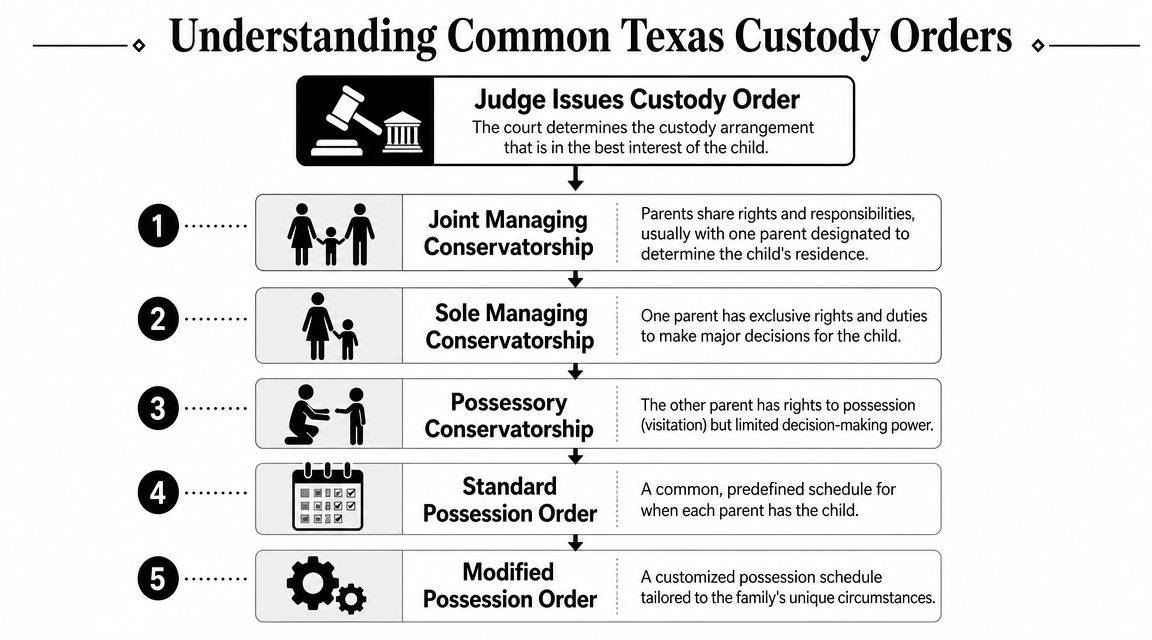
Texas courts usually divide custody issues into two buckets. One covers rights and duties. The other covers possession and access.
Common terms in an order include:
- Conservatorship: which parent has the right to make certain decisions about education, medical care, counseling, and other major issues
- Standard Possession Order: a set parenting-time schedule often used for school-age children
- Modified possession order: a custom schedule adjusted for work hours, distance, a child's needs, or the parents' history
- Under-3 possession order: a step-up or age-appropriate schedule for very young children
- Supervised possession: parenting time that must occur with supervision because of safety, substance abuse, or other serious concerns
- Geographic restriction: a limit on where the child's primary residence can be located
Parents often use the word “custody” as one label. Judges usually do not. They enter detailed terms that answer specific questions.
What these orders mean in daily life
A conservatorship ruling affects who can make important calls for the child. A possession schedule affects where the child sleeps on ordinary weekdays, weekends, holidays, and summer breaks. A geographic restriction can decide whether a parent may accept a job in another city without first going back to court.
Those details shape real life fast.
For example, if one parent receives the exclusive right to determine the child's primary residence, that parent usually decides where the child lives within any geographic restriction in the order. If both parents share certain decision-making rights, they may still need to consult each other before changing doctors, schools, or counseling arrangements. If visits are supervised, the order may name who supervises, where the visits happen, and how long that condition stays in place.
A few common situations
A parent may leave court believing the case is only temporary, so the details can wait. That is a mistake I see often. Temporary language has a way of becoming the routine everyone follows.
Consider a relocation dispute. The question is often not “Who gets custody?” The question is whether the child will stay in the current school, how exchanges will work, and whether the move will weaken the child's relationship with the other parent.
Or consider missed child support. Parents are often surprised to learn that support and possession are usually enforced separately. If the other parent is behind on support, that does not usually give you the right to block court-ordered visits. The safer response is to file for enforcement or modification and ask the court to address it directly.
Read the order like an instruction manual
The families who avoid repeat trips to court usually do one thing well. They read the order closely and follow the exact language.
Pay special attention to:
- Exchange terms, including location, time, and who provides transportation
- Holiday schedules, because they often override the regular weekend plan
- Summer and school-year provisions, because the schedule may change during the year
- Notice requirements, especially for travel, schedule changes, or relocation
- Conditions tied to possession, such as counseling, sobriety terms, or supervision rules
If you want help preparing for the kind of hearing that often leads to these orders, our guide on how to prepare for a custody hearing walks through the practical steps.
A custody order is not just a legal result. It is the operating schedule for your child's week. The clearer you are about what the judge signed, the fewer expensive problems you are likely to face later.
Your Preparation Checklist Before Going to Court
The night before a Texas custody hearing often feels heavier than the hearing itself. Parents expect a long chance to explain everything. Many are surprised to learn the judge may hear only the points that fit into a very short temporary hearing. Preparation is what lets you use that limited time well.

What to gather before the hearing
Bring proof that helps the judge make a practical decision for your child right now. At a temporary hearing, the court is usually not trying to hear every grievance from the relationship. The judge wants a clear picture of the child's needs, each parent's involvement, and any immediate concern that affects safety, stability, school, or the exchange schedule.
Useful records often include:
- School materials: attendance records, report cards, teacher emails, disciplinary notes
- Medical information: appointment summaries, treatment records, prescriptions, and follow-up instructions
- Communication records: texts or emails showing cooperation, schedule changes, denied access, or repeated conflict about the child
- Your timeline: a short dated summary of major events tied to caregiving, pickups, medical needs, school issues, or police involvement
Organization matters. Judges and lawyers can use a clean packet in seconds. They cannot use 200 mixed screenshots while your case is being called.
If you want a more detailed document plan, read our guide on how to prepare for a custody hearing.
What to practice before you testify
Good testimony is usually brief, specific, and child-focused. A parent who tries to tell the whole history often runs out of time before reaching the point that matters.
Before court, write down four things:
- The exact temporary order you want
- Why that order helps your child this month, not just in theory
- The two or three strongest facts that support it
- Which document, photo, or witness backs up each fact
Then practice saying it out loud in plain language. For example: “I am asking that exchanges happen at school because it reduces conflict and keeps the child on schedule.” That lands better than a long speech about how difficult the other parent has been for years.
Cut anything that is mainly about anger, old relationship issues, or moral judgments. Those points may feel important. In a short hearing, they usually distract from the order you need.
If you have legal representation, the Law Office of Bryan Fagan, PLLC handles child custody and related family-law matters in Texas, including hearings involving conservatorship, possession, and enforcement issues.
Day-of-court basics that matter
The practical details affect how steady you look and how clearly you think.
- Arrive early: leave time for parking, security, and a last review with your lawyer
- Dress conservatively: neat, simple clothing helps you present yourself as calm and prepared
- Arrange childcare: children usually should not sit through the stress and confusion of the courthouse
- Bring copies: keep your documents labeled and easy to hand over fast
- Silence your phone: court staff and judges notice small signs of respect for the courtroom
One final point. If there is a bad fact, prepare for it. A missed exchange, an angry text, or a past mistake is usually easier to manage when it is addressed directly and put in context, instead of exposed by the other side first.
Contact The Law Office of Bryan Fagan for a Free Consultation
A Texas custody hearing feels less overwhelming when you know what the judge is deciding, what proof matters, and how quickly key rulings can happen. Careful preparation can change the tone of your case and protect your child's stability from the start.
If you need help navigating divorce, custody, or estate planning in Texas, contact Law Office of Bryan Fagan, PLLC today for a free consultation.