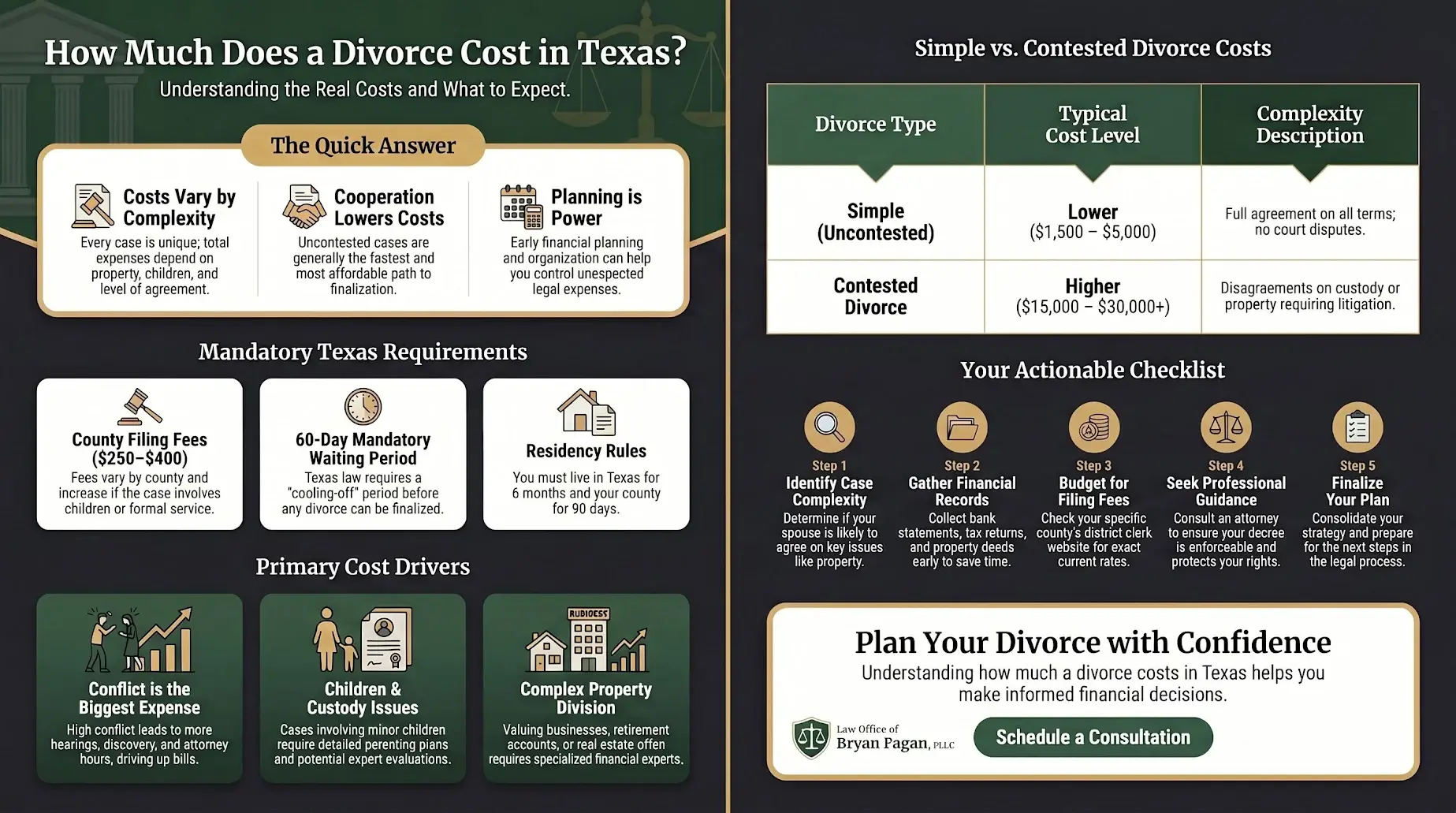
It often begins with a conversation that doesn’t unfold the way you expected. Maybe it happens late in the evening, when the house is quiet, and what seemed like a small disagreement starts to feel like something much bigger—something that makes you realize the relationship may be changing for good. Almost immediately, the practical question follows: how much does a divorce cost in Texas when everything in your life is about to shift?

Most people assume the answer is just a number, but it rarely is. In reality, the cost can range from a few thousand dollars to well over $50,000 depending on conflict, complexity, and the decisions made early in the process. What matters most is not just the price tag—it’s understanding what drives that number and how to keep control over it before the situation escalates.
At The Law Office of Bryan Fagan, PLLC, we’ve guided families across Houston and throughout Texas through this exact moment. Bryan Joseph Fagan, a South Texas College of Law graduate and recognized authority in Texas divorce and custody law, built this firm to do more than handle cases—we help people find clarity when everything feels uncertain. Texas law itself reflects that need for thoughtful decision-making. Under Texas Family Code §153.002, courts focus on the best interest of the child, which often shapes the direction, strategy, and ultimately the cost of a divorce.
In this article, we’ll break down what divorce really costs in Texas, what causes those costs to rise, and how your early choices can make the difference between a controlled process and an expensive one. If you’re standing at the beginning of this decision and want to move forward with confidence, this is where clarity starts.
Key Takeaways
- The cost range is wide on purpose. A truly uncontested Texas divorce can finish for under $1,000, while a contested case with kids and a business can cross $50,000. The variable isn’t the law — it’s the level of disagreement.
- Filing fees are a small part of the bill. Court filing fees in most Texas counties land between roughly $300 and $400. The rest of your spend is attorney time, expert fees, and discovery.
- Most clients underestimate “soft” costs. Custody evaluations, business valuations, forensic accountants, and depositions can each cost $3,000 to $25,000 — and they’re triggered by disputes, not by the case itself.
- Texas has a 60-day mandatory waiting period. Even an agreed divorce cannot finalize before day 61 after filing. Time is not a cost lever you control.
- Mediation is almost always cheaper than litigation. The earlier you mediate, the more you save. Clients who fight every issue and mediate only on the courthouse steps pay for both.
- The single biggest cost driver is your spouse’s behavior — and yours. Lawyers don’t make divorces expensive. Conflict does.
- The cost of a divorce lawyer in Texas is not the same as the cost of your divorce. Hourly rates ($300–$600) tell you almost nothing. What matters is how many hours your case will take, and that depends on the issues, not the rate.

Your Family’s Future Starts Here
Don’t navigate your legal journey alone. Schedule a consultation now and get the clarity and support you deserve.
The Real Cost Range for a Texas Divorce
Let’s get specific. Across the cases my firm handles, divorces in Texas typically fall into one of four cost tiers:
The average cost of divorce in Texas for a contested case sits around $15,600 based on the data I see across our files and what national surveys consistently show. But “average” is the most misleading word in family law. Your case will be cheaper or more expensive than the average for specific reasons — none of them luck.
When I quote a prospective client a range during a Legal Strategy Session, I’m reading three things: the level of disagreement on assets, the level of disagreement on children, and how reasonable the other spouse is willing to be. Those three inputs predict 90% of the eventual cost.
The number you should focus on isn’t the average. It’s your delta. Two divorces filed the same day in Dallas County can finish $40,000 apart — same court, same statutes, same 60-day waiting period. Everything that creates the gap is decided in the first 30 days, before most clients understand what’s at stake.
What Texas Law Actually Requires You to Pay
When people ask How Much Does a Divorce Cost in Texas, it helps to separate what the law requires from what actually drives the total cost. Texas does not require you to hire a lawyer to get divorced. Legally, you must file an Original Petition for Divorce, meet residency requirements under Texas Family Code §6.301, wait the mandatory 60-day period outlined in §6.702, and obtain a Final Decree signed by a judge. Beyond those basics, parties often go through discovery, mediation, temporary orders, and even trial. Texas law does not require these steps in every case, but conflict and complexity often make them necessary in practice.
The mandatory out-of-pocket costs imposed by Texas law are relatively limited. Filing fees to open a divorce case typically range from $300 to $400 depending on the county. If your spouse does not sign a Waiver of Service, you may also incur citation and service costs, usually between $75 and $200. Additional expenses can also include issuance fees for subpoenas or hearings, as well as court reporter fees when transcripts are required. These baseline costs are consistent across most cases and are not what significantly impacts the overall financial picture.
In straightforward situations, where both spouses agree on property division and, if applicable, parenting arrangements under Texas Family Code §153.002, these basic costs may represent the majority of your total expense. However, in more complex cases—particularly those involving disputes over custody, financial transparency, or asset division under §7.001—the process expands quickly. When disputes are contested, courts evaluate each party’s credibility, diligence, and stability, especially in cases involving children under §153.134. This is where optional legal steps become necessary, and where costs begin to rise.
The key distinction is this: the law sets the minimum cost, but conflict determines the actual cost. Delays in decision-making, lack of financial organization, or disagreement over key issues can turn a simple filing into a prolonged legal process. For those navigating custody concerns or looking to better understand how parenting decisions impact both cost and outcome, exploring resources like child custody in Texas can provide valuable clarity. Similarly, understanding the broader Texas divorce process can help you anticipate where costs may increase—and how to avoid unnecessary escalation.
Recognizing early whether your situation is simple or requires structured legal strategy is one of the most important steps you can take. In some cases, minimal guidance is enough to move forward efficiently. In others—especially where disputes involve children, finances, or cooperation challenges—experienced legal support becomes critical to protect both your outcome and your financial stability.
If you and your spouse genuinely agree on everything — property division, debt allocation, custody, support, and the parenting schedule — Texas law allows you to file, wait 60 days, and finalize for the cost to file for divorce in Texas plus a Waiver of Service. The path exists. The challenge: most couples discover their disagreement only after they start writing the agreement down.
Uncontested vs. Contested Divorce Cost in Texas
When you evaluate how much does a divorce cost in Texas, the single biggest factor is whether your case is uncontested or contested. The distinction may sound simple, but the financial impact is significant—and it often determines whether your case stays efficient or becomes complex.
| Factor | Uncontested | Contested |
|---|---|---|
| Typical total cost | $300–$5,000 | $7,500–$50,000+ |
| Time to finalize | 61–90 days | 6–18 months |
| Court appearances | 1 (prove-up) | Multiple — TROs, hearings, mediation, trial |
| Discovery | None or minimal | Interrogatories, RFPs, depositions |
| Mediation | Optional | Usually required by court |
| Experts needed | Rarely | Often (custody, business, forensic) |
| Risk of trial | Near zero | Real until settled |
In straightforward situations, where both spouses agree on property division under Texas Family Code §7.001 and any custody arrangements guided by §153.002, an uncontested divorce remains the most cost-effective path. These cases typically require limited legal work—drafting the petition, preparing the Final Decree, and ensuring everything complies with Texas law. Because there is no dispute to resolve, the process moves quickly, and costs stay predictable. For a deeper look at how these cases work, you can review this guide on simple divorce costs in Texas.

In more complex cases, where disputes are contested, costs increase because the legal work expands. Disagreements over property, custody, or financial obligations trigger additional steps such as discovery, negotiation, and potentially litigation. Courts begin evaluating diligence, financial transparency, and credibility—especially when children are involved under §153.134. A contested divorce involving custody issues or business ownership can reach significant cost levels, not because of unnecessary action, but because resolving those disputes requires time, documentation, and strategic decision-making.
The category many people underestimate is the partially contested divorce. These cases fall somewhere in the middle—perhaps both parties agree on assets but disagree on custody, or vice versa. In these situations, early mediation can be one of the most effective cost-control tools. Addressing a small number of unresolved issues through structured negotiation often avoids the need for prolonged litigation and keeps the case within a more manageable cost range.
Understanding where your situation falls is critical. In straightforward situations, a simplified approach may be enough to move forward efficiently. In more complex cases, especially where disagreements involve children, finances, or cooperation challenges, a more structured legal strategy becomes necessary to avoid escalating costs. Recognizing this early allows you to make informed decisions that protect both your financial position and your long-term outcome.
“The most expensive thing in family law isn’t the lawyer. It’s the second hearing on the same issue because no one settled it the first time.” — Bryan Fagan
Property Division Issues That Increase Divorce Costs
Not all assets create the same level of complexity during a divorce. When people ask how much does a divorce cost in Texas, the type of property involved often drives the outcome, especially when spouses dispute ownership, valuation, or characterization under Texas Family Code §7.001.
In straightforward situations, where spouses primarily own standard bank accounts, vehicles, and a home with clear records, property division is usually manageable. Costs rise significantly when assets require additional analysis, valuation, or tracing. Retirement accounts often require specialized drafting through a Qualified Domestic Relations Order (QDRO), while business ownership may require forensic valuation experts to determine fair market value and income streams.
Separate property disputes are another major cost driver. Texas law generally treats assets acquired during marriage as community property unless one spouse can prove otherwise through clear and convincing evidence. Tracing separate property claims—especially involving inherited funds, premarital assets, or commingled accounts—often requires extensive financial documentation and expert review.
Higher-asset divorces may also involve stock options, restricted shares, cryptocurrency holdings, deferred compensation packages, or allegations that one spouse concealed or dissipated assets during the marriage. These disputes frequently lead to additional discovery, forensic accounting, and contested hearings, all of which increase overall legal expenses.
The important distinction is that wealth alone does not make divorce expensive. Complexity and disagreement do. A couple with substantial assets who cooperate may spend far less than a couple with modest assets engaged in prolonged disputes over valuation, transparency, or control.
What You’re Really Paying a Divorce Lawyer For
When evaluating How Much Does a Divorce Cost in Texas, most people focus on hourly rates—but that only tells part of the story. In Texas, divorce attorneys typically charge between $300 and $600 per hour, but the total cost depends on how many hours your case requires and, more importantly, what those hours are accomplishing. In straightforward situations, where there is agreement and minimal conflict, costs stay controlled. In more complex cases—especially those involving custody disputes or property division under Texas Family Code §7.001 and §153.002—costs increase as the work becomes more detailed and strategic.
Issue Spotting and Financial Clarity
A large part of what you are paying for is identifying what is truly at stake. This includes distinguishing between separate and community property, uncovering hidden financial issues, and ensuring full financial transparency. Courts often evaluate credibility and diligence, especially when assets or income are disputed. Missing these issues early can lead to costly consequences later.
Strategic Planning and Case Direction
Strategy is one of the biggest cost drivers—and cost savers. Deciding when to negotiate, when to pursue temporary orders, and how to approach settlement or litigation can significantly impact the overall expense. In straightforward situations, early agreement keeps costs low. In more complex contested cases, spouses need a structured approach to prevent unnecessary escalation and prolonged litigation.
Drafting Strong, Enforceable Agreements
Drafting is not just paperwork—it is protection. Divorce decrees, possession orders, and financial agreements must be precise and enforceable under Texas law. Poorly drafted agreements often lead to future disputes, enforcement actions, or costly modifications. Taking the time to get it right the first time can prevent significant financial and legal issues down the road.
Negotiation and Resolution
Most Texas divorce cases resolve through negotiation or mediation rather than trial. Effective negotiation helps you reach a fair outcome without the expense of prolonged litigation. However, where disagreements involve custody under §153.134 or financial disputes, the ability to negotiate strategically can determine whether your case resolves efficiently or becomes more expensive over time.
Litigation When Necessary
In higher-conflict cases, litigation may be unavoidable. This includes hearings, depositions, and potentially trial. Judges evaluate not only the facts but also each party’s credibility, organization, and willingness to cooperate. Cases that involve business ownership, complex assets, or custody disputes tend to require more court involvement, which increases overall costs.
Understanding Your Situation Early
The most important step in managing cost is recognizing where your case falls. In straightforward situations, limited legal guidance may be enough to move forward efficiently. In more complex cases—especially those involving children, financial disputes, or lack of cooperation—structured legal strategy becomes critical. Delaying that decision or trying to handle a complex situation without guidance often leads to higher costs later.
If you are unsure where your situation fits, starting with a clear understanding can help you avoid unnecessary expenses. The firm’s Start Here page is designed to help you evaluate your case, identify potential cost drivers, and determine the right next step based on your specific circumstances.
Most clients overvalue litigation skill and undervalue strategy. Aggressive courtroom presence sells well in commercials. But 95% of Texas divorces settle. The lawyer who saves you $30,000 isn’t the one who fights hardest at trial — it’s the one who shapes the case so trial never becomes necessary.
Who Pays Attorney’s Fees in a Texas Divorce?

One of the most common questions people ask when evaluating how much does a divorce cost in Texas is whether a court can order one spouse to pay the other spouse’s attorney’s fees. The answer is yes—but only in certain circumstances, and never automatically.
Texas courts have discretion to award attorney’s fees in divorce cases, particularly when there is a significant financial imbalance between the spouses or when one party’s conduct unnecessarily increases litigation costs. In practice, courts most commonly address attorney’s fees during temporary orders proceedings, where one spouse requests interim funds to hire counsel or continue litigation on more equal footing.
Courts may also consider fee-shifting when one spouse hides assets, refuses to comply with discovery obligations, violates court orders, or engages in conduct that drives up unnecessary legal expenses. In custody disputes involving children under Texas Family Code §153.002, judges may also evaluate whether one parent’s behavior has prolonged conflict or undermined cooperation.
That said, Texas is not a guaranteed “loser pays” system. In many divorces, each spouse remains responsible for their own legal fees, even when income levels differ. Judges retain broad discretion, and outcomes depend heavily on the facts of the case, the parties’ financial circumstances, and the overall reasonableness of each side’s conduct throughout the process.
Understanding this distinction matters early because litigation strategy directly affects cost exposure. In straightforward situations, attorney’s fees often remain predictable. In more contested cases, especially where cooperation breaks down, fee disputes themselves can become another layer of litigation expense.
How Much Will Your Texas Divorce Cost? — Quick Estimator
Every divorce is different, but the cost drivers are predictable. Answer the eight questions below to get a realistic range for your situation. This isn’t a quote — it’s a calibrated estimate based on the cases I see every week.
What Will Your Texas Divorce Cost?
8 questions. Less than 2 minutes. Real ranges, not generic averages.
Estimates are educational ranges based on cases handled by The Law Office of Bryan Fagan, PLLC. Actual cost depends on case-specific factors and is not a quote. For a tailored estimate, schedule a Legal Strategy Session.
Dallas County Filing Fees and Procedural Costs
If you’re filing in Dallas County, here’s the practical picture as of the current Dallas County District Clerk schedule. Fees do change — always confirm with the District Clerk before you file — but the structure is stable.
Filing in Tarrant, Collin, or Denton County looks similar — filing fees in that $300–$400 range, with minor procedural variations. The bigger difference between counties isn’t the filing fee. It’s the time on the court’s docket, which affects how long you’ll wait for hearings, mediation referrals, and final prove-ups. Collin County tends to move faster than Dallas County. None of them move as fast as a fully agreed case where the only court contact is a 10-minute prove-up.
If your spouse will sign a notarized Waiver of Service, you skip the cost of process service entirely — that’s $75–$200 saved with one document. We draft Waivers in every uncontested case. If your spouse won’t sign one, that’s also useful information — it tells you something about how cooperative the rest of the case will be.
The Hidden Cost Drivers That Blow Up Divorce Budgets
This is the section most cost articles skip, and it’s the section that matters most. Filing fees and attorney rates are predictable. The line items below are what turn a $10,000 case into a $40,000 case — and clients almost never see them coming.
The pattern: every one of these costs is triggered by a dispute, not by the case existing. A divorce with a $2 million estate and full agreement costs less to finish than a divorce with no assets and total disagreement. The estate doesn’t drive cost. The disagreement does.
Custody evaluations. A court-ordered custody evaluation in a contested conservatorship case typically costs $5,000–$15,000, often split between the parents. The evaluator interviews both parents, the children, sometimes teachers and therapists, and produces a report the judge will rely on heavily.
Amicus or attorney ad litem. When the court appoints an attorney for the children, both parents typically share that fee — another $3,000–$10,000.
Business valuations. If either spouse owns a business or professional practice, a forensic business valuation runs $7,500–$25,000 depending on complexity. Skipping it isn’t optional in most contested cases.
Forensic accounting. When one spouse suspects hidden income, dissipated assets, or unreported cash flow, a forensic CPA can cost $5,000–$30,000+. Worth every dollar when there’s real money to find.
Depositions. A single deposition with court reporter, transcript, and attorney prep typically runs $2,500–$5,000. Two or three depositions in a contested case is normal.
Temporary orders hearings. Each contested temporary orders hearing is several thousand dollars in attorney time before you even get to the merits.
How the 60-Day Waiting Period Affects What You Spend
When people ask How Much Does a Divorce Cost in Texas, one of the most overlooked factors is time—specifically, the mandatory waiting period built into Texas law. Under Texas Family Code §6.702, you must wait at least 60 days from the date you file your Original Petition for Divorce before a judge can finalize your case. With very limited exceptions, this timeline applies in nearly every divorce, making it a critical phase that can either control costs or drive them higher.
The difference comes down to how that time is used. In straightforward situations, where both spouses agree on property division under §7.001 and any custody arrangements guided by §153.002, the 60-day period becomes a window to finalize terms and move efficiently toward a prove-up hearing. Costs stay low because there is little need for court involvement, and decisions are made early with clarity and cooperation.
In more complex cases, however, that same 60-day period often becomes the most expensive part of the process. Where disputes are contested—especially involving custody under §153.134, financial disagreements, or questions about stability—this phase can include temporary orders hearings, discovery, and strategic positioning. Judges begin evaluating diligence, credibility, and financial transparency early, and delays or reactive decisions during this period can significantly increase both time and cost.
The overall timeline reflects this divide. Uncontested divorces may finalize shortly after the waiting period ends. Mid-level contested cases often take six to nine months, while high-conflict cases—particularly those involving business ownership or complex asset division—can extend beyond a year. Each additional month adds legal work, increases communication costs, and raises the likelihood of escalation.
Understanding how to approach this early phase is one of the most important cost-control decisions you can make. In straightforward situations, staying organized and focused on agreement keeps costs manageable. In more complex cases, particularly where financial structure or asset protection is a concern, tools like postnuptial agreements in Texas can help clarify expectations and reduce future disputes.
If you are unsure where your situation falls, taking the time to evaluate your options early can prevent costly missteps later. The firm’s Start Here page is designed to help you understand your case, identify potential cost drivers, and determine the right path forward before time—and cost—begin to compound.
The 60-day waiting period is the single best cost-management tool you have if you use it correctly. Filing on Monday and spending the next eight weeks calmly negotiating with your spouse through counsel is dramatically cheaper than filing on Monday and spending the next eight weeks litigating temporary orders. Same waiting period. Different bill.
Mediation vs. Litigation: The Cost Difference Is Real
A full-day mediation in the Dallas–Fort Worth metroplex typically costs $1,500–$3,500 per side, including the mediator’s fee and your attorney’s prep and attendance time. One day. One bill.
Compare that to a contested final trial: trial preparation alone runs $10,000–$30,000+ per side, plus the trial itself ($5,000–$20,000+ depending on length), plus any post-trial motions. A two-day contested trial in Dallas County routinely produces $40,000+ legal bills per side.
| Path | Cost Per Side | Time | Risk |
|---|---|---|---|
| Direct negotiation | $2,000–$8,000 | Weeks | Low — you control the outcome |
| Mediation | $3,000–$10,000 | One day | Low — you control the outcome |
| Collaborative divorce | $7,500–$20,000 | 3–6 months | Low — committed to settlement |
| Litigated to trial | $25,000–$75,000+ | 9–18 months | High — judge decides for you |
Most Texas judges will require mediation before trial in any contested case. The clients who save money treat that mediation as the real opportunity to settle. The clients who spend money treat it as a checkbox before trial.
The Most Expensive Mistakes I See Clients Make
After thousands of cases, the same costly mistakes repeat. These are the ones that consistently turn manageable divorces into expensive ones:
Hiring the cheapest lawyer they can find for a contested case. Family law is one of the few areas where the wrong attorney can cost you ten times their fee in lost property division or a bad custody schedule. A $250/hour attorney who misses a reimbursement claim costs more than a $500/hour attorney who catches it.
Treating temporary orders as a warm-up. Temporary orders set the tone for the entire case and become the de facto baseline for final orders. Clients who rush temporary orders pay for it for years.
Refusing to mediate early. Every client who tells me “I’ll mediate at the end” pays for both. The earlier you mediate, the less discovery and litigation you fund first.
Communicating with their spouse through counsel for everything. Lawyer emails about pickup times and birthday parties are the most expensive emails you’ll ever pay for. Use a co-parenting app for routine communication. Use your attorney for legal issues.
Filing protective orders that aren’t necessary. If facts justify them, file. If they don’t, the cost of fighting a denied protective order — and the credibility hit — is enormous.
Hiding assets. This is the most expensive mistake of all. The forensic CPA finds the assets. The judge finds the credibility issue. The cost compounds for the rest of the case.
How to Lower Your Divorce Cost Without Sabotaging Your Outcome
Cost control in a divorce isn’t about cutting corners — it’s about making the right call early. What actually works:
1. Get organized before the strategy session. Bring a list of assets, debts, account numbers, and recent statements. Every hour your attorney doesn’t spend reconstructing your financial picture is an hour you don’t pay for.
2. Decide what you actually want. A clear statement of priorities — “I want primary custody, I’m willing to negotiate on the house, I want my retirement protected” — is the most cost-effective document in your file.
3. Treat your attorney like a strategist, not a therapist. Therapists charge $150 an hour. Attorneys charge $400. Use each for what they’re good at.
4. Use a co-parenting app from day one. OurFamilyWizard, TalkingParents, or AppClose. Routine communication off email saves thousands in legal review time.
5. Negotiate before you litigate. Direct settlement, mediation, and collaborative divorce are all cheaper than contested litigation — in that order.
6. Don’t punish the case to punish your spouse. This is the most common cost driver and the hardest to coach out of clients. The clients who detach emotionally from the process spend the least.
7. Ask your attorney for a phased budget. A good Texas family lawyer can give you a budget by phase — temporary orders, discovery, mediation, trial prep. If your attorney won’t, ask why.
Clients who follow this list typically come in 30–50% under our initial cost estimate. Clients who don’t come in 30–50% over.
What I Tell Every Client Who Calls About This
When people ask How Much Does a Divorce Cost in Texas, the most honest answer is that the range is wide—sometimes just a few hundred dollars, and in other cases, the price of a small home. That is not uncertainty—it reflects reality. The cost is not determined by the courthouse alone. It is shaped by your specific circumstances, including the complexity of your assets under Texas Family Code §7.001, whether children are involved under §153.002, and how much agreement or conflict exists between you and your spouse.
In straightforward situations, where both parties are aligned on property division, custody arrangements, and financial responsibilities, costs stay predictable and manageable. These cases move efficiently because decisions are made early and with clarity. In more complex cases—especially where disputes are contested, children are involved under §153.134, or financial transparency becomes an issue—costs increase as the case requires deeper legal strategy, negotiation, and potentially litigation. Judges in these situations evaluate diligence, credibility, and whether each party is acting reasonably or contributing to unnecessary escalation.
One of the most important insights clients gain early is that divorce cost is not fixed—it is driven by decisions made in the first few weeks. Delaying action, avoiding difficult conversations, or approaching the process without a clear strategy often leads to higher costs later. This is especially true in cases involving child support, where understanding obligations early can prevent disputes. Tools like the firm’s Texas child support calculator can help you estimate potential obligations and make more informed financial decisions from the beginning.
The reality is that the lowest-cost path is rarely about doing the least—it is about doing the right things at the right time. In straightforward cases, that may mean moving forward with limited guidance and clear agreements. In more complex cases, particularly those involving custody, financial disputes, or lack of cooperation, structured legal strategy becomes critical to protect both your outcome and your financial stability.
If your questions go beyond general information—if you are thinking about your home, your retirement, your children, or how your spouse may respond—that is usually the point where legal guidance becomes valuable. Taking action early, before costs begin to escalate, is often the most effective way to stay in control of both your case and your future.
Conclusion
Divorce is not just a legal filing—it is a series of decisions that directly shape your finances, your family dynamics, and your future. When people ask How Much Does a Divorce Cost in Texas, what they are really trying to understand is how to move forward without losing control of what matters most. The reality is that the cost is influenced far less by the court itself and far more by the decisions made early in the process, particularly when it comes to cooperation, financial transparency under Texas Family Code §7.001, and, where applicable, the stability of children under §153.002.
In straightforward situations, where both spouses are willing to resolve issues early and work toward agreement, costs tend to remain manageable. These cases benefit from efficiency because there is less need for court intervention, fewer disputes, and a clear path forward. However, in more complex cases—especially where disputes are contested, children are involved under §153.134, or there are disagreements over assets or financial disclosures—the stakes increase quickly. Judges begin evaluating not only the facts, but also each party’s diligence, credibility, and willingness to cooperate. Delays, lack of organization, or reactive decisions can significantly increase both cost and complexity.
Understanding where your situation falls is one of the most important steps you can take. In straightforward situations, limited legal guidance may be enough to move forward efficiently. In more complex cases, particularly those involving custody concerns, high-conflict dynamics, or significant financial issues, a structured, strategy-driven approach becomes critical. Recognizing this early allows you to avoid costly mistakes and make informed decisions that protect both your financial position and your long-term outcome.
At The Law Office of Bryan Fagan, PLLC, the focus is on helping families navigate these decisions with clarity and confidence. By prioritizing education, thoughtful strategy, and practical guidance, the goal is to help you move forward in a way that protects what matters most. If you want to better understand how your situation fits into the broader process and what your next step should be, exploring the firm’s approach to guiding families through complex legal decisions can provide valuable insight before small decisions turn into costly ones.
Frequently Asked Questions
Costs vary based on whether the divorce is contested. An uncontested divorce may cost only a few hundred dollars in court fees if handled without an attorney, while attorney-assisted uncontested cases often range from $1,500–$3,500. Contested cases involving property or custody disputes can cost significantly more.
Court filing fees typically range from about $250–$400 depending on the county. Additional service fees may apply if your spouse must be formally served. Those who qualify financially may request a fee waiver through a Statement of Inability to Afford Payment of Court Costs.
Many attorneys offer flat-fee services for uncontested divorces. Costs commonly range from $1,500–$3,500, although cases involving children or more complex property issues may increase the total.
Contested divorces are generally more expensive because they require additional attorney time, negotiations, court hearings, and sometimes expert evaluations. Costs vary widely depending on the complexity of the issues and the level of conflict between spouses.
Usually not. However, a Texas court may order one spouse to contribute to the other’s attorney fees in certain circumstances, such as significant financial disparity or litigation misconduct. The decision is discretionary and depends on the facts of the case.
Related Articles
- Divorce Cost Texas: Complete Guide to Texas Divorce Expenses in 2026
- How Much Does a Texas Divorce Cost and How Can You Save?
- Uncontested Divorce Costs Texas: Complete 2026 Guide to Affordable Divorce
- Average Divorce Cost in Texas: How It Could Change Your Future
- Texas Divorce Costs Explained: Fees, Attorney Rates & Ways to Save
- $300 Divorce Cost a Man $100,000 in Texas
- Why Divorce Costs in Texas Are Rising Faster Than Expected
- How Much Does a Simple Divorce Cost in Texas?
- What Can Make Your Divorce Cost More Money?