
Divorce can be one of life’s most difficult transitions, both emotionally and financially. One of the very first questions we hear from clients is, "How much is this going to cost me?" The honest truth is that the final price tag on a Texas divorce comes down to one critical factor: the level of conflict between you and your spouse. If you can remain amicable, an uncontested divorce can be relatively affordable. But a high-conflict, drawn-out fight can become expensive—fast.
This guide is designed to give you a clear-eyed perspective from the very beginning. We'll break down the average costs and what goes into them, so you can make smart, informed decisions as you move forward.
The True Cost of a Texas Divorce
When you're facing a divorce, the financial uncertainty can be paralyzing. The reality is, there's no one-size-fits-all answer. The cost is a direct reflection of how complicated your situation is and, more than anything, how well you and your spouse can cooperate to find common ground.
To give you a starting point, let's look at some recent national numbers. The average cost of a divorce in the U.S. lands at around $11,300. But that number can swing dramatically depending on whether your split is a friendly agreement or a full-blown courtroom battle. For example, a simple uncontested divorce, where both sides agree on everything from the start, usually costs about $4,100.
However, the moment alimony or other contested issues come into play, those costs can shoot up. For Texas families, cases that involve child custody disputes or the division of a high-net-worth estate can easily blow past $15,000 to $20,000. You can dig into these national divorce cost trends to see how the numbers stack up.
Understanding the Financial Landscape
To give you a better visual of how conflict drives up the price, this chart breaks down the average costs for different divorce scenarios across the country.
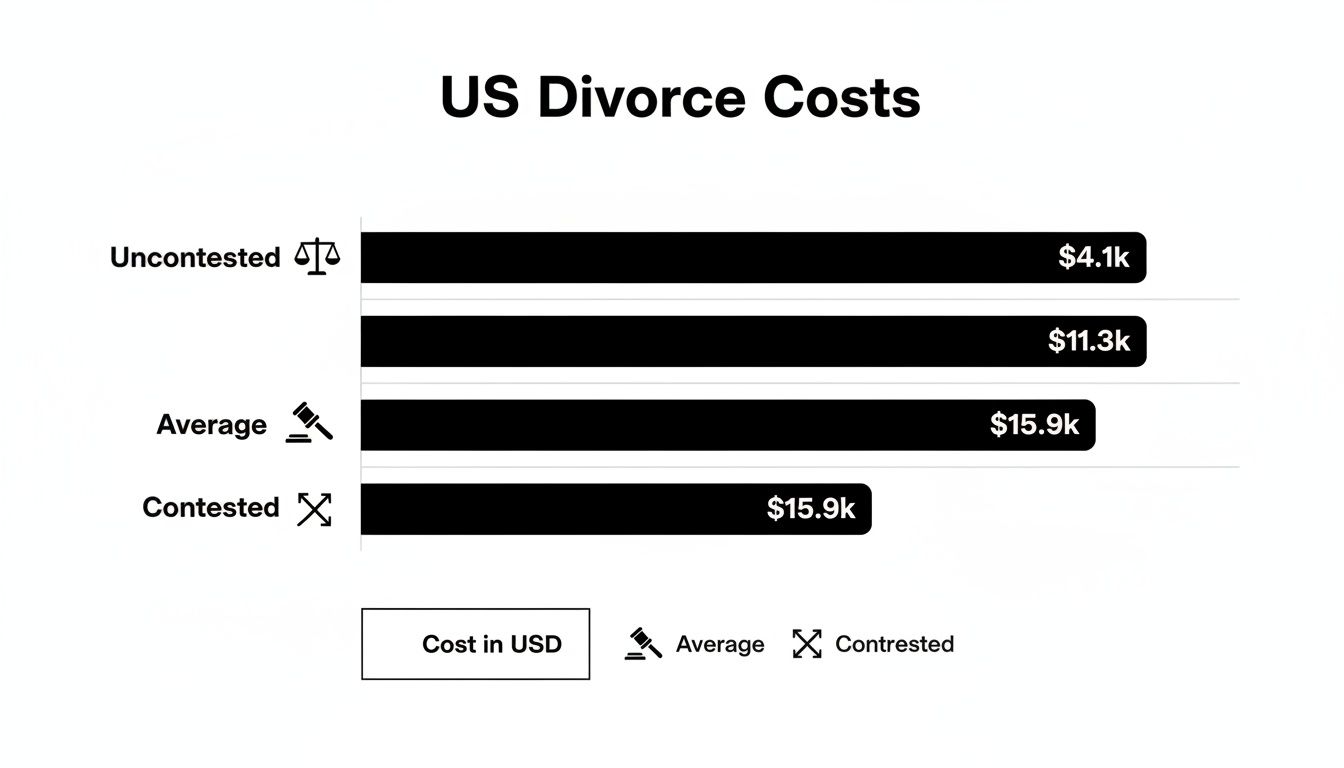
As you can see, working things out amicably in an uncontested divorce keeps costs at their lowest. It’s the contested cases, where disputes drag on, that really drive the expenses through the roof.
To give you a better handle on what to expect, we've put together a quick reference table showing the typical cost ranges for different types of divorces right here in Texas.
Estimated Divorce Costs in Texas by Type
This table provides a quick reference for the typical financial ranges of different divorce scenarios in Texas, from simple uncontested cases to complex litigation.
| Divorce Type | Typical Cost Range | Key Characteristics |
|---|---|---|
| Uncontested Divorce | $3,000 – $5,000 | Spouses agree on all major issues (property, debt, children). Minimal attorney involvement, mostly for paperwork. |
| Contested Divorce (Standard) | $15,000 – $30,000 | Disagreements on one or more key issues. Requires mediation, discovery, and potential court hearings. |
| High-Net-Worth Divorce | $50,000+ | Involves complex assets like businesses, investments, or multiple properties. Often requires financial experts. |
| Military Divorce | $15,000 – $35,000 | Involves specific rules for dividing military retirement and benefits, adding complexity. |
These numbers are just estimates, of course, but they give you a realistic idea of the financial road ahead.
The single greatest factor in determining the cost of your divorce is conflict. Reducing disagreements and finding common ground is the most effective way to protect your financial resources.
Ultimately, the goal isn’t just to get divorced. It’s to emerge on the other side financially stable and ready to start your next chapter. By understanding what drives the cost, you can take strategic steps to manage the expenses and protect your future.
If you need help navigating divorce, custody, or any other family law matter in Texas, contact The Law Office of Bryan Fagan today for a free consultation.
Decoding Your Legal Bill: What You Are Paying For
Understanding where your money is going is the first step toward feeling in control of your divorce. A legal bill might look intimidating at first glance, but it’s really just a breakdown of the services and required costs that keep your case moving forward. Once you demystify these expenses, you can budget more effectively and work with your attorney as a true partner.

The very first costs you’ll run into are the non-negotiable fees required by the state or county. Think of these as the basic administrative price of admission to get your case into the legal system.
Foundational Divorce Expenses
Before any real legal work can even start, a few standard fees apply to nearly every single case.
- Court Filing Fees: Every divorce kicks off with filing an Original Petition for Divorce. Texas counties charge a fee for this initial paperwork, which is typically in the $300 to $350 range. This fee is what officially opens your case with the court.
- Service of Process Fees: Your spouse must be formally notified that you’ve filed for divorce. This is handled by a “process server” or a sheriff’s deputy who physically delivers the legal documents. This service usually costs between $75 and $150.
These initial costs are unavoidable, but they’re just a small piece of the puzzle. The biggest chunk of your legal bill will almost always come from your attorney’s direct work on your case.
Understanding Attorney Fees
This is the main driver of divorce costs, and it’s structured to reflect the time, expertise, and effort your specific case demands. Getting a handle on how these fees work is absolutely essential for managing your budget.
Most family law attorneys in Texas work on an hourly basis. This means you’re billed for the actual time your legal team spends on your case—everything from phone calls and drafting documents to court appearances. The rates can vary quite a bit based on an attorney’s experience, but it’s a transparent system where you can see exactly what work is being done. You can learn more about how Texas family law attorneys bill for their services in our detailed guide.
A retainer is not a flat fee for your entire divorce. It’s an upfront deposit that your attorney bills against as they perform work. You will be required to replenish the retainer if the funds are depleted and work still needs to be done.
A retainer is the upfront payment most attorneys require to get started. This isn’t the total cost of your divorce; it’s more like a down payment held in a trust account. As your attorney works, they deduct their hourly fees from this retainer. You may need to add more funds to it if the initial amount runs low.
In some very simple, completely uncontested cases, an attorney might offer a flat fee. This is a single, agreed-upon price for a specific scope of work, like drafting and filing all the necessary documents for a divorce, where both spouses agree on everything from the start.
Costs for Third-Party Professionals and Experts
When a case gets more complicated, you often need to bring in outside experts for specialized analysis. These professionals work with your attorney to protect your interests, particularly when it comes to children and valuable property.
- Mediation: Most courts in Texas will require you to try mediation before you can go to trial. A neutral third-party mediator sits down with you and your spouse to help you negotiate a settlement. Mediators usually charge by the hour, and the total cost (which is often split between spouses) can run anywhere from $1,000 to $5,000 or even more, depending on how complex the issues are.
- Property Appraisers & Business Valuators: If you own a house, a business, or other complicated assets, you’ll likely need an expert to determine their fair market value so they can be divided equitably.
- Forensic Accountants: In messy situations where one spouse thinks the other is hiding assets or lying about their income, a forensic accountant can dig through financial records to uncover the truth.
While hiring these experts does add to the overall cost, their input is often absolutely critical to securing a fair and just outcome.
Key Issues That Drive Up Divorce Costs
If you want to manage the cost of your divorce, you first have to know what makes it expensive in the first place. After decades practicing family law here in Texas, we can tell you that high legal bills almost always boil down to two core areas of conflict: disagreements over children and disputes over property.

It’s shocking how fast a seemingly minor disagreement can spiral into a full-blown, costly legal battle. What starts as a simple debate over a holiday visitation schedule or the true value of a small family business can quickly escalate. Before you know it, you’re dealing with formal motions, multiple court hearings, and extensive information gathering—all of which drive up attorney hours and your final bill.
Our goal is to give you the knowledge to handle these sensitive issues strategically. Understanding how Texas law looks at these disputes helps you focus your resources on what truly matters for your family’s future, potentially saving you thousands of dollars.
The Financial Impact of Custody Battles
For any parent, nothing is more important than their children’s well-being. That fierce, protective instinct is completely natural. But sometimes, it can lead to stubborn, intractable disputes over custody and possession schedules, making it the single biggest driver of high divorce costs.
When parents just can’t agree, the court has to step in. And that process isn’t simple. It often involves:
- Temporary Orders Hearings: Think of these as mini-trials right at the start of your case. They set the temporary rules for where the kids will live and what the visitation schedule will look like while the divorce is ongoing.
- Discovery: This is the formal process of exchanging information. It can include written questions (interrogatories), requests for documents, and depositions (out-of-court testimony given under oath).
- Custody Evaluations: If there are serious concerns about a parent’s fitness, the court might appoint a mental health professional to conduct a deep-dive evaluation of the family and make a recommendation. This step alone can cost $5,000 to $15,000 or even more.
The Texas Family Code § 153.002 mandates that all custody decisions must be in the “best interest of the child.” This is a very broad standard. Proving what’s best for your child can demand a significant amount of time, evidence, and legal argument, all of which translate directly into higher legal fees.
The Complexity of Property Division
The second major factor that sends divorce costs soaring is the division of community property. According to the Texas Family Code § 7.001, all property acquired during the marriage is considered community property and must be divided in a “just and right” manner.
Sounds straightforward, right? But the disagreements often pop up in the details:
- Characterization of Property: Arguments can erupt over whether an asset is community property or one spouse’s separate property (anything owned before the marriage or received as a gift or inheritance).
- Valuation of Assets: Spouses frequently disagree on the value of a house, a business, retirement accounts, or stock options. This often means hiring expensive expert appraisers to settle the debate.
- Hidden Assets: If one spouse suspects the other is hiding money or property, your attorney might need to bring in a forensic accountant to trace the financial records. It’s a costly step, but sometimes a necessary one.
For example, if a couple disagrees on the value of a small business, one spouse might claim it’s worth $50,000 while the other insists it’s worth $250,000. To resolve this, each side might hire their own business valuation expert. This could lead to depositions of both experts and a contested hearing before a judge, easily adding $10,000 to $20,000 or more to the final bill over a single asset.
Ultimately, cooperation and a willingness to find common ground are your most powerful cost-saving tools. By working to find a middle ground on these key issues, you can keep control of the process—and your finances.
Proven Strategies to Reduce the Cost of Your Divorce
The financial strain of a divorce can feel like a heavy weight, but you have more control over the final bill than you might think. The key is to be strategic and proactive from the very beginning. By focusing on cooperation and using the right legal tools, you can slash expenses while still protecting your long-term interests.
The single most powerful way to save money is to stay out of the courtroom as much as possible. Courtroom litigation is, by a huge margin, the most expensive and emotionally draining path you can take. Fortunately, Texas law encourages methods known as Alternative Dispute Resolution (ADR), which are designed specifically to help couples find common ground without a judge making the final call.
These methods don’t just save a ton on attorney fees and court costs; they also give you and your spouse more control over the outcome. Instead of a stranger in a black robe deciding your family’s future, you get to craft a solution that actually works for your family.
Embrace Mediation and Collaborative Divorce
Two of the most effective tools in the ADR toolbox are mediation and collaborative divorce. They’re different, but they both share the goal of resolving disputes respectfully and efficiently.
Mediation is a process where you and your spouse sit down with a neutral third-party mediator. This person doesn’t make decisions for you. Instead, they facilitate a productive conversation, helping you find areas of compromise on tough issues like dividing property or creating a parenting plan. Nearly every court in Texas requires couples to at least try mediation before going to trial, and for good reason—it works. The cost of a mediator for one day is a tiny fraction of what it costs to prepare for and conduct a trial. You can find more details in our guide on the role of mediation in a Texas family law case.
Collaborative Divorce is a more structured approach where you, your spouse, and your respective attorneys all sign a contract agreeing to resolve every issue without going to court. This creates a team environment focused on creative problem-solving rather than fighting. It often brings in other neutral professionals, like financial planners or child specialists, to help build a fair and comprehensive settlement.
Key Takeaway: Choosing an out-of-court process like mediation or collaborative divorce is the single most impactful decision you can make to lower the cost of your divorce. It replaces conflict with cooperation, saving both money and emotional heartache.
Work Efficiently with Your Attorney
Your relationship with your attorney is a partnership, and how you manage it directly affects your legal bill. Being an organized, prepared client helps your legal team work more efficiently, which saves you money. Here are a few practical, actionable steps you can take:
- Gather Your Documents: Before you even meet with your attorney, start collecting all the relevant financial documents. We’re talking tax returns, bank statements, pay stubs, retirement account info, and property deeds. Handing this over in an organized way saves your attorney’s team from spending billable hours hunting it all down.
- Communicate Clearly: Try to bundle your questions and updates into a single, concise email instead of sending five different messages or making a bunch of short phone calls. This lets your attorney address everything at once, cutting down on the time spent on administrative back-and-forth.
- Be Honest and Transparent: Hiding information or being less than truthful with your lawyer will always cost you more in the long run. Your attorney can only build a strong strategy if they have all the facts. Surprises that pop up later often require expensive course corrections.
Focus on Compromise
Finally, a willingness to compromise is your greatest financial asset during a divorce. Not every issue is a hill worth dying on. It’s absolutely crucial to figure out the difference between your “must-haves” and your “nice-to-haves.”
Spending thousands of dollars in legal fees fighting over a piece of furniture worth a few hundred bucks just doesn’t make financial sense. Save your emotional and financial energy for the most critical decisions, like custody arrangements and how major assets are divided. To reduce conflict and potentially save on legal bills, you might also want to explore ‘conscious uncoupling’ as a mindset for a more amicable separation.
By focusing on these strategies, you can take control of the divorce process and steer it toward a more affordable and dignified conclusion.
If you need help navigating divorce, custody, or estate planning in Texas, contact The Law Office of Bryan Fagan today for a free consultation.
Putting Texas Divorce Costs in a Global Context
When you see the potential price tag for a Texas divorce, it’s easy to feel a bit of sticker shock. You might even wonder why the financial investment has to be so high. But if we pull back and look at the bigger picture, things start to make a lot more sense. While divorce is a universal experience, the legal and financial journey to get there is wildly different from one country to the next. That contrast really shines a light on what makes the American legal system—and Texas family law—so unique.

This isn’t just a feeling; the numbers tell a pretty clear story. The global market for divorce services hit an estimated $4.5 billion in 2024 and is on track to reach $6.2 billion by 2035. While crude divorce rates hover around 1.7 per 1,000 people worldwide, the U.S. rate is quite a bit higher, landing between 2.3 and 2.7 per 1,000.
The financial gap is where it really gets interesting. A divorce filing in the UK runs about $600. In a country like Sweden, the entire process might cost between $500 to $1,500. Now, compare that to the average U.S. divorce, which costs between $11,300 and $15,000. Here in Texas, it’s not uncommon for contested cases to blow past $20,000. You can dig deeper into these divorce marketing statistics to get a better sense of the global landscape.
Why Is Divorce in Texas More Expensive?
So, what’s behind this massive difference in cost? It boils down to the fact that the American legal system, including Texas family law, is built on an adversarial model. This system is designed with extensive procedures to protect individual rights, but those very protections are what drive up the cost.
These procedures often involve:
- Formal Discovery: A long and detailed process where both sides exchange information through written questions (interrogatories), sworn testimony (depositions), and requests for documents.
- Motion Practice: Filing legal motions and going to court for temporary orders, resolving disputes over discovery, or handling other issues that pop up along the way.
- Expert Reliance: Frequently needing to hire third-party experts like property appraisers, custody evaluators, or forensic accountants to provide specialized evidence.
In many other countries, the legal process feels more administrative and less like a battle, especially if the spouses are in agreement. The U.S. system’s intense focus on detailed evidence and formal court proceedings just naturally burns through more attorney hours and racks up higher costs.
The point of this comparison isn’t to scare you, but to arm you with a clear understanding of what you’re facing. The complexity of Texas divorce law is precisely why having a skilled attorney in your corner is so valuable. An experienced lawyer knows how to navigate this system efficiently, sidestep unnecessary fights, and focus your resources where they’ll do the most good. That expertise doesn’t just protect your rights—it’s your most powerful tool for managing the financial side of your divorce.
If you need help navigating divorce, custody, or estate planning in Texas, contact The Law Office of Bryan Fagan today for a free consultation.
Taking Your Next Steps with Confidence and Clarity
The money side of divorce is often overwhelming, but we want to be crystal clear about something: you don’t have to figure this out alone. As we’ve walked through in this guide, the costs can be steep, but they are far from uncontrollable. You have more power over the final price tag than you might think.
By understanding how the process works, choosing the right legal path for your situation, and leaning into cooperation whenever you can, you’re already taking steps to protect your financial future. The single biggest decision you’ll make is picking an experienced attorney who can give you guidance that actually fits your family’s unique circumstances.
Charting Your Path Forward
It’s completely normal to feel uncertain about what to do next. The best way to replace that uncertainty is with good information and a solid plan. Think of an attorney as both your advocate and your guide—someone who makes sure you understand your rights and options under the Texas Family Code every step of the way.
A productive first step isn’t just about hiring a lawyer; it’s about finding a trusted partner who will listen to your story, answer your questions, and empower you to make clear-headed decisions for your future.
Knowledge is the bedrock of confidence. Before you commit to anything, it makes sense to explore all your options. If you’re wondering what comes next, you can get a better sense of things by reading about taking your first step toward a Texas divorce. It will help you prepare for the road ahead with a much clearer perspective on what to expect.
We’re here to help you build that confidence. Our team is committed to giving you the clear, compassionate, and expert advice you need to get through this. Your peace of mind is our priority, and that always starts with an honest conversation about where you are now and where you want to be.
If you need help navigating divorce, custody, or estate planning in Texas, contact The Law Office of Bryan Fagan today for a free consultation.
Frequently Asked Questions About Divorce Costs
Going through a divorce brings a wave of questions, and many of them revolve around the financial side of things. We’ve gathered some of the most common questions we hear from clients to give you direct, practical answers and a little extra clarity as you figure out your next steps.
What Is the Cheapest Way to Get a Divorce in Texas?
Without a doubt, the most affordable path is an uncontested divorce. This is the route you can take when you and your spouse have already agreed on all the big issues—how to divide property, who takes what debt, and every detail involving the kids—before anything is even filed with the court.
When you can resolve these disagreements on your own, you drastically cut down on attorney hours and completely sidestep expensive court battles. It’s not always easy, but working together allows you to finalize your divorce for a tiny fraction of what a contested case would cost.
Can I Get My Spouse to Pay My Attorney Fees?
It’s possible, but it’s far from a sure thing. Under the Texas Family Code, a judge has the authority to order one spouse to pay some or all of the other’s attorney fees.
This isn’t something judges do automatically. It’s typically reserved for situations where there’s a huge gap in income between the spouses, or if one person has acted in bad faith—lying, hiding assets, or dragging things out just to be difficult. The judge will look at the whole picture and decide what’s fair and just for everyone involved.
While you can always ask the court to make your spouse cover your legal fees, you should never count on it. Always go into a divorce prepared to finance your own legal representation from the start.
Why Is My Retainer Not the Total Cost of My Divorce?
This is a point that trips a lot of people up, so it’s a critical one to understand. Your retainer isn’t a flat fee that covers the entire divorce. It’s better to think of it as a down payment or a security deposit that we hold for you in a special trust account.
As your attorney works on your case, they bill their hourly rate against that retainer fund. Once those initial funds run out, you’ll need to add more money to the account to cover the ongoing legal work. The final, total cost of your divorce is determined by the actual hours your legal team spends on your case, which all comes down to its complexity and the level of conflict between you and your spouse.
Does a Fault Divorce Cost More?
Yes, almost every time. When you file for a “fault” divorce in Texas, you’re asking the court to grant the divorce based on your spouse’s misconduct, like adultery or cruelty. To win, you have to prove the fault with solid evidence.
This process often requires digging deep with formal discovery, conducting depositions, and sometimes even hiring private investigators to gather proof. All of that extra legal work and investigation adds up quickly, translating directly into higher attorney fees and a much more expensive divorce.
If you need help navigating divorce, custody, or estate planning in Texas, contact The Law Office of Bryan Fagan, PLLC today for a free consultation.