
Going through a divorce can be one of life’s most difficult transitions—but understanding your rights under Texas law can make it less overwhelming. Financial stability is one of the biggest concerns we see, and in Texas, the rules around post-divorce support can be confusing. What most people call alimony is legally known as "spousal maintenance," and Texas law is much more restrictive than you might find in other states. It’s a huge myth that this kind of support is a given in every divorce—in reality, it’s the exception, not the rule.
Your Guide to Spousal Maintenance in Texas
Divorce can feel like you're navigating a storm, but understanding your rights is the first step toward finding solid ground and planning your future. We created this guide to pull back the curtain on the often-misunderstood topic of alimony in Texas. Our goal is to give you a clear, realistic overview of what to expect so you can face this transition with confidence.
Here at The Law Office of Bryan Fagan, we believe that an informed client is an empowered one. We'll walk you through key principles in the Texas Family Code, starting with the critical difference between court-ordered support and a private agreement between spouses, and provide practical guidance you can use.
Understanding the Texas Approach to Alimony
Texas has a unique history when it comes to post-divorce financial support. Believe it or not, Texas was the very last state in the country to allow court-ordered alimony, finally passing a law in 1995. For decades, the state's public policy was firmly against it. Even though Texas eventually joined the other 49 states, that historical skepticism still shapes the law today, resulting in one of the most restrictive systems in the nation. You can read more about this history and its modern-day impact.
This background really matters because it influences how judges view these requests. Unlike in states where alimony is common, Texas law sets a very high bar for anyone seeking spousal maintenance.
What Is the Difference Between Spousal Maintenance and Contractual Alimony?
It's vital to know that there are two different paths to post-divorce support in Texas, and they work in completely different ways:
- Court-Ordered Spousal Maintenance: This is what a judge can require one spouse to pay the other after the divorce is final. It is strictly controlled by the Texas Family Code, which lays out rigid rules on who qualifies, how much they can get, and for how long.
- Contractual Alimony: This is a voluntary, private agreement made between the two spouses, usually as part of their overall divorce settlement. Since it's a contract, it isn't bound by the strict limits of the law. This option gives couples the flexibility to create a support plan that fits their unique situation, often going beyond what a court could order.
For the most part, this guide will concentrate on court-ordered spousal maintenance because that's where the legal hurdles are highest. Getting a firm grip on these foundational concepts will set you up for success as we dive into the details.
How to Qualify for Spousal Maintenance in Texas
Unlike many other states where post-divorce support is almost a given, Texas sets a very high bar for court-ordered spousal maintenance. Securing these payments is never automatic. The spouse seeking support must first prove to the court that they've made a genuine, good-faith effort to provide for their own "minimum reasonable needs." This is the first hurdle you have to clear.
This means you have to show that you’ve actively looked for work or tried to develop the skills needed to become self-sufficient. Only after you’ve demonstrated this effort will the court even begin to consider if you meet one of the specific legal grounds for eligibility. This initial requirement reinforces a core principle in Texas law: each spouse is expected to strive for financial independence after a divorce.
The Foundational Test of Financial Need
Before a judge even looks at the reasons you might qualify, they’re going to scrutinize your financial situation. The Texas Family Code is clear: you must prove that you will lack sufficient property, including your separate property, to provide for your minimum reasonable needs once the divorce is final.
This is a very fact-specific analysis. There's no magic number for what constitutes "minimum reasonable needs," as it can vary dramatically based on the circumstances of the marriage. The court will dig into your monthly expenses, your earning potential, and the assets you’re set to receive in the property division. If the judge decides that the assets you are awarded are enough to meet your basic needs, your request for maintenance will almost certainly be denied, no matter what other factors are at play.
This visual decision tree helps illustrate the initial paths and key questions in a Texas spousal support case.
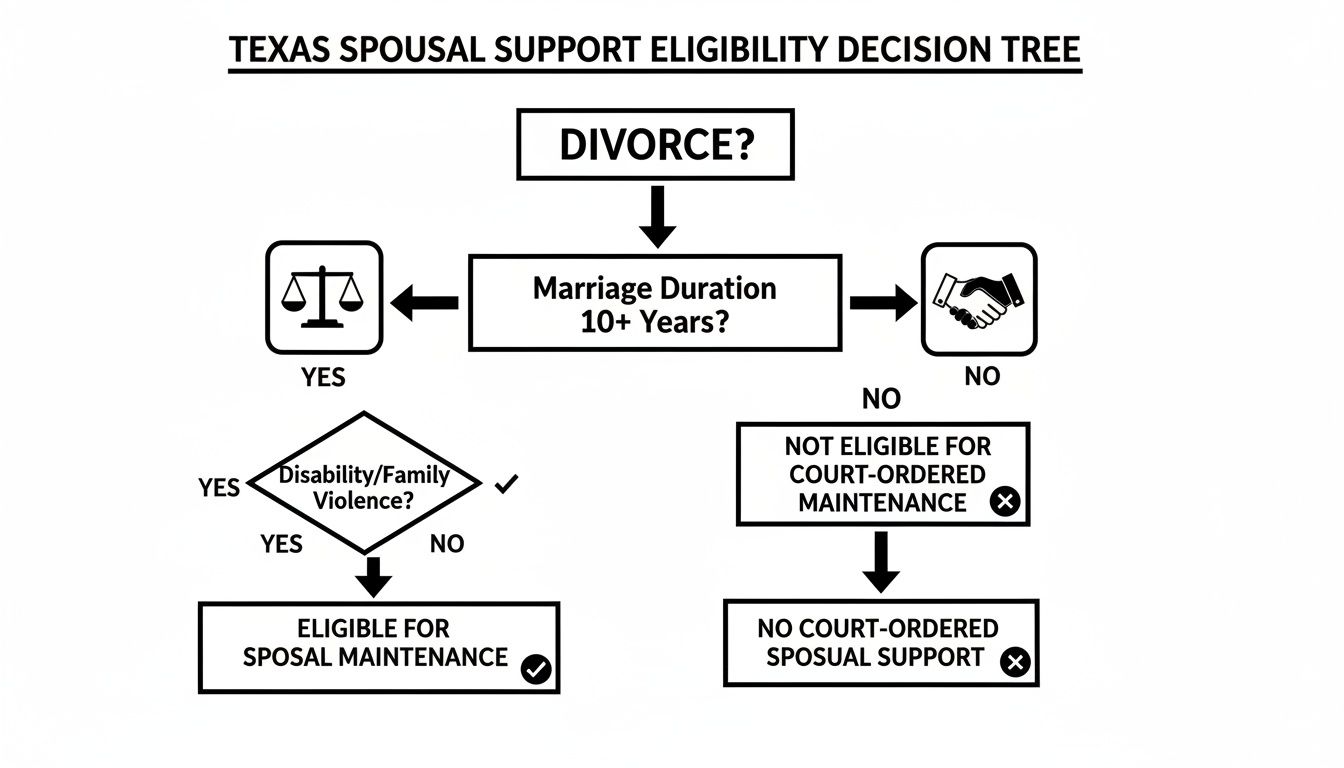
As the flowchart shows, the path to a court order is narrow and demands you meet specific legal tests. A private agreement between spouses, on the other hand, offers a lot more flexibility.
Primary Paths to Eligibility in Texas
So, let's say you've proven you've tried to be self-supporting but still can't cover your basic needs. What's next? You must then qualify under at least one of the scenarios laid out in Texas Family Code § 8.051.
-
The 10-Year Marriage Rule: This is the most common route. You may be eligible for maintenance if you were married for 10 years or longer and lack the ability to earn a sufficient income to provide for your minimum reasonable needs. A classic example is a stay-at-home parent who has been out of the workforce for 15 years to raise children and now has an uphill battle to re-enter the job market.
-
Family Violence Conviction: The 10-year rule is waived if your spouse was convicted of (or received deferred adjudication for) a criminal offense that also constitutes an act of family violence under the Texas Family Code. This must have occurred within two years of filing for divorce or while the case is pending. This is a critical protection for victims of abuse.
-
Disability of the Requesting Spouse: If an incapacitating physical or mental disability prevents you from earning enough to support yourself, you may be eligible for maintenance regardless of how long you were married.
-
Caring for a Child with a Disability: You may also qualify if you are the primary caretaker of a child of the marriage (of any age) who has a physical or mental disability requiring substantial care, which in turn prevents you from earning sufficient income.
To help clarify these narrow grounds, here is a quick summary of the legal requirements.
Spousal Maintenance Eligibility at a Glance
This table breaks down the primary legal grounds a spouse must prove to qualify for court-ordered spousal maintenance in Texas.
| Eligibility Ground | Key Requirement (Texas Family Code Sec. 8.051) | Common Scenario |
|---|---|---|
| 10-Year Marriage | Married for 10 years or longer and lacks the ability to earn sufficient income to meet minimum needs. | A long-term homemaker with limited recent work experience who supported the family while the other spouse built a career. |
| Family Violence | Spouse was convicted of or received deferred adjudication for an act of family violence within the last 2 years. | A spouse who is leaving an abusive marriage and needs financial support to establish a safe, independent life. |
| Spouse's Incapacitating Disability | An incapacitating physical or mental disability prevents the requesting spouse from earning a sufficient income. | A spouse suffers a debilitating illness or injury during the marriage that makes it impossible to work. |
| Child's Disability | Custodian of a child of the marriage with a disability that requires substantial care, preventing work. | A parent who provides full-time, round-the-clock care for a child with special needs. |
As you can see, eligibility for spousal maintenance in Texas is highly restricted. It all comes down to meeting these specific statutory criteria. Unlike in more permissive states, Texas courts don't just hand out alimony. They must find that the requesting spouse truly cannot support themselves after the divorce, and only then if they fit into one of these strict categories. You can discover more insights about Texas divorce statistics to see just how these strict rules play out in practice. Understanding which path, if any, applies to your situation is the critical first step in building a strong case.
Calculating Maintenance Amounts and Duration
Once a Texas court agrees that a spouse is eligible for maintenance, the conversation pivots to two critical questions: "How much will the payments be?" and "How long will they last?"
Unlike some states where judges have significant discretion, Texas law puts firm guardrails on both the amount and the duration of spousal maintenance. This is designed to keep awards reasonable and reinforce the idea that this support is temporary, not a permanent lifestyle. These calculations aren't just plugging numbers into a formula; they require a careful look at the Texas Family Code and the specific facts of your case.

How Texas Courts Determine the Payment Amount
Texas law is very clear: there’s a hard ceiling on court-ordered spousal maintenance. A judge cannot order payments that are more than the lesser of two figures: $5,000 per month or 20% of the paying spouse's average monthly gross income. This statutory cap is important because it prevents runaway awards and gives everyone a predictable range to work within.
To land on a final number below that cap, the judge has to weigh all the relevant circumstances. The guiding list of factors comes directly from Texas Family Code § 8.052.
Key Factors Influencing the Maintenance Amount:
- The financial resources each spouse has after the community property is divided.
- The education, job history, and realistic earning ability of each person.
- The age, physical health, and emotional well-being of the spouse asking for support.
- How long the couple was married.
- Any marital misconduct, like adultery or cruelty, committed by either spouse.
- The contributions one spouse made as a homemaker.
- Any history or pattern of family violence.
For example: Sarah and Tom are divorcing after a 22-year marriage, and Sarah, who was a stay-at-home parent, qualifies for maintenance. Tom earns a gross monthly income of $15,000. The absolute most a judge could award Sarah is $3,000 per month (20% of $15,000), since that's less than the $5,000 cap. The judge might award that full $3,000 if Sarah has very few job prospects and the property division leaves her without many income-producing assets. But if Sarah already works part-time and received a significant cash payout in the divorce, the judge might order a smaller amount, perhaps $1,500, just to bridge the gap.
How Long Can Spousal Maintenance Last?
Just like the payment amount, the duration of maintenance is also strictly limited. The biggest factor here is the length of the marriage. Texas law sets up a tiered system that ties the maximum support period to the time the receiving spouse was likely out of the workforce or financially dependent.
The entire point is to provide support for the shortest reasonable time needed for the receiving spouse to get on their feet and meet their own "minimum reasonable needs." The law makes important exceptions for situations involving a disability, but for most, the clock is ticking from the start.
The table below breaks down the maximum time limits for maintenance payments according to the Texas Family Code.
Maximum Duration of Spousal Maintenance Payments in Texas
This table outlines the maximum period a court can order spousal maintenance based on the length of the marriage, as defined by the Texas Family Code.
| Length of Marriage | Maximum Duration of Maintenance | Applicable Circumstance |
|---|---|---|
| 10 to 20 years | 5 years | This applies to most standard eligibility cases based on marriage length. |
| 20 to 30 years | 7 years | For longer marriages where a spouse may need more time to become self-sufficient. |
| 30 years or more | 10 years | Acknowledges the significant economic dependency that can develop over a very long-term marriage. |
| Any length (with disability or family violence) | Varies | For cases involving a spouse's disability, care of a disabled child, or family violence. |
It’s critical to remember that these are maximums. A judge can—and frequently will—order maintenance for a shorter period if they believe the receiving spouse can become self-sufficient sooner.
In fact, the law operates on a “rebuttable presumption” that maintenance isn’t needed at all unless the spouse has been actively looking for a job or getting the skills necessary to find one. This really drives home the Texas expectation that both people will work toward their own financial independence after a divorce. Understanding these strict limits on alimony in Texas is a crucial first step in planning for your financial future post-divorce.
Contractual Alimony vs. Court-Ordered Maintenance
When it comes to post-divorce financial support in Texas, you aren’t stuck on a single path. The road actually forks into two very different routes, and knowing the difference is one of the most important things you can do to protect your financial future. The two options are court-ordered spousal maintenance and contractual alimony, and they play by completely different sets of rules.
Court-ordered spousal maintenance is what a judge can force one spouse to pay the other. As we’ve covered, this type of support is tightly controlled by the Texas Family Code. There are strict limits on who qualifies, how much they can get, and for how long. It’s meant to be a temporary safety net, not a permanent solution.

The Flexibility of Contractual Alimony
Contractual alimony is a different animal altogether. It’s a private agreement negotiated between you and your spouse, usually hashed out in mediation or a collaborative divorce setting. Because it’s a contract, it isn’t chained to the strict legal limits that tie a judge’s hands. This flexibility is its biggest advantage, letting you and your spouse craft a solution that actually fits your lives—something a court simply can’t do.
With a private agreement, you and your spouse call the shots:
- Payment Amounts: You can agree to payments that go above the $5,000/month or 20% income cap.
- Duration: The support can last much longer than the maximums allowed by law.
- Modifications: You can make the agreement non-modifiable, which means a court can’t touch the terms later on. This gives both of you certainty.
- Payment Method: Payments can be made in a single lump sum or structured in other creative ways to benefit both of you.
This kind of creative freedom can be an incredibly powerful tool for reaching a final settlement that everyone feels is fair.
Why Agree to Contractual Alimony?
Now, you might be wondering why a higher-earning spouse would ever agree to pay more in contractual alimony than a court could possibly order. The answer almost always comes down to the classic give-and-take of dividing up property. Contractual support can become a strategic bargaining chip to get something else you really want in the divorce.
Scenario: Let’s say a husband, David, wants to keep the family business, which is a big community property asset. His wife, Emily, might not qualify for court-ordered maintenance, but she’s still entitled to half the value of that business. To avoid having to sell the company or take out a huge loan to buy Emily out, David could offer to pay her contractual alimony for several years instead.
In this case, Emily gets the steady financial support she needs to get back on her feet, and David gets to keep the business he built. It’s a win-win that would be almost impossible to achieve in a courtroom battle over maintenance and property. If this sounds like a possibility, you can learn more about how contractual alimony is used as a form of spousal support. It opens the door to solutions that respect what’s important to both people, turning a major point of conflict into a mutually beneficial agreement.
When and How to Modify or End Maintenance Payments
Life rarely stands still after a divorce. A new job, a major health crisis, or a new relationship can completely upend the financial reality that existed when your spousal maintenance order was first signed. What seemed fair and necessary then might not make any sense today. Fortunately, Texas law understands this and provides a clear legal path to adjust or even terminate these payments.
But a court won’t change an order just because you ask. You have to prove there has been a material and substantial change in the circumstances of either spouse since the original order was made. This is the legal standard, and it requires solid, compelling evidence. Just feeling like the payments are unfair isn’t enough; you need to show the judge that a truly significant financial shift has happened.
Proving a Material and Substantial Change
So, what exactly counts as a “material and substantial change”? While every case is different, Texas courts are generally looking for major life events that directly impact someone’s ability to pay or their need for support. This isn’t about minor monthly income fluctuations—it’s about a fundamental change to the financial picture.
Common examples that might justify a modification include:
- Involuntary Job Loss: If the paying spouse gets laid off, this is a strong reason to ask for payments to be reduced, either temporarily or permanently.
- Significant Promotion or Raise: On the flip side, if the receiving spouse lands a new job with a much higher salary, their need for support may be reduced or eliminated entirely.
- A Change in Health: A serious illness or disability that prevents either spouse from working can definitely be grounds for a modification.
- Remarriage or Cohabitation: This is a big one. It’s often the event that brings maintenance payments to a final stop.
It’s critical to act fast when these changes happen. A court can’t go back in time and modify past payments. Any change will only apply from the date you officially file your request with the court.
Automatic Termination of Maintenance Payments
While some situations require a court hearing to change an order, others lead to an automatic, immediate end to the spousal maintenance obligation under the Texas Family Code. In these specific cases, you don’t even need to go back to court for a new order—the obligation simply ends by law.
Spousal maintenance automatically ends if:
- The receiving spouse remarries. The law assumes their new partner will provide financial support, which ends the former spouse’s obligation.
- The receiving spouse cohabits with a romantic partner. If the person receiving payments starts living with someone else in a permanent, romantic relationship, the maintenance can be terminated.
- Either the paying or receiving spouse dies. The duty to pay support or the right to receive it doesn’t pass on to their estate.
For example: if your ex-spouse, who gets maintenance from you, gets married on June 1st, your legal duty to make payments ends right then and there. You would not owe the payment for July or any month after that.
Understanding the specific events that can change your support order is crucial, whether you’re paying or receiving. If you believe your circumstances have changed significantly, the next logical step is to explore your options. You can learn more about how spousal maintenance can be terminated or modified in our detailed article on this topic. Gathering the right evidence and presenting a strong case is the key to getting a fair result.
How Maintenance Affects Property Division and Child Support
In a Texas divorce, none of the financial decisions happen in a vacuum. It’s a classic mistake to treat spousal maintenance, property division, and child support like separate checklist items. The reality is, they are deeply intertwined. A decision in one area sends ripples across your entire financial settlement.
Thinking about these pieces together is absolutely essential for building a stable future. The assets you walk away with, the support your kids receive, and any maintenance payments all have to fit together like a puzzle. Our approach is always to look at the complete financial picture to make sure your final agreement is cohesive and actually works for you in the real world.
The Link Between Property Division and Maintenance
One of the most direct connections is between the property you’re awarded and your eligibility for spousal maintenance. Before a judge can even consider awarding maintenance, Texas law requires them to look at whether the requesting spouse will have enough property—including their own separate property—to cover their minimum reasonable needs.
What this means is that the outcome of your property division can literally make or break a maintenance claim.
- Scenario: Let’s say Sarah is divorcing after a long marriage. If she receives the family home with a lot of equity and a good chunk of her husband’s 401(k), a court might decide those assets are enough to meet her needs. In that case, her request for maintenance would likely be denied.
- Strategic Asset Division: But what if, instead, Sarah is awarded an income-producing asset, like a rental property? That changes the whole equation. The rental income would be counted as a financial resource, which could reduce or even eliminate her need for monthly alimony in Texas.
An effective legal strategy involves carefully balancing the assets you get with the need for ongoing support. Sometimes it makes more sense to take less property in exchange for a solid contractual alimony agreement. Other times, securing a specific income-generating asset is the smarter long-term move.
How Maintenance and Child Support Influence Each Other
While child support and spousal maintenance are legally separate obligations, they are not calculated in isolation. The Texas child support guidelines are based on the paying parent’s net resources, and spousal maintenance can affect this number for both parents.
Here’s how they interact:
- For the Paying Spouse: Court-ordered spousal maintenance payments are usually deducted from the paying spouse’s gross income before their net resources are calculated for child support. This can lead to a lower monthly child support obligation.
- For the Receiving Spouse: On the flip side, the maintenance payments received are typically counted as income for the recipient. While this increases their net resources, its exact impact on the final child support amount really depends on the specific custody arrangement.
This interplay shows just how important a comprehensive strategy is. A skilled attorney will model different financial scenarios, showing how tweaking maintenance could change the child support amount, the property division, and even your tax situation. This allows you to make informed decisions that align with what’s most important to you—whether that’s maximizing monthly cash flow, securing long-term assets, or ensuring your children’s needs are met without compromise.
A truly successful outcome is one that addresses every financial piece of your divorce in a way that works together.
Common Questions About Alimony in Texas
When you’re facing the possibility of divorce, it’s normal for your mind to be swimming with questions. The topic of spousal maintenance, what most people call alimony in Texas, often feels like one of the most confusing and overwhelming parts of the process.
To help bring some clarity and calm your concerns, we’ve put together straightforward answers to the questions we hear most often from our clients. Our goal is to give you solid information, based on the Texas Family Code, so you can feel more prepared for what comes next. Every divorce is different, but these answers should provide a good foundation for understanding where you stand.
Is Alimony Always Awarded in a Texas Divorce?
No, not at all. This is probably the biggest myth about divorce in Texas. In reality, court-ordered spousal maintenance is rare.
Texas law sets a very high bar for a judge to order it. The spouse asking for support has to prove they cannot meet their own “minimum reasonable needs” and also fit into one of several strict categories, such as being married for 10 years or more. Unlike what you may see in movies, there’s no automatic assumption that one spouse will have to pay the other.
Can We Make Our Own Alimony Agreement?
Absolutely. In fact, this is how most post-divorce support happens in Texas. You and your spouse can negotiate your own private agreement, which is called contractual alimony.
This approach gives you the freedom to set terms that actually work for your family, without being locked into the strict limits on amount and duration that a court would impose. Contractual alimony offers tremendous flexibility and is often used as a tool to help settle other significant issues, like how to divide property.
How Does Adultery Affect Spousal Maintenance?
Marital misconduct, and especially adultery, is definitely one of the factors a judge will consider when deciding on spousal maintenance.
If the spouse asking for support was the one who was unfaithful, it could seriously weaken their case or lead to a much smaller award. On the flip side, if the spouse who would be paying maintenance is the one who committed adultery, it could strengthen the other spouse’s argument for needing support. It’s important to remember, though, that it’s just one factor among many and does not automatically guarantee any particular outcome.
What Happens if My Ex-Spouse Stops Paying?
If your ex-spouse is ignoring a court order for maintenance payments, you have legal options. The typical next step is to file an enforcement motion with the court.
A judge has several powerful tools to ensure you get paid. They can issue wage withholding orders to take the money directly from your ex’s paycheck, seize funds from their bank accounts, or even find them in contempt of court, which could lead to fines or even jail time.
It is a violation of a court order to not make these payments, and Texas courts take enforcement seriously.
If you need help navigating divorce, custody, or estate planning in Texas, contact The Law Office of Bryan Fagan today for a free consultation.