
The night Jason finally decided to move out, he wasn’t thinking about courtrooms or legal strategy—he was sitting on the edge of his bed, staring at his phone, wondering one simple thing: how bad is this going to cost me? Divorce cost Texas was the phrase he had typed into Google just minutes earlier, hoping for a clear answer in the middle of a very unclear moment. Like many people, he had heard wildly different stories—some divorces costing a few thousand dollars, others draining life savings—and he had no idea where his situation would fall.
What Jason didn’t realize yet is that the cost of divorce isn’t just shaped by paperwork and attorney fees—it’s shaped by decisions, timing, and how the process is handled from the very beginning. At The Law Office of Bryan Fagan, PLLC, we’ve worked with families across Houston who started exactly where Jason did: uncertain, overwhelmed, and trying to make the right move without making things worse. Texas law, including the “best interest of the child” standard under Texas Family Code §153.002, places a strong emphasis on stability and thoughtful decision-making—especially when children are involved.
Led by Bryan Joseph Fagan, a South Texas College of Law graduate and a recognized authority in Texas family law, our firm is built on a simple mission: to help people regain clarity, control, and peace of mind during life’s most difficult transitions. That means not only explaining what divorce may cost, but helping you understand how to navigate the process in a way that protects your future.
In the sections that follow, we’ll break down what really drives divorce cost Texas, how those costs connect to the decisions you make, and what you can do right now to move forward with confidence instead of uncertainty.
Key Takeaways
- Preparation and organization save money. Clients who gather documents early, stay responsive, and focus on priorities consistently spend less.
- Divorce cost Texas is driven more by decisions than by fixed fees. The way you approach the process—especially early on—has the biggest impact on your total cost.
- Upfront costs are only the starting point. Filing fees and retainers are just the beginning; total expenses depend on conflict level, case complexity, and efficiency.
- Conflict is the single biggest cost driver. The more disagreement between spouses, the more attorney time, court involvement, and overall expense.
- Early decisions shape the entire case. Temporary orders, initial strategy, and early negotiations often determine both cost and outcome.
- Texas courts prioritize stability—especially for children. Under Texas Family Code §153.002, decisions are based on the child’s best interest, which often favors consistency and cooperation.
- DIY divorce can create expensive problems later. While it may reduce upfront costs, mistakes often lead to modifications, delays, and higher long-term expenses.
- Collaborative divorce and mediation can significantly reduce costs. These approaches limit conflict and often lead to faster, more predictable outcomes.
- Uncooperative behavior increases both cost and stress. Delays, unnecessary filings, and refusal to negotiate can quickly escalate expenses.
- Post-divorce costs are often overlooked. Modifications, enforcement actions, and ongoing disputes can add to long-term financial impact.
- Emotional decisions are expensive decisions. Fighting over minor issues or acting out of frustration often leads to higher fees with little practical benefit.
- The right attorney can reduce total cost—not increase it. Efficient strategy, strong negotiation, and proper case management often save more than they cost.

Your Family’s Future Starts Here
Don’t navigate your legal journey alone. Schedule a consultation now and get the clarity and support you deserve.
Divorce Cost Texas: The Short Answer
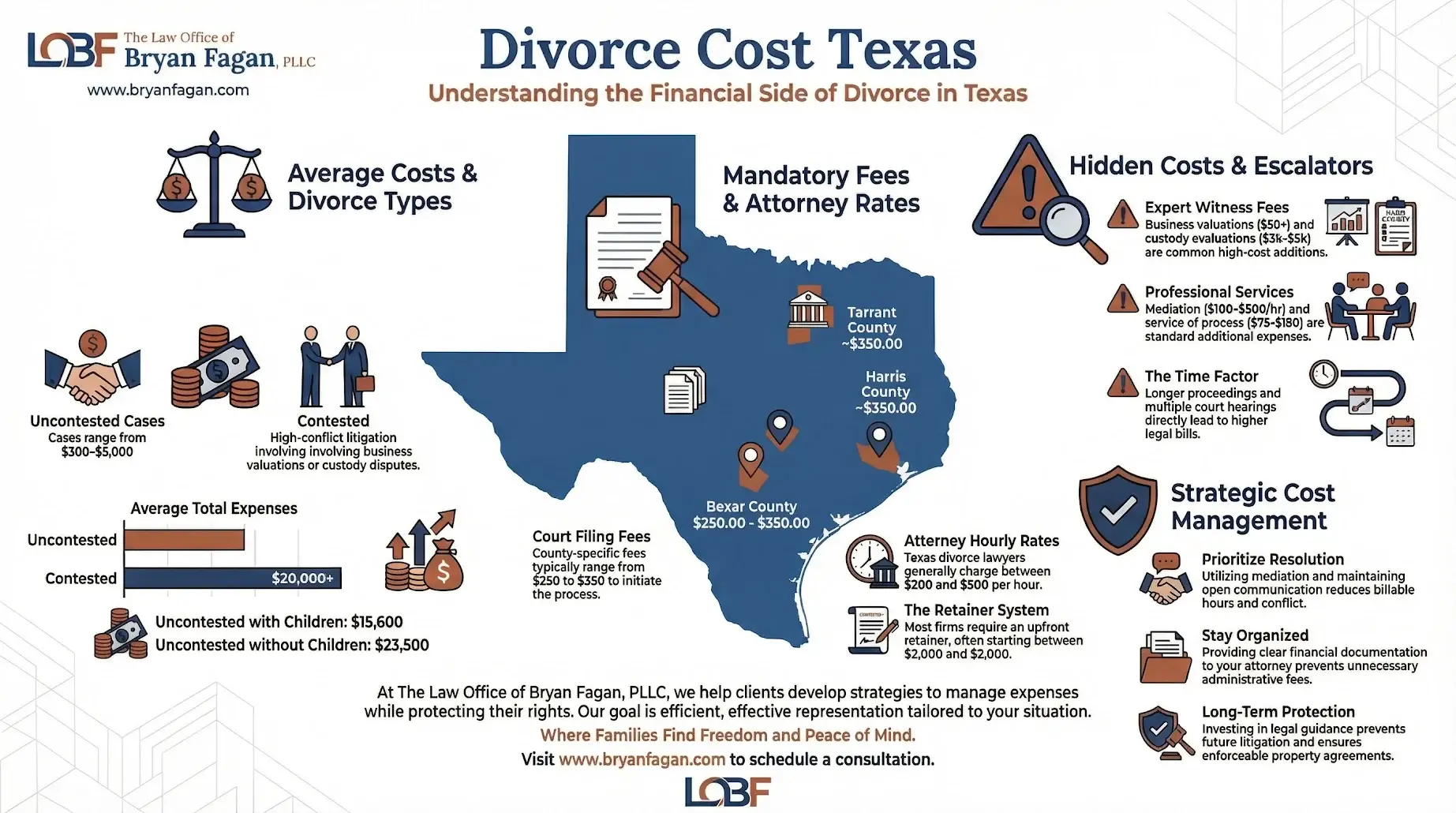
The reality of divorce cost texas is that it varies widely based on how much agreement—or disagreement—exists between spouses. When couples are able to reach consensus on key issues like property division, custody, and support, an uncontested divorce can often be resolved efficiently, with total costs typically ranging from $1,000 to $5,000. These cases move more quickly through the system and require less court involvement. In contrast, contested divorces—where disputes arise over children, finances, or both—can escalate significantly, often ranging from $7,500 to $50,000 or more depending on complexity and duration.
Texas law reinforces why these differences matter. Under Texas Family Code §153.002, courts must make decisions based on the “best interest of the child,” which often requires deeper investigation, hearings, and sometimes expert involvement when parents disagree. Similarly, property division must be handled in a manner that is “just and right” under Texas Family Code §7.001, which can become more time-consuming and expensive when assets are complex or disputed. These legal standards are essential protections for families—but they also explain why contested cases require more time, effort, and cost.
In our experience working with families across Texas, the single greatest factor influencing total cost is conflict. The more issues that require negotiation, discovery, or court intervention, the more attorney time and resources are needed. This is why understanding the factors that increase costs early in the process is so important. For a deeper look at what can drive expenses higher, you can review this resource on factors that can increase divorce costs in Texas, which outlines common pitfalls and how to avoid them.
Ultimately, while no two divorces are the same, one principle remains consistent: cooperation and early strategic planning can significantly reduce both financial and emotional strain. By approaching the process with clarity and informed guidance, families are better positioned to protect their resources and move forward with confidence.

What Is the Average Divorce Cost in Texas?
Understanding divorce cost texas starts with recognizing that most cases fall into predictable ranges based on complexity, level of conflict, and the issues involved. For example, a simple uncontested divorce with no children and minimal assets may cost between $1,000 and $3,000, while uncontested cases involving children often range from $2,500 to $6,000 due to the added need for custody and support arrangements. As disputes increase—particularly around conservatorship, property division, or financial support—costs can rise significantly, with moderately contested cases ranging from $7,500 to $20,000 and high-conflict or trial cases reaching $20,000 to $50,000 or more.
These ranges reflect the total cost of a divorce, including filing fees, attorney fees, mediation, expert evaluations, and other necessary services. Texas law plays a direct role in shaping both the timeline and cost. Under Texas Family Code §6.702, a divorce cannot be finalized until at least 60 days after filing, a mandatory waiting period that applies to nearly all cases. While this timeframe provides an opportunity for reflection and potential settlement, it also impacts how long attorneys are involved and, ultimately, how much a case may cost. Additionally, when children are involved, courts must follow the “best interest of the child” standard under Texas Family Code §153.002, which can require additional hearings, evaluations, and legal work if parents do not agree.
For families trying to plan ahead, reviewing resources like divorce and custody case cost breakdown can provide deeper insight into how expenses are calculated in Texas. You can also explore how child custody is determined in Texas to better understand how legal standards may influence both cost and outcome.
The encouraging reality is that many of these costs are within your control. Families who approach divorce with organization, realistic expectations, and a willingness to cooperate often stay on the lower end of these ranges. With thoughtful planning and the right legal guidance, you can move through the process more efficiently while protecting both your financial future and your family’s well-being.

Real-Life Divorce Cost Scenarios in Texas
Understanding where your situation fits helps set realistic expectations:
Scenario A – Simple Uncontested A couple with no children and minimal shared assets agrees on everything. They use an online divorce service for document preparation and have an attorney review the paperwork. Total cost: approximately $1,000–$2,500.
Scenario B – Uncontested with Children Parents agree on custody, visitation, and child support. An attorney prepares the settlement agreement and files the paperwork. Mediation may be used to finalize details. Total cost: approximately $2,500–$6,000.
Scenario C – Moderately Contested Spouses disagree on who keeps the house and how custody should be structured. Discovery is required, one expert appraiser is hired, and multiple hearings occur before settlement. Total cost: approximately $10,000–$25,000.
Scenario D – High-Conflict with Trial One spouse owns a business, there are allegations affecting custody, and assets are hidden. Forensic accountants, custody evaluators, and multiple court appearances are required. A trial is necessary. Total cost: $30,000–$75,000+.
Your choices determine your category. The path you choose at the beginning shapes everything that follows.
Divorce Cost Breakdown in Texas
Table 1 – Divorce Cost Breakdown in Texas
| Cost Category | Low Range | High Range | When This Applies | Can This Be Avoided? |
|---|---|---|---|---|
| Filing fees | $250 | $400 | Required in every case | No (fee waivers available for financial hardship) |
| Service of process | $50 | $300+ | Required to notify spouse | Partially—cooperative spouses can reduce this |
| Attorney fees (flat fee) | $1,500 | $5,000 | Uncontested cases | Choose flat-fee arrangements when available |
| Attorney fees (hourly) | $5,000 | $30,000+ | Contested cases | Reduce conflict and stay organized |
| Mediation | $300 | $3,000+ | Most contested cases; often court-ordered | Settlement reduces sessions needed |
| Expert witnesses | $2,000 | $25,000+ | Custody evaluations, business valuations | Agree on joint experts; limit scope |
| Discovery costs | $500 | $5,000+ | Disputed assets or income | Cooperate early; produce records promptly |
| Court hearing costs | $500 | $5,000+ | Temporary orders, trial | Settlement avoids most hearings |
Key insight: Attorney fees are usually the largest factor in the total cost of a divorce. Choosing experienced legal representation that works efficiently can save thousands.
Uncontested vs Contested Divorce Costs
Uncontested divorces occur when both spouses agree on all major issues—property division, custody, child support, and spousal support. These cases involve minimal court involvement, often wrap up within 2–4 months, and cost significantly less.
Contested divorces occur when spouses disagree on one or more significant issues. Disputes trigger discovery, temporary orders hearings, mediation, expert evaluations, and potentially trial. These cases often stretch 6–12 months or longer.
Table 2 – Cost Comparison by Divorce Type
| Divorce Type | Estimated Cost | Timeline | Complexity | Stress Level | Control Level |
|---|---|---|---|---|---|
| Uncontested (no children) | $1,000–$3,000 | 2–3 months | Low | Low | High |
| Uncontested (with children) | $2,500–$6,000 | 2–4 months | Low–Moderate | Moderate | High |
| Moderately contested | $7,500–$20,000 | 6–12 months | Moderate | High | Moderate |
| High-conflict / trial | $20,000–$50,000+ | 12–24 months | High | Very High | Low |
The pattern is clear: control and cooperation reduce cost. Conflict increases both expense and time.
How Timeline Affects Divorce Cost in Texas
When it comes to divorce cost texas, time is one of the most important—and often underestimated—factors. The longer a case remains open, the more attorney hours accumulate, and those hours add up quickly. In contested divorces, it’s not uncommon for cases to require 50 to 100 or more attorney hours before reaching trial, with hourly rates often ranging from $250 to $400 or higher depending on experience and complexity. Every additional hearing, filing, or delay increases the overall financial impact.
Texas law directly influences this timeline. Under Texas Family Code §6.702, there is a mandatory 60-day waiting period from the date of filing before a divorce can be finalized. While this waiting period applies to nearly all cases, uncontested divorces often resolve shortly after that timeframe—typically within two to four months—because both parties are aligned on key issues. For a deeper look at how streamlined cases can reduce expenses, resources like uncontested divorce cost in Texas help illustrate how cooperation can significantly shorten timelines and lower costs.
On the other hand, contested divorces can extend well beyond the minimum waiting period. Cases involving custody disputes, complex property division under Texas Family Code §7.001, or disagreements over conservatorship under §153.002 may stretch six months, a year, or even longer. These extended timelines often involve discovery, mediation, temporary orders hearings, and sometimes trial preparation, all of which increase both cost and stress.
Families working with our Houston-based legal team often find that early strategy makes a measurable difference. By identifying priorities, staying organized, and pursuing resolution through negotiation or mediation when appropriate, it is possible to avoid unnecessary delays. The key takeaway is simple but powerful: the faster you can responsibly resolve disputes, the more control you maintain over both your timeline and your total cost.

What Factors Affect Divorce Costs in Texas
Several key factors determine your total divorce expenses:
- Level of conflict between spouses – Disagreement on any issue increases attorney time and court involvement
- Child custody and support issues – Disputes over children trigger evaluations, hearings, and additional legal work
- Property and asset complexity – Business ownership, retirement accounts, and real estate require valuations and expert involvement
- Attorney involvement required – More complex issues demand more billable hours
- Number of hearings and filings – Each court appearance adds cost
This is where having a clear strategy early can save thousands. An experienced divorce attorney helps you identify priorities, avoid unnecessary battles, and focus resources where they matter most.
Hidden Costs of Divorce
Many people budget for the attorney—but not everything else that comes with divorce. Hidden costs frequently surprise Texas families:
- Mediation and repeat mediation sessions – If initial mediation doesn’t resolve all issues, additional sessions add cost
- Expert witnesses – Custody evaluators, forensic accountants, and real estate appraisers can cost $3,000–$25,000 combined
- Additional court filings and corrections – Paperwork errors, amended petitions, and post-judgment motions add fees
- Time off work and lost income – Court appearances, meetings, and emotional stress affect earning capacity
- Moving, housing, and transition costs – Changing residences, childcare arrangements, and establishing separate households
These additional costs often equal or exceed attorney fees in complex cases. Planning for them prevents unexpected financial burden.
How Child Custody Affects Divorce Cost
Child custody issues significantly increase divorce costs. When parents disagree about conservatorship, possession schedules, or decision-making rights, the case becomes substantially more complex.
Custody disputes require:
- Temporary orders hearings to establish interim arrangements
- Custody evaluations by court-appointed professionals (often $3,000–$15,000)
- Guardian ad litem appointments to represent children’s interests
- Additional attorney time for investigation, preparation, and hearings
Texas courts make custody decisions based on the “best interest of the child” standard under Texas Family Code §153.002. Judges consider each parent’s abilities, the child’s needs, home stability, and any history of harm. Establishing these factors requires significant legal work.
Real-world insight: Custody cases require deeper investigation, more documentation, and more court time—all of which increase total expense.
Property Division and Financial Complexity
When evaluating divorce cost texas, one of the most significant factors is the complexity of property division. Texas is a community property state, which means that most assets and debts acquired during the marriage must be divided in a manner the court considers “just and right” under Texas Family Code §7.001. While that standard sounds straightforward, the reality is that dividing financial lives built over years—or decades—often requires careful analysis, documentation, and sometimes outside expertise.
In more complex cases, property division goes far beyond simply splitting bank accounts. Business ownership may require forensic accountants to determine accurate valuation, especially when income or assets are disputed. Retirement accounts often involve Qualified Domestic Relations Orders (QDROs), which must comply with both federal requirements and Texas law. Real estate holdings may need formal appraisals, and situations involving commingled or hidden assets can trigger discovery and financial tracing efforts. Each of these steps adds layers of time, strategy, and cost to the process.
For many families working with our legal team, understanding these complexities early makes a meaningful difference. Resources like what divorce costs really mean in Texas provide helpful insight into how financial factors influence the overall process. You may also find it useful to explore how property is divided in a Texas divorce to better understand how courts approach these decisions.
In cases involving multiple properties, a family-owned business, or significant retirement assets, expert fees alone can range from $15,000 to $30,000 or more. While that can feel overwhelming, the goal is not simply to divide assets—but to do so accurately and fairly, protecting your long-term financial future. With thoughtful planning and experienced guidance, even complex property division can be handled efficiently, helping you move forward with clarity and confidence.

Is Divorce Worth the Cost?
This question involves both emotional and financial considerations. While divorce carries significant costs, remaining in an unhealthy marriage also has consequences—ongoing conflict, emotional toll, and long-term financial entanglement.
Consider what divorce provides:
- Stability and clarity for you and your children
- Financial independence and the ability to plan your own future
- Resolution of ongoing disputes that may never end otherwise
Smart planning makes divorce manageable. The families who approach divorce strategically—with clear goals, realistic expectations, and experienced guidance—consistently spend less and achieve better outcomes.
How to Reduce Divorce Costs in Texas
You have significant control over your total divorce expenses. These strategies consistently help Texas families save money:
- Stay organized with documents – Gather financial records, tax returns, and account statements before filing
- Avoid unnecessary conflict – Fight only for what truly matters to you and your children
- Use mediation or collaborative divorce – Alternative dispute resolution methods cost far less than trial
- Communicate and negotiate in good faith – Good-faith efforts often reach settlement faster
- Choose experienced counsel for efficiency – An experienced family law attorney avoids costly mistakes
- Plan and budget early – Understanding potential expenses helps you make informed decisions
Key insight: Trying to “win everything” often costs more than it’s worth. Focus on outcomes that matter most.
Payment Options for Divorce
Multiple options exist for managing divorce expenses:
- Attorney retainers – Most attorneys require upfront deposits, typically $5,000–$15,000 for contested cases
- Payment plans – Some law offices offer structured payment arrangements
- Budgeting for legal expenses – Setting aside funds monthly before filing helps manage cash flow
- Fee waivers – Under Rule 145 of the Texas Rules of Civil Procedure, individuals facing financial hardship may qualify for waived court costs
- Savings vs. financing – Using savings generally costs less than loans, but financing options exist
Important insight: Lower upfront cost doesn’t always mean lower total cost. Choosing the cheapest option initially sometimes leads to more expensive problems later.
How a Texas Divorce Attorney Helps Control Costs
When evaluating divorce cost texas, one of the most important decisions you will make is choosing the right attorney. While it may seem counterintuitive, experienced legal guidance often reduces overall costs rather than increasing them. Divorce in Texas involves detailed procedural requirements, and even small mistakes—missed deadlines, incomplete disclosures, or improper filings—can lead to delays and additional expenses. Working with a knowledgeable legal team helps ensure that your case moves forward efficiently and in compliance with Texas law.
Under Texas Family Code §6.502, courts may issue temporary orders that shape financial responsibilities, custody arrangements, and property use during the case. Similarly, decisions involving conservatorship and possession must align with the “best interest of the child” standard under §153.002, which can require careful preparation and strategic presentation. Without proper guidance, these stages can become costly and time-consuming. An experienced attorney helps you navigate these legal requirements with clarity, avoiding unnecessary hearings and minimizing the risk of prolonged litigation.
Clients working with our Houston-based firm often benefit from a structured, strategic approach from the very beginning. This includes identifying the most efficient path to resolution, organizing financial information early, and focusing on solutions that avoid unnecessary conflict. Strong negotiation skills also play a critical role, as most cases resolve outside of trial. By reaching fair agreements through mediation or settlement, families can significantly reduce both financial strain and emotional stress. For additional insight into protecting your financial future, resources like divorce costs in Texas and how to prepare offer practical guidance for navigating the process.
Ultimately, the value of experienced representation is not just in legal knowledge, but in efficiency. Proper case management reduces unnecessary motions and billable hours, while accurate documentation prevents costly corrections later. You may also find it helpful to review what to expect during a Texas divorce consultation to better understand how early planning can set the tone for the entire case.
Choosing the right attorney is not just about cost—it is about outcomes. A well-handled case can often resolve faster, with fewer complications, and at a lower total cost than a case that drags on due to inexperience or poor strategy.

Checklist: Divorce Cost Texas
Use this checklist to control your divorce expenses:
- ☐ Estimate potential costs based on your situation
- ☐ Gather all financial documents (bank statements, tax returns, debt records)
- ☐ Understand whether your divorce is likely contested or uncontested
- ☐ Set a realistic budget for legal and related expenses
- ☐ Consider mediation before litigation
- ☐ Track all expenses throughout the process
- ☐ Avoid unnecessary disputes—focus on priorities
- ☐ Stay organized and respond promptly to attorney requests
- ☐ Consult an experienced attorney early for strategic guidance
- ☐ Revisit and adjust your strategy as circumstances change
Pro Tip: Early clarity equals greater cost control. The decisions you make in the first few weeks often determine your total expenses.
Conclusion
Divorce is one of those moments in life where everything feels uncertain—but your next steps don’t have to be. When you understand how divorce cost Texas is shaped, you begin to see something important: you have more control than you think. The choices you make early, the way you approach conflict, and the guidance you rely on can all move you toward a smoother, more manageable path forward.
If you’re in that place right now—asking questions, weighing options, trying to make the right call for yourself and your family—this is your opportunity to slow things down and get clarity before taking action. A conversation with an experienced Texas family law attorney can help you understand what your specific situation may look like, where you can save money, and how to avoid costly missteps that many people don’t see coming.
At The Law Office of Bryan Fagan, PLLC, we believe you deserve more than just answers—you deserve a plan. Our team is here to help you navigate this process with confidence, protect what matters most, and move toward a future that feels stable and secure again.
Because at the end of the day, divorce isn’t just about ending something—it’s about building what comes next, and doing it the right way makes all the difference.
Frequently Asked Questions
Texas divorce costs range from approximately $1,000 for simple uncontested cases to $50,000 or more for high-conflict contested divorces. The average contested divorce with children typically costs between $12,000 and $25,000. Your specific cost depends on complexity, conflict level, and how efficiently the case is handled.
The cheapest divorce option is an uncontested divorce where both spouses agree on all issues and use minimal attorney involvement. Using online divorce services for document preparation with limited attorney review can keep costs between $1,000 and $3,000 for couples without children or significant assets.
Yes, uncontested divorces in Texas are typically much less expensive than contested cases. Uncontested divorces generally cost $1,500–$5,000, while contested divorces average $12,000–$25,000 and can exceed $50,000 in high-conflict situations.
The primary factors that increase divorce costs are disagreement between spouses, child custody disputes, complex property division, and the need for expert witnesses or extended litigation. Each disputed issue requires additional attorney time, court hearings, and potentially trial.
Yes, you can significantly reduce costs by staying organized, avoiding unnecessary conflict, using mediation, negotiating in good faith, and working with an experienced attorney who handles cases efficiently. Cooperation with your spouse typically saves thousands of dollars.
Texas law does not require an attorney for divorce, but legal representation is strongly recommended for cases involving children, significant assets, or any disagreement. An experienced divorce attorney helps avoid costly mistakes and often saves money overall through efficient case handling.
Texas requires a minimum 60-day waiting period after filing. Uncontested divorces typically finalize within 2–4 months. Contested divorces usually take 6–12 months, and high-conflict cases may extend to two years or longer.
Texas court filing fees typically range from $250 to $400 depending on the county. Additional fees may apply for service of process, certified copies, and other court services. Fee waivers are available for individuals who qualify based on financial hardship.
Unfortunately, an uncooperative spouse can increase costs through unnecessary disputes, discovery delays, and refusal to negotiate. However, courts can sometimes award attorney fees against a spouse who acts in bad faith. Working with an experienced attorney helps minimize the impact of an obstructive spouse.
Each spouse is generally responsible for their own attorney fees during divorce. However, Texas courts have discretion to order one spouse to contribute to the other’s fees, particularly when there’s significant income disparity or when one party has acted unreasonably during the process.