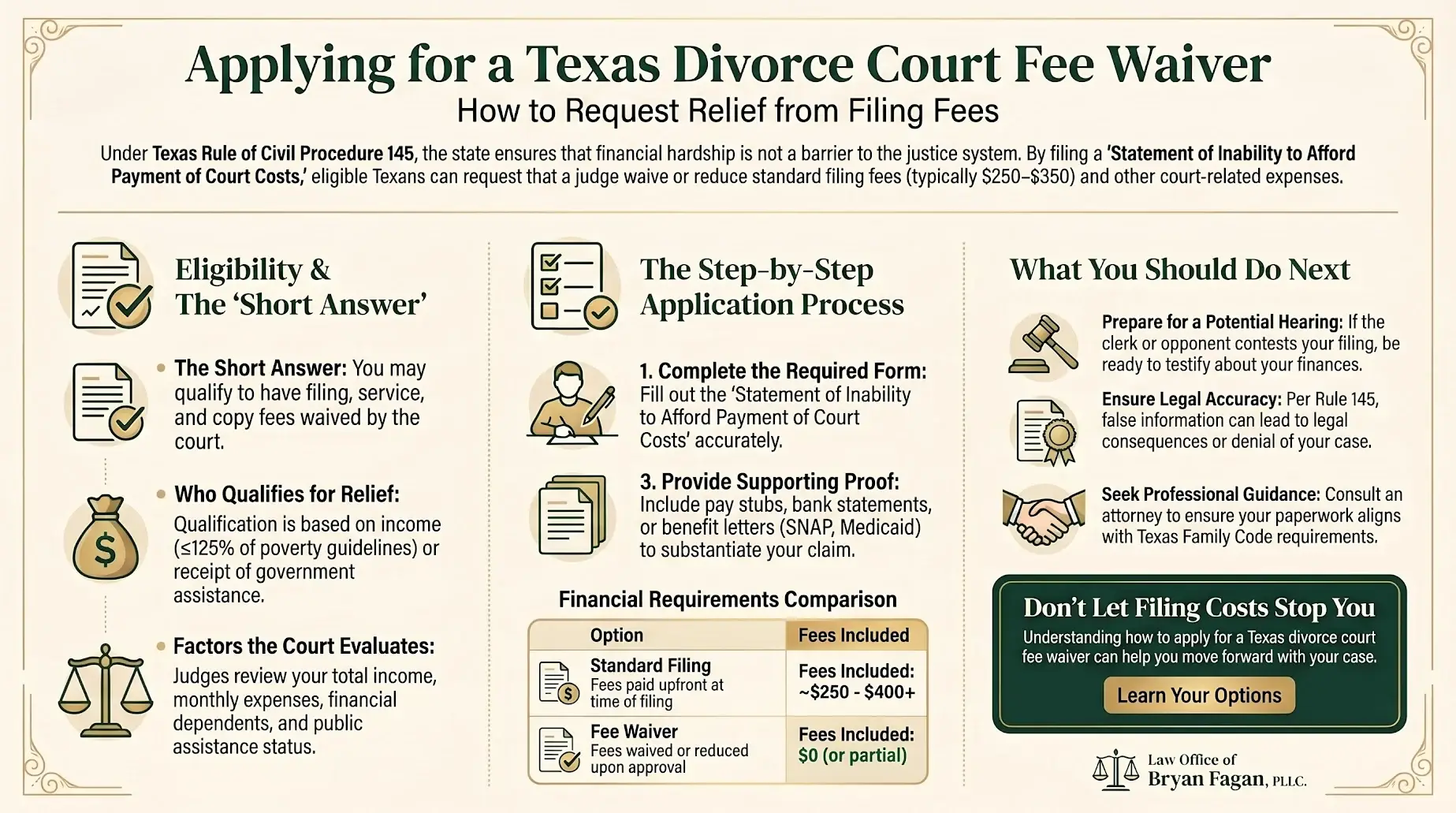
If you’re wondering whether a free divorce in Texas is really possible, the answer is: sometimes. Texas law allows qualifying individuals to ask the court to waive certain filing fees and court costs by filing a Statement of Inability to Afford Payment of Court Costs. While a fee waiver can reduce the upfront cost of filing for divorce, it does not automatically eliminate every expense that may arise during the case.

At The Law Office of Bryan Fagan, PLLC, we help individuals and families navigate the legal and financial challenges of divorce. Many people are surprised to learn that a court fee waiver is not automatic—eligibility rules apply, and the information submitted to the court can affect the outcome.
For parents, divorce often involves additional decisions about conservatorship, possession, and child support. When children are involved, Texas courts prioritize the child’s best interest under Texas Family Code §153.002.
Our firm was founded on the belief that clients deserve clear, practical guidance during major life transitions. Understanding your options early can help you avoid delays and make informed decisions.
In this article, we explain what a free divorce in Texas really means, who may qualify for a fee waiver, how the process works, and common misconceptions that often lead to confusion.
Key Takeaways
- The waiver is filed, not granted. Under TRCP 145, a Statement of Inability is filed with the court and generally treated as effective unless it is later challenged. Any dispute is resolved through a separate hearing process.
- Eligibility is based on financial need. Courts commonly consider whether a person receives public benefits (such as SNAP, Medicaid, TANF, or SSI), meets income guidelines (often referenced at 125% of the federal poverty level), or cannot afford basic living expenses and court costs.
- The waiver covers court costs, not the entire divorce. It may cover filing fees, citation, service of process, and similar court charges. It does not cover attorney’s fees, mediation, copies, or most post-judgment expenses.
- Waiver challenges are heard on an expedited basis. If a Motion to Require Payment of Costs is filed, the court will typically set a prompt hearing under TRCP 145(f), often within a short timeframe depending on the county docket.
- Your financial statement can be used later in the case. The information in your Statement of Inability may be reviewed or used for credibility purposes if financial disclosures later conflict with other evidence.
- The waiver does not eliminate the 60-day waiting period. Under Texas Family Code §6.702, no divorce can be finalized in less than 60 days from filing, regardless of fee waiver status.
- If you are served with a waiver filing, timing matters. You may challenge it through a Motion to Require Payment of Costs. Early action can preserve your ability to raise financial concerns before the hearing is set.
What “Free Divorce in Texas” Actually Means
The phrase “free divorce in Texas” can be misleading. In most cases, it does not mean that every aspect of the divorce is free. Instead, it usually refers to a court-approved waiver of filing fees and certain court costs for individuals who cannot afford to pay them.
Texas Rule of Civil Procedure 145 allows eligible individuals to file a Statement of Inability to Afford Payment of Court Costs. If the statement qualifies under the rule and is not successfully challenged, the case can proceed without requiring payment of certain court costs upfront. This can remove a significant financial barrier to filing for divorce.
However, a fee waiver does not automatically eliminate all divorce-related expenses. Attorney’s fees, mediation costs, service of process fees in some circumstances, expert witness expenses, and other litigation-related costs may still apply. The amount a person ultimately spends on a divorce often depends on whether the case is contested and the issues involved.
It is also important to understand that the Statement of Inability is a sworn filing. The financial information provided should be accurate, complete, and consistent with other information submitted to the court. In contested cases, inaccuracies or omissions can raise questions about credibility and create unnecessary complications.
Timing matters as well. Filing the divorce petition starts Texas’s mandatory waiting period. Under Texas Family Code § 6.702, most divorces cannot be finalized until at least 60 days after the petition is filed. For many individuals, obtaining a fee waiver is not the end goal—it is simply the first step in moving the divorce process forward.
Who Qualifies for a Texas Divorce Court Fee Waiver?

Under Texas Rule of Civil Procedure 145, there are three primary paths to qualifying for a court-cost waiver when filing for divorce. Understanding which path applies to your situation can help you prepare the information and documentation the court may require.
Path One: Receiving a Means-Tested Public Benefit
The most straightforward path is receiving a qualifying means-tested government benefit. Examples may include SNAP, Medicaid, TANF, SSI, or other public-assistance programs that are based on financial need. If you receive one of these benefits, you can identify the program in your Statement of Inability to Afford Payment of Court Costs and provide supporting information when requested.
Path Two: Meeting Income-Based Guidelines
You may also qualify if your household income falls at or below the threshold established by Rule 145. The rule references federal poverty guidelines, which are updated periodically. Because these figures can change from year to year, applicants should review the current guidelines when preparing their filing.
Path Three: Inability to Afford Court Costs While Meeting Basic Necessities
The third path applies when paying court costs would make it difficult to afford basic living expenses. Courts may consider factors such as income, housing costs, utilities, transportation expenses, medical expenses, debts, available cash, and other financial obligations when evaluating whether a person can afford court costs.
Regardless of which path applies, the Statement of Inability is a sworn filing. The information provided should be accurate, complete, and consistent with other financial information that may be presented during the divorce. Taking the time to prepare accurate disclosures can help avoid delays and keep the case moving forward.
What the Fee Waiver Covers — and What It Doesn’t
A Texas divorce fee waiver under TRCP 145 may cover court costs charged by the district clerk and other court-required filing expenses that would otherwise be due at the time of filing.
It does not cover payments to private third parties. This includes attorney’s fees, mediator fees, private process servers, and most post-judgment costs.
A common misconception is that a waiver makes divorce free. In reality, it only removes certain court-related fees.
Fee Waiver Coverage Map
| Cost Category | What Texas Practice Says | Practical Impact |
|---|---|---|
| Original petition filing fee | Generally waived under TRCP 145 if approved | $300–$400 saved (varies by county) |
| Citation issuance | Typically waived | $8–$15 saved |
| Constable/sheriff service | Typically waived | $75–$155 saved |
| Private process server | Not covered | $75–$200 still owed if used |
| Jury fee | Generally waived if requested | ~ $30 saved |
| Court reporter/transcripts | Not automatically covered | May still be charged depending on orders |
| Mediation | Not covered | $200–$2,500+ |
| Attorney’s fees | Not covered | Usually the largest cost |
| Certified copies | Generally not covered | $1–$5 per page |
| Post-judgment filings | Separate determination required | Waiver does not automatically apply |
Mediation is often the most unexpected expense. Many Texas courts require mediation before trial in contested cases, and those costs are not included in a fee waiver. Some counties offer reduced-fee mediation through local dispute resolution centers, depending on availability.

Certain court-appointed costs—such as custody evaluators or amicus attorneys—may sometimes be allocated by the court, but they are not automatically waived under TRCP 145 and often require a specific order.
How to Apply: The Statement of Inability Process Step by Step
Applying for a Texas divorce fee waiver begins by filing a Statement of Inability to Afford Payment of Court Costs at the same time as, or before, your Original Petition for Divorce under Texas Rule of Civil Procedure 145.
Once filed, the district clerk must accept and process the case. The waiver request is then subject to review, and it may be approved or challenged later. The divorce case itself is not delayed solely because a waiver is requested. The 60-day waiting period under Texas Family Code §6.702 begins when the petition is filed.
The Statement of Inability is a sworn financial affidavit. It requires disclosure of income, expenses, bank accounts, property, debts, and dependents. Because it is filed under oath, it becomes part of the court record and may be reviewed later if the waiver is questioned or if financial issues arise in the case.
Step-by-Step Process
- File your Original Petition for Divorce in the proper county under Texas Family Code §6.301
- Submit the Statement of Inability (TRCP 145) at the same time or before filing fees are paid
- Clerk processes the filing and opens the case
- Service is issued (often through constable or sheriff if approved under the waiver)
- Case proceeds normally, including the 60-day waiting period
- Waiver may be challenged under TRCP 145(f), triggering a court hearing where you must prove inability to pay
If a challenge is filed, the court will schedule a hearing on an expedited basis. At that hearing, the judge evaluates your financial affidavit and any supporting evidence to determine whether the waiver should be granted or revoked.
In simple cases, the process moves forward without issue. In more complex divorces involving disputed assets or financial inconsistencies, the Statement of Inability can become a central point of scrutiny.
What Judges Look At When Reviewing a Statement of Inability

Judges do not approve or deny a Statement of Inability based on a single number. Instead, they evaluate the full financial picture to determine whether a person genuinely cannot afford court costs under Texas Rule of Civil Procedure 145. The review is focused on ability to pay, not just reported income.
Income, Expenses, and Household Reality
One of the first things courts look at is monthly income compared to basic living expenses. This includes wages, self-employment income, government benefits, and any other regular financial support. Judges also consider whether reported expenses are consistent with the claimed financial situation and whether the household has room to pay court costs without hardship.
Household income is often reviewed as a whole, not just the individual filing the waiver. This means contributions from a spouse or other household members may be relevant in evaluating overall financial capacity.
Assets and Access to Funds
Judges also review assets, not just income. This includes bank accounts, vehicles, real property, retirement accounts, and business interests. The key issue is not only what a person owns, but whether those assets can realistically be used to pay court costs without creating financial hardship.
For example, a person may own a vehicle or have retirement savings but still qualify if those assets are not reasonably accessible or would cause undue hardship if liquidated.
Public Benefits and Presumptions of Indigency
Receipt of certain public benefits—such as SNAP, Medicaid, TANF, or SSI—can strongly support a claim of inability to pay. While not always automatic, these benefits are often treated as strong indicators of indigency under Texas procedure.
Consistency and Credibility
Judges also compare the Statement of Inability against other filings in the case. If later financial disclosures, such as an inventory and appraisement, conflict with the waiver application, it can raise credibility concerns. Consistency across documents is therefore important, especially in contested divorces.
What Happens If Your Spouse or the Court Contests Your Waiver
A fee waiver may be challenged by your spouse or reviewed by the court through a Motion to Require Payment of Costs under Texas Rule of Civil Procedure 145(f). When this happens, the court will set a hearing on an expedited basis.
At the hearing, the burden shifts to you to prove by a preponderance of the evidence that you are unable to afford court costs. The judge reviews your Statement of Inability along with any supporting or opposing evidence, such as financial records or testimony.
If the court determines that you can afford some or all costs, it may:
- deny the waiver (requiring full payment of costs),
- grant a partial waiver (requiring partial payment), or
- uphold the waiver (no payment required).
If costs are assessed against you, the case may not move forward on certain actions until those costs are addressed, depending on the court’s order.

What Courts Commonly Review
Judges may examine income sources, bank accounts, vehicle ownership, business income, home equity, retirement accounts, and other financial resources disclosed in the case. They may also consider whether household or third-party financial support is available and relevant.
Practical Consideration
A waiver contest is often one of the first disputed hearings in a divorce case. While it does not determine the outcome of custody or property issues, it can signal how aggressively the financial aspects of the case may be litigated.
For some filers, paying the filing fee upfront may reduce early procedural disputes. For others, the waiver remains an appropriate option depending on financial circumstances and risk tolerance.
The Community-Property Landmine: How the Statement of Inability Becomes Evidence Later
Most fee waiver contests in Harris County and the surrounding counties depend on one document the filer didn’t realize they were creating: the sworn financial statement on the Statement of Inability itself, which becomes admissible evidence at every later hearing in the divorce. This is the part the texaslawhelp.org guides cannot tell you, because they cannot give legal strategy advice. I can.
Here’s how the trap closes. You file the Statement, swearing your monthly income is $2,200, your bank balance is $185, and you have no real property of value. The waiver isn’t contested, you proceed. Three months later, in regular discovery, you serve and respond to inventory and appraisement under Texas Family Code § 7.001, and the fight over the marital home begins. Your spouse’s attorney puts your inventory side-by-side with your Statement of Inability and finds discrepancies — $40,000 of home equity in the inventory you didn’t list earlier, a small business interest, a retirement account.
The discrepancy doesn’t have to prove anything criminal. It just has to undermine your credibility on every other contested issue. When the judge has to make a credibility call between you and your spouse on a discretionary issue — and most contested family law issues come down to credibility — the impeachment material from your fee waiver paperwork moves the needle.
Two practical implications. First, if you have meaningful community property, do not file the Statement of Inability without legal advice. The cost of getting the form wrong is much higher than the cost of the filing fee. Second, if you do qualify and do file, treat the form like trial testimony — because functionally, it is. Use accurate, defensible numbers. List every account, even small ones. Disclose every asset, including the ones you think don’t matter. Sign nothing you wouldn’t repeat from the witness stand.
“The Statement of Inability is not a separate filing that lives in its own world. It’s a sworn document in your case file, and any cross-examiner who can read can use it. I’ve seen sworn financial statements from the first week of a divorce torpedo a client’s credibility at a final trial nine months later — not because anything was malicious, but because the form was filled out fast, with rough numbers, and nobody warned the filer it would matter again.
— Bryan Fagan
“My Spouse Just Filed a Fee Waiver Against Me — Now What?”
Your Right to Challenge the Waiver
If you’ve been served with divorce papers and see that your spouse is applying for a Texas divorce fee waiver, you may challenge it by filing a Motion to Require Payment of Costs under Texas Rule of Civil Procedure 145(f). The court will set a hearing on an expedited basis, making early timing important. This is one of the first procedural points where action may affect how financial issues are handled in the case.
What Happens at the Hearing
At the hearing, the judge reviews the sworn Statement of Inability along with any evidence submitted by either party. The filer may be required to testify regarding income, assets, debts, and expenses. Judges evaluate whether the financial information is consistent with available records and other evidence in the case. In some matters, this can overlap with issues involving property division, support, or custody considerations under Texas Family Code §153.002, where credibility and stability are important factors.
When Challenging Makes Sense
In straightforward cases where the waiver is clearly justified, challenging it may not change the outcome and can add unnecessary litigation. Courts generally expect motions to be based on legitimate financial concerns rather than delay or pressure tactics.
However, where there are disputed assets, business income, or incomplete disclosures, an early hearing may bring financial issues into focus sooner. This can affect negotiations, temporary orders, and how the case develops procedurally.
Strategic Consideration
Deciding whether to challenge a waiver depends on the complexity of the case. In simpler divorces, limited action may be appropriate. In more complex cases involving financial disputes or long-term obligations, addressing accuracy early can help clarify the financial picture before the case progresses further.
Understanding how a fee waiver fits into the broader divorce process helps ensure decisions are made strategically rather than reactively.
Harris, Fort Bend, and Montgomery County: Where Local Procedure Differs

Texas Rule of Civil Procedure 145 applies statewide, but the way fee waivers and contests are handled in practice can vary by county. These differences often relate to court assignment, docket structure, and how quickly hearings are scheduled.
County Procedure Overview — Houston Metro
| County | Typical Filing Fee | Where Matters Are Commonly Assigned | Practical Note |
|---|---|---|---|
| Harris | ~$350 | Family district courts (various assigned judges) | High-volume docket; filings are generally accepted for processing without pre-screening |
| Fort Bend | ~$315 | 328th and 387th district courts; may involve associate judges | Smaller docket; hearings may be scheduled more quickly depending on assignment |
| Montgomery | ~$340 | 410th, 418th, and 457th district courts | Conroe-based filings; generally more direct intake processing |
| Galveston | ~$320 | 306th district court (family) | Island-based filing system; service timelines may vary by local constable schedules |
In Harris County, Statements of Inability are commonly accepted through electronic filing systems such as eFileTexas.gov, subject to local formatting and clerk intake procedures. Processing in other counties may vary depending on local filing workflows and court assignment practices.
In Fort Bend and Montgomery Counties, fee waiver contests may be assigned to either elected district judges or associate judges depending on docket structure and availability, which can affect scheduling speed.
For residents of Sugar Land, Katy, The Woodlands, Pearland, Spring, or Conroe, venue is determined by county of residence under Texas Family Code § 6.301, not by city name. Cases are filed with the appropriate county district clerk based on that rule.
When DIY Works, When It Doesn’t, and When to Hire an Attorney
When DIY Works
Applying for a Texas Divorce Court Fee Waiver can be appropriate in limited situations where the case is truly straightforward. This typically involves spouses who agree on all major issues and have no meaningful disputes over children, property division, retirement accounts, or business interests.
In these uncontested cases, both parties are generally able to sign a final decree without disagreement, and the matter proceeds after the 60-day waiting period required under Texas Family Code §6.702. A fee waiver under Texas Rule of Civil Procedure 145 may help reduce qualifying court costs and allow the case to move forward without upfront filing expenses.
When It Doesn’t Work
Most divorces do not fall into the simple uncontested category. When there are children, property division issues, retirement accounts, or disagreements over terms, the complexity increases quickly.
Texas courts evaluate custody matters under the “best interest of the child” standard in §153.002 and expect consistent and accurate filings throughout the case. In these situations, financial disclosures tied to a fee waiver may also become part of the broader evidentiary record if the case becomes contested.
At this stage, the issue is no longer just affordability—it becomes legal risk, procedural strategy, and long-term outcome planning.
Where Problems Usually Appear
DIY approaches often break down after filing rather than at the beginning. Possession schedules that seem workable on paper may not account for real-life changes. Property that is not clearly awarded in the decree can later become a source of dispute. Retirement accounts also require precise legal orders to divide properly, and mistakes can make them difficult to access or enforce.
These issues are not merely technical—they can affect financial stability and long-term compliance with court orders.
When to Consider Legal Help

In simple uncontested divorce cases, limited guidance may be enough to complete the process. In more complex situations involving disputes, financial uncertainty, or children, early legal structure can help reduce avoidable problems later in the case.
The goal is not only to complete the paperwork, but to ensure the final outcome remains enforceable and workable after the divorce is finished.
Checklist: What to Do If You’re Applying for a Texas Divorce Fee Waiver
- Confirm Texas residency — at least 90 days in the county and 6 months in Texas under §6.301
- Obtain the Statement of Inability to Afford Payment of Court Costs or an Appeal Bond from the Texas courts website or county clerk
- Gather supporting documents such as benefit letters, recent pay stubs, bank statements, tax returns, and housing expenses
- Compare household income to the 125% federal poverty guideline (used as a general reference in indigency evaluations)
- Inventory all real and personal property, including retirement accounts and business interests, with reasonable estimated values
- Review which common basis applies under TRCP 145 (income level, public benefits, or inability to afford basic necessities)
- Assess whether the case involves contested issues and consider whether legal guidance is appropriate before filing
- File the Statement of Inability at the same time as the Original Petition for Divorce with the district clerk
- Provide required copies to the opposing party in accordance with service rules for your case
- Track the timeline after filing; if a Motion to Require Payment of Costs is filed, consider seeking legal advice promptly due to the expedited hearing process
What I Tell Every Client Who Calls About Applying for a Texas Divorce Court Fee Waiver

If you genuinely cannot afford the filing fee, applying for a Texas Divorce Court Fee Waiver under Texas Rule of Civil Procedure 145 is a legitimate and effective way to begin your case. You file the Statement of Inability alongside your Original Petition for Divorce, and the clerk files it without pre-screening the merits of your financial claim. The legal process then begins, and the 60-day waiting period under Texas Family Code §6.702 starts running. In many cases, this allows the case to move forward without upfront court costs. In straightforward situations—where there are no children, no property disputes, and both parties agree on all terms—a fee waiver can make it possible to start the process with minimal complication.
The more important conversation arises when the case is not simple. In complex divorces involving children, property, retirement accounts, or financial disputes, the waiver only addresses court costs—it does not guide how the case will be decided. Courts evaluate issues such as custody under Texas Family Code §153.002, and financial disclosures made in your Statement of Inability may later be reviewed if the case becomes contested. Inconsistencies between early filings and later evidence can affect credibility in court.
Timing also matters if a waiver is challenged. Under Rule 145(f), an opposing party may file a Motion to Require Payment of Costs, and the court will set an expedited hearing. While timing varies by county, these hearings are generally scheduled quickly. In simple cases, no challenge is necessary. In contested or higher-conflict cases, early procedural decisions can influence how the rest of the case develops.
Some situations require only basic guidance, while others benefit from a more structured legal approach to avoid early missteps that are difficult to correct later.
Conclusion
Applying for a Texas Divorce Court Fee Waiver is often the first step toward moving forward, but it is rarely the most important decision in your case. In the context of a free divorce in Texas, the waiver may reduce upfront court costs, but it does not determine how property, custody, or financial issues will ultimately be resolved. What matters most is how that filing fits into your overall strategy, financial situation, and long-term goals for your family.
In straightforward cases where both parties agree on all major issues and there are no significant disputes, filing the waiver and proceeding without attorney involvement may be enough to complete the process. However, most cases are more complex. When children, property division, business interests, or disagreements are involved, the early decisions in your case can have lasting effects.
If your situation includes contested custody, financial complexity, or concerns about how your disclosures may be evaluated later, it is important to consider the broader impact before moving forward. A fee waiver addresses court costs, but it does not reduce the importance of accurate filings or strategic decision-making. In some cases, how you begin can influence how your case develops.
At The Law Office of Bryan Fagan, PLLC, we help clients understand their position, evaluate their options, and choose a path that fits their circumstances. Whether your case is simple or complex, the goal is to move forward with clarity, protect your interests, and make informed decisions at every stage of the process.

Frequently Asked Questions
Yes, you can file without paying court costs charged by the district clerk by submitting a Statement of Inability to Afford Payment of Court Costs under TRCP 145. If approved, it may waive qualifying court costs, but it does not cover attorney’s fees, mediation, copies, or most post-judgment expenses. While a simple uncontested, pro se divorce with a waiver may significantly reduce costs, most contested cases will still involve some out-of-pocket expenses.
There is no separate “approval” step before filing. Under TRCP 145, the Statement of Inability is filed with the court and the case proceeds unless it is challenged. If a Motion to Require Payment of Costs is filed under TRCP 145(f), the court will set an expedited hearing, typically on a short timeline depending on the county’s docket.
Yes. The Statement of Inability is part of the court record and is generally served on the other party along with the Original Petition for Divorce. It is not a confidential filing, and the other party has the right to review and, if appropriate, challenge it.
No. A fee waiver does not change the statutory timeline. Under Texas Family Code §6.702, there is a mandatory 60-day waiting period between filing and final decree in most cases. The waiver affects court cost requirements, not the speed of the divorce process.
If a waiver is challenged, the court holds an expedited hearing. At the hearing, the judge reviews financial information and may hear testimony or argument from both sides. The judge may grant the waiver, deny it, or grant it in part, depending on whether the filer has shown an inability to pay court costs.
Related Articles
- Free Divorce Forms in Texas: Key Things to Consider Before You File
- 6 Tips for Getting a Free Divorce Consultation
- Divorce Lawyer Houston Free Consultation: A 2026 Guide
- How to Get Your Divorce Started for Free: A Step-by-Step Guide
- Breaking Down the Steps of Divorce Lawyers In Texas Free Consultation
- The Complete Guide to How To File For Divorce For Free
- Easiest Way to Get Divorce in Texas: Quick, Affordable, and Hassle-Free
- Nunc Pro Tunc Meaning in Texas Divorce Cases
- Financial Freedom After Divorce: Texas Truths!
- How to Draft and File an Answer to a Texas Divorce – Free Downloadable Forms