
Separation can turn ordinary problems into urgent ones fast. One day you're trying to sort out bills, pickup schedules, and who stays in the house. The next day you're wondering whether you need court protection because your spouse is threatening you, showing up uninvited, emptying accounts, or talking about taking the children out of Texas.
That kind of uncertainty is exhausting. Many people searching for protective order vs restraining order Texas aren't looking for abstract legal definitions. They want to know one thing. What can I do right now to protect myself, my children, my home, and my finances?
Texas law gives families more than one tool, but those tools do different jobs. A protective order is built for personal safety. A restraining order, usually a temporary restraining order or TRO in family court, is usually built to control conduct during a lawsuit and preserve the status quo until the court can hear more evidence.
The confusion starts because both orders can affect daily life in major ways. In a divorce or custody case, the same household may have both safety concerns and property concerns at the same time. That's where careful legal guidance matters.
Feeling Unsafe or Unsure? Understanding Your Legal Options
A common situation looks like this. A spouse moves out after months of arguing. Then the texts become threatening. The other spouse starts driving by the house, calling repeatedly, and warning that if a divorce gets filed, the children will be taken out of school and all the money will disappear from the joint account.
At that moment, the appropriate legal remedy is often unclear. They may ask for a “restraining order” because that's the term they've heard on television. But in Texas, the right answer depends on what the court needs to stop.
If the problem is violence, threats, stalking, sexual assault, or fear for personal safety, a protective order may be the proper path. If the problem is that a spouse may sell property, transfer funds, change a child's school, or interfere with the status quo during a divorce, a TRO may be the proper tool.
Practical rule: Ask yourself what needs protection first. Your physical safety, or the stability of the lawsuit.
That question often changes everything.
Texas family law can feel overwhelming when you're living inside the conflict. But the legal distinction is more manageable than it seems. One order is designed to protect people from harm. The other is designed to keep one side from changing the facts on the ground while a judge decides the case.
Why readers get stuck here
People often assume a restraining order is the stronger option because the name sounds broad. In Texas, that isn't usually how it works in family cases.
A person in danger may need a protective order because it can address contact, proximity, and other safety restrictions. A person facing financial sabotage in a divorce may need a TRO because the court can use it to stop transfers, withdrawals, relocations, and similar conduct while the case moves forward.
What taking control looks like
Start by writing down specific events. Save messages. Note dates, locations, witnesses, and anything involving children, money, firearms, property, or threats. If police were called, keep that information too. Clear facts help a judge understand what kind of order fits your situation.
If you're in immediate danger, call law enforcement first. Court orders matter, but immediate safety matters more.
The Core Distinction: A Shield for Safety vs Rules for a Lawsuit
You may be dealing with both problems at once. Your spouse is sending threatening messages, and at the same time trying to empty accounts, change the children's school, or remove property from the house before a hearing. In that kind of case, the primary question is not which label sounds stronger. The question is what problem the court needs to solve right now.
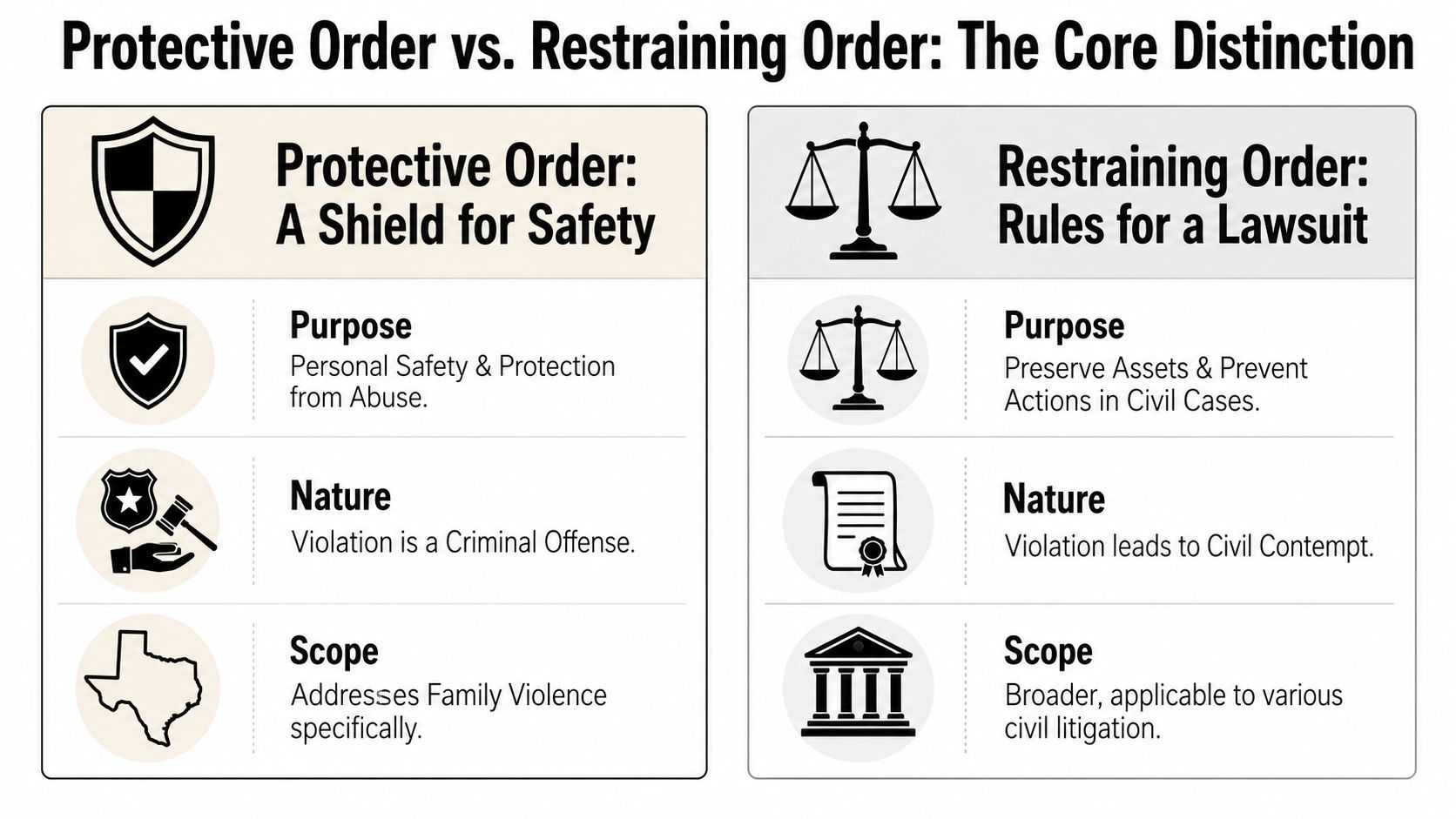
A protective order is built for personal safety. A restraining order, usually a TRO in family court, is built to control conduct during a lawsuit. Those purposes can overlap in one family's crisis, especially during divorce or a custody fight, but the legal job of each order is different.
What a protective order is for
Texas created protective orders as a safety remedy for people facing family violence and related threats. Courts across the state issue them often, which reflects how commonly they are used in serious safety cases, according to the Texas Courts 2024 protective-order report.
In practice, a protective order can limit contact, keep someone away from a home, job, school, or daycare, and in some cases restrict firearm possession. The point is direct protection for a person who may be at risk.
That matters in family law because danger rarely stays in one lane. A threatening spouse may also be a co-parent. A violent dating partner may still know your schedule, your child's campus, and where your family members live.
What a restraining order is for
A TRO usually comes up inside a divorce, custody case, or other civil proceeding. The court uses it to freeze the situation long enough for a judge to hear evidence and make more informed temporary orders.
That can include stopping someone from transferring money, destroying records, canceling insurance, moving a child, changing schools, hiding property, or disturbing possession of the home. In other words, a TRO helps keep one side from rewriting the facts before the court can step in.
Why this distinction matters in a divorce or custody case
Clients often ask which order they should file for, as if they must choose only one. Sometimes you do need one more than the other. Sometimes you need both because the case has two separate problems. One is safety. The other is control over children, money, property, or daily routines while the lawsuit is pending.
A useful way to sort this out is to match the order to the immediate risk. If you need the court to stop threats, stalking, violence, or dangerous contact, a protective order may fit. If you need the court to stop sudden legal or financial moves inside the case, a TRO may fit. As explained by Whitley Law Firm's discussion of protective orders vs restraining orders in Texas, the consequences and enforcement tools are also different, which can affect strategy.
The takeaway is practical. In Texas family court, these orders are not competing versions of the same thing. They are different tools, and in a hard divorce or custody dispute, the right plan often involves using the tool that matches each specific danger.
A Detailed Comparison of Texas Protective and Restraining Orders
In a divorce or custody case, these two orders often sit in the same conversation because the family is dealing with more than one kind of risk at once. One problem may be fear of harm. Another may be fear that a spouse will drain an account, hide a child, cancel insurance, or change the locks before the judge can step in.
That is why the better question usually is not, "Which order is better?" The better question is, "What problem do I need the court to solve right now?"
| Feature | Protective Order | Temporary Restraining Order (TRO) |
|---|---|---|
| Primary purpose | Personal safety | Preserve the status quo in a lawsuit |
| Typical context | Family violence, stalking, sexual assault, related safety cases | Divorce, custody, or other civil litigation |
| What it can restrict | Contact, proximity, access to certain places, firearms, and other safety-related conduct | Property transfers, account withdrawals, school changes, travel, removal of children, and other lawsuit-related conduct |
| Duration | Often longer-term | Short-term |
| Enforcement | Stronger safety-based enforcement consequences | Civil court enforcement |
Purpose and legal function
A protective order is built for safety. The court uses it to address family violence, stalking, sexual assault, or similar conduct and to reduce the chance of future harm. In practice, this is the order people seek when they are afraid of contact, confrontation, or escalation.
A TRO serves a different job. It is a short-term court order used inside a lawsuit to keep either side from making major changes before a hearing. In family court, that often means freezing the situation long enough for the judge to sort out temporary possession of the children, use of property, access to money, and other day-to-day issues.
A simple way to understand the difference is this. A protective order works like a court-ordered safety boundary. A TRO works like a pause button on disruptive legal or financial moves.
Who may need one
Someone may need a protective order even if no divorce has been filed. The key issue is whether the facts fit a legal basis for protection, such as family violence or stalking.
A TRO, by contrast, is usually tied to a pending case or one being filed immediately. It is common in divorce and custody matters where one person fears the other will act fast and create a new problem before the first hearing.
Sometimes the same client needs both.
For example, a spouse may need a protective order because threatening behavior has made the home unsafe. That same spouse may also need a TRO in the divorce to stop account withdrawals, school changes, or removal of the children from the county. These are separate requests because they solve separate problems.
Duration
The timing difference matters because it affects strategy.
Protective orders can last much longer and may remain in place well beyond the opening stage of a family case. A TRO is brief by design. It is emergency, short-term relief meant to hold things steady until the court can hold a hearing and decide what temporary rules should stay in place.
That is why a TRO is not a good substitute for a true safety order. If the danger is ongoing, you need to ask whether the court should enter relief designed to protect a person, not just preserve a lawsuit.
Scope of restrictions
A protective order usually targets dangerous or threatening conduct. Depending on the facts and the relief granted, it may include:
- No-contact limits on calls, texts, messages, or in-person contact
- Stay-away rules for a home, job, school, or daycare
- Firearm-related restrictions
- Family-related terms that can affect children or support in some situations
A TRO usually targets case-related conduct that could upset the status quo, such as:
- Selling, hiding, or giving away property
- Draining accounts or creating unusual debt
- Changing a child's school or routine without agreement
- Removing children or important records
- Destroying documents, digital records, or other evidence
This overlap is where many people get confused. Both orders can affect daily life. Both can contain serious restrictions. But they are aimed at different kinds of harm. One is centered on personal protection. The other is centered on preserving fairness and stability while the case is pending.
The question clients ask most often
Clients often ask whether one order can cover everything. Sometimes part of the answer is yes, and part is no.
A court can address several issues in the same family case, but each type of relief still has its own legal standard, proof, timeline, and enforcement method. If your spouse is dangerous, the court needs to hear the safety facts clearly. If your spouse is also moving money or disrupting the children's routine, the court needs those facts clearly too.
That is why careful case planning matters. In a hard divorce or custody dispute, the right approach is often layered. You match each legal tool to the problem it is designed to fix, then build a plan that protects your safety, your children, and your position in the case.
When to Use Each Order: Real-World Scenarios
Maria needs safety first
Maria separates from her husband after repeated arguments that escalated into threats. He starts waiting outside her apartment, sending messages that frighten her, and telling her that if she keeps the children from him, he'll “make her pay.” She isn't mainly worried about furniture or bank statements. She's worried about what happens when she leaves work.
In that situation, a protective order may be the right fit because the central issue is safety. The court can focus on whether the facts show family violence or another qualifying basis and whether restrictions are needed to protect Maria and the children.
A protective order makes sense when the question before the judge is, “How do we prevent harm?”
If your daily decisions are being shaped by fear of contact, confrontation, or physical danger, ask about protective-order relief immediately.
David needs the court to freeze the chaos
David files for divorce. Within days, his spouse starts moving money between accounts, talks about selling a vehicle, and threatens to enroll the children in another school district without agreement. Nobody is alleging physical violence, but the situation is unstable and changing fast.
That is the classic setting for a TRO. The court can order both sides to stop taking unilateral action until a hearing. The goal isn't punishment. It's to keep one side from rewriting the facts before temporary orders are entered.
The overlap that confuses families
The harder cases look like both of these examples at once. A spouse may be threatening, controlling access to money, and trying to interfere with the children during a divorce.
Texas family-law practice recognizes that overlap. A TRO in a family case can restrict out-of-state travel, school changes, account withdrawals, and property disposal, while a protective order can also include stay-away, firearm, child support, and visitation provisions. That overlap is discussed in Versus Texas's explanation of protective orders in Texas.
A simple decision framework
If you're trying to sort out which order fits, start here:
- Ask what harm is happening now. Fear of violence points in one direction. Fear of financial or parental disruption during litigation points in another.
- Identify whether a case is already pending. TROs usually live inside a lawsuit.
- Look at the immediate objective. Do you need distance and safety, or do you need the court to stop a spouse from acting unilaterally?
- Consider whether both problems exist. In some divorces, they do.
That last point matters. You don't have to force your situation into a false either-or if the facts show a safety issue and a litigation-control issue at the same time.
How to Obtain a Protective Order or Restraining Order in Texas
A lot of people reach this point in the middle of chaos. You may be asking two different questions at once. How do I stay safe, and how do I keep my spouse from cleaning out an account, changing the children's school, or taking them out of state before the judge can step in?
Those questions often come up together in divorce and custody cases. The filing process depends on which order you need, but both requests work better when you can show the judge a clear timeline, specific facts, and a precise explanation of what needs to stop.
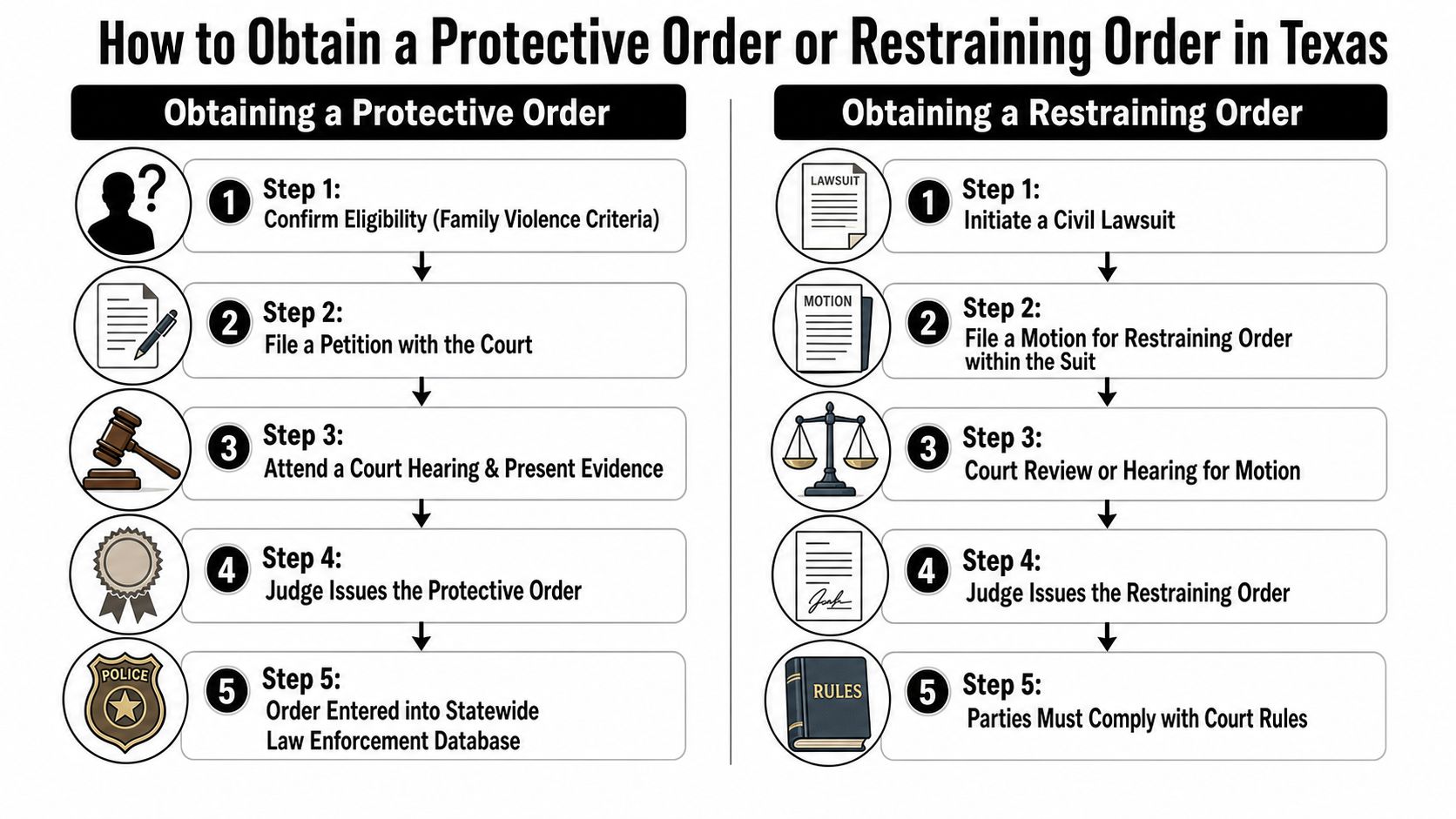
How a protective order case usually works
A protective order is a safety case. The court is looking for facts that show family violence, stalking, sexual assault, or another legal basis under Texas law. General statements rarely carry the same weight as specific examples.
Confirm that the facts fit the legal grounds. Start by matching the conduct to a recognized basis for a protective order. If you are unsure, that confusion is common. Many people know something is wrong long before they know which legal label applies.
File an application with the court. The application should describe incidents in concrete terms. Include dates, locations, threats, injuries, police contact, damaged property, or witness names if those facts exist.
Ask for immediate ex parte relief if the risk is urgent. A judge can sometimes enter short-term protection before the other side appears in court. That temporary step is meant to reduce immediate danger until the full hearing.
Prepare for the hearing carefully. This is where details matter. Organize texts, emails, photographs, medical records, reports, screenshots, and witness information so the judge can follow the story from beginning to end.
Use the signed order correctly. Keep copies where they may be needed, such as at home, work, your child's school, or with childcare providers. If the order includes child-related terms, read those terms closely so you understand what exchanges, communication, or possession rules apply.
How a TRO in a divorce or custody case usually works
A temporary restraining order, or TRO, usually starts inside an existing family-law case. It functions more like a freeze-frame. The goal is to stop sudden changes until the court can hold a fuller hearing and set temporary rules.
File the divorce, SAPCR, or other underlying case. In family court, a TRO is usually attached to a pending lawsuit rather than filed as a stand-alone request.
Ask for specific restraints. Judges respond better to targeted requests than broad complaints. If the problem is emptying bank accounts, hiding records, canceling insurance, removing a child from school, or taking a child out of Texas, say that directly.
Explain why immediate court action is needed. The judge needs to see what could happen before the temporary-orders hearing if no restraint is entered now.
Attend the follow-up hearing. A TRO is short-term. If you need longer protection over finances, property, parenting time, or use of the home, the court may address those issues through temporary orders or a temporary injunction after notice and hearing.
Treat the TRO as an early stabilizing tool. In many family cases, it creates breathing room. It does not decide the whole case, and it does not replace the evidence you will need at later hearings.
What evidence helps the most
Judges need facts they can act on. A useful way to prepare is to build a simple timeline, then attach proof to each event.
Helpful evidence often includes:
- Written communications such as text messages, emails, voicemail records, and call logs
- Financial documents showing unusual withdrawals, transfers, account changes, or new debt
- Child-related records involving school enrollment, attendance, pickup problems, travel plans, or medical decisions
- Photos, videos, and reports if there are injuries, property damage, or police involvement
- Witness information from relatives, neighbors, teachers, or other people who directly observed key events
Evidence reminder: "He is unstable" is a conclusion. "On Tuesday he texted that he would take the children and close the joint account, and by that evening the account balance had dropped" gives the court something concrete to evaluate.
Choosing the right filing path in a family case
This is the part that often gets oversimplified online. Some situations call for a protective order. Some call for a TRO. Some require both, because the danger and the case-management problem are happening at the same time.
For example, if a spouse has threatened you, shown up uninvited, and also started moving money or interfering with the children, your lawyer may need to assess both tracks at once. One order addresses personal safety. The other can help preserve the status quo in the divorce or custody case.
That overlap does not mean your case is unusual. It means the facts need to be framed correctly.
Why legal guidance matters
The paperwork is only one part of the job. The wording of the requested relief, the evidence you bring, and the way the facts are presented at the hearing can affect housing, parenting arrangements, financial stability, and your credibility with the court.
For people who want legal help with divorce, custody, and related protective issues, Law Office of Bryan Fagan, PLLC offers Texas family-law consultations.
Enforcement, Penalties, and Overlap in Divorce Cases
What happens after the order is signed is often the most important question.

Protective orders carry stronger enforcement consequences
A protective order is a safety-based order. That means violations can trigger serious consequences beyond ordinary civil case management. This is one reason clients often hear that protective orders are “stronger,” though that shorthand can be misleading. They are stronger in enforcement because they are designed for danger.
By contrast, a TRO is generally enforced through the court's civil contempt powers. The judge can address noncompliance, but the mechanism is different from the public-safety framework attached to protective orders.
Why divorce cases get complicated
Many guides oversimplify the issue by saying protective orders are for violence and TROs are for property. In real family cases, the facts are messier than that.
A TRO in a divorce can restrict out-of-state travel with children and property disposal, while a protective order can also dictate child visitation and support. That overlap creates real confusion and requires careful legal analysis, as noted in the earlier discussion of Texas family-law practice.
How courts may use both tools
A single divorce may involve:
- Safety concerns that justify a protective order.
- Property concerns that justify a TRO or temporary injunction.
- Parenting concerns that need temporary orders on possession, access, or support.
Those remedies don't necessarily compete with each other. They may address different risks in the same family.
What clients should do after an order is entered
- Read every line carefully. Orders often contain specific distances, dates, deadlines, and conduct restrictions.
- Follow the order exactly. Even if you believe the other side started the contact, your compliance matters.
- Document violations. Save messages, note times and places, and report issues through the proper channels.
- Coordinate with your broader case. An order may affect possession schedules, exchanges, finances, and hearing strategy.
Court orders work best when they are specific, enforceable, and matched to the actual problem the family is facing.
Frequently Asked Questions About Texas Orders
Sometimes, yes. Texas guidance recognizes protective orders in situations involving family violence, sexual assault, stalking, human trafficking, and certain related conduct. The legal relationship and facts matter, so it's worth having your situation reviewed closely.
What happens after a TRO expires?
A TRO is short-term relief. If the court needs restrictions to continue, the case usually moves to a hearing on temporary injunctions or other temporary orders. You shouldn't assume the protection continues automatically.
Can I have both a protective order and a restraining order at the same time?
Yes, some cases involve both because they solve different problems. One may address personal safety, while the other preserves property or parenting stability during litigation.
How can a protective order affect child custody?
It can affect possession, exchanges, communication, visitation terms, and sometimes support-related issues. If children are involved, the court will look closely at safety and the child's best interest under Texas family-law principles.
If you need help sorting out a protective order, a TRO, or both in a Texas divorce or custody case, contact Law Office of Bryan Fagan, PLLC for a free consultation. You don't have to guess which legal tool fits your situation. Clear advice can help you protect your safety, your children, and your next steps.