If you’re searching for a temporary guardianship form Texas PDF, you’re likely in a situation where someone else may need to care for your child temporarily. This often happens during family emergencies, extended work travel, medical issues, or military deployment. In these moments, having the right legal document in place can provide peace of mind. It allows a trusted adult to make important decisions for your child when you are unavailable.

In Texas, what people commonly refer to as a “temporary guardianship form” is usually an authorization agreement under Texas Family Code Chapter 34. This document allows parents to delegate limited decision-making authority without giving up parental rights. With a properly completed form, a caregiver may help with medical care, school enrollment, and day-to-day needs. This helps the child’s routine continue with minimal disruption.
At the Law Office of Bryan Fagan, PLLC, we’ve worked with many Texas parents who start by searching for a temporary guardianship form Texas PDF. They often learn that the correct form and requirements depend on their specific situation. In some cases, a simple authorization agreement is enough. In others, more formal legal steps may be necessary to avoid complications or conflicts with existing custody orders.
This guide explains what a temporary guardianship form is. It also covers where a temporary guardianship form Texas PDF may be used. You’ll learn what authority a caregiver can receive. It walks through how to complete the proper documents. It also explains when court involvement or a more formal guardianship arrangement may be required.
Key Takeaways
- A temporary guardianship form Texas parents commonly seek is usually an authorization agreement. It allows a trusted adult to help with a child’s care without court involvement.
- Authorization agreements under Texas Family Code Chapter 34 generally last up to six months. They may renew automatically unless revoked or ended in writing.
- Court approval may be required in some situations. This includes cases with existing custody orders, ongoing court proceedings, or disputes between parents.
- Temporary authorization can allow decisions about medical care, education, and daily needs. However, it does not transfer custody or parental rights.
- Texas does not have one single statewide temporary guardianship form. The correct document depends on the family’s situation and legal requirements.
- Proper completion is important. This includes notarization and, in some cases, notice to the other parent to ensure the agreement is valid.

Your Family’s Future Starts Here
Don’t navigate your legal journey alone. Schedule a consultation now and get the clarity and support you deserve.
Temporary Guardianship Form Texas: The Short Answer
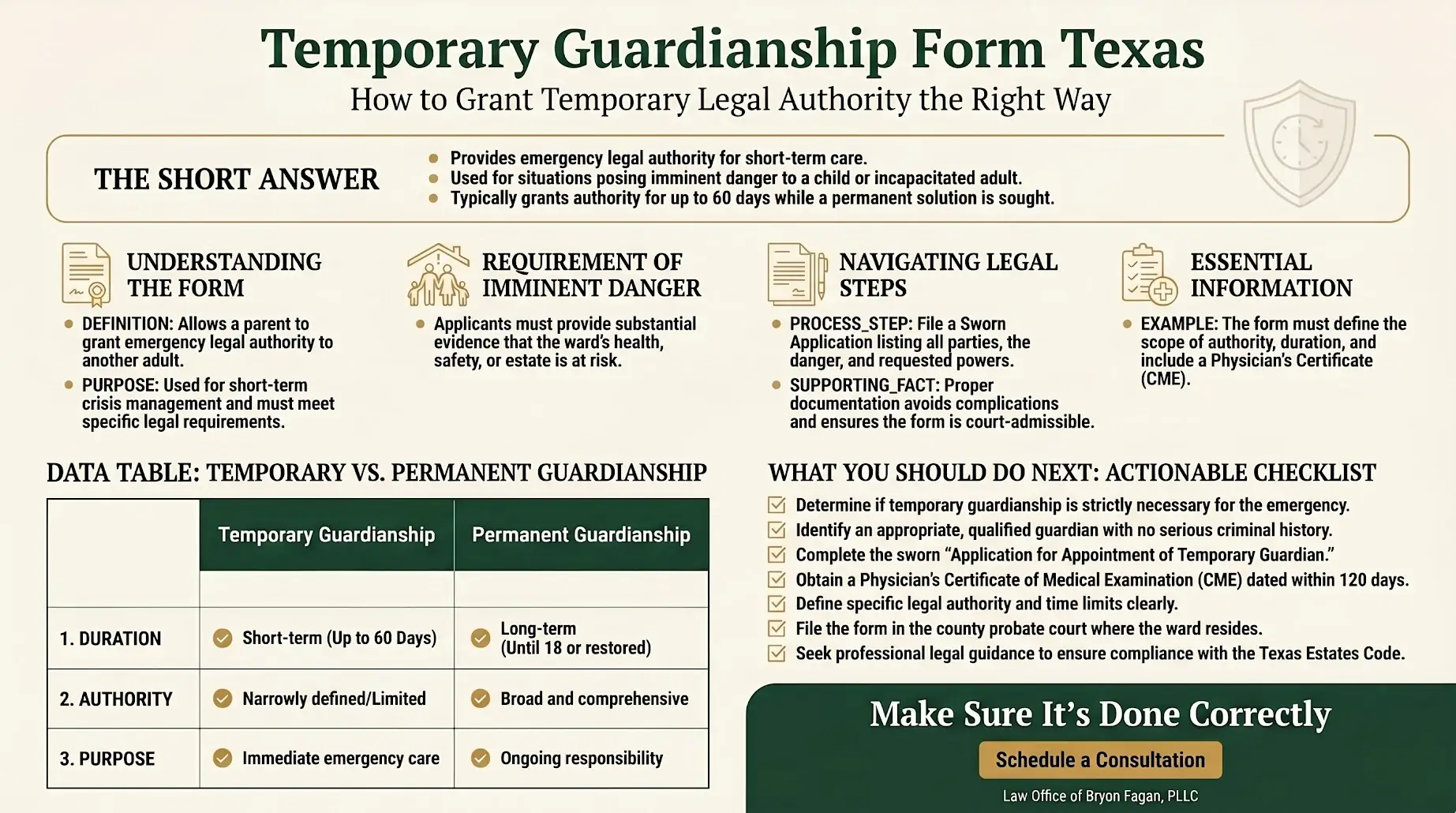
A temporary guardianship form Texas parents use is a practical legal tool that allows a trusted adult to step in and make important decisions for a child—without permanently changing parental rights. Under Texas Family Code Chapter 34, many parents accomplish this through an authorization agreement, which grants a caregiver limited authority over matters such as medical care, education, and daily needs while parental rights remain intact.
In straightforward situations—such as short-term travel, temporary work obligations, or a planned absence—this type of authorization can be an efficient and effective solution. It allows families to maintain stability without the time and expense of court involvement. Many parents successfully rely on these agreements when they are properly completed and when there are no existing custody conflicts. If you want a deeper understanding of how this works in practice, you can explore this guide on temporary authorization for care of a minor child in Texas, which walks through real-world use and requirements.
That said, it’s important to understand the limitations. A temporary guardianship Texas arrangement does not transfer custody, override existing court orders, or resolve disagreements between parents. In more complex cases—especially where custody orders exist, parents do not agree, or CPS or court involvement is present—this type of form may not be enough. Courts begin focusing on the child’s best interests, and issues like enforceability, proper execution, and legal authority become far more important.
The key is recognizing where your situation falls. Some families need a simple, well-prepared document to handle a temporary gap. Others require a more structured legal approach to avoid complications and protect their rights. Understanding that distinction early can help you avoid costly mistakes, reduce stress, and ensure your child’s care remains stable no matter what circumstances arise.
What Is a Temporary Guardianship Form?

A temporary guardianship form used by Texas families is a legal document that allows a parent to give a trusted adult limited authority to make decisions for a child during a defined period of time. Under Texas Family Code Chapter 34, this arrangement is formally known as an authorization agreement, and it is designed to provide flexibility without transferring custody or permanently affecting parental rights.
In practical terms, when a parent cannot be physically present, a designated caregiver can step in to handle essential responsibilities such as consenting to medical treatment, enrolling the child in school, or managing day-to-day care. The authority granted is specific and limited, which is an important distinction from formal guardianship under the Texas Estates Code. Formal guardianship involves court oversight, broader decision-making power, and longer-term implications, while a temporary authorization agreement is intended for short-term needs without unnecessary legal complexity.
When It Is Used and How It Works in Practice
A temporary guardianship form is commonly used in situations where a parent needs a trusted adult to care for a child for a limited period. This may include planned travel, temporary work assignments, or military deployment. It can also apply during medical recovery. Some families use it when a child is staying with a relative or close family friend.
In these situations, families often look for a temporary guardianship form Texas PDF because a printable document makes it easier to complete, sign, and provide to schools, healthcare providers, or caregivers without court involvement. The purpose is to maintain continuity in the child’s education, healthcare, and daily routine while the parent is temporarily unavailable.
Limitations and When Legal Complexity Matters
The effectiveness of an authorization agreement depends heavily on how it is prepared and the circumstances in which it is used. In more complex situations—such as custody disputes, existing court orders, or CPS involvement—the document may be limited or subject to scrutiny.
Courts may review whether the agreement was properly executed, whether it conflicts with prior orders, and whether it serves the child’s best interests. If these issues arise, the arrangement can lead to delays, confusion, or challenges to its validity.
Because of these limitations, some families only need a properly completed form for a simple temporary situation, while others may require a more structured legal solution to ensure enforceability under Texas law. Understanding this distinction early helps prevent complications and ensures the child’s care is protected in the most appropriate way.
When Do You Need a Temporary Guardianship Form?
A temporary guardianship form used by Texas parents is most helpful when a parent knows they will be unavailable to make decisions for their child. It allows a trusted adult to step in without delays. Under Texas Family Code Chapter 34, this arrangement—formally known as an authorization agreement—allows a parent to delegate limited decision-making authority. Parental rights are still fully retained. These forms work best when prepared in advance, before an urgent situation arises.
In many cases, this comes up during planned travel or work-related absences. Whether leaving the state for business or taking an extended trip, having a written authorization ensures a caregiver can handle routine needs and unexpected issues without interruption. It is also commonly used in medical situations where a parent may be temporarily unavailable, allowing a caregiver to communicate with healthcare providers and consent to necessary treatment when immediate decisions are required.
Families also rely on this type of agreement during military deployment or temporary living arrangements. When a child stays with a grandparent, relative, or trusted caregiver, written authority helps prevent issues with schools, doctors, and other institutions that require legal consent before acting.
For a more detailed breakdown of how these situations apply in practice, this guide on temporary authorization in Texas custody-related scenarios provides additional context on when the document is typically used.
When It Becomes Legally Insufficient
While a temporary authorization works well in routine situations, its limits become clear in more complex circumstances. If there is an existing custody order, disagreement between parents, or CPS involvement, a simple form may not be enough to resolve authority issues.
In those cases, an authorization agreement cannot override court orders or settle disputes between legal parents. Courts may also review whether the document was properly executed and whether it aligns with the child’s best interests, particularly when competing claims of authority exist.
Because of this, relying on a temporary form alone in contested situations can create legal risk or delay. The key is recognizing when the document is sufficient for practical caregiving needs—and when a more formal legal process is required to ensure stability and enforceability.
Temporary Guardianship vs Legal Guardianship
Understanding the difference between a temporary authorization agreement and court-ordered guardianship is essential when deciding what is appropriate for your family. These arrangements serve different purposes and involve very different levels of legal authority.
A temporary authorization agreement under Texas Family Code Chapter 34 is a private agreement between a parent and a caregiver. It does not require court approval and is intended for short-term caregiving situations. Court-ordered guardianship, on the other hand, is a formal legal process under the Texas Estates Code that requires filing an application, a court hearing, and a judge’s decision.
Key Differences Between Temporary Authorization and Court Guardianship
| Feature | Temporary Authorization (Chapter 34) | Court-Ordered Guardianship (Estates Code) |
|---|---|---|
| Court involvement | Not required unless existing orders apply | Required (application, hearing, judge approval) |
| Duration | Typically up to 6 months and renewable | Temporary orders may apply in emergencies; long-term until modified by court |
| Authority | Limited (medical care, school, daily needs) | Broader authority over personal care and/or estate matters |
| Parental rights | Fully retained by parent | May be limited or transferred by court |
| Cost | Minimal (often notarization only) | Court fees and possible attorney costs |
| Best suited for | Short-term, cooperative caregiving arrangements | Long-term care needs, disputes, incapacity, or serious risk situations |
Temporary authorization agreements are most effective when parents remain actively involved. They are used when someone simply needs to step in temporarily. These arrangements are designed for practical, cooperative situations. Common examples include travel, temporary work obligations, or short-term caregiving arrangements.
Court-ordered guardianship is used in more serious or long-term situations where parental care is not available or cannot be relied upon. In these cases, the court evaluates the circumstances and determines what level of authority is necessary to protect the child’s best interests.
Unlike private authorization agreements, court guardianship involves judicial oversight and can grant broader legal authority depending on the situation. Temporary guardianship orders issued by a court are typically limited in duration and used for urgent needs while a longer-term solution is considered.
What Should Be Included in a Temporary Guardianship Form

Completing a temporary guardianship form correctly helps ensure it will be accepted by schools, medical providers, and other institutions. In Texas, the Texas Department of Family and Protective Services (DFPS) provides Form 2638, the Authorization Agreement for Nonparent Relative, which is commonly used as a reference for these arrangements.
Key Information to Include in a Temporary Guardianship Form
| Section | Purpose |
|---|---|
| Child information | Full name, date of birth, and identifying details for each child covered |
| Parent information | Name, address, and contact details of the parent or parents granting authority |
| Caregiver information | Name, relationship to the child, address, and contact information of the designated caregiver |
| Duration | Start date and end date, or confirmation of a set temporary period (often up to six months under Texas law) |
| Medical authorization | Permission for the caregiver to consent to medical treatment and access medical records |
| School authorization | Permission to enroll the child, communicate with schools, and access educational records |
| Emergency contacts | Additional individuals to be contacted in urgent situations |
| Specific permissions | Clearly defined authority to avoid confusion about what decisions the caregiver can make |
| Signatures | Signature of the parent(s) and the designated caregiver |
| Notarization | Notary acknowledgment to support validity and acceptance |
When completing a temporary guardianship form, clarity is more important than broad wording. The document should clearly state what the caregiver is allowed to do, especially regarding medical and educational decisions.
At the same time, it should include enough authority to allow the caregiver to act without delay in real-world situations. Overly vague instructions can lead to confusion, while overly narrow permissions may prevent the caregiver from responding effectively when issues arise.
What Decisions Can a Temporary Guardian Make in Texas?
A temporary guardianship form Texas parents use can give a trusted adult authority to make certain decisions for a child when a parent is temporarily unavailable. The exact powers depend on the permissions granted in the authorization agreement. Parental rights remain intact.
In many situations, the caregiver may be authorized to handle educational matters, including enrolling the child in school, communicating with teachers, accessing school records, and signing permission slips for activities and field trips. This can help ensure the child’s education continues without interruption.
The agreement may also allow the caregiver to make healthcare decisions. Common authorizations include consenting to routine medical treatment, obtaining prescriptions, communicating with healthcare providers, and accessing medical records when necessary.
Depending on the terms of the document, a caregiver may also be able to:
- Arrange childcare and supervision
- Access health insurance information
- Participate in school meetings
- Authorize extracurricular activities
- Provide for the child’s daily care and welfare
However, there are important limitations. A temporary guardianship Texas arrangement does not transfer custody or terminate parental rights. The caregiver cannot override a parent’s decisions or modify existing court orders. They cannot consent to an adoption, or exercise authority beyond what the agreement specifically allows. Texas law also prohibits authorization agreements from granting authority to consent to an abortion or emergency contraception for a child.
Understanding the scope of the caregiver’s authority is essential. While a temporary authorization can provide the flexibility needed during a parent’s absence, it is intended for limited situations and does not replace formal court-ordered guardianship when broader legal authority is required.
Where to Find a Temporary Guardianship Form Texas PDF
If you are looking for a temporary guardianship form Texas PDF, it is important to understand that Texas does not provide a single, universal statewide “temporary guardianship” form for all situations. Instead, the correct document depends on the child’s circumstances and the level of authority being transferred.
For many families, the most commonly used document is the Authorization Agreement for Nonparent Relative or Voluntary Caregiver under Texas Family Code Chapter 34. This form allows a parent to grant certain caregiving and decision-making authority to a nonparent without going through court. A downloadable PDF version is typically available through official legal aid resources such as TexasLawHelp.org.
In situations requiring formal court involvement—such as when a judge must appoint a temporary guardian—forms are usually obtained through the local county court or probate court where the case is filed. These forms are not standardized statewide and may vary by county.
You can generally find reliable PDF versions of these documents through:
- Official legal aid websites such as TexasLawHelp.org
- The Texas Judicial Branch self-help resources
- County clerk or probate court websites for the specific county where the case will be filed
Because requirements vary significantly depending on the child’s circumstances, it is often recommended that parents or caregivers confirm the correct form with the appropriate court or seek legal guidance before filing.
Does a Temporary Guardianship Form Require Court Approval?

In many cases, a temporary guardianship form used by Texas parents does not require court approval. Under Texas Family Code Chapter 34, authorization agreements are designed to allow parents to delegate limited decision-making authority to a trusted caregiver without involving the court system. When both parents are cooperative and no court orders are in place, this type of arrangement is typically straightforward, cost-effective, and widely accepted by schools, healthcare providers, and other institutions.
When Court Involvement Becomes Necessary
Court involvement becomes necessary when legal complications are present. This may include situations where there is an existing custody order, an active Suit Affecting the Parent-Child Relationship (SAPCR), or conflicting claims of authority between parents or caregivers.
In these circumstances, a temporary authorization agreement alone is not enough. The court must be involved to ensure that any temporary arrangement does not conflict with existing legal orders or compromise the child’s best interests.
When a court process is required, a formal request is filed and reviewed by a judge. The court considers factors such as the urgency of the situation, the child’s safety and welfare, and whether the proposed arrangement is appropriate under the circumstances. These cases often move quickly, but the outcome depends heavily on the clarity and strength of the supporting information provided.
When a Court Is Not Needed
If there are no custody disputes or existing court orders, parents can usually proceed with an authorization agreement without court approval. The caregiver can step in immediately when needed. This is especially helpful in time-sensitive situations. Examples include medical care, travel, or temporary living arrangements.
It is also important to understand how this document interacts with other legal tools. For example, medical decision-making authority and privacy rights under HIPAA may require separate documentation to ensure full access to a child’s medical information. These tools often work alongside an authorization agreement but serve distinct legal purposes.
A properly completed authorization agreement is often sufficient for cooperative, short-term caregiving situations. However, when disputes or court orders are involved, a more formal legal process is required to avoid conflicts or invalid arrangements. Understanding which category your situation falls into helps ensure the child’s care is handled correctly and without unnecessary legal complications.
How to Complete a Temporary Guardianship Form
Completing a temporary guardianship form (authorization agreement) requires accurate and consistent information so it can be accepted by schools, medical providers, and other institutions in Texas. Under Texas Family Code Chapter 34, the form must be completed carefully to ensure it is valid and enforceable in practical use.
1. Provide Clear and Accurate Information
Include the full legal names of the parent(s) and caregiver. Avoid nicknames. Make sure addresses, phone numbers, and other contact details are current and complete. The child’s full name and date of birth should also be entered accurately.
2. Set the Duration of the Agreement
The agreement may follow the default six-month term under Texas law unless a shorter period is specified. Parents can also include a specific end date. If no end date is listed, the agreement may renew in six-month intervals unless properly terminated in writing.
3. Define the Caregiver’s Authority Clearly
Clearly indicate what the caregiver is allowed to do. Common authorizations include making medical decisions, enrolling the child in school, managing extracurricular activities, and accessing insurance or educational records. Clear language helps prevent misunderstandings or delays when the form is used.
4. Obtain Required Signatures and Notarization
The form must be signed by the parent or parents granting authority, as well as the designated caregiver. In most cases, notarization is required for the agreement to be accepted by institutions and to confirm its authenticity.
5. Provide Notice if Required
If only one parent signs the agreement, Texas law generally requires that the other parent be notified within a set timeframe unless an exception applies. Proper notice helps reduce the risk of disputes or challenges to the agreement.
Important Clarification
Court filing fees, hardship waivers, and formal legal procedures apply only when a case requires court-ordered guardianship—not when completing a standard authorization agreement. Those processes are separate and follow different legal rules under the Texas Estates Code.
Limitations of a Temporary Guardianship Form
A temporary authorization agreement provides important but limited authority. Understanding these limitations helps families determine when the form is sufficient and when more formal legal action may be required. In Texas, a temporary guardianship form (authorization agreement) does not change custody or parental rights and cannot replace court-ordered arrangements.
What a Temporary Authorization Cannot Do
A temporary authorization agreement does not:
- Transfer legal custody of the child or remove parental rights
- Grant permanent or court-enforceable conservatorship or visitation rights
- Allow the caregiver to act beyond the specific permissions listed in the agreement
- Continue to operate after the expiration date or after proper revocation
- Override existing court orders involving custody or conservatorship
Because the authority is limited, any disputes over possession of the child or enforcement of custody arrangements must be resolved through the court system rather than through an authorization agreement.
Duration and Revocation Limits
Most temporary authorization agreements follow a limited duration, commonly up to six months under Texas law, and may be renewed if the parents choose to extend them. However, either parent may revoke the agreement at any time in writing.
The agreement also ends automatically if a court issues orders that affect the parent-child relationship or if it is replaced by a more formal legal arrangement.
Practical Acceptance Considerations
While many schools, healthcare providers, and other institutions accept properly completed authorization agreements, acceptance may vary depending on internal policies and documentation requirements. Having a fully completed and notarized form generally improves the likelihood that it will be recognized and used without issue.
However, in some cases, additional documentation may still be requested before a caregiver is allowed to act on behalf of the child.
When Formal Guardianship Is Necessary
A temporary guardianship form used in Texas is designed for short-term caregiving situations, but there are circumstances where that level of authority is no longer sufficient. While authorization agreements under Texas Family Code Chapter 34 allow parents to delegate limited responsibilities, they do not replace the broader legal authority that comes with court-ordered guardianship.
In simple, cooperative situations, a temporary authorization is often enough because parents remain involved and there is no dispute over decision-making. However, more serious or long-term circumstances may require a formal legal process. This includes situations where a parent is unavailable for an extended period, has passed away, or is unable to care for the child. It may also apply when family members disagree about who should take responsibility or when authority is needed beyond day-to-day care, such as managing financial matters, benefits, or other legal rights.
Formal guardianship, governed by the Texas Estates Code, requires court involvement. This includes filings, hearings, and judicial review. Courts determine whether guardianship is necessary. They also evaluate whether the proposed guardian is suitable. They further consider whether the arrangement serves the child’s best interests. In custody-related disputes or cases involving CPS or ongoing court proceedings, a formal process may also be required to establish or clarify legal rights and responsibilities.
For a broader understanding of how these options compare, this guide on guardianship arrangements and decision-making authority in Texas provides additional context on when each legal path is appropriate.
The key difference is the level and duration of authority required. A temporary authorization agreement works for short-term caregiving needs. It is not designed for long-term legal or custody issues. When those issues arise, court involvement becomes necessary. It helps ensure stability, enforceability, and proper legal protection for the child.
How a Texas Family Law Attorney Can Help

While many families complete a temporary guardianship form without legal assistance, there are situations where a Texas family law attorney can provide important guidance. This is especially true when the arrangement involves custody issues, existing court orders, or uncertainty about the correct legal process.
Ensuring Proper Documentation
An attorney can help ensure that a temporary authorization agreement is completed correctly and complies with Texas Family Code requirements. This reduces the risk of rejection by schools, medical providers, or other institutions, particularly in situations where additional legal factors may affect its validity.
If court involvement becomes necessary, an attorney can assist with preparing and filing the appropriate documents and representing a parent or caregiver in hearings. This may include custody-related proceedings under a Suit Affecting the Parent-Child Relationship (SAPCR) or other family law matters where legal authority over a child must be formally determined.
Helping Families Choose the Right Option
Many families are unsure whether a temporary authorization agreement is sufficient or whether a more formal legal arrangement is required. An attorney can evaluate the situation and help determine which option best fits the family’s circumstances, especially when timing, safety, or long-term planning is a concern.
Addressing Complex Family Situations
In more complicated cases involving custody disputes, divorce proceedings, or other overlapping legal issues, legal guidance helps ensure that a temporary authorization agreement does not conflict with existing or ongoing court matters.
The Law Office of Bryan Fagan, PLLC assists Texas families with these types of legal decisions, helping parents and caregivers understand their options and complete the appropriate arrangements based on their specific circumstances.
Actionable Checklist: Temporary Guardianship Form Texas
Follow these steps to properly complete a temporary guardianship form (authorization agreement) in Texas:
- Determine your need — Identify why temporary authorization is needed and how long the arrangement should last.
- Check for existing court orders — Review any divorce decrees, custody orders, or pending family law cases that may affect decision-making authority.
- Select a trusted caregiver — Choose a responsible adult who understands the temporary nature of the role.
- Gather required information — Collect full legal names, dates of birth, addresses, and contact details for all parents, children, and caregivers.
- Obtain the correct form — Use Texas DFPS Form 2638 or another document that complies with Texas Family Code Chapter 34 requirements.
- Complete the form carefully — Clearly state the duration and specify the exact permissions granted, such as medical or school-related authority.
- Sign and notarize the document — The parent(s) and caregiver must sign the agreement, and notarization is typically required for acceptance by institutions.
- Provide notice if required — If only one parent signs, written notice to the other parent may be required unless an exception applies.
- Keep copies accessible — Ensure the caregiver has an original or certified copy to present to schools, healthcare providers, or other institutions.
- Review expiration and renewal — Most agreements follow a six-month period and should be renewed or terminated in writing as needed.
Conclusion
Life doesn’t always give you time to prepare—but having the right plan in place can make a meaningful difference. A temporary guardianship form Texas families rely on is more than just paperwork. It is a practical way to ensure a child is supported and cared for when a parent is temporarily unavailable. In straightforward situations—such as short-term travel, work obligations, or temporary schedule changes—this type of authorization can provide the flexibility and continuity families need.
However, the effectiveness of a temporary guardianship form Texas PDF or any authorization agreement depends on the circumstances. In more complex situations, especially where custody orders exist, parents disagree, or long-term care arrangements are involved, a simple form may not be enough. In those cases, the legal path forward may require court involvement and a more structured approach under Texas family law.
Understanding where your situation falls is key. If there are overlapping court orders, uncertainty about parental rights, or questions about whether a temporary authorization is sufficient, getting the right legal guidance can help prevent mistakes and ensure your child’s care is properly protected.
The Law Office of Bryan Fagan, PLLC assists Texas families in navigating these decisions, helping parents and caregivers choose the right legal tools for their situation so they can move forward with clarity and confidence.
Need Help With a Temporary Guardianship Form in Texas?
While many parents can complete a temporary guardianship form on their own, some situations require additional legal guidance. Existing custody orders, disagreements between parents, questions about guardianship authority, or concerns about court involvement can make the process more complicated than it first appears.
At the Law Office of Bryan Fagan, PLLC, we help Texas parents and caregivers understand their options. We prepare the appropriate documents and determine whether a simple authorization agreement or a more formal legal arrangement is needed. Our team can help you avoid common mistakes, protect your parental rights, and ensure your child’s care remains uninterrupted.
If you have questions about a temporary guardianship form Texas families use, need help locating the correct forms, or want advice tailored to your situation, contact the Law Office of Bryan Fagan, PLLC today. We are committed to helping Texas families navigate guardianship and child custody matters with confidence and peace of mind.
Frequently Asked Questions
No. A temporary guardianship form in Texas is an authorization agreement under Texas Family Code Chapter 34 that gives a caregiver limited decision-making authority. Legal guardianship is a court-ordered arrangement that can grant broader and longer-term authority over a child. They serve different purposes and are not interchangeable.
Usually, no. Most families can complete a temporary guardianship form Texas parents rely on without going to court, as long as there are no custody disputes or conflicting court orders. However, court involvement may be required if there is an active case or disagreement between parents.
These agreements typically follow a six-month term under Texas law, unless a shorter period is written in. They can often be renewed if needed, and either parent may revoke the agreement in writing before it expires.
Yes. It is commonly used when a parent is temporarily unavailable due to travel, medical needs, or military deployment. It allows a caregiver to handle school, medical, and daily care decisions without delay, but it does not replace court orders.
Most institutions accept properly completed and notarized authorization agreements, but requirements can vary. If it is refused, additional documentation may be requested. In more complex situations, legal guidance may help resolve acceptance issues.
Related Articles
- How to File for Temporary Guardianship the Right Way: What You Need to Know
- Temporary Guardianship vs Permanent Guardianship: Legal Differences Explained
- Temporary Guardianship in Texas: A Practical Guide for Families
- How Temporary Guardianship For School Purposes Texas Works: Step-by-Step Insights
- Temporary Guardianship Affidavit Texas: Who Needs It and Why It Matters
- Texas Law and Temporary Guardianship Without Court Texas: What You Should Prepare For
- How to Get Guardianship in Texas: Your 2026 Legal Guide
- Do Temporary Guardianship Papers Require Both Parents in Texas?
- How Long Does Temporary Guardianship Last in Texas?
- Understanding Temporary Guardianship In Texas