
You may be sitting at your kitchen table in Houston Heights, looking at pay stubs, school expenses, and a calendar full of parenting exchanges, wondering one simple question that feels anything but simple: How is child support supposed to work? If your income changes from month to month, or your co-parent earns bonuses, commissions, or self-employment income, that question gets harder fast.
A lot of parents come in feeling anxious for the same reason. They don't just want a number. They want stability for their child, a fair process, and some confidence that they aren't missing something important. If that's where you are, you're not alone.
This guide walks through how Texas child support works, where parents in Harris County often get tripped up, and why variable income creates so many disputes. If you're also dealing with broader family law concerns, this overview from a Houston Heights family lawyer can help place child support in the larger picture.
A parent in Houston Heights separates, moves into a new apartment, and starts building two households out of one family budget. One parent gets a regular paycheck. The other earns a base salary plus commissions. Both are trying to make good decisions for their child, but the numbers don't line up neatly. That is where confusion usually starts.
Child support in Texas is supposed to create predictability. In practice, it can still feel overwhelming when you're trying to sort through tax documents, insurance costs, school schedules, and court paperwork at the same time. Many parents worry about opposite things. One fears paying too much based on incomplete income information. The other fears receiving too little because important income was left out.
Child support works best when both parents treat the calculation as a legal and financial question, not a personal scorecard.
In Houston Heights cases, the stress often comes from details people don't expect to matter until they're already in court. A bonus paid once or twice a year. Overtime that isn't guaranteed but keeps showing up. Business income that looks smaller on paper than it does in day-to-day life. Those issues can change the final support picture in a meaningful way.
That doesn't mean the process is impossible. It means you need a clear framework. Once you understand the legal foundation, the guideline formula, the handling of non-traditional income, and the local Harris County process, the situation usually becomes much more manageable.
Understanding The Foundation of Texas Child Support
Texas child support law starts with one central idea. A child should keep receiving financial support from both parents after a separation, even though the family now lives under two roofs. The duty is owed to the child, and the court treats it that way.
That point helps many Houston Heights parents reset their thinking. Child support is not designed to reward one parent, punish the other, or revisit what went wrong in the relationship. The court is trying to keep the child's daily life funded in a steady, predictable way.
Why the law requires support
Child support works like a financial framework for ordinary life. Rent still comes due. Groceries still need to be bought. School fees, shoes, prescriptions, and copays do not disappear because the parents' relationship changed.
For parents in Harris County, that framework becomes especially important when income is not simple. A parent with a salary, quarterly bonus, side work, or self-employment income may look financially different from month to month. The legal foundation stays the same. The child is still entitled to support, and the harder question becomes how the court identifies the income that should count.
If you want a practical overview of the formula the court uses later in the process, this guide on how Texas child support is calculated is a useful companion.
When support usually ends
Parents also need a clear sense of duration. Under Texas Family Code § 154.001, a parent generally has a duty to support a child until the child turns 18 or graduates from high school, whichever happens later. The statute also addresses situations involving an adult disabled child, where support can continue longer. You can review the rule directly in the Texas Family Code.
That general rule gives families a planning point. It does not answer every timing question, but it tells you where the legal obligation usually begins and ends.
A practical way to view your role
If you are paying support, it helps to treat the order like both a family obligation and a financial recordkeeping system. Accurate income documents matter. Payment records matter. If part of your compensation comes from commissions, contract work, overtime, or business draws, those details matter too, because support disputes often start with incomplete or uneven income reporting.
If you are receiving support, the order gives structure you can rely on. It sets expectations, creates a paper trail, and gives you a formal way to respond if payments stop or if the other parent's real income is higher than the first numbers suggested.
A simple rule helps here. The more clearly you understand what the order covers, and the more carefully you document income and payments, the easier it is to protect your child and avoid preventable disputes later.
How Child Support Is Calculated in Texas
A Houston Heights parent may look at a pay stub, add up the monthly take-home pay, and assume the child support number should be simple. Then the questions start. What if part of the income comes from quarterly bonuses? What if the parent is self-employed and business deposits rise and fall? What if the tax return and the bank statements tell different stories?
Texas gives courts a formula, but the formula only works if the income figure going into it is accurate.
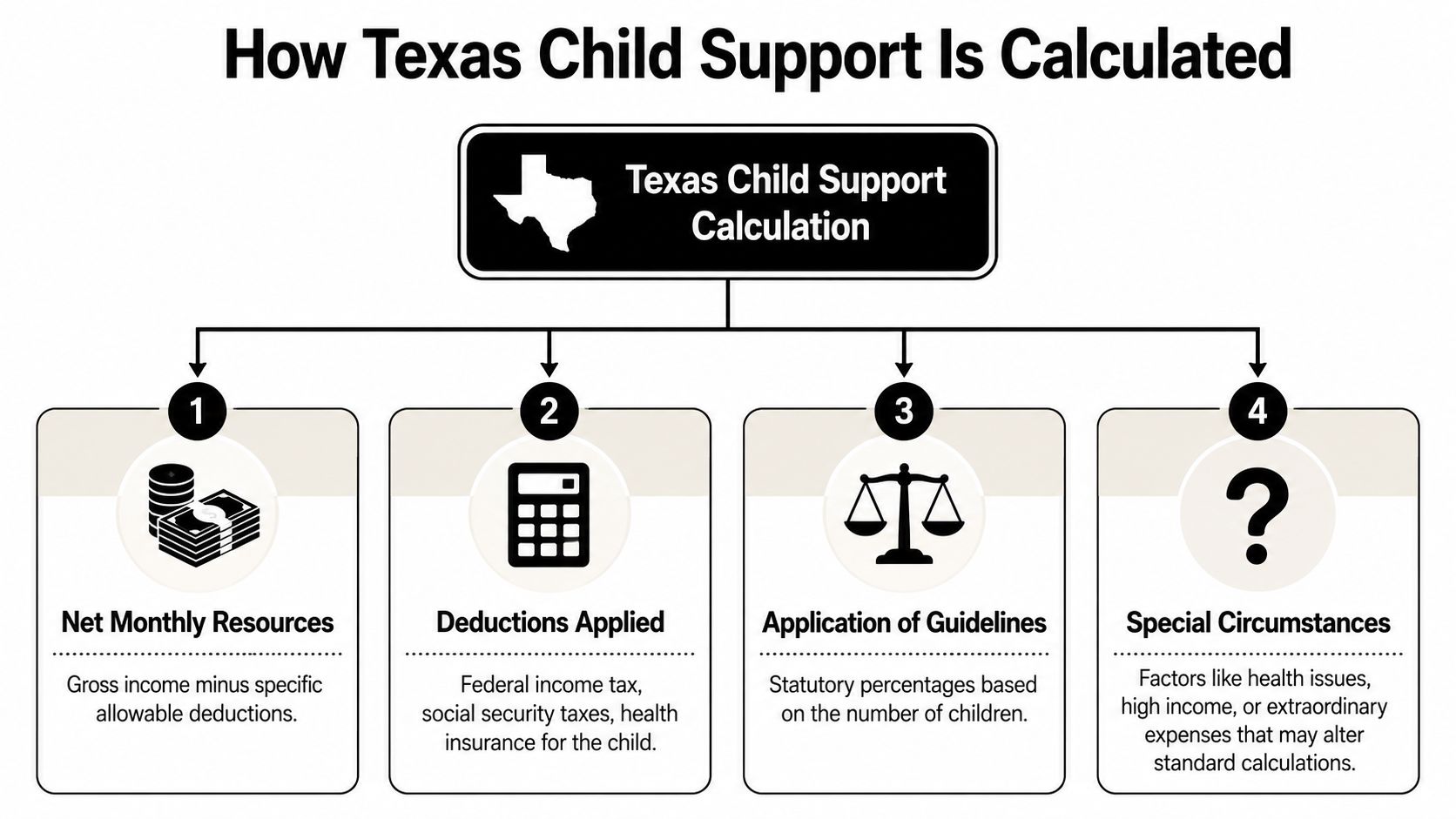
A useful companion for this section is Bryan Fagan's breakdown of how to calculate child support, which walks through the formula from a practical perspective.
Step one starts with net monthly resources
Under Texas Family Code Chapter 154, the court begins with the obligor's net resources, not only gross wages and not always the same number that lands in a checking account after payroll runs. The legal question is narrower. What resources count under Texas law, and what deductions are allowed before the guideline percentage is applied?
That distinction causes real confusion in Harris County cases. A salaried employee may have a relatively clear paper trail. A parent paid through commissions, contract work, overtime, cash flow from a small business, or year-end bonuses often does not. The formula stays the same. The hard part is getting to the right starting number.
Step two applies the guideline percentages
Texas Family Code § 154.125 sets the standard guideline percentages for children before the court. For many families, the court applies these percentages to the obligor's monthly net resources, up to the statutory cap. The cap is adjusted periodically. As of September 1, 2025, the cap is set to be $11,700 per month under the Texas Family Code provisions on guideline child support and net resources.
Here is the standard structure:
| Number of children | Guideline percentage |
|---|---|
| 1 child | 20% |
| 2 children | 25% |
| 3 children | 30% |
| 4 children | 35% |
| 5 or more children | 40% |
Texas also has low-income guidelines under Texas Family Code § 154.125(c) and related provisions. Courts use those rules in qualifying cases, but the answer depends on the parent's proven net resources under the statute in effect at the time of the case. That is why I tell parents to be careful with rough estimates. A mistaken income figure can change the guideline amount.
Step three asks whether the guideline amount fits the facts
The guideline number is the starting point courts use in most cases. It is not a calculator that spits out a final answer with no judgment involved. Courts can consider whether the circumstances justify a different result under the Family Code.
A simple analogy helps. The guideline formula works like a blueprint. It gives the court a standard design. Evidence about the child and the parents tells the court whether that design fits the house being built.
For example, if a Houston Heights parent has one child before the court and $5,000 in monthly net resources, the guideline starting point is 20 percent. If the parent receives a large annual bonus or irregular self-employment income, the dispute often is not about the 20 percent figure. The dispute is about whether the monthly net resources should be higher after averaging income over time.
That issue is easy to miss. It is also one of the most common reasons parents feel blindsided by the final number.
Why careful math matters so much
In many Houston Heights cases, the actual fight is not over the percentage chart. It is over what counts as income, how income should be averaged, and whether claimed deductions are legitimate. A business owner may call certain expenses necessary. The other parent may see personal spending mixed into the business account. A parent with bonuses may argue the payments are unpredictable. The court may still treat that compensation as part of the bigger income picture.
That is one reason steady records matter. If your income changes from month to month, budgeting for child support can feel difficult long before a judge signs an order. Some parents find it helpful to use Peaceful Mindful Pocket's budgeting system to plan around irregular income while the legal numbers are being sorted out.
A child support calculation is only as reliable as the income information behind it.
If you are worried that the other parent's income is being understated, or worried your own fluctuating income will be misunderstood, you are asking the right questions. Texas has a formula. Getting the right result depends on proving the right financial picture.
The Challenge of Calculating Non-Traditional Income
A parent in Houston Heights may walk into court with pay stubs that look inconsistent from month to month. One month includes a year-end bonus. Another reflects slow commission sales. A self-employed parent may show modest taxable income on a return while bank deposits suggest a different cash flow. That is often where child support disputes get harder, because the question is no longer just what was earned last month. The primary question is what income pattern the court should rely on.

Why this issue matters in Harris County
Texas child support is based on net resources, and variable pay often fits into that calculation. The difficult part is proving a fair monthly amount when income rises and falls. Courts in Harris County regularly see disputes over whether bonuses should be treated as recurring income, whether overtime has become part of a parent's normal earnings, and whether a business owner's reported expenses are truly business-related.
For many parents, this feels like trying to judge the size of a river by looking at it on one day. A single paycheck can be misleading. Judges usually need a longer view, which is why tax returns, year-to-date earnings, profit and loss statements, 1099s, bank records, and payroll history often matter more than one isolated document.
The Texas Attorney General explains the rules for applying child support guidelines and net resources in its Texas child support guidelines overview. The broad rule is simple. Applying it to uneven income is not.
Common examples that create disputes
Certain kinds of pay lead to repeat arguments in child support cases:
- Bonuses: A parent may say a bonus was unusual or discretionary. The other parent may point to a history of similar payments year after year.
- Commissions: A strong quarter can inflate one period and a slow quarter can understate earning ability if the court sees only a narrow slice of time.
- Self-employment income: Tax returns may show deductions that reduce income on paper, while credit card records or business accounts suggest personal expenses are mixed in.
- Overtime: Extra hours may be labeled optional, but a consistent overtime pattern can still influence how income is viewed.
- Contract or gig work: Side jobs, freelance payments, and cash-based work are easy to overlook unless records are gathered carefully.
If you're also sorting through the end of a marriage, Divorce covers Texas divorce representation for contested, uncontested, and high-conflict cases.
Practical steps when income is irregular
If your income changes throughout the year, start by organizing records in a way that shows patterns over time. Twelve months of statements usually tell a more accurate story than two recent pay periods. Business owners should also separate personal and business spending as much as possible. That alone can reduce suspicion and save time.
Parents with uneven earnings often benefit from budgeting outside the court process too. A resource like Peaceful Mindful Pocket's budgeting system can help you organize monthly planning when your income doesn't arrive in equal amounts.
If you are preparing for a child support case, the paperwork side matters just as much as the math. This guide to the filing process for child support in Texas can help you understand what documents and steps usually come next.
A short explainer can also help put the legal issue in perspective:
What matters most is documentation that is complete and consistent. If you earn variable income, show the court the full picture. If you believe the other parent is understating income, look for records that reveal repeat payments, regular deposits, or spending that does not match the income being claimed.
Courts can work through complicated income. They struggle to reach a fair number with incomplete records.
Once parents understand the formula, the next challenge is procedure. In Harris County, many child support disputes are won or lost because one side didn't file the right paperwork, didn't disclose income fully, or didn't prepare for the hearing.
The basic path through a child support case
Most cases follow a sequence that looks familiar, even though the details vary:
- A case is filed. This may happen within a divorce, a suit affecting the parent-child relationship, or a modification case.
- The other parent is served or appears. Formal notice matters.
- Financial information is exchanged. Pay records, tax returns, insurance information, and business records often become central.
- The parties may negotiate or mediate. Many cases narrow issues before a final hearing.
- A judge signs an order. That order controls until it is modified.
For a more detailed walkthrough of the paperwork side, Bryan Fagan's guide to essential steps for the filing process for child support in Texas is a helpful reference.
What local parents should expect
Harris County parents may deal with the Family Law Center and, in some cases, IV-D child support courts. Local practice can affect timing, required forms, and how financial issues are presented. That doesn't change the law, but it does affect how efficiently your case moves.
A recurring mistake is treating the case like a simple math problem when it is really a mix of law, procedure, and proof. If your documents are disorganized or your income picture is incomplete, the court may not have what it needs to enter the result you think is fair.
Attorney General services and private counsel
Some parents use the Office of the Attorney General's child support system. That can be useful, especially when the main issue is establishing or collecting support. But it helps to understand the difference between that route and private legal representation.
Here is a practical comparison:
| Option | Often helpful for | Limits to keep in mind |
|---|---|---|
| Attorney General process | Basic establishment and enforcement matters | The focus is child support administration, not broad personal legal advice |
| Private attorney | Cases with disputed income, business records, modification issues, or related custody concerns | Requires choosing counsel and preparing a case strategy |
If your case involves commissions, self-employment, side income, reimbursement disputes, or contested facts, a private attorney can help develop evidence in a way the court can use.
What helps most before court
Parents usually reduce stress when they prepare these items early:
- Income records: gather recent pay information, tax returns, and any documents tied to variable compensation.
- Child-related costs: keep organized records of insurance and other recurring expenses tied to the child.
- Communication history: save messages or emails that may clarify disputed facts without escalating conflict.
- Questions for counsel: write them down. People forget key concerns once the hearing starts.
Parents who prepare early usually make better decisions than parents who wait until the week of court.
Common Issues After a Child Support Order Is in Place
A support order can feel final on paper, but real life rarely stays still. A parent in Houston Heights may start the year with a steady salary, then shift to contract work, lose overtime, receive an irregular bonus, or see a small business slow down. Another parent may count on support arriving each month, only to find the payments becoming late or uneven. Those post-order problems are common in Harris County, and they usually fall into two categories: modification and enforcement.

When a parent needs a modification
The first point to keep in mind is simple. The current court order controls until a judge signs a new one. If income drops, a parent cannot safely reduce payments on their own, even if the reason feels obvious.
Under Texas Family Code Section 156.401, a court may modify child support if the circumstances of the child or a parent have materially and substantially changed, or in some cases if enough time has passed and the guideline amount would differ by the required margin. That rule sounds straightforward, but disputes often arise over proof.
This is especially true when income is not a simple paycheck. A salaried employee who loses a job may have clear records. A self-employed parent, a parent paid in commissions, or a parent whose earnings include seasonal bonuses may face a harder question: is the drop in income real, temporary, or partly hidden inside business deductions and uneven deposits? Courts usually want documents that make the change easy to follow, such as tax returns, profit-and-loss statements, bank records, and updated pay information.
A good way to view modification is this: the court is not reacting to a story alone. The court is checking whether the numbers and records support a legal change.
When enforcement becomes necessary
Enforcement issues often begin subtly. One missed payment becomes two. Then a parent receiving support has to cover groceries, school costs, or insurance without the money the order required.
Texas law provides several enforcement tools. They can include income withholding, judgments for unpaid support, interest on child support arrears, liens, contempt proceedings, and suspension of certain licenses under the Texas Family Code. For a parent owed support, those tools help restore consistency. For a parent who has fallen behind, they show why delay usually makes the situation harder and more expensive to fix.
Variable income can complicate enforcement too. For example, a parent paid through a business account may argue that cash flow is uneven, while the other parent believes money is being diverted or underreported. In those cases, payment records and financial tracing matter. The issue is no longer just whether support was ordered. The issue is whether income existed and what should have been paid under the order.
Two practical reminders
Written orders matter more than side conversations. If parents agree informally to lower, pause, or redirect support, that private agreement may not protect either side later.
Act early. A parent seeking lower payments should request a modification before arrears build up. A parent missing support should address the problem before inconsistent payments become a long-running pattern. In both situations, early action usually means clearer records, fewer missed details, and a better chance of presenting the court with a clean, understandable timeline.
How a Houston Heights Attorney Protects Your Interests
A parent in Houston Heights may look at a pay stub, a year-end bonus, a 1099, and a business bank statement and wonder which number the court will use. That confusion is common. Child support cases often become disputes about math before they become disputes about parenting.
An attorney helps protect your interests by turning scattered financial information into a clear, credible story the court can follow. In Harris County, that matters most when income does not fit neatly into a salary box. A base paycheck is usually straightforward. Bonuses, commissions, overtime, contract work, cash payments, and self-employment income require closer examination because the wrong starting number can affect the entire support order.
Texas child support follows a formula, but the formula only works if the income figure is accurate. The law sets guideline percentages based on the paying parent's net resources, and those guidelines generally begin at 20 percent for one child. The hard part is often not the percentage. The hard part is deciding what counts as income, what deductions are allowed, and whether irregular earnings should be averaged over time.

A good lawyer addresses those questions in practical ways:
- Uncovering the complete income picture: reviewing pay records, tax returns, profit and loss statements, bank deposits, and employer compensation records to see whether income is being overstated, understated, or hidden inside a business.
- Explaining irregular earnings: showing the court how bonuses, commissions, seasonal work, or self-employment revenue should be treated over time rather than relying on one unusually high or low month.
- Testing claimed deductions: separating legitimate business expenses from personal spending that may be run through a company account.
- Presenting numbers clearly: organizing records, summaries, and timelines so the judge can understand the calculation without sorting through a stack of disconnected documents.
- Protecting the final order: checking that the written order is specific enough to enforce later if payments stop or income changes.
That work matters for both parents. If you receive support, it can help prevent undercounting income that should have been included. If you pay support, it can help prevent a temporary bonus or distorted business record from creating an order that does not match your true ability to pay. A child support case is often like building a house. If the foundation number is off, every later calculation rests on the wrong base.
For many families, one practical option is the Law Office of Bryan Fagan, PLLC, which handles Texas family law matters including child support.
If you need help with a support case, a Houston Heights child support attorney can explain the numbers, prepare the evidence, and help you approach the process with a clearer plan. You do not have to sort through bonus income, self-employment records, and court procedure on your own.