When you're sitting at your kitchen table in Houston Heights, looking at school papers, bills, texts from your co-parent, and a future that suddenly feels uncertain, it's hard to know what matters most. You may be worried about where your children will live, whether your role as their primary parent will be recognized, and how you'll afford life after separation or divorce.
Those concerns are valid. They aren't overreactions, and they aren't signs of weakness. Family cases feel personal because they are personal. You're not arguing over abstract legal issues. You're trying to protect your child's routine, your voice in major decisions, and your financial footing at the same time.
An Empathetic Introduction for Houston Mothers
A lot of mothers come into this process carrying two fears at once. The first is fear of losing time with their children. The second is fear that the court process will be too complicated, too cold, or too stacked against them to manage effectively.
In Houston Heights, that worry often shows up in practical ways. You may be the parent handling school pickup, pediatric appointments, therapy scheduling, homework, meals, and bedtime. Then a separation happens, and suddenly you're hearing words like conservatorship, possession, temporary orders, mediation, and injunctions. That shift can feel disorienting.

The good news is that clarity helps. Once you understand how Texas family courts approach custody, support, and property, the process becomes less mysterious. You can start making decisions based on strategy instead of fear. If you're comparing legal options, reviewing guidance from top divorce lawyers in Houston, Texas can help you understand what strong representation should look like in a serious family case.
Practical rule: Start documenting daily parenting now. Keep records of school communication, medical appointments, calendars, and major exchanges with the other parent.
A Houston Heights mothers rights attorney doesn't seek a special advantage for mothers. Their work is instead more disciplined. It is to protect your equal legal standing, organize your evidence, and present a credible, child-focused case that holds up in court.
That distinction matters. In Texas, results usually turn on preparation, consistency, and proof.
The Foundation of Mothers Rights in Texas Law
Many mothers still assume the court will naturally favor them because they have been the more hands-on parent. That assumption can hurt a case if it leads to weak preparation. Texas law does not start from a maternal preference. It starts from a neutral legal standard focused on the child.

What the law actually says
Under Texas Family Code §153.003, courts can't favor one parent based on gender. Mothers do not automatically receive custody over fathers, and a father does not need to prove the mother is unfit before he can be considered for a primary caregiving role, as explained in this discussion of Texas custody rules for parents in Houston Heights.
That single principle changes how a smart case is built. A mothers rights case in Texas is not about asking for deference. It is about proving, with specifics, that your proposed arrangement serves your child best.
For a broader overview, this guide to Texas child custody laws is a useful starting point.
What judges tend to focus on
The phrase you'll hear often is best interest of the child. In practice, that means the court looks for facts that reveal who is providing steadiness and sound parenting judgment.
A judge may pay close attention to issues like these:
- Daily involvement: Who gets the child ready for school, attends meetings, and tracks assignments?
- Medical consistency: Who schedules appointments, follows treatment plans, and communicates with providers?
- Emotional stability: Which home offers calmer routines and more reliable follow-through?
- Co-parenting behavior: Which parent supports the child's relationship with the other parent when it's safe to do so?
If your case involves a dispute over conservatorship, Child Custody representation may include handling high-conflict custody and conservatorship issues where facts need to be carefully organized and presented.
Here is a concise explanation many parents find helpful before hearings:
Courts respond better to specifics than conclusions. "I am the better parent" is far less persuasive than "I attended school meetings, managed medications, and maintained the weekly therapy schedule."
Why equal standing matters
A Houston Heights mothers rights attorney should be honest about the legal realities. Equal standing is fair, but it also means you must come prepared. If you have been the parent carrying most of the day-to-day load, you need records that show it.
This same evidence-based mindset shows up in other family-centered legal decisions too. For example, parents making early choices around childbirth often benefit from learning about understanding home birth regulations in Texas, because rights and responsibilities tend to depend on what the law states, not on common assumptions.
Your Core Rights Conservatorship Possession and Support
Most Texas custody cases revolve around three moving parts. If you understand how these fit together, court orders become much easier to read and negotiate.
Conservatorship means decision-making power
Conservatorship addresses parental rights and duties. It functions as the decision-making structure for your child's life. It covers issues such as education, medical care, mental health treatment, and other major choices.
Parents often hear terms like joint managing conservatorship or sole managing conservatorship and assume one is always good and the other is always bad. It isn't that simple. The key question is how decision-making authority is allocated and whether one parent should have exclusive authority over specific issues.
A beneficial approach involves considering:
| Issue | What the court is deciding |
|---|---|
| School choices | Who can make educational decisions |
| Medical care | Who can consent to treatment |
| Counseling | Who can authorize mental health care |
| Residence | Who decides the child's primary home |
If you're trying to understand where a custody case formally begins, reviewing a SAPCR form in Texas can help you see how suits affecting the parent-child relationship are framed.
Possession and access means time with the child
Possession and access is the schedule. It answers when the child is with each parent, where exchanges happen, how holidays are split, and what summer time looks like.
For some families, a standard schedule works. For others, it doesn't. A young child with a very structured routine, a parent who works unusual hours, or a child with therapy or medical needs may need a custom arrangement.
What works well in real cases:
- Specific pickup terms: Clear exchange times reduce fights.
- Holiday detail: Spell out Thanksgiving, winter break, birthdays, and Mother's Day.
- School-based exchanges: They often lower direct conflict between parents.
What doesn't work well is relying on loose promises. "We'll figure it out later" usually becomes the next dispute.
Child support is separate from visitation
Child support is the financial side of the parent-child order. It is distinct from visitation. A parent can't usually withhold access because support hasn't been paid, and a parent can't stop paying support because parenting time is disputed.
That point matters in emotionally charged cases. Parents sometimes try to tie money and time together, but the court treats them as separate obligations.
A missed support payment is an enforcement issue. A denied visit is a possession issue. Mixing the two usually makes both problems worse.
If safety is part of your case, Protective Orders address domestic violence and family safety matters, and they can directly affect how possession and communication are handled.
Some cases become difficult not because the law is unclear, but because the facts are sensitive. Paternity disputes, family violence concerns, and relocation questions often place mothers under intense pressure. In these situations, timing and paperwork matter almost as much as the final hearing.
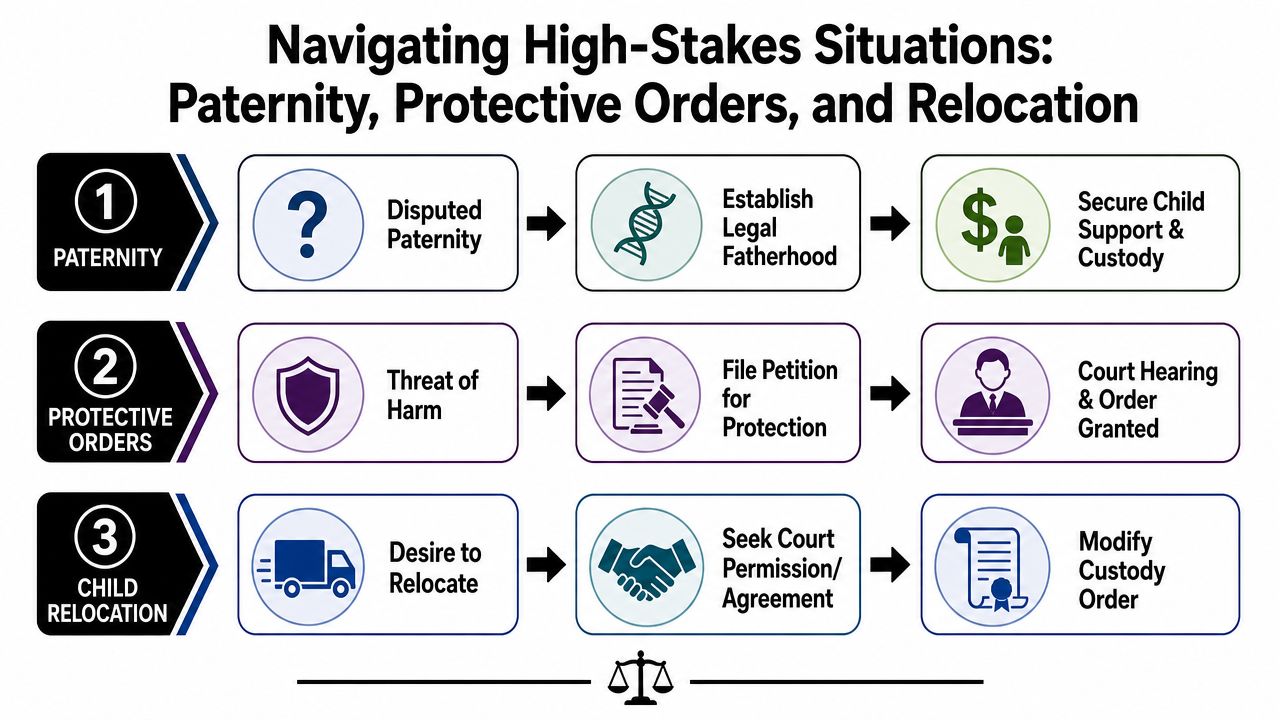
Paternity affects both rights and duties
Consider a common situation. A mother has cared for her child for years, but the father was never legally established. He now wants visitation, or she needs child support, or both. Emotionally, everyone may already know who the father is. Legally, that isn't enough.
Establishing paternity creates enforceable rights and duties. Paternity Actions deal with establishing legal paternity and the responsibilities that follow, including support and custody-related issues.
Without legal paternity, a case can stall in ways that frustrate both parents. With it, the court can issue enforceable orders.
Protective orders change the legal conversation quickly
Another scenario involves threats, stalking, intimidation, or violence in the home or after separation. In that setting, the first question isn't "How do I negotiate a schedule?" It is "How do I protect myself and my child safely and quickly?"
Start with immediate steps:
- Preserve evidence: Save messages, call logs, photos, and reports.
- Limit informal contact: Use written communication when possible.
- Seek urgent legal help: Temporary protections may be necessary before broader custody issues can be addressed.
A protective order case can shape possession terms, exchange conditions, and communication boundaries. It can also affect whether temporary orders should restrict contact.
If you're afraid of the other parent, treat that fear as legally relevant information, not something you have to downplay to appear cooperative.
Relocation cases require planning, not assumptions
A third scenario is relocation. You may want to move closer to family support, accept a job in another city, or leave an unsafe housing situation. Many mothers assume that if they are the primary parent, they can move with the child. That assumption can create serious problems.
Under Texas Family Code § 153.001 and § 153.254, conservatorship decisions must rest on the child's best interest without gender bias, and a mother must show that her proposed arrangement supports the child's physical and emotional stability, as outlined in this discussion of mothers' rights under Texas conservatorship law.
In relocation disputes, the court often wants practical answers, not general frustration. How will schooling continue? What happens to the child's existing support network? How will the other parent's relationship be preserved if the move is allowed? Strong relocation requests usually address those questions head-on.
Protecting Your Financial Future and Property Rights
Mothers' rights cases aren't only about parenting orders. They also involve your ability to leave a marriage with financial stability, protected assets, and a realistic plan for supporting your household.
Separate property and community property are not the same
Texas generally treats property acquired during marriage as community property. But some assets are separate property, and that distinction can have major consequences in divorce.
According to Texas Law Help's explanation of property division in divorce, separate property cannot be divided once it is proven. Separate property includes property owned before marriage, gifts or inheritances received individually during the marriage, and compensation for personal injuries. The spouse claiming separate property carries the burden of proof.
That proof issue is where many cases become technical. Saying "my grandmother left that to me" isn't the same as proving it. Tracing documents, account records, closing papers, and gift documentation often matter.
What this looks like in everyday life
A few examples make the rule easier to apply:
- Inheritance kept in your name: That may be separate property, but records matter.
- A house owned before marriage: The house itself may be separate, though other financial issues can still arise.
- A bank account mixed with marital funds: That can create disputes about whether part of the account lost its separate character.
For mothers planning a move or a property sale during divorce, practical real-estate timing matters too. This guide on how to navigate your home sale during divorce can help you think through the housing side of the transition.
What works and what doesn't
What works is early document gathering. Pull deeds, account statements, inheritance records, gift letters, retirement statements, and loan paperwork before the paper trail gets harder to reconstruct.
What doesn't work is assuming the court will sort it out from memory alone. Financial rights are protectable, but they usually aren't self-proving.
When to Hire a Houston Heights Mothers Rights Attorney
Some family law disputes stay manageable for a while, then suddenly become serious. A calm conversation turns into a threat to "take the kids." An informal support arrangement stops. A disagreement about school becomes a filing for primary custody.
Red flags that usually call for legal help
You should strongly consider hiring a Houston Heights mothers rights attorney if any of the following are true:
- The other parent hired counsel: You need someone who can evaluate filings, deadlines, and proposed orders.
- There are abuse, neglect, substance use, or mental health allegations: These claims can affect possession, temporary orders, and credibility.
- Your case involves business interests, separate property disputes, or complicated finances: Property issues often influence settlement pressure.
- The other parent wants to relocate, or you do: Move-away cases can change the entire shape of conservatorship.
- You feel frozen by the process: Overwhelm itself is a practical reason to get representation.
Why local familiarity matters
Harris County family practice has its own rhythm. Judges differ in how they prefer evidence presented, how they handle temporary orders, and how much detail they expect in parenting plans. A lawyer who regularly works in these courts can often help you avoid preventable mistakes.
The Law Office of Bryan Fagan, PLLC handles Texas family law matters including divorce, custody, and property disputes. In a mothers' rights case, that kind of representation typically means gathering records, preparing testimony, responding to allegations, and pursuing orders that are specific enough to enforce.
Good legal help doesn't just argue. It organizes your facts so the court can act on them.
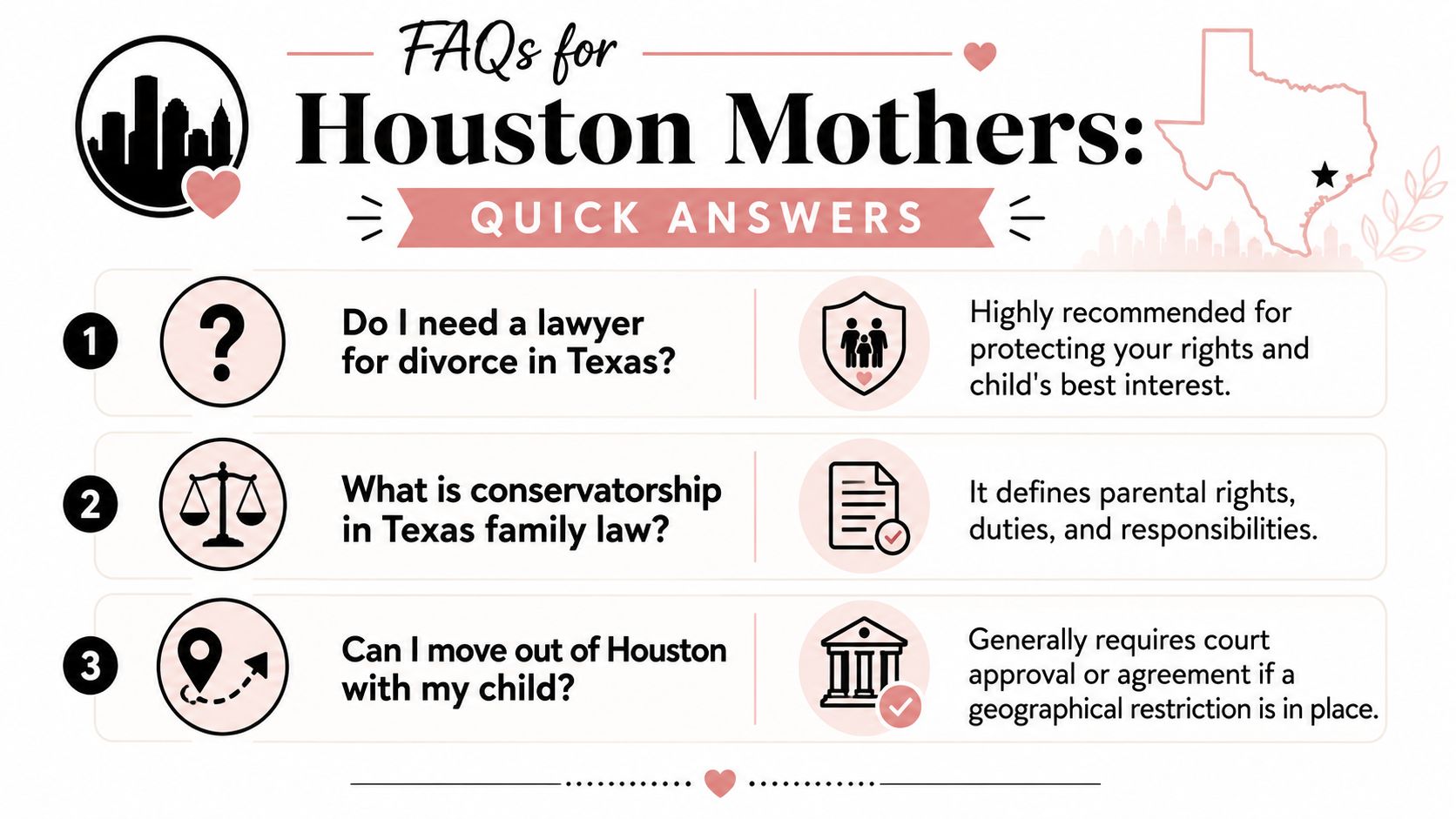
Frequently Asked Questions for Houston Mothers
Even after you've read the law and started preparing documents, a few practical questions tend to stay front and center. These are some of the most common.
Can I stop my ex from seeing our child if he doesn't pay child support
Usually, no. Support and possession are separate issues. If the other parent isn't paying, the answer is generally to pursue enforcement through the court rather than deny visitation on your own.
If there is a safety concern, that is different. Safety issues should be addressed directly through the appropriate legal process, not folded into a payment dispute.
How can I prove I am the better primary parent
Courts usually respond better to consistent evidence than emotional labels. Start with the basics:
- School records: Show your communication with teachers and attendance at meetings.
- Medical records: Track appointments, prescriptions, therapy, and follow-up care.
- Daily routine evidence: Calendars, childcare arrangements, and transportation records matter.
- Communication history: Keep messages that show your efforts to co-parent reasonably.
The strongest proof often tells a simple story. You were present, organized, reliable, and focused on the child's needs.
What is the first step in filing for custody in Houston
The first step is usually to identify the correct type of case and gather your key facts before filing. That includes where the child has been living, what orders already exist, what immediate issues need temporary relief, and what arrangement you want the court to adopt.
Then you prepare the proper pleadings and request any urgent temporary orders if needed. If there has already been a divorce or prior custody case, the procedure may be different than filing a first-time suit.
Do I need a lawyer if the other parent and I are mostly getting along
Not every case requires a courtroom fight, but even cooperative parents benefit from clear orders. Informal agreements often break down when schedules change, new partners enter the picture, or one parent decides the old arrangement no longer works.
A lawyer can help reduce ambiguity, identify hidden risks, and make sure the final order says what you think it says.
If you need help navigating divorce, custody, or estate planning in Texas, contact The Law Office of Bryan Fagan today for a free consultation.