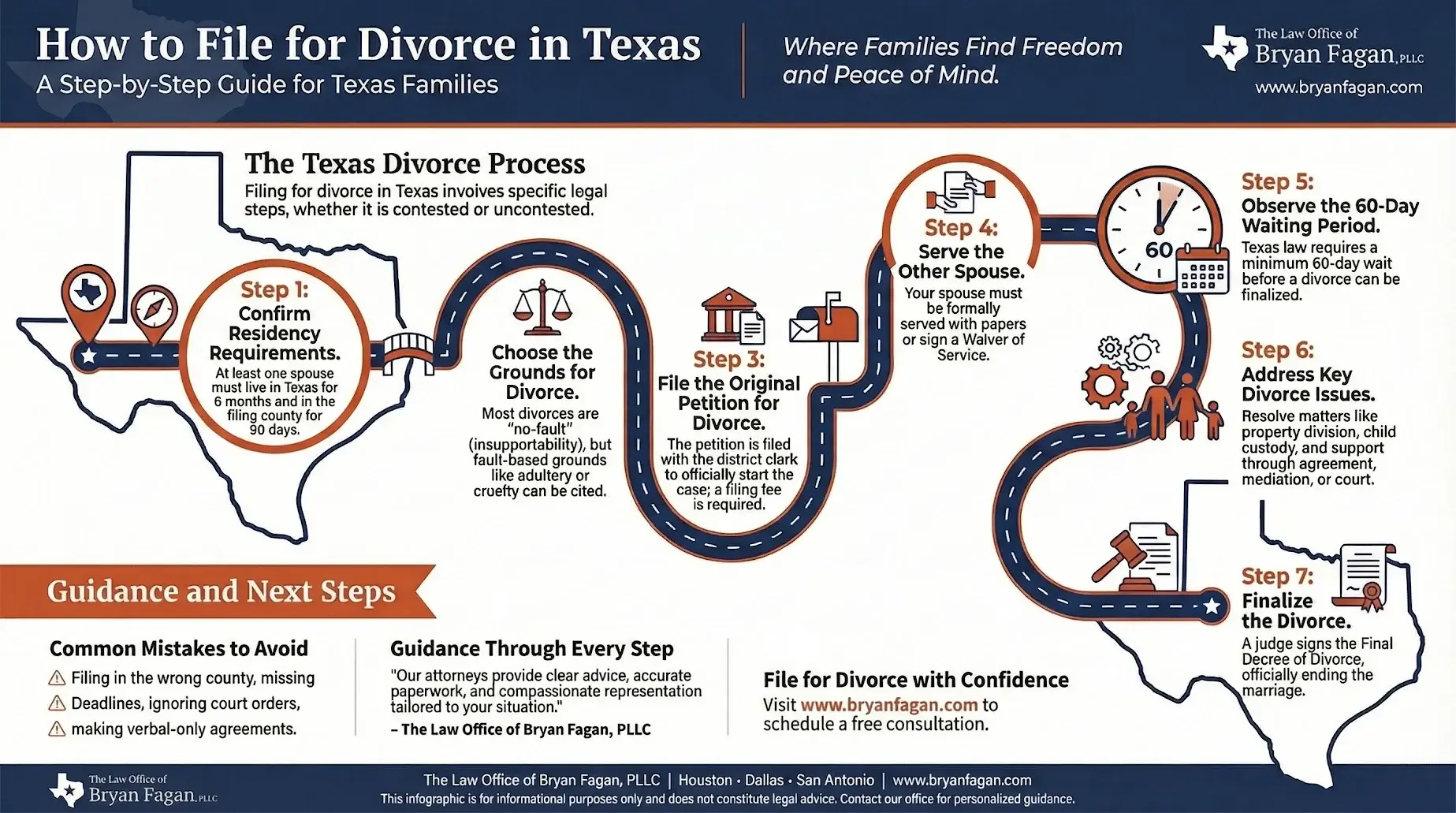

Have you ever found yourself staring at a calendar late at night, wondering how a decision you’ve already made still feels so complicated? For many Texas families, deciding to divorce is emotionally clear long before the legal path forward is. That uncertainty often begins with one simple question: how do you even start? Understanding How to File for Divorce in Texas is the first step toward turning a difficult decision into a process you can actually navigate with confidence.
At The Law Office of Bryan Fagan, PLLC, we see this moment every day. Parents and spouses come to us not just looking for forms or instructions, but for reassurance that they are doing the right thing—for themselves, for their children, and for their future. Texas law sets specific requirements for filing, including residency rules under Texas Family Code §6.301 and waiting periods designed to ensure fairness and reflection. Knowing these rules upfront can prevent unnecessary delays and help you avoid mistakes that add stress at an already challenging time.
Led by Bryan Joseph Fagan, a South Texas College of Law graduate and a widely respected authority on Texas divorce and custody law, our Houston-based firm was built on the belief that families deserve clarity and peace of mind during life’s hardest transitions. Through compassionate counsel, education, and practical legal guidance, we help Texans move from uncertainty to understanding—one step at a time.
In the sections ahead, you’ll learn exactly what filing for divorce in Texas involves, what courts expect at each stage, and how thoughtful preparation can protect what matters most. If you’re ready to replace confusion with clarity, we invite you to keep reading and take the next step forward with confidence.
Key Takeaways
- Residency requirements are mandatory: At least one spouse must have lived in Texas for six months and in the filing county for 90 days before the petition for divorce can be filed.
- The 60-day waiting period is non-negotiable: Texas law requires at least 60 days between filing and finalizing any divorce, with limited exceptions for cases involving family violence.
- Contested and uncontested divorces follow different paths: An agreed divorce where both spouses align on all issues moves faster and costs less than contested cases requiring negotiation, mediation, or trial.
- Proper service is essential: Your spouse must be formally served with divorce papers or sign a waiver of service—without this step, your case cannot proceed.
- Legal representation protects your interests: An experienced family law attorney helps you avoid costly mistakes, protect your parental rights, and navigate complex property division issues.

Your Family’s Future Starts Here
Don’t navigate your legal journey alone. Schedule a consultation now and get the clarity and support you deserve.
Who Can File for Divorce in Texas?
Before taking the first formal step in How to File for Divorce in Texas, it is essential to meet the residency requirements established by Texas Family Code §6.301. These requirements are more than procedural rules—they determine whether a Texas court has the legal authority to hear your case and issue binding orders affecting your family, finances, and property. When residency is misunderstood or poorly documented, courts may dismiss the case outright, forcing families to start over and lose valuable time.
Texas applies a two-part residency test that courts enforce strictly. At least one spouse must have lived in Texas for a continuous six-month period immediately before filing, and the spouse who files must have lived in the county where the divorce is filed for at least 90 days immediately before filing. Only one spouse needs to meet these requirements. You and your spouse do not both have to reside in Texas for the court to accept jurisdiction over your divorce.
This distinction is especially important for couples who have already separated geographically. If your spouse lives outside Texas but you have established residency here, you may still file in a Texas court. Conversely, if your spouse maintained Texas residency while you relocated elsewhere, they may file in Texas even though you now live in another state. Questions like these often arise early in the process, which is why the firm has created a detailed resource on Texas divorce residency requirements and what you need to know to help families understand how the law applies to real-life situations.
Consider a common example we see in practice. Michael moved from California to Fort Bend County eight months ago after separating from his wife, who remained in Los Angeles. Because Michael has lived in Texas for more than six months and in Fort Bend County for more than 90 days, Texas Family Code §6.301 allows him to file for divorce in Fort Bend County. His wife’s residence in California does not prevent him from initiating the case or asking a Texas court to address marital issues within its jurisdiction.
Attorneys with the firm regularly advise clients to confirm residency before filing any paperwork, as this step lays the legal foundation for everything that follows. Establishing jurisdiction correctly at the outset helps prevent delays and gives your case momentum from day one. If you would like additional context on what happens after residency is established, the firm’s overview of the Texas divorce process from filing to finalization provides a helpful roadmap for the stages ahead.

Texas law recognizes that not every family’s living situation fits neatly into one box, particularly for military families and individuals in transition. When discussing How to File for Divorce in Texas, active-duty service members are often given special consideration under Texas Family Code §6.303. A Texas domiciliary stationed outside the state on military orders may still qualify as a Texas resident for divorce purposes, while a service member stationed in Texas can often file here after meeting the required presence periods even if their legal home of record is elsewhere. These provisions help ensure military service does not prevent families from accessing Texas courts.
Timing remains one of the most critical factors when filing for divorce. Filing before residency requirements are fully satisfied or in the wrong county is a common mistake that can lead to dismissal under Texas Family Code §6.301. When a case is dismissed for lack of jurisdiction, the filing spouse must start over, repay court costs, and wait until residency requirements are met, adding unnecessary delay and stress during an already difficult transition.
Because residency determinations are fact-specific, documentation plays a central role in proving eligibility to file. Courts commonly look for objective evidence such as a Texas driver’s license reflecting a current address, lease agreements or mortgage statements, utility bills, voter registration records, and pay stubs from a Texas-based employer. Collecting these records in advance helps ensure your filing date aligns with statutory requirements and reduces the risk of court challenges.
Families who are relocating or adjusting to new living arrangements often benefit from additional guidance tailored to transitional situations. The firm has published a detailed resource on filing for divorce while transitioning residency in Texas that explains common pitfalls and how to avoid them. For a broader understanding of what follows after residency is established, readers may also find value in reviewing the Texas divorce process, which outlines the steps courts expect from filing through final resolution.

Step-by-Step Guide: How to File for Divorce in Texas
Step 1: Determine if Your Divorce Will Be Contested or Uncontested
One of the earliest and most important decisions you will face when learning How to File for Divorce in Texas is whether your case will proceed as uncontested or contested. This distinction shapes nearly every aspect of the process that follows, including cost, timeline, and emotional impact. Texas courts do not favor one path over the other, but they do expect clarity about where disagreements exist so the case can move forward appropriately under the Texas Family Code.
An uncontested divorce occurs when both spouses agree on all major issues before the case is finalized. This typically includes the division of community property and debts under Texas Family Code §7.001, child custody and conservatorship arrangements governed by Chapter 153, child support calculations under Chapter 154, and any spousal maintenance issues that may apply. When children are involved, possession schedules and decision-making authority must also be resolved. In these cases, the responding spouse often signs a Waiver of Service acknowledging receipt of the petition and later signs an agreed Final Decree of Divorce. Because the court is presented with a unified agreement, uncontested divorces generally move faster, cost less, and reduce emotional strain—particularly for children.
A contested divorce arises when spouses cannot agree on one or more significant issues. Disputes may involve who keeps the family home, how parenting time should be structured, whether child support accurately reflects income, or how to divide business interests or retirement accounts. Under Texas law, unresolved disagreements often require additional court involvement, which can include temporary orders hearings to establish rules while the case is pending, formal discovery to exchange financial and factual information, and court-ordered mediation before trial. These steps are designed to encourage resolution while ensuring each party has a fair opportunity to present evidence.
Although the word “contested” can sound intimidating, it is important to understand that most contested divorces do not end in a full trial. The majority resolve through negotiation or mediation once both sides have better information and legal guidance. Attorneys with the firm often remind clients that understanding the process early can ease anxiety and help set realistic expectations. For those navigating early strategic decisions—including residency planning that affects where and when a case can be filed—the firm has published practical guidance on strategies for meeting Texas divorce residency requirements. Readers may also benefit from reviewing the Texas divorce process, which explains how cases move from filing to resolution.
Choosing whether your divorce will be contested or uncontested is not about winning or losing; it is about identifying where agreement exists and where support may be needed to reach resolution. With informed legal guidance and a clear understanding of Texas law, families can move through either path with greater confidence and a focus on protecting their futures.
Step 2: Prepare Your Original Petition for Divorce
The original petition for divorce is the document that officially starts your case. This pleading tells the court who you are, who your spouse is, what you are asking for, and why the court has jurisdiction.
A properly prepared petition includes:
- Party identification: Full legal names of both spouses (Petitioner and Respondent)
- Jurisdictional allegations: Statements confirming that residency requirements are met
- Grounds for divorce: Most petitions cite “insupportability”—the no-fault ground under Texas Family Code Section 6.001 stating the marriage has become insupportable due to discord or conflict
- Children’s information: If minor children are involved, the petition identifies them and requests orders regarding conservatorship, possession, and child support
- Property requests: General requests for a “just and right” division of community property and debts
- Temporary orders requests: If needed, requests for immediate relief regarding custody, support, or protection
- Name change request: If either spouse wishes to restore a former name
The Texas State Law Library and TexasLawHelp.org provide standardized divorce forms and court forms for simpler, uncontested cases. However, these forms work best when circumstances are straightforward—no significant property disputes, no complex custody issues, and both parties cooperating fully.
Step 3: File Your Petition with the District Court
Once your original petition is completely filled out and ready, you file it with the district clerk’s office in the appropriate county. Many Texas counties now allow e-filing through the statewide eFileTexas system, though in-person filing at the clerk’s office remains available.
When you file:
- The district clerk assigns a cause number to your case
- You receive a file stamped copy of your petition
- The filing fee is collected (or you submit a Statement of Inability to Afford Payment if you cannot pay court costs)
- The 60-day mandatory waiting period officially begins
Filing fees vary by county but typically range from several hundred dollars. If you lack enough money to pay, Texas allows you to request a fee waiver by demonstrating financial hardship. The court evaluates your income, expenses, and assets before deciding.
Step 4: Serve Your Spouse
Texas law requires that your spouse receive proper legal notice of the divorce. This happens through either formal service or a waiver of service.
Waiver of Service: If your spouse agrees to cooperate, they can sign a service form (waiver) in front of a notary public after receiving a file stamped copy of the petition. This waiver is then filed with the court, confirming your spouse knows about the case and agrees to waive formal service. This approach saves money and avoids potential confrontation.
Formal Service: If your spouse will not sign a waiver—or you cannot locate them—formal service becomes necessary. Options include:
- Private process server: A certified individual personally delivers the divorce papers to your spouse
- Constable or sheriff: Law enforcement officers can serve papers, typically for a fee
- Service by publication: When a spouse lives out of state or cannot be located despite diligent effort, the court may authorize publishing notice in a newspaper
Proper service is not optional. Without it, the court cannot proceed, and any signed final decree could later be challenged as void.
Once served, your spouse typically has until the first Monday after 20 days have passed to file an answer form. If no answer form is filed, you may be able to pursue a default divorce—though evidence and testimony are still required.

Step 5: Handle Temporary Orders (If Necessary)
Temporary orders establish rules that govern your family while the divorce is pending. They do not determine final outcomes but provide stability and protection during a difficult transition.
Temporary orders commonly address:
- Child custody and possession: Where children will live, who makes decisions, and visitation schedules
- Child support: Interim financial support for the children
- Spousal support: Temporary maintenance payments during the proceedings
- Use of marital property: Who remains in the family home, who uses which vehicles
- Protection from family violence: Injunctions, no-contact provisions, or referral to emergency procedures
Either party can request temporary orders by filing a motion and scheduling a hearing. In emergency situations involving crime involving family violence, courts can issue emergency protection orders or temporary restraining orders immediately, with a hearing following shortly afterward.
Temporary orders significantly influence final outcomes—judges often prefer maintaining stability for children. Early legal representation helps ensure your rights and your children’s wellbeing are protected from the start.
Step 6: Complete Financial Discovery
Both spouses must provide complete and accurate financial information. Texas is a community property state, meaning assets acquired during marriage generally belong equally to both spouses and must be divided fairly.
Financial disclosure typically includes:
- Income documentation: Pay stubs, tax returns, W-2s, 1099s
- Asset statements: Bank accounts, investment accounts, retirement plans
- Real property information: Home values, mortgage statements, deeds
- Debt records: Credit cards, loans, medical bills
- Business interests: Ownership documents, profit and loss statements
In uncontested cases, parties often exchange this information informally. In contested divorces, formal discovery tools—interrogatories, requests for production, depositions—may be necessary to compel complete disclosure.
Hiding assets or providing false information creates serious consequences, potentially including sanctions and an unfavorable property division. Courts expect transparency, and experienced attorneys know how to identify red flags suggesting incomplete disclosure.

Step 7: Negotiate Settlement or Prepare for Trial
Most Texas divorces resolve through settlement rather than trial. Negotiation can happen informally between attorneys, through collaborative processes, or in formal mediation.
Mediation involves a neutral third-party mediator—often an experienced family law attorney—who helps both parties reach agreement. Many Texas courts require mediation before allowing a contested case to proceed to trial, particularly when children are involved.
During mediation:
- Parties typically meet in separate rooms with the mediator shuttling between them
- Discussions remain confidential under mediation privilege
- If agreement is reached, parties sign a Mediated Settlement Agreement that becomes binding
The settlement rate in mediation is remarkably high. While precise statistics vary, experienced practitioners commonly report that 80-90% of cases settle before trial. This means even if your divorce begins contested, it likely will not end that way.
If no settlement is reached, the case proceeds to trial where a judge (or sometimes a jury for certain issues) makes final decisions about property, custody, and support.
Step 8: Finalize Your Divorce
The culmination of your divorce process is the final decree of divorce—the comprehensive judgment that:
- Officially dissolves your marriage
- Divides community property and allocates debts
- Confirms separate property
- Establishes conservatorship, possession, and child support orders
- Contains enforcement provisions for ongoing obligations
Even in an agreed divorce, at least one spouse (usually the Petitioner) must attend a brief final hearing called a “prove-up.” The judge calls your case, and you testify under oath about:
- Your identity and residency
- The date and circumstances of your marriage
- The grounds for divorce (typically insupportability)
- Whether reconciliation is possible
- Whether the proposed orders serve the children’s best interests (if applicable)
- Whether the property division is just and right
Once satisfied, the judge signs the final decree, and your divorce is complete. You will want to obtain certified copies for future reference and begin implementing the decree’s terms—transferring titles, dividing accounts, updating beneficiaries, and making any necessary name changes through the Texas Vital Statistics Unit if requested.
Understanding the Mandatory 60-Day Waiting Period
Texas Family Code Section 6.702 establishes a firm rule: courts cannot grant a divorce before the 60th day after the suit was filed. This “cooling off” period applies to all divorces, giving couples time to reconsider, negotiate, or seek counseling.
How the 60 days are calculated:
- Day 0: The day you file your petition
- Day 1: The day after filing
- Day 61: The earliest possible date for your divorce to be finalized
If Day 60 falls on a weekend or court holiday, your prove-up hearing will be scheduled for the next available court date. In practice, busy court dockets may push hearings somewhat later.
Exceptions for family violence: Courts may waive the 60-day requirement when:
- The respondent has been convicted of or received deferred adjudication for a crime involving family violence against the petitioner or household member
- An active protective order or active magistrate’s order based on family violence exists
Even with these exceptions, some judges prefer a brief interval. An attorney familiar with local practices can advise whether a waiver is realistic in your county.
Use this waiting period productively. Gather financial documents, consider your priorities for property division and custody, and consult with an attorney about your options.
Essential Documents Required to File for Divorce in Texas
Having the right paperwork ready prevents delays and rejected filings. While specific requirements vary by county and case complexity, essential documents typically include:
Initial Filing Documents:
- Original Petition for Divorce (completely filled and signed)
- Civil Case Information Sheet (required in many counties)
- Filing fee payment or Statement of Inability to Afford Payment
Service Documents (choose one):
- Waiver of Service (signed by respondent before a notary)
- Answer form filled by respondent (if formally served)
- Return of Service (completed by process server or constable)
Financial Documents:
- Recent pay stubs and tax returns
- Bank and investment account statements
- Retirement account statements
- Mortgage and loan documents
- Credit card statements
- Property appraisals (for real property or significant assets)
Child-Related Documents (when children are involved):
- Parenting plan proposals
- Child support calculation worksheets
- Medical insurance cost information
- School and childcare expense documentation
Final Documents:
- Final Decree of Divorce (signed by both parties in agreed cases)
- Qualified Domestic Relations Order (QDRO) for retirement account division
- Property transfer deeds if real property is divided
- Wage withholding orders for child support
Additional documents may be needed depending on your circumstances. An attorney ensures nothing is overlooked.

Common Mistakes That Delay Texas Divorce Cases
Even well-intentioned people can make mistakes that quietly derail their divorce cases, especially when they are learning How to File for Divorce in Texas for the first time. Many of these errors stem from misunderstanding jurisdictional rules that Texas courts enforce strictly under Texas Family Code §6.301. Filing in the wrong county—where neither spouse has lived for the required 90 days—often results in dismissal or transfer, costing time and additional filing fees. Courts do not make exceptions for convenience, even when both spouses agree on the divorce.
Another common misstep is filing too early, before residency requirements are fully satisfied. Texas law requires that at least one spouse reside in Texas for six months and in the filing county for 90 days before filing, and cases filed prematurely are routinely dismissed. These situations can become even more complicated when one spouse challenges residency, which is why careful preparation and documentation are critical. The firm has addressed these scenarios in detail in its guidance on handling residency disputes in a Texas divorce, which explains how courts evaluate contested residency claims.
Paperwork errors are another frequent source of delay. Using the wrong form set, leaving required sections blank, or including contradictory information can lead to rejected filings and repeated trips to the clerk’s office. Courts expect forms to match the complexity of the case, particularly when children, property, or support issues are involved. Service mistakes are equally serious. Informal notice by text or email does not satisfy Texas service requirements, and without proper service or a valid waiver under Texas Family Code §6.4035, a final decree may be vulnerable to challenge years later.
Financial oversights often create problems long after the divorce is finalized. Child support miscalculations—such as relying on gross income instead of net resources under Texas Family Code §154.062 or failing to account for overtime, bonuses, or multiple children—can quickly lead to modification or enforcement actions. Retirement accounts earned during the marriage are community property under Texas Family Code §7.001, and decrees that fail to address them properly or omit required QDRO language may cause a spouse to lose significant benefits. Similarly, unclear debt allocation leaves spouses exposed if the other defaults, even though creditors may pursue both parties.
Finally, many filers underestimate the impact of local court rules. Some counties require parenting classes, mediation certificates, or specific formatting before a case can be finalized, and missing these requirements often delays hearings. Attorneys with the firm encourage families to look beyond the basics and understand how statewide law and local practice intersect. For a broader overview of how these pieces fit together, readers may find it helpful to review the Texas divorce process from start to finish, which outlines common requirements and expectations at each stage. By avoiding these pitfalls and seeking informed guidance early, families can protect their time, resources, and peace of mind.
Why Legal Representation Matters in Texas Divorce
Texas family law is governed by detailed statutes and strict procedural rules, and courts expect those rules to be followed precisely. While self-representation is permitted, the realities of How to File for Divorce in Texas often make professional guidance essential. Early filing decisions can affect your children’s stability, your financial security, and the enforceability of court orders, and even minor procedural errors can result in dismissed cases, delayed hearings, or outcomes that are difficult and costly to correct.
An experienced Texas family law attorney helps ensure your case is built on a solid legal foundation from the start. This includes confirming jurisdiction and residency under Texas Family Code §6.301, preparing accurate pleadings, and navigating county-specific procedures that frequently trip up self-represented filers. In cases involving military service, recent relocation, or safety concerns, legal counsel can also identify whether statutory exceptions apply, as explained in the firm’s resource on exceptions to Texas divorce residency requirements.
When children are involved, the need for careful legal guidance becomes even more important. Texas courts must apply the “best interest of the child” standard under Texas Family Code §153.002, and custody and support orders must comply with Chapters 153 and 154. An attorney helps protect parental rights, ensure child support is calculated correctly, and draft clear conservatorship and possession terms that reduce the risk of future conflict or enforcement actions.
Property and debt division also benefit from professional oversight. Texas Family Code §7.001 requires a “just and right” division of community property, which depends on proper identification and valuation of assets, including retirement accounts and debts. Beyond drafting documents, attorneys guide clients through negotiations, mediation, and court hearings, providing strategy and advocacy at each stage. For additional perspective on how these pieces fit together, readers may find it helpful to review the Texas divorce process. In many cases, the cost of legal representation is far outweighed by the long-term protection and peace of mind it provides.
Why Choose The Law Office of Bryan Fagan PLLC
At The Law Office of Bryan Fagan, PLLC, our work is rooted in the belief that families deserve clarity, confidence, and steady guidance during one of life’s most difficult transitions. When clients come to us seeking help with How to File for Divorce in Texas, they are often overwhelmed by legal requirements, emotional strain, and uncertainty about what comes next. Our role is not simply to prepare documents, but to guide families through the process with compassion, strategic planning, and precise legal execution grounded in the Texas Family Code.
Because Texas divorce law is both technical and evolving, our attorneys focus exclusively on Texas family law and remain current on statutory updates and court practices. From confirming jurisdiction and residency under Texas Family Code §6.301 to ensuring a “just and right” property division under §7.001 and child-focused decisions under §153.002, every step is handled with careful attention to detail. Our experience across Harris County, Fort Bend County, Montgomery County, and surrounding areas allows us to anticipate county-specific procedures that often cause delays for self-represented filers.
Families also benefit from our commitment to clear, consistent communication. Divorce affects far more than legal status—it impacts children, finances, and long-term stability. We take time to explain complex legal concepts in plain English, keep clients informed as their case progresses, and remain accessible when questions arise. Whether the case is resolved through agreement, mediation, or court proceedings, our advocacy is guided by the goal of protecting parental rights, financial security, and future peace of mind.
Ultimately, our approach allows clients to focus on rebuilding while we manage the legal complexity. For readers who want a broader understanding of what to expect from start to finish, the firm offers a detailed overview of the Texas divorce process that explains each stage in practical terms. With informed guidance and experienced representation, Texas families can move forward knowing their case is built on a solid legal foundation and handled with care.
Actionable Checklist: How to File for Divorce in Texas
Use this checklist to track your progress:
- [ ] Confirm residency requirements: Verify that you or your spouse has lived in Texas for six months and in your county for 90 days
- [ ] Gather documentation proving residency: Driver’s license, utility bills, lease or mortgage documents
- [ ] Decide between contested or uncontested divorce: Assess whether you and your spouse can agree on major issues
- [ ] Prepare your Original Petition for Divorce: Include all required information and allegations
- [ ] File the petition with the district clerk: Pay filing fees or submit fee waiver request
- [ ] Calendar your 60-day waiting period end date: Mark Day 61 as the earliest possible finalization date
- [ ] Serve your spouse or obtain a signed waiver of service: Ensure proper notice is accomplished
- [ ] Gather financial documents: Tax returns, pay stubs, account statements, property values
- [ ] Exchange financial information: Complete formal or informal discovery as needed
- [ ] Attend mediation if required: Prepare priorities and settlement ranges with your attorney
- [ ] Finalize the divorce decree: Ensure all terms are accurately documented
- [ ] Attend the final hearing (prove-up): Testify about jurisdiction, grounds, and proposed orders
- [ ] Obtain certified copies of the judge signed decree: File for future reference
- [ ] Implement the decree: Transfer property, divide accounts, update beneficiaries
Conclusion
Filing for divorce is rarely something anyone feels completely ready for, but understanding the process can make it far less intimidating. When you know what Texas law requires and what to expect at each step, uncertainty starts to fade and a sense of control takes its place. The goal isn’t just to file paperwork correctly—it’s to move forward with clarity and protect the people and priorities that matter most to you.
At The Law Office of Bryan Fagan, PLLC, we believe knowledge is empowering. Taking the time to learn how divorce works in Texas allows you to make thoughtful decisions instead of rushed ones, even when emotions are running high. Whether you’re still considering your options or preparing to take action, having accurate information gives you a stronger footing from the very beginning.
If you’re feeling unsure about your next move, speaking with an experienced Texas family law attorney can help you turn questions into a plan. Sometimes a brief conversation is enough to confirm you’re on the right track—or to prevent a mistake that could slow everything down. And if nothing else, remember this: taking informed steps today can make tomorrow feel a lot more manageable.
Instructions & Forms FAQ: Texas Divorce Documentation Requirements
Texas Divorce Documentation Requirements refer to the specific court forms, supporting records, and procedural steps Texas judges require before they can grant a divorce or issue enforceable orders. These requirements are not optional. Courts rely on properly completed paperwork to determine jurisdiction, divide property, set child support, establish custody, and order medical support. Even when spouses agree on everything, missing or incorrect documentation can delay or derail the case.
When minor children are involved, agreed divorces require more than just a petition and decree. Courts expect documentation that clearly addresses conservatorship, possession schedules, child support, and medical support. This includes income verification, health insurance information, and language that complies with Texas Family Code requirements. Ambiguous parenting terms or incomplete child support paperwork are among the most common reasons judges reject agreed decrees.
If a final custody or child support order already exists, your divorce documentation must reference that order correctly and avoid unintentionally changing it. Courts often require a file-stamped copy of the existing order and precise decree language confirming what remains in effect. Filing in the wrong court or using inconsistent language can convert an agreed divorce into a contested case, causing delays and added expense.
Divorces without children generally involve fewer documents, but they still require careful drafting. Texas courts expect clear and enforceable property and debt division terms. Vague references to assets, retirement accounts, or debts can lead to post-divorce enforcement disputes. Proper documentation ensures the court’s order can actually be carried out without returning to court later.
Service of process is a legal requirement that protects due process rights. If service is defective, the court may refuse to move forward. Even in agreed divorces, Waivers of Service must be completed and notarized correctly. Service errors are one of the most common reasons divorce cases stall early, often forcing parties to redo weeks or months of work.
You should begin collecting pay stubs, tax returns, proof of health insurance costs, childcare invoices, medical expense records, bank statements, retirement account statements, and property documents. Judges make decisions based on proof, not estimates. Having these records ready early helps ensure your child support numbers, property division, and support requests align with what you can document.
Some people do, but many later discover that technical errors or unclear language created delays or future disputes. Texas courts do not correct mistakes for you. Even small issues—such as missing medical support language or unclear possession schedules—can prevent a decree from being signed. This is why many families choose to have an experienced Texas family law attorney review or prepare their documentation.
The Law Office of Bryan Fagan, PLLC helps Texas families ensure their divorce documentation is complete, accurate, and enforceable. Whether you need full representation or limited-scope review of forms you’ve already prepared, our team focuses on preventing mistakes that lead to rejected filings, enforcement problems, or unexpected court outcomes. Proper documentation is not just about getting divorced—it’s about protecting your future and your children’s stability.