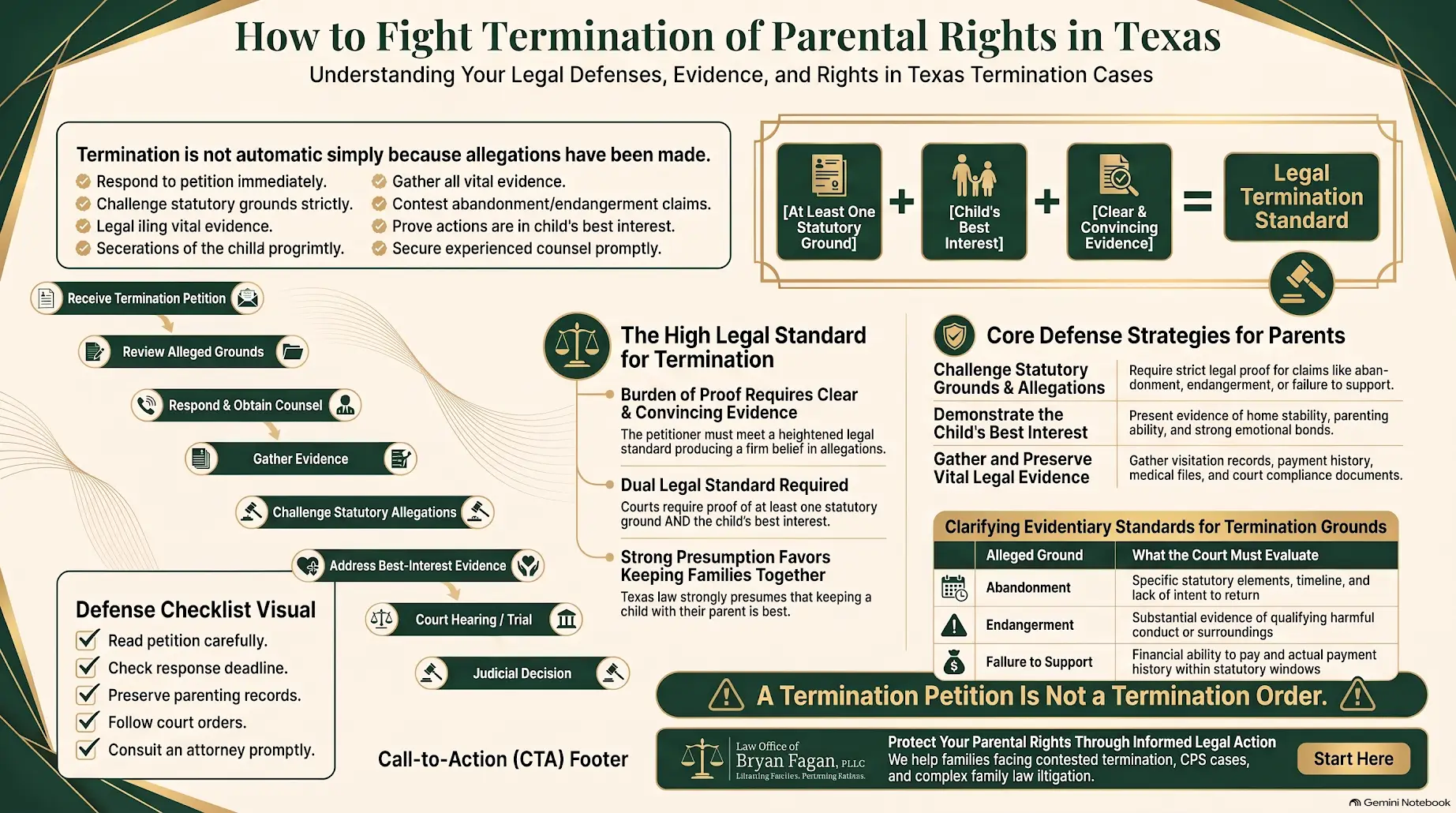
Being served with papers asking a Texas court to end your parental rights is frightening. It can make an ordinary day feel like everything has changed at once. One moment you are trying to get through work, dinner, bills, or bedtime; the next, you are reading allegations that could affect your relationship with your child forever. How to Fight Termination of Parental Rights in Texas starts with one clear takeaway: do not ignore the papers, do not guess at the deadline, and do not assume the other side automatically wins.
This guide explains what being served means, how to respond, and how to contest both the alleged legal ground and the child’s best interest. In Texas, termination cases require serious proof. The petitioner must prove a statutory ground under Texas Family Code §161.001 and must also prove that termination is in the child’s best interest. In custody matters, Texas Family Code §153.002 makes the child’s best interest the court’s primary concern, and that same child-centered focus runs through termination cases.
At The Law Office of Bryan Fagan, PLLC, a Houston-based family law firm led by Bryan Joseph Fagan, a South Texas College of Law graduate and recognized authority on Texas divorce and custody law, we know these cases are not just legal disputes. They are family crises. Our mission is educating families and protecting futures, which means helping parents understand the law, organize their evidence, and move forward with calm, practical direction.
If you have been served, the next steps matter. This article will help you understand answer deadlines, evidence, defenses, hearings, best-interest arguments, and the ways experienced Texas family law guidance can help protect what matters most.
Quick Answer
A parent facing a termination suit in Texas should answer on time and hold the other side to its burden: a statutory ground and that termination is in the child’s best interest, each proved by clear and convincing evidence. Ignoring the papers risks a default judgment, so read the citation, note the answer date it states and get legal help before that date.
Key Takeaways
- Do not ignore the papers. The citation warns that a default judgment may be taken if no answer is filed.
- The other side carries the burden. It must prove a statutory ground and the child’s best interest, each by clear and convincing evidence.
- Each finding can be contested. Challenging the ground and challenging best interest answer different parts of the case.
- Evidence matters. Organize documents, records and witnesses early.
- A lawyer can help. Whether the court must appoint one for a parent depends on who filed the suit.
| Answer first: if you were served | Short answer |
|---|---|
| What is the first thing to do? | Read the citation and find the answer date it states. |
| Can I ignore it if the allegations are false? | No. Rule 239 allows a default judgment if no answer is filed and the return of service has been on file for the required time. |
| What does the other side have to prove? | A statutory ground and best interest, each by clear and convincing evidence. |
| Do I automatically get a lawyer? | Not in every case. Section 107.013 is written for suits filed by a governmental entity, for an indigent parent who opposes termination. |
How to Fight Termination of Parental Rights in Texas After Being Served

Being served means a termination case has been filed, and you must respond by the deadline listed in the citation. How to Fight Termination of Parental Rights in Texas starts with reading the petition, finding the answer date, and identifying who filed the case. The other side does not win simply because papers were served, but ignoring the case can put your parental rights at serious risk.
Under Texas Family Code §102.009(a), a parent whose rights have not already been terminated and who has not waived service is generally entitled to service of citation. In plain English, citation is the formal notice that tells you a lawsuit exists and that the court expects a response. The petition should also tell you what the other side is asking for and which termination grounds are being alleged.
In a Texas civil case, the citation usually directs the defendant to file a written answer by 10:00 a.m. on the Monday after twenty days have passed from service. Read your own citation carefully because that date controls. Missing the answer deadline may allow the other side to seek a default judgment, which is why the first days after service matter so much.
In straightforward situations, the first filing may be an original answer with a general denial. In more complex cases, especially if CPS or DFPS filed the case, a parent may need to consider temporary orders, discovery, witness preparation, appointment-of-counsel issues, or a trial strategy. The Law Office of Bryan Fagan, PLLC helps parents turn a frightening stack of papers into a clear plan, and parents seeking guidance can learn more from our Texas termination of parental rights attorney resource.
| Step | Why it matters | Where to learn more |
|---|---|---|
| Read every page of the citation and petition | The petition states what the other side is asking the court to do and the statutory grounds it relies on. | Our grounds page |
| Find the answer date on the citation | The citation states when a written answer is due; that date controls, not a guess. | This page, below |
| Check who filed the case | A private case and a case filed by the Department can involve different appointment rules and procedures. | This page, below, and our CPS defense team’s guide |
| Note the best-interest facts the petition claims | A ground alone is not enough; best interest is a separate finding the petitioner must prove. | Our best-interest guide |
| Gather your documents | Orders, records and messages may become evidence in the case. | Our evidence guide |
| Talk with a family-law attorney | A lawyer can review the petition, prepare the answer and identify what the other side must prove. | This page, below |
| Track every court date | The court decides on the evidence presented, and a parent who appears can present it. | Our involuntary termination page |
Served with termination papers?
The answer date on your citation matters. A Texas family-law attorney at the Law Office of Bryan Fagan, PLLC can review the petition and help you respond, without promising a particular result.
Why Responding on Time Matters
Responding on time keeps you in the case and protects your right to be heard. In a Texas termination lawsuit, missing the answer deadline can allow the petitioner to ask for a default judgment, meaning the court may move forward without your side fully presented. That is why How to Fight Termination of Parental Rights in Texas begins with the citation, the answer date, and a written response filed before the deadline.
Texas Rule of Civil Procedure 239 allows a plaintiff to seek a default judgment after the answer time has passed if no answer has been filed and the return of service has been on file for the required time. Rule 239a requires notice after a default judgment is signed, but the rule also says failure to comply with that notice rule does not affect the judgment’s finality. In plain English, notice after default is not a substitute for answering the case on time.
Notice still matters. In the Department case In re E.R., the Supreme Court of Texas reversed a termination judgment after finding that service by publication was constitutionally inadequate where the Department knew the mother, had regular contact with her, and had met with her in person. The lesson is narrow but important: before a court ends a parent’s rights, the parent must receive legally adequate notice and a fair opportunity to respond.
Parents should also understand that responding to a termination case is different from agreeing to give up parental rights. A parent may hear terms like relinquishment, waiver, or termination and assume they all mean the same thing, but they do not. For more background on that distinction, our firm’s guide on relinquishment and termination of parental rights explains why parents should slow down, read carefully, and get clear guidance before signing anything that could affect their relationship with their child.
Contesting the Alleged Ground
The petitioner must prove one of the grounds listed in Section 161.001(b)(1), along with best interest, by clear and convincing evidence. Each ground has its own elements, so start by identifying which subdivision the petition pleads and what facts it alleges.
Contesting a ground means testing each element against the evidence. If the petition lists a ground you do not understand, compare it to the current grounds list on our grounds page before deciding how to respond.
Private Case Note: Proof of the Ground Matters
Holick v. Smith was a private case decided in 1985 under an earlier version of the Family Code: relatives sought to end a mother’s rights so they could adopt. The Supreme Court of Texas said termination proceedings should be strictly scrutinized and involuntary termination statutes strictly construed in favor of the parent, and it denied termination because the statutory ground was not proved, even though best interest was not contested. The case does not predict the outcome of any modern case; it shows that the ground itself must be proved.
Contesting Best Interest
Best interest is a separate finding in a Texas termination case, and the petitioner must prove it by clear and convincing evidence. That means even if the other side claims a statutory ground for termination, the court must still decide whether ending the legal parent-child relationship is best for the child. How to Fight Termination of Parental Rights in Texas often turns on showing the court the full picture of your relationship, your progress, and your child’s needs.
Texas Family Code §153.002 says the best interest of the child is the primary consideration in custody decisions, and that same child-centered focus matters in termination cases. In plain English, the court is not supposed to look only at accusations or past mistakes. The judge may also consider the child’s safety, emotional needs, stability, family connections, support system, and whether a less drastic option could protect the child without permanently ending parental rights.
Evidence matters here. A parent may use visitation records, text messages, school or medical records, counseling records, support payments, photographs, witness testimony, and proof of recent improvements to show involvement and stability. In more complex cases involving substance abuse allegations, mental health concerns, incarceration, family violence claims, or a pending adoption, the best-interest defense may require a deeper review of records and witnesses.
The Law Office of Bryan Fagan, PLLC helps parents prepare for this part of the case with careful evidence review and practical guidance. Parents outside the Houston area can also review our San Antonio termination attorney resource for more information about how Texas termination cases are evaluated. Our mission is educating families and protecting futures, and in a best-interest dispute, that means helping the court see the child’s real life, not just one side of the story.
Organizing Your Evidence
Evidence should help the court understand what is true, what has changed, and what outcome protects the child. In a Texas termination case, the petitioner must meet the clear and convincing evidence standard, which is higher than the usual civil standard. That makes organization important for any parent learning How to Fight Termination of Parental Rights in Texas.
Texas Family Code §101.007 defines clear and convincing evidence as proof that produces a firm belief or conviction in the factfinder’s mind about the truth of the allegations. In plain English, the court is looking for reliable proof, not guesswork, assumptions, or one-sided stories. Your evidence should help answer the specific allegations in the petition and the best-interest issues the court must decide.
Useful records may include court orders, visitation calendars, text messages, emails, child support payment history, school records, medical records, counseling records, photographs, drug testing results, treatment records, employment documents, and names of witnesses who know your relationship with your child. In straightforward situations, a simple folder organized by date may be enough. In more complex cases involving CPS, substance abuse allegations, mental health concerns, incarceration, or disputed visitation, evidence may need to be sorted by issue, witness, and legal ground.
The Law Office of Bryan Fagan, PLLC helps Texas parents turn scattered documents into a practical case plan. Parents in Montgomery County and nearby communities can also review our Woodlands parental rights resource for more information about protecting parental rights in Texas family courts. Our goal is to help families move from confusion to clarity with evidence that speaks to the child’s safety, stability, and future.
Who Speaks for Your Child?
In a termination suit not filed by a governmental entity, Section 107.021(a-1) requires the court to appoint an amicus attorney or an attorney ad litem for the child unless it finds that a party whose interests do not conflict with the child’s will adequately represent the child. An attorney ad litem provides legal services to the child; an amicus attorney assists the court in protecting the child’s best interests (Section 107.001).
Do You Have a Right to a Lawyer?

You may defend a termination case yourself, but whether the court must appoint a lawyer depends on who filed the case and whether you qualify under Texas law. Under Texas Rule of Civil Procedure 7, a party may appear and defend in person or through an attorney. In plain English, that means you can represent yourself, but in a case involving the possible permanent loss of parental rights, legal strategy, deadlines, evidence, and courtroom procedure matter.
In a case filed by a governmental entity, such as the Department of Family and Protective Services, Texas Family Code §107.013 requires the court to appoint an attorney ad litem for an indigent parent who responds in opposition to termination. The court must also tell an unrepresented parent about that right at the first appearance. This appointment rule is important for parents trying to understand How to Fight Termination of Parental Rights in Texas, especially when CPS or DFPS is asking the court to end the parent-child relationship.
Private termination cases are different. If another parent, relative, or prospective adoptive parent filed the case, the same automatic appointment rule may not apply. In straightforward situations, a parent may start by filing an answer and appearing in court; in more complex cases involving abandonment, endangerment, substance abuse allegations, incarceration, child support arrears, or a pending stepparent adoption, early legal advice can help protect against mistakes that are hard to fix later.
Parents should also be careful before signing anything that gives up notice or participation rights. A waiver can have serious consequences, and the concept of giving up citation is not limited to family law. For more background on how waiver language can affect legal proceedings, you can review our discussion of a waiver of citation in Texas. The Law Office of Bryan Fagan, PLLC helps Texas parents understand these choices before fear, pressure, or confusion leads to a decision that affects their child and their future.
Where Each Related Question Belongs
This page covers the practical steps for a parent who is responding. It is not a guide to forms for starting a case. Each related question has its own page:
- The full list of current grounds: our grounds page.
- How a private case proceeds from filing to order: our involuntary termination page.
- How courts weigh best interest in termination: our best-interest guide.
- What kinds of evidence matter: our evidence guide.
- What a termination order changes: our consequences page.
- Voluntary termination and relinquishment affidavits: our voluntary process guide and affidavit page.
- An overview of termination in Texas: our termination overview.
- A case brought by the Department: our CPS defense team’s guide.
Need help preparing your response?
Bring the citation, the petition and any orders already in place. A Texas family-law attorney can explain what the other side must prove and how to respond.
Legal Resources
Legal research note: This page was checked against the current official text of Texas Rules of Civil Procedure 7, 99, 239 and 239a, and Texas Family Code Sections 101.007, 102.009, 107.001, 107.013, 107.021 and 161.001, and against the opinions in Holick v. Smith and In re E.R. The authorities were last checked on October 7, 2026.
- Texas Rules of Civil Procedure — official text, including Rules 7, 99, 239 and 239a. Official text.
- Texas Family Code Chapter 102 — official text, including Section 102.009. Official text.
- Texas Family Code Chapter 107 — official text, including Sections 107.001, 107.013 and 107.021. Official text.
- Texas Family Code Chapter 161 — official text, including Section 161.001. Official text.
- Texas Family Code Chapter 101 — official text, including Section 101.007. Official text.
- In re E.R., No. 11-0282 (Tex. 2012) — Department case: service by publication was constitutionally inadequate where the Department knew and was in contact with the parent. Opinion text (unofficial reproduction).
- Holick v. Smith, 685 S.W.2d 18 (Tex. 1985) — private case under an earlier version of the Family Code: termination proceedings are strictly scrutinized; termination denied because the ground was not proved. Opinion text (unofficial reproduction).
Meet Kimberly P. Washington
Attorney Routing
Kimberly P. Washington
Senior Managing Attorney
Kimberly Washington has been with the Law Office of Bryan Fagan, PLLC since 2015 and provides senior legal leadership in Texas family-law matters, including divorce, child custody, and mediation. When a parent has just been served, the citation, the petition and the answer date are where she will start.
Licensed by the State Bar of Texas since 2008 · Juris Doctor, Thurgood Marshall School of Law
Conclusion:
How to Fight Termination of Parental Rights in Texas comes down to timely action, credible evidence, and a clear focus on the child’s best interest. In straightforward situations, that may mean filing an answer, organizing records, and preparing for the first hearing. In more complex cases involving CPS, substance abuse allegations, incarceration, mental health concerns, default judgments, child support arrears, or a pending stepparent adoption, the strategy often needs to be more detailed.
If your case involves disputed facts, urgent deadlines, or allegations that could permanently affect your relationship with your child, the right level of legal guidance matters. The Law Office of Bryan Fagan, PLLC helps Texas parents understand what is being alleged, what must be proven, and what evidence may protect their rights. Parents in Montgomery County and nearby communities can also review our Shenandoah termination of parental rights resource for more information about how these cases are handled in Texas family courts.
Our mission is educating families and protecting futures. If you have been served with termination papers or believe a termination case may be coming, speaking with a Texas family law attorney can help you move from fear and confusion toward clarity, preparation, and a plan focused on protecting what matters most.
About the Author
Bryan Fagan
Founder, Law Office of Bryan Fagan, PLLC
Texas Divorce & Family Law Attorney · Licensed in Texas Since 2012
Bryan Fagan founded the Law Office of Bryan Fagan, PLLC in 2012. His work includes Texas family-law strategy, firmwide leadership, team-based case planning, and client education designed to help families understand their legal options and make informed decisions.
Juris Doctor, South Texas College of Law, 2011 · Licensed by the State Bar of Texas May 4, 2012 · Bar No. 24080889
About the Law Office of Bryan Fagan, PLLC
The Law Office of Bryan Fagan, PLLC helps Texas families understand and navigate family-law issues involving divorce, child custody, possession and access, and related matters. Founded by Bryan Fagan in 2012, the firm combines legal representation with education designed to give families clearer information about their options and the decisions ahead.
This page provides general information for parents responding to a suit to end a parent’s rights in Texas. It is not legal advice, and reading it does not create an attorney-client relationship. How these rules apply depends on the citation, the petition, the evidence, the governing statutes and the individual facts.
Frequently Asked Questions
Start with the citation, the answer date it states, who filed the case, the ground alleged, and the best-interest facts the petition claims. Then gather records that respond to those allegations and talk with a family-law attorney before the answer date. Waiting is not a safe plan.
Rule 99 says the citation warns that a default judgment may be taken if no answer is filed. Rule 239 then allows the petitioner to seek one after the answer time has passed, if the return of service has been on file for the time Rule 107 requires. Filing an answer keeps you in the case.
Rule 7 lets a party defend a suit in person or through an attorney. A lawyer can help you answer on time and hold the other side to its burden. Mandatory appointment under Section 107.013 applies in suits filed by a governmental entity, for an indigent parent who responds in opposition.
Evidence depends on the ground alleged and the best-interest claim. Useful categories can include records, messages, school or medical documents, witness testimony, proof of contact, proof of support, and evidence of safe housing or parenting progress. What matters is whether the evidence responds to what the petition alleges; our evidence guide covers the details.
In a termination suit not filed by a governmental entity, Section 107.021(a-1) requires the court to appoint an amicus attorney or an attorney ad litem unless it finds that a party whose interests do not conflict with the child’s will adequately represent the child.
Yes. A case brought by the Department of Family and Protective Services follows its own procedures and timelines, which this page does not cover. Our CPS defense team’s guide explains that process, and the appointment rule in Section 107.013, written for suits filed by a governmental entity, applies there.