
Divorce can be one of life’s most difficult transitions, and when children are involved, the primary concern is ensuring their stability and well-being. A 50/50 custody schedule is often seen as a way to achieve that balance, allowing children to spend roughly equal time with each parent and maintain strong, consistent relationships after a separation. Understanding your rights and options under Texas law can make this overwhelming process feel more manageable.
This guide is designed to provide clear, step-by-step explanations of how 50/50 custody works in Texas, helping you feel supported and understood as you make these critical decisions for your family.
Understanding the Shift Towards Equal Parenting Time
Going through a separation is tough, no matter the circumstances. When kids are in the picture, it adds a whole other layer of complexity and emotion. The goal of any custody arrangement isn't just to split time down the middle; it's about honoring your child’s right to have a meaningful, ongoing relationship with both parents.
In Texas, every decision about custody boils down to one guiding principle: the "best interest of the child." You'll find this phrase in Texas Family Code § 153.002, and it's the standard judges live by. While the law doesn't automatically default to a 50/50 split, there's a growing recognition in courtrooms across the state that equal parental involvement often provides the stability kids need. This isn't just a legal trend; it reflects a much broader understanding in our society that both parents play a crucial role in raising happy, healthy children.
What This Means for Your Family
For many families, an equal possession schedule does more than just divide time—it builds a foundation for a healthy co-parenting future. Some of the biggest upsides we see in practice include:
- Deeper Parent-Child Bonds: When kids have consistent, quality time with each parent, it allows them to build secure, lasting attachments. It's about more than just weekend visits.
- Shared Parental Responsibilities: An equal schedule means both parents are in the trenches together. From homework and doctor's appointments to bedtime stories, the daily duties of parenting are shared, which helps prevent burnout on either side.
- Greater Stability for Children: Kids thrive on routine. A predictable schedule that includes both parents helps them adjust to the new family dynamic and minimizes the feeling that their world has been turned upside down.
A Growing Trend Supported by Research
This move toward shared parenting isn’t just happening in Texas; it's a nationwide shift in how family law approaches custody. The numbers don't lie. Research shows that the likelihood of a court ordering shared physical custody after a divorce more than doubled, jumping from just 13% in 1985 to 34% between 2010 and 2014. You can learn more about the findings on shared custody trends here. This data confirms what many of us have seen firsthand: societal norms and legal standards are catching up to the reality that kids do best with both parents actively involved.
Consider this your first step toward figuring out how to create a possession order that actually fits your family’s unique situation. We'll walk you through what these schedules look like in the real world, break down the legal jargon, and give you the practical, actionable guidance you need to build a stable, positive future for you and your kids.
Exploring Practical 50/50 Custody Schedule Options
Figuring out a 50/50 custody schedule isn't about picking a template off a shelf; it’s about finding a rhythm that actually works for your family. The real goal here is to build consistency and stability for your kids as they get used to a new way of life. Taking a look at the most common rotations can help you picture what might be best for your co-parenting dynamic and, more importantly, for your children.
Let's walk through some of the practical 50/50 schedules that Texas parents often land on. Each one has its own vibe—some are great, some have definite drawbacks. The right fit usually comes down to things like your kids' ages, how far apart you live, and how well you and your co-parent can communicate.
The Alternating Weeks Schedule
One of the simplest and most popular 50/50 models is the alternating weeks schedule, often called the week-on/week-off rotation.
- How it Works: The concept is straightforward. Your child lives with you for one full week, then with the other parent for the next week. The handoff usually happens on the same day each time, like a Friday after school or Sunday evening, to keep things predictable.
- Best For: This schedule is often a great fit for older kids and teenagers. They can usually handle being away from one parent for a longer stretch. It also cuts down on the constant back-and-forth, which means less time spent living out of a suitcase.
- Potential Challenges: For younger children, especially toddlers, a full week can feel like an eternity. Being away from a parent for seven days straight can be tough. This setup also demands top-notch communication between parents to keep track of homework, school events, and activities that fall across both weeks.
The 2-2-3 Schedule
When you have younger kids, frequent contact with both parents is non-negotiable. It’s essential for building and maintaining those strong bonds. The 2-2-3 schedule was designed with exactly that in mind.
- How it Works: In this rotation, one parent has the kids for two days (say, Monday and Tuesday), the other parent takes the next two (Wednesday and Thursday), and then you alternate who gets the three-day weekend (Friday to Sunday). This means a child is never away from a parent for more than three days.
- Best For: This is a go-to schedule for infants, toddlers, and early elementary schoolers who really thrive on seeing both parents regularly.
- Potential Challenges: The biggest hurdle is the number of exchanges. For example, a family might exchange on Wednesday morning before school and again on Friday after school. This really only works if parents live close to each other and have a cooperative, low-conflict relationship to manage all the handoffs without a hitch.
This graphic shows the fundamental idea guiding Texas courts: every decision, including the custody schedule, must serve the child's best interest by creating a stable environment.
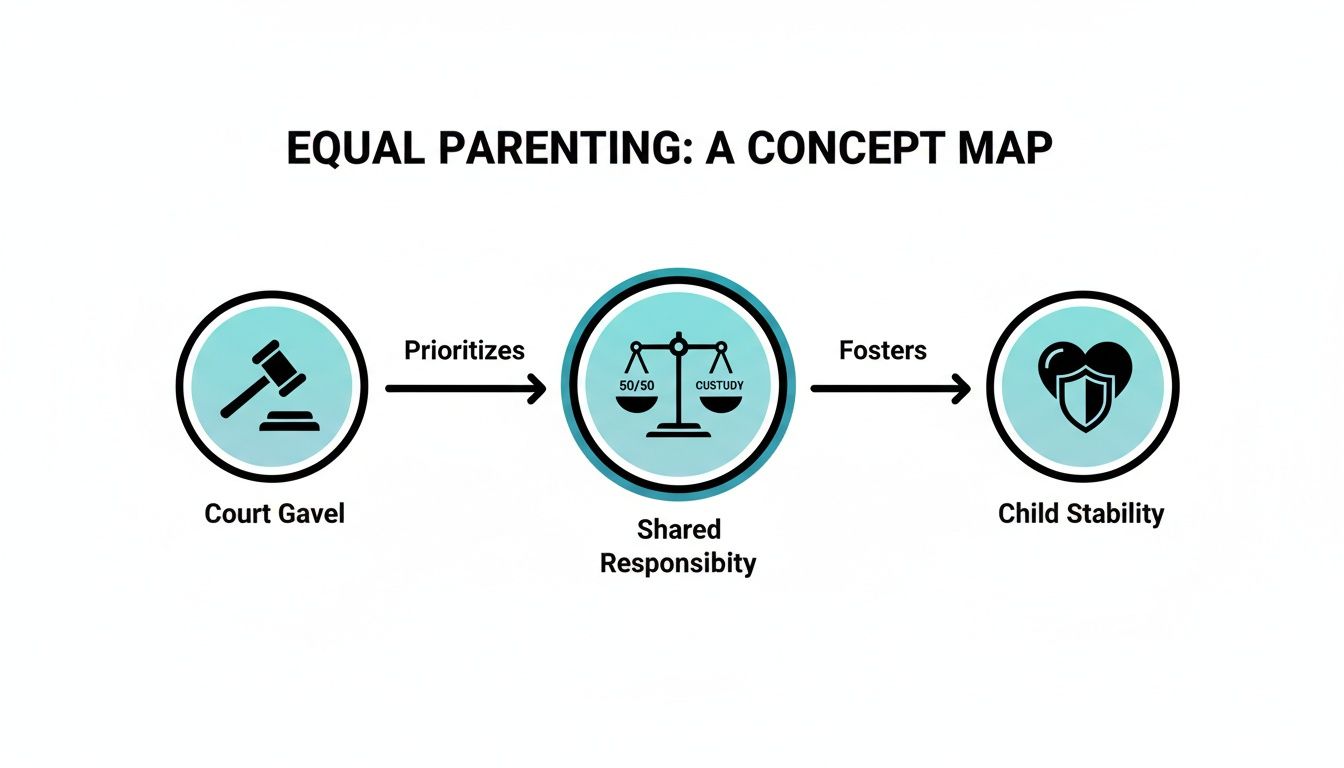
The flow from the court's authority, to the balance of a 50/50 plan, and finally to the child’s stability, makes it clear: the schedule is just a tool. The real goal is a positive outcome for the child.
Comparison of Common 50/50 Custody Schedules
This table compares the key features of popular 50/50 schedules to help parents choose the best fit for their children's needs and family logistics.
| Schedule Type | Best For | Pros | Cons |
|---|---|---|---|
| Alternating Weeks | Older children and teens who handle longer separations well. | Minimizes exchanges and disruption; simple to track. | Can be too long for young children; requires strong co-parent communication. |
| 2-2-3 Schedule | Infants, toddlers, and young children who need frequent contact. | Child never goes more than 3 days without seeing a parent. | High number of exchanges; requires parents to live close and cooperate well. |
| 2-2-5-5 Schedule | Families who need a predictable weekly routine. | Consistent days with each parent (e.g., Parent A always has Mon/Tues). | Still involves frequent exchanges, which can be disruptive for some children. |
Choosing the right schedule is a balancing act. It’s about finding what provides stability for your kids while being realistic about what you and your co-parent can manage.
The 2-2-5-5 Schedule
The 2-2-5-5 schedule is another option that provides a predictable, consistent structure that many families like. It’s a nice blend of consistency and longer blocks of time with each parent.
The biggest selling point of the 2-2-5-5 is that each parent gets the kids on the same two days every single week. For example, you might always have Mondays and Tuesdays, and your co-parent always has Wednesdays and Thursdays. You just alternate the bigger five-day block that includes the weekend.
This kind of consistency makes it so much easier to plan your work schedule and personal life. The trade-off, much like the 2-2-3, is the frequent transitions, which don’t work for every kid. At the end of the day, the best schedule is the one that keeps conflict low and puts your child’s well-being first. Thinking through these options is a solid starting point, and you can get more insight on how to think about dividing parenting time with your co-parent in our detailed guide.
Why Equal Possession Time Benefits Your Child
When you’re navigating a separation, your child’s well-being is everything. We spend a lot of time talking about schedules and rotations, but it’s just as important to understand why a balanced approach like a 50/50 custody schedule can make such a positive difference. Let’s move past the legal logistics for a moment and look at the real, human impact that equal time with both parents can have on a child’s life.
Having consistent, meaningful time with both parents sends a powerful message: they are loved, supported, and a top priority in two homes, not just one. This sense of stability becomes the bedrock of their emotional security as they adjust to a new family dynamic.

Fostering Emotional and Developmental Health
Probably the single biggest advantage of a 50/50 custody schedule is the chance for your child to build and maintain strong, secure relationships with both of you. This isn’t just about feelings; it’s a cornerstone of healthy psychological development. Kids thrive when they know they can count on both Mom and Dad for comfort, guidance, and day-to-day care.
This consistent presence helps normalize what life looks like after a divorce. Instead of feeling like they are just “visiting” one parent, they feel like they have two real homes. That sense of belonging is absolutely crucial for their self-esteem and ability to bounce back from challenges.
The Academic and Social Advantages
The benefits of equal possession often spill over into the classroom and your child’s social life. A predictable routine helps lower the stress and anxiety that can come with a major family transition. When a child feels secure at home, they’re in a much better position to focus on school, friendships, and their favorite activities.
And this isn’t just wishful thinking—the research is compelling. A major 2023 meta-analysis found that children in stable 50/50 arrangements do just as well academically, emotionally, and socially as their peers from intact two-parent homes. In fact, the benefits often got stronger the closer the time split was to a true 50/50 share, pushing back against outdated ideas that kids absolutely need one “primary” home. Discover more insights about the positive outcomes of shared parenting.
By making sure both parents are involved in everything from homework help to parent-teacher conferences, a 50/50 schedule reinforces the message that their education and growth are a shared priority. This shared involvement shows your child that even though you live apart, you’re still a dedicated parenting team working together for them.
Benefits for Parents and the Co-Parenting Relationship
The upsides of a 50/50 custody schedule aren’t just for the kids. This kind of arrangement offers huge benefits for parents, too, which in turn creates a healthier environment for everyone.
- Shared Responsibilities: Equal time means the duties are shared. You both get to handle the daily joys and the challenges, from packing school lunches to cheering on the sidelines at soccer games. This helps prevent one person from becoming the “fun” parent while the other is stuck with all the discipline and chores.
- Reduced Parental Burnout: Let’s be honest, parenting is a tough job. Having regular breaks to recharge allows you to be more present, patient, and engaged when your child is with you. It can make a world of difference in the quality of the time you spend together.
- Strengthened Co-Parenting: Successfully managing an equal schedule forces you to communicate and cooperate. Over time, this can help you build a more positive, business-like co-parenting relationship that’s focused on your child’s best interests, not on old conflicts.
At the end of the day, when parents are less stressed and working together more effectively, children feel the positive ripple effects. A well-run 50/50 schedule isn’t just about dividing time—it’s about multiplying the support, stability, and love available to your child.
How Texas Courts Determine the Child’s Best Interest
When you’re thinking about a custody schedule, especially a 50/50 arrangement, it’s vital to get inside a Texas judge’s head. A lot of parents walk into court assuming an equal split is the default, but that’s a common misconception. In Texas, there’s no automatic legal rule saying a 50/50 schedule is right for every family.
The court’s entire decision hangs on a single, powerful principle: the best interest of the child. This standard is the North Star for every family court judge in the state. It means the focus isn’t on what’s “fair” to the parents, but on what arrangement will truly help the child thrive—emotionally, physically, and mentally. To figure that out, Texas courts lean on a set of guidelines known as the “Holley Factors.”
The Holley Factors Explained
The Holley Factors come from a landmark 1976 Texas Supreme Court case, Holley v. Adams. Think of them as a judge’s checklist for evaluating what custody arrangement genuinely serves a child’s best interest. While you won’t find them written word-for-word in the Texas Family Code, they are universally applied in every custody case.
A judge will carefully weigh evidence related to these factors, which include:
- The emotional, physical, and developmental needs of the child: The court looks closely at the child’s age and unique needs. A schedule that works great for a self-sufficient teenager might be completely wrong for a toddler who needs more frequent contact with both parents to feel secure.
- The parental abilities of each individual: This is all about each parent’s capacity to provide a safe, stable, and loving home. The court will consider who has historically been the primary caregiver and who is better equipped to handle the day-to-day work of parenting.
- The stability of the home environment: Judges look for consistency and a predictable routine. A parent who can offer a stable home, free from chaos or constant disruption, is often seen as a better fit.
- Any acts or omissions by a parent that may indicate an improper parent-child relationship: This is where things like a history of family violence, neglect, substance abuse, or other dangerous behaviors come into play.
- The plans each parent has for the child: The court wants to see that you’ve thought things through. Do you have a solid plan for your child’s education, healthcare, and general upbringing?
A judge’s job is to be an impartial fact-finder. They piece together a complete picture of your family’s life to create an order that protects the child and helps them develop in a healthy way. Understanding these factors is non-negotiable because they directly decide whether a judge will sign off on a 50/50 custody schedule. If the evidence shows one parent is significantly more stable, or that the parents simply can’t cooperate, the court will likely lean toward a more traditional possession schedule instead.
Practical Considerations That Influence the Court
Beyond the formal Holley Factors, judges are practical people. They look at the real-world logistics that will impact a child’s day-to-day life. These practical details can easily make or break a request for an equal possession schedule.
Proximity of Parents’ Homes:
One of the biggest logistical hurdles is how far apart the parents live. A 50/50 schedule with frequent handoffs, like a 2-2-3 rotation, just isn’t going to work if you live an hour away from each other. The constant travel would be exhausting and stressful for a child. Most successful 50/50 arrangements involve parents who live in the same school district or at least a short drive apart.
The Co-Parenting Relationship:
A judge will also put your co-parenting relationship under a microscope. Equal parenting time demands a high level of communication and coordination on everything from homework and doctor’s appointments to extracurriculars. If there’s a history of high conflict, nasty texts, or a flat-out refusal to work together, a judge will be very hesitant to order a 50/50 schedule. They’ll rightly fear it would just stick the child in the middle of your ongoing battles.
Ultimately, you have to be ready to show the court that a 50/50 custody schedule isn’t just about what you want—it’s about what is genuinely best for your child. You can learn more about what factors a Texas judge will look at when deciding custody in our dedicated article. Presenting a clear case that thoughtfully addresses these factors is always your most effective strategy.
Crafting a Comprehensive Parenting Plan
A successful 50/50 custody schedule is about more than just a calendar. It has to be supported by a detailed, forward-thinking parenting plan. Think of this legal document as the constitution for your co-parenting relationship. It moves beyond the basic rotation schedule to anticipate future needs and, most importantly, prevent conflict before it ever starts.
A vague agreement is just an invitation for future disagreements down the road. On the other hand, a thorough plan provides the kind of clarity and stability your children absolutely need to thrive in their new normal. It’s the custom-built instruction manual for your family’s new structure, outlining not just when the children are with each parent, but how you’ll handle the countless decisions that come with raising them. Without this roadmap, simple questions can easily escalate into major disputes.

Beyond the Basic Schedule: Essential Details to Include
A rock-solid parenting plan gets into the nitty-gritty details that daily life is actually made of. It transforms abstract agreements into practical, actionable rules that both parents can follow. While the possession schedule is the foundation, these additional components are what make the entire structure sound.
Here are the critical topics your parenting plan must cover:
- Decision-Making Authority: Who makes the final call on the big stuff? The plan should specify how decisions on education (like school choice or tutoring), non-emergency healthcare (choosing doctors or getting braces), and religious upbringing will be handled. These rights can be held jointly, independently, or exclusively by one parent.
- Holiday and Vacation Schedules: You can avoid so many future arguments by defining these schedules with precision. Instead of a vague promise to “share holidays,” your plan should spell out which parent gets Thanksgiving in even-numbered years and which one gets it in odd-numbered years. It also needs to outline clear procedures for summer vacation, spring break, and other school holidays.
- Communication Protocols: It’s smart to set clear boundaries for how you and your co-parent will communicate. Will you use a specific co-parenting app? Agree to limit discussions to text or email? Agreeing on a method and a respectful tone helps keep conversations focused on the kids, not old baggage.
- Transportation and Exchanges: Define who is responsible for pick-ups and drop-offs. Be sure to specify the exact location and time for each exchange to eliminate any confusion or ambiguity.
A well-drafted parenting plan is proactive, not reactive. It anticipates the “what-ifs” of co-parenting so that you have a predetermined solution ready when challenges arise, protecting your children from conflict.
Planning for Life’s Inevitable Changes
Your children will grow, and your circumstances will inevitably change. A truly comprehensive parenting plan acknowledges this reality by building in some flexibility while also addressing sensitive issues that are likely to pop up down the road. Thoughtfully considering these topics now can save you a significant amount of emotional and financial stress later on.
Your plan should also address more nuanced situations to ensure long-term stability:
- Introducing New Partners: Establishing guidelines for when and how to introduce a new significant other to your children can help make sure the transition is handled with care and respect for everyone’s feelings.
- Travel Rules: The plan can require parents to provide detailed itineraries and contact information when traveling with the children, especially for any out-of-state or international trips.
- Extracurricular Activities: How will you decide which activities the kids participate in? Who’s on the hook for transportation and costs? Putting these rules in writing prevents one parent from over-scheduling the child without the other’s consent.
- Right of First Refusal: This common clause requires a parent to offer the other parent the chance to care for the children before calling a babysitter or another family member if they’ll be away for a specific amount of time.
Crafting a parenting plan that covers these crucial details is one of the most empowering steps you can take. It provides a clear, enforceable framework that allows your 50/50 custody schedule to function smoothly, giving your family the predictability it needs to move forward with confidence.
Modifying or Enforcing Your Custody Order
Life doesn’t stand still. A parenting plan that was perfect when your child was a toddler can quickly become impractical once they’re a teenager with a job, extracurriculars, and a busy social calendar. When big life changes happen, your custody order might need to change, too.
But here’s the critical part: you can’t just decide to stop following the court order on your own. Any adjustments have to be legally approved through a formal modification process.
Likewise, you might find yourself in a frustrating situation where the other parent simply isn’t following the terms of your agreed-upon 50/50 custody schedule. Knowing your rights and the steps to take is essential for protecting your child’s stability and ensuring the court’s order is respected. Whether you need to adapt the plan or enforce it, the Texas legal system provides clear pathways to get it done.
When Can You Modify a Custody Order?
In Texas, you can’t change a custody order just because it’s inconvenient or you’ve had a minor disagreement. A court will only even consider a modification if you can prove there has been a “material and substantial change in circumstances” since the last order was signed. That’s the official legal standard right out of the Texas Family Code § 156.101.
So, what does that legal phrase actually mean in the real world? It refers to significant life events that directly impact the child’s well-being.
Common examples that might qualify include:
- A parent losing their job or having a major shift in their work schedule that makes the current possession schedule unworkable.
- The relocation of one parent to a different city or, especially, a different state.
- A change in the child’s needs as they get older, like new medical requirements, specialized educational opportunities, or even their own expressed preference (if they’re old enough).
- Evidence that the child’s current home with one parent has become unstable or even dangerous.
Proving this change is the first and most critical hurdle. After that, you must also convince the judge that the change you’re asking for is truly in the child’s best interest.
What to Do When an Order Is Violated
It is incredibly frustrating when a co-parent decides not to follow the custody order. This could mean they are constantly late for exchanges, refuse to return the child on time, or flat-out deny your scheduled possession time altogether. When this happens, you have the right to file an enforcement action with the court.
An enforcement action is essentially asking a judge to force the other parent to comply with the existing order. To have a shot at winning, you must be able to clearly show the court three things:
- There is a valid, clear, and specific court order already in place.
- The other parent violated a specific part of that order.
- You have to identify the exact date, time, and how each violation occurred. Documentation is your best friend here.
If the court finds the other parent in violation, it has several tools at its disposal. A judge can order make-up possession time, impose hefty fines, or even order jail time for repeated or particularly bad violations. For a more detailed breakdown, you can learn more about modifying a child custody order in Texas in our dedicated article.
Common Questions About 50/50 Custody in Texas
When you start exploring a 50/50 custody schedule, a lot of practical questions naturally come to mind. Thinking through the real-world details is a key part of navigating this new chapter for your family.
Below, we’ve put together straightforward answers to some of the most common questions we hear from Texas parents. Our goal is to clear up any confusion and give you the direct information you need to move forward with confidence.
Does a 50/50 Custody Schedule Eliminate Child Support?
That’s one of the biggest myths out there. In Texas, both parents have a legal duty to support their child financially, and a 50/50 schedule doesn’t automatically wipe out a child support obligation.
While having equal time can certainly affect the final calculation, the court’s primary focus is on both parents’ incomes and the child’s needs. The goal, as laid out in the Texas Family Code, is to ensure the child’s standard of living stays consistent between both homes. In some cases, the higher-earning parent will still pay support to the other to equalize the financial resources available in each household.
What If We Live in Different School Districts?
This is a major logistical hurdle for making a 50/50 custody schedule work. For this kind of arrangement to be practical—and more importantly, in your child’s best interest—you and the other parent usually need to live fairly close to one another.
Your parenting plan must legally name one parent’s home as the child’s primary residence for the specific purpose of school enrollment. If you can’t come to an agreement on this crucial point, a judge will have to decide for you, and a 50/50 schedule becomes much less likely.
Can We Get a 50/50 Schedule If My Ex Is Uncooperative?
It’s tough. A judge’s number one priority is always the child’s best interest, and a true equal possession schedule demands a high level of communication, flexibility, and teamwork from both parents.
If there’s a history of serious conflict, poor communication, or a demonstrated inability to work together constructively, a court will likely find that a different setup—like a Standard Possession Order—provides more stability and predictability for your child. A successful 50/50 arrangement hinges on cooperation. A court will prioritize a child’s stability over a parent’s desire for an equal schedule if high conflict makes co-parenting impossible.
If you need help navigating divorce, custody, or estate planning in Texas, contact The Law Office of Bryan Fagan today for a free consultation. We are here to provide the compassionate, tailored guidance you need.