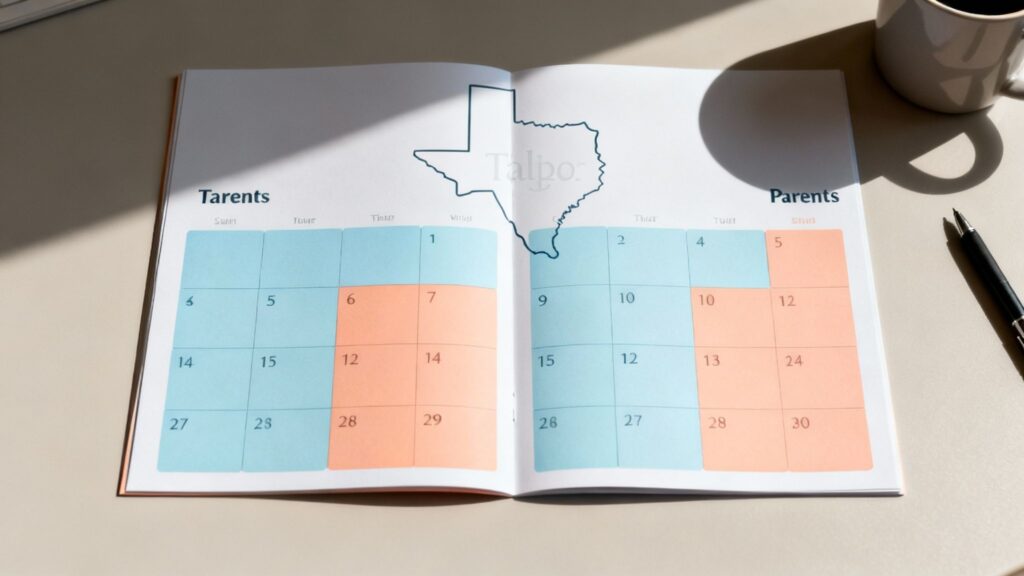
The transition to a co-parenting arrangement is one of life’s most difficult transitions—but understanding your options under Texas law can make it less overwhelming. Your primary goal is to create stability and ensure your child maintains a strong, loving relationship with both parents. A 50/50 possession schedule, where each parent has equal or near-equal time, is often an ideal solution for achieving this balance. However, choosing the right structure from the many available sample custody schedules 50 50 can feel overwhelming.
In Texas, the law presumes that a Standard Possession Order is in the best interest of the child, as outlined in the Texas Family Code. However, parents have the flexibility to agree on a schedule that better suits their specific circumstances. Every family’s needs, work commitments, and children’s ages are unique, making a one-size-fits-all approach impractical. The key is finding a routine that minimizes disruption for your child and fosters a consistent, predictable environment. When navigating the complexities of co-parenting, especially with a 50/50 schedule, it’s essential to consider the emotional impact on children and implement effective strategies for prioritizing children’s mental health.
This guide is designed to empower you with clarity and confidence. We will walk you through several proven 50/50 custody schedules, breaking down the pros and cons of each. You’ll see detailed examples, practical, actionable guidance for implementation, and relatable scenarios. Our goal is to provide the information you need to make an informed decision that puts your child’s well-being first, helping you build a stable and supportive future for your family.
1. Week-On/Week-Off 50/50 Custody Schedule
The week-on/week-off schedule is one of the most straightforward and popular sample custody schedules 50 50 parents consider. In this arrangement, each parent has possession of the child for a continuous seven-day period, alternating every week. This creates a predictable and consistent rhythm, minimizing the number of exchanges and allowing for extended, uninterrupted time for both parent and child.
This schedule is particularly well-suited for school-aged children who can adapt to longer periods away from one parent. It offers stability by allowing the child to settle into one home for a full week, reducing the stress of frequent transitions. Parents also benefit from having a full week to manage their own schedules, work commitments, and personal lives, followed by a full week dedicated to parenting.
Strategic Analysis: Why It Works
The primary strength of the week-on/week-off schedule is its simplicity and predictability. Both parents and children can easily track whose week it is, making long-term planning for vacations, appointments, and extracurricular activities much simpler.
- Reduced Conflict: With only one exchange per week, there are fewer opportunities for parental conflict or miscommunication. Exchanges can be scheduled on a consistent day and time, such as Friday after school or Sunday evening, to create a seamless transition.
- Deeper Bonding: Seven consecutive days allow for deeper parent-child bonding. It provides enough time to establish household routines, help with a full week of homework, and engage in meaningful weekend activities without feeling rushed.
- Logistical Simplicity: This schedule simplifies logistics for parents who live a moderate distance from each other but still within the same general area, like the Dallas-Fort Worth or Houston metroplexes. The child only needs to transport their belongings once a week.
Actionable Takeaways for Your Possession Order
When drafting a possession order for a week-on/week-off schedule, precision is key to avoiding future disputes. Vague language can lead to confusion and conflict, undermining the schedule’s intended simplicity. For more details on what it takes to achieve this type of arrangement, you can learn more about getting 50/50 time with your children.
Key Drafting Tip: Your court order should specify the exact day and time for exchanges. For example: “Parent A’s period of possession shall begin each Friday at 6:00 p.m. and conclude the following Friday at 6:00 p.m., at which time Parent B’s period of possession shall begin.”
Consider these additional tips for successful implementation:
- Establish a Neutral Exchange Point: If co-parenting communication is strained, designate a neutral location like a school, library, or police station “safe zone” for exchanges.
- Parallel Routines: While each home will have its own culture, try to maintain similar homework times, bedtimes, and screen time rules to ease the child’s adjustment each week.
- Communication Plan: Designate which parent is the primary contact for school and medical matters during their respective weeks to avoid confusion for teachers and doctors.
2. 2-2-3 Rotating Custody Schedule
The 2-2-3 rotating schedule is another popular option for parents seeking sample custody schedules 50 50 that offer more frequent contact with the child. In this arrangement, the child spends two days with Parent A, two days with Parent B, and then a three-day weekend (Friday, Saturday, Sunday) with Parent A. The following week, the schedule flips, and Parent B gets the three-day weekend. This creates a predictable two-week rotation where each parent enjoys a mix of school nights and weekend time.

This schedule is often favored for younger children, such as toddlers and preschoolers, who may struggle with being away from either parent for a full week. It ensures that the child never goes more than a few days without seeing each parent, which can provide a strong sense of security and consistency. Parents who live close to one another and have a cooperative co-parenting relationship, like many in the Austin or San Antonio areas, often find this schedule highly effective.
Strategic Analysis: Why It Works
The core strength of the 2-2-3 schedule is its balance between frequent contact and predictable routine. It prevents long absences while still providing a consistent, alternating weekend structure that parents and children can easily follow.
- Frequent Parent-Child Contact: This schedule is ideal for parents who want to be involved in the daily details of their child’s life, from weekday homework to weekend fun. It ensures neither parent misses out for too long.
- Shared Weekends: By alternating the three-day weekend block, both parents get equal opportunities for extended quality time, making it easier to plan short trips or family activities.
- Reduced Child Anxiety: For younger children or those who have difficulty with long separations, the frequent transitions can be reassuring, reducing separation anxiety and helping them feel connected to both homes.
Actionable Takeaways for Your Possession Order
Clarity in your possession order is crucial for a schedule with more frequent exchanges like the 2-2-3. Ambiguity about transition times or days can quickly lead to disagreements. Your order must be a precise roadmap that eliminates guesswork. You can learn more about the specifics of Texas parental visitation to better understand how these details are documented.
Key Drafting Tip: Your court order should explicitly define the two-week rotation. For example: “In Week One of the two-week rotation, Parent A shall have possession of the child beginning Monday at 6:00 p.m. until Wednesday at 6:00 p.m., and again from Friday at 6:00 p.m. until Monday at 6:00 p.m. In Week Two, Parent B shall have possession of the child during these same periods.”
Consider these additional tips for successful implementation:
- Use a Shared Digital Calendar: Tools like Google Calendar or OurFamilyWizard are essential for keeping track of the rotation. Color-code each parent’s days to provide a clear visual for everyone, including the child.
- Duplicate Essential Items: To minimize the burden of packing, keep duplicate sets of essentials like toiletries, school supplies, and medications at both homes.
- Streamline Exchanges: Use school or daycare as the exchange point. One parent can handle drop-off in the morning, and the other can handle pick-up in the afternoon, which minimizes direct contact and potential conflict.
3. 3-3-4-4 Custody Schedule
The 3-3-4-4 custody schedule offers a balanced approach for parents seeking a middle ground between frequent exchanges and long separations. In this two-week rotating plan, Parent A has the child for three days, followed by Parent B for three days. Then, Parent A has the child for four days, and Parent B concludes the cycle with their four-day period. This structure is one of the more versatile sample custody schedules 50 50 because it ensures neither parent goes longer than four days without seeing their child.
This arrangement is often successful for school-aged children and even some younger children who benefit from seeing both parents multiple times each week. It provides more stability than a 2-2-3 schedule but avoids the long seven-day gap of a week-on/week-off plan. For parents in the Houston or Dallas areas who want to remain deeply involved in daily routines like school drop-offs and homework, the 3-3-4-4 schedule maintains that frequent contact without the constant back-and-forth of other high-frequency schedules.

Strategic Analysis: Why It Works
The core advantage of the 3-3-4-4 schedule is its hybrid nature, blending consistency with frequent contact. The rotation ensures that weekends are split fairly over a two-week cycle, with one parent typically getting a long weekend on their four-day block.
- Balanced Contact: The schedule prevents a child from going too long without seeing a parent, which can be crucial for younger children or those who experience separation anxiety.
- Predictable Long Weekends: The four-day blocks often encompass a weekend, giving each parent dedicated time for longer activities, family visits, or short trips without disrupting the school week.
- Reduced Planning Fatigue: Compared to a 2-2-3 schedule, the longer blocks mean slightly fewer exchanges and less short-term planning, which can reduce co-parenting friction. It provides a good rhythm once the family adjusts to the two-week pattern.
Actionable Takeaways for Your Possession Order
When incorporating a 3-3-4-4 schedule into a Texas possession order, clarity is essential to manage the rotating days. The order must precisely define the start and end of each possession period to prevent confusion about which parent has which days, especially as the pattern shifts week to week.
Key Drafting Tip: Your court order should map out the two-week rotation clearly. For example: “Parent A shall have possession of the child beginning Monday at 6:00 p.m. until Thursday at 6:00 p.m. Parent B shall have possession from Thursday at 6:00 p.m. until Sunday at 6:00 p.m. Parent A shall then have possession from Sunday at 6:00 p.m. until Thursday at 6:00 p.m., at which point Parent B’s possession begins for four days. This 14-day cycle shall repeat continuously.”
Consider these additional tips for effective implementation:
- Use a Shared Calendar App: Digital calendars like Google Calendar or OurFamilyWizard are invaluable for tracking the 3-3-4-4 rotation and preventing misunderstandings.
- Duplicate Key Items: To minimize packing stress with mid-week exchanges, keep duplicates of essential items like clothes, toiletries, and school supplies at both homes.
- Align Exchange Times with School: Schedule exchanges to align with the end of the school day or an after-school activity to create a more natural and less disruptive transition for the child.
4. Alternating Weekends with Mid-Week Overnight Custody Schedule
This hybrid schedule combines the consistency of alternating weekends with a guaranteed mid-week overnight visit, creating a true 50/50 split. In this arrangement, one parent typically has the child from Friday after school until Sunday evening or Monday morning. The other parent then has the child for a designated overnight during the week, often on a Wednesday, to break up the long stretch and stay involved in school-week routines. This is one of the more creative sample custody schedules 50 50 that balances longer periods of possession with consistent contact.

This schedule is often a good compromise for parents who want the stability of the alternating week schedule but feel that seven days is too long for a child to be away from the other parent. It works well for school-aged children (especially those 10 and older) who can manage the schedule’s complexity and benefit from seeing both parents during the school week. It ensures both parents remain actively engaged in homework, school projects, and daily routines, preventing one parent from becoming solely a “weekend parent.”
Strategic Analysis: Why It Works
The strength of this schedule lies in its ability to blend longer, relaxing weekend periods with essential mid-week involvement. It prevents the out-of-possession parent from becoming disconnected from the child’s day-to-day academic and social life.
- Consistent Mid-Week Contact: The overnight visit ensures the non-weekend parent remains a consistent presence during the school week, able to help with homework and hear about the child’s day.
- Best of Both Worlds: It provides the uninterrupted weekend time that many parents and children value, while the mid-week visit prevents the feeling of a long absence.
- Adaptable for Work Schedules: This arrangement can be ideal for parents with non-traditional work hours, such as a parent who works night shifts. For instance, the mid-week visit can be scheduled on their day off.
Actionable Takeaways for Your Possession Order
Clarity in your possession order is crucial for this schedule to function smoothly, as the mid-week exchange adds a moving part that requires precise definition. Ambiguity about timing or responsibilities can quickly lead to conflict.
Key Drafting Tip: Your order must clearly define both the weekend and mid-week possession periods. For example: “Parent A shall have possession of the child on the first, third, and fifth weekends of a month, beginning when school is dismissed on Friday and ending at the beginning of school on Monday. Parent B shall have possession of the child on all other weekends. Additionally, the parent not in possession of the child for the weekend shall have possession of the child every Wednesday, beginning when school is dismissed and ending at the beginning of school on Thursday.”
Consider these additional tips for successful implementation:
- Minimize School Disruption: Schedule the mid-week overnight to cause the least disruption. A Wednesday overnight leading into a Thursday school day is often a practical choice.
- Coordinate on Supplies: To avoid frantic last-minute trips, keep a duplicate set of essential school supplies, chargers, and toiletries at each home.
- Plan Extracurriculars Thoughtfully: When possible, schedule activities on days a parent consistently has possession to simplify transportation logistics. Of course, this won’t always be possible, which is why a flexible co-parenting relationship is important. This is also a key consideration when you start splitting holidays and vacations with the other parent.
5. Every-Other-Weekend Plus Weekday Transitions Custody Schedule
This flexible arrangement is a creative spin on traditional schedules and is a less common but highly effective sample custody schedules 50 50 option. In this model, one parent (the “school-week parent”) has the child for the majority of the school weeks, while the other parent (the “weekend parent”) has possession every other weekend, typically from Friday after school until Monday morning drop-off at school. To achieve a 50/50 split, the weekend parent also has additional weekday or overnight visits strategically placed throughout the month.
This schedule is uniquely suited for families where one parent’s work schedule is not a standard 9-to-5, or where there is a moderate geographic distance that makes frequent exchanges impractical. It prioritizes academic consistency by having one parent manage the school routine, while ensuring the other parent enjoys substantial, quality weekend time. It’s an excellent solution for military families or those in professions like healthcare or law enforcement with non-traditional hours.
Strategic Analysis: Why It Works
The core strength of this schedule is its ability to blend stability with flexibility, providing a 50/50 split without the constant back-and-forth of other plans. It acknowledges that equal time doesn’t always mean identical schedules.
- Academic Stability: With one parent consistently overseeing homework, school projects, and bedtime routines during the week, the child benefits from a stable academic environment. This can reduce stress and improve school performance.
- Adapts to Non-Traditional Work: It’s a perfect fit for parents with demanding or irregular work schedules. The school-week parent can maintain a consistent routine, while the weekend parent can fully engage during their dedicated time off without work-related interruptions.
- Quality Over Quantity: The every-other-weekend parent gets uninterrupted, quality time for outings, activities, and bonding, making the most of their possession periods. Additional weekday visits prevent long gaps between seeing the child.
Actionable Takeaways for Your Possession Order
Drafting an order for this schedule requires careful attention to the transition details and the specific days that make up the 50/50 split. Ambiguity can quickly lead to conflict, especially when coordinating school drop-offs and mid-week visits. For families considering unique arrangements, it is crucial to understand the legal framework. You can learn more about getting 50/50 time with your children to see how such schedules are implemented under Texas law.
Key Drafting Tip: Clearly define the start and end of the weekend possession and specify the exact days and times for the supplemental weekday visits. For example: “Parent A shall have possession of the child on the first, third, and fifth weekends of a month, beginning when school is dismissed on Friday and ending at the time school resumes on Monday. Additionally, Parent A shall have possession of the child every Tuesday and Thursday from the time school is dismissed until 8:00 p.m.”
Consider these additional points for a successful plan:
- Define Transition Logistics: Your order should state who is responsible for transportation and where exchanges occur. Using the school as the primary exchange point simplifies logistics and minimizes parent-to-parent contact.
- Shared Digital Calendar: Use a co-parenting app or shared digital calendar to track the schedule, school events, and homework assignments. This ensures both parents are informed and on the same page.
- Plan for School Holidays: Specify how school holidays, teacher in-service days, and three-day weekends that fall on a Monday or Friday will be handled to avoid confusion.
6. Alternating Months Custody Schedule
The alternating months schedule is a less common but highly effective sample custody schedules 50 50 for specific family situations. In this arrangement, each parent has possession of the child for an entire calendar month before exchanging. This creates extended, uninterrupted blocks of parenting time, which can be ideal for certain lifestyles and developmental stages.
This schedule is best suited for parents who live a significant distance apart, making weekly or bi-weekly exchanges impractical. It can also work well for military families dealing with deployments or for older children, like teenagers or college students, who have long summer breaks. By dramatically reducing the number of transitions, it offers maximum stability within each parent’s home for long stretches.
Strategic Analysis: Why It Works
The core strength of the alternating months schedule is its ability to provide profound stability and routine for a child within one household at a time. This long-form arrangement minimizes the logistical and emotional strain of frequent moves, allowing a child to fully settle in before the next exchange.
- Reduced Transition Stress: With only 12 exchanges per year, this schedule virtually eliminates the constant back-and-forth that can be stressful for some children. This is particularly beneficial for children who have difficulty with frequent changes in environment.
- Facilitates Long-Distance Co-Parenting: When parents live in different cities or states, this is one of the few 50/50 schedules that remains practical. It makes the travel time and expense associated with exchanges more manageable.
- Maximum Parenting Immersion: A full month allows each parent to become fully immersed in their child’s daily life, from school projects and doctor’s appointments to social activities, without interruption. This fosters a deep sense of routine and connection.
Actionable Takeaways for Your Possession Order
When drafting a possession order for an alternating months schedule, extreme clarity is necessary to account for the long periods of possession and potential for logistical complications. The Texas Family Code provides flexibility, but your order must be airtight to prevent disputes over holidays, school events, and expenses.
Key Drafting Tip: Define the exchange day and time with absolute precision to avoid confusion. For instance: “Parent A’s period of possession shall begin on the first day of each calendar month at 6:00 p.m. and conclude on the last day of that same month at 6:00 p.m., at which time Parent B’s possession shall begin.”
Consider these additional strategies for successful implementation:
- Create a Detailed Packing Checklist: For a month-long stay, a comprehensive checklist is crucial. Agree on which items travel between homes (e.g., favorite toys, electronics) and which items each parent will provide (e.g., toiletries, basic clothing).
- Establish a Robust Communication Protocol: Agree on a schedule for video calls and phone calls to ensure the child maintains a strong connection with the non-possessory parent. Define how to handle emergencies and share information about school or medical issues that arise during a parent’s month.
- Specify Financial Responsibilities: Your order should clearly state which parent is responsible for specific expenses during their month of possession. This can prevent disagreements over costs related to extracurricular activities, school supplies, or medical co-pays.
7. School-Day/Off-Day Split with Equal Weekend Sharing Custody Schedule
The School-Day/Off-Day Split is a highly customized arrangement within the family of sample custody schedules 50 50. This schedule assigns possession based on the school calendar, where one parent has the children on all school days and the other parent has them on all non-school days, including weekends, holidays, and summer breaks. It’s designed for families with unique work schedules or when one parent’s availability naturally aligns with the academic year.
This innovative schedule works particularly well for parents with non-traditional work hours, such as those in retail, hospitality, or healthcare. For example, if one parent works a standard Monday-to-Friday job and the other works weekends, this plan leverages their availability perfectly. It can also be an excellent fit for teenagers who are old enough to manage the schedule’s complexity and benefit from the consistency of being with one parent during the structured school week.
Strategic Analysis: Why It Works
The core strength of this schedule is its ability to align custody time with the natural rhythms of a family’s life, specifically the school year and parents’ work commitments. It replaces arbitrary date divisions with a logical, calendar-based system that can reduce friction and maximize each parent’s quality time.
- Tailored to Real-Life Schedules: It is ideal for parents whose work schedules are fundamentally different, such as a teacher and a weekend-shift nurse. This maximizes each parent’s time with the child when they are most available, avoiding the need for third-party childcare.
- Creates Consistency During School: The child has one primary home base during the school week, which can help with academic focus, homework routines, and participation in after-school activities. The school-day parent can manage the day-to-day educational responsibilities without interruption.
- Maximizes Non-School Fun: The non-school-day parent gets to enjoy all the weekends, three-day holidays, and longer breaks, which are often prime times for fun, travel, and extended family visits. This creates distinct but equally valuable parenting experiences.
Actionable Takeaways for Your Possession Order
Because this schedule is non-standard, your possession order must be meticulously drafted to cover all contingencies related to the school calendar. Ambiguity is the enemy of a successful custom schedule. For a deeper understanding of how to present a unique schedule to a Texas court, you can learn more about getting 50/50 time with your children.
Key Drafting Tip: Clearly define “school day” and “non-school day” in the order. For example: “A ‘school day’ shall be defined as any day that the child’s school is in regular session according to the official school district calendar. Parent A’s possession shall begin at 6:00 p.m. on the day prior to the first day of a school period and end at 6:00 p.m. on the last day of the school period.”
Consider these additional points to ensure your order is comprehensive:
- Address Calendar Variations: Explicitly state how to handle early dismissals, teacher workdays, and unexpected school closures. Do these count as school days or non-school days?
- Define Summer and Major Holidays: Summer break and major holidays like Thanksgiving and Christmas must be addressed separately to ensure a 50/50 split. The order should specify that these periods are divided equally, often by alternating weeks or using another 50/50 schedule just for that time.
- Create a Master Calendar: Attach the official, board-approved school district calendar for the upcoming year as an exhibit to your possession order. This becomes the official reference point for determining possession and avoids disputes.
7-Way Comparison: 50/50 Custody Schedules
| Schedule | Complexity 🔄 | Logistics / Resources ⚡ | Expected Outcomes 📊 | Ideal Use Cases 💡 | Key Advantages ⭐ |
|---|---|---|---|---|---|
| Week-On/Week-Off 50/50 Custody Schedule | Low — simple weekly rotation 🔄 | Low–Moderate — one exchange/week; best if close proximity ⚡ | Strong stability and routines; extended bonding; less daily contact for off-week 📊 | Parents living nearby; school-age children; steady work schedules 💡 | High predictability; fewer transitions; easier planning ⭐ |
| 2-2-3 Rotating Custody Schedule | High — frequent rotation every 2 weeks 🔄🔄 | High — four transfers/2 weeks; duplicate supplies and travel ⚡ | Frequent parent contact; sustained involvement; potential routine disruption 📊 | Younger children needing regular contact; cooperative co-parents 💡 | Balanced weekday/weekend access; prevents long separations ⭐ |
| 3-3-4-4 Custody Schedule | Moderate — structured 14-day rotation 🔄 | Moderate — two transitions/week; manageable duplicate items ⚡ | Mix of stability and regular contact; equitable weekend sharing 📊 | Elementary-aged children; parents seeking balance between frequency and stability 💡 | Fewer transitions than 2-2-3; extended blocks for routine ⭐ |
| Alternating Weekends with Mid-Week Overnight | Moderate — hybrid pattern with weekly overnight 🔄 | Moderate — weekend travel + one mid-week transfer; coordinate school pick-ups ⚡ | Good weekend time plus weekly involvement; fewer total exchanges than very frequent plans 📊 | One parent primary during week; parents valuing weekend continuity with mid-week contact 💡 | Weekend equity with maintained school-week connection; reduced weekly exchanges ⭐ |
| Every-Other-Weekend Plus Weekday Transitions | Low–Moderate — clear weekend/weekday roles 🔄 | Moderate — two primary transitions/week; travel viable for weekend parent ⚡ | Strong school-week stability; quality long weekends; longer weekday separation for weekend parent 📊 | Geographic separation or mismatched work schedules; military/shift families 💡 | Fewer exchanges; easier for long-distance weekend travel; clear roles ⭐ |
| Alternating Months Custody Schedule | Low — monthly blocks; simple rotation 🔄 | Low — one transition/month; high packing needs for month stays ⚡ | Deep continuity and bonding; long separations for other parent; limited school-year suitability 📊 | Long-distance parents; older teens; summer-only arrangements 💡 | Minimal transitions; strong continuity for extended stays ⭐ |
| School-Day/Off-Day Split with Equal Weekend Sharing | High — aligns to dynamic school calendar 🔄🔄 | High — requires calendar management, holiday/summer coordination ⚡ | Clear academic vs. recreational roles; strong school consistency; complex holiday handling 📊 | Parents with schedules tied to school year (teachers, seasonal workers); teens 💡 | Aligns custody to school calendar; defined responsibilities for academics vs. leisure ⭐ |
Choosing the Best Path Forward for Your Family
Navigating the landscape of co-parenting is one of the most significant challenges a family can face during and after a divorce. The journey through various sample custody schedules 50 50 is more than just a logistical exercise; it’s about building a new foundation for your children’s future. As we’ve explored, schedules like the consistent Week-On/Week-Off, the high-frequency 2-2-3 rotation, and the balanced 3-3-4-4 plan each offer unique benefits and present distinct challenges. The key is not to find a universally “perfect” schedule, but the one that is perfectly suited to your family’s specific circumstances.
The Texas Family Code, particularly Section 153.002, places the “best interest of the child” at the heart of every custody decision. This guiding principle requires parents and courts to look beyond mere equal time and consider crucial factors: the child’s age and developmental needs, the parents’ work schedules and geographical proximity, and the historical involvement of each parent in the child’s daily life. A schedule that works wonderfully for a teenager who thrives on independence and less frequent transitions may be disruptive for a toddler who needs more frequent contact with both parents to maintain strong bonds.
Synthesizing Your Options and Taking Action
Your primary takeaway should be that these sample schedules are not rigid molds but flexible blueprints. The most successful co-parenting plans are those that are customized, collaborative, and capable of evolving as your children grow. The process of selecting and implementing a schedule is a dynamic one, requiring open communication, flexibility, and a shared commitment to your child’s well-being.
Here are the actionable next steps to take with the information you’ve gathered:
- Evaluate Your Priorities: Sit down and list the non-negotiable elements for your family. Consider your work commitments, your child’s school and extracurricular activities, and the distance between your homes.
- Discuss with Your Co-Parent: If possible, approach your co-parent with a collaborative mindset. Present one or two of the sample schedules you feel are most viable and be prepared to listen to their perspective and concerns.
- Master Communication Skills: Co-parenting is an ongoing negotiation. Effective communication is not just beneficial; it’s essential for the long-term success of any 50/50 arrangement. For parents looking to improve how they manage disagreements, mastering conflict resolution strategies can help create a more stable and peaceful environment for your children.
The Lasting Impact of a Well-Crafted Plan
Ultimately, the goal of creating a detailed 50/50 possession order is to provide your children with predictability, stability, and the unwavering support of both parents. A thoughtfully constructed schedule minimizes conflict, reduces stress, and allows children to feel secure in the knowledge that they have two homes and two loving parents actively involved in their lives. This foundation of security is invaluable and will support their emotional and psychological development long after the divorce is finalized.
Drafting a possession order that is clear, comprehensive, and legally sound is a critical step that protects this foundation. Vague language or overlooked details, such as holiday schedules, transportation logistics, or the right of first refusal, can lead to future disputes. This is where professional guidance becomes indispensable. An experienced family law attorney can help you translate your family’s needs into a formal, enforceable order that anticipates potential issues and provides clear solutions, ensuring your co-parenting relationship starts on the strongest possible footing.
If you need help navigating divorce, custody, or estate planning in Texas, contact The Law Office of Bryan Fagan today for a free consultation. The experienced attorneys at the Law Office of Bryan Fagan, PLLC are dedicated to helping Texas families craft customized and effective 50/50 custody schedules that truly serve the best interests of their children. Contact the Law Office of Bryan Fagan, PLLC today for a free, no-obligation consultation to discuss your specific situation and learn how we can help.