
Planning for the future can feel overwhelming, especially when considering situations where you might not be able to make your own decisions. Taking clear, proactive steps today, however, can provide incredible peace of mind for both you and your family. A Durable Power of Attorney is a legal document that allows you to hand the keys to your financial and legal life over to someone you trust. This person, known as your agent or attorney-in-fact, gets the authority to manage your affairs for you. The real magic is in the word durable—it means the document keeps working even if you become unable to make decisions for yourself because of an illness or injury.
Understanding the Foundation of Your Estate Plan

Thinking about the future can be daunting, but taking steps now to protect yourself and your family brings incredible peace of mind. A Durable Power of Attorney (DPOA) is easily one of the most critical tools you can have in your estate planning toolkit.
Think of it like choosing a trusted co-pilot for your life. They can step in and take the controls if you’re ever unable to fly the plane yourself. This isn’t about giving up control; it’s about making sure your wishes are followed and your family is shielded from legal chaos during what would already be a tough time.
The Key Players and Purpose
A Durable Power of Attorney is a straightforward legal document that involves two main people:
- The Principal: That’s you. You’re the one creating the document and giving someone else the authority to act for you.
- The Agent (or Attorney-in-Fact): This is the person you handpick to act on your behalf. Under Texas law, they are legally required to act in your best interest.
The purpose of a DPOA is to give your agent the legal authority to handle specific financial and legal tasks for you. This creates a smooth transition of management over your affairs without your family having to go through the courts, which can be an expensive, public, and time-consuming process. It’s a cornerstone document and a critical piece of any comprehensive end-of-life planning.
To give you a clearer picture, here’s a quick breakdown of the essential parts of a Texas DPOA.
Key Elements of a Texas Durable Power of Attorney at a Glance
| Component | Description | Why It Matters |
|---|---|---|
| Principal | The individual creating the DPOA (you). | You are the one in control, deciding who gets the power and what they can do. |
| Agent / Attorney-in-Fact | The person you appoint to manage your affairs. | This person must be trustworthy and capable of handling your finances and legal matters responsibly. |
| Durability Clause | The specific language that makes the POA “durable,” meaning it stays in effect if you become incapacitated. | Without this, the document becomes useless exactly when you need it most. |
| Granted Powers | The list of specific actions your agent is authorized to take (e.g., banking, real estate, paying bills). | Clearly defining powers prevents confusion and protects you from unauthorized actions. |
| Effective Date | When the agent’s authority begins. This can be immediate or upon a specific event (like incapacitation). | This gives you control over when your agent can start acting on your behalf. |
| Notarization | The requirement for the document to be signed in front of a notary public. | Notarization validates the document, proving your signature is authentic and you signed it willingly. |
This table shows how each piece fits together to create a powerful legal shield for you and your family.
What Powers Can an Agent Have?
The authority you grant can be as broad or as limited as you want, depending on how you structure the document. You can empower your agent to handle a whole host of tasks, giving your family the flexibility they’ll need if they have to step in.
Common powers include:
- Financial Transactions: Managing bank accounts, paying bills, and making deposits or withdrawals.
- Real Estate Matters: Buying, selling, or leasing property on your behalf.
- Business Operations: Keeping your business running or managing your investments.
- Legal and Tax Issues: Filing tax returns and handling legal claims or disputes.
Under the Texas Estates Code, the powers you grant your agent must be explicitly stated. An agent cannot simply assume they have the authority to do something; the document must clearly grant that power.
This level of detail is crucial. It protects you from unintended actions while giving your agent the authority to do what’s necessary. A well-drafted DPOA ensures someone you trust is ready to pay your mortgage, access money for your medical care, and keep your life running without a hitch, protecting your legacy and your loved ones.
If you need help navigating divorce, custody, or estate planning in Texas, contact The Law Office of Bryan Fagan today for a free consultation.
Why the Word Durable Makes All the Difference

When we think about planning for the future, our minds usually jump to the big, happy milestones. But real peace of mind doesn’t just come from planning for the best-case scenarios; it comes from being prepared for the unexpected turns life can take.
In estate planning, one small word can carry an enormous amount of weight, and in a power of attorney, that word is “durable.” It’s the single most important detail that ensures your plan actually works when you need it most.
The Problem With a Standard Power of Attorney
A standard, or non-durable, power of attorney has a massive flaw: it becomes legally worthless the very moment you’re declared incapacitated.
Think about that. The exact situation that would force your family to step in and help—a sudden illness, a serious accident, or cognitive decline—is the same event that would make a standard POA completely useless. This single distinction turns the document from a simple convenience into an essential safeguard.
The High Stakes of a Non-Durable Document
Let’s walk through a real-world scenario. Your loved one suffers a stroke and can no longer manage their own affairs or even communicate their wishes. If they only have a non-durable power of attorney, the authority you thought you had is gone in an instant.
Suddenly, the family is locked out of the bank accounts needed to pay the mortgage and the stacking medical bills. No one has the legal standing to manage investments, talk to the IRS, or handle even the most basic financial tasks.
Their only path forward would be petitioning a court for guardianship. This is a public, often painfully slow, and emotionally draining process that can easily cost thousands in legal fees—a nightmare no family wants to face during a crisis.
A durable power of attorney is specifically designed to prevent this exact chaos.
How Durability Creates a Lifeline
That “durable” provision, clearly laid out in the Texas Estates Code, is what ensures your agent’s authority continues without interruption, even if you become incapacitated. It effectively builds a bridge over the legal mess that incapacity can create, allowing for a seamless and private transition of financial management.
This resilience means your chosen agent can immediately step in to:
- Pay your bills without missing a beat, protecting your financial stability.
- Access funds for your medical care and other essential needs.
- Manage your property and investments just as you instructed.
- Handle communications with banks and other institutions on your behalf.
The true value here is its staying power. It doesn’t end if you lose mental capacity from an illness like Alzheimer’s or an accident. It gives your designated agent the power to manage your affairs without ever needing to involve a court.
Ultimately, the durable provision is your way of saying, “If I can’t be in charge, I want this specific person I trust to take the reins, not a judge.” This simple choice keeps control within your family and honors the decisions you made when you were perfectly capable of making them. It is also important to remember the critical distinction that a regular power of attorney expires at death, which makes the durable component so vital for providing authority during your lifetime, especially through periods of incapacity.
Comparing Types of Powers of Attorney in Texas
The world of estate planning has quite a few important tools, and it’s easy to feel overwhelmed by all the different names and functions. When we talk about a power of attorney, understanding the subtle but critical differences between each type is absolutely essential. Picking the wrong document—or assuming one document covers all your needs—can leave you and your family exposed right when you need protection the most.
Let’s clear up the confusion and break down the key distinctions between a durable power of attorney and other related documents in Texas. This will help you see exactly how they all fit together to form a solid plan.
General Power of Attorney
A General Power of Attorney gives your agent broad authority to manage your financial and legal matters, much like a durable power of attorney does. They can handle things like banking, real estate deals, and other transactions on your behalf.
But there’s one crucial difference that changes everything: a general power of attorney automatically becomes void the moment you become incapacitated. This means it’s only useful while you’re mentally competent and able to supervise your agent. Because of this major limitation, it’s typically used for very specific, short-term situations, like authorizing someone to sell your car for you while you’re out of the country.
Medical Power of Attorney
While a durable power of attorney is all about your financial life, a Medical Power of Attorney is designed exclusively for healthcare decisions. This is a completely separate legal document, governed by the Texas Health and Safety Code. It appoints an agent to make medical choices for you only when a doctor determines you cannot make them for yourself.
Your medical agent has the authority to:
- Consent to or refuse medical treatments.
- Decide on surgical procedures.
- Choose your doctors and where you receive care.
- Make end-of-life care decisions based on the wishes you’ve expressed.
It is vital to understand that your durable power of attorney agent has no authority over your healthcare, and your medical agent has no power over your finances. These documents serve separate but equally important functions. They work in tandem to provide complete protection for both your money and your health.
A common misconception is that one power of attorney covers everything. In Texas, you need both a Durable Power of Attorney for finances and a Medical Power of Attorney for healthcare to ensure all your bases are covered.
Springing Durable Power of Attorney
A Springing Durable Power of Attorney is a unique type of DPOA that only “springs” into effect after a specific event happens. That trigger is almost always your incapacitation, which must be certified in writing by a physician.
Some people feel more secure with this option because the agent has no power until it’s medically necessary. The downside, however, is that this built-in delay can create serious problems. Getting a doctor to officially certify incapacity can be a slow, bureaucratic process, potentially leaving your family unable to access funds or manage your affairs during an emergency.
For this very reason, many legal professionals recommend a DPOA that is effective immediately upon signing. You give it to a trusted agent with the clear understanding that they will only use it if and when it’s truly needed.
To make these differences even clearer, here’s a simple breakdown of how these documents stack up against each other.
How Texas Powers of Attorney Differ
This table offers a side-by-side comparison of the most common types of power of attorney to help you understand their distinct purposes and when they take effect.
| Type of Power of Attorney | Primary Purpose | When It Becomes Effective | Terminates Upon Incapacity? |
|---|---|---|---|
| Durable Power of Attorney | Managing financial & legal affairs | Immediately upon signing (usually) | No, it remains in effect |
| General Power of Attorney | Managing financial & legal affairs | Immediately upon signing | Yes, it terminates immediately |
| Springing Durable POA | Managing financial & legal affairs | Upon a future event (incapacity) | No, it begins upon incapacity |
| Medical Power of Attorney | Making healthcare decisions | Only when you are unable to decide | No, it begins upon incapacity |
As you can see, each document is designed for a very specific job. Grasping their distinct roles is the first step toward building a plan that protects both your financial well-being and your personal health preferences.
If you need help navigating divorce, custody, or estate planning in Texas, contact The Law Office of Bryan Fagan today for a free consultation.
Creating a Valid Durable Power of Attorney in Texas
Putting a Durable Power of Attorney in place is a profound act of foresight and care for your loved ones. But this powerful document is only as good as its creation. The Texas Estates Code has strict legal requirements that must be followed to the letter, and a simple mistake can render the entire thing invalid—usually at the exact moment your family needs it most.
Understanding these steps isn’t just about filling out a form; it’s about making thoughtful decisions about who you trust and what power you’re willing to give them. Each choice builds a protective shield around your future.
Selecting the Right Agent
Your first and most critical decision is choosing your agent. This is the person who will have significant control over your finances and property, so you must select someone with unwavering trustworthiness, good judgment, and the ability to handle responsibility under pressure. This is often a spouse, an adult child, or a very close friend.
Life is unpredictable, so it’s just as important to name at least one alternate agent. If your primary choice can’t serve when the time comes, your alternate can step in seamlessly, preventing any gaps in managing your affairs. Without an alternate, your family could be forced into court to get a guardian appointed, which defeats the whole purpose of creating a DPOA in the first place.
Defining Your Agent’s Powers
Texas provides a Statutory Durable Power of Attorney form, which is an excellent starting point. This form lists numerous powers you can grant to your agent, giving you complete control over which ones to include. You simply initial the specific authorities you want your agent to have, such as:
- Real property transactions: Buying, selling, or managing your home and other real estate.
- Banking and financial transactions: Accessing your bank accounts, paying bills, and handling investments.
- Business operating transactions: Keeping your business running if you’re unable to.
- Tax matters: Filing tax returns and dealing with the IRS on your behalf.
It is crucial to be precise. Vague instructions can lead to confusion or legal challenges down the road. If you want to limit a power—for instance, letting your agent sell your car but not your home—that limitation must be clearly spelled out in the document. The goal is to give your agent enough flexibility to act while building in the protections you want.
This diagram helps clarify how different POAs serve distinct functions.
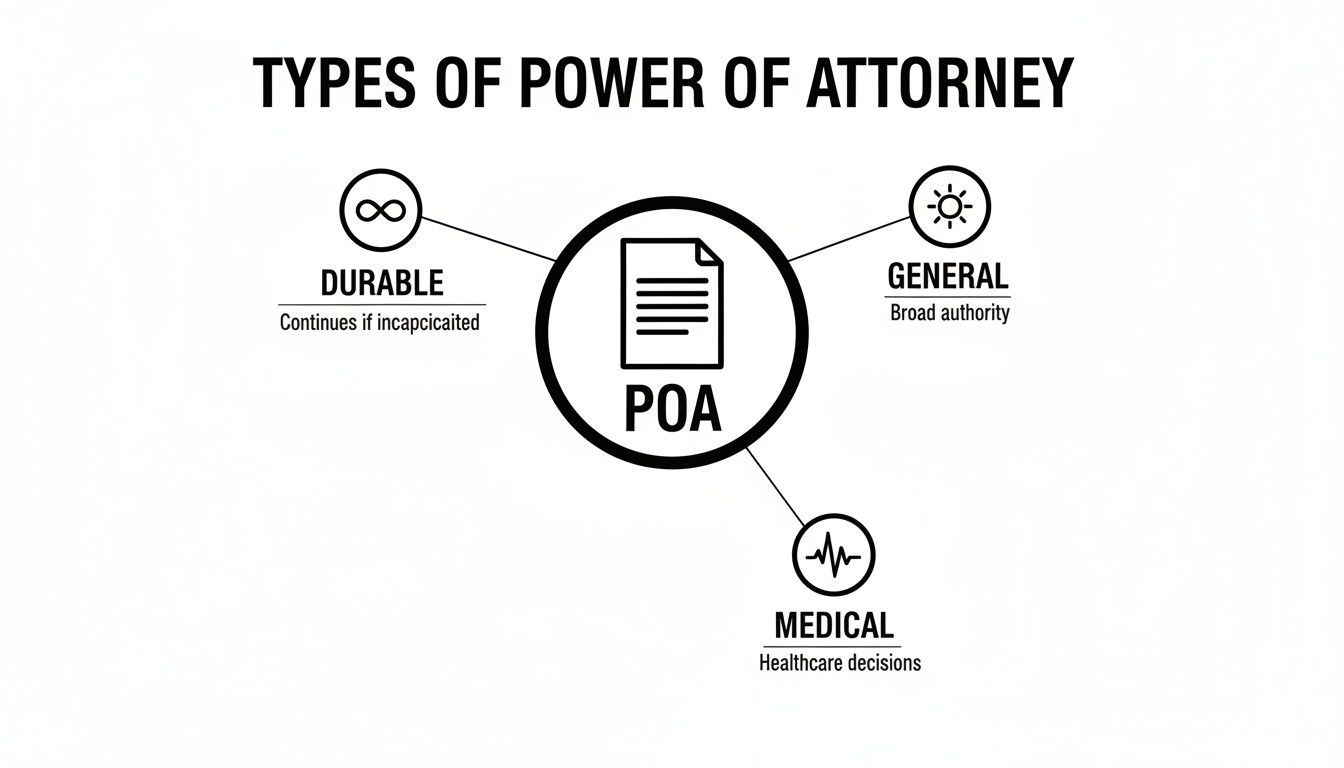
As you can see, the Durable Power of Attorney is designed for financial matters and stays effective even if you become incapacitated, which is the key difference from a General POA. A Medical POA, on the other hand, is strictly for healthcare decisions.
Proper Execution Is Not Negotiable
After you’ve made all your decisions, the document must be executed correctly to be legally valid in Texas. This is a step where many do-it-yourself attempts fall flat.
To be legally binding, a Durable Power of Attorney must be signed by you (the principal) in the presence of a notary public. The notary’s seal and signature are the official proof that you signed the document willingly and with a clear mind.
Failing to have the document properly notarized is one of the most common—and devastating—mistakes. An improperly signed DPOA is just a piece of paper. It has no legal authority, and banks or other institutions will reject it, leaving your family in the exact legal bind you were trying to avoid.
Finally, once signed, the original document needs to be kept in a secure yet accessible place. It’s essential to tell your agent where to find it. For more detailed tips, you can explore our advice on storing your estate planning documents to ensure they are protected and available when needed. While these steps provide a strong foundation, consulting an attorney is the best way to ensure your DPOA is tailored to your unique circumstances and is legally airtight.
Understanding Your Agent’s Fiduciary Duty
When you name someone as your agent in a Durable Power of Attorney, you’re handing them more than just a list of tasks—you’re placing your complete trust in their hands. Legally, this profound trust isn’t just a suggestion; it comes with a strict and non-negotiable set of responsibilities known as a fiduciary duty.
This is a serious legal obligation for your agent to act solely and exclusively in your best interests, with absolute loyalty and good faith. Grasping what this duty means is vital when you’re choosing your agent. It’s equally important for the person you appoint so they can handle their role ethically and legally.
The Core Principles of Fiduciary Duty
At its heart, a fiduciary duty means your agent must always put your welfare above their own. This is one of the oldest principles in law, specifically designed to protect people who place their trust in others. It demands that your agent act with the highest degree of care and honesty in every single decision they make for you.
This means they absolutely cannot:
- Use your money or property for their own personal gain.
- Mix their personal funds with yours (a major legal misstep called commingling).
- Sell your assets to themselves or their friends at a bargain price.
- Make decisions that create a conflict between their needs and yours.
In short, every single action your agent takes must be for your direct benefit. Think of them as a steward of your affairs, not a beneficiary. This duty is very similar to the responsibilities placed on the executor of a will, who also must act in the best interest of the estate. You can read more about the duties of an executor in Texas to see how these critical roles compare.
Record-Keeping: A Legal Requirement, Not a Suggestion
A critical part of an agent’s fiduciary duty under Texas law is keeping meticulous records. Your agent is legally required to maintain a clear and accurate log of every transaction they handle for you. This includes all receipts, payments, and any significant decisions they make.
This isn’t just good practice; it’s a legal shield for both of you. These records prove the agent acted properly and can protect them from false accusations of mismanagement. For you, it provides a transparent accounting of how your assets are being handled, giving you and your family essential peace of mind.
The Evolution and Importance of This Trust
The idea of a durable power of attorney isn’t new; it evolved from common law principles to solve the age-old problem of needing a trusted person to act for another during incapacity. These documents really gained legal traction in the 20th century, and by the 1980s, uniform acts helped standardize them across the U.S. This legal tool has become even more crucial as our population ages and awareness of conditions like dementia grows. To give you some perspective, the UK saw 1,161,958 similar power of attorney registrations in 2023 alone—a 37% jump from the previous year, which shows just how vital this planning tool has become globally. You can discover more insights about these trends to understand their growing relevance.
This history underscores why the fiduciary duty is so central to the entire concept. The law recognizes the immense power an agent holds and builds in these protections to prevent abuse. When you choose an agent, you’re not just picking a helper; you are selecting the one person you believe will honor this sacred trust, no matter what challenges may arise.
If you need help navigating divorce, custody, or estate planning in Texas, contact The Law Office of Bryan Fagan today for a free consultation.
When You Need an Experienced Estate Planning Attorney
Putting a Durable Power of Attorney in place is one of the most thoughtful things you can do for your family. It’s a profound act of love, designed to protect them from hardship and uncertainty down the road. While it might be tempting to grab a do-it-yourself form online, the reality is that the risks of a poorly drafted document are huge. A tiny mistake, often discovered right in the middle of a crisis, can ignite the very court battles you were trying to prevent.
Think of a DPOA as less of a fill-in-the-blank form and more of a custom-built legal strategy tailored to your unique life. That’s why getting expert legal guidance isn’t just a good idea—in many cases, it’s absolutely critical.
When Professional Guidance Is Non-Negotiable
While we believe you should always talk to an experienced attorney, you absolutely need to if you:
- Own a business
- Have a blended family with complex dynamics
- Hold out-of-state property
- Want to place specific, customized limits on your agent’s powers
An attorney makes sure every single detail lines up perfectly with Texas law and your personal wishes. They close loopholes that could otherwise be exploited or cause legal headaches for your loved ones. They can also help you figure out if other parts of your estate plan need attention, like whether you might need a probate lawyer, a topic we dive into in our guide on whether a probate lawyer is necessary.
A durable power of attorney is a vital legal tool that empowers someone you trust to handle your financial or property decisions if you become incapacitated. This instrument has surged in popularity worldwide, reflecting a growing awareness of the need for proactive estate planning.
Don’t leave your family’s security up to chance. An experienced attorney at The Law Office of Bryan Fagan, PLLC ensures your DPOA is a rock-solid shield, not just a piece of paper. We’re here to help you make informed decisions, protecting your legacy and the people you love most.
If you need help navigating divorce, custody, or estate planning in Texas, contact The Law Office of Bryan Fagan today for a free consultation.
Common Questions About Durable Powers of Attorney
When you’re putting together a durable power of attorney, you’re making some big decisions. It’s only natural to have questions pop up along the way. Getting clear answers helps make sure the final document truly reflects your wishes and gives your family the protection they deserve.
Can I Appoint More Than One Agent?
Yes, Texas law does let you name co-agents to act together. However, think carefully before you go this route. If your co-agents can’t agree on a decision, it can bring everything to a grinding halt.
A more practical approach that we often recommend is to name one primary agent and then list one or more alternates in a specific order. This creates a clear line of succession, ensuring someone can step in without confusion or delay if your first choice is unable to serve.
When Does My Durable Power of Attorney Expire?
A durable power of attorney is a powerful tool designed to last for your lifetime, but it isn’t forever. Its authority automatically ends the moment you pass away.
At that point, your will or trust takes the reins to guide how your estate is handled. It’s also important to remember that you can revoke the DPOA at any time, as long as you still have the mental capacity to make that decision.
Am I Required to Pay My Agent?
According to the Texas Estates Code, an agent is entitled to reasonable compensation for their work. In reality, though, it’s very common for family members—like a spouse or an adult child—to take on this role without ever accepting payment.
You get to decide what happens here. You can state directly in the document that your agent should be paid, that they should serve without compensation, or that they should simply be reimbursed for any out-of-pocket expenses they have while managing your affairs.
Do I Give Up Control by Signing a DPOA?
This is a very common and completely understandable fear, but the answer is a firm no. Signing a durable power of attorney doesn’t mean you’re handing over the keys to your life.
As long as you are mentally capable of making your own decisions, you are still in the driver’s seat. You can manage your finances and property exactly as you always have. If you ever disagree with a decision your agent makes, your decision will always win. Think of the DPOA as a safety net, not a surrender of your independence.
If you need help navigating divorce, custody, or estate planning in Texas, contact The Law Office of Bryan Fagan today for a free consultation.