As a father, the thought of a custody battle and the fear of losing precious time with your child can be overwhelming. Many dads enter this process believing the system is automatically stacked against them, a common but outdated myth. The reality in Texas is that courts are focused on one guiding principle: what is in the best interest of the child. This means your gender is not the deciding factor; your dedication as a parent is.
Facing a custody battle is one of the most stressful experiences a parent can go through. At The Law Office of Bryan Fagan, we understand your concerns and are here to provide clear, calm guidance. Understanding your rights under Texas law is the first step toward feeling empowered and taking control of your future.
Dispelling the Myth: Texas Law is Gender-Neutral
For fathers, the stress of a custody dispute is often compounded by the worry that Texas courts automatically favor mothers. Let's address that fear directly: it is simply not true.
The Texas Family Code is explicitly gender-neutral. The entire case operates under one powerful principle—the best interest of the child. Your role as an active, stable, and committed parent is what truly matters to a judge. The days of courts presuming a mother is automatically the better caregiver are long gone. Instead, judges perform an evidence-based analysis of each parent’s capabilities and dedication.
The Shift Toward Equal Parenthood
Modern family law has caught up to modern reality: fathers are just as capable of being the primary caregiver. In Texas, what most people call "custody" is legally known as "conservatorship." The law actually presumes that naming both parents "joint managing conservators" is in the child's best interest (Texas Family Code § 153.131). This means you start on equal legal footing.
Winning primary custody as a father isn’t about beating the odds; it's about proving you are the parent best equipped to provide a stable, nurturing, and consistent home. This shift is reflected in custody outcomes nationwide.
In the United States, a staggering 3,054,000 children under the age of 18 live exclusively with their fathers as of recent 2025 statistics. This marks a significant change in child custody outcomes where fathers are increasingly awarded sole custody. You can discover more insights about these child custody statistics on ParentClassesOnline.com.
What This Means for Your Case
This legal evolution is great news for dedicated fathers. It means your case will be decided on its merits, not your gender. The court will dig into the facts and look at concrete factors, such as:
- Who has historically been the primary caregiver for daily needs like meals, homework, and doctor visits?
- Which parent can provide the most stable home environment?
- Who is best able to support the child's emotional, developmental, and physical well-being?
Understanding that winning is an achievable goal is the first step toward building a powerful case. Your focus should be on gathering the evidence that clearly tells the story of your commitment and ability to be the great parent you are.
Understanding the "Best Interest of the Child" Standard
In every single Texas custody case, the judge’s decision comes down to one guiding principle: the best interest of the child. This isn’t a vague concept; it's a hard legal standard defined by the Texas Family Code. For any father fighting for custody, understanding this standard isn't just a good idea—it’s the entire foundation of your case.
It is critical to remember: Texas law does not favor mothers over fathers. Instead, the law gives judges a checklist of factors to weigh when deciding what’s genuinely best for a child. These are known as the “Holley Factors,” which come from a landmark Texas Supreme Court case. Winning custody means proving, with hard evidence, that you are the parent who can best meet your child’s needs according to these specific factors.
What Are the Holley Factors?
The Holley Factors are not weighted, meaning a judge can consider all of them or focus on the few that are most relevant to your family’s situation. Together, they paint a complete picture of each parent’s ability to provide a safe, stable, and nurturing home.
Here is a practical breakdown of what these factors mean for you:
- The emotional, physical, and developmental needs of the child. Can you show that you understand your child’s unique personality, their health issues, and what they need to succeed in school? More importantly, can you prove you've been the one meeting those needs?
- The emotional and physical danger the child may face now or in the future. A judge will scrutinize each parent’s home for risks. This could be anything from exposure to unstable people and substance abuse to simple neglect.
- The parental abilities of each individual seeking custody. This is where your day-to-day involvement becomes a massive asset. Do you help with homework? Do you attend doctor’s appointments? Do you handle discipline calmly and constructively?
- The stability of the home or proposed home. Courts prioritize consistency. A steady job, a safe place to live, and a predictable daily routine are all powerful signals of a stable environment.
- The plans for the child by each parent. You need to present a clear, forward-looking plan. Where will your child go to school? Who will be their doctor? How will you support their hobbies and friendships?
- Acts or omissions of a parent that may indicate the existing parent-child relationship is not a proper one. This factor targets toxic behavior, like a parent who tries to turn a child against the other parent (parental alienation) or who consistently fails to co-parent effectively.
The infographic below cuts through the common myths, reinforcing the point that the law cares about these best-interest factors, not a parent's gender.
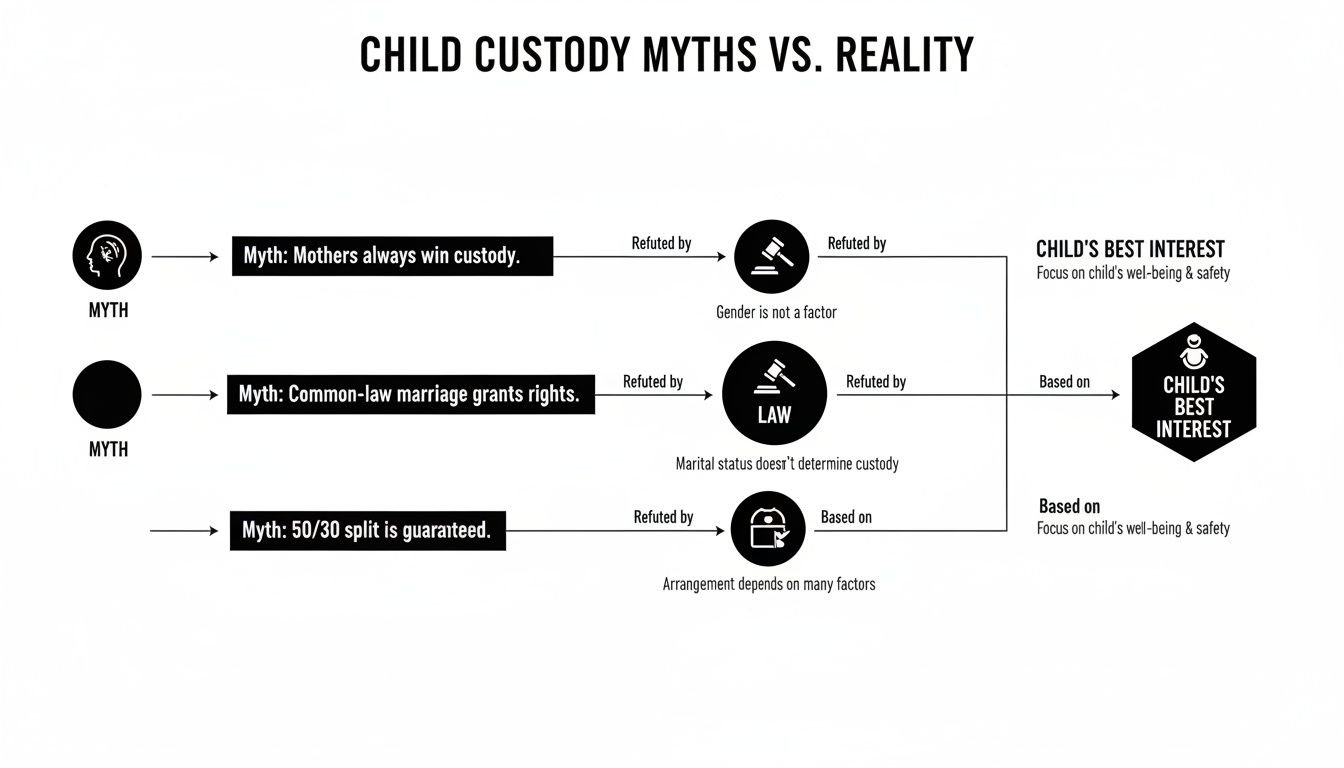
The simple but powerful truth is that outdated myths have been replaced by the gender-neutral reality of Texas law. The child’s well-being is what matters.
A Father's Guide to Applying the Holley Factors
Translating the legal standard into a winning strategy is everything. This table breaks down key Holley Factors, showing you how to connect your strengths as a father to what the court is looking for.
| Holley Factor | What It Means for Your Case | Example of Strong Evidence |
|---|---|---|
| Child's Needs | Demonstrating you are tuned into your child’s specific emotional, physical, and educational needs. | Records of doctor’s visits you attended, emails with teachers about homework, or a log of you managing your child’s daily medication schedule. |
| Danger to Child | Proving your home is safe and stable, while highlighting any legitimate risks in the other parent's environment. | Photos of your child's clean and safe bedroom, a clear drug test, or testimony about the other parent's substance abuse or neglectful behavior. |
| Parental Abilities | Showing you are the more capable, involved, and effective parent on a daily basis. | A calendar showing you handle school drop-offs, testimony from a coach you’ve worked with, or your detailed knowledge of your child's friends and daily routine. |
| Home Stability | Proving you can offer a consistent and predictable environment. | A history of steady employment, a long-term lease or mortgage in a good school district, and a consistent daily schedule for your child. |
| Plans for the Child | Presenting a clear, thoughtful, and detailed plan for your child's future. | A written plan detailing the child’s school, daycare, medical providers, and how you'll support their extracurricular activities. |
| Improper Acts/Omissions | Documenting any behavior by the other parent that harms the child's relationship with you. | Texts or emails showing the other parent is blocking communication (parental alienation) or refusing to share information about the child. |
By focusing on these factors, you are not just telling the judge you are a good dad; you are showing them that you are the parent best equipped to meet the legal standard.
Example Scenario: Connecting Your Actions to the Law
Imagine a father has consistently managed his child’s asthma, communicated with teachers about a learning disability, and maintained a clean, safe home. In court, he isn’t just being a “good dad”—he is actively proving his superior ability to meet the child’s physical, emotional, and developmental needs as defined by the Holley Factors.
Your job is to paint a vivid picture for the judge. Show them, don’t just tell them, that you are the parent who can provide a stable, loving, and supportive future. By focusing your energy on these specific legal standards, you can turn your dedication as a father into a compelling case a Texas court will recognize. This is one of the most important steps in the many child custody cases where the father wins.
How Fathers Win Primary Managing Conservatorship
Let’s move from legal theory to practical steps. How do fathers actually win primary managing conservatorship—the exclusive right to decide where their child lives? The “Best Interest of the Child” standard is the court’s roadmap, but your actions, documentation, and preparation are what build a winning case.

Many fathers enter a custody battle assuming they face an uphill fight. The truth is, the reality on the ground is changing. The number of fathers winning primary custody is growing, a clear sign that courts are recognizing the indispensable role dads play in a child’s life.
Recent U.S. custodial parent stats show 1.6 million single fathers acted as primary custodians in 2023, marking a 50% increase since 1993. This translates to fathers winning sole or primary custody in approximately 18% of post-divorce arrangements. In Texas, our firm sees this trend firsthand, with fathers often prevailing when they present a strong, evidence-based case. You can learn more about the findings related to family law statistics on Clio.com.
These numbers aren’t just abstract figures. They represent real families and fathers who successfully showed a judge they were the parent best suited to provide a stable, loving home.
Step 1: Demonstrate You Are the Primary Caregiver
One of the most powerful arguments in child custody cases where the father wins is simple: proving you’ve consistently been the child’s primary caregiver. A judge wants to see who has been doing the day-to-day work of parenting all along.
The court’s goal is to cause the least amount of disruption to the child’s life. If you can show you are already the parent handling the daily nuts and bolts, it makes a compelling case for keeping that routine intact.
Your job is to document your involvement meticulously. Start a parenting journal and log everything:
- Daily Routines: Who gets them up, makes breakfast, packs their lunch, and handles the bedtime story?
- School Involvement: Who helps with homework, emails teachers, and shows up for parent-teacher conferences?
- Medical Care: Who schedules and takes them to the doctor and dentist? Who keeps track of medications?
- Extracurriculars: Who’s the one driving to soccer practice or piano lessons week after week?
This detailed record transforms your daily efforts into concrete evidence that a judge can use to evaluate the Holley Factors and see you as the anchor in your child’s life.
Step 2: Present a Concrete Plan for the Future
Winning primary conservatorship isn’t just about showing what you’ve done in the past. It’s about presenting a clear, thoughtful plan for the future. A judge needs to feel confident that you have thought through every detail of your child’s life if they end up living with you.
Your plan needs to be specific and detailed. Don’t just say you’ll provide a good home. Show them exactly what that looks like.
Your Parenting Plan Should Cover:
- Housing: Where will you and the child live? Is it in a safe neighborhood with good schools?
- Schooling: Which school will your child attend? Have you looked into its programs and reputation?
- Healthcare: Who will be the child’s pediatrician and dentist? What’s your plan for handling medical emergencies?
- Childcare: If your child is young, what are your arrangements for daycare or after-school care?
- Supporting the Other Parent’s Relationship: This is a crucial point. How will you make sure the child keeps a strong, healthy relationship with their mother? Proposing a generous possession schedule for her can show the court you’re focused on the child’s needs, not just on “winning” against your ex. For more in-depth strategies, you might want to read our guide on fighting for custody as a Texas father.
A father who walks into court with a comprehensive, well-prepared plan stands out. It shows foresight, stability, and a deep commitment to the child’s well-being—the cornerstones of a successful custody case.
Building Your Case with Compelling Evidence
A Texas custody case is won with objective proof, not just emotional arguments. While your feelings as a father are valid, a judge must make decisions based on verifiable facts. Building a strong case means methodically gathering the evidence that paints a clear, undeniable picture of your dedication and your ability to provide a stable, loving home.

Think of yourself as the historian of your child’s life. Your job is to collect the records that tell the true story of your involvement. This process transforms your everyday actions into powerful exhibits that speak directly to the “Best Interest of the Child” standard the court must follow.
The Father’s Evidence Checklist
Organization is your best friend. A well-organized file helps your attorney build the strongest case and shows the court your stability and forethought. Start gathering these vital documents now.
- Proof of Involvement: This is the bedrock of your case. Collect school records, report cards, and any email chains with teachers. Gather medical records from doctor and dentist visits you attended, and keep a log of every time you cared for your child when they were sick.
- Financial Support Records: Show your consistency. Compile bank statements, canceled checks, or receipts proving you have consistently provided for your child’s needs, both formally and informally.
- Communication Logs: How you communicate with the other parent will be scrutinized. Keep a log of all texts and emails. Remain professional and child-focused in every interaction. Evidence showing you are a reasonable co-parent who communicates with respect is invaluable.
- A Stable Home Environment: Document your home. Take photos of your child’s clean and organized bedroom, play areas, and the general safety of your home. A copy of your lease or mortgage statement helps prove you have a stable residence.
The Power of Witness Testimony
Evidence isn’t limited to paperwork. The people who see you parent every day can provide some of the most compelling testimony in child custody cases where the father wins. A neutral third party who can speak to your character and parenting skills is incredibly persuasive to a judge.
For example, a teacher who testifies that you’re the parent who always shows up for conferences, a neighbor who sees you playing outside with your child, or a coach who has watched your supportive presence at every game—these voices lend powerful, objective credibility to your case. They back up the story you are telling the court: that you are the active, engaged parent.
Scenario: How Evidence Defeats False Claims
Imagine the other parent claims you are uninvolved and don’t care about your child’s education. An emotional denial in court is weak.
Now, imagine you present this instead:
- A log of every parent-teacher conference you attended for the past 2 years.
- A string of emails between you and the child’s math teacher discussing strategies to help with homework.
- A report card showing your child’s grades went up after you started a new tutoring routine with them.
Suddenly, the false claim isn’t just defeated; it’s completely dismantled by objective proof. This is how evidence works. It replaces “he said, she said” arguments with undeniable facts, allowing the judge to see the truth. To better understand how judges weigh different types of proof, you can learn more about the role of evidence in court hearings in our detailed guide.
Building your case with compelling evidence is a proactive strategy. It empowers you to take control of the narrative and show, with certainty, that you are the parent best equipped to provide the stable, nurturing home your child deserves.
Custody battles are emotionally draining, and unfortunately, they can sometimes bring out the worst in people. Facing false allegations of abuse, neglect, or instability can feel like a punch to the gut. It is absolutely critical that you respond calmly, strategically, and with the guidance of an experienced attorney.
Remember, the legal system has safeguards in place to uncover the truth. A judge’s job is to look at evidence, not just accusations. A proactive, truthful, and well-documented defense is your strongest asset when the stakes are this high.
Step 1: Respond to False Allegations Calmly and Strategically
When false accusations surface—especially serious ones involving Child Protective Services (CPS)—the pressure can be immense. It is vital to avoid emotional reactions, like firing off angry texts or confronting the other parent, as that behavior can be used against you.
Instead, take a deep breath and treat the situation with the gravity it deserves. Cooperate fully with any official investigation, but do not speak to CPS or any other official without your attorney present. Your lawyer will help you gather the counter-evidence needed to dismantle the claims and protect your parental rights. Our firm has deep experience in these trenches, and you can learn more about how to defend yourself from false divorce allegations in our detailed guide.
It’s easy to feel defeated when you’re being falsely accused, but remember: the burden of proof is on the accuser. They must provide credible evidence to support their claims. Your job is to systematically dismantle their narrative with facts and documentation.
Step 2: Cooperate with an Amicus Attorney
In highly contested cases, particularly those involving serious allegations, a judge may appoint an Amicus Attorney. This is an independent lawyer whose only client is your child. Their job isn’t to take sides; it’s to investigate the family’s situation and make a recommendation to the court about what is truly in the child’s best interest.
An Amicus Attorney will typically:
- Interview you, the other parent, and the child.
- Speak with teachers, counselors, doctors, and other neutral third parties.
- Visit both parents’ homes.
- Review all evidence.
Working with an Amicus Attorney is an opportunity to show your stability and dedication. Be open, honest, and cooperative. Provide them with the same organized evidence and witness lists you would give the judge. A positive recommendation from the Amicus can be incredibly influential in child custody cases where the father wins.
Step 3: Defend Against Relocation Attempts
Another common challenge arises when the other parent wants to move away with the child. Under the Texas Family Code, the parent who has the right to decide where the child lives is usually restricted to a specific geographic area—often the current county and its neighbors.
If the other parent wants to move outside this area, they must get your agreement or a court order. To win, they have to prove the move is in the child’s best interest, not just their own. This is your chance to object and show the court how the move would harm your relationship with your child and disrupt their stability, making a powerful case for the importance of having both parents close by.
Why Joint Custody Is a Major Victory for Texas Fathers
In the heat of a custody fight, it’s easy to think “winning” means getting sole custody. But for most dads in Texas, a real victory looks very different—and it’s far better for your child. The goal isn’t to push the other parent out; it’s to secure a joint managing conservatorship with a possession schedule that maximizes your time and cements your role.
The Texas Family Code starts with the presumption that a joint arrangement is in the child’s best interest. This is a huge deal. It means the law is on your side from day one, assuming both parents should have a significant, ongoing role. Shifting your mindset from conflict to cooperation can completely change the game.
The Power of Being the Cooperative Parent
A judge’s number one job is to create a stable, predictable, and low-conflict life for your child. When you show a genuine willingness to work with your child’s mother, you prove to the court that you are mature and child-focused. This proactive, cooperative stance can dramatically strengthen your case.
This isn’t just a local trend. It reflects a worldwide understanding of what helps kids thrive after parents separate. For instance, joint physical custody has become the norm across Europe, influencing U.S. family courts. U.S. studies show fathers “win” shared primary rights in 35% of cases, and Texas fathers who can prove their equal involvement secure joint custody in a staggering 40-45% of contested cases. You can explore the research about joint physical custody trends on NIUSSP.org.
Negotiating a Possession Schedule That Works for You
Getting the joint managing conservator title is the first step. The second, and arguably more important, step is negotiating a possession schedule that gives you substantial, meaningful time with your child. The Standard Possession Order is just a starting point.
A true win is a parenting plan that guarantees a strong, loving relationship between the child and both parents. Showing the court you are committed to that outcome is one of the most powerful moves a father can make.
You can—and should—push for a schedule that fits your family’s real-life needs. Some great options include:
- A 50/50 Possession Schedule: This is becoming a popular and successful option for dads. It can be structured as alternating weeks (week-on/week-off) or a “2-2-5-5” schedule, where you might have the kids every Monday and Tuesday, the mother has them Wednesday and Thursday, and you alternate weekends.
- An Expanded Standard Possession Order (ESPO): This gives the non-primary parent significantly more time than a standard order, often starting possession when school gets out on Thursday and ending when school resumes on Monday morning.
When you propose a generous, well-thought-out schedule, you’re sending a clear message: you aren’t just fighting for a title—you’re fighting for the meaningful time it takes to be a hands-on, active parent. In many child custody cases where the father wins, the victory came from skillfully negotiating a plan that enshrined his role as an equal and indispensable parent.
Frequently Asked Questions About Fathers’ Custody Rights
Going through a custody case raises many questions. As you prepare to protect your relationship with your child, you need clear, straightforward answers. Here, we address some of the most common concerns we hear from fathers, grounding our responses in the realities of the Texas Family Code and our experience in the courtroom.
Can a Father Get Full Custody in Texas?
Yes, absolutely. A father can be awarded sole managing conservatorship—what most people call “full custody”—in Texas. The court’s decision is not based on gender. It’s based on a careful evaluation of what’s in the child’s best interest.
If you can bring forward compelling evidence showing you are the more stable and suitable parent, and that living primarily with you is best for your child’s emotional and physical well-being, a judge has the full authority to give you the exclusive right to decide where your child lives. Achieving this outcome is a central goal in many child custody cases where the father wins.
How Much Weight Does My Child’s Preference Have?
If your child is 12 years of age or older, a Texas judge is required to interview them to hear their preference on which parent they want to live with (Texas Family Code § 153.009). This is a significant part of the process, but it is not the only factor.
A child’s stated preference is important, but it’s just one piece of a much larger puzzle. The judge will still weigh that preference against all the other “Holley Factors” to determine the child’s overall best interest. A father must still prove he offers the superior environment, regardless of the child’s stated wish.
How Do I Prove I Am the Better Parent?
You prove you are the “better parent” by presenting concrete, objective evidence of your deep involvement and stability. This isn’t about attacking the other parent; it’s about showcasing your own strengths.
Key evidence often includes:
- Detailed Testimony: Your own account of your role in daily routines, from helping with homework to attending doctor visits.
- Third-Party Witnesses: Teachers, coaches, and neighbors who can speak to your character and parenting skills from their own observations.
- Documentation: Photos of your safe home, organized records of communication, and school and medical reports that paint a clear picture.
- Sound Judgment: Evidence showing your ability to consistently meet your child’s emotional and physical needs.
Does Paying Child Support Help Me Win Custody?
Paying child support is your legal obligation, and it is also a powerful demonstration of your responsibility as a parent. While it won’t automatically win you custody, it definitely strengthens your case.
A consistent history of making your child support payments on time is hard evidence that proves you are a reliable and committed father who puts your child’s needs first. This financial reliability is a key factor the court considers when looking at the child’s best interest and is a common thread in child custody cases where the father wins. It shows you can be counted on to provide for your child in every sense of the word.
If you need help navigating divorce, custody, or estate planning in Texas, contact The Law Office of Bryan Fagan, PLLC today for a free consultation at https://www.bryanfagan.com.