
Divorce can be one of life’s most difficult transitions—but understanding your rights and the process under Texas law can make it feel less overwhelming. Facing a divorce can feel like stepping into a legal maze. The rules may seem complicated, but the core idea behind them is actually pretty simple: the law aims to create a fair and orderly end to a marriage. The process starts when one spouse files an official document, a mandatory 60-day waiting period follows, and it all wraps up when a judge signs a Final Decree of Divorce.
The whole system is built to methodically address everything from property and debts to the needs of your children. It provides a clear path when the future feels anything but. Our goal is to replace anxiety with knowledge so you can make informed decisions. You are not alone on this journey, and having the right information is the first step toward protecting what matters most and moving forward with confidence.
Your First Steps in a Texas Divorce

When you're facing a divorce, it's easy to feel lost. The combination of emotional stress, financial worries, and legal uncertainty can be overwhelming. This guide is designed to cut through that noise, giving you clear, authoritative, and straightforward explanations of Texas divorce law. We’ll walk you through the entire process, from the first filing to the final decree, so you can feel supported and understood.
Preparing for the Emotional Journey
A divorce is much more than just a legal case; it's a major personal and emotional shift. The stress can bleed into every part of your life, affecting your well-being and making it hard to think clearly. Acknowledging this reality is the first step to managing it.
Because the emotional toll can be so heavy, prioritizing your mental health is essential. It's wise to explore available resources for support, such as finding appropriate Houston Texas mental health services. Taking care of yourself is what allows you to approach the legal decisions ahead with a calmer, more focused mindset.
The Initial Legal Document
The legal journey officially starts with a document called the Original Petition for Divorce. Filing this form is what opens your case with the court. It outlines who the parties are and what you're asking the judge to decide on regarding your property, children, and other issues.
Think of it as the foundational document that sets the stage for everything that follows. For example, the Petition will state the grounds for the divorce and ask the court to confirm the parties' separate property and divide their community estate. Understanding what goes into this petition is a critical first step. You can learn more about the specifics in our detailed guide to the Original Petition for Divorce.
If you need help navigating divorce, custody, or estate planning in Texas, contact The Law Office of Bryan Fagan today for a free consultation.
Meeting the Legal Requirements for a Texas Divorce
Before a Texas court can even begin to address your divorce, it needs to confirm two things: that it has the authority to hear your case (jurisdiction) and that you have a legal reason for ending the marriage (grounds). Think of these as the first two hurdles you have to clear. Getting these right from the start makes the entire process feel less intimidating and a lot more straightforward.
First, let’s talk about where you live. This isn't just a casual detail; it’s your "ticket" into the Texas family court system, and the rules are strict.
Establishing Residency in Texas
To file for divorce here, you or your spouse has to meet a two-part residency test spelled out in the Texas Family Code § 6.301. This is a non-negotiable requirement the court will verify right away.
- State Residency: One of you must have lived in Texas for at least the last six months before filing the divorce papers.
- County Residency: The same spouse must have also lived in the specific county where you file for at least the last 90 days.
So, for example, if you’ve been living in Harris County for the last ten years, you can file for divorce there even if your spouse moved to Oklahoma six months ago. You meet both the state and county requirements on your own. This rule exists to prevent "forum shopping"—basically, picking a court in a random county that you think might be more favorable—and ensures your case is handled locally.
Choosing Your Grounds for Divorce
Once you’ve established residency, you have to tell the court why you’re divorcing. This is known as the "grounds" for divorce. While that might sound like you need to start a fight, the reality is much simpler for most people.
In Texas, the vast majority of divorces are granted on a no-fault basis called "insupportability." This is legal language for saying the marriage has broken down due to a conflict of personalities, and there’s no reasonable chance of getting back together.
This no-fault option, found in Texas Family Code § 6.001, allows a couple to part ways without having to point fingers or prove one person did something wrong. It keeps things more private and often less contentious.
However, Texas law does recognize fault-based grounds, like cruelty, adultery, or a felony conviction. While proving fault won’t necessarily get you "more" in the divorce, it can sometimes influence how a judge divides your property. Just be aware that pleading fault requires you to present specific, credible evidence in court to back up your claim.
It's interesting to see how these trends play out. While divorce feels common, the rate in Texas has actually dropped significantly over the years. Back in 1990, the rate was 5.5 per 1,000 people; by 2020, it had fallen to just under 2.9 per 1,000. You can read more about Texas divorce statistics to see how our state compares to national trends. Deciding which grounds to use is a strategic choice, and it's one of the first things we can help you figure out.
If you need help navigating divorce, custody, or estate planning in Texas, contact The Law Office of Bryan Fagan today for a free consultation.
How Texas Divides Property and Spousal Support

Untangling a shared financial life is often the most complex and emotionally draining part of a divorce. For most couples, the simple question of "who gets what" is a huge source of anxiety. Getting a firm handle on how Texas divorce laws treat property and financial support can bring some much-needed clarity during a deeply uncertain time.
Texas is a community property state. Think of this as a guiding principle: most assets and debts you and your spouse picked up from the day you got married until the day you divorce are considered jointly owned. It doesn’t matter whose paycheck bought it or whose name is on the title. If you acquired it during the marriage, it generally belongs to the “community estate.”
Distinguishing Community From Separate Property
The very first step in any property division case is to take inventory and sort every asset and debt into one of two buckets: community property or separate property. This distinction is the bedrock of the entire process because judges can only divide what belongs to the community.
Separate property is anything that belongs exclusively to one spouse. Under the Texas Family Code, this is a pretty specific list:
- Property you owned before the marriage.
- Gifts received by only one spouse during the marriage.
- Inheritances received by only one spouse during the marriage.
Everything else acquired during the marriage is automatically presumed to be community property. If you want to claim an asset as your separate property, you have to prove it with "clear and convincing evidence"—a high legal bar to clear. Without that proof, a judge will treat it as part of the community estate to be divided. To really get a grip on this, you can explore the community property essentials for Texas divorces in our detailed article.
To make this easier to visualize, here's a quick breakdown of how common assets are typically classified.
Community Property vs Separate Property in Texas
This table helps you quickly see the difference between assets that are usually divided in a Texas divorce and those that are not.
| Asset Type | Typically Community Property (Divisible) | Typically Separate Property (Not Divisible) |
|---|---|---|
| Home/Real Estate | Equity in a home purchased during the marriage. | A house owned by one spouse before the marriage. |
| Retirement Accounts | The portion of a 401(k) or pension earned during the marriage. | The balance of a 401(k) or pension that existed before the marriage date. |
| Bank Accounts | Funds in a joint checking or savings account earned during the marriage. | Money from an inheritance kept in a separate, non-commingled account. |
| Vehicles | A car purchased and paid for during the marriage. | A classic car received as a personal gift to one spouse. |
| Personal Items | Furniture, art, and electronics bought during the marriage. | Jewelry or family heirlooms inherited by one spouse. |
| Business Interests | A business started and grown by the couple during the marriage. | A business owned entirely by one spouse before the marriage. |
Keep in mind, these are general rules. Things can get complicated quickly, especially when separate and community funds have been mixed, but this gives you a solid starting point for understanding the landscape.
What Is a “Just and Right” Division?
Once everything is properly characterized, the judge’s task is to divide the community estate in a way that is "just and right." This is where a common myth gets busted: "just and right" does not automatically mean a 50/50 split.
While a 50/50 division is often the starting point, judges have the authority to award a disproportionate share—say, 60/40—to one spouse. They can base this on a number of factors, including a large gap in earning power, the health of each spouse, benefits the innocent spouse lost because the marriage ended, and evidence of fault (like adultery or cruelty). The ultimate goal is fairness, not necessarily perfect mathematical equality.
Understanding Spousal Maintenance in Texas
Another major financial worry is spousal support, which Texas law calls spousal maintenance. Unlike in some states, getting spousal maintenance here is not automatic and can be quite difficult. The law sets very strict eligibility rules, reflecting a public policy that both spouses should work toward becoming self-sufficient after a divorce.
To even be considered, the spouse asking for support must first prove they will lack sufficient property after the divorce to provide for their "minimum reasonable needs." On top of that, they must also meet one of the following criteria:
- The marriage lasted 10 years or longer, and the spouse asking for support cannot earn enough income.
- The other spouse was convicted of (or received deferred adjudication for) an act of family violence.
- The requesting spouse has an incapacitating physical or mental disability.
- The requesting spouse is the primary caregiver of a child of the marriage who has a physical or mental disability.
The issue of spousal support is especially relevant with the rise of "gray divorces." While overall divorce rates are falling, they are climbing for those over 50. In fact, about 10% of Texas divorces now involve marriages that lasted 20 years or more, and nationally, the divorce rate for adults over 50 has doubled since 1990. Learn more about marriage and divorce statistics in Texas to see how these trends might impact long-term financial planning.
If you need help navigating divorce, custody, or estate planning in Texas, contact The Law Office of Bryan Fagan today for a free consultation.
Protecting Your Children in Custody and Support Matters
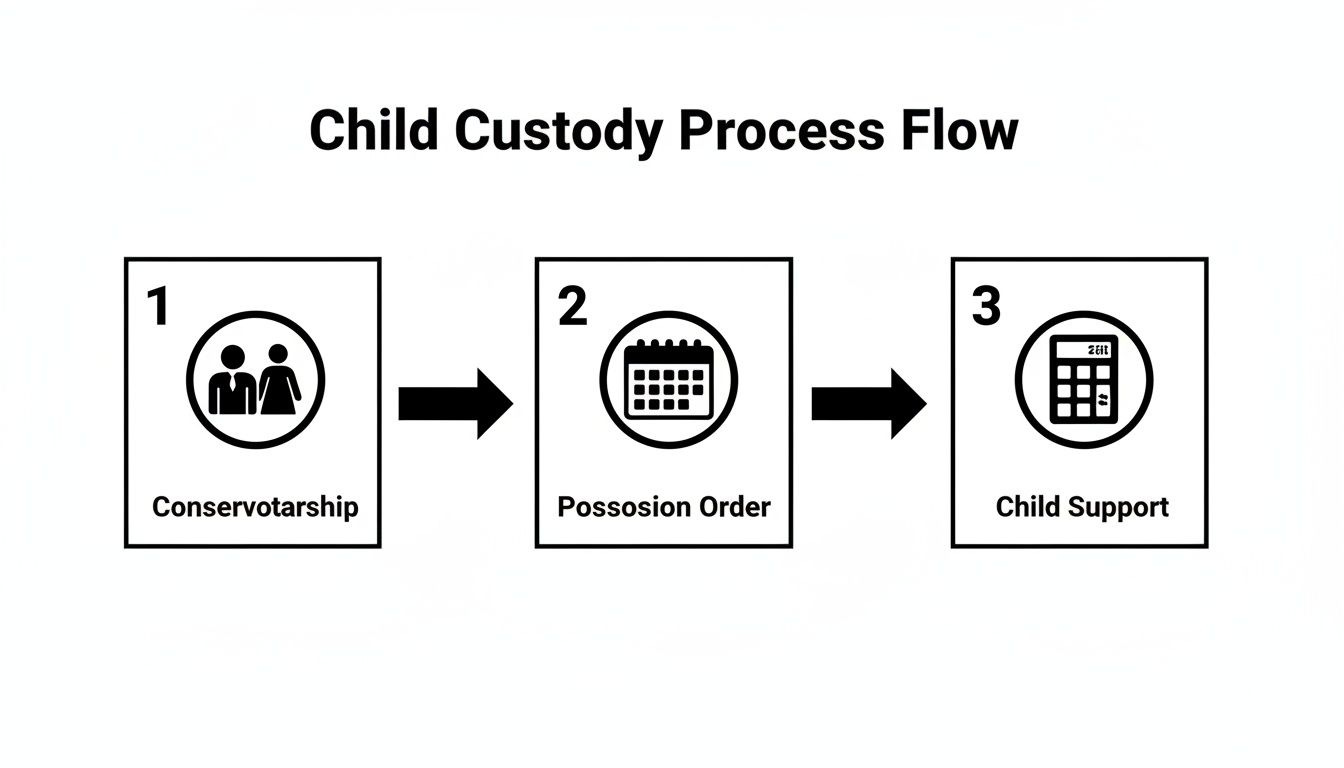
For any parent going through a divorce, nothing matters more than your children’s well-being. The fear and uncertainty surrounding what will happen with custody and child support can feel like the heaviest burden of all. The good news is that Texas law is built on that same priority. Every decision a judge makes is guided by one single principle: the best interest of the child.
This part of your divorce isn’t about one parent winning and the other losing. It's about working toward a stable, supportive new life for your kids. Let’s break down the legal jargon into real-world terms so you can feel more in control of the process.
Understanding Conservatorship in Texas
First things first: in Texas, we don't really use the word "custody." The legal term you'll hear is conservatorship. This simply refers to the rights and responsibilities each parent has for their children. The starting point for every Texas court is a strong belief that it's in a child's best interest for both parents to stay actively involved.
Because of this, the most common arrangement is for parents to be named Joint Managing Conservators (JMCs). This doesn’t automatically mean a 50/50 split of physical time with the kids. Instead, it means both parents share the rights and duties involved in raising them.
These shared rights almost always include things like:
- Making joint decisions about the child’s education and healthcare.
- Having the right to see the child's medical and school records.
- The duty to support the child, both financially and emotionally.
In a joint setup, one parent is usually named the "primary" conservator. This is the parent who has the exclusive right to decide where the children live (often within a certain geographic area) and who receives child support payments.
While joint conservatorship is the default, a court can name one parent as a Sole Managing Conservator if the situation calls for it. This is typically reserved for cases involving family violence, substance abuse, or such extreme conflict that giving one parent the final say is necessary to protect the child's physical and emotional well-being.
Creating a Predictable Schedule with a Possession Order
Once conservatorship is decided, the court will put a possession order in place. Think of this as a detailed calendar or visitation schedule. Its purpose is to give your children predictability and stability, so they always know when they will be with each parent.
In the vast majority of cases, judges will implement the Standard Possession Order (SPO), which is outlined directly in the Texas Family Code. This is the state’s default schedule because it's presumed to be in a child's best interest. The SPO provides a clear, consistent schedule for weekends, holidays, and summer breaks, which helps minimize arguments between parents.
For example, the non-primary parent usually has the children on the first, third, and fifth weekends of a month. Major holidays like Thanksgiving and Christmas are often split, with parents alternating years. This structure is specifically designed to ensure both parents get to enjoy consistent, quality time.
How Texas Calculates Child Support
Finally, let’s demystify child support. In Texas, child support is not a penalty or a reward. It is a legal obligation to make sure children get the financial support they need from both of their parents. The calculation itself is surprisingly straightforward and follows guidelines laid out in the Texas Family Code.
The support amount is figured as a percentage of the non-primary parent's net monthly resources.
Here is the basic guideline breakdown:
- 1 Child: 20% of net resources
- 2 Children: 25% of net resources
- 3 Children: 30% of net resources
- 4 Children: 35% of net resources
- 5+ Children: 40% of net resources
These percentages may be adjusted if the paying parent has other children from another relationship that they are also legally required to support. And while this formula gives everyone a clear starting point, a judge always has the authority to order a different amount if the child's proven needs justify it.
If you need help navigating divorce, custody, or estate planning in Texas, contact The Law Office of Bryan Fagan today for a free consultation.
Mapping the Texas Divorce Process Step by Step
Thinking about the Texas divorce process can feel overwhelming. It’s easy to picture a confusing legal maze, but the truth is, it’s a structured path. Knowing the map from start to finish helps take the anxiety out of the equation and lets you focus on what really matters: the decisions that will shape your future.
The whole thing kicks off the moment a case is filed and doesn't officially end until a judge signs the final order. Let's walk through what happens in between.
Kicking Off the Case
The process officially begins when one spouse, known as the Petitioner, files an Original Petition for Divorce. Don't let the legal language fool you—this document isn’t meant to be aggressive. It’s simply the formal way of telling the court and your spouse that you're seeking a divorce and outlining what you're asking for.
Once that petition is filed, your spouse, now called the Respondent, has to be formally notified. This step is called service of process. It’s a critical part of the legal system designed to make sure everyone is aware of the lawsuit and has a fair chance to respond.
The Mandatory Waiting Period and Temporary Orders
In Texas, you can’t get divorced overnight. The law requires a mandatory 60-day waiting period before a judge can finalize anything. This "cooling-off" period starts the day after the petition is filed. It's built into the system to give both people time to process, gather information, and maybe even reconsider, though reconciliation at this stage is rare.
Life doesn't hit pause just because a divorce is pending. That's where Temporary Orders come in. Either spouse can ask the court for these orders, which are basically a set of ground rules for how you'll handle things like custody, bill payments, and who gets to use what property while the divorce is ongoing. They create stability when everything else feels uncertain.
For children navigating the changes brought by divorce, providing them with effective tools to manage their feelings is paramount. Learning about anxiety coping skills for children can be an invaluable resource for parents looking to support their kids' emotional well-being during this transition.
Gathering Information and Finding Resolution
After the initial filings, the case moves into what’s called the discovery phase. This is the formal process for exchanging financial information. Think bank statements, retirement account details, property appraisals—everything gets put on the table. The law demands full transparency here, and it's the only way to ensure a fair and just division of your community estate.
Once you have a clear picture of the finances, you can start working toward a final agreement. The good news is most Texas divorces are settled out of court. The most common paths to resolution include:
- Informal Settlement: You and your attorneys negotiate directly to hammer out a deal.
- Mediation: A neutral third-party mediator sits down with both sides to help you find common ground and craft a settlement you can both live with. This is confidential and highly effective.
- Collaborative Divorce: A team-based approach where everyone—you, your spouse, and your specially trained attorneys—commits from the start to resolving everything without threatening to go to court.
If you simply can't reach an agreement on your own, the last resort is a trial. This means you'll present your case to a judge, who will then make the final decisions for you.
The process ends with the signing of a Final Decree of Divorce. This is the document that makes it all official. Signed by the judge, it legally ends your marriage and spells out every final decision on your property, debts, and children. It is the legally binding blueprint for your post-divorce life.
Choosing a Path Forward with Mediation and Collaborative Divorce
When most people think about divorce, their minds jump straight to a courtroom showdown. But that's not how the vast majority of Texas divorces actually end. In fact, Texas law strongly encourages spouses to find solutions outside of a formal trial. These alternative paths are almost always faster, more private, and far less stressful than battling it out in front of a judge.
Understanding these options puts you back in the driver's seat. You and your spouse get to decide what’s best for your family, especially when kids are involved. Staying out of the courtroom means you control the outcome, rather than handing that power over to a stranger in a black robe.
The Power of Mediation
In Texas, mediation isn't just a good idea—it's a required step in most divorce cases before you can ever go to a final trial. Think of it as a structured, confidential negotiation. You, your spouse, and your lawyers sit down with a neutral third party, called a mediator. The mediator’s only job is to help you find a path to an agreement.
A mediator doesn’t take sides or force anyone to do anything. Instead, they guide the conversation, point out the strengths and weaknesses in each side’s position, and help you brainstorm solutions for tough issues like who gets the house or how to create a parenting plan. If you succeed, you’ll sign a Mediated Settlement Agreement (MSA). This is a legally binding contract that lays out the terms of your divorce.
One of the biggest advantages of mediation is that it's completely confidential. Nothing you say or offer during mediation can be used against you later in court if you don't reach a full agreement. This protection creates a safe space to negotiate openly and honestly.
To get a better sense of how this works day-of, we break down what you can expect in our article on mediation in a Texas family law case.
The Collaborative Divorce Approach
For couples who are absolutely committed to staying out of court, collaborative divorce offers a different, team-focused path. Right from the start, both spouses and their specially trained collaborative lawyers sign a contract. In it, everyone pledges to work together respectfully and, most importantly, to resolve the entire case without ever setting foot in a courtroom.
The process is built around a series of meetings with your spouse and your legal team. You might also bring in neutral experts—like a financial planner to help with the budget or a child specialist to design a co-parenting plan—to help guide the decisions.
This model is incredibly effective for parents who want to lay the groundwork for a positive co-parenting relationship for years to come. It’s all about finding common ground and solving problems together. The commitment is real, too: if either spouse decides to abandon the process and take the fight to court, both collaborative attorneys are required to withdraw from the case. This gives everyone a powerful incentive to see the process through.
If you need help navigating divorce, custody, or estate planning in Texas, contact The Law Office of Bryan Fagan today for a free consultation.
Common Questions About Divorce in Texas
Going through a divorce brings a storm of questions and uncertainty. The unknown can be one of the most stressful parts of the process, but getting clear, direct answers helps make the path forward feel more manageable.
Here, we'll tackle some of the most common questions we hear from clients, giving you the straightforward information you need to understand your rights under Texas law.
How Long Does a Texas Divorce Take?
Every divorce has its own timeline, but Texas law puts a mandatory 60-day waiting period in place for everyone. This clock starts the day after the Original Petition for Divorce is filed, and no divorce can be finalized before those 60 days are up.
An uncontested divorce, where you and your spouse agree on everything, can often wrap up shortly after the 60-day mark. But if you have a contested divorce with disagreements over property or kids, the process can easily stretch from six months to a year, or even longer, depending on how complex the issues are.
The bottom line is that agreement is the great accelerator. The more you and your spouse can resolve on your own or through mediation, the faster you can finalize the divorce and start your next chapter.
Can My Spouse Be Ordered to Pay My Attorney Fees?
Yes, that’s a real possibility. A Texas judge has the discretion to order one spouse to cover some or all of the other's attorney's fees and court costs. It’s never guaranteed, but it is a request your attorney can make to the court.
The judge will usually weigh a couple of key factors:
- Need and Ability to Pay: The court looks at the financial situation of both spouses—the spouse asking for help and the other spouse’s ability to pay.
- The Merits of the Case: A judge might also consider how each party has behaved during the divorce. If one spouse is creating unnecessary conflict or dragging things out, that can play into the decision.
What Makes a Divorce Contested vs. Uncontested?
The difference boils down to one word: agreement.
- An uncontested divorce means you and your spouse have reached a 100% agreement on every single issue. This includes how to divide property and debts, custody and visitation schedules, and any child or spousal support.
- A contested divorce means you disagree on at least one of those things. Resolving the disagreement will require more negotiation, mediation, or ultimately, a judge’s ruling.
If you need help navigating divorce, custody, or estate planning in Texas, contact The Law Office of Bryan Fagan today for a free consultation.