
It’s 8:17 p.m. The dishes are still in the sink. Your toddler is in pajamas, clutching a stuffed animal, and you are finally sitting down after a long day when there’s a knock at the door. A CPS investigator stands outside and says there’s been a report. In that moment, your heart pounds and one question takes over your mind: What does immediate danger mean in Texas CPS hearings? Because whatever that phrase means could determine whether your child stays home tonight.
For many parents, the fear is instant and overwhelming. You may feel confused, defensive, or blindsided—especially if you are already navigating a divorce or custody dispute. Allegations can surface during high-conflict separations, and emotions can run high on both sides. Suddenly, you are not just arguing about schedules or property. You are trying to protect your child and your relationship with them.
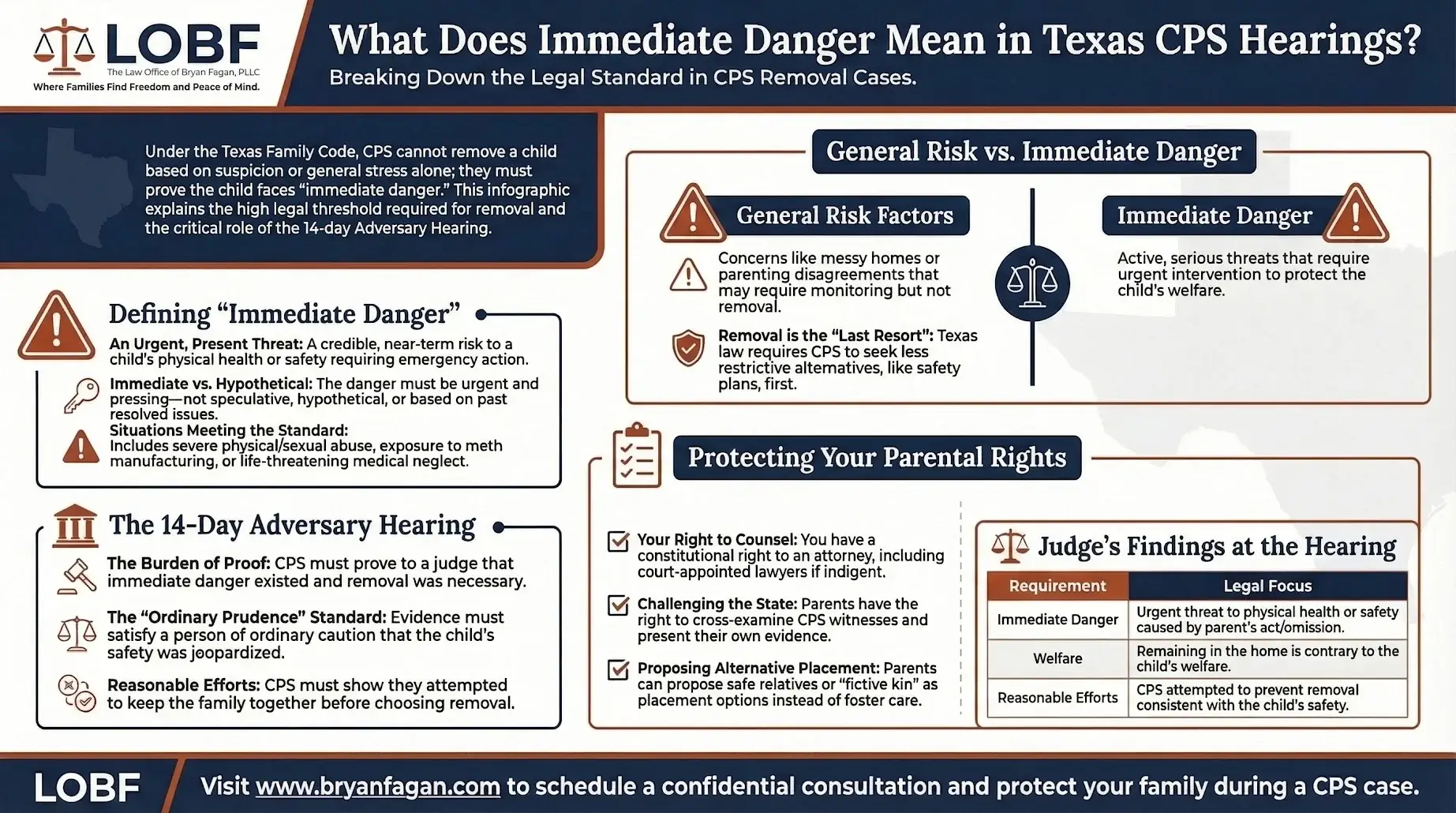
Under Texas Family Code Chapter 262, the term “immediate danger” has a specific legal meaning. It refers to a present and urgent risk to a child’s physical health or safety. It is not about ordinary parenting disagreements. It is not about messy homes or tense co-parenting conversations. It is a legal threshold that must be supported by evidence before a judge authorizes emergency removal. That distinction matters more than most parents realize.
At The Law Office of Bryan Fagan, PLLC, we have guided families across Houston and throughout Texas through some of the most frightening moments of their lives. Bryan Joseph Fagan, a graduate of South Texas College of Law and a recognized authority on Texas divorce and custody law, founded this firm with a clear purpose: to empower people to reclaim freedom and peace of mind during life’s hardest transitions. We believe families deserve clarity, not confusion. They deserve steady guidance, not intimidation.
When CPS becomes involved, especially during or after a divorce, the stakes feel deeply personal. You may worry about how allegations could influence conservatorship decisions under Section 153.002 of the Texas Family Code, which requires courts to focus on the best interest of the child. You may wonder how a temporary investigation could impact long-term custody orders under Section 153.134. These concerns are valid. And they deserve thoughtful answers.
This article will walk you through what the law actually requires, how Texas judges evaluate claims of urgent risk, and what practical steps you can take to protect both your child and your parental rights. Most importantly, it will help you replace panic with understanding. Because when you understand the legal standard, you begin to regain control—and that is the first step toward restoring stability for your family.
Key Takeaways
- Immediate danger in Texas CPS hearings means a credible, near-term risk of harm to your child’s physical health or safety that requires emergency action—not just concerns or allegations
- CPS must prove this legal standard with concrete evidence under Texas Family Code Chapter 262, not merely by stating it exists
- The immediate danger standard is evaluated at the adversary hearing, typically within 14 days of removal
- Parents have the right to challenge CPS’s evidence and present their own counter-evidence showing their home is safe
- If CPS cannot prove immediate danger with sufficient evidence, the judge may order your child returned home

Your Family’s Future Starts Here
Don’t navigate your legal journey alone. Schedule a consultation now and get the clarity and support you deserve.
What Does Immediate Danger Mean in Texas CPS Hearings? The Short Answer
What does immediate danger mean in Texas CPS hearings? Under Texas Family Code Chapter 262, it refers to a credible, near-term risk of serious harm to a child’s physical health or safety based on present conditions—not speculation, not general concerns, and not past allegations that have already been addressed. Sections 262.102 and 262.104 require a judge to make specific findings that immediate danger exists before authorizing emergency removal. This standard reflects the Legislature’s effort to protect children while also safeguarding a parent’s constitutional rights under the Fourteenth Amendment.
Immediate danger is more than suspicion. It must describe a real and urgent threat that a person of ordinary prudence would recognize as serious and ongoing. Section 262.102 requires sworn evidence supporting the need for emergency intervention, and Section 262.201 governs the adversary hearing, where CPS must justify its actions and show that removal was legally necessary. Courts also examine whether reasonable efforts were made to prevent removal and whether less restrictive alternatives—such as a safety plan or relative placement—could protect the child without separating the family. Recent statutory updates continue to emphasize evidentiary support and judicial oversight rather than conclusory statements.
CPS must connect the alleged danger directly to the child’s present safety and specific vulnerabilities. That means showing how the claimed condition affects this particular child, right now. A cluttered home alone is not immediate danger. A years-old allegation without current risk is not immediate danger. A heated parenting disagreement during divorce is not immediate danger. Judges look for concrete, time-sensitive evidence of serious harm. For a deeper explanation of the burden CPS must meet at the adversary hearing, families can review our detailed guide on what CPS must prove at the hearing and how the burden of proof works in Texas.
Our Houston-based family law team regularly represents parents facing these high-stakes hearings and helps them understand how district courts apply Chapter 262 in real life. If you are trying to understand your rights during an investigation, you may also find helpful insight in our article on Texas CPS investigations and your parental rights. At The Law Office of Bryan Fagan, PLLC, our mission is to educate families and protect futures. When you understand what the law truly requires, you can respond strategically rather than react out of fear—and that clarity is often the first step toward restoring peace of mind.

Where “Immediate Danger” Shows Up in the CPS Court Process
The immediate danger standard appears at multiple critical points in a Texas CPS case:
Emergency removal decisions occur when CPS caseworkers determine that waiting for a court order would endanger the child. Under Texas Family Code Section 262.104, CPS may take possession of a child without prior notice if there is immediate danger and no time for an adversary hearing consistent with the child’s safety.
The adversary hearing is your first formal opportunity to challenge the removal. Texas Family Code Section 262.201 requires this hearing within approximately 14 days after CPS takes possession. At this hearing, CPS must present evidence that immediate danger existed and that the child remains in continuing danger if returned home.
The initial hearing after removal without a court order requires the judge to order the child returned unless CPS shows continuing danger or immediate danger justifying ongoing removal. Texas Family Code Section 262.107 governs this standard.
Throughout these proceedings, judges review whether emergency removal was legally justified and whether less restrictive alternatives exist. The distinction between the initial removal standard and the continuing danger standard matters because CPS must meet both thresholds to keep a child in temporary custody.
Immediate Danger vs “Concerns”: Why the Difference Matters
Understanding the difference between a general safety concern and a legally defined emergency is critical for any parent facing CPS involvement. When families ask, What does immediate danger mean in Texas CPS hearings, they are trying to understand whether their situation truly meets the strict legal standard required for removal. Under Chapter 261 of the Texas Family Code, CPS may investigate a report of suspected abuse or neglect based on credible information. The threshold for beginning an investigation is intentionally lower because the state has a duty to assess child welfare concerns. However, investigation alone does not equal removal.
The legal standard shifts dramatically when CPS seeks to take possession of a child. Under Texas Family Code §§ 262.102 and 262.104, a judge must find that there is an immediate danger to the physical health or safety of the child and that remaining in the home would be contrary to the child’s welfare before authorizing emergency removal. Recent legislative updates continue to reinforce judicial oversight and the requirement that CPS present specific, fact-based evidence rather than broad allegations. Section 262.201 further requires a prompt adversary hearing, where CPS must demonstrate that immediate danger existed and that returning the child home would create continuing risk. This higher burden reflects the Legislature’s recognition that removal itself can be traumatic and must be supported by clear and credible proof.
Texas courts are also directed to consider less restrictive alternatives before approving removal. The statute requires CPS to show that reasonable efforts were made to prevent separation, including removing the alleged perpetrator from the home, implementing a safety plan, placing the child with a qualified relative, or seeking protective relief under Title 4 of the Texas Family Code. If these measures can protect the child without disrupting the parent-child relationship, courts may decline removal. Parents often find comfort in knowing that the law does not authorize removal simply because an investigation is ongoing.
For families worried about whether CPS can remove their children and what rights protect them, our firm has developed a comprehensive guide on your rights and legal protections when CPS is involved. You may also find helpful context in our resource on Texas CPS investigations and parental rights, which explains how investigations progress under state law.
At The Law Office of Bryan Fagan, PLLC, our mission is to educate families and protect futures. By helping parents understand how Texas courts distinguish between a concern and a legally defined emergency, our Houston-based legal team empowers families to respond calmly, strategically, and with confidence. When you understand what the law truly requires, you are better equipped to protect your child and safeguard your rights during one of the most challenging moments a family can face.

Table: Examples of What May vs May Not Qualify as Immediate Danger
Important disclaimer: Every case depends on its specific facts. Judges decide whether immediate danger exists based on the evidence presented. This table provides general guidance only—not legal advice for any individual situation.
| Examples That May Qualify as Immediate Danger | Examples Usually Not Immediate Danger Alone |
|---|---|
| Active domestic violence with children present and at risk of physical harm | A messy or cluttered home without structural hazards |
| Caregiver currently intoxicated or impaired while supervising young children | One-time parenting disagreement or discipline dispute |
| Unsecured firearms or lethal hazards accessible to children | Past incidents that have been resolved with no current risk |
| Untreated medical emergency where parent refuses necessary treatment | Verbal conflicts between parents without physical threats |
| Credible evidence of ongoing sexual abuse with risk of recurrence | Child expressing fear without corroborating evidence of harm |
| Severe structural home hazards posing imminent physical danger | Previous CPS involvement that resulted in case closure |
What CPS Must Connect the Danger to (Child-Specific and Time-Specific)
CPS must connect the danger to the child’s present safety in specific, documented ways. General statements about risk are not enough. The evidence must show:
Child’s age and specific vulnerabilities. An infant faces different dangers than a teenager. A child with disabilities may require different safety considerations. CPS must explain why this particular child is at immediate risk.
Current supervision arrangements. Who is watching the child? What access does the child have to dangerous conditions? CPS must show the supervision situation right now creates immediate risk.
Timeframe matters critically. The standard evaluates danger at the time of removal or petition—not what might happen weeks or months later. Past incidents alone do not prove present danger unless they create ongoing risk.
Patterns versus isolated events. Courts consider whether the alleged danger reflects a pattern of abuse or neglect versus a single incident that has been addressed. Severity, frequency, and duration all factor into the analysis.
Credibility and corroboration of reports. Under Texas Family Code Section 262.102(b-1), affidavits supporting removal must be based on personal knowledge or information corroborated by personal knowledge. Uncorroborated hearsay has limited weight.
The Other Legal Requirements Judges Consider Alongside Immediate Danger
Immediate danger is one piece of a larger legal framework. Judges also evaluate:
Continuing danger if the child returned home. Under Texas Family Code Section 262.107, if CPS took the child without a court order, the judge must determine whether returning the child poses continuing danger. This is separate from whether immediate danger existed at removal.
Whether CPS made reasonable efforts to prevent removal. Texas law requires CPS to make reasonable efforts consistent with the circumstances to avoid removing children when possible. If CPS failed to consider or attempt less drastic alternatives, this may undermine the removal justification.
Availability of safe alternative placements. Judges consider whether placement with family members or other safe alternatives could protect the child without full removal. Texas Family Code Section 262.102 requires CPS to show that placing the child with a relative caregiver would pose immediate danger or was offered and refused.
Balancing parental rights with child protection. Texas courts recognize that parents have constitutional rights to the care and custody of their children. Removal must be justified by more than speculation—it requires clear and convincing evidence at certain stages of the case.
Table: Evidence Map for Immediate Danger Claims
This table illustrates common patterns in CPS cases. Every case is different, and parents should seek legal advice from an experienced attorney to evaluate their specific situation.
| CPS Claim | Evidence CPS Typically Presents | Parent’s Lawful Counter-Evidence |
|---|---|---|
| Substance abuse creating danger | Drug test results, witness statements, caseworker observations | Completed treatment records, clean drug tests, compliance with substance abuse programs |
| Domestic violence in the home | Police reports, photographs of injuries, witness statements | Protective orders against perpetrator, safety plan compliance, counseling records |
| Unsafe housing conditions | Photographs, home inspection reports, environmental hazard documentation | Proof of repairs, new housing lease, home improvement receipts, safety equipment installation |
| Medical neglect | Medical records showing untreated conditions, doctor statements | Prescription records, appointment compliance records, medical professional testimony |
| Physical abuse | Medical examination findings, photographs, child statements | Character witnesses, alternative medical explanations, parenting class completion |
| Inadequate supervision | Witness reports, law enforcement documentation | Employment records showing supervision arrangements, childcare documentation, relative caregiver availability |
What Parents Can Do to Respond Legally and Effectively
If CPS alleges that your child is in immediate danger, it is critical to respond thoughtfully, strategically, and with the child’s well-being at the center of every decision. Many parents understandably ask, What does immediate danger mean in Texas CPS hearings, especially when the accusation arises during or after a divorce. Under Texas Family Code §§ 262.102 and 262.201, CPS must present evidence showing a present and urgent risk to the child’s physical health or safety before a court can authorize emergency removal or continue temporary possession. This is not a casual or automatic finding; it requires sworn testimony and judicial review at an adversary hearing.
The first and most important step is to seek experienced legal counsel immediately. A knowledgeable CPS defense attorney can review the affidavit filed under Chapter 262, evaluate whether the statutory requirements have been met, and challenge insufficient or conclusory evidence. Texas law provides for court-appointed counsel in qualifying cases involving removal, but early involvement of a seasoned family law advocate can significantly shape the direction of your case. The Houston-based legal team at The Law Office of Bryan Fagan, PLLC regularly appears in adversary hearings and understands how district courts apply these updated statutory standards in practice.
Documentation matters. Gathering proof of stable housing, employment, medical compliance, and consistent caregiving can directly counter allegations of danger. Under recent legislative refinements, courts must evaluate whether reasonable efforts were made to prevent removal and whether less restrictive alternatives exist. Providing leases, utility statements, clean drug test results, medical records, and school attendance documentation can demonstrate that the child’s current environment does not meet the legal definition of immediate danger. For additional context on how family instability can impact children, parents may find insight in our article on the dangers of getting a divorce, which discusses how conflict and disruption can affect a child’s emotional health.
Identifying credible witnesses is equally important. Teachers, doctors, childcare providers, neighbors, or extended family members may offer testimony supporting your parenting capacity and your child’s safety. Courts do not rely solely on CPS allegations; they weigh evidence from multiple sources. If legitimate safety concerns exist, proposing relative placement or a structured safety plan under the supervision of the court may satisfy the statutory requirement for protection without full removal. Texas Family Code § 262.102 specifically requires courts to consider alternatives before authorizing separation.
Compliance with temporary court orders also carries significant weight. Even if you disagree with the court’s initial decision, following directives regarding visitation, services, or drug testing demonstrates responsibility and respect for the judicial process. Failure to comply can be used to argue continuing danger under § 262.201. Calm, written communication with caseworkers and attorneys is also essential. Avoid emotionally charged confrontations and consult counsel before making statements that could be misinterpreted or used against you.
At The Law Office of Bryan Fagan, PLLC, our mission is to educate families and protect futures. By helping parents understand the legal framework governing CPS actions and by providing steady, informed advocacy, our firm empowers families to move from fear to clarity. When you understand both your rights and your responsibilities under Texas law, you are better positioned to protect your child and preserve your family’s stability during one of life’s most challenging chapters.

What Happens If CPS Cannot Prove Immediate Danger
If CPS cannot prove immediate danger at the adversary hearing, several outcomes become possible:
The judge may order immediate return home. Under Texas Family Code Section 262.201, if CPS fails to prove the removal was justified by immediate danger and continuing danger, the court must order the child returned to the parent.
Relative placement may be ordered. Even if some concerns exist, the judge may determine placement with safe family members is preferable to foster care.
Services may be ordered without removal. The court might require the family to participate in services—counseling, parenting classes, substance abuse treatment—while the child remains home.
Visitation restrictions may be narrowed. If the child remains in temporary custody, the court may expand visitation rights when immediate danger is not clearly established.
The case may be dismissed. If CPS cannot establish grounds for continued involvement, the court may dismiss the child protection suit entirely.
Common Myths About “Immediate Danger” in Texas CPS Cases
When families hear the phrase “immediate danger,” fear often fills in the gaps with assumptions that simply are not supported by Texas law. Many parents understandably ask, What does immediate danger mean in Texas CPS hearings, especially when the allegation appears sudden or overwhelming. Clearing up common myths can help you respond with confidence rather than panic.
One common misconception is that if CPS says “immediate danger,” the issue is already decided. In reality, Texas Family Code §§ 262.102 and 262.104 require a judge—not a caseworker—to determine whether sufficient evidence supports emergency removal. A sworn affidavit alone does not automatically prove the claim. At the adversary hearing governed by § 262.201, CPS must present credible, fact-specific evidence showing a present and urgent risk to the child’s physical health or safety. The judge evaluates testimony, documents, and whether reasonable efforts were made to prevent removal before continuing temporary custody.
Another myth is that any allegation automatically justifies removal. While reports under Chapter 261 may trigger an investigation, the threshold for investigating is much lower than the threshold for removal. The Legislature has structured Chapter 262 to ensure that separating a child from a parent occurs only when legally necessary. Many investigations close without removal because CPS cannot meet the higher evidentiary burden required in court. If you want to understand how investigations progress, our guide on Texas CPS investigations and parental rights provides helpful context.
Parents also worry that past mistakes automatically establish present danger. That is not how Texas courts analyze these cases. Judges must conduct a time-specific evaluation. Past conduct matters only if it creates a current, ongoing risk to the child. If a parent has completed counseling, treatment, or complied with court-ordered services, those steps can weigh heavily in their favor. The law focuses on present safety, not permanent punishment for prior hardship.
Another misunderstanding is that parents cannot challenge CPS findings. In truth, the adversary hearing exists precisely so parents can contest the evidence. You have the right to present witnesses, introduce documentation, and cross-examine the caseworker. Under recent updates to the Texas Family Code, courts are required to consider whether less restrictive alternatives—such as safety plans or relative placements—can adequately protect the child before removal continues. The legal system is designed to test the evidence, not simply accept allegations at face value.
Finally, some parents fear that cooperating with CPS means admitting wrongdoing. Cooperation with lawful investigations or compliance with temporary court orders does not equal conceding that immediate danger existed. You can follow court directives while still challenging whether the statutory requirements of Chapter 262 were satisfied. Working with experienced counsel ensures that your cooperation does not inadvertently weaken your legal position.
At The Law Office of Bryan Fagan, PLLC, our mission is to educate families and protect futures. Our Houston-based family law team believes clarity reduces fear and empowers parents to make thoughtful decisions during difficult moments. Understanding your rights under the Texas Family Code allows you to replace myth with knowledge and uncertainty with strategy. For broader insight into how legal processes intersect with public safety issues, readers may also explore our discussion on public safety and legal accountability. When you understand how the law truly works, you are better equipped to protect your child and move forward with confidence.

How a Texas CPS Attorney Helps Challenge Immediate Danger Claims
A Texas CPS attorney provides critical support when facing immediate danger allegations:
Challenging insufficient or unreliable evidence. Attorneys scrutinize CPS affidavits for vague language, unsupported conclusions, or reliance on uncorroborated hearsay. Weak evidence can be challenged at the adversary hearing.
Presenting safer alternatives. Attorneys help identify and propose relative placements, safety plans, or other arrangements that could protect the child without full removal.
Cross-examining CPS caseworkers. Effective cross-examination can reveal gaps in the investigation, assumptions without factual support, or failure to consider alternatives.
Protecting parental rights while maintaining child safety focus. Experienced attorneys balance aggressive advocacy with recognition that the child’s welfare matters most. This approach builds credibility with judges.
Connecting the immediate danger standard to Texas Family Code requirements. Attorneys ensure judges apply the correct legal standards and hold CPS to its burden of proof.
Understanding what does immediate danger mean in Texas CPS hearings becomes clearer with legal guidance tailored to your specific situation.
Why Choose The Law Office of Bryan Fagan, PLLC for CPS Immediate Danger Cases
When families are facing allegations of emergency removal, one of the first questions they ask is, What does immediate danger mean in Texas CPS hearings? The answer lies in Chapter 262 of the Texas Family Code, particularly §§ 262.102, 262.104, and 262.201, which govern emergency removals and adversary hearings. These provisions require a judge to find that there is a present and urgent threat to a child’s physical health or safety before authorizing removal. The Legislature has strengthened procedural safeguards in recent updates, emphasizing sworn evidence, judicial oversight, and consideration of reasonable efforts to prevent separation whenever possible.
The attorneys at The Law Office of Bryan Fagan, PLLC have extensive experience navigating adversary hearings and interpreting how Texas district courts apply these statutory standards in real courtrooms. Our legal team understands that removal is the most serious action the state can take in a child protection case. That is why we carefully analyze CPS affidavits, evaluate whether the statutory requirements have been met, and hold the state to its burden of proof under § 262.201. If you are trying to understand when removal is legally permitted, our in-depth guide on when CPS can remove your child from your home in Texas provides a comprehensive overview of your rights and the court process.
Strategic courtroom advocacy matters. Our Houston-based family law firm challenges insufficient or conclusory evidence, presents credible alternatives such as relative placements or safety plans, and ensures the court considers less restrictive measures before continuing removal. Texas law requires courts to evaluate whether reasonable efforts were made to avoid separation and whether the alleged danger is tied to the child’s present safety. These are not technicalities; they are essential protections built into the statute.
Compassionate communication is equally important. CPS proceedings can feel intimidating and overwhelming, especially when families are already dealing with divorce or custody disputes. We believe informed clients make stronger decisions. That is why we provide clear explanations of the law, realistic assessments of the evidence, and practical guidance every step of the way. Families may also find helpful context in our article on Texas CPS investigations and parental rights, which outlines how investigations and court proceedings typically unfold.
We represent parents throughout Texas in emergency CPS matters, offering responsive support when timing is critical. While no attorney can promise a specific outcome, our commitment remains consistent: thorough preparation, honest advice, and dedicated advocacy focused on protecting your parental rights and your child’s safety. At The Law Office of Bryan Fagan, PLLC, educating families and protecting futures is more than a slogan—it is the foundation of how we serve our community.

Actionable Checklist: Understanding Immediate Danger in Texas CPS Hearings
- [ ] Request and carefully review the CPS affidavit for immediate danger claims
- [ ] Document a detailed timeline of events leading to the removal allegation
- [ ] Gather proof of stable housing, employment, and caregiving arrangements
- [ ] Collect medical records, prescription documentation, and treatment compliance proof
- [ ] Identify witnesses who can speak to child safety and family stability
- [ ] Propose safe alternatives such as relative placement or safety plan compliance when appropriate
- [ ] Comply fully with any temporary court orders while the case is pending
- [ ] Consult an experienced CPS defense attorney immediately for adversary hearing preparation
- [ ] Prepare evidence showing immediate danger did not exist or no longer exists
- [ ] Understand your rights at the adversary hearing and throughout the court process
Conclusion
When legal language like “immediate danger” enters your life, it can feel like the ground has shifted beneath your feet. But knowledge has a way of steadying that ground. Understanding how Texas courts define urgent risk, how judges evaluate evidence, and how custody decisions intersect with your child’s overall stability gives you something powerful back—clarity. And clarity creates confidence.
If you are facing CPS involvement, a custody dispute, or simply trying to make the best decisions for your child during a difficult season, you do not have to navigate it alone. The Law Office of Bryan Fagan, PLLC is here to educate, guide, and advocate for families across Houston and throughout Texas. Our mission has always been to protect what matters most while helping parents reclaim peace of mind during life’s hardest transitions.
The next step may be as simple as asking the right questions. What does your current court order really say? What evidence would a judge want to see? How can you strengthen your position while reducing stress for your child? A conversation with an experienced Texas Family Law Attorney can help you move from uncertainty to a clear strategy.
If you are ready for answers tailored to your situation, we invite you to reach out and schedule a consultation. Sometimes the most important move you can make is deciding not to face a complex legal problem by yourself. Your family’s future is worth thoughtful, experienced guidance—and we are here when you are ready.
Frequently Asked Questions
In Texas CPS cases, “immediate danger” generally refers to a present and urgent risk of serious harm to a child’s physical health or safety. It is not based on suspicion alone. Instead, CPS must point to specific facts showing that a child faces a real threat that cannot safely wait for normal court procedures. Judges look at the totality of the circumstances before deciding whether this high legal standard is met.
The timeline depends on the type of case. Some investigations close quickly if CPS determines there is no ongoing safety concern. However, if CPS files a lawsuit affecting the parent-child relationship, the case can last several months or longer, depending on court schedules and compliance with services. Each case moves at its own pace based on the allegations and the evidence involved.
Child endangerment typically involves conduct or conditions that place a child at risk of physical or emotional harm. This may include serious neglect, exposure to violence, dangerous supervision failures, or substance abuse that interferes with safe parenting. Courts require credible evidence and look at patterns of behavior, not just isolated accusations.
An unstable environment often means a living situation that lacks consistency, safety, or reliable caregiving. Frequent moves, exposure to ongoing conflict, untreated substance abuse, or unpredictable supervision may raise concerns. Texas courts value stability and routine because those factors strongly support a child’s emotional and developmental well-being.
In legal terms, “immediate danger” describes a near-term threat that requires urgent action to protect a child’s safety. It is not about general parenting disagreements or past issues that have been resolved. The court must see evidence of a current and credible risk before allowing emergency intervention.
If a child faces an urgent threat, contact emergency services immediately. If the situation involves suspected abuse or neglect but is not an active emergency, a report can be made to the Texas Department of Family and Protective Services. If you are a parent accused of creating danger, prioritize safety, avoid confrontation, document facts carefully, and consult an experienced Texas family law attorney to understand your rights.
Yes. CPS does not make the final decision—judges do. A judge can deny a removal request, order a child returned home, or require less restrictive alternatives if the evidence does not support emergency action. Parents have the right to challenge CPS claims and present their own evidence in court.
In some situations, yes. If CPS quickly determines the report is unfounded or that there is no ongoing safety concern, a case may close relatively fast. However, more complex investigations or court-involved cases typically take longer. The timeline depends on the nature of the allegations and the evidence gathered.
Courts tend to respond negatively to actions that suggest avoidance or dishonesty. Hiding income, refusing to provide financial documentation, intentionally reducing income to lower support obligations, or ignoring court orders can significantly damage credibility. Judges generally favor parents who are transparent, cooperative, and focused on meeting the child’s needs rather than escalating conflict.