
The courtroom was quiet except for the soft shuffle of papers when the judge signed the final order. A mother sat frozen, trying to process what she had just heard. What Is Permanent Managing Conservatorship in Texas suddenly wasn’t just a phrase her attorney had explained weeks earlier—it was the new reality shaping where her child would live, who would make major decisions, and how her role as a parent would look moving forward. In that moment, fear and confusion mixed with one urgent question: “What does this really mean for my family?”
Permanent managing conservatorship is one of the most misunderstood concepts in Texas family law. It does not automatically terminate parental rights, but it can significantly shift decision-making authority and daily responsibility. Under Texas Family Code §153.002, courts must prioritize the best interest of the child above all else. That standard guides every conservatorship ruling, whether the case arises from divorce, a custody dispute, or involvement by the Department of Family and Protective Services. Understanding how judges apply this standard—and what rights and duties may be reassigned—can dramatically change how you prepare and respond.
At The Law Office of Bryan Fagan, PLLC, we know that legal definitions rarely capture the emotional weight families carry into court. Founded by Bryan Joseph Fagan, a South Texas College of Law graduate and recognized authority on Texas divorce and custody law, our firm has guided Texas parents through some of the most difficult transitions of their lives. We have seen how clarity reduces panic, how education restores confidence, and how strategic planning protects both parental rights and a child’s stability.
Our mission is rooted in empowerment. We believe families deserve the freedom and peace of mind that come from understanding their options. Through compassionate counsel and innovative legal solutions, we simplify complex statutes and court procedures so you can make informed decisions during uncertain times. Conservatorship orders shape the structure of your child’s life—where they live, who consents to medical care, who decides on activities, and how parenting time is shared. Those details matter deeply.
If you are facing a conservatorship decision, you do not need more fear—you need clarity. In the sections that follow, we will break down what permanent managing conservatorship means under Texas law, how courts evaluate these cases, and what practical steps you can take to protect your parental role and your child’s future.
Key Takeaways
- Permanent Managing Conservatorship in Texas means a court has granted long-term legal custody and decision-making authority over a child to a person or agency, but this does not automatically terminate parental rights.
- Parents subject to a PMC order often retain certain rights, such as visitation and the duty to pay child support, depending on the specific language of the court order.
- PMC can be modified under Texas Family Code §156.101 if you can demonstrate material and substantial changed circumstances and that modification serves the child’s best interest.
- The evidentiary burden to reverse or modify a PMC order is significant, but compliance with court-ordered services and documented stability can strengthen your case.
- Consulting an experienced Texas family law attorney is critical for understanding your rights and navigating the legal process effectively.

Your Family’s Future Starts Here
Don’t navigate your legal journey alone. Schedule a consultation now and get the clarity and support you deserve.
What Is Permanent Managing Conservatorship in Texas? — The Short Answer
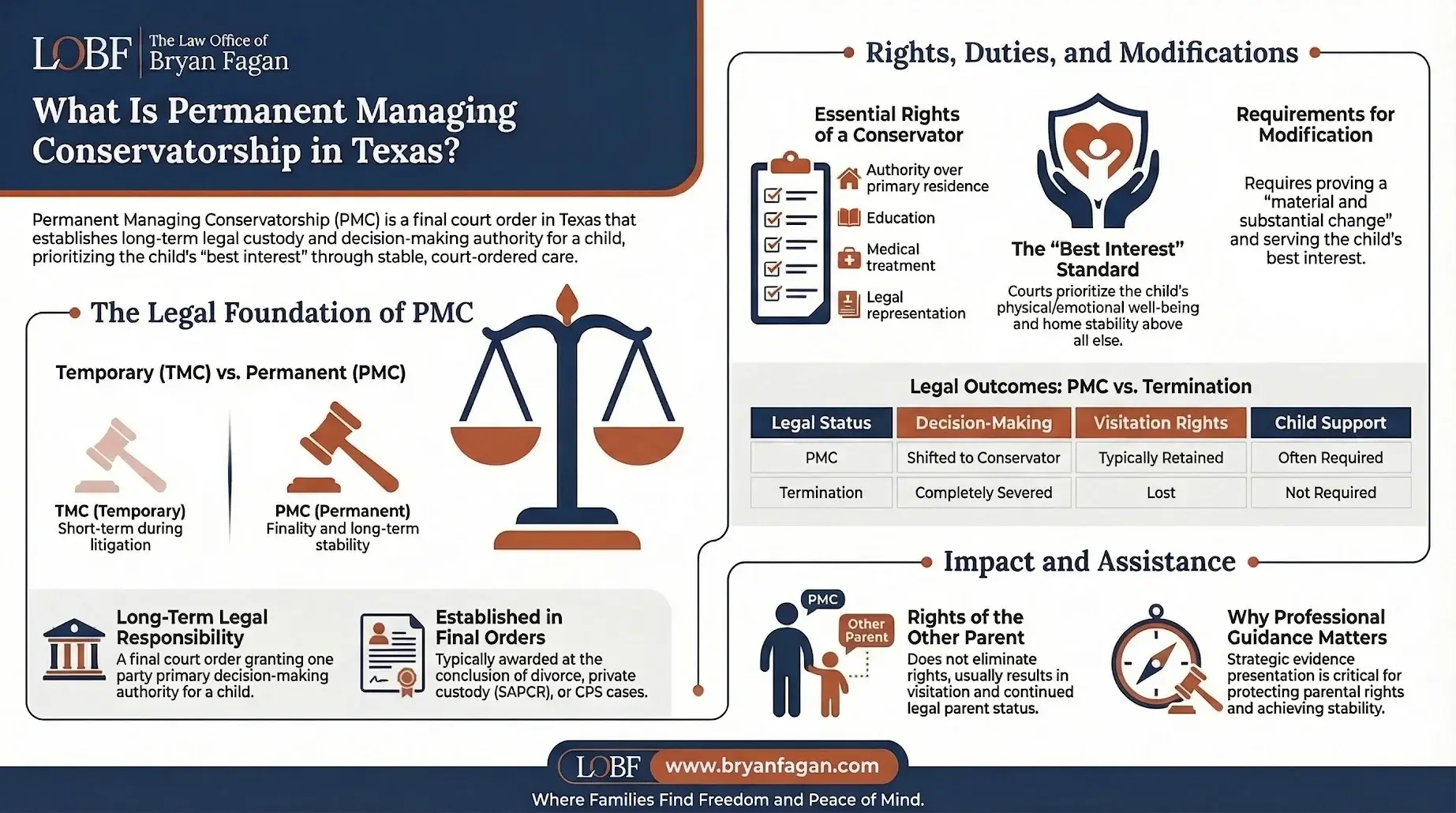
When parents ask What Is Permanent Managing Conservatorship in Texas, they are usually standing at a crossroads. Permanent Managing Conservatorship (PMC) is a court-ordered legal arrangement in which a managing conservator—often a parent, grandparent, relative, or in some cases the Texas Department of Family and Protective Services (DFPS)—is granted long-term authority over a child’s residence and major life decisions. This status is established through a final court order, typically after temporary managing conservatorship proceedings under Texas Family Code Chapters 262 and 263 or following a contested custody case in a Suit Affecting the Parent-Child Relationship (SAPCR).
Texas Family Code §153.002 makes clear that the court’s guiding principle is always the best interest of the child. Judges evaluate stability, safety, parental involvement, and the child’s physical and emotional needs. Under Chapter 153, a managing conservator may receive exclusive rights to determine the child’s primary residence, consent to medical and psychological treatment, and make educational decisions. These rights can significantly affect day-to-day parenting authority, which is why understanding the structure of the order is so important.
It is equally important to understand what PMC is not. Permanent managing conservatorship does not automatically terminate parental rights. Termination is governed by Texas Family Code Chapter 161 and requires clear and convincing evidence of specific statutory grounds. Unless the court expressly terminates rights under Chapter 161, birth parents remain the child’s legal parents. They may retain visitation rights under §153.192 and are typically responsible for child support under Chapter 154. Recent updates to the Texas Family Code continue to reinforce this distinction, ensuring that parental rights are not severed without meeting the high statutory threshold required for termination.
The word “permanent” often sounds final and frightening. Legally, it means the order is final rather than temporary. The order remains in place until the child turns 18, the court modifies it under Chapter 156 based on a material and substantial change in circumstances, or parental rights are terminated. It does not mean that change is impossible. Parents who want to better understand modification options can review our in-depth guide on whether Texas permanent managing conservatorship can be reversed.
Families seeking additional clarity about custody standards, parental presumptions under §153.131, and best interest evaluations may also benefit from our Texas child custody resource center. These resources are designed to educate and empower, because informed parents make stronger decisions.
At The Law Office of Bryan Fagan, PLLC, our commitment is to combine legal precision with compassionate guidance. Conservatorship cases are about more than statutes—they are about protecting your role in your child’s life. When you understand how Texas courts apply the law and what options remain available, uncertainty begins to give way to confidence and clarity.

Key Rights and Duties of a Permanent Managing Conservator
A central part of understanding What Is Permanent Managing Conservatorship in Texas is recognizing how much authority the court may place in the hands of a managing conservator—and what rights may still remain with a parent. Under Texas Family Code §153.371, a managing conservator is typically granted specific rights and duties that can significantly shape a child’s daily life. These powers often include the exclusive right to designate the child’s primary residence, make educational decisions, consent to medical and psychological treatment (including emergency care), and manage extracurricular, childcare, and routine scheduling matters. In many cases, the managing conservator may also guide the child’s religious and moral upbringing, depending on how the final order is structured.
That said, permanent managing conservatorship does not automatically eliminate a parent’s legal role. Unless parental rights have been terminated under Texas Family Code Chapter 161, the parent remains a legal parent. Under §153.192 and related provisions, parents commonly retain possession or visitation rights, which may be supervised or unsupervised depending on the court’s findings. Financial obligations generally continue as well. Chapter 154 of the Texas Family Code governs child support, and courts routinely order parents to contribute financially even when they are not the managing conservator. Recent statutory updates have continued to refine support calculations and enforcement procedures, reinforcing the court’s focus on ensuring children receive consistent financial care.
Parents may also retain the right to receive information about the child’s health, education, and general welfare unless the court specifically restricts access due to safety concerns. Additionally, Chapter 156 allows for modification of conservatorship orders when there has been a material and substantial change in circumstances and modification serves the child’s best interest. This is an important safeguard because it means a final order is not necessarily the end of the story if meaningful changes occur.
The exact division of rights always depends on the specific language in the signed order. At our Houston-based family law firm, we frequently remind parents that the details matter. Every clause in a conservatorship order defines real-world authority. Carefully reviewing your decree and understanding which rights are exclusive, independent, or subject to joint decision-making can prevent costly misunderstandings.
Families often confuse permanent managing conservatorship with other legal arrangements, such as guardianship. If you are weighing long-term care options, you may find helpful clarification in our resource on permanent guardianship in Texas, which explains how guardianship differs from conservatorship under Texas law. For broader guidance on custody standards and parental rights, our Texas child custody resource center provides detailed explanations grounded in current statutes and court practice.
At The Law Office of Bryan Fagan, PLLC, our mission is to educate families and protect futures. Conservatorship decisions are not abstract legal concepts—they affect where your child lives, who makes major decisions, and how your relationship continues moving forward. When parents understand both the authority granted to a managing conservator and the rights they may still retain, they are better equipped to move ahead with clarity, confidence, and peace of mind.
TMC vs PMC vs Termination — Comparison Table
| Category | Temporary Managing Conservatorship (TMC) | Permanent Managing Conservatorship (PMC) | Termination of Parental Rights (TPR) |
|---|---|---|---|
| Purpose | Short-term care during investigation or while working toward reunification | Long-term legal custody and decision-making after reunification fails or in contested custody | Complete legal severance of parent-child relationship, often to allow adoption |
| Duration | Until final hearing or permanency decision | Until child turns 18, court modifies order, or rights terminated | Permanent; parental rights cannot be restored except in rare circumstances |
| Parental Rights Retained | Parents retain most rights; visitation and compliance with service plan expected | Parents retain some rights (visitation, support) unless restricted; decision-making shifted | Parent loses all legal rights: visitation, decision-making, inheritance, contact |
| Court Standard | Best interest of child; temporary orders under Texas Family Code Chapters 262-263 | Best interest of child; parental presumption rebutted; final order under Chapter 153 | Clear and convincing evidence of statutory grounds under Texas Family Code Chapter 161 |
| Typical Context | CPS removal cases, initial SAPCR stages | CPS permanency hearings, contested private SAPCR, kinship placements | Serious abuse, neglect, abandonment; adoption preparation |

How Courts Decide to Appoint a PMC
Texas courts take conservatorship decisions seriously. The primary legal standard is the best interest of the child, as established in Texas Family Code §153.002. When deciding whether to appoint a permanent managing conservator, the court considers:
- Evidence of parental unfitness or inability: This includes documented neglect, abuse, substance use, mental health challenges, or failure to provide a stable home.
- CPS findings and reports: In CPS cases, the Texas Department of Family and Protective Services provides case management reports, safety assessments, and recommendations.
- Compliance with service plans: Courts examine whether parents completed court-ordered services, such as parenting classes, substance abuse treatment, or mental health counseling.
- Testimony and expert evaluations: Psychologists, social workers, and other services providers may testify about a parent’s fitness or the child’s needs.
- Housing, employment, and stability: Evidence of stable housing, employment, and a safe environment weighs heavily in the court’s decision.
Under Texas Family Code §153.131, there is a presumption that a parent should be appointed as managing conservator. However, this presumption can be rebutted if the court finds that appointing the parent would significantly impair the child’s physical health or emotional development, or if there is evidence of family violence.
In CPS cases, the court must also consider the permanency plan developed by DFPS. If reunification is not possible, the court may grant PMC to a relative, foster parents, or DFPS itself.
PMC in CPS Cases vs Non-CPS SAPCR Cases
CPS Pathway to PMC
In CPS cases, the path to permanent managing conservatorship typically follows these steps:
- Removal: DFPS removes the child from the home due to allegations of abuse, neglect, or danger.
- Temporary Managing Conservatorship (TMC): DFPS is named TMC while the case is investigated and services are provided.
- Permanency Hearings: Under Texas Family Code Chapters 262-263, the court holds hearings at least every six months to assess progress toward reunification or another permanent plan.
- Final Order: If reunification fails, the court may enter a final order appointing DFPS or another person as permanent managing conservator. This may or may not include termination of parental rights.
Throughout this process, DFPS provides case management, and the court reviews compliance with service plans, visitation, and safety.
Private SAPCR Pathway to PMC
In non-CPS Suit Affecting the Parent-Child Relationship (SAPCR) cases—such as custody disputes between parents or between a parent and grandparents—the process differs:
- A party files a petition seeking managing conservatorship.
- The court evaluates evidence, including testimony, financial records, and the child’s best interest.
- If the court finds that appointing someone other than a parent is in the child’s best interest, it may grant PMC to a nonparent.
Private SAPCR cases often involve mediation and negotiation, and the procedural timeline may be less structured than in CPS cases.
What Parental Rights Change — Practical Examples
Understanding What Is Permanent Managing Conservatorship in Texas becomes much clearer when you see how it plays out in real families. Permanent managing conservatorship (PMC) is governed primarily by Texas Family Code Chapter 153, and the rights and duties assigned in a final order can significantly affect a parent’s day-to-day involvement. While courts must always follow the “best interest of the child” standard under §153.002, the structure of each order depends on the specific facts of the case.
Consider a situation where an aunt is appointed permanent managing conservator because the child’s parents cannot provide stable housing. Under Texas Family Code §153.371, the managing conservator may receive the exclusive right to determine the child’s primary residence and make major decisions about education and medical care. However, unless parental rights are terminated under Chapter 161, the biological parents remain legal parents. The court may order supervised visitation under §153.192 and impose child support obligations under Chapter 154. Even though the parents no longer control primary decision-making, their legal relationship with the child continues.
In another example, a grandmother may be appointed PMC after DFPS intervenes due to substance abuse concerns. The parents retain possession rights, but the grandmother holds exclusive authority over schooling, healthcare, and daily supervision. The court may require compliance with a service plan before modification can be considered. Under Chapter 156, a parent seeking to change the order must show a material and substantial change in circumstances and that modification serves the child’s best interest. This reflects recent statutory refinements emphasizing stability while preserving pathways for reunification when appropriate.
There are also cases in which DFPS itself is appointed permanent managing conservator without terminating parental rights. The child may live in a foster placement, yet the birth parents remain legal parents and may continue visitation under court-ordered terms. Texas Family Code Chapters 262 and 263 govern removal and permanency proceedings, and courts conduct ongoing reviews to ensure the placement serves the child’s welfare. Parents can later petition for modification if circumstances significantly improve.
These examples illustrate a critical truth: the exact division of rights depends entirely on the language of the signed order. Permanent managing conservatorship is not automatically the same as sole custody between two parents. Many families instead operate under joint managing conservatorship arrangements, which are explained in greater detail in our guide on joint managing conservatorship in Texas. Comparing these structures helps parents better understand how authority is allocated and when a non-parent may step into a managing role.
For parents navigating these issues, clarity is power. Reviewing your final decree carefully and understanding which rights are exclusive, which are independent, and which are shared can prevent costly misunderstandings. Our Texas family law team regularly walks clients through the specific language of their court orders so they understand exactly what authority has been transferred and what rights they still retain. Additional guidance on custody standards and modification options can also be found in our Texas child custody resource center, where we break down current statutes and court practices in plain language.
Permanent managing conservatorship can feel overwhelming, but the law is structured to balance stability with fairness. When parents understand how Chapter 153 rights operate and how Chapter 156 modifications work, they can approach the future with informed confidence rather than fear.

Can PMC Be Reversed or Modified?
Yes, a permanent managing conservatorship order can be modified, but the process is challenging.
Under Texas Family Code §156.101, a court may modify a conservatorship order if:
- Modification is in the best interest of the child, and
- Circumstances have materially and substantially changed since the date of the prior order.
Other grounds for modification include:
- The child is at least 12 years old and expresses a preference to the court.
- The current conservator has voluntarily relinquished primary care and possession of the child for at least six months.
Modification vs. Termination
Modification is different from termination of parental rights. Modification changes the terms of conservatorship, while termination completely severs the parent child relationship. Termination requires clear and convincing evidence under Texas Family Code Chapter 161 and is nearly impossible to reverse once granted.
Realistic Pathways
Parents seeking modification should:
- Document compliance with all court-ordered services and programs.
- Provide evidence of stable housing, employment, and a safe environment.
- Show consistent involvement in the child’s life, including visits and communication.
- Present therapist or counselor reports, parenting course certificates, and drug test records if applicable.
The evidentiary burden for reversal or modification is heavy, but it is not insurmountable. Courts want to see genuine, sustained change and a clear benefit to the child.
How to Respond If You’re Facing (or Already Have) a PMC Order
If you are facing a PMC order or have already received one, take these steps:
- Obtain and read the court order carefully: Understand exactly what rights you retain and what authority has been transferred.
- Get certified copies: Keep certified copies of all conservatorship orders and CPS affidavits for your records.
- Document everything: Keep a neutral, date-stamped log of all contact, visits, and parenting involvement.
- Complete court-ordered services: Attend parenting classes, substance abuse treatment, mental health counseling, or other services as required.
- Stabilize your situation: Secure stable housing, employment, and a safe environment for your child.
- Ask the court for written reunification tasks: Request a clear list of what you must do to seek modification.
- Consult an experienced Texas family law attorney: An attorney can interpret your order, advise on your options, and represent you in court.
What to Expect at Hearings and What Evidence Helps
When parents begin asking What Is Permanent Managing Conservatorship in Texas, they are often preparing for one of the most important court appearances of their lives. Permanency hearings in CPS cases and modification hearings under Texas Family Code Chapter 156 are formal legal proceedings where judges carefully evaluate evidence before making decisions that shape a child’s future. Understanding what happens in these hearings can help reduce anxiety and allow you to prepare with clarity and purpose.
In a permanency hearing governed by Chapters 262 and 263 of the Texas Family Code, or in a modification hearing under §156.101, both sides have the opportunity to present evidence. This may include sworn testimony, documentary evidence, expert evaluations, and service plan updates. Attorneys can cross-examine witnesses such as CPS caseworkers, therapists, medical providers, teachers, or family members. After reviewing the evidence, the judge issues findings of fact and conclusions of law grounded in the statutory “best interest of the child” standard set forth in §153.002. Recent updates to the Texas Family Code continue to emphasize child safety, stability, and permanency timelines, particularly in cases involving DFPS oversight.
If termination of parental rights is at issue, the legal standard becomes even more stringent. Under Chapter 161 of the Texas Family Code, termination requires clear and convincing evidence of specific statutory grounds and that termination is in the child’s best interest. Parents seeking more information about this process may find guidance in our detailed discussion of terminating parental rights in Texas, which explains the legal thresholds and procedural safeguards involved.
Strong preparation matters. Courts are looking for stability and genuine effort. Helpful evidence often includes proof of stable housing and employment, certificates showing completion of court-ordered parenting classes or substance abuse treatment, documented mental health counseling, and clean drug test results when applicable. School and medical records demonstrating active parental involvement can carry significant weight. Character witnesses who can credibly speak to your growth and commitment may also be valuable. Maintaining a clear log of visitation, communication, and compliance with court orders can further support your case.
At The Law Office of Bryan Fagan, PLLC, we encourage clients to approach hearings with calm honesty and accountability. Judges are not searching for perfection; they are evaluating consistency, responsibility, and whether meaningful change has occurred. Our Houston-based legal team works closely with families to ensure evidence is properly organized and presented in a way that aligns with the Texas Family Code and current court expectations. For additional guidance on preparing for custody proceedings, parents may explore our Texas child custody resource center, which provides practical insight grounded in Texas law.
Court hearings can feel intimidating, but preparation transforms uncertainty into strategy. When parents understand the legal standards, gather credible evidence, and demonstrate sustained commitment to their child’s welfare, they place themselves in the strongest possible position moving forward.

Common Myths and Misconceptions
Myth: PMC means my parental rights are terminated.
Reality: PMC does not automatically terminate parental rights. Unless the court explicitly terminates your rights under Texas Family Code Chapter 161, you remain the child’s legal parent.
Myth: PMC is truly “permanent” and can never be changed.
Reality: PMC orders can be modified under Texas Family Code §156.101 if you demonstrate material and substantial changed circumstances and that modification is in the child’s best interest.
Myth: If DFPS is appointed PMC, there is no oversight.
Reality: Courts hold permanency hearings every six months when DFPS is permanent managing conservator without terminated parental rights, as required by Texas Family Code §263.501.
Myth: I can never see my child again after PMC.
Reality: Most PMC orders include visitation or possession rights for parents, though they may be supervised or limited depending on the circumstances.
How a Texas Family Law Attorney Helps
Navigating a permanent managing conservatorship case is complex. An experienced Texas family law attorney can:
- Interpret court orders: Help you understand what rights you retain and what authority has been transferred.
- Prepare modification petitions: Draft and file petitions to modify conservatorship orders when appropriate.
- Assemble admissible evidence: Gather and organize documentation, certificates, and records to support your case.
- Represent you at hearings: Advocate on your behalf in permanency hearings, modification trials, and other court proceedings.
- Negotiate realistic reunification plans: Work with CPS and other parties to develop achievable goals for reunification.
An attorney familiar with Texas Family Code Chapters 153, 156, and 262-263 can make a significant difference in your case.
Actionable Checklist: What Is Permanent Managing Conservatorship in Texas
Use this checklist to stay organized and protect your rights:
- Obtain and read the court order carefully — know exactly what rights were transferred and what you retain.
- Get certified copies of all orders and CPS affidavits — keep them in a safe place.
- Document housing, employment, and parenting involvement — save receipts, leases, pay stubs, and photographs.
- Keep a neutral, date-stamped log of all contact and visits — note dates, times, and details.
- Complete all court-ordered services on time — keep certificates and completion letters.
- Ask the court for written reunification tasks — request a clear list of requirements.
- Stay in contact with your child — follow visitation schedules and document your involvement.
- Consult an experienced Texas family law attorney immediately — get legal advice tailored to your situation.
Why Choose The Law Office of Bryan Fagan, PLLC
Families who begin researching What Is Permanent Managing Conservatorship in Texas are often navigating one of the most stressful chapters of their lives. Permanent managing conservatorship cases frequently involve the interplay of Texas Family Code Chapters 153, 156, 262, and 263, especially when CPS is involved or when a parent is seeking modification after a final order. Courts are required under §153.002 to prioritize the best interest of the child, and modification requests under §156.101 must show a material and substantial change in circumstances along with proof that the proposed change serves that best interest. These standards are not abstract legal theories—they shape real outcomes for families across Texas.
At The Law Office of Bryan Fagan, PLLC, our Houston-based family law team has extensive experience guiding parents through conservatorship disputes, CPS litigation, and reunification efforts. We understand how permanency hearings function under Chapters 262 and 263 and how courts evaluate evidence when determining whether to modify an existing order. Our approach combines statutory precision with compassionate advocacy, ensuring that clients not only understand the Texas Family Code but also understand how it applies to their unique circumstances. We believe education reduces fear, and clarity restores confidence.
Conservatorship questions sometimes overlap with guardianship concerns, particularly when extended family members are involved or when long-term care decisions must be made. If you are trying to distinguish between conservatorship and guardianship structures, our resource on temporary guardianship vs permanent guardianship provides helpful insight into the legal differences. For broader guidance on custody rights, parental presumptions under §153.131, and possession schedules, parents may also explore our Texas child custody resource center, which offers detailed explanations grounded in current Texas law.
Our mission has always been to educate families and protect futures. Whether you are facing a permanent managing conservatorship order, seeking to modify an existing decree, or working toward reunification, experienced legal guidance matters. The Bryan Fagan legal team is committed to providing strategic representation, transparent communication, and solutions designed to safeguard both your parental rights and your child’s stability. When you understand your legal options and have trusted counsel beside you, uncertainty becomes manageable—and the path forward becomes clearer.

Conclusion
Permanent managing conservatorship can feel overwhelming because it carries the weight of long-term decisions about your child’s life. But knowledge changes the tone of that conversation. When you understand how Texas courts evaluate conservatorship, what rights may shift, and how stability plays into the “best interest of the child” standard, you move from reacting in fear to planning with purpose. That shift alone can restore a surprising amount of peace of mind.
If you are facing questions about conservatorship, custody, or your parental rights, you do not have to navigate those questions alone. The Law Office of Bryan Fagan, PLLC was built on the belief that families deserve clarity during life’s hardest transitions. Working with an experienced Texas Family Law Attorney means having someone who not only understands the Texas Family Code, but also understands the emotional weight behind every court date, every order, and every decision affecting your child’s future.
The next step may be as simple as having a conversation. A consultation can help you see where you stand, what options you have, and what strategy makes sense for your family’s goals. Even if you are not sure whether action is necessary yet, gathering information now can prevent costly mistakes later.
Your child’s future is too important to leave to guesswork. When you are ready to move forward with clarity, confidence, and a plan designed to protect what matters most, our team is here to help you take that step.
Frequently Asked Questions
In Texas family law, a managing conservator is the person (or sometimes both parents together) who has the legal authority to make major decisions for a child. These decisions often include where the child lives, choices about education, medical and dental care, and other significant responsibilities. Conservatorship is about allocating rights and duties—it does not mean one parent “owns” the child or that the other parent has no role.
Conservatorship orders can reduce a parent’s control over important decisions and create strict, court-enforced schedules. If the order is vague or unrealistic, it can increase conflict. There may also be geographic restrictions, financial obligations, and the possibility of returning to court for enforcement or modification. The best way to minimize disadvantages is to ensure the order is clearly written and tailored to the child’s real-life needs.
Permanency refers to a long-term, stable plan for a child’s living situation and care. That plan could involve returning to a parent, placement with a relative, long-term conservatorship, or adoption. Adoption, however, creates a new legal parent-child relationship and typically requires termination of the biological parents’ rights. In short, permanency is the goal of stability; adoption is one legal path to achieve it.
Texas courts prioritize the best interest of the child. To be appointed sole managing conservator, a parent usually must show credible evidence that joint decision-making would significantly impair the child’s physical health or emotional development. Courts may consider factors such as family violence, substance abuse, instability, or consistent failure to cooperate in parenting decisions. Strong documentation, reliable testimony, and a child-focused plan are essential.
In Texas probate court, guardianship is typically divided into three categories: guardian of the person, guardian of the estate, and guardian of both. A guardian of the person makes decisions about daily care and medical treatment. A guardian of the estate manages financial matters. Some cases require one person to serve in both roles. Guardianship differs from conservatorship, which is used in Texas family courts for child custody matters.
A conservator can manage Social Security benefits only if appointed by the Social Security Administration as a representative payee. A family court order alone does not automatically grant authority over federal benefits. If approved as representative payee, the individual must use the funds for the beneficiary’s needs and comply with federal reporting requirements.
Neither is automatically better; they serve different purposes. Conservatorship is the legal framework for determining parental rights and duties over a child in family court. Guardianship is typically used in probate court for minors without parents available or adults who are legally incapacitated. The appropriate option depends on the individual’s circumstances and legal needs.
Legal responsibility depends on whether a court has appointed a guardian and what authority that guardian has. Many disabled adults remain legally independent unless a probate court determines incapacity. In some cases, alternatives such as supported decision-making agreements or powers of attorney may provide needed assistance without full guardianship.
A conservator is responsible for fulfilling duties assigned in the court order, but that does not automatically mean personal financial liability beyond those obligations. In child custody cases, parents typically remain responsible for child support and certain expenses. In guardianship cases involving an estate, financial responsibility usually means properly managing and accounting for the protected person’s funds—not paying expenses out of the conservator’s own pocket unless specifically ordered.