
The house was quiet for the first time in months. Jason stood in his new apartment—steady job, clean record, counseling completed—and stared at the framed photo of his daughter on the kitchen counter. Two years earlier, during a season of instability, a court had granted permanent managing conservatorship to a relative. He had done the work. He had rebuilt his life. And now one question wouldn’t leave his mind: can Texas permanent managing conservatorship be reversed?
The honest answer is yes—under certain circumstances, Texas law allows modification of permanent managing conservatorship. But it is not automatic, and it is never simple. Under Texas Family Code Chapter 156, a parent must prove a material and substantial change in circumstances and show that modification is in the child’s best interest as defined in §153.002. Courts do not focus on promises. They focus on stability, safety, and what truly serves the child moving forward.
At The Law Office of Bryan Fagan, PLLC, we understand that this question is rarely about legal terminology. It is about restoration. It is about whether the parent you are today can be recognized in a courtroom for the growth you have achieved. Bryan Joseph Fagan, a South Texas College of Law graduate and recognized authority on Texas divorce and custody law, built this firm on a clear mission: to empower people to reclaim freedom and peace of mind during life’s hardest transitions. That mission guides every conservatorship case we handle across Houston and throughout Texas.
We have represented parents who overcame substance abuse, rebuilt financial stability, completed service plans, and demonstrated sustained personal change. We have also stood beside grandparents and relatives who stepped in during crisis to protect a child. Because of that experience, we know Texas judges look carefully at patterns over time. They evaluate whether the home environment is stable, whether safety concerns have been resolved, and whether modifying conservatorship will genuinely improve the child’s well-being—not just satisfy a parent’s hope.
In the sections ahead, you will learn what Texas law actually requires to modify permanent managing conservatorship, who has standing to file, how timing rules like the one-year affidavit requirement can affect your case, and what evidence courts find persuasive. Most importantly, you will gain clarity—because informed decisions restore confidence.
If you are asking whether permanent managing conservatorship can be changed, it likely means you have been working hard to build something better. Let’s walk through what the law says, what judges look for, and what your next step should be.
Key Takeaways
- Permanent managing conservatorship in Texas can be modified, but only if a parent proves a material and substantial change in circumstances since the original order was entered.
- The burden of proof rests entirely on the parent seeking modification—courts do not presume change; it must be documented and demonstrated.
- Best interest of the child is the ultimate standard—even if circumstances have changed, courts must find that modification serves the child’s welfare.
- CPS case history matters significantly—compliance with prior service plans strengthens a modification request; non-compliance weakens it.
- Termination of parental rights is fundamentally different from PMC modification—if your parental rights were terminated, the legal path is far more limited.

Your Family’s Future Starts Here
Don’t navigate your legal journey alone. Schedule a consultation now and get the clarity and support you deserve.
Can Texas Permanent Managing Conservatorship Be Reversed? The Short Answer
Under Texas law, many parents ask, can Texas permanent managing conservatorship be reversed? The answer is yes—but only when the legal standards outlined in the Texas Family Code are clearly met. Modification of a permanent managing conservatorship order is governed primarily by Texas Family Code §156.101, which requires proof of a material and substantial change in circumstances since the original order was signed. In addition, under §153.002, the court must determine that any proposed change is in the best interest of the child. Both elements must be satisfied. It is not enough to show personal improvement alone; the court must be convinced that the modification will positively impact the child’s stability, safety, and long-term well-being.
This dual requirement creates a high legal threshold. Texas courts evaluate the totality of the circumstances, including the child’s emotional and physical needs, the stability of each proposed home, and the strength of the child’s attachment to the current managing conservator. Judges often reference the Holley best-interest factors when making these determinations, weighing issues such as parental abilities, consistency, and the child’s need for permanence. Recent updates to the Texas Family Code—including adjustments to child support guidelines under §154.125—reinforce the Legislature’s ongoing focus on protecting children’s financial and emotional stability during custody proceedings. While compliance with prior service plans, counseling, or sobriety requirements can strengthen a parent’s case, courts look for sustained change over time rather than short-term progress.
The legal team at The Law Office of Bryan Fagan understands that this process is rarely just about statutes and court filings. It is about families seeking restoration and clarity after difficult seasons. Whether you are exploring conservatorship modification or reviewing a prior order, it is important to understand how Texas courts analyze custody changes. For readers facing related post-judgment questions, our guide on can a divorce decree be reversed in Texas provides additional insight into how Texas courts approach final orders and modification standards. You may also find helpful guidance in our Texas Child Custody Resource Center, which explains conservatorship rights and procedural requirements in greater depth.
At its core, modification is not about rewriting history—it is about demonstrating that circumstances today are meaningfully different from when the court entered the original order. Texas courts focus on stability, consistency, and whether a proposed change genuinely serves the child’s best interest. With careful preparation, credible evidence, and experienced legal guidance, parents can present a clear and compelling case grounded in both law and lived growth.

What Is Permanent Managing Conservatorship in Texas?
Permanent managing conservatorship (PMC) is a court-ordered custodial arrangement governed by Texas Family Code Chapter 153, where one individual is granted primary legal responsibility for a child. Under §153.132, a managing conservator may receive significant rights and duties, including the exclusive right to designate the child’s primary residence, consent to medical, dental, and psychiatric treatment, make educational decisions, represent the child in legal matters, and oversee the child’s day-to-day welfare. These rights are substantial because Texas courts prioritize stability and clear decision-making authority when determining what arrangement best serves the child’s needs under §153.002, the “best interest of the child” standard.
When parents ask, can Texas permanent managing conservatorship be reversed, it is important to understand this legal structure first. In many cases, the non-managing parent—often referred to as the possessory conservator—retains specific rights under §153.073, such as access to school and medical records, along with court-ordered visitation. That parent typically continues to carry financial responsibilities under Chapter 154 of the Texas Family Code, including child support obligations. As of September 1, 2025, updates to §154.125 increased the child support guideline cap on net monthly resources, reflecting the Legislature’s continued effort to ensure children remain financially supported even when custody arrangements are unequal.
One of the most critical distinctions in any PMC case is whether parental rights were terminated. Permanent managing conservatorship does not automatically sever the parent-child relationship. Unless the court issued a termination order under Chapter 161 of the Texas Family Code, the legal parent retains a connection to the child—and potentially the ability to seek modification under §156.101 if a material and substantial change in circumstances can be proven. This distinction is significant because it determines whether a legal path forward exists. If parental rights were terminated, the opportunity to reverse that order is extremely limited and typically confined to direct appeal or narrowly defined post-judgment remedies.
For families facing post-judgment concerns, understanding procedural options is essential. In certain circumstances, parties may explore filing a motion for new trial within strict statutory deadlines after a final order is signed. Our firm explains these time-sensitive remedies in detail in our article on filing a motion for new trial after divorce in Texas. Parents navigating conservatorship questions may also benefit from our comprehensive Texas Child Custody Resource Center, which outlines conservatorship rights, enforcement options, and modification standards in plain language.
At its heart, Texas conservatorship law balances two powerful principles: stability for children and accountability for parents. The legal team at The Law Office of Bryan Fagan is committed to helping families understand both. Whether you are evaluating your rights under an existing order or considering whether modification is appropriate, clarity about the Texas Family Code—and how courts apply it—is the first step toward protecting your child’s future and restoring peace of mind.
Difference Between PMC, TMC, and Termination
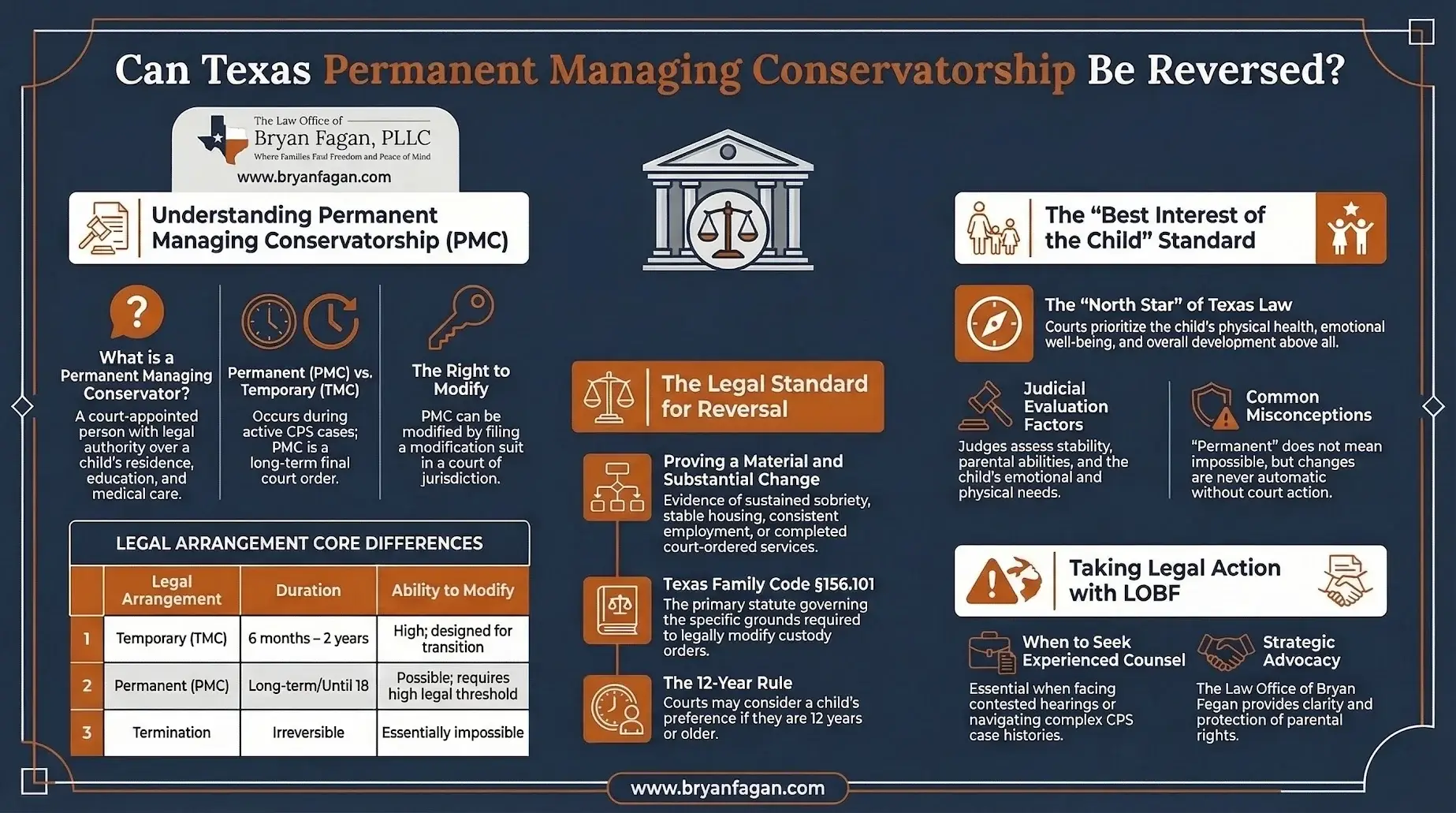
Understanding the differences between these legal arrangements is essential before pursuing modification. The following comparison table clarifies the key distinctions:
| Factor | Temporary Managing Conservatorship (TMC) | Permanent Managing Conservatorship (PMC) | Termination of Parental Rights |
|---|---|---|---|
| Duration | Temporary; typically 6 months to 2 years during active CPS proceedings | Long-term or permanent; remains in effect until modified by court order | Permanent and irreversible |
| Parental Rights Retained | Significant rights retained; parent remains legal parent with restricted authority | Depends on whether termination was included; if not, parental relationship continues with limited authority | None; parent has no legal relationship to the child |
| Ability to Modify | High; designed to transition to reunification, adoption, or PMC | Possible but difficult; requires material and substantial change | Essentially impossible after appellate deadlines pass |
| Legal Standard | Best interest of child; permanency planning goals established | Texas Family Code §156.101 (material and substantial change) plus best interest | Clear and convincing evidence at termination trial; no modification standard exists post-termination |

The Legal Standard to Reverse or Modify PMC
To modify a permanent managing conservatorship order, a parent must meet the requirements established in Texas Family Code Chapter 156, specifically §156.101. The legal standard requires demonstrating:
1. Material and Substantial Change in Circumstances
The circumstances affecting the child, the parent, or the managing conservator must have changed significantly since the court entered the original order. This change must be genuine, documented, and sustained—not temporary or superficial.
Examples of material and substantial change include:
- Completion of court-ordered services (substance abuse treatment, parenting classes, counseling)
- Demonstrated sobriety maintained over an extended period
- Stable housing in a safe, child-appropriate environment
- Consistent employment providing financial stability
- Resolution of safety concerns that prompted the original custody arrangement
2. Best Interest of the Child
Even when a parent demonstrates changed circumstances, the court applies the best interest standard under Texas Family Code §153.002. The judge considers factors such as:
- The child’s emotional and physical needs
- Current stability and attachment to the managing conservator
- Each party’s ability to provide a stable environment
- The child’s safety and well-being
- Any history of family violence or substance abuse
Burden of Proof
The parent seeking modification carries the entire burden. Courts do not assume improvement—they require documented evidence. A parent asserting change without verification will likely fail.
How CPS Cases Affect Permanent Managing Conservatorship
When Child Protective Services is involved, the path to and from permanent managing conservatorship follows specific procedures outlined in Texas Family Code Chapters 262 and 263.
Permanency Planning
During a CPS case, courts order the Texas Department of Family and Protective Services (DFPS) to develop a permanency plan with specific goals. The four primary permanency goals are:
- Family reunification
- Adoption
- Permanent managing conservatorship to a relative or suitable individual
- Another planned permanent living arrangement (APPLA)
When family reunification is no longer the primary goal and PMC becomes the permanency plan, the court has essentially determined that returning the child to the parent is not in the child’s best interest at that time.
Service Plan Compliance
DFPS files a service plan within 45 days of being named temporary managing conservator. This plan typically requires parents to complete substance abuse treatment, parenting classes, counseling, and maintain stable housing and employment.
For parents seeking future modification, documented compliance with the service plan is powerful evidence. Conversely, non-compliance or partial completion significantly weakens any modification request.
DFPS Dismissal
Once a court names someone other than DFPS as permanent managing conservator, the judge dismisses DFPS from the case. This means the parent loses case management services and support—but it also means DFPS is no longer monitoring or reporting. Future modification proceedings occur between the parent and the managing conservator, without ongoing CPS involvement.
What Evidence Courts Consider in a Modification Request
Texas district courts require more than good intentions when a parent seeks to modify a conservatorship order. If you are asking, can Texas permanent managing conservatorship be reversed, the answer will depend heavily on the quality and credibility of your evidence. Under Texas Family Code §156.101, a court may modify a conservatorship order if the parent proves a material and substantial change in circumstances and demonstrates that the requested modification serves the child’s best interest under §153.002. Courts look for objective, verifiable proof—not self-reported improvement or short-term progress.
Judges expect to see documentation that reflects long-term stability. Evidence of housing and employment consistency may include a current lease or mortgage statement, utility bills showing continuous residence, employment verification letters, recent pay stubs covering several months, and tax returns demonstrating sustained financial responsibility. Because Texas law also places strong emphasis on financial support under Chapter 154—including the updated child support guideline cap in §154.125—showing reliable income and compliance with support obligations strengthens credibility.
Completion of court-ordered services is equally important, particularly in cases that originated through CPS involvement. Certificates from substance abuse treatment programs, parenting classes, counseling participation letters, and documentation of support group attendance show follow-through. Courts also weigh sobriety and mental health documentation carefully. Sustained negative drug tests, letters from counselors, proof of medication compliance when applicable, and psychological evaluations can demonstrate meaningful change over time rather than temporary improvement.
Parenting involvement remains a central focus of the best-interest analysis. Visitation records, evidence of consistent communication, photographs reflecting healthy interaction, and testimony from individuals who have observed the parent-child relationship can all help the court understand the depth and quality of the bond. In addition, judges consider the child’s current well-being. Medical records, documentation of emotional stability, and information about how a parent plans to address any special needs are often part of a well-prepared modification case.
The legal team at The Law Office of Bryan Fagan frequently reminds clients that modification is not about rewriting history—it is about presenting a well-documented story of sustained change. This principle also applies in related contexts, such as adoption matters, where courts are especially cautious about disrupting established parent-child relationships. Our discussion of these issues in the legal risks of adoption reversal in a Texas divorce case explains why Texas courts prioritize permanence and stability. Parents exploring modification options may also benefit from reviewing our Texas Child Custody Resource Center, which provides practical guidance on conservatorship rights and enforcement procedures.
Ultimately, courts evaluate the totality of the evidence. The question is not simply whether a parent has improved, but whether the requested change promotes lasting stability for the child. With thorough preparation and experienced legal guidance, families can approach the modification process with clarity, confidence, and a strategy grounded firmly in the Texas Family Code.

How Long Does It Take to Reverse PMC?
Parents who are asking, can Texas permanent managing conservatorship be reversed, should be prepared for a process measured in months—not weeks. Modification cases are governed by Texas Family Code Chapter 156, and while the law provides a pathway for change, it also requires patience, documentation, and careful adherence to procedural rules. Under §156.101, a court may modify a conservatorship order only if a material and substantial change in circumstances is proven and the requested modification serves the child’s best interest under §153.002. Those standards shape not only the evidence required, but also the timeline of the case.
When a managing conservator agrees to modification, the process can move more efficiently. In uncontested cases, resolution may occur within approximately four to eight months from filing through final court approval, depending on the county and court docket. However, contested modifications—where the managing conservator objects—often take significantly longer. These cases frequently require formal discovery, potential expert evaluations, mediation, and ultimately a full evidentiary hearing before a judge. It is not unusual for contested matters to take twelve to twenty-four months or more, particularly in busier Texas district courts.
The procedural steps themselves contribute to the timeline. A parent must file a proper petition to modify under Chapter 156, ensure valid service on the opposing party, and comply with any applicable affidavit requirements under §156.102 if the modification is sought within one year of the prior order. In contested cases, the discovery phase can extend several months as both sides exchange documentation and prepare witnesses. Court scheduling varies widely across Texas counties, and congested dockets can add additional delay. If a party appeals the court’s ruling, that appellate process may extend the timeline by another six to twelve months.
The legal team at The Law Office of Bryan Fagan emphasizes that preparation before filing often determines how smoothly the case proceeds. Filing prematurely—without sustained evidence of stability, compliance with Chapter 154 child support obligations, and thorough documentation—can waste valuable time and resources. For parents navigating broader post-divorce concerns, our guide on the divorce process in Texas provides helpful context on how final orders are structured and why post-judgment modifications require a different legal strategy. You may also find practical insight in our Texas Child Custody Resource Center, which outlines conservatorship rights and modification procedures in greater detail.
Ultimately, the timeline for modification reflects the seriousness of the decision. Texas courts are tasked with protecting children’s stability, and that responsibility requires careful review. With thoughtful preparation and experienced legal guidance, families can approach the process strategically—ensuring that when the case is presented, it is supported by credible evidence and aligned with the child’s best interest.
Common Myths About Reversing Permanent Managing Conservatorship
Myth: “It can never be reversed.”
Reality: Permanent managing conservatorship can be modified under Texas Family Code Chapter 156. The standards are strict, but modification is legally possible when circumstances genuinely change and the child’s best interest supports it.
Myth: “Once CPS is involved, you permanently lose custody.”
Reality: CPS involvement does not automatically mean permanent loss. Many parents successfully complete their service plans and regain custody during the CPS case itself. Even after PMC is established, modification remains possible.
Myth: “Completing services guarantees reversal.”
Reality: Service completion is necessary but not sufficient. Courts balance completion against other factors, including the child’s current stability and attachment to the managing conservator. Some parents complete every requirement yet do not regain custody because modification would not serve the child’s best interest.
Myth: “The child automatically chooses where to live.”
Reality: While courts may consider a child’s preference (especially for older children), the child’s stated wishes are not determinative. Courts apply the comprehensive best interest analysis, which considers many factors beyond preference.
When Modification May Not Be Possible
Honest assessment is essential before investing time and resources in a modification petition. Modification may not be achievable when:
Parental Rights Were Terminated
If the court terminated the parent-child relationship (TPPR), modification through Chapter 156 is not available. Termination permanently severs legal rights. The only potential challenge is through direct appeal within strict appellate deadlines (typically 30 days). If those deadlines have passed, the termination is final.
Insufficient Evidence of Change
Parents who cannot document sustained change—stable housing, employment, service completion, sobriety—face extremely difficult odds. Courts require evidence, not promises.
Continuing Safety Concerns
If the circumstances that prompted the original custody arrangement persist—ongoing substance abuse, untreated mental health issues, domestic violence, child safety concerns—courts will not modify.
Strong Bond Between Child and Managing Conservator
When a child has lived with the managing conservator for many years, has bonded deeply, and regards them as their parent, courts are reluctant to disrupt this stability. The child’s emotional well-being weighs heavily in the best interest analysis.
How a Texas Family Law Attorney Helps With PMC Modification
When parents begin asking, can Texas permanent managing conservatorship be reversed, the answer often depends less on emotion and more on preparation. Under Texas Family Code §156.101, a court may modify a conservatorship order only if the parent proves a material and substantial change in circumstances and demonstrates that the requested modification is in the child’s best interest under §153.002. Those standards are not flexible. Texas courts expect detailed evidence, procedural precision, and a clear plan showing how the proposed change improves the child’s stability and long-term well-being.
An experienced Texas family law attorney plays a critical role in evaluating whether those legal thresholds are realistically met before filing. Filing too early—without sustained documentation of stability—can result in wasted resources or even strengthen the other party’s position. Careful case assessment includes reviewing prior court orders, examining compliance with Chapter 154 child support obligations (including the updated child support guideline cap under §154.125), and determining whether the facts truly satisfy the statutory definition of “material and substantial change.” This early evaluation often prevents unnecessary litigation and positions families for stronger outcomes when the timing is right.
Preparation is equally important. Courts require comprehensive documentation: stable housing records, consistent employment verification, service completion certificates, visitation histories, and evidence of the child’s emotional and physical stability. Under Chapter 153, judges are charged with protecting the child’s best interest, and they look closely at patterns over time. A well-prepared petition must also comply with Texas procedural rules, including proper filing, service, and, when applicable, affidavit requirements under §156.102 if the modification is sought within one year of a prior order.
In contested hearings, skilled advocacy becomes essential. Judges evaluate credibility, consistency, and whether the proposed modification strengthens the child’s environment. The legal team at The Law Office of Bryan Fagan understands that these cases are not just technical—they involve families seeking restoration after difficult chapters. We approach each modification with both strategic precision and compassionate communication, ensuring that parental rights are protected while keeping the child’s stability at the center of every argument.
Texas courts place a strong emphasis on permanence, particularly in cases involving adoption or termination of parental rights. For families navigating related concerns, our discussion of the impact of adoption reversal on children and families in Texas explains why courts are cautious about disrupting established family structures. Parents may also benefit from reviewing our Texas Child Custody Resource Center for practical guidance on conservatorship rights and modification procedures.
Ultimately, whether a conservatorship order can be modified often comes down to preparation and presentation. Texas law provides a pathway for change, but it demands evidence, timing, and thoughtful strategy. With experienced legal guidance and a clear understanding of the Family Code, parents can move forward with confidence, knowing they are taking deliberate steps to protect both their rights and their child’s future.

Why Choose The Law Office of Bryan Fagan, PLLC
When families begin asking, can Texas permanent managing conservatorship be reversed, they deserve clear answers grounded in the Texas Family Code—not guesswork or false hope. Modification cases are governed primarily by Chapter 156, particularly §156.101, which requires proof of a material and substantial change in circumstances along with a showing that modification serves the child’s best interest under §153.002. These are demanding legal standards, and courts expect persuasive, well-organized evidence that demonstrates long-term stability. That is where experienced legal guidance makes a meaningful difference.
The attorneys at The Law Office of Bryan Fagan bring focused experience to conservatorship modification cases throughout Texas. Our team maintains deep knowledge of Chapters 153 and 156 of the Texas Family Code, including the procedural safeguards and evidentiary requirements that can determine whether a case moves forward or stalls. We regularly handle CPS-related matters, contested conservatorship disputes, and post-judgment modifications across Texas district courts. Because child support obligations often intersect with conservatorship issues, we also remain current on legislative updates, including recent changes to §154.125 adjusting the guideline cap on net monthly resources, ensuring that financial considerations are addressed accurately and strategically.
Preparation and courtroom advocacy are critical. Texas judges evaluate credibility, patterns of conduct, and whether the proposed change strengthens the child’s stability. Our legal team focuses on presenting comprehensive documentation, complying with statutory requirements such as affidavit provisions under §156.102 when applicable, and protecting parental rights at every stage of the process. We understand that these cases are rarely just legal disputes—they are deeply personal transitions that affect children, extended families, and long-term relationships. That is why our approach combines strategic litigation with compassionate client communication, helping families move forward with clarity rather than confusion.
Parents sometimes confuse conservatorship with guardianship, particularly when relatives are involved. While guardianship proceedings are typically handled in probate court, conservatorship matters arise under the Texas Family Code. For families weighing those differences, we explain key distinctions in our resource on permanent guardianship in Texas. You may also find additional guidance in our Texas Child Custody Resource Center, which outlines conservatorship rights, enforcement procedures, and modification strategies in straightforward language.
Every case is different, and no attorney can promise a particular outcome. What our firm can promise is thorough preparation, honest assessment, and dedicated advocacy grounded in the most current provisions of the Texas Family Code. When families turn to The Law Office of Bryan Fagan, they gain a team committed to educating parents, protecting futures, and ensuring that every legal step taken is deliberate, strategic, and focused on the child’s best interest.
Checklist: Can Texas Permanent Managing Conservatorship Be Reversed
Use this checklist to evaluate your situation before pursuing modification:
- [ ] Review your court order carefully – Determine whether parental rights were terminated or only restricted
- [ ] Document changes in circumstances – Gather evidence of housing, employment, service completion, and sobriety
- [ ] Complete all prior service requirements – Ensure any court-ordered services are fully completed with documentation
- [ ] Maintain stable housing and employment – Demonstrate sustained stability, not temporary improvement
- [ ] Gather supporting evidence – Collect third-party verification from therapists, employers, and service providers
- [ ] Consider the child’s current situation – Honestly assess the child’s bond with the managing conservator
- [ ] Consult a Texas family law attorney – Get professional evaluation before filing
Conclusion
Life rarely moves in straight lines. Families change. People grow. Circumstances that once felt overwhelming can become chapters of strength and resilience. If you’ve been asking whether permanent managing conservatorship can be reversed, that question likely comes from a place of hope—a belief that the stability you’ve worked hard to build deserves to be recognized. Texas law does allow for change in the right circumstances, but it requires preparation, clarity, and a strategy grounded in your child’s best interest.
The most important takeaway is this: courts are not looking for perfection. They are looking for consistency, safety, and genuine progress. If your life today looks different than it did when the original order was entered, that matters. But how you present that change—and whether it meets the legal standards under the Texas Family Code—can make all the difference.
You do not have to navigate that process alone. Working with an experienced Texas Family Law Attorney can help you understand whether the timing is right, whether the evidence is strong enough, and what steps will put you in the best position moving forward. At The Law Office of Bryan Fagan, PLLC, our role is not just to file paperwork. It is to educate you, guide you, and help protect what matters most—your family’s future.
If you’re unsure about your next step, start with a conversation. Ask questions. Get clarity. Sometimes peace of mind begins not with a courtroom, but with understanding your options. And if you’re ready to explore those options, our team is here to walk that path with you—steadily, strategically, and with your child’s best interest at the center of every decision.
Frequently Asked Questions
Permanent managing conservatorship (PMC) is a court-ordered custody arrangement where one person is given primary legal rights and duties for a child, often including the exclusive right to determine the child’s primary residence and make major decisions. PMC is “permanent” in the sense that it is not temporary like an active CPS placement, but it can still be modified in the right circumstances if Texas legal requirements are met.
If CPS (through DFPS) is named temporary managing conservator, the court has authorized the state to make key decisions for the child during an active CPS case. This typically happens when the court believes there are safety concerns that must be addressed before the child can safely return home. Parents often still have rights, but they may be restricted, and the court will closely track compliance with court orders and service plans.
The biggest mistake is focusing on “beating” the other parent instead of proving you can create stability for your child. Texas judges notice patterns. Ignoring court orders, refusing reasonable co-parenting communication, dragging children into adult conflict, or trying to “win” through aggression can harm your credibility. The parents who do best are the ones who stay calm, document responsibly, and consistently put the child’s needs first.
A sole managing conservator typically has exclusive rights to make major decisions for the child. Depending on the wording of the court order, that can include the exclusive right to designate the child’s primary residence, consent to medical and psychological treatment, make educational decisions, and manage other significant legal rights. The other parent is often a possessory conservator and may have visitation and certain limited rights, but not the same decision-making authority.
The phrase “3 year rule” can mean different things depending on who is using it and what issue they’re talking about. People sometimes use it informally when discussing how long a pattern must exist to show stability or instability, but Texas family law doesn’t have one single “three-year rule” that applies to all custody cases. If someone told you the “3 year rule” affects your situation, it’s worth asking a Texas family law attorney to identify the exact statute or rule they mean.
People often refer to three broad guardianship categories: guardian of the person (personal care and day-to-day decisions), guardian of the estate (finances and property), and guardian of the person and estate (both). In Texas, guardianship is generally handled in probate court and is different from conservatorship in family court, so it’s important not to assume the rules are interchangeable.
In many Texas civil and family law matters, a temporary restraining order (TRO) is short-term and commonly lasts up to 14 days unless extended by the court. It is often followed by a temporary orders hearing, where the judge can put longer-lasting temporary orders in place while the case proceeds. Deadlines can move quickly, so it’s important to confirm the dates and next hearing settings right away.
The “6 month rule” is commonly mentioned in custody discussions because a child’s living pattern over six months can matter for certain jurisdiction questions and stability arguments. The exact legal impact depends on the issue—such as where the case should be filed, whether a child has established a home state, or whether a living arrangement has become established. If this is being used in your case, the best approach is to connect it to the specific legal question at hand rather than relying on a general rule of thumb.
Courts often view a home as unstable when there are repeated patterns of unpredictability or safety concerns, such as frequent moves, unsafe living conditions, untreated substance abuse or mental health issues, domestic violence, lack of reliable supervision, or ongoing conflict that spills into the child’s day-to-day life. Judges tend to focus on consistent patterns over time, not one isolated mistake, and they look for a home environment that is safe, steady, and supportive.