
When you believe your child isn't safe, your mind goes straight to the worst possibilities. You may be dealing with threats, chaotic behavior, unexplained injuries, drug use around the child, or a parent who has started talking about leaving with the child and not coming back. In that moment, it helps to know that Texas law does have a fast legal response for true emergencies.
An emergency custody order in Texas is a short-term court intervention meant to protect a child when waiting for the usual court timeline could expose that child to immediate harm. The process moves quickly, but it still follows rules. Judges want facts, not fear alone. They want details, not conclusions. And they want a legal request that matches the level of danger you're facing.
If you're in that position, there is a path forward. It starts with understanding what counts as an emergency, which legal tool fits your situation, and what proof a Texas judge is most likely to act on.
Realizing Your Child Is in Danger
Your child calls after bedtime and whispers that they do not want to go back. A teacher mentions repeated unexplained absences. A police officer leaves a voicemail about a disturbance at the other parent's home. That is usually how these cases begin. Not with a clean set of legal facts, but with scattered warning signs that suddenly add up.
In that moment, the first job is not to argue the whole custody case. The first job is to protect your child and start documenting what is happening. Texas courts can act fast when the risk is immediate, but judges do not issue emergency orders based on fear alone. They look for specific facts, a clear timeline, and evidence that waiting for a regular hearing could put the child in danger.
That practical distinction matters early. Some parents hear "emergency custody" and assume every urgent problem fits the same remedy. It does not. A true emergency request, such as a temporary restraining order, is different from a temporary injunction or standard temporary orders. The right tool depends on how immediate the threat is and what protection the child needs right now.
Start with safety.
If there is active violence, intoxicated driving with the child, a credible threat to disappear with the child, or an injury that needs treatment, call law enforcement or seek medical care first. Court orders help, but they do not replace emergency responders in the middle of a dangerous event.
Then preserve proof while the facts are fresh. Save texts, call logs, photos, voicemails, school messages, medical discharge papers, and names of witnesses. Write down dates, times, and exactly what was said or seen. Small details often make the difference between a judge seeing a family dispute and seeing immediate risk.
Temporary planning matters too. If the child cannot safely stay where they are, choose short-term care carefully. That includes vetting childcare professionals if childcare becomes part of the solution.
What to do in the first few hours
- Get the child safe: Use police, medical care, or a safe adult if the danger is current.
- Record facts, not conclusions: Write "I saw bruising on the child's upper arm at 7:15 p.m." instead of "the other parent is abusive."
- Preserve electronic evidence: Screenshot messages and back them up so they are not lost or deleted.
- Avoid escalation: Do not send angry messages or make threats that can distract from the child's safety.
- Prepare for a fast legal decision: Gather the documents and names your lawyer will need if emergency relief is appropriate.
A calm, fact-driven response gives the court something it can act on. That is often the difference between feeling trapped and getting protection in place quickly.
What Constitutes a True Emergency in Texas Family Law
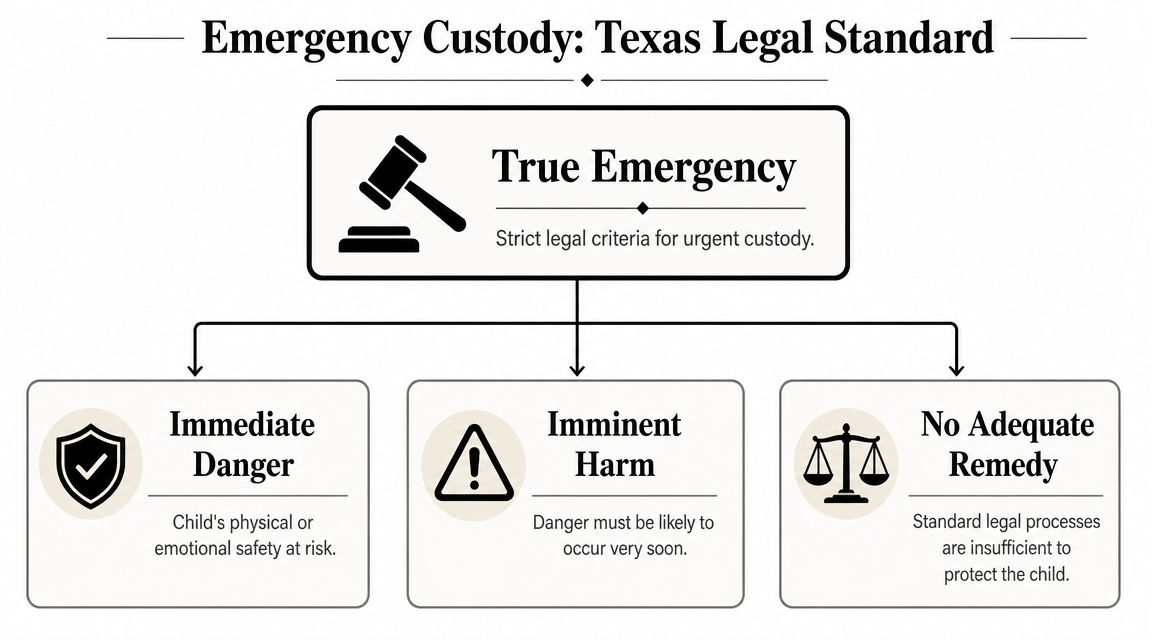
Not every custody problem is an emergency in the legal sense. Some situations are serious but still belong in a regular temporary orders hearing. Texas sets a high bar for emergency relief.
Texas-focused guidance based on the Family Code explains that emergency relief is typically reserved for cases with detailed sworn facts showing immediate danger, serious risk of physical or emotional harm, or threats that a child may be removed from Texas. The same guidance notes that some relatives may also have standing to seek emergency custody, but they still need specific facts, not general accusations or family conflict, as explained in this Texas emergency custody discussion.
Situations that may qualify
A Texas judge is more likely to treat the matter as a true emergency when the facts show immediate risk, such as:
- Credible abuse or neglect: A child reports violence, injuries appear, or the living conditions are plainly unsafe.
- Family violence in the child's environment: The issue isn't just arguing. It's conduct that places the child in danger.
- Substance abuse tied to actual risk: A parent's use is affecting supervision, driving, or the safety of the home.
- Threatened removal of the child: A parent says they are leaving Texas with the child or has taken concrete steps suggesting flight.
Situations that often do not qualify
Some facts can support a custody case without meeting the emergency threshold:
| Situation | Why judges may not treat it as an emergency |
|---|---|
| Parenting style disagreements | The court sees conflict, not immediate danger |
| A parent being rude, unreliable, or late | Frustrating, but not necessarily urgent harm |
| General claims of emotional damage without specifics | Judges need detailed facts tied to immediate risk |
| Old incidents with no current danger | Emergency relief focuses on present threat |
Courts don't grant emergency orders because one parent is difficult. They grant them when waiting could put a child at risk.
If you want a useful comparison outside Texas, this practical guide for Florida families is helpful for seeing how another state also separates routine custody disputes from immediate danger cases. The legal standards differ, but the urgency analysis is similar.
Understanding Your Legal Options for Urgent Protection
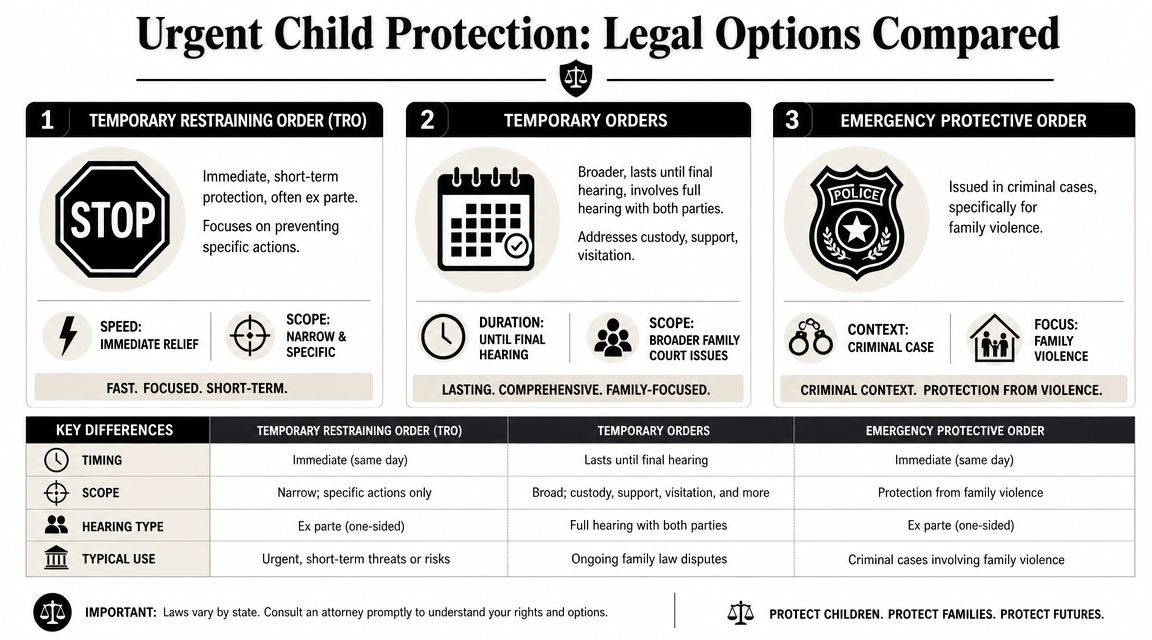
One of the most common mistakes in a crisis is asking for the wrong thing. In Texas, a TRO, a temporary injunction, and temporary orders are related tools, but they are not interchangeable.
Texas legal aid materials make that distinction directly. They explain that a Temporary Restraining Order is for urgent, immediate harm, while standard temporary orders are the normal way to establish custody and support rules while the main case is pending. They also distinguish TROs, temporary injunctions, and temporary orders as separate mechanisms with different purposes and thresholds, as outlined by Texas Law Help on child custody emergencies.
How these tools differ
Temporary Restraining Order
A TRO is the fastest option for a true emergency. It is designed to stop immediate harm. In the custody context, that may include urgent restrictions while the court gets to a fuller hearing.
This is often the right tool when you need the court to act first and hear the full dispute very soon afterward.
Temporary injunction
A temporary injunction usually comes after the court has had a chance to consider the matter more fully than it would with an immediate TRO request. It can continue restraints or protections during the pending case.
Think of it as a bridge. The TRO addresses the first urgent moment. The injunction may carry protections forward if the evidence supports it.
Standard temporary orders
Temporary orders are broader. They are the normal vehicle for deciding who has temporary conservatorship, possession schedules, child support, and day-to-day rules while the case is ongoing.
They matter in nearly every family law case, but they are not a substitute for emergency relief when a child faces immediate danger tonight, not weeks from now.
A simple decision guide
- Use a TRO when: the risk is immediate and waiting for ordinary notice could expose the child to harm.
- Use temporary orders when: the child needs structure and protection during the case, but the facts don't require instant ex parte relief.
- Consider whether a protective order is also needed when: family violence is part of the situation and safety concerns extend beyond conservatorship.
The right filing tells the judge you understand the level of urgency. The wrong filing can slow you down when time matters most.
Gathering Compelling Evidence for the Court
Emergency cases are won or lost on specificity. A judge is being asked to intervene quickly in a parent-child relationship. That is a serious step, and the evidence has to justify it.
The strongest emergency filings usually tell a clear story in chronological order. What happened, when did it happen, who saw it, how do you know, and why would waiting put the child at risk? That is very different from saying, “The other parent is unstable” or “I'm afraid something bad could happen.”
What evidence usually carries weight
Judges tend to focus on evidence that is concrete, dated, and easy to connect to immediate danger:
- Threatening communications: Texts, emails, or voicemails that show threats, intoxication, admissions, or plans to take the child.
- Photos and videos: Images of injuries, damaged property, drug paraphernalia, unsafe living conditions, or conditions the child was exposed to.
- Official records: Police reports, CPS documents, medical records, school incident reports, or emergency room paperwork.
- Third-party witnesses: Teachers, relatives, neighbors, counselors, or childcare workers who can testify to specific events.
If much of your evidence is digital, this discussion of social media and text messaging in family law evidence is useful because it shows how online conduct and messages can affect what the court sees.
Your affidavit matters more than most people realize
A sworn affidavit is often the backbone of an emergency request. It should read like a timeline, not a rant.
A weak affidavit says:
- He is dangerous.
- She neglects our child.
- I know my child isn't safe.
A stronger affidavit says:
- Date and time: On Tuesday at 8:15 p.m., my child called me crying.
- Specific event: She said the other parent had been drinking and had passed out.
- What you observed: When I arrived, I saw broken glass on the kitchen floor and no adult supervising the child.
- Corroboration: Officer Smith responded, and the incident number is attached.
What doesn't work well
The court is often skeptical of broad accusations with no detail. These are common weak points:
- General attacks on character: “He's a narcissist” or “She lies constantly.”
- Old complaints with no current urgency: History matters, but emergency relief focuses on immediate risk.
- Screenshots without context: A judge needs to know who sent them, when, and how they relate to danger now.
- Rumor: “Someone told me” is rarely enough unless the witness can back it up directly.
A judge doesn't need the longest affidavit. The judge needs the clearest one.
The Step-by-Step Filing and Service Process
Once the facts are organized, the legal process moves fast. That speed is helpful, but it also means mistakes can cost valuable time.
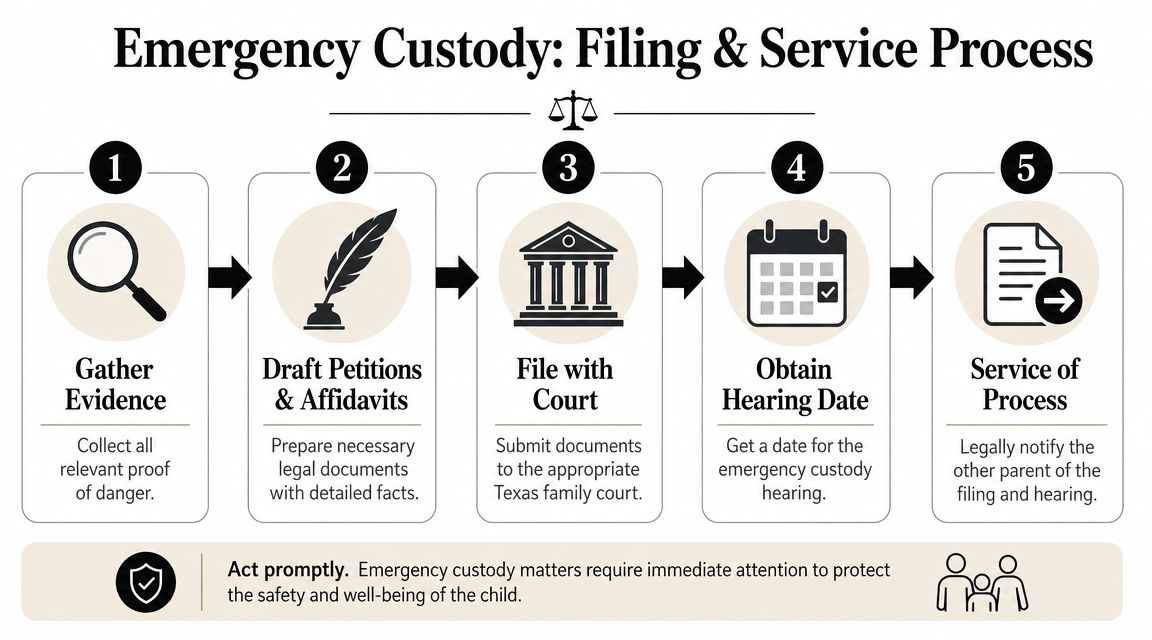
Texas emergency custody orders are typically limited to about 14 days, and a full hearing with both parties generally must occur within that same period, according to this overview of Texas emergency custody timing. That two-step process lets the court address immediate safety concerns first and then quickly review the matter with both sides present.
What usually gets filed
In many cases, the emergency request is part of a Suit Affecting the Parent-Child Relationship, often called a SAPCR. If you're unfamiliar with the underlying case structure, this overview of the SAPCR form in Texas can help you understand where the emergency request fits.
A typical emergency filing package may include:
- The initial custody petition: This opens the underlying case.
- The application for emergency relief: This asks for immediate court action.
- A sworn affidavit: This gives the judge the facts supporting the request.
- A proposed order: This shows the court the exact protections you want entered.
How the process usually unfolds
Filing with the clerk
Your paperwork is filed with the appropriate court. In urgent situations, counsel often works to get the request before a judge quickly for review.
Initial judicial review
The judge looks at the filing and supporting facts. If the request meets the emergency standard, the court may enter short-term relief designed to stabilize the situation until the follow-up hearing.
Service on the other parent
Even when the court acts quickly at the start, the other parent usually must be formally served with the lawsuit, the signed order if one is entered, and notice of the upcoming hearing. Service is technical. If it isn't done properly, your hearing can become more complicated than it needs to be.
Setting the hearing
This is the due process checkpoint. The court will hear from both sides, review evidence, and decide whether to extend, modify, or dismiss the emergency relief.
What to do while waiting for the hearing
- Follow the order exactly: Don't improvise or retaliate.
- Keep documenting events: New incidents may matter at the next hearing.
- Prepare witnesses and exhibits: The follow-up hearing often carries more weight than the initial emergency review.
By the time you reach the hearing, the case usually feels very personal. The court treats it as a focused safety decision. The judge wants clear proof, a realistic plan for the child, and an order that can be followed.

This hearing also helps sort out which legal tool is in play. A true emergency order, often entered through a TRO, is meant to stop immediate harm for a short period. A temporary injunction can continue restraints after notice and hearing. Standard temporary orders deal with the child's day-to-day structure during the case, such as possession, decision-making, support, and exchange terms. Parents often group all of that together as an "emergency custody order," but judges do not. That distinction affects what evidence matters and how high the proof must be.
What the judge is deciding
At this stage, the judge is usually not choosing a final custody outcome. The court is deciding what must happen now to protect the child until the case can be developed further.
That means the hearing usually turns on practical questions:
- Is there a present, specific risk to the child
- What evidence makes that risk credible
- What order would reduce the danger right away
- Can the child remain in contact with the other parent safely, and under what limits
- What arrangement is stable enough to hold until the next phase of the case
The strongest presentations stay tied to current danger. A judge may care very much about a parent's past bad conduct, but old grievances carry less weight unless they connect to a present risk.
How evidence plays out in the courtroom
Many emergency cases are won or lost based on the evidence presented by the parent. The parent asking for relief must usually do more than say, "I'm scared." Fear may be completely genuine and still fall short legally if the proof is vague.
Useful evidence tends to be specific and easy to verify: dated messages, medical records, photographs, police reports, school records, testimony from a witness with firsthand knowledge, or a short timeline that matches the exhibits. If there was a recent incident, be ready to explain exactly when it happened, who saw it, what the child experienced, and why waiting would put the child at risk.
I often tell clients to answer like this: date, event, effect on the child, and what protection is needed. That format helps the judge trust what you are saying.
How to testify effectively
A calm witness is easier to believe.
That does not mean you need to sound unemotional. It means you should stay disciplined. Answer the question asked. Use names, dates, and places. If you do not know an answer, say so. If you learned something from someone else, make that clear instead of presenting it as firsthand knowledge.
Judges notice exaggeration fast. They also notice parents who can explain a hard situation without turning the hearing into a running account of every problem in the relationship. The goal is not to prove the other parent is a bad person in every respect. The goal is to show why this child needs this protection now.
For a broader factual discussion of emergency custody requests and ex parte relief in Texas family law, the Law Office of Bryan Fagan, PLLC has published a video on the topic.
After you've read through the legal issues, this short video can also help you picture the process:
What the judge may do at the end of the hearing
The result may be narrower than a parent hoped, but still protective. The court might keep one parent in temporary primary possession, order supervised visitation, restrict travel, set exchange rules, bar certain communications or conduct, require drug testing, or put other short-term restraints in place. In some cases, the court dissolves the emergency relief and shifts the case into ordinary temporary orders because the evidence shows concern, but not immediate danger.
That outcome matters. If the other parent later violates what the judge ordered, a Texas motion to enforce family court orders may become part of the next step.
After the Order Enforcement and Next Steps
Once the hearing ends, many parents assume the hardest part is over. Usually, it isn't. Emergency relief solves the immediate safety problem. It does not finish the custody case.
If the judge grants emergency relief, the next issue is compliance. The order only works if everyone follows it. If the other parent ignores possession restrictions, refuses to return the child, violates a restraint, or disobeys another term, you may need an enforcement response. This overview of a Texas motion to enforce shows how courts address violations of family court orders.
If the order is granted
Your focus should shift from crisis response to disciplined follow-through.
- Keep a copy of the signed order available: Schools, caregivers, and law enforcement may need it.
- Document every violation carefully: Record dates, times, missed exchanges, and communications.
- Stay within the order yourself: Judges expect the parent seeking protection to respect the court's limits too.
If the order is denied
A denial doesn't always mean the judge thinks your concerns are false. Sometimes it means the court believes the facts don't meet the emergency standard, or the proof wasn't specific enough for immediate ex parte-style relief.
That may still leave room for:
- Regular temporary orders
- A more developed evidentiary hearing
- Additional filings if new events occur
- A protective order if family violence is part of the situation
Emergency relief is one tool. It is not the whole custody case, and it is not the only path to protecting your child.
The long case that follows the short emergency
Most emergency custody disputes continue as a SAPCR or as part of a divorce involving children. That longer case may address conservatorship, possession, support, geographic restrictions, and decision-making rights on a more lasting basis.
Strategy matters. A parent who handled the emergency well can still hurt the larger case by becoming reactive, violating temporary rules, coaching the child, or failing to prepare for the next hearing. The strongest position is usually built by doing the basics consistently: follow the order, keep good records, protect the child, and present facts cleanly.
If you need help navigating divorce, custody, or estate planning in Texas, contact Law Office of Bryan Fagan, PLLC today for a free consultation. If you're facing an emergency custody situation, our team can help you evaluate whether you need immediate relief, prepare the right evidence, and build a plan for both the urgent hearing and the larger case ahead.