
If you're a father staring at divorce papers, a custody petition, or a situation where you're worried about losing time with your child, the fear is usually immediate. Many dads assume Texas courts still lean toward mothers. That fear is understandable, but it isn't how Texas law is written.
The better question isn't whether fathers have rights. They do. The key question is how a father shows the court that the arrangement he wants serves his child well. If you understand that shift early, you can make smarter decisions from the start.
The Foundation of a Father's Rights in Texas
Texas law starts from a gender-neutral position. If you are a father and you have established paternity, the law treats your rights and responsibilities the same as the mother's in a custody case. Texas Family Code § 153.003 also bars courts from favoring one parent over the other based on gender, as explained in this discussion of Texas fathers' rights in custody cases.

Why Texas says conservatorship instead of custody
One point confuses fathers right away. Texas usually doesn't use the word custody in statutes and court orders. It uses the word conservatorship.
Conservatorship refers to the legal rights and duties a parent has regarding a child. That includes authority over major decisions and, in some situations, the right to determine where the child primarily lives. Texas also separately addresses possession and access, which means the parenting schedule and each parent's time with the child.
A simple way to think about it is this:
| Term | What it means in plain language |
|---|---|
| Conservatorship | Who makes important decisions and what legal rights each parent has |
| Possession and access | When the child is with each parent |
| Child support | How financial support is handled |
The standard that controls every case
The court's focus is not whether a parent is the mother or father. The court asks what is in the best interest of the child.
That standard shapes everything. It affects who gets decision-making authority, where the child lives, how holidays are divided, and whether a custom schedule makes sense. Texas law generally presumes that naming both parents as joint managing conservators is in the child's best interest unless the evidence shows otherwise.
Practical rule: A father usually doesn't win by arguing, "I'm the dad, so I deserve equal rights." He moves his case forward by showing how his proposed order supports the child's routine, health, education, and stability.
What this means for you right now
If you're asking what rights do fathers have in Texas custody, the answer begins here. A father can ask for:
- Decision-making rights about education, medical care, and other major issues
- Possession and access through a court-ordered parenting schedule
- Primary conservatorship if the facts support it
- Joint managing conservatorship as a common starting point under Texas law
That foundation matters because it changes your approach. You're not asking the court for a favor. You're preparing to prove, with facts, that your continued involvement benefits your child.
Establishing Paternity for Unmarried Fathers
For an unmarried father, legal rights don't become practical rights until paternity is established. This is the step many men underestimate. They may have raised the child, signed school papers, or had their name placed on the birth certificate, yet still discover they need formal legal recognition before the court can fully address conservatorship, possession, and support.
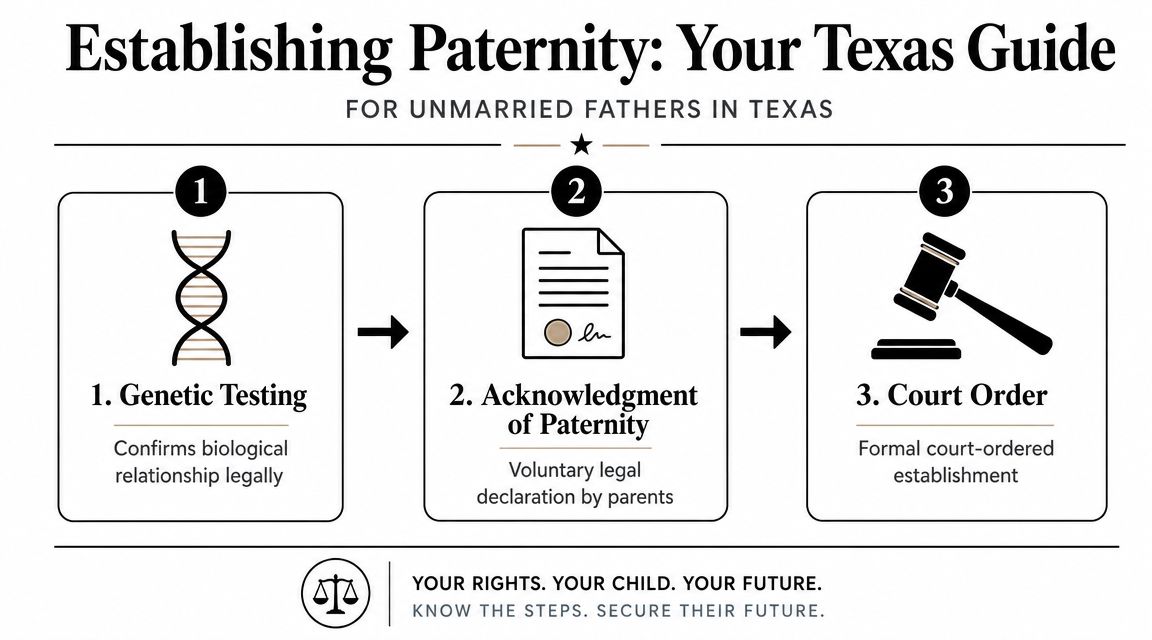
Two common paths to legal fatherhood
Texas fathers usually establish paternity in one of two ways.
First, there is a voluntary path. If both parents agree on the father's identity, they can sign an Acknowledgment of Paternity, often called an AOP. This is a legal document. Once properly completed and filed, it gives the father legal standing that can support later court orders involving conservatorship, possession, and child support.
Second, there is a court path. If paternity is disputed, uncertain, or if one parent won't cooperate, a paternity case may need to be filed. In that setting, the court can resolve the issue and may use genetic testing if needed.
A fuller discussion of these issues appears in our article on child custody laws in Texas for unmarried parents.
A short example of where fathers get stuck
Take a father who has cared for his child every weekend since birth. He pays for clothes, attends doctor visits, and the child knows him as Dad. Then the parents separate, communication falls apart, and he suddenly can't see the child.
He may assume that prior involvement alone guarantees court-enforceable rights. It doesn't. If paternity hasn't been properly established, he may first need to handle that threshold issue before the court can enter orders that protect his relationship with the child.
This video gives a useful overview of paternity and custody issues fathers often face in Texas:
What to do if you're unmarried
If you're not married to the child's mother, think in terms of sequence.
- Confirm your legal status. Don't assume informal involvement equals legal fatherhood.
- Gather documents early. Keep any paperwork that may relate to paternity, past caregiving, and communications with the mother.
- Use the cooperative route if possible. If both parents agree, an AOP can simplify the path.
- File when cooperation breaks down. If there's disagreement, delay usually makes the problem harder.
The court can't protect rights that haven't been legally attached to you yet.
Why timing matters
Waiting creates practical problems. The longer a father stays outside the legal framework, the easier it becomes for the other parent to argue that an existing routine should continue without him having a larger role. That doesn't mean an unmarried father loses his chance. It means early action usually puts him in a stronger position.
If you're asking what rights do fathers have in Texas custody and you weren't married when your child was born, start with paternity. Everything else rests on that.
Understanding Conservatorship and Decision-Making Authority
Once legal parentage is established, the case usually turns to conservatorship. In this phase, the court defines who has authority to make important choices for the child and how that authority is shared.

Joint managing conservatorship and sole managing conservatorship
Many fathers hear joint managing conservatorship and assume it means everything is split evenly. Not always. Joint managing conservatorship usually means both parents share a legal role in raising the child, but one parent may still have certain exclusive rights.
By contrast, sole managing conservatorship places the major legal authority with one parent. Courts typically reserve that arrangement for cases where shared decision-making would not protect the child's welfare.
If you'd like a deeper look at long-term conservatorship authority, this guide on permanent managing conservatorship in Texas can help.
What rights a father may ask the court to define
Think of conservatorship like a map of parental authority. The order can assign rights in different ways. Some rights may be exercised independently. Others may require agreement. Some may belong exclusively to one parent.
Common areas include:
- Education decisions such as school-related involvement and important academic issues
- Medical decision-making involving treatment, providers, and health information
- Psychological care if counseling or similar support becomes necessary
- Religious upbringing when parents want the order to address that area
- Residence decisions involving which parent determines the child's primary home
The role of the primary conservator
A father can be named the parent with the right to determine the child's primary residence. That's often what people informally mean when they say one parent "has custody."
Courts don't decide that role based on labels. They look at the child's life in practical terms. Who gets the child to school on time. Who knows the teachers. Who handles medical appointments. Who provides routine and calm decision-making. Who supports the child's relationship with the other parent.
A judge is usually looking less at promises and more at patterns.
A useful way to think about your case
If joint conservatorship is like co-owning a business for your child's benefit, then the court wants to know whether both owners can responsibly manage it. If one parent is more organized, more available, and better able to keep the child's life steady, that evidence matters. If both parents are capable, a shared arrangement may make sense, with one parent still handling the residence decision.
A father helps himself when he can show specific, day-to-day involvement such as:
| Evidence | Why it matters |
|---|---|
| School communications | Shows consistent educational involvement |
| Medical records or appointment history | Shows attention to health needs |
| Calendars and parenting logs | Shows actual caregiving, not just claims |
| Messages with the other parent | Shows cooperation or interference |
What fathers often overlook
Many dads focus only on time. Time matters, but authority matters too. A father may want the right to receive information from doctors and schools, consent to certain care, or participate in major decisions even if the child doesn't live with him most of the time.
That is why a careful conservatorship order matters. It doesn't just say who loves the child. It spells out who can act, when, and with what authority.
Possession Orders and Your Time with Your Child
For most fathers, the hardest part of a custody case isn't legal vocabulary. It's the fear of becoming a visitor in their child's life. Texas addresses parenting time through possession orders, and understanding them can make the process feel much less uncertain.
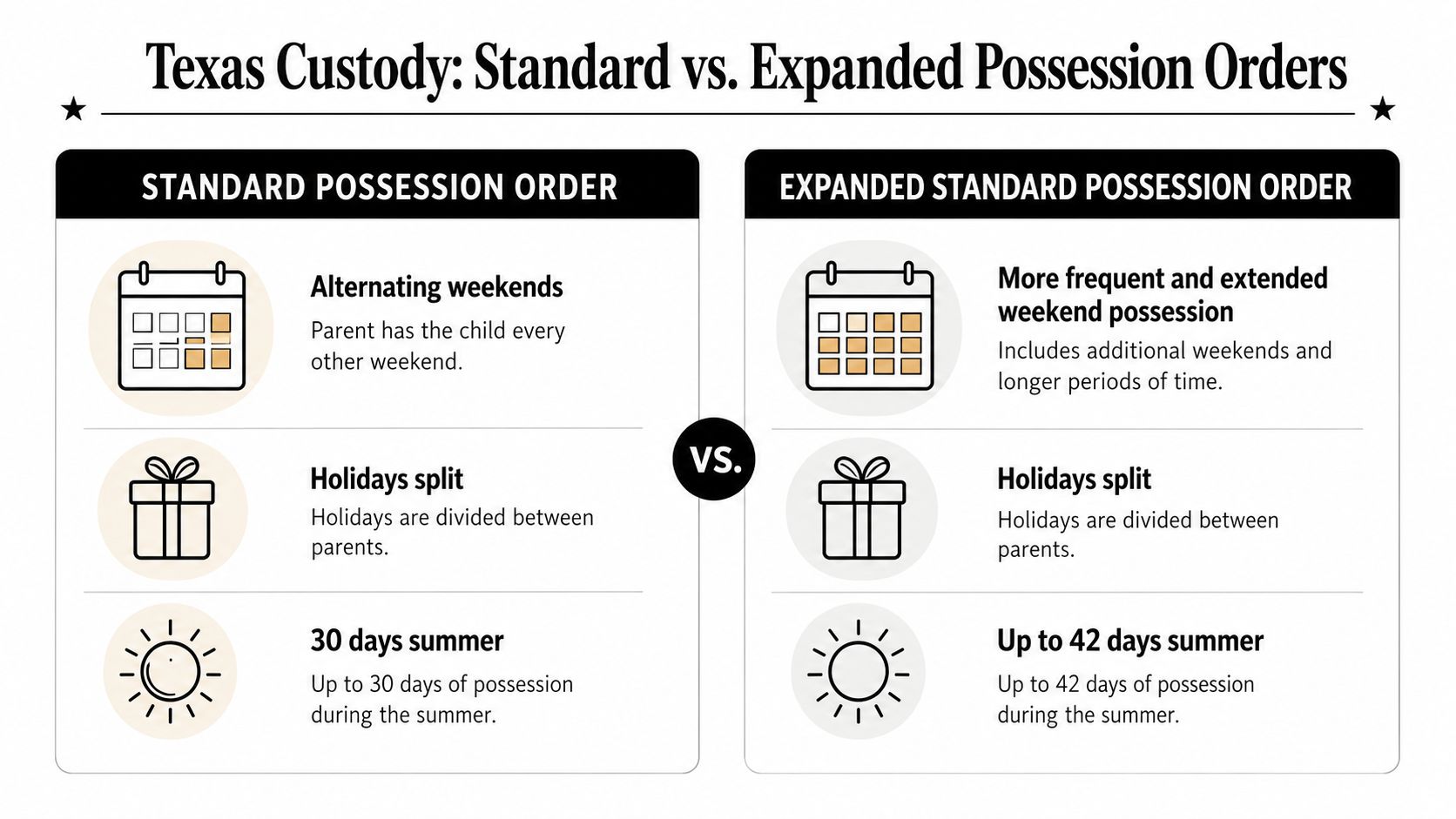
The standard possession order
A Standard Possession Order, often called an SPO, is the framework many Texas courts use as a starting point. In everyday terms, it often includes first, third, and fifth weekends, a regular weekday period during the school term, holiday divisions, and summer possession. Parents who live relatively close to each other are the most likely to see this structure used.
An expanded version may allow longer periods around weekends and can better fit school schedules and work routines. Our overview of Texas standard visitation rights explains how these possession schedules work in practice.
Why equal legal standing doesn't always mean equal time
A father's legal status and his actual parenting time aren't always the same thing. One Texas-focused summary reports that fathers receive about 33% of parenting time in Texas, compared with a 35% nationwide average, according to this review of Texas divorce and custody statistics.
That point matters because it shows a common misunderstanding. Texas law gives fathers equal legal standing, but many real-world outcomes still fall short of a 50/50 division of time. The order depends on the evidence, the history of caregiving, the logistics between households, and what arrangement serves the child best.
When a father can ask for more than the default
A standard order isn't the only option. Courts can approve custom schedules when the facts support them.
A father may ask for an expanded schedule or a more balanced division of time if he can show that the proposed routine works for the child. That often means presenting evidence about school transportation, distance between homes, work flexibility, homework supervision, and the child's existing routine.
Here are examples of facts that can help:
- Stable weekday availability if you can handle school mornings, pickups, homework, and bedtime
- Close geographic distance when both parents live near the child's school and activities
- A reliable record of involvement such as attendance at medical appointments, parent-teacher meetings, and extracurricular events
- A child-centered communication style that shows you can coordinate with the other parent without constant conflict
Important: "I want 50/50" is a preference. "I can get our child to school every morning, live nearby, and have followed the routine for months" is evidence.
A simple comparison
| Possession approach | How courts often view it |
|---|---|
| Standard schedule | A familiar baseline when parents need structure |
| Expanded standard schedule | A good fit when added time supports consistency |
| Custom schedule | Appropriate when the family's real routine doesn't fit the default model |
What fathers should do before temporary orders
Temporary orders often shape the direction of the final case. If you wait until late in the process to become more involved, the court may see the earlier routine as the child's normal pattern.
Before the first major hearing, focus on conduct that can be shown clearly:
- Be on time every time. Missed exchanges weaken credibility fast.
- Attend the ordinary events. School meetings and doctor visits often matter more than dramatic courtroom statements.
- Keep a calm paper trail. Short, respectful written communication can become valuable evidence.
- Propose a workable schedule. Courts respond better to a practical plan than to vague demands.
Some fathers also choose to work with a family law attorney early to build a record, draft proposed schedules, and prepare for mediation or hearings. That can include firms such as Law Office of Bryan Fagan, PLLC, which handles Texas custody and visitation matters.
Child Support Obligations for Texas Fathers
Child support is one of the most emotional parts of any custody case, especially when a father already feels he's fighting to stay closely involved. It helps to view support for what it is. A legal method of assigning financial responsibility for a child's needs.
Texas courts treat child support and possession as separate issues. That means a parent usually can't stop paying support because parenting time problems exist, and a parent generally doesn't gain extra rights just because support is being paid.
How support is usually approached
In many cases, support is tied to the broader conservatorship and possession structure. If one parent has the right to determine the child's primary residence, the other parent may be ordered to pay support. The court can also address health insurance and related medical support obligations as part of the same case.
Fathers often ask whether paying support means they have less authority as a parent. It doesn't. Financial support and decision-making authority are different parts of the order.
Questions fathers ask most often
A few issues come up again and again.
- Can I still owe support if I have significant time with my child? Yes, that can happen. Parenting time alone doesn't automatically answer the support question.
- Does support buy visitation rights? No. Possession rights come from the court order, not from the payment itself.
- What if I cover expenses directly? Informal spending on clothes, activities, or school items may help your child, but it doesn't replace a court-ordered obligation unless the order specifically says so.
Paying support doesn't reduce your role as a father. Failing to understand the order can.
What helps a father protect himself
The practical side matters here.
| Step | Why it helps |
|---|---|
| Read the order carefully | You need to know what is required and when |
| Keep payment records | Proof prevents later disputes |
| Track insurance details | Medical support issues often create confusion |
| Request changes through court | Informal side deals can cause serious problems |
If your circumstances change, the safer path is to ask whether a modification is appropriate rather than making unilateral decisions. The same is true if the other parent claims you owe something different from what the order states. The written order controls until the court changes it.
Some custody disputes don't fit a standard pattern. A father may be in the military, facing a proposed relocation, or blindsided by allegations that threaten both his reputation and his parenting time. In each situation, the guiding principle stays the same. The court focuses on the child's stability, health, and welfare, not the parent's gender.
As noted in this discussion of Texas child custody laws for fathers, a father can request joint managing conservatorship or a customized possession schedule, but he must back that request with evidence showing why it better serves the child.
Military service and parenting orders
A military father may worry that service obligations will be mistaken for lack of commitment. Courts know military life brings irregular schedules, temporary assignments, and deployment concerns. What matters is whether the father plans ahead and presents a realistic parenting proposal.
For example, a service member with an upcoming transfer should gather duty information early, think through transportation logistics, and propose communication methods that preserve the parent-child relationship when in-person time becomes harder. Judges respond better to specific planning than to broad assurances that things will work out.
Relocation disputes and geographic limits
A common problem starts when one parent wants to move with the child. Sometimes the existing order contains a geographic restriction. Sometimes it doesn't, but the move still changes the child's school, support system, and access to the other parent.
A father in that situation should focus on facts, not anger.
- Show the child's current routine. School, friends, medical providers, and family support all matter.
- Document your current involvement. The court needs to see what would be lost if distance grows.
- Offer an alternative if needed. Judges often appreciate a practical solution more than a flat objection.
Responding to false allegations
False allegations of abuse or neglect can throw a case into crisis quickly. Fathers often make one of two mistakes. They either panic and send reactive messages, or they assume the truth will speak for itself.
A calmer approach works better.
- Follow every temporary restriction immediately. Even if the accusation is false, violating an interim order creates a new problem.
- Preserve communications and records. Keep texts, emails, call logs, and witness information.
- Avoid direct confrontation. Heated exchanges can be used against you.
- Build your response with evidence. School records, medical records, neutral witnesses, and documented parenting history often matter more than emotional denials.
When allegations surface, the father who stays organized usually puts himself in the strongest position to protect his relationship with his child.
Enforcing and Modifying Your Custody Order
A signed order is not the end of the parenting case. It is the rulebook both parents must follow. If the other parent ignores it, or if life changes enough that the order no longer fits, Texas law provides a path forward.
Enforcement when the other parent violates the order
If your possession time is denied, exchanges are repeatedly disrupted, or decision-making provisions are ignored, you may need an enforcement action. The court generally expects you to rely on the written order and prove specific violations.
That means details matter. Save messages. Keep a calendar. Note missed exchanges, denied phone contact, or other repeated problems. A father usually helps his case by staying polite in writing and resisting arguments that create distractions from the actual violation.
Modification when circumstances change
Sometimes the order isn't being broken. It has become outdated. A new job, a school change, a major move, or a shift in the child's needs may justify asking the court to modify conservatorship, possession, or support.
The key is not inconvenience alone. The court looks for a meaningful change in circumstances and a revised arrangement that still serves the child well. Fathers often do best when they can show both the change itself and a workable new plan.
If you need help navigating divorce, custody, or estate planning in Texas, contact Law Office of Bryan Fagan, PLLC today for a free consultation. A focused legal strategy can help you protect your parental rights, present the right evidence, and pursue a court order that supports your relationship with your child.