

What did I do wrong?” That was the first question a Houston mother asked after finding a CPS investigator’s business card taped to her front door. She hadn’t been arrested. Her children were safe inside. Yet within seconds, her mind raced through every worst-case scenario imaginable. Could they come into her home? Could they take her children? Could one anonymous report turn her entire life upside down? Understanding What CPS Can and Cannot Do in Texas becomes critically important the moment that uncertainty enters a family’s life because knowing your rights often determines what happens next.
For many parents, a CPS investigation doesn’t happen in isolation. It often arrives during an already stressful divorce, custody dispute, or family transition. Emotions run high, communication breaks down, and children can find themselves caught in the middle. When legal uncertainty combines with family instability, even routine decisions can feel overwhelming.
At The Law Office of Bryan Fagan, PLLC, we understand that families facing CPS involvement are looking for more than legal information. They are looking for clarity, reassurance, and a path forward. Founded by Bryan Joseph Fagan, a South Texas College of Law graduate and recognized authority on Texas divorce and custody law, our firm has helped thousands of Texas families navigate difficult circumstances while protecting their relationships, their rights, and their future.
Texas law places clear limits on CPS authority. While Child Protective Services has the power to investigate allegations of abuse or neglect, interview children, and seek court intervention when necessary, investigators must operate within boundaries established by the Texas Family Code and the United States Constitution. Understanding those boundaries can help parents make informed decisions instead of reacting out of fear.
At the same time, Texas courts focus heavily on stability when making decisions involving children. Under Texas Family Code §153.002, judges must make custody decisions based on the best interest of the child. That analysis often includes evaluating whether a child’s home environment, daily routines, emotional well-being, and educational experience remain consistent during periods of family change.
Knowledge creates confidence. When parents understand what CPS can and cannot do, how investigations affect custody disputes, and how courts evaluate a child’s need for stability, they are better positioned to protect what matters most. In this guide, you’ll learn where CPS authority begins and ends, what rights Texas parents have during an investigation, how CPS involvement can impact custody cases and children’s well-being, and the practical steps families can take to move forward with greater clarity, confidence, and peace of mind.
The Short Answer
In Texas, CPS can investigate reports of abuse or neglect, interview your child, request entry to your home, and ask you to take a drug test. CPS cannot force entry without your consent or a court order, cannot remove your child without a court order except in a genuine emergency, and cannot compel you to answer questions. You have the right to say no and to have an attorney.
Key Takeaways
- CPS needs your consent or a court order to enter your home. An investigator at your door has no automatic right to come inside. Absent an emergency, they need permission or a judge’s order.
- A child cannot be removed without a court order — except in a true emergency. Under Texas Family Code §262, emergency removal requires immediate danger, and a court must review it within days.
- You are not required to take a drug test on request. CPS can ask; without a court order you can decline. There can be case consequences either way, which is exactly why this is a decision to make with counsel, not on your porch.
- You have the right to remain silent and to record the interaction. Anything you say to an investigator can appear in an affidavit. Texas is a one-party consent state for recording.
- The investigation runs on a statutory clock. CPS generally must complete an investigation within 30 days, and an emergency removal triggers a full adversary hearing within 14 days.
- A safety plan is voluntary — even when it isn’t presented that way. Investigators often ask a parent to move out or send a child to a relative “voluntarily.” You can negotiate or decline these terms.
- Hiring an attorney is not an admission of guilt. It signals that the case will be handled by the rules, which changes how an investigator builds the file.

Your Family’s Future Starts Here
Don’t navigate your legal journey alone. Schedule a consultation now and get the clarity and support you deserve.
What CPS Is Legally Allowed to Do in Texas
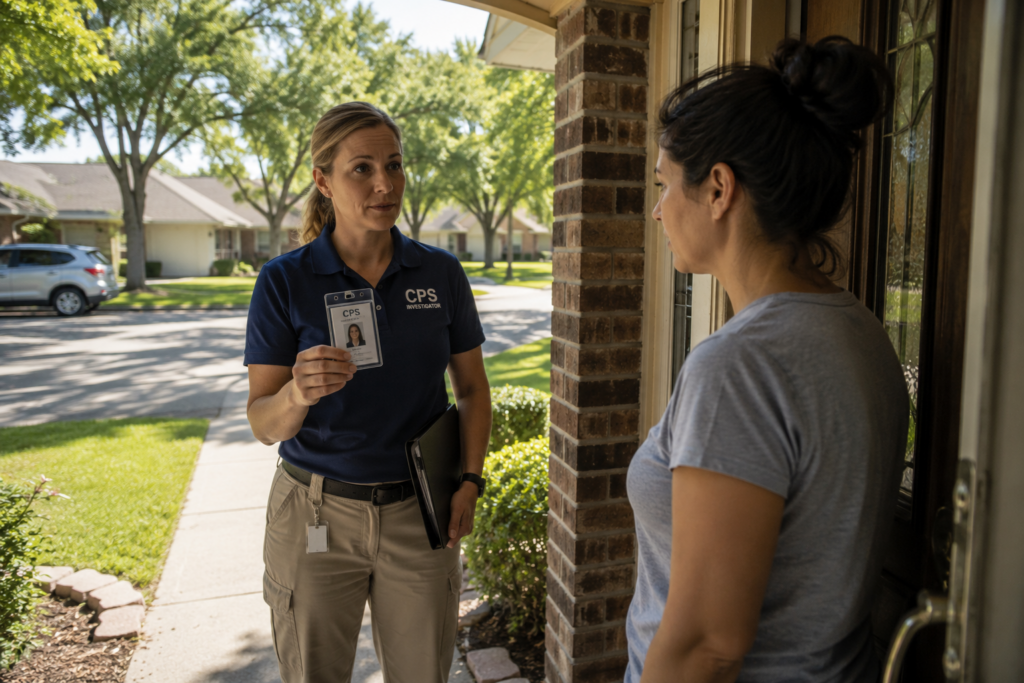
Understanding What CPS Can and Cannot Do in Texas starts with recognizing that Child Protective Services has the authority to investigate reports of abuse or neglect under Texas Family Code Chapter 261. CPS investigators can interview children and household members, request access to the home, gather records, ask for drug testing, and collect evidence related to the allegations. Once a report is received, the agency’s responsibility is to assess child safety and determine whether additional action is necessary.
What many parents do not realize is that a CPS investigation is ultimately about building a record. Every interview, observation, document, and statement becomes part of a case file that may later affect custody decisions, safety plans, or court proceedings. While CPS can gather information, significant actions involving parental rights often require evidence, judicial review, and compliance with Texas Family Code Chapters 262 and 263.
In straightforward situations, an investigation may end after basic fact-gathering and interviews. In more complex cases involving contested allegations, custody disputes, substance abuse concerns, or potential removal, early decisions can have lasting consequences. Understanding your rights, knowing when cooperation is appropriate, and recognizing when strategic legal guidance becomes important can make a meaningful difference in protecting your family and your future. Parents facing questions about child custody in Texas or CPS-related concerns can benefit from learning how family courts evaluate safety, stability, and the best interests of the child under Texas Family Code §153.002. For families also planning for long-term financial security, resources like this guide to a Humble retirement planning lawyer can help address broader family protection goals alongside legal concerns.
Treat every contact as on the record. Be polite, confirm the investigator’s name and badge, and ask what specific allegation was reported. You are allowed to ask. The answer tells you what the case is actually about — which is often far narrower than the fear in your head.
What CPS Cannot Do in Texas
Understanding What CPS Can and Cannot Do in Texas is just as important as understanding the agency’s investigative powers. While CPS has authority under Texas Family Code Chapters 261 and 262 to investigate allegations of abuse or neglect, investigators must still respect constitutional protections and follow strict legal procedures. CPS cannot force its way into your home without your consent, a court order, or a genuine emergency involving immediate danger to a child. Likewise, CPS generally cannot remove a child without judicial authorization unless emergency circumstances exist that justify immediate action.
One of the most common misconceptions is that parents must comply with every request simply because it comes from an investigator. In reality, CPS cannot compel you to answer questions, cannot require a drug test without legal authority, and cannot bypass the court process when significant parental rights are at stake. Knowing these limits is not about creating conflict—it’s about ensuring that the safeguards built into Texas law are respected. Courts are responsible for evaluating evidence, credibility, and child safety concerns, not investigators acting alone.
In straightforward situations, understanding your rights may be enough to help you navigate a routine investigation. In more complex cases, particularly where allegations are disputed, a safety plan is proposed, or CPS involvement overlaps with a custody dispute, strategic legal guidance can become increasingly important. Texas courts evaluating child custody in Texas matters under Texas Family Code §§153.002 and 153.134 often consider not only the allegations themselves but also how each parent responds to the investigation and protects the child’s stability.
CPS also cannot retaliate against a parent for asserting their rights, requesting legal counsel, or asking questions about the process. The agency cannot keep a case open indefinitely without reaching a disposition, and investigators cannot misrepresent their authority to obtain compliance. When emergency removal is being considered, or when findings could affect future family court proceedings, the decisions made early in the process often have lasting consequences. Families facing high-conflict custody issues, CPS allegations, or significant financial concerns may benefit from understanding how these matters intersect with broader family law issues, including those addressed by a Humble high-net-worth divorce lawyer.
The bottom line is simple: CPS has important responsibilities, but it also has legal limits. Understanding where those boundaries exist helps parents make informed decisions, protect their parental rights in Texas, and approach the investigation process with greater clarity, confidence, and peace of mind.
Consenting to entry “just to show you have nothing to hide” is the most common unforced error I see. Once you invite an investigator in, everything they observe — a messy kitchen, a prescription bottle, a roommate — becomes part of the file. Declining entry is not evidence of guilt, and a court cannot treat it that way.
Can CPS Enter Your Home Without Permission?
One of the most common questions parents ask when learning What CPS Can and Cannot Do in Texas is whether an investigator can simply walk into their home. In most situations, the answer is no. CPS cannot enter your home without your consent, a valid court order, or a genuine emergency involving an immediate threat to a child’s safety. While Texas Family Code Chapter 261 gives CPS the authority to investigate allegations of abuse or neglect, that authority does not eliminate a parent’s constitutional right to privacy within their home.
A CPS investigator may knock on your door, ask questions, and request permission to come inside. They may also observe anything that is visible from where they are legally standing. However, if you decline entry, CPS generally must seek judicial authorization before entering the home. If removal is being considered under Texas Family Code Chapter 262, a judge—not the investigator—ultimately evaluates whether the facts support further action. This legal safeguard exists to balance child protection concerns with the parental rights protected under Texas law.
In straightforward situations, parents often choose to cooperate while still maintaining appropriate boundaries. For example, speaking with an investigator outside the home may allow communication to continue without giving unrestricted access to the residence. In more complex cases, particularly where allegations are disputed, safety plans are being discussed, or CPS involvement overlaps with a custody dispute, understanding the legal implications of consent becomes increasingly important. Small decisions made during the first contact can affect the direction of the investigation and the evidence available later.
One common mistake is assuming that declining entry automatically makes a parent appear uncooperative. Courts typically focus on evidence, credibility, and child safety—not whether a parent immediately granted access to their home. When reviewing Texas CPS investigations, judges often look at the totality of the circumstances, including the parent’s willingness to address concerns and protect the child’s best interests under Texas Family Code §153.002.
If removal is being considered, or if the investigation has moved beyond routine fact-gathering into a contested matter, obtaining accurate legal guidance early can be especially valuable. Families seeking to better understand their parental rights in Texas and the legal process surrounding CPS involvement may also find helpful information from a Humble CPS defense lawyer resource. Knowing where CPS authority ends and where your legal protections begin can help you make informed decisions, protect your family, and move through the process with greater confidence.
You can cooperate without consenting to entry. “I’m happy to talk with you out here, but I’m not able to let you inside today” is a complete, lawful answer. It keeps the conversation going while protecting the one space the law guards most closely.
The parents who keep their families intact aren’t the ones with nothing to hide. They’re the ones who made CPS follow every rule in the book.
Can CPS Interview My Child Without Me?

Yes. One of the more surprising aspects of What CPS Can and Cannot Do in Texas is that CPS generally has the authority to interview a child without a parent’s consent and without the parent being present. Under Texas Family Code Chapter 261, investigators are permitted to speak with children as part of an abuse or neglect investigation, including interviews conducted at school, daycare, or other locations where the child is present.
The purpose behind these interviews is to allow children to speak openly about their experiences without feeling pressure from adults around them. As a result, schools often cooperate with Texas CPS investigations by allowing investigators access to students during the school day. While parents typically cannot prevent the interview from occurring, they can document when the interview took place, ask questions about the process, and stay informed about the overall investigation.
In straightforward situations, a child’s interview may be one of several routine steps used to gather information before a case is closed. In more complex cases, especially where allegations are disputed, custody issues are involved, or conflicting accounts exist, what a child says can become an important piece of evidence. Judges reviewing CPS matters under Texas Family Code §§153.002 and 153.134 often consider the totality of the evidence, including statements from children, parents, teachers, medical professionals, and other witnesses when evaluating safety, credibility, and the child’s best interests.
One common mistake parents make is attempting to prepare a child for the interview by discussing what they should say. While it is appropriate to encourage a child to be calm, honest, and respectful, coaching specific answers can create additional concerns and may affect how CPS views the investigation. Where allegations are contested or when CPS involvement overlaps with a custody dispute, seemingly small decisions can have significant consequences later in family court proceedings.
If removal is being considered, if a child’s statements become a central issue in the case, or if the investigation is progressing toward court involvement under Texas Family Code Chapters 262 or 263, strategic legal guidance often becomes increasingly important. Understanding your parental rights in Texas, the role of child interviews, and how evidence is evaluated can help families make informed decisions throughout the process. Families dealing with related family law issues may also find value in learning about topics such as enforcing a delinquent Texas child support order, as many family law matters intersect and affect a child’s long-term stability and well-being.
Can CPS Make You Take a Drug Test in Texas?
CPS can ask you to take a drug test in Texas, but cannot force you to without a court order. A request is not a requirement, and “cps drug testing law texas” is one of the most misunderstood corners of the whole process.
If you refuse, CPS can ask a court to order testing, and a judge may draw inferences from a refusal. If you consent and pass, you remove an issue from the case. If you consent and fail, that result is now in the file. None of those paths is automatically right — it depends on your specific circumstances, your history, and what the allegation is, which is exactly the analysis a Legal Strategy Session is built to do.
| 24–72 hrsTypical window for CPS to make first contact after a report | 30 daysGeneral deadline to complete an investigation (§261) | 14 daysDeadline for an adversary hearing after emergency removal (§262) |
When Can CPS Remove a Child in Texas?
CPS cannot remove your child in Texas without a court order, except in an emergency where the child faces immediate danger. Emergency removal without a prior order is the exception, not the rule, and it triggers fast judicial review.
Under Texas Family Code §262 (2025), when CPS removes a child in an emergency, the agency must file suit and a court must hold a full adversary hearing within 14 days to decide whether the child stays in care. At that hearing you have the right to an attorney, to present evidence, and to cross-examine. Most non-emergency removals require CPS to first obtain a court order based on a sworn affidavit.
This is the highest-stakes moment of any case, and it is where having counsel already engaged changes outcomes. The 14-day hearing arrives fast, and parents who walk in unrepresented are at a structural disadvantage against an agency attorney who does this daily.
If your child is removed, the adversary hearing is within 14 days — and it sets the trajectory of the entire case. Do not wait to “see how it goes.” By the hearing, CPS has already built its affidavit. You need yours.
How Long Does a CPS Investigation Take?
A CPS investigation in Texas generally must be completed within 30 days, though extensions happen and removal cases continue well beyond that on a separate court track. The clock is real, and it works in your favor.
By the end of the investigation, CPS assigns a disposition. “Ruled out” means no abuse or neglect occurred. “Unable to determine” means insufficient evidence. “Reason to believe” means CPS concluded abuse or neglect more likely than not occurred — and that finding can land you on the Central Registry. Knowing the deadline lets you push for closure rather than letting a case drift.
What CPS Can and Cannot Do: The Core Breakdown
| Category | What Texas Law Says | Practical Impact |
|---|---|---|
| Enter your home | Requires consent or court order; emergency exception only (§261, §262) | You may decline entry and speak outside |
| Interview your child | Allowed without parental consent, including at school | You generally cannot block it; document it after |
| Drug test | May request; cannot compel without court order | Refusal can prompt a court order; decide with counsel |
| Remove your child | Requires court order except in genuine emergency (§262) | Emergency removal forces a hearing within 14 days |
| Compel answers | Cannot force you to answer questions | You may remain silent and request an attorney |
Free Rights Qualifier
Where Does Your CPS Situation Stand?
Urgent — Time-Sensitive
Your case is at its highest-stakes stage
A removal or removal threat triggers a court hearing within 14 days under Texas Family Code §262. This is the moment that sets the trajectory of everything that follows — and it moves fast. You should speak with an attorney today, not after the hearing is scheduled.
Most clients hear back within 5 minutes during business hours (8 AM–10 PM CT, 7 days a week)
Start overActive Case — No Counsel Yet
You have an open CPS matter and no attorney
An active investigation without counsel is where the most avoidable mistakes happen — consenting to entry, unprepared interviews, signing a safety plan you could have negotiated. Getting a clear read on your rights now, while the file is still being built, is what changes the outcome.
Most clients hear back within 5 minutes during business hours (8 AM–10 PM CT, 7 days a week)
Start overCounsel Already Engaged
You have a lawyer — here’s where a second read helps
You already have representation, which is the right move. If you want a second perspective on strategy, a specific question your current counsel hasn’t addressed, or you’re reconsidering fit, a Legal Strategy Session can give you clarity without disrupting your case.
Most clients hear back within 5 minutes during business hours (8 AM–10 PM CT, 7 days a week)
Start overNo Active Case
You’re informed and ahead of it
There’s no open case right now, which means the best thing you can do is know your rights cold before anything starts. Save the firm’s number, read the checklist below, and if a CPS contact ever happens, you’ll know exactly what to do in the first 48 hours.
Most clients hear back within 5 minutes during business hours (8 AM–10 PM CT, 7 days a week)
Start overYour answers point to one thing: get clear before you act
A Legal Strategy Session turns a frightening, vague situation into a concrete plan with deadlines and next steps.
Schedule a Legal Strategy SessionHow CPS Procedure Differs Across Texas Counties

CPS operates under one statewide statute, but procedure and court culture vary meaningfully by county. The law is the same in Harris and Montgomery; how fast a case moves and which judge hears it is not.
In Harris County, the volume of cases means investigators and courts move on tight schedules, and removal dockets are busy. Fort Bend and Galveston tend to run smaller dockets with more individualized attention. Montgomery and Brazoria counties each have their own local practices around safety plans and family-based safety services. Knowing the local landscape — which I do across all five — affects how a case is best approached from day one.
Reading Your Own Situation
| Your Status | The Question That Decides It | What It Means For You |
|---|---|---|
| Contacted, no entry yet | Have you consented to anything in writing or verbally? | You still hold most of your leverage — protect it |
| Investigation open | Do you know the allegation and disposition timeline? | Push for the 30-day disposition; don’t let it drift |
| Drug test / safety plan requested | Was it framed as mandatory? | Likely voluntary — negotiate terms with counsel |
| Child removed | Has the 14-day adversary hearing been set? | Highest stakes — engage counsel immediately |
Checklist: What to Do If You’re Dealing With CPS in Texas
- 1Stay calm and confirm who you’re dealing with. Get the investigator’s name, badge, and supervisor. Ask what specific allegation was reported.
- 2Do not consent to home entry on the spot. Step outside, close the door, and talk on the porch. You can cooperate without inviting them in.
- 3Say less, not more. Be polite but exercise your right to remain silent on substance until you’ve spoken with an attorney.
- 4Document everything. Write down dates, times, names, and what was said. Texas is one-party consent — you may record the interaction.
- 5Don’t agree to a drug test or safety plan without advice. Ask whether it’s mandatory. Most safety plans are voluntary and negotiable.
- 6Don’t coach your child. Encourage honesty and calm. Coaching can deepen a case far more than the original allegation.
- 7Call an attorney before your next CPS contact. The earlier counsel is involved, the more options you have.
- 8If your child is removed, treat the 14-day hearing as the priority. Engage counsel immediately — this hearing sets the case trajectory.
- 9Track the 30-day clock. Push for a disposition rather than letting the investigation drift open.
- 10Get the outcome in writing. Confirm the disposition and whether your name lands on any registry.
Want this checklist working for your specific case?
We’ll map these steps to your situation, your county, and your deadline in a single session.
Schedule a Legal Strategy SessionWhat I Tell Every Client Who Calls About What CPS Can and Cannot Do in Texas
Understanding What CPS Can and Cannot Do in Texas often makes the difference between responding from fear and responding from knowledge. A CPS contact can be stressful, especially when parents are unsure of their rights or what comes next. One of the most common mistakes families make is assuming they must immediately agree to every request without understanding the legal process. In reality, CPS has important investigative powers under Texas Family Code Chapters 261 and 262, but those powers are balanced by legal protections designed to safeguard parental rights in Texas.
The most important thing to remember is that CPS can investigate allegations, interview children, gather evidence, and request cooperation. However, there are limits to that authority. Investigators generally cannot enter your home without consent or a court order, cannot remove a child outside of legally defined emergency circumstances, and cannot bypass the judicial process when significant parental rights are involved. Knowing where those boundaries exist allows parents to make informed decisions rather than reacting to pressure or uncertainty.
In straightforward situations, an investigation may be resolved through communication, documentation, and cooperation. In more complex cases, particularly where allegations are disputed, safety plans are proposed, drug testing is requested, or CPS involvement overlaps with a custody dispute, strategic planning becomes increasingly important. If removal is being considered under Texas Family Code Chapter 262, or if the case progresses into court proceedings governed by Chapter 263, the decisions made during the early stages of the investigation can have lasting consequences for both parents and children.
Texas courts evaluating CPS matters and child custody in Texas cases focus heavily on evidence, credibility, parental decision-making, and the child’s best interests under Texas Family Code §§153.002 and 153.134. Waiting too long to understand your options can limit the choices available later. Whether the issue involves a routine CPS inquiry or a more serious court-involved matter, informed action is almost always more effective than hoping the situation resolves itself.
At The Law Office of Bryan Fagan, PLLC, our mission is to help families replace uncertainty with clarity. By understanding your rights, documenting important information, and learning how the CPS process works, you can make better decisions for your family and protect what matters most. Families navigating related family law challenges may also find value in learning more about topics such as navigating divorce in Texas, as many family law issues intersect and affect a family’s long-term stability and future.
Get clear on your rights before your next CPS contact
The first 48 hours shape the case. Make them count.
Schedule Your Legal Strategy SessionConclusion:
Understanding What CPS Can and Cannot Do in Texas is about more than knowing the law—it’s about protecting your family’s stability during a time when uncertainty can feel overwhelming. When parents understand their rights, the CPS process, and how Texas courts evaluate decisions affecting children, they are better equipped to make informed choices that support both their family’s immediate needs and their long-term future. Knowledge creates confidence, and confidence allows families to move forward with greater clarity and peace of mind.
In straightforward situations, a CPS inquiry may be resolved quickly with the right information and documentation. In more complex cases, especially those involving custody disputes, allegations of abuse or neglect, emergency removal proceedings, safety plans, substance abuse concerns, or ongoing court involvement, having experienced legal guidance can make a meaningful difference. If your case involves multiple legal issues, competing allegations, or questions about protecting your parental rights while maintaining stability for your child, it may be time to seek a deeper understanding of your options.
At The Law Office of Bryan Fagan, PLLC, we believe families deserve more than answers—they deserve a strategy built around their unique circumstances. Through education, compassionate guidance, and experienced advocacy, our team helps Texas parents navigate difficult transitions while protecting what matters most. Whether you are facing a routine CPS investigation or a more challenging family law matter, the right information and the right legal support can help you take the next step with confidence.
Questions My Clients Ask About What CPS Can and Cannot Do in Texas
No. In Texas, the identity of the person who made a CPS report is confidential by statute, and CPS will not tell you who reported you. The report can be made anonymously. What you can ask for is the nature of the allegation — what you’re accused of — which CPS will generally share so you can respond to it.
A CPS investigation in Texas generally must be completed within 30 days under Texas Family Code §261, though extensions occur for complex cases. If a child is removed, the case continues on a separate court track far beyond 30 days. At the end, CPS assigns a disposition of ruled out, unable to determine, or reason to believe.
No. CPS investigation records are confidential under Texas law and are not public record. They are not available for general lookup the way court filings are. A removal lawsuit filed in court creates a court record, but the underlying CPS investigation file stays confidential and is released only in limited circumstances.
CPS can ask you to take a drug test, but cannot force you without a court order. If you decline, CPS may petition a court to order testing, and a judge can consider a refusal. Whether to consent depends on your specific history and the allegation — it’s a decision to make with an attorney, not on the spot.
No. CPS cannot enter your home without your consent or a court order, except in a genuine emergency where a child faces immediate danger. You can decline entry and speak with the investigator outside. Declining is lawful and cannot be treated as proof of wrongdoing.
Yes. CPS can interview your child without your consent and without you present, including at school. The law allows this so children can speak freely about possible abuse. You generally cannot block it, but you can document the date and ask your child afterward what was discussed.
You have the right to remain silent and to decline to answer CPS questions. Refusing to talk is not itself proof of anything. CPS may continue investigating through other means and can seek a court order if they believe a child is in danger, which is why asserting your rights calmly and engaging counsel is the stronger move.
CPS is required to notify you of the outcome of an investigation, including the disposition assigned to your case. If you haven’t received written notice near the 30-day mark, you or your attorney can request a status update. Don’t assume a quiet phone means the case closed in your favor — confirm it in writing.
Generally no. CPS needs a court order to remove a child, except in a true emergency involving immediate danger. After an emergency removal, Texas Family Code §262 requires a full adversary hearing within 14 days where you can contest the removal with an attorney and present evidence.
No. Hiring an attorney is not an admission of anything and cannot be used against you as evidence of guilt. It signals that your case will be handled by the rules. In practice, it often makes the process cleaner because everyone follows correct procedure from that point forward.
Still have a question that isn’t answered here?
Every CPS situation has details that change the analysis. Bring yours to a Legal Strategy Session and get answers specific to your family.
Schedule a Legal Strategy Session