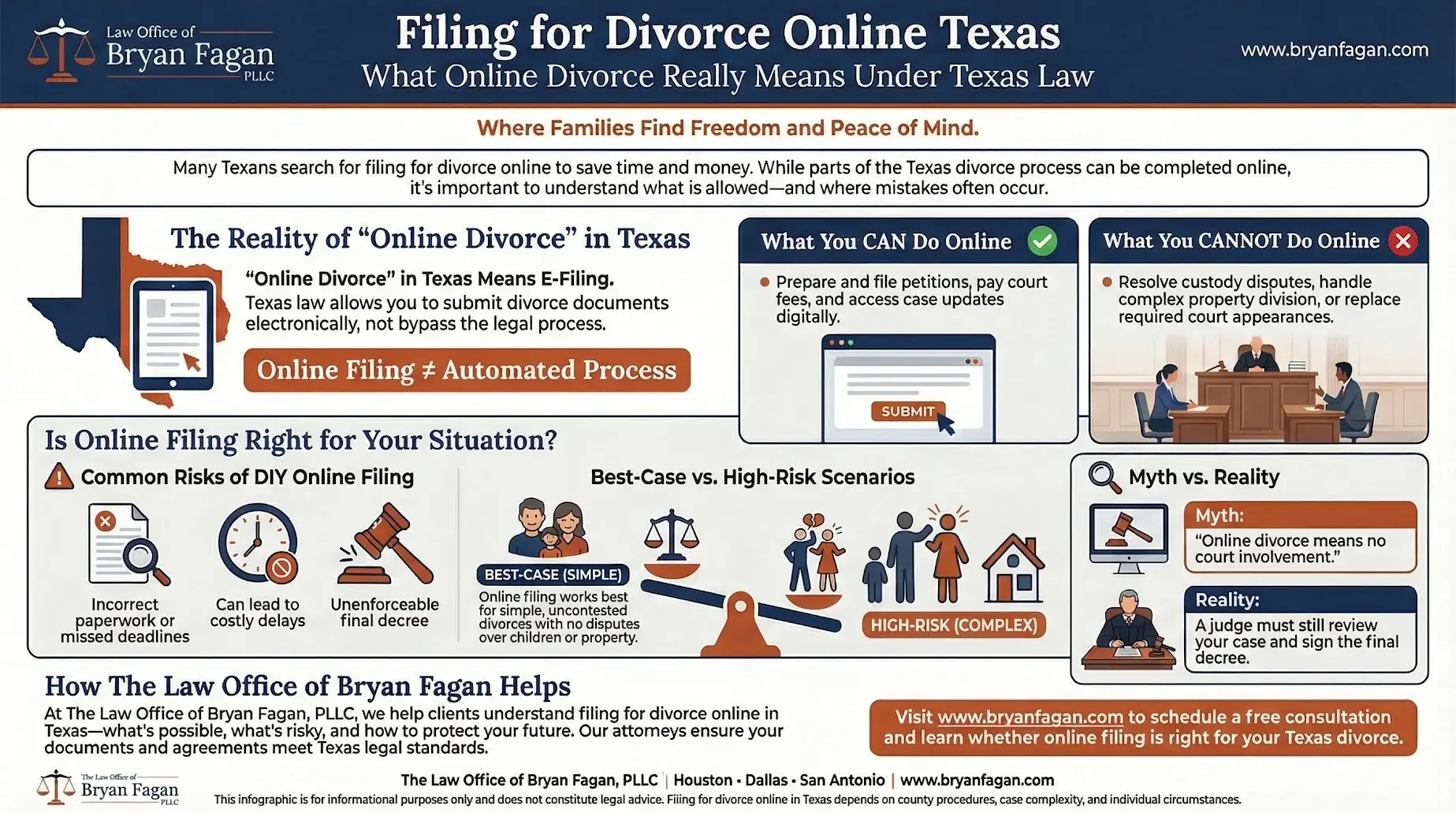
Submitting a divorce online Texas filing often feels like the moment everything becomes official. You finish the forms, upload documents, pay the required fees, and click submit, expecting the court to immediately take over your case.
In reality, that submission is only the beginning of an administrative process inside the Texas e-filing system and the district clerk’s office. Your divorce is not yet an active court case, and nothing is scheduled or assigned in a judicial sense until the clerk accepts and file-stamps your petition.
What happens after submission is a sequence of procedural steps that determines whether your filing becomes an official case, is returned for correction, or remains pending in the system.

What Happens When You Submit A Divorce Online Texas Filing
Once you submit a divorce online Texas filing, your documents are transmitted through the state’s electronic filing system into the county’s intake queue. Even though everything happens digitally, your filing is not immediately part of the court’s docket.
At this point, the system is only acting as a delivery channel. Your documents are stored in a pending status until the district clerk reviews them. Many people assume that seeing a “submitted” or “received” status means the case has started, but legally, nothing has been filed yet in the court’s record.
For example, someone might submit a divorce petition late at night after completing all forms. The system confirms submission instantly, but the filing will usually sit until a clerk processes it during business hours. In some counties, especially busy ones, this queue can take longer depending on volume.
This stage is best understood as administrative intake rather than a legal filing event.
How The Clerk Reviews A Divorce Online Texas Filing
After submission, the district clerk or e-filing review staff checks the filing for procedural compliance. This is not a judicial review and does not involve any evaluation of the facts of your case or whether your divorce should be granted.
Instead, the clerk is determining whether the filing can legally and procedurally become a court case. The focus is entirely on completeness and correctness of the paperwork under Texas filing rules and local court requirements.
Document Completeness And Required Forms
The clerk first checks whether all required documents are included. This typically includes the Original Petition for Divorce and any mandatory local forms required by the specific county. Even if the substance of the filing is correct, missing attachments can prevent acceptance entirely.
Signatures, Notarization, And Execution Requirements
Next, the clerk verifies that documents are properly signed or electronically executed where required. In Texas, certain filings require notarization or specific signature formatting. A missing or improperly executed signature is one of the most common reasons filings are rejected.
Jurisdiction And Venue Verification
The clerk also confirms that the case is filed in the correct county and meets basic jurisdiction and venue requirements. For example, if residency requirements are not properly reflected in the petition, the filing may be rejected even before a judge ever sees it.
Formatting, Legibility, And E-Filing Compliance
Finally, the clerk checks whether documents meet technical requirements for electronic filing. This includes readable PDFs, correct file types, and proper document separation. Even when everything else is correct, formatting issues alone can cause rejection.
Even small issues can stop the process. A missing signature page, an incorrect form version, or a filing in the wrong county can result in the entire submission being rejected. Clerks typically do not modify or correct filings; instead, they return them for correction and resubmission to maintain the integrity of the court record system.
This is one of the most common points of delay in online divorce cases because the review is strict, even when the underlying divorce is uncontested.
What Happens To Payment After Submission

When you submit a divorce online Texas filing, payment is usually authorized at the same time through the e-filing system. This includes both court filing fees and electronic filing service charges. However, payment authorization does not mean the case has been accepted or opened. The court still must complete the clerk review process before any case is created in the system.
If the filing is rejected, the payment may be handled in different ways depending on the county. In some systems, it is voided automatically. In others, it is held temporarily or applied when the corrected filing is resubmitted. This distinction is important because many filers assume payment equals filing. In reality, payment only covers the attempt to file the documents—it does not guarantee that a case will be created or docketed.
When Your Case Becomes Officially Opened By The Court
A divorce case in Texas does not legally exist until the district clerk accepts the filing and assigns a cause number. This is the point where the court formally recognizes the matter as an active case.
Once accepted, the petition is file-stamped with an official filing date. That date is legally significant because it triggers procedural timelines, including the mandatory waiting period required under Texas law.
Before acceptance, there is no court case—only a pending submission. After acceptance, the case becomes part of the court’s active docket and is governed by the Texas Rules of Civil Procedure.
This distinction is important because deadlines, service requirements, and waiting periods all depend on the file-stamped date, not the submission date.
What Happens After Court Assignment
Once the filing is accepted, the case is assigned to a district court within the county. This assignment is generally automatic and based on internal rotation systems designed to distribute cases evenly among judges.
At this stage, many people expect immediate court involvement, but that is not how most divorce cases begin procedurally. Instead, the case remains in a preparatory phase while service is completed and statutory time periods run.
Even though the case is now officially open, there may be no visible activity for weeks. This is normal, especially in uncontested divorces where no hearings are immediately required.
Why Service Still Matters After Filing Online
Filing a divorce online in Texas does not notify the other spouse. Texas law still requires formal service of process unless the respondent signs a waiver of service. After acceptance, the clerk issues a citation that must be served on the other party. This ensures due process by providing legal notice of the case and an opportunity to respond.
Service can occur in several ways. In cooperative cases, the respondent may sign a waiver of service, which avoids formal delivery. A process server, constable, or sheriff delivers the citation in other cases. In limited situations, alternative service may be approved by the court.
Without proper service or waiver, the case cannot proceed to final judgment, regardless of agreement between the parties.
How The 60-Day Waiting Period Affects Your Case
Texas imposes a mandatory 60-day waiting period for divorce cases, beginning from the date the petition is officially filed—meaning when it is accepted and file-stamped by the clerk.
This waiting period applies to almost all cases, regardless of whether they are contested or uncontested. It functions as a statutory cooling-off period before a divorce can be finalized.
During this time, the court generally cannot sign a final decree except in limited circumstances involving protective orders. Although the case is active, most of the work during this period happens outside the courtroom, such as completing service or finalizing agreements.
Common Problems After Submission That Slow Cases Down
Even after a divorce online Texas filing has been accepted and the case is officially opened, delays can still happen later in the process—most often during preparation or submission of the final decree. At this stage, the court is focused on making sure the final order is complete, legally enforceable, and consistent with Texas family law requirements.
Even small drafting issues can create setbacks because judges cannot sign off on a decree that is unclear, incomplete, or missing required provisions. These issues typically do not restart the case, but they do require corrections before the divorce can be finalized.
Common problems include:
- Unclear property division language – Assets or debts may be listed vaguely or without specifying who receives what, which forces revisions before approval.
- Missing custody or visitation terms – In cases involving children, the decree must clearly address conservatorship, possession schedules, and decision-making rights.
- Incorrect legal descriptions of property – Real estate or other titled assets may require precise legal descriptions, not informal labels or addresses alone.
- Missing signatures or notarization – Final orders must be properly signed by the parties and, in some cases, notarized to be valid.
- Inconsistent terms across documents – Differences between earlier agreements and the final decree can trigger court requests for clarification.
While these issues do not invalidate the divorce filing itself, they can delay final approval because the judge must ensure the decree fully complies with legal standards before signing.
Timeline After Submitting A Divorce Online Texas Filing
The timeline above reflects how a typical uncontested divorce progresses after a divorce online Texas filing is submitted. While the process may appear linear, it often involves pauses between stages, especially during clerk review and service. Some cases move quickly if the paperwork is complete and the parties cooperate, while others slow down due to corrections or delays in serving the other spouse.
| Stage | What Happens | Typical Timeframe |
|---|---|---|
| Submission | Filing enters electronic intake queue (no case exists yet) | Same day |
| Clerk Review | Administrative compliance review by clerk staff | 1–5 business days |
| Acceptance Or Rejection | Filing is either docketed or returned for correction | 1–7 business days |
| Case Opening | Cause number assigned and petition file-stamped | Immediately after acceptance |
| Service Of Process | Respondent is served or signs waiver | Days to weeks |
| Mandatory Waiting Period | 60-day statutory waiting period runs | 60 days minimum |
| Finalization | Final decree reviewed and signed by judge | 1–4 weeks after waiting period |
What Your Spouse Can Do After You File
Once service is completed, the respondent may choose to participate in the case by filing an answer, agreeing to the requested terms, or submitting a counterpetition raising their own claims regarding property, custody, or support.
If the respondent does not respond within the required deadline and service was properly completed, the case may proceed by default judgment. Even in default cases, the court still reviews the paperwork to ensure legal requirements are satisfied before granting a final decree.
These procedural rights apply regardless of whether the divorce was initiated online or through traditional filing methods.
Conclusion
After you click submit on a divorce online Texas filing, your case does not immediately become active in court. It first enters a clerk review process where it may be accepted, corrected, or rejected. Only once it is accepted and file-stamped does a legal case officially begin in Texas.
From there, the case proceeds through service, a mandatory 60-day waiting period, and final decree preparation under Texas procedural rules. While submission feels like the start of the process, the legal system treats acceptance—not submission—as the moment the divorce case actually begins.
Frequently Asked Questions
After submission, your documents enter the county’s electronic filing queue for clerk review. At this stage, no court case has been opened yet and no judge is assigned. The filing must still be accepted and file-stamped before it becomes an official divorce case.
Not yet. Submission only means the paperwork has been delivered to the court’s system. The divorce legally begins only when the district clerk accepts the filing and assigns a case number. Until then, it is still in the review stage.
Most rejections happen because of procedural issues, not legal problems. Common reasons include missing forms, incorrect signatures, filing in the wrong county, payment errors, or unreadable documents. When rejected, the filing must be corrected and resubmitted.
Yes. Filing online does not notify the other spouse. Texas law still requires formal service of process unless the spouse signs a waiver. Without proper service or waiver, the case cannot move toward final judgment.
Even in simple uncontested cases, finalization usually takes at least 60 days due to the mandatory waiting period. Additional time may be needed for clerk review, service, and preparation of the final decree, depending on the case.
Related Articles
- Understanding Texas Divorce Filing Fees: Costs & Tips
- The Truth About Divorce Filing Fees in Harris County, Texas
- How to Check the Status of a Divorce Filing in Texas: The Legal Side Explained
- Making Sense of Divorce Filing In Texas: What It Means for You
- How Online Divorce Filing Works for Uncontested Divorces in Texas
- How long do you have to be separated before Divorce Filing in Texas?
- Can you file for divorce in another state? A Guide to Residency & Filing
- Transforming Texas Divorce Filings: How to Navigate with Mediation
- What No One Tells You About Filing for Divorce in Texas
- What Happens After Filing for Divorce Texas: 2026 Guide