When a loved one dies, families often find themselves juggling grief, paperwork, and hard conversations at the same time. If you're trying to understand how probate works in Texas, you probably don't need more legal jargon. You need a calm roadmap.
Probate is the court process used to recognize a will, appoint the person who will handle the estate, deal with debts and claims, and transfer property to the right people. In Texas, the process is often manageable when the estate is organized and family members are on the same page. But even then, the steps can feel unfamiliar.
A good way to approach probate is to think of it as both a legal process and a family process. The court cares about notice, authority, and proper administration. Families care about clarity, fairness, and keeping conflict from growing. Both matter.
Starting the Probate Process in Texas
The phone has not stopped ringing. A parent has died, family members are asking what happens next, and someone is searching drawers for a will while another person worries about the house, the bills, and whether anything can be touched yet. That is often how probate starts in real life in Texas.
The first question is simple, even if the situation is not: Did your loved one leave a will? If there is a will, the person named as executor is usually the one who asks the probate court to open the estate. If there is no will, or the named executor cannot serve, a family member or other qualified person may ask the court to appoint an administrator instead.
Timing matters, but so does triage. Under the Texas Estates Code, a will generally should be offered for probate within four years after death, subject to limited exceptions depending on the facts. See Tex. Estates Code § 256.003. In the first few days, families are usually better served by focusing on the immediate tasks in front of them: find the original will, protect property, gather basic records, and slow down any arguments about who gets what.
What probate means in plain English
Probate is the court process that confirms who has legal authority to act for the estate.
If there is a valid will, the court is usually being asked to admit that will to probate and appoint the executor. If there is no will, the court may appoint an administrator and the estate will be distributed under Texas intestacy rules. The legal rules matter, but the practical question is often more immediate: who has authority to deal with the bank, the house, the mail, and unpaid bills?
Families are often relieved to learn that probate does not automatically pull every asset into the court process. Some assets pass outside probate by their own rules, such as life insurance with a named beneficiary, payable-on-death accounts, or property that was set up to transfer automatically at death. That means part of the job at the start is sorting assets into two groups: property the estate controls and property that passes another way.
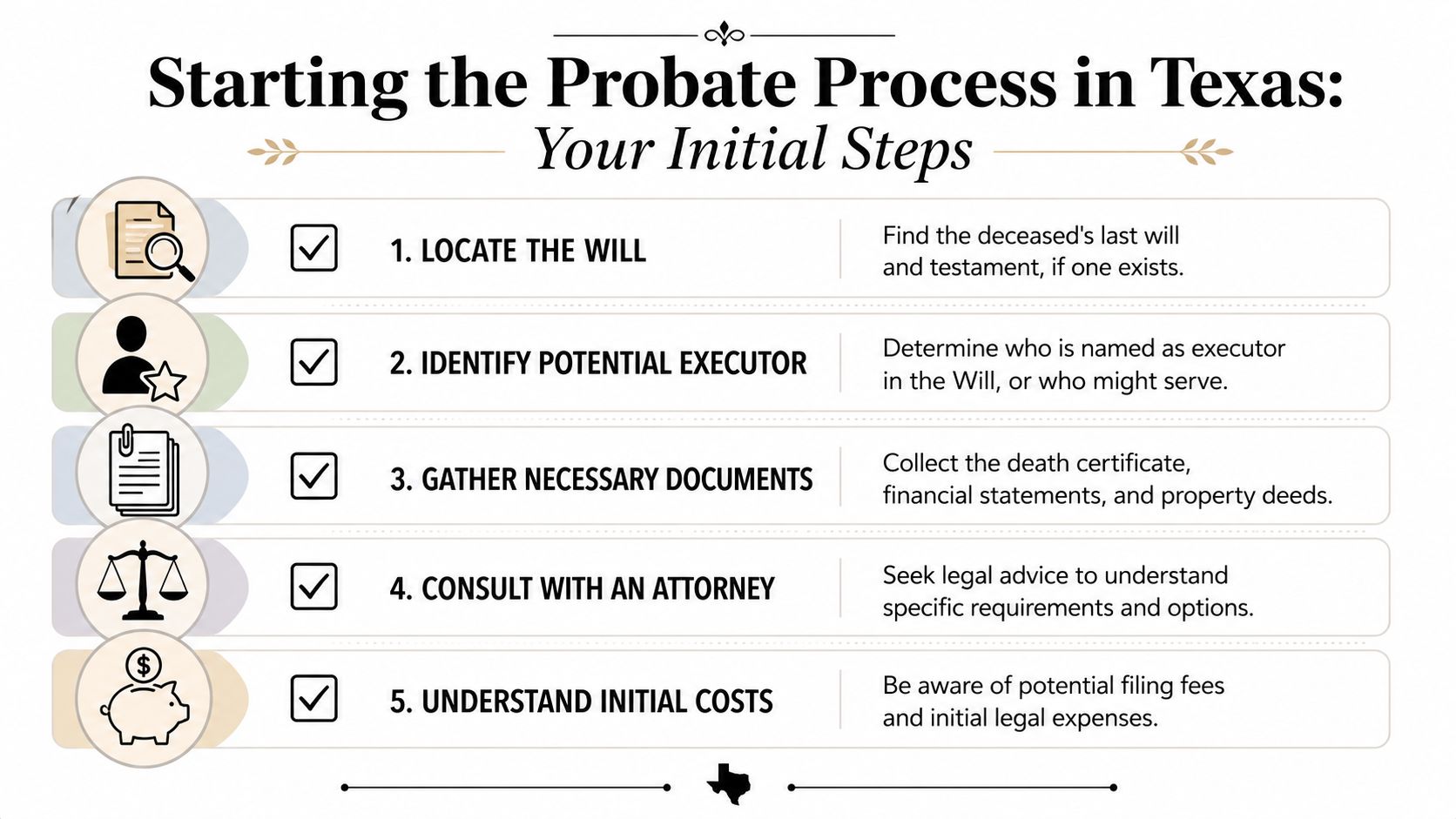
A practical checklist for the first few days
In a hard week, a short list helps.
- Find the original will. The signed original matters. Check a home safe, desk files, a safe deposit box if accessible, or the office of the lawyer who prepared it.
- Confirm who may serve. If the will names an executor, contact that person early. If that person has died, declines, or is not able to serve, the court may need to appoint someone else.
- Order death certificates. Financial institutions, title companies, and government offices often require certified copies.
- Gather the estate's paper trail. Pull together deeds, bank statements, retirement account records, insurance documents, tax returns, vehicle titles, and recent bills.
- Protect property that could be lost or mishandled. Lock the home, secure vehicles, forward mail if appropriate, and make an inventory of valuables.
- Hold off on distributions. Passing out jewelry, firearms, cash, or furniture too early can create legal and family problems that are hard to unwind later.
Practical rule: Verbal agreement among relatives does not give anyone legal authority to distribute estate property. That authority usually comes only after the court appoints the personal representative and issues the proper paperwork.
Where families usually get stuck
The first obstacles are often emotional. One child wants to avoid court because it sounds expensive. Another believes a will means probate is automatic and easy. Someone else may suspect documents are missing or that a sibling is acting too quickly. Grief tends to magnify old family roles, and probate often brings those roles back to the surface.
A simple way to lower the temperature is to build one shared working list. Write down the property you know about, the debts you know about, and the people who may need formal notice. That list works like a map before a road trip. It does not answer every question, but it shows where you are starting and helps everyone discuss facts instead of fears.
If you are the person likely to file the case, keep your goal narrow at the beginning. You are not solving the whole estate in one weekend. You are getting organized, protecting what needs protection, and putting the court in a position to appoint the right person to act. That is the first real step toward order.
Understanding the Different Types of Texas Probate
Texas doesn't use a one-size-fits-all probate system. The path depends on whether there is a will, whether there are debts, whether family members agree, and how much court supervision is needed. The most common options come from the Texas Estates Code, including independent administration, dependent administration, and muniment of title. In some situations, a small estate procedure may also be available.
Near the start of your review, it helps to compare the paths side by side.
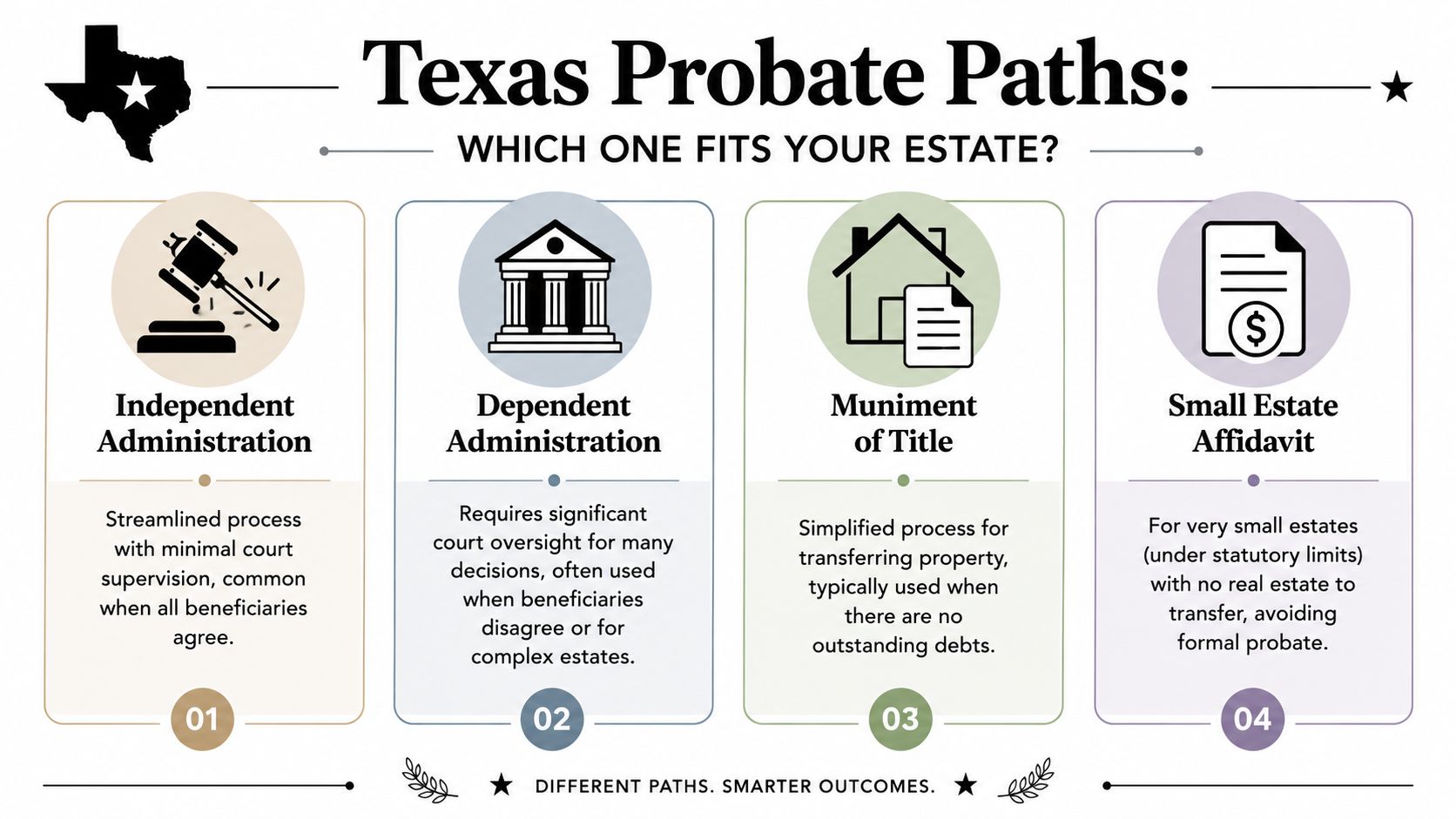
A side-by-side view of the main options
| Probate path | Best fit | Court involvement | Practical effect |
|---|---|---|---|
| Independent administration | A will authorizes it, or interested parties agree | Lower ongoing supervision | The executor can handle many tasks without asking the court each time |
| Dependent administration | Disputes, uncertainty, or no workable independent path | Higher supervision | The court stays involved in many estate decisions |
| Muniment of title | There is a will and the estate mainly needs title transfer | Limited proceeding | Often used when property needs to be put in the right name and full administration isn't necessary |
| Small estate procedure | A very small qualifying estate | Simplified alternative | May avoid a full probate administration if statutory requirements are met |
Independent administration
This is the path many Texas families hope for. When a valid will names an executor and allows independent administration, or when the required people agree, the executor can usually manage the estate with less court oversight.
That matters because less supervision often means fewer hearings, fewer filings, and less friction in day-to-day estate work. If you're looking into Probate, you're looking at probate administration and estate settlement in Texas, which often centers on whether the estate can proceed independently or needs tighter court control.
Dependent administration
Dependent administration is more structured. The court may require approval for actions that would be more routine in an independent case.
This path often appears when families disagree, when there are concerns about estate handling, or when no will creates a clear plan. If your family dynamic is tense, more supervision can feel burdensome, but it can also provide guardrails. For some estates, that extra oversight protects everyone involved.
A short overview can help if you're deciding which description sounds most like your situation:
Muniment of title and small estate options
A muniment of title is often useful when there is a valid will and the main issue is transferring title to property, not running a full administration with active debt resolution. Families often encounter this after a parent dies owning a home, where the title needs to reflect the correct heirs or beneficiaries.
A small estate affidavit is a separate simplified route for certain very small estates that meet statutory conditions. It isn't available in every case, and it's not a shortcut for a complicated estate.
The right probate path isn't the one that sounds easiest. It's the one that fits the estate's facts, debts, and family dynamics.
A lot of families reach this stage feeling pulled in two directions at once. Grief is still fresh, but banks, bills, real property records, and relatives all seem to want answers right away. Probate administration gives that chaos an order. It is the court-supervised process for identifying who has authority, what belongs to the estate, what must be paid, and when property can be distributed.
For an executor, it often helps to view the job as part record keeper, part fiduciary, and part peacekeeper. Texas law expects care, honesty, and patience. Family members may see only the delays. The executor has to see the whole picture.
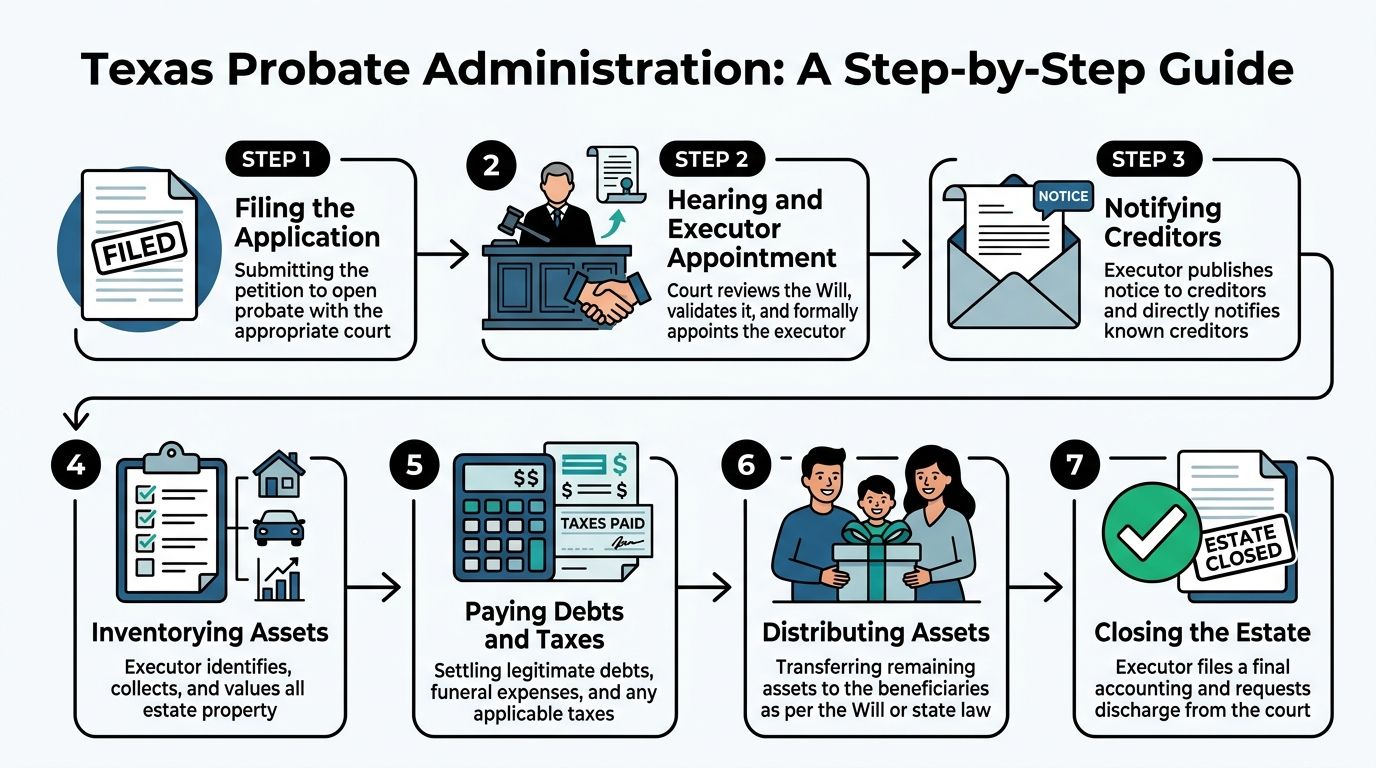
Filing the application
The administration phase begins with an application filed in the proper Texas court, usually in the county where the decedent resided. If there is a will, the application asks the court to admit it to probate and appoint the named executor. If there is no will, the filing asks the court to appoint an administrator under the Texas Estates Code.
This first filing matters more than families often realize. A small mistake in the decedent's name, county, heirs, or requested relief can slow the case and create confusion later. It helps to gather the death certificate, the original will if one exists, a preliminary list of heirs, and a basic picture of assets before filing.
Filing the application does not give immediate authority to act for the estate.
That point causes a lot of anxiety. A son may want to list the house for sale, or a daughter may want to close a bank account to stop automatic drafts. Until the court appoints someone and that person qualifies, authority is still limited.
The hearing, qualification, and letters
Texas probate procedure includes a built-in waiting period before the court can hear the application, as noted earlier in this article. That pause can feel frustrating, especially when urgent tasks are piling up, but it serves a purpose. It gives interested parties time to receive notice and raise concerns if needed.
At the hearing, the judge decides whether the will should be admitted to probate and whether the proposed executor or administrator is qualified to serve. If the court approves the appointment, the personal representative must qualify. Depending on the case, that may include taking an oath and, in some administrations, posting a bond under the Estates Code.
Once qualified, the representative receives Letters Testamentary or Letters of Administration. Those letters work like proof of legal authority. Banks, title companies, and other institutions usually will not deal with an estate until they see them.
What the executor actually does after appointment
After appointment, the work becomes practical very quickly. Mail starts arriving. Utility companies need direction. Beneficiaries ask when they will receive something. Creditors may appear before the family even knows the full size of the estate.
A careful executor usually starts with four priorities:
- Secure and organize the estate. Forward mail, protect the home, inventory keys and records, and keep estate papers in one reliable file.
- Separate estate property from non-estate property. Some assets pass under the will or by intestacy. Others pass outside probate through beneficiary designations, survivorship rights, or trusts.
- Address notices and claims. The representative may need to publish notice to creditors and give direct notice in some situations, then evaluate which claims are valid and when they must be paid.
- Set expectations with the family. Short, calm updates often prevent suspicion from growing into conflict.
That last step is easy to underestimate. Silence tends to make people assume the worst. Even a simple message such as "The court has appointed me, I am collecting records, and no distributions can be made until debts and asset values are clearer" can lower tension.
Inventory, appraisement, and list of claims
One of the executor's central duties is preparing the Inventory, Appraisement, and List of Claims, unless the estate qualifies for an allowed alternative such as an affidavit in lieu of inventory in the proper case. Under Texas Estates Code Section 309.051, the inventory is generally due within 90 days after the representative qualifies, unless the court grants more time.
This document is the estate's working map. It identifies what the decedent owned, gives estimated values, and lists claims owed to or by the estate. If the estate includes a home, vehicles, mineral interests, business interests, or personal property with uncertain value, this step can take time and judgment.
Families often get stuck here because they assume "Dad's property" is a simple category. Legally, it may not be. A truck might be titled in one name, a bank account might have a payable-on-death beneficiary, and a house might include title issues no one discovered during life. Sorting out what is part of the probate estate is one of the places where careful legal guidance saves time and conflict.
Paying debts and protecting beneficiaries
Before distributions are made, the executor has to deal with valid estate debts, expenses of administration, and tax issues if they apply. Texas law sets out priority rules for claims. That means the executor should not pay bills in the order they arrive or distribute property just because a beneficiary is demanding it.
An estate works like a family budget after a loss. You need to know what came in, what must be paid first, and what remains before promising anyone a final amount. Rushing this part can expose an executor to personal risk and create unfairness among beneficiaries.
Distribution and recordkeeping
Only after assets are identified, claims are addressed, and the estate is in a position to distribute should the executor begin transferring property to beneficiaries or heirs. Some distributions are straightforward. Others require deeds, vehicle title transfers, account paperwork, receipts, or court approval, depending on the type of administration.
Good records matter from the first day to the last. Keep copies of letters, appraisals, account statements, receipts, reimbursement requests, and any distribution documents signed by beneficiaries. In probate, clear records do more than satisfy the court. They help families see that the estate was handled fairly.
Probate Timelines Costs and Common Pitfalls
A daughter files the will after her father dies and hopes the court process will be over by summer. Then an old creditor writes in, one brother stops returning calls, and no one can find the deed to the house. That is why families often feel unsettled during probate. The legal steps may be orderly, but real life rarely is.
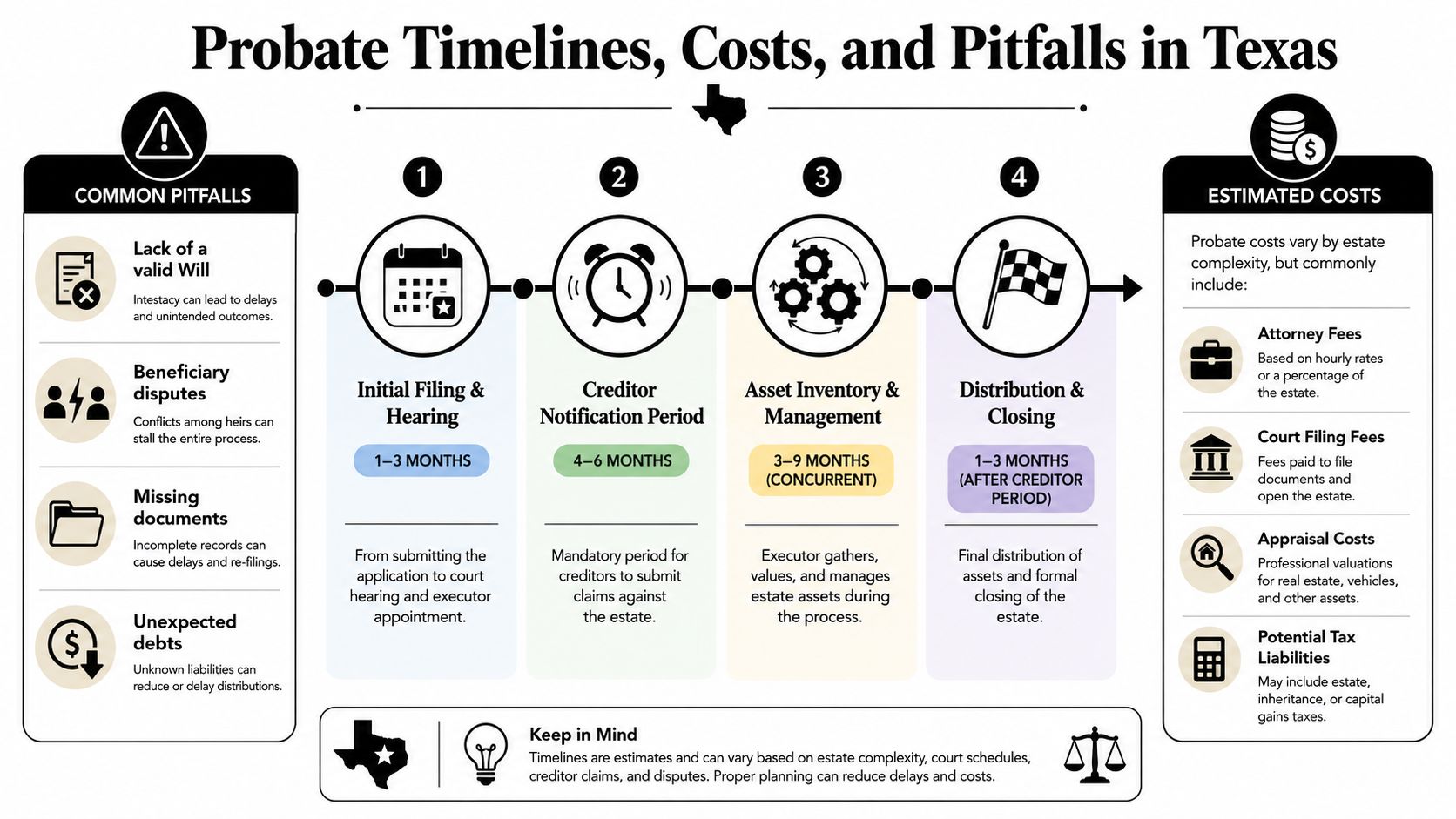
The two questions families usually ask first are still the right ones: How long will this take? and What will it cost? The honest answer is that Texas probate can move fairly quickly in a clean, uncontested estate, but it often slows down when paperwork is missing, assets are hard to value, or family members disagree. Good expectations at the beginning reduce stress later.
How long probate may take
Probate works a lot like clearing out a family home after a move. If everything is labeled and everyone agrees on what belongs where, progress is steady. If important papers are missing or people dispute what should happen, even small decisions take longer.
As noted in Seth K. Bell probate guidance, some straightforward Texas probates may wrap up in a matter of months, while others last much longer. Those different time ranges are not inconsistent. They reflect the difference between an estate that is simple on paper and an estate that stays simple once the work begins.
A case often takes longer for practical reasons families do not expect at first. The court may need time to issue letters. Financial institutions may respond slowly. Real property may have title problems. A handwritten note in the file cabinet may trigger questions about whether a later will exists. None of that means the probate is failing. It means the executor is working through the estate carefully.
What probate may cost
Cost causes a different kind of anxiety. Families are grieving, and now someone has to ask whether the estate can afford filing fees, legal help, appraisals, and other expenses. That conversation can feel uncomfortable, especially when one sibling thinks probate should be inexpensive and another wants every question answered before anything is distributed.
Published estimates for Texas probate often include court filing fees, publication costs, attorney's fees, and extra expenses tied to the estate's condition. In an uncontested matter, costs may stay relatively modest. In a disputed or disorganized estate, they can rise quickly because more attorney time, more filings, and sometimes more investigation are needed.
Here is a practical way to view the usual categories:
| Cost area | What it covers |
|---|---|
| Court filing and related fees | Opening the probate case and required court paperwork |
| Publication cost | Public notice required in many estates |
| Attorney's fees | Advice, filings, hearings, and help keeping the administration on track |
| Additional estate expenses | Appraisals, certified copies, document retrieval, title work, and dispute-related work if problems arise |
Texas law also addresses executor compensation. Under Texas Estates Code § 352.002, an executor is generally entitled to a 5% commission on sums received or paid out in the administration of the estate, with important limits and exceptions. For example, the commission does not apply to certain cash already on hand or to amounts paid out in final distribution to beneficiaries. Families are often surprised by this rule when a relative serves as executor, but it is part of the statutory framework, not a punishment.
One practical point helps here: probate cost usually grows when the estate is unclear, not only when the estate is large.
Common pitfalls that make probate harder
The legal issues are only half the story. The other half is human. Silence gets mistaken for secrecy. Delay gets mistaken for favoritism. Grief can turn a simple misunderstanding into a family standoff.
The trouble spots I see most often include:
- Missed deadlines. Delay can create avoidable court and notice problems.
- Missing original documents. If the signed original will cannot be found, proving the estate plan may become harder.
- Early distributions. An executor who gives out property before debts, expenses, or claims are handled can create personal risk.
- Poor communication. Beneficiaries are less likely to assume the worst when they receive clear updates, even short ones.
- Confusion about non-probate assets. Accounts with beneficiary designations may pass outside the will, which can surprise relatives and create tension.
A calm process usually depends on one habit. Keep legal decisions and emotional disputes in separate boxes. If two siblings are fighting over a ring, first determine whether the ring is part of the probate estate and who has legal authority over it. After that, the family can discuss sentimental concerns with a clearer frame.
That approach does not erase grief. It does make the next step easier to see.
Closing the Estate and Planning to Avoid Future Probate
The end of probate usually involves four final jobs: finish paying legitimate debts, handle final tax matters, distribute what remains under the will or Texas law, and complete the steps needed to close the estate. For beneficiaries, this is often the first point when things start to feel settled.
Closing the estate is also when many families decide they don't want their own children to face the same uncertainty. That's a healthy response. Probate teaches people where confusion begins: missing documents, unclear authority, outdated beneficiary designations, and no plan for real property.
Some assets can pass outside probate with better planning. Texas recognizes tools such as beneficiary designations on certain accounts and transfer-on-death deeds for some real property, as noted earlier in the Texas probate guidance. Many families also consider wills and trusts when they want clearer instructions and smoother transitions.
If you've just gone through probate for a parent, this is a good time to review your own documents while the lessons are still fresh. Make sure your will reflects your current wishes. Check who is named on your accounts. Review who would handle matters if you became incapacitated. Small updates now can spare your family major stress later.
If you need help navigating probate or creating a plan to protect your family in Texas, contact Law Office of Bryan Fagan, PLLC for a free consultation. A lawyer can help you evaluate the right probate path, prepare the required filings, and build an estate plan that reflects your wishes with clarity and care.