When a loved one dies, the legal paperwork rarely waits for your grief. You may still be making funeral arrangements, answering family texts, and trying to find important documents when someone says, “You're the executor.”
That moment can feel heavy. You might wonder what does an executor do in Texas, whether you're already responsible for bills and property, and what happens if you make a mistake. Those questions are normal.
A common situation looks like this. A daughter finds her father's will in a desk drawer and sees her name listed as executor. She assumes she can start closing accounts and dividing property right away. Then the bank refuses to speak with her, a sibling asks when inheritance will be paid, and the mortgage company keeps mailing statements. She isn't failing. She's encountering the gap between being named in a will and having legal authority to act.
If that sounds familiar, take a breath. This job is serious, but it becomes manageable when you break it into steps. You don't need to solve everything in one day, and you don't need to carry the stress alone. If grief is making it hard to focus, even simple support strategies can help, including practical guidance on managing time and coping with stress.
Coping with Loss and a New Responsibility
Being an executor is part legal duty, part logistics, and part family diplomacy. You may be expected to stay organized at the exact time you feel least able to do that.
That's why it helps to separate two realities. First, your loved one has died, and your grief is real. Second, an estate now needs protection. Both things can be true at once.
What most people misunderstand early on
Many people think the will alone gives immediate power. In Texas, it doesn't work that way. Being named in the will matters, but the court process still matters too.
Until the court formally approves the executor, you should think in terms of protecting and preserving, not administering and distributing. That distinction can keep you from stepping outside your authority.
Practical rule: In the first days after a death, focus on securing records, property, and information. Leave major financial moves until you have legal authority.
What helps in the first week
Try to reduce the task into categories instead of one giant obligation. Ask yourself:
- What needs protection now: A house, vehicle, mail, pets, or important papers
- What needs information gathered: The original will, death certificate, account statements, insurance paperwork
- What needs patience: Family expectations about who gets what and when
An executor doesn't need to know everything immediately. You need a calm starting point and a clear understanding of your actual role.
Your Core Legal Duties as a Texas Executor
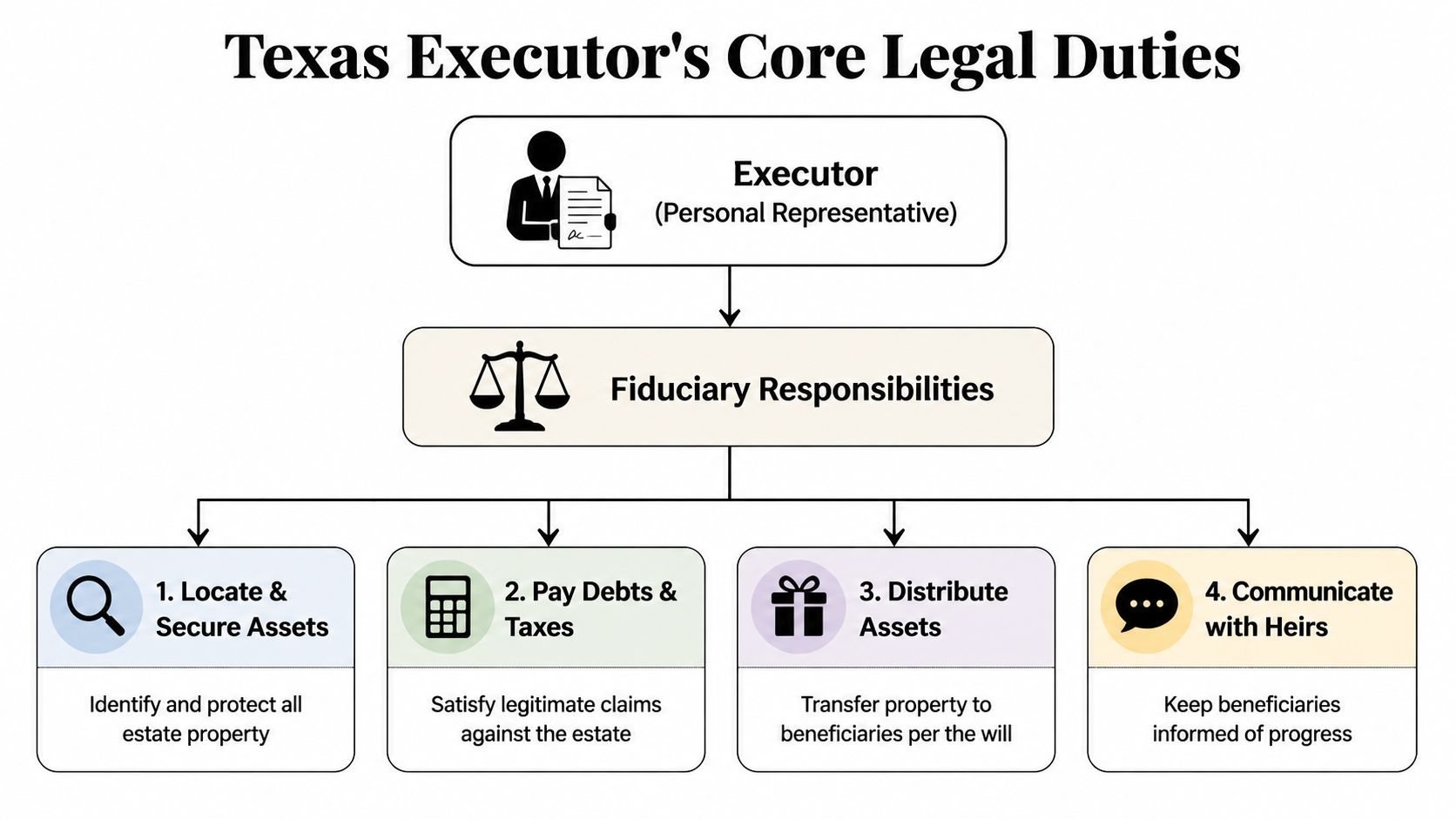
In Texas, an executor is more than the person named in the will. The court must approve that person before they can act, and the role includes safeguarding the estate, filing the will and death certificate, gathering and appraising assets, paying valid debts and taxes, and distributing what remains to beneficiaries. Texas State Law Library guidance also notes that executors are often expected to work with an attorney, and Texas Estates Code §352.002 caps executor compensation at 5% of the estate's market value, excluding cash, certain bank accounts, and life insurance, as described by the Texas State Law Library's executor guidance.
Think of the executor as a fiduciary
The most important legal idea is fiduciary duty. That means you must act for the benefit of the estate and the people entitled to receive from it, not for your own convenience or personal preference.
If you like analogies, think of yourself as the temporary steward of property that isn't yours to use freely. You're responsible for protecting it, documenting what happens to it, and transferring it according to the law and the will.
That fiduciary duty shapes every decision you make. It affects how you handle money, how you communicate with heirs, and how carefully you keep records.
The main duties in plain language
Most executor work falls into four practical lanes:
- Protect the property: Secure the home, locate financial records, preserve vehicles, monitor mail, and prevent loss.
- Handle the legal filing: Bring the will into probate and obtain the authority needed to act.
- Pay what the estate legally owes: Valid debts, taxes, and administration expenses must be addressed before final distribution.
- Transfer what remains: Beneficiaries receive what the will directs after the estate is properly administered.
A question many families ask is whether an executor can decide who gets what. The short answer is no. The executor carries out the will rather than rewriting it. This comes up often in disputes, and this explanation of whether an executor can decide who gets what in Texas helps clarify the limits of the role.
Why legal guidance is often part of the job
Texas practice often expects executors to work with counsel because probate has deadlines, filings, notice requirements, and recordkeeping duties. Even in estates that seem straightforward, one missed step can create delay or conflict.
For many families, that means dealing with Probate administration and estate settlement in Texas through a formal process rather than informal family agreement.
The executor's job is not to make things “fair” in a personal sense. It's to follow the will, protect the estate, and account for what was done.
Your First Steps Before Probate Begins
One of the most confusing parts of this process is the period right after death and before the court formally appoints the executor. Existing Texas guidance often focuses on powers after appointment, but families still need immediate next steps for protecting property, preserving records, and handling practical risks in the meantime, as discussed in this overview of what an executor can do before formal appointment in Texas.

What you can do right away
Before the court appoints you, avoid acting like you already control the estate. But you can still take sensible protective steps.
Here's a practical checklist:
Locate the original will
Search for the signed original, not just a copy. Also gather any codicils or later amendments.Order death certificates
You'll likely need certified copies for institutions and court filings.Secure real property
Make sure the home is locked, valuables are not sitting out, and basic upkeep continues. If mail is piling up, address that quickly.Gather key documents
Look for bank statements, deeds, car titles, insurance policies, tax returns, bills, and account contact information.Start a written asset list
You're not preparing a final inventory yet. You're creating a working list so nothing gets overlooked.Preserve digital access information if available
Note what accounts exist, even if you can't access them yet.
What you should avoid before appointment
The line between protecting and administering matters. Until formal appointment, be cautious about actions that look like control over estate property.
Avoid:
- Distributing property: Don't start handing out jewelry, vehicles, furniture, or cash because family members “know what Mom wanted.”
- Closing accounts: Financial institutions usually require legal authority.
- Paying debts from your own account without advice: You can create reimbursement and tracking problems.
- Mixing items into your personal property: Even temporary mixing can create suspicion and confusion later.
A useful way to think about this stage is that you're preserving evidence as much as preserving property.
A simple example
Suppose your aunt lived alone and named you as executor. After her death, you can change the locks if needed, photograph valuables, remove perishable items, collect mail, and gather her paperwork. You shouldn't sell her car, empty her account, or give her ring to a cousin just because everyone agrees that was the plan.
That difference protects you. It also protects the estate.
If your family is reading this while planning ahead rather than reacting after a death, Estate Planning involves wills, trusts, and estate plans to protect assets and wishes. Good planning often makes this early period much less chaotic.
Once the court appoints you, your role shifts from caretaker of information to legally authorized personal representative. This is the formal part of answering what does an executor do in Texas.
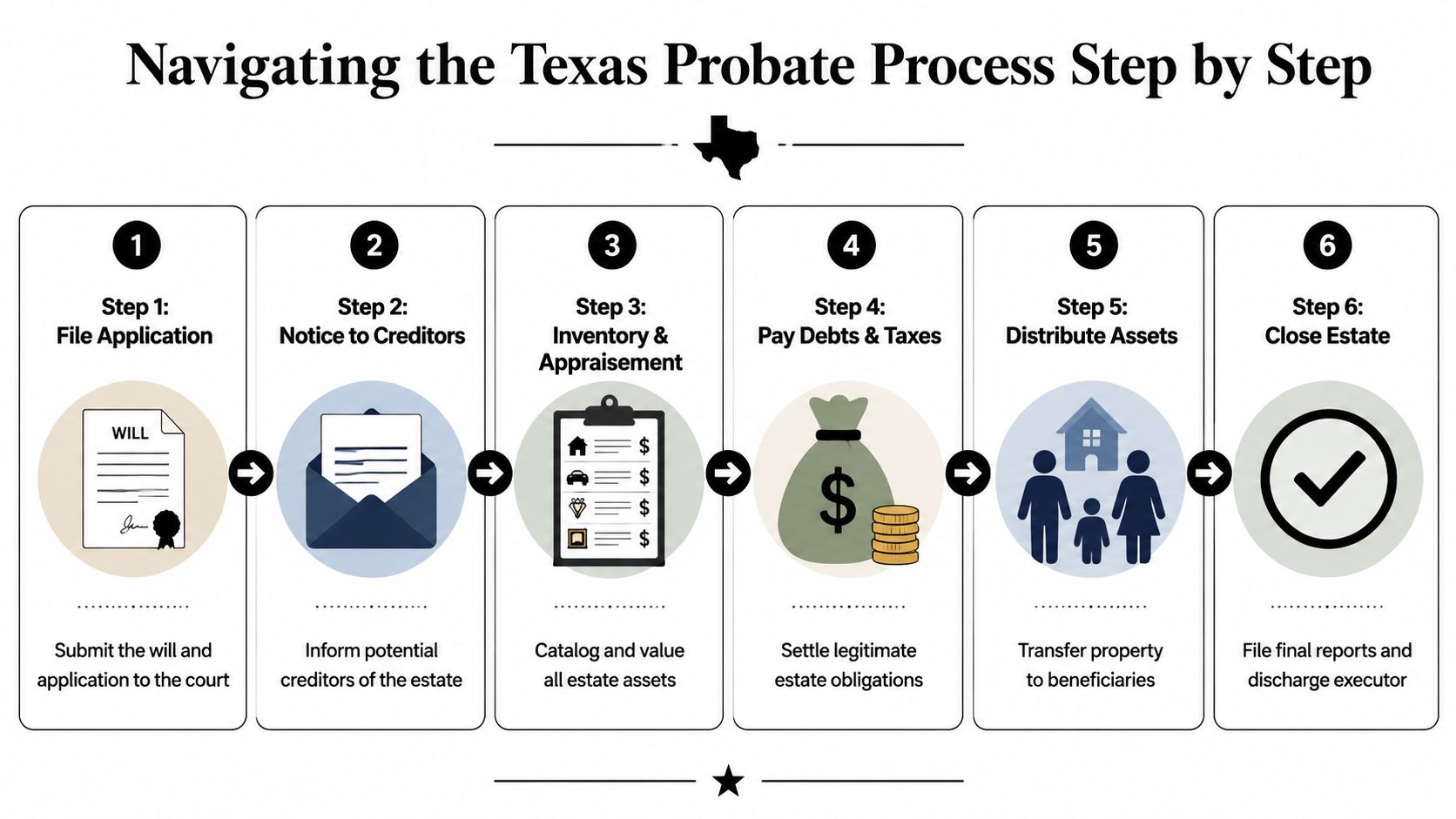
Early in the process, it helps to see the sequence visually.
Filing the probate case
The process begins with filing the will and the probate application in the appropriate court. The court reviews the filing, schedules the matter, and determines whether the will can be admitted to probate and whether the named executor is qualified to serve.
This stage is procedural, but it matters because legal authority comes from the court, not from family consensus.
Court approval and letters testamentary
If the court approves the will and appoints you, you receive Letters Testamentary. Those letters are what banks, title companies, and others usually want to see before they recognize your authority.
From a practical standpoint, this is the point where your job becomes active in the legal sense.
Once you have court authority, every estate action should be documented as if someone may review it later. Because they might.
A more detailed overview of the broader probate process in Texas can help if you want a separate look at filing and administration.
This short video also gives a useful visual overview of probate concepts:
What happens after appointment
Once appointed, the executor's work usually unfolds in a repeating pattern of notice, collection, review, payment, and documentation.
Your working sequence
| Stage | What you do | Why it matters |
|---|---|---|
| Notice | Notify the people and entities that legally need notice | It starts the administration process properly |
| Collection | Identify, gather, and safeguard estate assets | You can't manage property you haven't found |
| Review | Determine what the estate owns and owes | This prevents premature distribution |
| Payment | Address valid debts, taxes, and expenses | Beneficiaries are paid after obligations are handled |
| Distribution | Transfer remaining property according to the will | This completes the executor's core mission |
Inventory and asset management
You'll need to identify what belongs to the estate. That can include real estate, vehicles, business interests, household contents, and financial accounts that are part of probate administration.
This often takes longer than people expect. Some assets are obvious, such as a house or truck. Others take more digging, such as forgotten accounts, refunds, or items held in storage.
Keep a running file with statements, titles, property descriptions, contact names, and copies of every significant communication. Executors who stay organized usually make better decisions and face fewer disputes.
Debts, taxes, and claims
An executor doesn't pay every bill that arrives without question. Your role is to evaluate and handle valid estate obligations through the proper process.
That means you should be careful, methodical, and documented. If a debt is unclear, unsupported, or disputed, legal advice is especially important before payment.
A practical workflow for debt handling
- Open a tracking log: Record each claim, invoice, due date, and response.
- Separate personal sympathy from legal duty: A creditor may sound urgent, but urgency doesn't equal validity.
- Use estate records, not memory: Compare demands against statements, contracts, and account records.
- Pause before major payments: Early mistakes can reduce what's available for legitimate obligations and beneficiaries.
Final distribution and closing
Only after administration is ready should the executor distribute estate property. That usually means you've confirmed the governing will, identified estate assets, handled valid obligations, and prepared the records needed to show what happened.
For beneficiaries, this stage can feel like the only part that matters. For the executor, it's the last step, not the first.
A good habit is to think of every distribution as something you should be able to explain clearly: what was transferred, to whom, under what authority, and after what obligations were addressed.
Executor Compensation and Estate Tax Responsibilities
One of the first questions many executors ask is simple. Do I get paid for doing this work? In Texas, the answer can be yes, but compensation is tied closely to careful administration.
Texas Estates Code §352.002 provides a framework for reasonable compensation, and the commonly cited statutory ceiling is 5% of amounts received and paid out in estate administration. That compensation is typically paid from estate funds and may be reduced or disputed if the executor mishandles assets, mixes funds, or fails to maintain records, as explained in this discussion of Texas executor duties and compensation under Estates Code §352.002.
Why recordkeeping affects compensation
Many people hear “5%” and assume payment is automatic. It isn't that simple. Compensation exists within a fiduciary framework, which means the executor has to be able to support what happened in the estate.
If records are incomplete, account activity is mixed with personal funds, or transactions can't be explained, compensation can become a point of conflict. In practice, that means your bookkeeping is not separate from your right to be paid. It's part of it.
Key point: Good records don't just help the estate. They help protect the executor.
What careful tracking looks like
A practical executor keeps a file that includes:
- Account records: Statements, deposits, checks, wire confirmations, and receipts
- Property records: Titles, appraisals, sale documents, and transfer paperwork
- Expense support: Invoices, bills, reimbursement requests, and proof of payment
- Communication logs: Notes of conversations with heirs, creditors, and professionals
This doesn't need to be fancy. A paper binder, a spreadsheet, and well-labeled digital folders can go a long way.
The tax side of the job
Executors also need to address tax responsibilities connected to the decedent and, in some cases, the estate. The exact filings depend on the facts of the estate, the type of assets involved, and whether the estate itself generated income during administration.
Here's the practical point. Tax tasks are easy to underestimate because they often don't feel urgent until a deadline is close. But they should be part of your administration calendar early.
Questions to raise with a tax professional or probate attorney
- Was a final personal income tax return needed for the decedent
- Did the estate receive income after death
- Were there asset sales during administration that changed reporting needs
- Do the estate records support all deductions, expenses, and payments
Even organized executors benefit from help here. The legal duty to protect the estate includes not overlooking tax filings that could affect beneficiaries or expose the executor to criticism later.
Common Pitfalls and When to Seek Legal Help
A common Texas executor problem starts like this. A parent has just died, bills are arriving, one sibling wants money right away, and another says a truck or ring already belongs to them. The executor is trying to keep the peace and may make a quick decision before the court has issued Letters Testamentary. That is often where trouble begins.
Most executor mistakes do not come from dishonesty. They come from acting too soon, trying to be fair without legal authority, or treating estate property like family property before the rules are clear. An executor's job works like holding something in trust for someone else. The property is not yours to use, divide, or promise, even if you are also a beneficiary.
As noted in this discussion of executor duties, compensation, and removal in Texas probate litigation, disputes often grow out of compensation questions, accounting problems, and requests to remove an executor after administration starts going off track.
Mistakes that create trouble fast
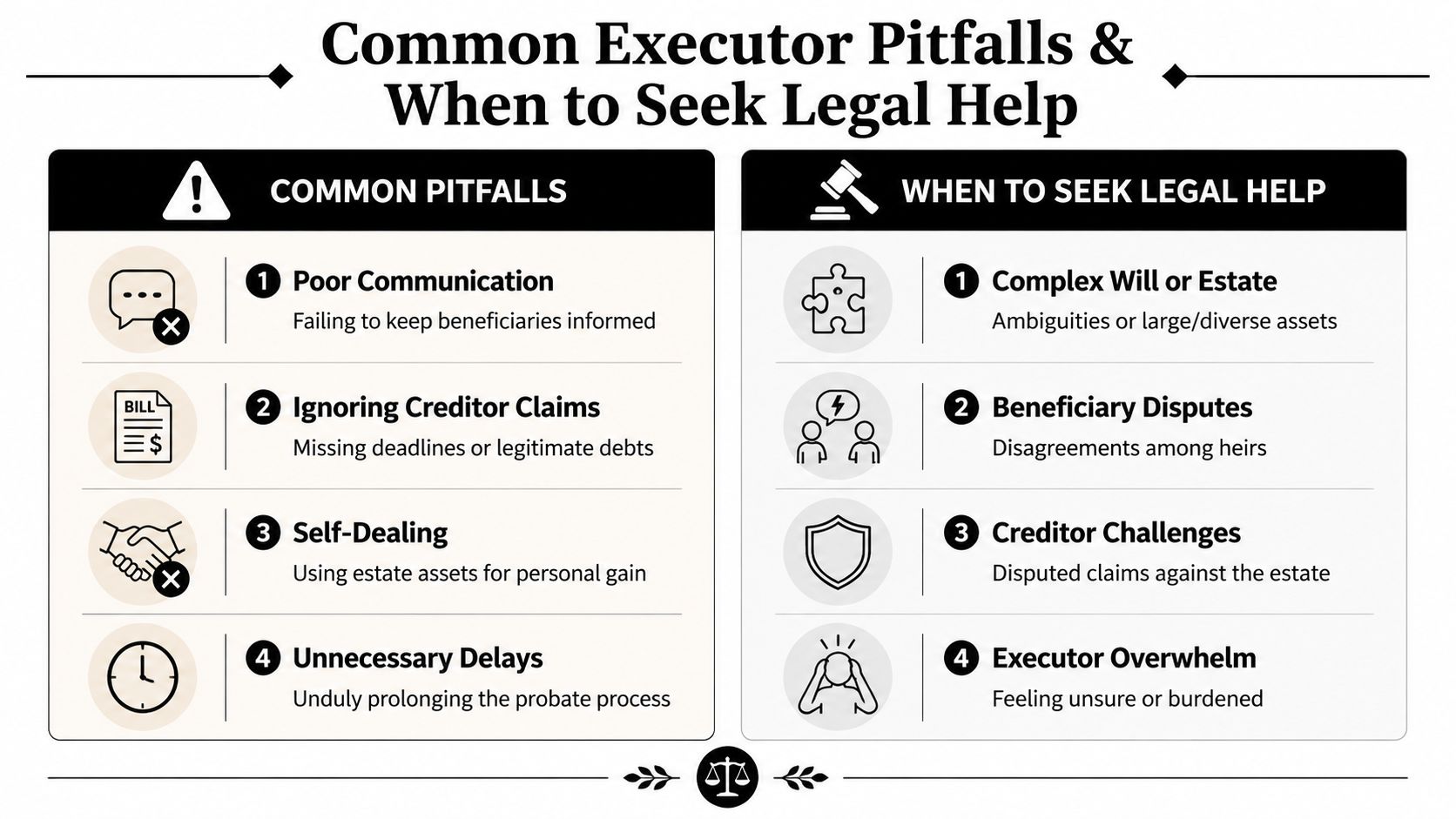
Some errors create risk almost immediately because they cut against the executor's fiduciary duty.
- Acting before authority is formalized: Promising assets, selling property, or distributing money before the court appoints you can create personal exposure
- Mixing funds: Depositing estate money into your account or paying estate expenses without a clear paper trail
- Paying yourself casually: Executor compensation in Texas is tied to the work allowed by law and the way you handle estate funds. It is not a personal draw you take whenever the job feels stressful
- Poor communication: Letting beneficiaries guess about timing, expenses, or what is happening with property
- Using estate property for convenience: Driving the decedent's vehicle regularly, letting a relative stay in estate property without clear authority, or lending out valuables
- Letting pressure control decisions: Giving one heir an early advance or making side agreements to avoid conflict
These problems often build from a mistaken belief that small informal choices will save time. In probate, informal choices often create formal disputes.
When legal help is a wise move
Some estates are straightforward. Others have warning signs early, sometimes before the probate application is even filed.
You should get legal advice promptly if the will is unclear, someone is contesting what the decedent wanted, or you are unsure what you can do before appointment. That early period after death is especially easy to mishandle because practical tasks feel urgent, but your legal authority is still limited.
You should also ask for help if family members are demanding distributions, accusing you of favoritism, refusing to share records, or occupying estate property without agreement. Those situations are easier to address with a clear legal process than with repeated personal explanations.
A third category is less dramatic but just as important. You may need counsel when you are trying hard to do the job correctly and still feel uncertain. That is not weakness. It usually means you understand that fiduciary work requires precision.
A careful executor does not get paid for guessing. Compensation is tied to carrying out fiduciary duties properly, keeping records, and protecting the estate.
For families dealing with conflict outside probate, some disputes are resolved through structured settlement discussions rather than courtroom hearings. In other family law matters, people sometimes consider options such as Divorce. The broader lesson applies here too. Process protects people better than pressure does.
A quick look at that probate resource may also be helpful here:
If you're asking what does an executor do in Texas, the practical answer is this. You protect property, avoid premature distributions, document your actions, and ask for guidance before a preventable mistake turns into a breach of duty.
If you need help navigating probate, executor duties, or estate planning in Texas, contact Law Office of Bryan Fagan, PLLC for a free consultation. A Texas probate attorney can help you understand your responsibilities, protect the estate, and avoid mistakes that could create personal liability or family conflict.