
When someone calls our office asking about What Texas Divorce Law Requires, they are rarely looking for a list of statutes or court procedures. Usually, they are standing at the edge of one of the hardest decisions they have ever faced. The question underneath the legal question is often much more personal: What is going to happen to my children? How much will their lives change? And how do I protect them while everything else seems uncertain?
Those concerns are understandable. Divorce affects more than two spouses ending a marriage. It changes routines, living arrangements, financial realities, and family dynamics. For children, those changes can show up in ways parents do not always expect. A child who was once outgoing may become withdrawn. A student who rarely struggled may begin missing assignments or losing focus. The legal process itself cannot eliminate those challenges, but the decisions parents make during a divorce can have a lasting impact on how children adjust and move forward.
I have seen both versions play out. One family approached the process determined to create stability from the beginning. They developed a parenting plan that kept routines consistent, communicated regularly with teachers and counselors, and focused on minimizing conflict. Their children experienced the transition, but they remained connected, supported, and successful. Another family spent months fighting over issues that had little to do with the children while communication broke down completely. The difference was not that one family loved their children more than the other. The difference was understanding how legal decisions and parenting decisions work together to shape a child’s future.
At the Law Office of Bryan Fagan, PLLC, we believe families deserve more than legal answers. They deserve clarity, education, and a strategy that helps them reclaim peace of mind during life’s most difficult transitions. In this article, we will walk through what Texas divorce law requires, how Texas courts evaluate issues affecting children, and why stability, consistency, and thoughtful planning can make a meaningful difference in your child’s emotional well-being and academic success long after the divorce is finalized.
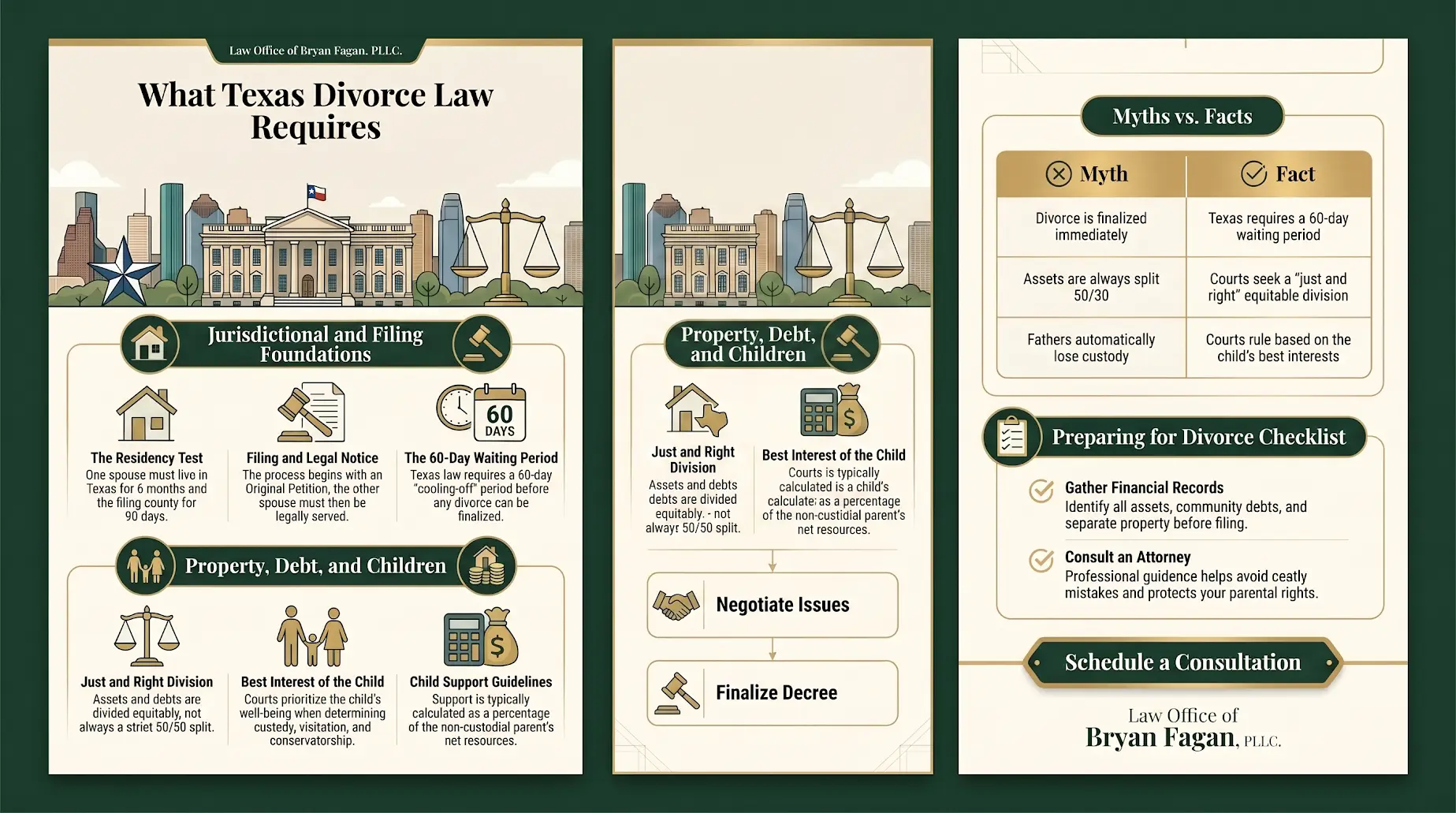
Texas divorce law requires that at least one spouse has lived in Texas for six months and in the filing county for 90 days (Family Code §6.301), that a petition state a legal ground — almost always no-fault “insupportability” under §6.001 — and that the court wait at least 60 days after filing before granting the divorce (§6.702). The court must also divide community property in a “just and right” manner (§7.001) and decide any child custody and support issues.
Key Takeaways
- Residency is the gatekeeper. No Texas court can hear your divorce unless one spouse meets the six-month state and 90-day county thresholds under §6.301.
- Texas is a no-fault state — but fault still matters. You can divorce on “insupportability” without proving wrongdoing, yet fault grounds like adultery or cruelty can shift property division your way.
- The 60-day waiting period is a floor, not a ceiling. §6.702 sets the fastest possible finalization; contested cases routinely run 6–12 months or longer.
- “Community property” does not mean an automatic 50/50 split. Texas requires a “just and right” division under §7.001, which judges can — and do — weight unequally.
- Spousal maintenance is limited and conditional. Under §8.051, it is hard to qualify for and capped — Texas is far stingier than states like California.
- County procedure varies. Harris, Fort Bend, Montgomery, Galveston, and Brazoria each have local rules on standing orders, mediation, and prove-up that change your timeline.

Your Family’s Future Starts Here
Don’t navigate your legal journey alone. Schedule a consultation now and get the clarity and support you deserve.
The Residency Requirement: The First Thing Texas Divorce Law Requires

One of the first and most important aspects of What Texas Divorce Law Requires is meeting Texas residency requirements. Under Texas Family Code §6.301, at least one spouse must have lived in Texas for the six months before filing and in the county where the divorce is filed for at least 90 days. Without satisfying these requirements, a Texas court generally cannot grant a divorce, regardless of whether the parties agree on every issue.
Many people are surprised to learn that only one spouse must meet the residency threshold. In straightforward situations, this allows a divorce to proceed in Texas even if the other spouse has moved out of state. However, questions about domicile, multiple residences, military assignments, or recent relocations can quickly complicate matters. If you are unsure where your divorce should be filed, our guide on how to handle residency disputes in a Texas divorce can help clarify common jurisdictional issues.
Residency is more than a procedural technicality. It establishes the court’s authority to make legally binding decisions regarding property division, spousal maintenance, child custody, and child support. Filing before residency requirements are met or filing in the wrong county can create delays, increase costs, and provide the other party with grounds to challenge the case. In more complex cases involving contested custody matters, significant assets, or interstate disputes, resolving jurisdictional questions early often becomes a critical part of an effective legal strategy.
Understanding this requirement before filing helps families avoid unnecessary setbacks and move through the Texas divorce process with greater confidence. Whether your divorce is relatively straightforward or involves contested issues, taking the time to confirm residency requirements can protect your case, preserve valuable time and resources, and place you in a stronger position as the proceedings move forward.
Because only one spouse must meet residency, military families and recent transplants have more options than they assume. If your spouse has lived in Texas long enough, you can often file here even if you have not — and Texas courts may be far more favorable to your position than the state you just left.
Legal Grounds: What Your Petition Must State
Another important part of What Texas Divorce Law Requires is identifying the legal basis for ending the marriage. Under Texas Family Code §6.001, most divorces are filed on the no-fault ground of insupportability, meaning the marriage has become insupportable because of discord or conflict that destroys the legitimate ends of the marital relationship. In practical terms, Texas does not require one spouse to prove wrongdoing simply to obtain a divorce. For many families, this allows the focus to remain on resolving property, financial, and parenting issues rather than assigning blame.
However, Texas law also recognizes fault-based grounds for divorce, including cruelty (§6.002), adultery (§6.003), felony conviction (§6.004), abandonment (§6.005), and living apart for at least three years (§6.006). While many people assume these grounds rarely matter, that is not always the case. Judges have broad discretion when making a “just and right” division of community property under Texas Family Code §7.001, and evidence of fault can sometimes influence how assets and debts are divided. Readers interested in broader Texas divorce requirements may also find our guide on residency requirements for divorce in Texas helpful for understanding the filing process from the beginning.
In straightforward situations where spouses agree on most issues and there are limited assets, pursuing a no-fault divorce is often the most efficient path forward. In more complex cases involving significant marital property, business interests, hidden assets, or highly contested custody disputes, the decision to allege fault may require careful evaluation. Courts expect credible evidence, financial transparency, and well-supported claims. Where disputes arise, strategic decisions made early in the case can affect negotiations, settlement opportunities, and even the outcome at trial.
Many people treat the grounds for divorce as a simple box to check on a petition. In reality, it can be an important legal and strategic decision that shapes the direction of the entire case. Understanding the difference between no-fault and fault-based divorce grounds allows you to make informed choices, avoid unnecessary mistakes, and develop a legal strategy that aligns with your goals, your family circumstances, and the issues most important to your future.
Pleading fault raises the evidentiary burden and the temperature of the case, but in high-asset divorces it can be worth tens of thousands of dollars in a disproportionate award. The decision turns on what you can actually prove — bring your evidence to a strategy session before you decide.
The 60-Day Waiting Period: How Long a Texas Divorce Really Takes
One of the most frequently misunderstood aspects of What Texas Divorce Law Requires is the mandatory waiting period. Under Texas Family Code §6.702, courts generally cannot finalize a divorce until at least 60 days have passed from the date the Original Petition for Divorce is filed. This waiting period applies in most cases, regardless of whether the divorce is contested or uncontested. As a result, even the most cooperative spouses should not expect a divorce to be completed immediately. For readers navigating filing timelines while relocating, our guide on filing for divorce while transitioning residency in Texas provides additional insight into how timing and jurisdiction can affect the process.
The 60-day period is often called a “cooling-off” period because it gives spouses time to consider important decisions involving property division, child custody, child support, and future financial obligations before a final decree is entered. In straightforward situations where the parties agree on all terms, a divorce may be finalized shortly after day 60, often within 61 to 90 days. Many Texas courts now permit uncontested prove-up hearings by Zoom, helping streamline the final stages of the process. However, the waiting period itself remains mandatory except in limited circumstances involving family violence or protective orders.
In more complex cases, the timeline can extend well beyond the statutory minimum. Where disputes arise over parenting arrangements, community property, business interests, or financial disclosures, the case may require mediation, discovery, temporary orders, or trial preparation. Judges expect parties to comply with court deadlines, provide accurate financial information, and demonstrate credibility throughout the process. If children are involved, courts applying Texas Family Code §§153.002 and 153.134 will focus heavily on stability, parental involvement, and the best interest of the child when evaluating proposed custody arrangements.
A common mistake is assuming that agreement alone can eliminate the waiting period or that delaying preparation until the end of the 60 days will speed things up. In reality, early planning often creates the greatest opportunities to protect your interests and avoid unnecessary delays. Understanding how the waiting period fits into the broader Texas divorce process allows families to set realistic expectations, make informed decisions, and move forward with greater confidence and peace of mind.
What Texas Divorce Law Requires, at a Glance
| Category | What Texas Law Says | Practical Impact |
|---|---|---|
| Residency | 6 months in Texas + 90 days in county (§6.301) | Only one spouse must qualify; sets which court hears your case. |
| Grounds | No-fault insupportability (§6.001) or fault grounds (§§6.002–6.006) | No blame required, but proven fault can shift property. |
| Waiting period | Minimum 60 days after filing (§6.702) | Fastest finalization is day 61; contested cases run far longer. |
| Property | “Just and right” division of community property (§7.001) | Not automatic 50/50; judges can divide unequally. |
| Maintenance | Limited eligibility and caps (§8.051) | Hard to qualify; far more restrictive than many states. |
Property Division: What “Just and Right” Actually Requires

A major part of What Texas Divorce Law Requires involves dividing marital property under Texas Family Code §7.001. Many people enter the divorce process believing Texas is a strict 50/50 divorce state, but that is one of the most common misconceptions in Texas family law. While Texas is a community property state, courts are required to divide the community estate in a manner that is “just and right.” That distinction matters because a fair division is not always an equal division. Judges have discretion to consider the unique circumstances of each family when determining how assets and debts should be allocated.
In general, community property includes assets acquired during the marriage, while separate property typically consists of assets owned before marriage or received through gift or inheritance. However, identifying which assets belong in each category is often more complicated than people expect. Bank accounts may contain commingled funds, retirement accounts may include both separate and community interests, and businesses can raise significant valuation questions. In straightforward situations with limited assets and few disputes, property division may be relatively simple. In more complex cases involving real estate portfolios, closely held businesses, professional practices, or substantial investments, proper asset characterization becomes a critical part of the legal strategy.
Texas courts may also consider factors such as earning capacity, fault in the breakup of the marriage, financial misconduct, future financial needs, and who will have primary responsibility for the children. If children, significant assets, or contested issues are involved, the financial decisions made during divorce can have long-term consequences that extend well beyond the final decree. Judges expect financial transparency, credible evidence, and complete disclosure of assets and liabilities. Attempts to conceal property or understate income often create additional litigation and can negatively impact the outcome of the case. Readers seeking additional information about residency-related filing issues can review exceptions to residency requirements in a Texas divorce, while those evaluating asset division may benefit from learning more about community property division in Texas.
Questions such as “Who gets the house?” or “What is a spouse entitled to in a Texas divorce?” rarely have simple answers. The outcome depends on the nature of the asset, the evidence supporting its classification, and the specific facts of the case. Understanding these principles early allows families to make informed decisions, avoid costly mistakes, and develop a strategy that protects both their financial future and the people who depend on them.
“Community property is the starting point, not the formula. Texas requires a just-and-right division — and ‘just and right’ is rarely a clean split down the middle.”
Children, Custody, and Support: What the Court Will Not Let You Skip
When children are involved, What Texas Divorce Law Requires extends far beyond ending a marriage. Before a Texas court can finalize a divorce, it must resolve conservatorship, possession and access, and child support. Texas Family Code §153.002 makes the guiding principle clear: every decision must be made in the best interest of the child. Judges will not approve a final decree that leaves important parenting issues unresolved, and they expect parents to present thoughtful, workable plans that promote stability, consistency, and the child’s overall well-being.
Many parents are surprised to learn that Texas’s preference for Joint Managing Conservatorship does not automatically mean equal parenting time. Instead, it generally means both parents retain certain rights and responsibilities regarding major decisions affecting the child. Courts evaluating custody arrangements often look beyond schedules and focus on factors such as parental involvement, communication, educational stability, compliance with court orders, and each parent’s ability to meet the child’s emotional and developmental needs. Readers seeking a broader understanding of filing requirements may also find our guide on Texas residency requirements for divorce helpful when preparing for the divorce process.
Child support is another issue courts take seriously. Texas child support obligations are generally calculated using statutory guidelines based on the paying parent’s net resources, but every family’s circumstances are unique. In straightforward situations where parents communicate effectively and agree on parenting responsibilities, these issues can often be resolved efficiently. In more complex cases involving contested custody disputes, relocation concerns, special-needs children, high-conflict co-parenting, or CPS-related issues, developing a parenting strategy often requires significantly more planning and preparation. Courts expect honesty, financial transparency, and a demonstrated commitment to placing the child’s interests above parental conflict.
One of the most common mistakes parents make is focusing heavily on property division while underestimating the long-term impact of custody and parenting decisions. The parenting plan established during a divorce can influence a child’s daily life, education, extracurricular activities, and relationships for years to come. Understanding these requirements early allows parents to make informed decisions, avoid unnecessary disputes, and create a foundation that protects both their children’s future and their own peace of mind as they move forward.
Will your spouse cooperate with the divorce?
An agreed, uncontested divorce moves far faster than a contested one.
Yes — we mostly agree Not sure yet No — we disagree on major issues ← Start overDo you and your spouse have minor children together?
Cases with children require the court to resolve custody and support before finalizing.
No minor children Yes — we have minor children ← BackHas either spouse met the Texas residency rule?
One spouse must have lived in Texas 6 months and in the filing county 90 days (§6.301).
Yes — residency is met I think so No / not yet ← BackRoughly 61–90 days
Because your case looks uncontested and residency appears met, you are on the fastest track Texas allows. The law still requires the mandatory 60-day waiting period (§6.702), so day 61 is the earliest finalization. Getting the paperwork and waiver right is what keeps you on schedule.
Often 6–12 months or longer
When spouses disagree on major issues like property, a business, or children, the case becomes contested and typically runs well past the 60-day minimum. Most Texas counties require mediation before trial, which resolves a large share of disputes. How you position the case in the first few weeks heavily affects how long it takes.
Residency may need to be resolved first
A Texas court cannot grant your divorce until one spouse meets the 6-month state and 90-day county residency rule under §6.301. If neither of you qualifies yet, the timeline starts once residency is established — but there may be options depending on where each spouse lives. This is worth a direct conversation before you file anywhere.
How long will your Texas divorce take?
Answer four quick questions for an estimate based on Texas law. This is general guidance, not legal advice about your specific case.
Start the estimate →Custody and support are where most Texas divorces get hard. Get a clear read on your position before the other side does.
Schedule a Strategy SessionSpousal Maintenance: What Texas Law Allows — and Limits
Texas divorce law requires a spouse seeking maintenance to clear specific eligibility hurdles under Family Code §8.051 (2025), and even then the amount and duration are capped. Texas does not have generous “alimony” in the way popular culture suggests.
In general, a spouse must show they cannot meet minimum reasonable needs and that the marriage lasted at least 10 years (or that there is family violence, a disability, or care of a disabled child). Awards are limited by statutory caps on both monthly amount and number of years. Compared to states like California or New York, where long-term spousal support is common, Texas is markedly more restrictive.
If you are counting on maintenance, or worried about paying it, do not assume the outcome from what you have heard about other states. The Texas rules are narrow and specific — map your facts to §8.051 before you negotiate.
The Texas Divorce Process, Step by Step
| Step | Typical Timeline | Action Item |
|---|---|---|
| Confirm residency | Before filing | Verify the 6-month / 90-day rule and the correct county. |
| File the Original Petition | Day 0 | File with the district clerk; pay the filing fee. |
| Serve or waive service | Days 0–30 | Serve your spouse or have them sign a Waiver of Service. |
| Waiting period runs | Days 0–60 | Negotiate; complete inventories; mediate if contested. |
| Finalize (prove-up) | Day 61+ (uncontested); 6–12+ mo (contested) | Present the agreed decree, often by Zoom in many counties. |
Common Misunderstandings About What Texas Divorce Law Requires

The most damaging misunderstanding is that Texas is a 50/50 divorce state. It is a community property state, which is not the same thing — the court divides the community estate in a just-and-right manner that can be far from even.
A second is that filing first does not matter. It can: the petitioner sets the county, frames the issues, and in some courts presents evidence first at trial. A third is that you can speed past the 60-day waiting period by agreeing — you cannot, outside the narrow family-violence exceptions. And a fourth is that an online “DIY” divorce is risk-free; it is fine for the simplest cases but routinely creates expensive problems when property or children are involved.
Signing a Waiver of Service or an agreed decree you do not fully understand is one of the costliest mistakes in Texas family law. Once a decree is final, undoing an unfair property division is extremely difficult. Have the agreement reviewed before you sign — not after.
County-by-County: How Procedure Differs Across the Houston Metro
While Texas Family Code requirements apply statewide, the county where you file shapes your day-to-day experience. Standing orders, mediation expectations, and prove-up logistics differ across Harris, Fort Bend, Montgomery, Galveston, and Brazoria counties.
In Harris County (Houston), automatic standing orders take effect at filing and most courts expect mediation before a contested trial. Fort Bend (Sugar Land, Katy) and Montgomery (The Woodlands, Conroe) run their own family courts with local rules on scheduling and prove-up. Galveston (Pearland-adjacent areas) and Brazoria have smaller dockets that can move faster or slower depending on the court. The statute is uniform; the courthouse is not.
If your case crosses county lines — you live in one, your spouse in another — the residency and venue rules determine where you can and should file. That choice can meaningfully affect your timeline and even your judge.
| County | Primary Cities | What to Expect |
|---|---|---|
| Harris | Houston, Spring, Cypress | Standing orders at filing; mediation expected before trial. |
| Fort Bend | Sugar Land, Katy | Dedicated family courts; local scheduling rules. |
| Montgomery | The Woodlands, Conroe | Own local rules; Zoom prove-up common in simple cases. |
| Galveston | League City, Galveston | Smaller docket; timeline varies by court. |
| Brazoria | Pearland, Angleton | Local procedure; confirm venue if spouse is out-of-county. |
Costly Mistakes and Deadlines Texas Divorce Law Punishes
The most expensive mistakes in a Texas divorce are usually procedural, not emotional. Filing before residency is met, missing a response deadline after being served, violating a standing order by moving money or property, and signing a decree without understanding the property characterization all create damage that is hard to reverse.
Deadlines are real. Once you are served, you have a limited window to file an answer or risk a default. Standing orders restrict what you can do with assets and children the moment the case is filed. And the just-and-right division is decided once — there is no easy do-over after the decree is signed.
One missed deadline can cost you leverage you never get back. Get your case mapped before the clock starts.
Schedule a Strategy SessionWhat to Do If You’re Dealing With a Texas Divorce
- 1. Confirm residency. Verify the 6-month state and 90-day county thresholds under §6.301 before doing anything else.
- 2. Inventory your assets and debts. List everything and note what is community versus separate property — this drives the entire division.
- 3. Decide on grounds. Determine whether to file no-fault or plead a fault ground that could shift property your way.
- 4. Choose the right county. File where venue and residency rules allow — it affects your timeline and your court.
- 5. Respect standing orders. Once filed, do not move money, sell assets, or relocate children in violation of automatic orders.
- 6. Calendar your deadlines. If served, note your answer deadline immediately to avoid a default judgment.
- 7. Build your parenting plan. If you have children, treat conservatorship and support as the center of the case.
- 8. Do not sign blind. Have any waiver or decree reviewed before signing — an unfair final order is hard to undo.
- 9. Book a strategy session. Map your specific facts to the requirements above with a Texas family law attorney before you file.
Know exactly what Texas divorce law requires of you.
Bring your situation to a Legal Strategy Session and walk out with a clear, specific plan for your case.
Schedule a Strategy SessionWhat I Tell Every Client Who Calls About a Texas Divorce
What Texas divorce law requires is not mysterious: meet residency, state a ground, clear the 60-day waiting period, and resolve property and children in a just-and-right way. The requirements are fixed. What is not fixed is how well you position yourself within them — and that is decided in the first few weeks, often before anyone files a single document.
The clients who come out ahead are the ones who understood the rules before the other side forced them to. They knew their property was not automatically split down the middle, they did not sign anything they had not had reviewed, and they treated deadlines as the hard lines the law makes them. The clients who struggle are almost always the ones who assumed Texas worked like television, or like the state they moved from.
If you are facing a divorce in Houston, Sugar Land, The Woodlands, Katy, Spring, Pearland, Cypress, or anywhere in Texas, the next move is simple: get your specific facts mapped to these requirements before you act. Call (281) 810-9760 or book a Legal Strategy Session, and let’s build your plan.
Conclusion:
Understanding What Texas Divorce Law Requires is about more than meeting legal deadlines or satisfying court procedures. It is about making informed decisions that protect your future and create stability for the people who matter most. In straightforward situations, that may mean working through an agreed divorce with a clear plan and minimal conflict. In more complex cases, especially those involving children, business interests, significant assets, relocation concerns, or disputes over custody and support, the stakes are often much higher and require a more strategic approach.
Every family’s circumstances are different, which is why there is no one-size-fits-all solution in Texas family law. If your case involves questions about your child’s well-being, educational stability, parenting arrangements, or protecting assets you’ve worked hard to build, having the right guidance can make a meaningful difference. At the Law Office of Bryan Fagan, PLLC, our goal is to provide the clarity, education, and practical legal counsel families need to move forward with confidence. By understanding your options early and developing a plan tailored to your situation, you can take control of the process instead of letting the process control you.
Questions My Clients Ask About What Texas Divorce Law Requires
Yes. Texas allows you to divorce on the no-fault ground of “insupportability” under Family Code §6.001, meaning you do not have to prove your spouse did anything wrong. Texas also keeps fault grounds like adultery and cruelty available, and proving fault can affect how the court divides property. Most of my clients file no-fault, but we always evaluate whether pleading fault would help.
No, not in the way people mean. Texas is a community property state, and the court must divide the community estate in a “just and right” manner under §7.001. That often lands near 50/50, but a judge can divide unequally based on fault, earning capacity, custody, and other factors. Assuming an automatic even split is one of the most common and costly errors I see.
The law requires a minimum 60-day waiting period after filing under §6.702, so the fastest a divorce can finalize is day 61. An uncontested case typically runs 61 to 90 days. A contested case — where you disagree on property or children — commonly takes 6 to 12 months or longer. Many counties now allow uncontested prove-ups by Zoom, which can speed the final step.
First, confirm residency — one spouse must have lived in Texas six months and in the filing county 90 days. Then file an Original Petition for Divorce with the district clerk and pay the filing fee. Your spouse is served or signs a waiver, the 60-day clock runs, and you resolve property and any child issues before finalizing. The steps are straightforward; the strategy behind them is where having counsel matters.
Texas divorce law is gender-neutral — entitlements do not depend on being a husband or wife. Either spouse is entitled to a just-and-right share of the community estate, and either may seek spousal maintenance if they meet the strict §8.051 criteria. What you actually receive depends on the characterization of assets as community or separate and on the just-and-right factors, not on your role in the marriage.
Cost depends almost entirely on whether the case is contested. Court filing fees generally run a few hundred dollars. An uncontested, agreed divorce is relatively inexpensive, while a contested case involving property disputes or custody fights can cost substantially more because of the hours required. The biggest cost driver is conflict — the more you and your spouse disagree, the more the case costs.
You can file the petition electronically in most Texas counties, and uncontested prove-up hearings are increasingly available by Zoom. But “filing online” is not the same as a DIY divorce being a good idea. For cases with real property, retirement accounts, a business, or children, an online form often misses issues that surface painfully later. Use online filing for logistics, not for legal judgment.
It depends on whether the house is community or separate property and on the just-and-right division. If the home was bought during the marriage, it is usually community property and subject to division — one spouse may keep it and buy out the other, or it may be sold. If a parent has primary custody, courts sometimes award them the home to keep the children stable. Characterization and custody drive the outcome.
An uncontested divorce — where both spouses agree on everything — can finalize shortly after the mandatory 60-day waiting period, often in the 61-to-90-day range. The exact timing depends on how quickly your spouse signs a waiver or is served, how fast you complete the paperwork, and your county’s prove-up scheduling. Agreement is what makes it fast; the law still requires the 60 days.
When children are involved, the court must resolve conservatorship, possession and access, and child support under the best-interest standard before finalizing. Texas presumes joint managing conservatorship for decision-making, and child support follows statutory guidelines based on the paying parent’s net resources. The parenting plan is usually the most contested part of the case, so it deserves the most attention early.
Still have a question this guide did not answer? That is exactly what a Legal Strategy Session is for.
Schedule a Strategy Session