
Asset Division Attorneys in Houston Heights, Texas: How Your Property Is Actually Split in a Divorce

The first question almost every client asks when they sit down across my desk in the Heights is some version of, “What do I actually get to keep?” If you’re searching for Asset division Attorneys in Houston Heights Texas, chances are you’re looking at a home you’ve spent years paying for, a retirement account that represents decades of hard work, maybe a family business, investment accounts, or even debt you never expected to be arguing over. Now someone who once helped build that life has a very different opinion about who owns what. If that feels overwhelming, you’re not alone. The good news is that Texas law provides a framework for answering those questions, and understanding how that framework works is often the first step toward protecting what you’ve built.
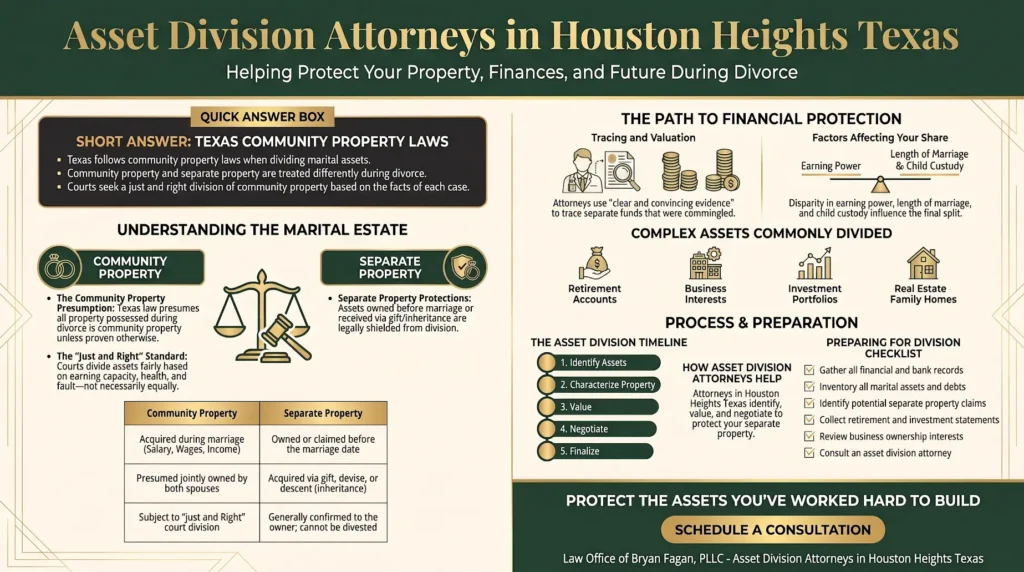
Texas is a community property state, but that phrase is one of the most misunderstood concepts in divorce. It doesn’t automatically mean every asset is divided equally, and it doesn’t guarantee that the spouse who earned more receives a larger share. Instead, Texas courts begin with the presumption that property acquired during the marriage belongs to the community estate and then divide that estate in a manner the judge considers “just and right” under the Texas Family Code. The outcome often depends on how property is characterized, valued, and documented long before anyone walks into a courtroom.
After helping Texas families navigate divorce for years, I’ve learned that property division is rarely just about numbers on a financial statement. Behind every retirement account is a career. Behind every house is a lifetime of memories. Behind every closely held business is years of sacrifice and risk. The clients who achieve the best outcomes are rarely the ones who argue the loudest—they’re the ones who understand the law, gather the right evidence, and develop a strategy before critical decisions are made.
One conversation from not long ago still stands out. A homeowner from the Heights came into my office convinced the home was unquestionably separate property because only her name appeared on the deed. As we dug into the financial records, we discovered the down payment and years of mortgage payments had been made with income earned during the marriage. What looked like a straightforward case quickly became a complex property characterization dispute involving well over $150,000 in equity. By carefully tracing the source of the funds and addressing the issue before temporary orders were entered, we were able to protect a significant portion of her financial interests. Cases like that remind me every day that timing, preparation, and understanding Texas law can change the outcome of a divorce.
In this guide, I’ll explain how Texas courts divide community property, what qualifies as separate property, how debts and high-value assets are handled, when reimbursement and tracing claims can dramatically affect the final division, and the practical strategies that help families protect their financial future. My goal is the same as it has always been: to give you the knowledge and confidence to make informed decisions so you can move forward with greater clarity, security, and peace of mind.
The Bottom Line
In Texas, asset division means a court divides the community estate — property acquired during the marriage — in a way that is “just and right” under Texas Family Code §7.001, which is not always equal. Separate property you owned before marriage or received by gift or inheritance stays yours if you can prove it. The fight is usually over characterization, valuation, and reimbursement.
Key Takeaways
- Community property is presumed. Under Texas Family Code §3.003, everything either spouse holds at divorce is presumed community unless you prove otherwise.
- “Just and right” is not 50/50. Judges can award an unequal split based on fault, earning capacity, and who has the children.
- Separate property must be traced. A clear paper trail is the difference between keeping an inheritance and losing it to the community estate.
- Reimbursement claims move real money. If community funds paid down your spouse’s separate mortgage, the estate may be owed reimbursement under §3.402.
- Retirement and businesses are the hidden battlegrounds. A QDRO and a defensible valuation often matter more than the house.
- Temporary orders set the tone. What happens at the first hearing frequently shapes the final division.

Your Family’s Future Starts Here
Don’t navigate your legal journey alone. Schedule a consultation now and get the clarity and support you deserve.
Family lawyers and attorneys advise our clients of the immediate aftermath as well as the long-term effects of Family Law related issues, such as the following:
Trust us to help you with your Family Law Attorneys in the Houston Heights in Texas. Call (281) 245-1776 or contact us online today to schedule a free consultation with your Family Law Attorney in Humble, Texas.
How Texas Law Divides Assets in a Divorce

Asset division Attorneys in Houston Heights Texas regularly help clients understand that Texas does not automatically divide marital property equally. Instead, Texas Family Code §7.001 requires courts to divide the community estate in a manner that is “just and right,” giving judges flexibility to reach a fair outcome based on the unique facts of each divorce. If you’d like a broader overview of the process, visit our guide to asset division in Houston Heights.
The foundation of every Texas property division case is determining what belongs to the community estate and what qualifies as separate property. Under Texas Family Code §§3.001 and 3.002, most assets acquired during the marriage are considered community property, while assets owned before marriage, along with gifts and inheritances, generally remain separate property. However, homes, retirement accounts, businesses, investment portfolios, and even cryptocurrency can become the subject of complex property characterization and tracing disputes when community and separate funds have been mixed.
Texas Family Code §3.003 also creates an important presumption that all property owned at the time of divorce is community property unless proven otherwise with clear and convincing evidence. Financial records, closing documents, bank statements, inheritance records, and other documentation often determine whether a spouse successfully establishes a separate-property claim or reimbursement claim. In straightforward situations, organized records may resolve these issues through negotiation or mediation. In more complex cases involving business ownership, substantial real estate holdings, retirement accounts requiring QDROs, or hidden assets, detailed financial analysis and strategic legal preparation often become essential.
Unlike states that require an almost equal division of marital property, Texas combines a community property system with a fairness-based approach that allows judges to evaluate the evidence presented in each case. That is why preparation matters. Understanding how Texas courts analyze valuation, documentation, credibility, and property characterization before negotiations begin can help protect your financial future and position you for a stronger outcome throughout the divorce process.
| Category | What Texas Law Says | Practical Impact |
|---|---|---|
| Community property | Acquired during marriage; presumed divisible (§3.002, §3.003) | Default bucket; you must prove anything out of it |
| Separate property | Pre-marriage, gifts, inheritance (§3.001) | Stays yours only if traced with clear evidence |
| Reimbursement claim | One estate pays another’s debt or asset (§3.402) | Can shift tens of thousands at division |
What this means for you: If you can document where an asset came from, Texas law is on your side. Most “lost” separate property is not lost on the merits — it is lost because no one kept the records. Bring statements early.
Community vs. Separate Property: The Distinction That Decides Most Cases
Asset division Attorneys in Houston Heights Texas often tell clients that the biggest disputes in a Harris County divorce are not about who earned more money or whose name appears on a deed. Instead, they center on property characterization—whether an asset belongs to the community estate or qualifies as separate property under Texas Family Code §§3.001 and 3.002. A home purchased during the marriage is generally presumed to be community property, even if only one spouse is listed on the title. Likewise, an inheritance that begins as separate property can become much harder to protect if it is mixed with community funds. If you’re considering putting down roots in the area, our guide to moving to the Heights offers helpful information about the community many of our clients call home.
Texas Family Code §3.003 presumes that property owned at the time of divorce belongs to the community estate unless a spouse proves otherwise with clear and convincing evidence. That is why separate property tracing is so important. In my experience, the strongest cases are built with organized financial records that clearly show where money originated and how it moved over time. Bank statements, closing documents, inheritance records, brokerage accounts, and retirement statements often become the evidence that determines whether an asset remains separate or becomes subject to Texas property division.
In straightforward situations, tracing may involve only a few financial accounts and can often be resolved through negotiation or mediation. In more complex cases involving business ownership, investment properties, executive compensation, cryptocurrency, reimbursement claims under Texas Family Code §3.402, or substantial retirement assets, tracing frequently requires forensic accountants, valuation experts, and careful financial analysis. Where spouses disagree over commingled assets or inherited property, preparation and documentation often matter far more than emotion.
The lesson is simple: protecting separate property starts long before anyone enters a courtroom. Understanding how Texas courts evaluate financial records, credibility, and property characterization can help you avoid costly mistakes and preserve the assets you’ve worked hard to build. The sooner you understand how community and separate property rules apply to your circumstances, the more options you’ll have for protecting your financial future.
Strategy note: Open a separate account for any inheritance or pre-marriage funds the day they arrive and never deposit marital income into it. That one habit preserves more separate property than any argument I can make later.
What Clients Get Wrong About Dividing Assets
Asset division Attorneys in Houston Heights Texas frequently meet clients who believe Texas law requires every divorce to end with a 50/50 split. That simply is not how the law works. Under Texas Family Code §7.001, judges divide the community estate in a manner that is “just and right,” which may result in an unequal division depending on factors such as the size of each spouse’s separate estate, earning capacity, reimbursement claims, fault in the breakup of the marriage, or waste of community assets. If you’re looking for a broader overview of the process, our guide to property division in Greater Heights explains how Texas courts approach dividing marital property.
Another common misconception is that ownership depends on whose name appears on the title or account. In reality, Texas courts focus on property characterization. A home, investment account, or business interest titled in one spouse’s name may still be community property if it was acquired during the marriage. Likewise, inherited property or gifts can lose their separate character if they are commingled with community funds and cannot be traced through reliable financial records. Documentation—not assumptions—often determines the outcome.
Retirement accounts create another costly mistake. Many people assume a 401(k), pension, IRA, or other retirement benefit belongs entirely to the account holder. In many cases, however, the portion earned during the marriage is part of the community estate and may require a Qualified Domestic Relations Order (QDRO) to divide it correctly. An improperly prepared QDRO can create unnecessary taxes, penalties, or enforcement problems long after the divorce is final.
In straightforward situations involving a limited number of assets, these issues can often be resolved through careful negotiation or mediation. In more complex cases involving business ownership, executive compensation, multiple real estate holdings, substantial retirement accounts, reimbursement claims, or hidden assets, early financial analysis and experienced legal strategy become increasingly important. Understanding how Texas courts evaluate valuation evidence, property characterization, and financial documentation before negotiations begin can help protect the assets you’ve worked hard to build and prevent expensive mistakes that are difficult to undo later.
What Matters in a Contested Asset Division

Asset division Attorneys in Houston Heights Texas know that contested property division cases are rarely decided by emotion alone. In Harris County, the outcome often turns on three critical issues: accurate valuation, proper property characterization, and well-supported reimbursement claims. Whether the dispute involves a closely held business, investment property, executive compensation, retirement accounts, or commercial real estate, judges rely on credible evidence rather than estimates or assumptions. If you’d like to learn more about how Texas courts approach these issues in another historic neighborhood, visit our guide to property division in Winnetka Heights.
Valuation is often where high-value divorce cases are won or lost. A family business, professional practice, rental property, or investment portfolio is only as persuasive as the evidence supporting its value. In my experience, courts place significant weight on qualified appraisals, business valuations, financial disclosures, and expert testimony when spouses present competing opinions. When significant assets are involved, preparation long before mediation or trial frequently makes the difference between a favorable settlement and an expensive courtroom dispute.
Reimbursement claims under Texas Family Code §3.402 are another issue many people overlook. If community income was used to reduce the mortgage on a spouse’s separate property, improve a separately owned business, or enhance another separate asset, the community estate may have a claim for reimbursement. These cases depend on organized financial records, tracing evidence, and documentation that clearly demonstrates how community funds benefited separate property. Without that evidence, even a valid claim may be difficult to prove.
In straightforward situations, accurate financial records and productive negotiation may resolve most property disputes without extensive litigation. In more complex cases involving business ownership, substantial retirement assets, multiple real estate holdings, hidden assets, reimbursement claims, or disagreements over valuation, strategic preparation becomes essential. Understanding how Texas courts evaluate documentation, credibility, and financial evidence before temporary orders or mediation can help protect your financial interests and position you for a stronger outcome throughout the divorce process.
§7.001
The “just and right” division standard
Not 50/50
Unequal splits are common and legal
QDRO
Required to divide most retirement plans
Strategy: How to Protect Your Share
The strongest asset division strategy starts before the first hearing. Gather statements for every account going back to the marriage date, identify which assets you will claim as separate, and document the tracing for each. Temporary orders often dictate who stays in the house and who controls accounts during the case, and that early footing frequently shapes the final split.
From there, the work is prioritization: decide which assets you actually want versus which you are arguing over for leverage. Keeping a house you cannot afford to maintain is rarely a win. A clear-eyed view of after-tax, after-cost value beats an emotional attachment to a specific asset every time.
| Scenario | Likely Outcome | What to Do |
|---|---|---|
| Inheritance deposited into joint account | At risk of being treated as community | Trace it now; pull every statement |
| Spouse’s separate home paid with marital income | Reimbursement claim for the community (§3.402) | Document mortgage payments from joint funds |
| Retirement earned during marriage | Community portion is divisible | Insist on a properly drafted QDRO |
| Closely held business | Valuation fight; outcome depends on method | Retain a credible valuation expert early |
Mistakes, Risks, and Deadlines That Cost People Their Fair Share
Asset division Attorneys in Houston Heights Texas often remind clients that the strongest property division strategy begins long before the first court hearing. Start by gathering statements for every bank account, retirement account, investment portfolio, mortgage, loan, and business interest dating back to the beginning of the marriage. Identify any assets you believe qualify as separate property and preserve the financial records needed to trace them. Temporary orders frequently determine who remains in the family home, who manages community accounts, and how financial obligations are handled while the divorce is pending, making early preparation one of the most valuable steps you can take. If you’re thinking beyond the divorce and planning for the future, our guide to asset protection and business planning in Houston Heights provides additional strategies for protecting what you’ve worked to build.
A successful strategy also means deciding which assets truly matter to your long-term financial security. Clients sometimes focus on keeping the family home without considering future mortgage payments, maintenance costs, tax consequences, or whether another asset—such as retirement accounts, investment property, or a business interest—offers greater long-term value. Looking beyond emotional attachment and evaluating the after-tax, after-cost value of each asset often leads to stronger financial decisions and more productive settlement negotiations.
In straightforward situations involving a limited number of assets, careful organization and realistic negotiation may produce an efficient resolution through mediation. In more complex cases involving closely held businesses, executive compensation, multiple real estate holdings, reimbursement claims, separate-property tracing, or high-value retirement accounts requiring QDROs, strategic preparation becomes even more important. Judges in Harris County expect credible financial records, well-supported valuations, and organized evidence—not assumptions or last-minute documentation.
The best way to protect your share is to prepare before disagreements become more expensive and more difficult to resolve. Gathering documents early, understanding how Texas community property laws apply to your circumstances, and developing a clear legal strategy before temporary orders or mediation can significantly improve your position. The more informed and organized you are from the beginning, the better equipped you’ll be to protect your financial future and move through the divorce process with confidence.
Warning: Moving community funds out of reach before or during a divorce is the fastest way to lose a judge’s trust — and a chunk of your estate. If you think your spouse is doing this, document it and raise it at temporary orders, do not retaliate.
How Harris County Handles Asset Division

In Harris County, asset division cases run through the family district courts, and most contested property issues are first shaped at the temporary orders hearing. Heights residents file here, and local practice favors parties who arrive with organized financial disclosures and a clear inventory of community and separate property. Judges expect a sworn inventory and appraisement, and the quality of that document often sets the tone for the entire case.
Because Harris County dockets are busy, mediation is strongly encouraged and frequently ordered before trial. A well-prepared division proposal going into mediation is worth more than a strong argument at trial you may never reach.
Listen to Our Texas Family Law Podcast
Prefer listening? In this episode, we discuss asset division in Houston Heights, Texas, including why property is not always split 50/50, what factors courts may consider, and how to protect your financial interests during divorce.
Where Nearby Counties Differ
The Texas Family Code applies statewide, so the substantive law on community property is the same in Fort Bend, Montgomery, Galveston, and Brazoria counties as it is in Harris. What differs is local procedure: standing orders, mediation requirements, inventory deadlines, and individual judges’ expectations. A division strategy that lands well in a Houston court may need adjusting in Conroe or Sugar Land.
If you live in the Heights but your spouse has moved to a neighboring county, venue can become its own dispute. Where the case is filed affects which local rules and which judge you draw, so it is worth resolving venue early rather than litigating it later.
Used the checker above? Let’s turn that result into a real plan.
Schedule a Legal Strategy SessionWhat to Do If You’re Facing Asset Division in the Heights
- Pull every financial statement back to your marriage date — accounts, retirement, property, debts.
- List separate-property claims and gather the documents that trace each one to its source.
- Inventory community assets and debts in writing; you will need a sworn version anyway.
- Identify reimbursement claims — any time marital money paid a separate debt or asset.
- Get defensible valuations for the house, any business, and complex assets.
- Do not move or hide money — it is the fastest way to lose a judge’s trust.
- Decide what you actually want versus what you are arguing for leverage.
- Prepare for temporary orders — early footing shapes the final division.
- Plan the QDRO before you sign anything dividing retirement.
- Book a strategy session before the first hearing, not after.
Want this checklist turned into a plan for your specific assets?
Schedule a Legal Strategy SessionWhat I Tell Every Client Who Calls About Asset Division

Asset division Attorneys in Houston Heights Texas often begin every consultation with the same message: Texas property division is neither a guessing game nor an automatic 50/50 split. It is a legal process built on well-established rules involving the community property presumption, separate-property tracing, reimbursement claims, and the court’s obligation to reach a “just and right” division under Texas Family Code §7.001. The clients who achieve the strongest outcomes are usually the ones who understand those rules early and prepare their financial evidence before negotiations begin. If retirement benefits are part of your marital estate, our guide to whether a pension is a separate or community asset explains how Texas courts evaluate one of the most valuable assets many couples own.
Over the years, I’ve noticed that the clients who lose the most ground are rarely those with the weakest legal position—they’re the ones who wait too long to act. Financial records become harder to locate, accounts continue to change, reimbursement claims become more difficult to document, and temporary orders may be entered before a clear strategy is in place. Whether your divorce involves a family home, retirement accounts, business interests, investment property, or separate property claims, early organization almost always creates more options later.
In straightforward situations involving limited assets, careful documentation and productive negotiation may be enough to resolve property division efficiently. In more complex cases involving high-value real estate, business ownership, executive compensation, pensions requiring QDROs, hidden assets, or disputes over separate property tracing, strategic legal preparation becomes significantly more important. Courts look closely at financial records, valuation evidence, credibility, and documentation when deciding how to divide the community estate fairly.
My advice is always the same: don’t wait until you’re reacting to your spouse’s strategy. Take the time to gather your financial statements, understand what you own, identify potential separate-property claims, and learn how Texas law applies to your circumstances. The earlier you understand your rights and responsibilities, the better positioned you’ll be to protect your financial future and move through the divorce process with greater confidence and clarity.
Protect what you’ve built. Get a clear read on your division before the first hearing.
Schedule a Legal Strategy Session or call (281) 810-9760Conclusion:
Dividing property in a Texas divorce is about more than deciding who gets the house or how retirement accounts are split. It’s about protecting the financial foundation you’ll rely on long after the divorce is over. Whether you’re concerned about community debt, a family business, separate property claims, or simply making sure the division is fair, understanding your rights today can prevent costly mistakes tomorrow. That’s why so many families turn to Asset division Attorneys in Houston Heights Texas who can explain the law clearly and develop a strategy tailored to their specific circumstances.
In straightforward situations, dividing a few bank accounts, vehicles, and household assets may be resolved through negotiation or mediation with relatively little conflict. In more complex cases, however, issues involving business ownership, high-value real estate, retirement plans, executive compensation, hidden assets, reimbursement claims, or separate property tracing often require a deeper level of legal analysis and preparation. If your case involves any of these challenges, having an attorney who understands both the legal and financial complexities can make a meaningful difference in protecting what you’ve worked so hard to build.
At the Law Office of Bryan Fagan, PLLC, we believe every family deserves clear answers before making life-changing decisions. Our goal is to educate you, simplify the legal process, and help you move forward with confidence—not uncertainty. If you’re ready to better understand your options, a Legal Strategy Session can provide the clarity, guidance, and personalized plan you need to protect your future and the people who matter most.
Questions My Clients Ask About Asset Division
Yes. Texas is one of nine community property states. Everything you and your spouse acquire during the marriage is presumed to belong to the community estate and is divisible at divorce. Property you owned before marriage, or received as a gift or inheritance, is separate — but you carry the burden of proving it.
A judge divides the community estate in a way that is “just and right” under Texas Family Code §7.001. That can be equal, but it does not have to be. Courts weigh factors like each spouse’s earning capacity, who has the children, fault in the breakup, and the size of each separate estate.
It depends on whether the house is community or separate and what the rest of the division looks like. A home bought during the marriage is usually community even if one spouse is on the deed. Courts often award the house to the parent with primary custody, or order it sold and the equity split. Affordability matters — keeping a house you cannot maintain is rarely the right outcome.
Less than most people think. Texas characterizes property by when and how it was acquired, not by whose name appears on the title. An account in your name alone can still be community property if it was funded with marital earnings.
Yes, if you can trace it. Inheritance is separate property under §3.001. The problem arises when it is deposited into a joint account and mixed with marital funds. If the money can still be followed from the source, it stays separate; if the trail is broken, the community presumption can absorb it.
The portion of a 401(k), pension, or similar plan earned during the marriage is community property and divisible. Dividing it correctly almost always requires a Qualified Domestic Relations Order so the transfer happens without triggering taxes or penalties. Getting the QDRO right is as important as winning the award.
Under §3.402, when one estate pays the debts or improves the property of another, the contributing estate may be owed reimbursement. The classic example is using marital income to pay down the mortgage on a home one spouse owned before marriage. These claims can shift significant value at division.
No. The standard is “just and right,” not equal. Judges regularly order unequal divisions when one spouse earns far more, has primary custody, or where fault is proven. Walking in expecting an automatic 50/50 split leaves money on the table.
Hiding or wasting community assets is treated as fault, and courts can award you a larger share to make up for it. Discovery tools, subpoenas, and forensic accounting can surface concealed money. If you suspect it, document what you can and raise it early rather than confronting your spouse directly.
Texas requires a minimum 60-day waiting period from filing, but contested asset cases routinely run six months to over a year depending on complexity, valuation disputes, and docket congestion. Cases that settle in mediation resolve far faster than those that go to trial.
Still have a question I didn’t answer here?
Schedule a Legal Strategy Session