

Most parents who call Collaborative Divorce Attorneys in Houston Heights Texas are not calling because they want to fight. In fact, they are usually exhausted from fighting long before the divorce petition is ever filed. They want out of the marriage, but they do not want every disagreement turned into a courtroom battle. They do not want their children caught in the middle of depositions, hearings, and constant conflict. Most of all, they want to know whether there is a way to end the marriage without creating more damage for the people they care about most.
What many of these parents are really asking is a different question: if we divorce, what happens to our children? Not just where they will live or who will pick them up from school, but how they will handle the stress, uncertainty, and disruption that often comes with major family change. Parents worry about emotional struggles, behavioral changes, and declining academic performance. They worry that the decisions they make during the divorce process could affect their child’s future long after the final decree is signed.
Those concerns are not misplaced. Texas courts recognize that stability matters. Under Texas Family Code §153.002, the best interest of the child is always the primary consideration in custody decisions. Judges routinely evaluate factors that affect a child’s daily life, including consistency, parental involvement, and the ability of parents to work together after divorce. In many cases, educational stability becomes an important part of that conversation because children tend to perform better when their routines remain predictable and conflict remains low.
I recently spoke with a Heights couple who had already agreed on almost everything. They had decided to sell the house, divide their assets, and move forward separately. The one issue keeping them awake at night was not money—it was their son. He had always been an excellent student, but as tensions between the parents increased, they began noticing changes in his attitude, focus, and behavior. Neither parent wanted the divorce itself to become another source of stress. Through a collaborative approach, they were able to create a parenting plan that reduced conflict, improved communication, and kept their child’s needs at the center of every decision. The result was not a perfect divorce—those do not exist—but it was a healthier transition for everyone involved.
That experience is far from unique. Families throughout Houston Heights, Woodland Heights, and greater Harris County face similar concerns every day. The good news is that the way a divorce is handled can make a meaningful difference. When parents choose solutions that prioritize cooperation over confrontation, children are often better positioned to maintain stability and thrive despite the changes happening around them.
This guide will explain how divorce can affect a child’s academic performance, why Texas courts place significant value on stability, and how collaborative divorce can help parents create arrangements that support both their children’s well-being and their long-term success. Whether you are considering collaborative divorce, mediation, or a traditional court process, understanding these issues can help you make informed decisions that protect what matters most.
The Quick Version
Collaborative divorce in Texas is a private, out-of-court process where both spouses and their attorneys sign a participation agreement to resolve every issue by negotiation, often with neutral financial and child specialists. If either spouse later chooses to litigate, both collaborative attorneys must withdraw — which is the structural feature that keeps everyone at the table. It works best when both spouses genuinely want to settle and are willing to disclose finances fully.
Key Takeaways
- It is a statutory process, not a handshake. Texas recognizes collaborative family law by statute [VERIFY §___ — attorney review], which means the participation agreement and the disqualification rule are legally binding, not informal promises.
- The disqualification clause is the engine. Because both lawyers must withdraw if the case goes to court, everyone is financially motivated to settle rather than posture.
- Full financial disclosure is mandatory. Collaborative divorce collapses the moment one spouse hides assets — transparency is the price of admission.
- It is usually faster and more private than litigation. No public hearings, no waiting on the Harris County court’s docket for every dispute.
- It is not for every couple. Where there is family violence, a serious power imbalance, or a spouse unwilling to be honest about money, litigation or mediation protects you better.

Your Family’s Future Starts Here
Don’t navigate your legal journey alone. Schedule a consultation now and get the clarity and support you deserve.
Family lawyers and attorneys advise our clients of the immediate aftermath as well as the long-term effects of Family Law related issues, such as the following:
Trust us to help you with your Family Law Attorneys in the Houston Heights in Texas. Call (281) 245-1776 or contact us online today to schedule a free consultation with your Family Law Attorney in Humble, Texas.
What Collaborative Divorce Is Under Texas Law

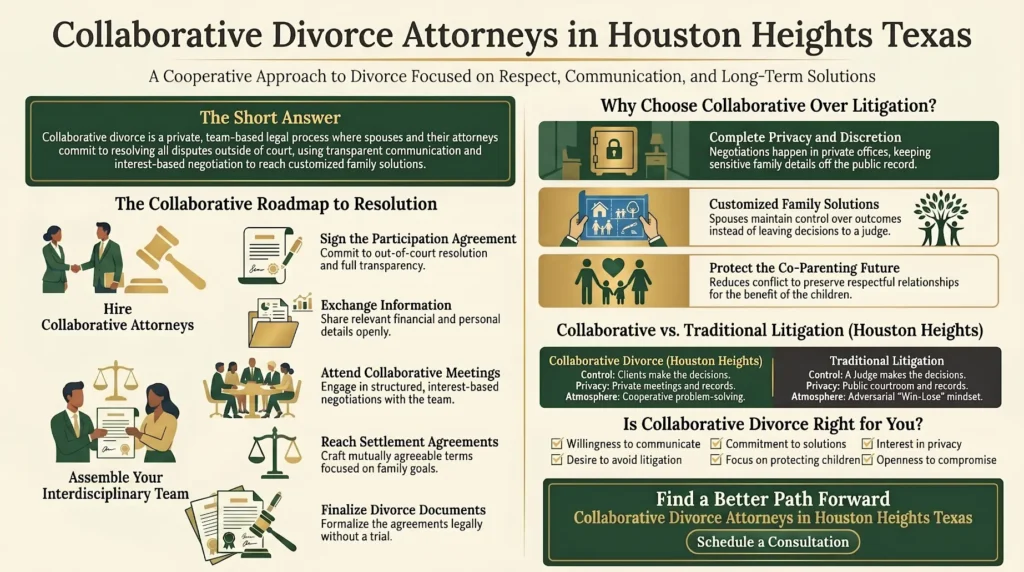
When most people hear the word “collaborative,” they assume it simply means being amicable. In reality, collaborative divorce is a formal legal process recognized under Texas Family Code Chapter 15. Spouses who choose this path each retain their own attorney and sign a participation agreement committing to resolve their disputes outside of court. For many families working with Collaborative Divorce Attorneys in Houston Heights Texas, the appeal is straightforward: they want a structured process that provides legal protection, preserves privacy, and avoids turning their divorce into a courtroom battle.
One of the most important features of collaborative divorce is the disqualification rule. If either spouse decides to leave the collaborative process and pursue litigation, both collaborative attorneys must withdraw from the case. That requirement changes the dynamics from the very beginning. Rather than preparing for trial and using court as leverage, everyone involved is encouraged to focus on practical solutions. In straightforward situations, this can help couples resolve parenting, property, and support issues efficiently. In more complex cases involving significant assets, business ownership, or contested parenting concerns, the collaborative framework creates a structured environment where difficult issues can be addressed constructively rather than through costly litigation.
Experienced Texas family law attorneys often view collaborative divorce as more than a settlement method—it is a team-based problem-solving process. Neutral financial professionals may assist with evaluating assets and developing equitable property division options, while child specialists can help parents create parenting plans that support stability and the child’s best interests. Because Texas courts prioritize a child’s well-being under Texas Family Code §153.002, collaborative divorce often gives families more flexibility and control than a judge could provide after a contested hearing. Families seeking a deeper understanding of the process and its benefits can explore our guide to collaborative divorce in Texas.
Texas has one of the most developed collaborative family law systems in the country, offering families a legally recognized alternative to traditional litigation. While collaborative divorce is not appropriate in every situation—particularly when family violence, hidden assets, or significant power imbalances exist—it can be highly effective for couples committed to transparency and good-faith negotiations. Determining whether your case is relatively straightforward or requires a more strategic approach is often one of the most important decisions you will make early in the process. For many Houston Heights families, that evaluation is the first step toward protecting what matters most while moving forward with greater clarity, stability, and peace of mind.
Why couples choose it
In a collaborative divorce, you control the outcome instead of a judge. You decide the parenting schedule, how the house is handled, and how retirement is split — at a private table, on your timeline, with professionals whose job is settlement rather than victory.
What People Get Wrong About Collaborative Divorce
The most common misunderstanding is that collaborative divorce means “friendly” or “no lawyers.” Neither is true. You each have your own attorney advocating for your interests — the difference is that the advocacy happens through structured negotiation instead of motions and hearings. You do not have to like your spouse to do this; you only have to be willing to settle.
The second misunderstanding is that it is always cheaper. It usually is, because you avoid contested hearings, discovery fights, and trial prep. But if a couple uses the collaborative table to relitigate every grievance, the professional fees add up. Collaborative divorce rewards couples who come to solve problems; it punishes couples who come to keep score.
The third is that the disqualification rule is a trap. It is actually a protection — it guarantees that the lawyer at the table is fully committed to settlement and has no incentive to steer you toward a profitable trial.
What Matters When Spouses Disagree
Many people assume collaborative divorce only works when spouses already agree on everything. In reality, the opposite is often true. Families frequently turn to Collaborative Divorce Attorneys in Houston Heights Texas because they have real disagreements but want to resolve them without a courtroom battle. The process is designed to address disputes constructively, whether the issue involves parenting schedules, the marital home, spousal support, or the value of a family-owned business. Disagreement alone does not make a case unsuitable for collaborative divorce—it is often the reason the process exists.
In straightforward situations, spouses may disagree about specific terms while remaining committed to finding common ground. In more complex cases involving high-value assets, business interests, relocation concerns, or contested parenting plans, collaborative divorce provides a structured framework for working through difficult decisions. When children are involved, many of the same factors that guide Texas courts under Texas Family Code §§153.002 and 153.134—stability, cooperation, and child-focused decision-making—also contribute to successful collaborative outcomes. Families who want a deeper understanding of the process can explore how a collaborative divorce approach helps many Houston-area couples resolve disputes while maintaining greater control over the outcome.
The issue that most often undermines collaborative divorce is not disagreement—it is a lack of transparency. The process relies on complete financial disclosure and good-faith participation from both spouses. If one party is concealing assets, failing to disclose income, withholding financial records, or refusing to participate honestly, the collaborative framework may not provide enough protection. Where disputes become contested because of credibility concerns, hidden assets, or significant financial complexity, formal discovery tools available through litigation may become necessary to protect the integrity of the case and ensure a fair result.
A simple question often helps determine whether collaborative divorce is the right fit: can both spouses openly share financial information and work toward a solution, even if they disagree about what that solution should look like? If the answer is yes, collaborative divorce may offer a more private, efficient, and family-focused path forward. If the answer is no, or if significant parenting, financial, or litigation concerns exist, obtaining strategic legal guidance early can help prevent costly mistakes and position the case for a more effective resolution.
Strategy note
Bring your three most recent statements for every account to the first session — bank, retirement, and any business books. The faster the financial picture is complete, the fewer billable hours the neutral spends reconstructing it, and the cheaper your collaborative divorce becomes.
How I Approach a Collaborative Case

One of the first things experienced Collaborative Divorce Attorneys in Houston Heights Texas evaluate is whether collaborative divorce is actually the right fit for the family. Not every case belongs in the collaborative process, and identifying potential problems early can save significant time, expense, and frustration later. Before a participation agreement is signed, it is important to assess whether both spouses are willing to negotiate in good faith, provide complete financial disclosure, and participate in a respectful problem-solving environment. Issues such as family violence, serious power imbalances, hidden assets, or a refusal to be transparent can make collaborative divorce far less effective and may require a different legal strategy.
In straightforward situations, once both spouses commit to the process, the focus shifts to building a roadmap for resolution. The collaborative team is assembled, priorities are identified, and information is gathered. Full financial disclosure typically comes first because informed decision-making depends on accurate information. Families who want a broader understanding of how the process works can learn more about the benefits of a collaborative divorce approach and how it differs from traditional litigation.
From there, successful collaborative cases tend to follow a deliberate sequence. Areas of agreement are often addressed first, creating momentum and building confidence in the process. More complex issues—such as parenting plans, property division, business valuations, or support obligations—are then tackled with the assistance of neutral professionals when appropriate. When children are involved, this approach often aligns with the priorities Texas courts emphasize under Texas Family Code §§153.002 and 153.134, including stability, cooperation, and child-focused decision-making.
In more complex cases involving significant assets, business ownership, contested parenting issues, or concerns about future litigation, strategic planning becomes increasingly important. The goal is not simply to reach an agreement but to reach one that is durable, practical, and tailored to the family’s long-term needs. By addressing issues in a logical order and focusing on solutions rather than positions, collaborative divorce often allows families to move forward with greater clarity, reduced conflict, and a stronger foundation for the future.
Core breakdown
| Category | What Texas Law Says | Practical Impact |
|---|---|---|
| Participation agreement | Binding under Texas Family Code § 15.101 (2025), which sets the requirements for a collaborative family law participation agreement. | Both spouses are legally committed to the out-of-court process once signed. |
| Disqualification rule | Under Texas Family Code § 15.106 (2025), collaborative attorneys and their firms must withdraw if the matter proceeds to litigation. | Removes the incentive to threaten court; keeps everyone settlement-focused. |
| Financial disclosure | Texas Family Code § 15.109 (2025) governs disclosure of information during the collaborative process. | Concealment ends the collaborative process and exposes the hiding spouse. |
| Final decree | Under Texas Family Code § 15.105 (2025), a written settlement agreement reached through the collaborative process is enforceable. | The agreement you build at the table becomes a binding court order. |
“Collaborative divorce rewards couples who come to solve problems and punishes couples who come to keep score.”
Risks, Mistakes, and Deadlines
One of the biggest risks in collaborative divorce is assuming the process is right for every family. While Collaborative Divorce Attorneys in Houston Heights Texas often help couples resolve disputes efficiently and privately, the process depends on both spouses being willing to negotiate in good faith and provide complete transparency. In straightforward situations, collaborative divorce can be an excellent alternative to litigation. In more complex cases involving hidden assets, significant power imbalances, family violence, or a spouse unwilling to participate honestly, a different legal strategy may provide stronger protections. Choosing the right process at the beginning can prevent unnecessary delays, expenses, and frustration later.
Another common mistake is incomplete financial disclosure. Collaborative divorce is built on trust and transparency, which means both spouses must provide accurate information about income, assets, debts, retirement accounts, business interests, and other financial matters. Sometimes the issue is intentional concealment; other times it is something as simple as forgetting an old investment account or overlooking a retirement plan from a previous employer. Either way, incomplete disclosure can create problems that delay settlement negotiations or undermine the final agreement. Families who want a deeper understanding of the process can learn more about what collaborative divorce involves and the commitments required from both parties.
Timing is another factor that should not be overlooked. Even when spouses reach agreements quickly, Texas law generally requires a 60-day waiting period before a divorce can be finalized. Collaborative divorce may reduce conflict and streamline negotiations, but it does not eliminate statutory deadlines. When children are involved, additional time may be needed to develop parenting plans that support stability and align with the child-focused considerations reflected in Texas Family Code §§153.002 and 153.134.
Finally, successful collaborative cases remain focused on solving problems rather than reliving every past disagreement. The professionals involved are there to help resolve legal, financial, and parenting issues—not to referee old arguments. Where disputes become contested or emotions begin driving decision-making, costs can increase and progress can slow. The families that often achieve the best outcomes are those that stay focused on practical solutions, maintain financial transparency, and keep their long-term goals at the center of the process. Understanding these risks early can help you determine whether collaborative divorce is the right path for your specific circumstances.
When collaborative is the wrong call
If there is family violence, a history of hidden money, or a spouse who refuses to be honest about finances, do not start in the collaborative process. The protections of formal discovery and the court exist for exactly these situations. Tell your attorney the truth in the first conversation so you start on the right path.
The collaborative process, step by step
| Step | Typical Timeline | Action Item |
|---|---|---|
| Strategy session & fit screen | Week 1 | Confirm collaborative fits; rule out disqualifiers. |
| Sign participation agreement | Weeks 1–2 | Both spouses and attorneys commit to the process. |
| Full financial disclosure | Weeks 2–5 | Produce every account; engage the financial neutral. |
| Joint settlement meetings | Weeks 4–12 | Work through parenting, property, support. |
| Decree & waiting period | Earliest day 61 after filing, under Texas Family Code § 6.702 (2025) | Reduce the agreement to an enforceable final decree. |
2
attorneys, one at each side of the table
0
contested court hearings in a successful case
100%
financial disclosure required to participate
Listen to Our Texas Family Law Podcast
Prefer listening? In this episode, we discuss collaborative divorce in Houston Heights, Texas, including how couples can work together to resolve issues outside of court and why this approach may help reduce conflict and preserve relationships.
Houston Heights and Harris County Procedure
For Houston Heights residents, a collaborative divorce is filed in Harris County, where the case is assigned to one of the county’s family district courts. The advantage of the collaborative process here is that you spend almost no time inside that courthouse — the negotiation happens privately, and the court’s involvement is largely limited to entering the final decree once you have an agreement. That keeps you off the Harris County family docket, which can be slow for contested matters.
Practically, that means a Heights couple controls the pace. You are not waiting weeks for a hearing slot to resolve a single dispute; you are scheduling settlement meetings on your own calendar. The county procedure becomes a formality at the end rather than the arena where your divorce is fought.
Where Nearby Counties Differ
One advantage of collaborative divorce is that the core process remains consistent throughout Texas. Whether a case is filed in Harris County, Fort Bend County, Montgomery County, Galveston County, or Brazoria County, the legal framework established under Texas Family Code Chapter 15 remains the same. Families working with Collaborative Divorce Attorneys in Houston Heights Texas can generally expect the same foundational principles of transparency, cooperation, and problem-solving regardless of where the divorce is filed.
What often differs from county to county is not the collaborative process itself, but the administrative realities surrounding the case. Court scheduling practices, local standing orders, filing procedures, and the time it takes for a judge to approve a final decree can vary significantly. In straightforward situations, these differences may have little impact on the overall timeline. In more complex cases involving multiple properties, business interests, relocation concerns, or parenting issues spanning different counties, understanding those local procedures becomes increasingly important. Families interested in evaluating the advantages and potential limitations of the process can learn more about the pros and cons of collaborative divorce in Texas.
The availability of collaborative professionals can also vary by location. Larger metropolitan areas such as Harris County and Fort Bend County often have broader networks of collaborative attorneys, financial neutrals, mental health professionals, and child specialists. Smaller counties may have fewer collaborative resources available, which can sometimes affect scheduling and team composition. When children are involved, having access to experienced professionals can be particularly valuable because Texas courts consistently emphasize stability, cooperation, and the child’s best interests under Texas Family Code §§153.002 and 153.134.
A common misconception is that owning property, operating a business, or maintaining assets in another county automatically complicates the collaborative process. In many cases, it does not. However, when significant financial issues are involved or disputes become contested, strategic planning becomes increasingly important. Understanding where assets are located, which court has jurisdiction, and how local procedures may affect the timeline can help families avoid surprises and make more informed decisions. The goal is not simply to reach an agreement, but to create a durable resolution that works for your family both now and in the future.
Are both of you willing to fully disclose all finances?
Yes, full disclosure is fine Mostly, with some hesitation No, or I suspect hidden assets ← Back to startIs there any history of family violence or a serious power imbalance?
No, none Yes, or I’m not sure it’s safe ← BackDo you have contested issues you’ll need to work through (parenting, property, support)?
Yes, a few real disagreements No, we mostly agree already ← BackDo you and your spouse live in Texas (Harris County or a nearby county)?
Yes, in Texas Partly — one of us is out of state ← BackCollaborative divorce looks like a strong fit
You both want to settle, you’re willing to disclose finances, there’s no safety concern, and you’re in Texas. That’s exactly the profile collaborative divorce is built for. The next step is a strategy session to confirm fit and map your issues.
Collaborative divorce may work — with a few questions to resolve
You have the cooperative foundation, but a wrinkle (such as an out-of-state spouse or jurisdiction question) needs to be sorted before you commit. These are solvable, and a strategy session is the fastest way to get a clear answer for your situation.
Collaborative divorce may not be the safest path — let’s talk
When there’s a safety concern, a power imbalance, or a worry about hidden assets, the collaborative process may not protect you the way formal court tools can. That doesn’t mean you’re out of options — it means we should talk through the right path before you decide anything.
Collaborative divorce likely isn’t the right tool here
The process only works when both spouses want to stay out of court. If one of you wants to litigate, a different approach will serve you better — and we can walk you through what that looks like.
Is collaborative divorce a fit for your situation?
Answer five quick questions to see whether the collaborative process is likely to work for you. This is general guidance, not legal advice — a strategy session gives you the real answer for your case.
Step 1 of 5Do both you and your spouse genuinely want to settle out of court?
Yes, we both want to settle I think so, but I’m not certain No, one of us wants to fight it outWant a straight answer on whether your divorce can stay out of court?
Schedule a Legal Strategy SessionWhat to Do If You’re Considering a Collaborative Divorce
- 1. Decide if you both want to settle. Collaborative divorce only works when both spouses genuinely want out of court.
- 2. Gather your financial records. Pull statements for every bank, retirement, and business account.
- 3. Be honest about disqualifiers. Family violence or hidden assets mean a different process is safer.
- 4. List your non-negotiables. Know which outcomes matter most before you sit at the table.
- 5. Book a strategy session. Get a professional fit screen before signing anything.
- 6. Confirm your attorney is collaboratively trained. The process requires specific training, not just family-law experience.
- 7. Understand the disqualification rule. Know that choosing court later means changing lawyers.
- 8. Commit to the timeline. Show up to meetings prepared so the process stays efficient and affordable.
Ready to find out if collaborative divorce fits your situation?
Schedule a Legal Strategy SessionWhat I Tell Every Client Who Calls About Collaborative Divorce
If there is one thing I tell every family considering collaborative divorce, it is this: collaborative divorce can be an excellent solution, but only when it matches the realities of your situation. Families often contact Collaborative Divorce Attorneys in Houston Heights Texas because they want to avoid the stress, expense, and uncertainty of litigation. They want greater privacy, more control over the outcome, and a process that allows them to focus on solutions instead of conflict. For the right couple, collaborative divorce can provide exactly that.
In straightforward situations, where both spouses are committed to transparency, willing to negotiate in good faith, and focused on reaching an agreement, collaborative divorce often creates a more efficient path forward. When children are involved, the process can also support the stability and cooperation that Texas courts value under Texas Family Code §§153.002 and 153.134. Families who want to better understand whether this approach fits their circumstances can learn more about the advantages of working with a collaborative divorce lawyer and how the process differs from traditional litigation.
In more complex cases, however, additional analysis becomes important. Issues such as high-value assets, business ownership, hidden income, contested parenting arrangements, relocation concerns, or significant conflict between spouses can affect whether collaborative divorce is the best option. Choosing the wrong process can create unnecessary delays and expenses if the case ultimately has to transition into litigation. That is why evaluating the facts honestly at the beginning is often one of the most important decisions a family can make.
The goal is not simply to settle a divorce—it is to choose a process that protects your future, your finances, and your family relationships. When you understand your options before making commitments, you are in a stronger position to move forward with confidence. Whether your situation is relatively straightforward or involves more complex legal and financial considerations, the right strategy begins with understanding what fits your family’s unique needs rather than forcing your case into a process that may not be the best match.
Get a straight answer about your collaborative divorce.
Schedule a Legal Strategy SessionConclusion:
Divorce is never just about ending a marriage—it is about creating a stable path forward for the people who matter most. The choices parents make during the process can influence everything from daily routines to long-term opportunities for their children. That is why many families turn to Collaborative Divorce Attorneys in Houston Heights Texas when they want a process focused on solutions rather than conflict. In straightforward situations, a collaborative approach may provide the structure and cooperation needed to reach an agreement efficiently. In more complex cases, additional planning and guidance may be necessary to address concerns involving significant assets, business interests, high-conflict parenting issues, or unique family dynamics.
No two families face the same challenges, which is why there is no one-size-fits-all answer. If your case involves questions about educational stability, custody arrangements, financial complexity, or protecting important family relationships, taking the time to understand your options can make a meaningful difference. At The Law Office of Bryan Fagan, PLLC, we believe families deserve clarity before they make major decisions. Through education, compassionate guidance, and strategic legal counsel, we help parents move forward with confidence, protect what matters most, and create a stronger foundation for the next chapter of their lives.
Questions My Clients Ask About Collaborative Divorce
Collaborative divorce is a private, out-of-court process where both spouses keep their own attorneys and sign a binding agreement to settle every issue through negotiation. Neutral financial and child professionals often join the team. The defining feature is that if either spouse chooses to litigate, both attorneys must withdraw — which keeps everyone committed to settlement.
It varies with the complexity of your estate and how many issues are genuinely contested, but it is usually less than a litigated divorce because you avoid contested hearings, formal discovery battles, and trial preparation. The biggest cost driver is how cooperative both spouses are — couples who come to solve problems finish faster and cheaper. I give you a realistic range in the strategy session once I understand your situation.
Most collaborative divorces resolve faster than contested cases because you are not waiting on the court’s docket. Texas requires a mandatory waiting period before any divorce is final [VERIFY waiting period — attorney review], and the rest of the timeline depends on how quickly you complete financial disclosure and work through the issues. Couples who disclose fully and meet regularly often finish in a few months.
If the process breaks down and you decide to litigate, the disqualification rule requires both collaborative attorneys to withdraw, and you each retain new litigation counsel. That is the built-in cost of the process — and the reason everyone is motivated to make it work. A good fit screen at the start is how we keep that from happening.
Yes. Collaborative divorce is not mediation with a single neutral — each spouse has a separate collaborative-trained attorney advocating for them. The advocacy simply happens through structured negotiation rather than courtroom litigation.
Disagreement is normal and is exactly what the process is built to resolve. What matters is whether you both want to settle and will both be honest about finances. If yes, collaborative divorce handles disagreement well. If one spouse will not disclose or there is a serious power imbalance, another path protects you better.
Yes, and it is often the best choice for parents. A child specialist can join the team to design a parenting plan focused on the children rather than the conflict, and keeping the case out of court spares kids the stress of contested hearings.
In mediation, a single neutral helps you negotiate and you may or may not have attorneys present. In collaborative divorce, each spouse has their own attorney at the table the entire time, the process is governed by a binding participation agreement, and the disqualification rule applies. Collaborative divorce gives you more dedicated advocacy throughout.
Then collaborative divorce is likely the wrong process, because it depends on full, good-faith financial disclosure. If you suspect concealment, the formal discovery tools available in litigation protect you better. Tell your attorney your concern in the first conversation so you start on the right path.
Almost never in a successful collaborative case. The negotiation happens privately, and the court’s role is generally limited to entering your final decree once you have reached agreement. That is a major part of the appeal for Houston Heights couples who want privacy.
Have a question that isn’t answered here?
Schedule a Legal Strategy Session