
CPS Defense in the Houston Heights: What to Do When Child Protective Services Contacts Your Family

If Child Protective Services has contacted your family in the Heights while you’re already navigating a divorce or custody dispute, the decisions you make over the next few hours can affect far more than the investigation itself. Child Protective Services Defense Attorney in Houston Heights Texas is often the first thing parents search after receiving a call from a CPS investigator or learning that a report has been made. The uncertainty can be overwhelming. Should you answer every question? Can you refuse a home visit? What happens if your child is interviewed? Knowing your rights from the beginning—and exercising them calmly—is often one of the most important steps you can take to protect both your family and your future. From our Heights office on Heights Boulevard, the Law Office of Bryan Fagan, PLLC proudly serves families throughout the 77007 area and across Harris County.
Many of the parents who contact our office aren’t trying to hide anything—they simply don’t know what the law actually requires. They’re worried about saying the wrong thing, signing a safety plan they don’t fully understand, or making decisions that could affect their custody case or their child’s well-being. Those first conversations with CPS often shape the direction of the entire case. Texas law provides important protections for parents, while also requiring courts to place the best interests of the child at the center of every custody decision under Texas Family Code §153.002.
At the Law Office of Bryan Fagan, PLLC, we believe informed families make stronger decisions. Founded by Bryan Joseph Fagan, a graduate of South Texas College of Law and a recognized authority on Texas family law, our firm has spent years helping parents throughout Houston navigate CPS investigations, divorce, and child custody matters with confidence and compassion. In this guide, you’ll learn how CPS investigations work in Harris County, how these cases can affect custody and your child’s overall stability, what rights you have throughout the process, and the practical steps you can take to protect your family while moving forward with greater clarity and peace of mind.
The Short Answer
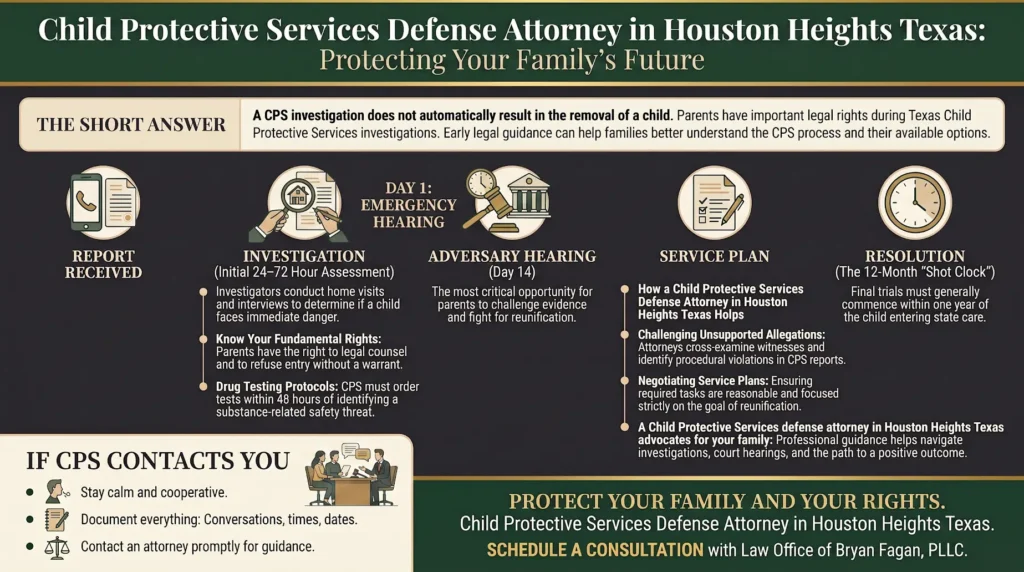
In Texas, a CPS investigation is a civil child-safety inquiry run by the Department of Family and Protective Services. You are generally not required to let a caseworker into your home or allow your children to be interviewed without a court order, and a single missed step early on can be hard to undo. The fastest way to protect your family in the Heights is to speak with a family law attorney before you agree to home entry, interviews, or a safety plan.
Key Takeaways
- You have rights during an investigation. Being polite and being compliant are different things. You can decline home entry without a court order and still cooperate appropriately.
- The first contact is the highest-stakes moment. What you say and sign in the first visit can define the rest of the case.
- CPS cannot remove a child on a whim. Under Texas Family Code §262.102, a court must find immediate danger before authorizing emergency removal.
- A positive marijuana test alone is not grounds for removal. Texas Family Code §262.116 specifically limits this.
- If a child is removed, a hearing comes fast. §262.201 requires a full adversary hearing within 14 days — you need representation before it.
- Heights cases run through Harris County. Investigations are handled by DFPS Region 6 and filed in the Harris County family courts.

Your Family’s Future Starts Here
Don’t navigate your legal journey alone. Schedule a consultation now and get the clarity and support you deserve.
Family lawyers and attorneys advise our clients of the immediate aftermath as well as the long-term effects of Family Law related issues, such as the following:
Trust us to help you with your Family Law Attorneys in the Houston Heights in Texas. Call (281) 245-1776 or contact us online today to schedule a free consultation with your Family Law Attorney in Humble, Texas.
How CPS Investigations Work in Texas

A Child Protective Services Defense Attorney in Houston Heights Texas can help you understand what happens after the Texas Department of Family and Protective Services (DFPS) opens an investigation. A CPS investigation is a civil process designed to determine whether a child is safe, not a criminal prosecution, although criminal investigations sometimes occur at the same time. Most cases begin with an unexpected phone call, an unannounced home visit, or a request to interview your child. Understanding your rights from the outset can help you make informed decisions and avoid mistakes that may affect both the investigation and any related custody proceedings.
During an investigation, a CPS caseworker may ask to inspect your home, speak with parents and children, review medical or school records, and interview individuals familiar with your family. Under Chapter 262 of the Texas Family Code, CPS has authority to investigate reports of abuse or neglect, but parents also have important legal rights throughout the process. In straightforward situations, investigations often close without court involvement when concerns are addressed and insufficient evidence supports the allegations. In more complex cases involving disputed facts, emergency removals, or ongoing custody litigation, early legal guidance can help protect your parental rights while ensuring you understand every step of the process.
Texas courts focus on the child’s best interests, consistent with Texas Family Code §153.002, when evaluating evidence presented during a CPS case. Judges may consider the credibility of witnesses, the stability of the child’s home environment, each parent’s involvement in the child’s life, and whether parents have complied with court orders or service recommendations. When emergency removal has occurred or CPS has filed suit in the Harris County family courts, these factors can significantly influence how the case progresses and whether reunification remains the appropriate goal.
The most effective way to protect your family is to understand the process before making important decisions. If your case involves contested allegations, emergency intervention, or complex custody issues, experienced legal representation can provide the strategic guidance needed to navigate the Texas CPS system with confidence. To learn more about protecting your rights, visit our guide to CPS Defense in Houston Heights or explore our resources on Child Custody in Texas to better understand how CPS investigations and conservatorship proceedings can intersect.
Cooperation done right
You can tell a caseworker, politely, that you want to speak with your attorney before answering questions or allowing entry, and then call us. That single sentence preserves your options without making you look uncooperative.
Your Rights During a CPS Investigation
Your rights do not disappear simply because Child Protective Services opens an investigation. Child Protective Services Defense Attorney in Houston Heights Texas starts with understanding that a CPS investigation is governed by both the Texas Family Code and constitutional protections designed to balance child safety with parental rights. Although a CPS caseworker may request to enter your home, interview your children, or ask detailed questions, you are generally not required to consent to every request immediately. In many situations, you have the right to consult with an attorney before making important decisions, particularly when there is no court order or true emergency.
The Texas Department of Family and Protective Services (DFPS) has a legal duty to investigate reports of suspected abuse or neglect, but investigators must also follow established legal procedures. In straightforward investigations, parents who remain respectful, organized, and informed often resolve concerns without court involvement. In more complex CPS cases involving disputed allegations, emergency removals, contested custody matters, or litigation in the Harris County Family Courts, understanding your rights early can help prevent avoidable mistakes and preserve important legal options throughout the investigation.
Many parents mistakenly believe that exercising their rights will be viewed as refusing to cooperate. In reality, Texas judges generally distinguish between parents who calmly protect their legal rights and those who actively interfere with an investigation. Courts are more concerned with the child’s safety, the credibility of the evidence, the stability of the home environment, and each parent’s willingness to comply with lawful court orders than whether every request was immediately granted. If your CPS investigation also affects significant family assets, a closely held company, or agricultural property, you may benefit from learning how those issues can intersect with family law by reading our guide to family business and farm law in Texas.
If CPS has filed suit under Chapter 262 of the Texas Family Code, an emergency removal has occurred, or your investigation overlaps with a divorce or child custody dispute, the legal issues often become more complex. Early guidance can help you understand your rights, meet important deadlines, and make informed decisions that support both your parental rights and your child’s long-term well-being. The earlier you understand the process, the better positioned you are to protect your family and move forward with confidence.
| Situation | What Texas Law Says | Practical Impact |
|---|---|---|
| Caseworker asks to enter | No general right to enter without consent, a court order, or exigent circumstances. | You may decline entry and ask to involve your attorney first. |
| Positive marijuana test | §262.116 — not sufficient alone to remove a child. | A positive test by itself does not justify removal. |
| Emergency removal | §262.102 — court must find immediate danger. | Removal requires a judge’s finding, not just a caseworker’s opinion. |
| After removal | §262.201 — adversary hearing within 14 days. | You get a fast hearing; have a lawyer before it. |
Warning
Do not sign a “safety plan” or agree to send your children to stay elsewhere without understanding what you’re agreeing to. These documents feel routine but can function as an admission or a voluntary removal. Read nothing, sign nothing, and agree to nothing major until you’ve spoken with an attorney.
When CPS Can Actually Remove a Child
A Child Protective Services Defense Attorney in Houston Heights Texas can explain that CPS cannot remove a child simply because a caseworker has concerns or someone made a report. Under Texas Family Code §262.102, emergency removal generally requires a court to find that the child faces an immediate danger to their physical health or safety, remaining in the home would be contrary to the child’s welfare, and there is not enough time to hold a full hearing before taking action. In most cases, a judge—not a CPS investigator—must authorize the removal, providing an important layer of judicial oversight for families in Houston Heights, Harris County, and throughout Texas.
When CPS believes emergency action is necessary, it typically seeks an ex parte order from the court. Although parents are not present for that initial request, Texas law also provides important procedural protections after removal. Under Texas Family Code §262.201, the court must hold a full adversary hearing within 14 days, giving parents the opportunity to challenge the removal, present evidence, question witnesses, and propose alternatives that protect the child while preserving the family whenever appropriate. In straightforward cases, early preparation can resolve misunderstandings quickly. In more complex CPS cases involving disputed allegations, prior CPS history, or concurrent divorce or child custody litigation, the evidence presented at this hearing often shapes the remainder of the case.
Texas judges evaluating whether a child should remain in CPS care focus on evidence rather than assumptions. They consider the child’s immediate safety, the credibility of witnesses, the parents’ willingness to comply with court orders, and whether there are reasonable alternatives to continued removal, such as placement with a qualified relative or implementation of a safety plan. If your CPS investigation began during a divorce or separation, understanding the broader legal issues may also be helpful. You can learn more by reading our guide on the cheapest way to get a divorce in Texas, which explains how different family law proceedings can affect long-term planning and decision-making.
If emergency removal has already occurred, the time available to protect your parental rights is limited. Preparing for the adversary hearing, gathering relevant records, identifying witnesses, and developing a clear legal strategy early can significantly affect the outcome. Understanding what Texas law actually requires—and responding with informed, thoughtful action rather than fear—places families in the strongest position to pursue reunification and protect their future.
Listen to Our Texas Family Law Podcast
Prefer listening? In this episode, we discuss CPS defense in Houston Heights, Texas, including how CPS investigations work, your legal rights as a parent, and steps you can take to protect your family.
Strategy
If your child has been removed, the 14-day adversary hearing is your first real chance to push back. Cases are frequently shaped — sometimes resolved — by how prepared the parents are at that hearing. Using the days before it to gather records, line up witnesses, and present a safe-home plan is where good representation earns its keep.
The CPS Process for Heights Families in Harris County

For families in the Heights and the 77007 area, CPS investigations are handled through DFPS Region 6, which covers the greater Houston area. Under Texas Family Code §262.002, a removal suit is filed in a court with jurisdiction in the county where the child is found — for Heights families, that means the Harris County family courts. Knowing the local caseworkers, courts, and tendencies of that system is part of responding effectively. The underlying law is the same statewide, which we cover in our guide to CPS defense across Texas, but how it plays out locally varies county to county.
Walk Through the Process
The CPS Case Process, Stage by Stage
Tap any stage to see what happens, how long it takes, and what to do. Most Harris County cases move through these stages in order, though many close early.
Stage 1 · Initial Contact
A CPS caseworker reaches out or shows up at your home, often unannounced, in response to a report. They may ask to come inside, speak with you, and interview your children. This is the highest-stakes moment in the whole process, because what you agree to here shapes everything after.
Typical timing: Day 1
What to do: Stay calm and polite, and say you’d like to speak with an attorney before agreeing to entry or interviews. That single sentence preserves your options.
Stage 2 · Investigation
CPS gathers information — interviews, home visits, records, and sometimes drug testing — to assess child safety. They may propose a “safety plan” or voluntary services. Many investigations close at this stage with no court involvement when parents respond carefully and with guidance.
Typical timing: Up to about 30 days
What to do: Document everything, route communication through your attorney, and don’t sign a safety plan without having it reviewed first.
Stage 3 · Removal (if it happens)
If CPS believes a child is in immediate danger, it can seek an emergency court order to remove the child. Under Texas Family Code §262.102, a court must find immediate danger first — a caseworker’s concern alone isn’t enough. Not every case reaches this stage.
Typical timing: Emergency (ex parte) order
What to do: Engage counsel immediately — the clock to the adversary hearing starts the moment a child is removed.
Stage 4 · Adversary Hearing
After a removal, Texas Family Code §262.201 requires a full adversary hearing within 14 days. This is where the court decides whether the child stays in CPS care during the case, and where you and your attorney can challenge the removal, present evidence, and propose a safe-home plan. It is often the single most important hearing in the case.
Typical timing: Within 14 days of removal
What to do: Use every day before it to gather records, line up witnesses, and prepare with counsel. Preparation here changes outcomes.
Stage 5 · Service Plan & Resolution
If the case continues, CPS develops a service plan — classes, counseling, testing, or supervised visits — and the court reviews progress at regular hearings. Reunification is the default goal in most Texas cases, but it runs on the court’s timeline and isn’t automatic. Cases resolve through return of the child, dismissal, or, in the most serious situations, termination.
Typical timing: Months, with periodic review hearings
What to do: Complete services promptly, document everything, and stay ahead of each review hearing with your attorney.
Wherever you are in this process, the next step is the same.
Call (281) 810-9760 — Available 24/7| Step | Timeline | Action Item |
|---|---|---|
| Initial contact | Day 1 | Stay calm; call an attorney before consenting to entry or interviews. |
| Investigation | Up to ~30 days | Document everything; route communication through your attorney. |
| Removal (if ordered) | Ex parte order | Engage counsel immediately — the clock to the hearing starts now. |
| Adversary hearing | Within 14 days (§262.201) | Contest the removal with prepared evidence and a safe-home plan. |
“In a CPS case, the parents who do best are rarely the ones who fought hardest at the door — they’re the ones who got advice fastest and stayed organized.”
Our Houston Heights Office
Law Office of Bryan Fagan, PLLC
848 Heights Blvd, Houston, TX 77007
Hours: Open 24 hours
Serving the Heights, 77007, and all of Harris County
Call (281) 810-9760 Available 24/7 Schedule a Strategy Session Same-week availabilityWhen a CPS Case and a Criminal Case Overlap
A Child Protective Services Defense Attorney in Houston Heights Texas can help families understand that a CPS investigation and a criminal investigation are separate legal proceedings, but they often involve the same allegations and evidence. Information shared with a CPS investigator may later be reviewed by law enforcement or prosecutors if criminal charges are being considered. While the Texas Department of Family and Protective Services (DFPS) focuses on child safety, a criminal investigation may focus on whether a crime has occurred, meaning the outcome of one case can influence the other.
When both investigations are active, every conversation and decision matters. In straightforward CPS investigations where no criminal allegations exist, parents may be able to resolve concerns through cooperation and compliance with the investigative process. In more complex cases involving allegations of physical abuse, serious neglect, or drug-related offenses, statements made to a caseworker, medical provider, or police officer may become part of both proceedings. Responding thoughtfully rather than emotionally can help protect your rights while allowing your attorney to develop a strategy that addresses the full legal picture.
Texas judges handling CPS cases remain focused on the child’s immediate safety, while criminal courts evaluate whether the evidence satisfies the legal standard for criminal liability. If emergency removal has occurred or the investigation may result in criminal charges, both matters should be considered together rather than separately. A strategy that benefits one proceeding but unintentionally harms the other can create avoidable challenges. To better understand how emergency removals fit into the overall CPS process, read our guide on child removal in Child Protective Services cases.
When allegations are disputed or both CPS and law enforcement are investigating the same events, experienced legal guidance becomes increasingly important. Coordinating your response from the beginning helps protect your parental rights, preserves important legal defenses, and places your family in the strongest possible position as both cases move through the Harris County court system.
Service Plans and the Path Back to Your Children
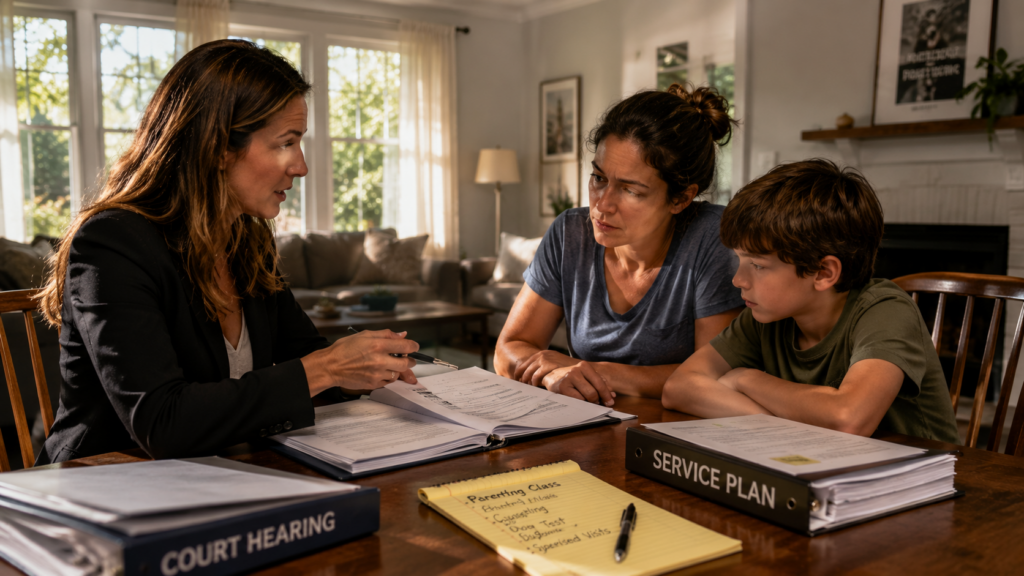
A Child Protective Services Defense Attorney in Houston Heights Texas can explain that a CPS service plan is more than a checklist—it is the court-approved roadmap the Texas Department of Family and Protective Services (DFPS) uses to evaluate whether a child can safely return home. Service plans often include parenting classes, counseling, substance abuse treatment, drug testing, supervised visitation, or other requirements tailored to the family’s circumstances. In Harris County CPS cases, judges regularly review a parent’s progress when making decisions about reunification, so understanding the plan from the beginning is essential rather than treating it as routine paperwork.
In straightforward CPS cases, parents who complete services promptly, attend scheduled visits, and document their progress often place themselves in a stronger position for reunification. In more complex cases involving disputed allegations, repeated CPS involvement, or concerns about compliance, every missed appointment or incomplete requirement may become part of the evidence presented during review hearings. A service plan should be understood, discussed, and, when appropriate, negotiated so it reflects realistic expectations while still addressing the concerns that brought CPS into the family’s life.
Texas courts generally recognize that reunification is the preferred outcome whenever it can be accomplished safely, but it is not automatic. Judges consider whether parents have complied with court orders, demonstrated meaningful behavioral changes, maintained stable housing and employment where appropriate, and consistently acted in their child’s best interests. Parents should also understand that interfering with a CPS investigation or failing to cooperate with lawful court-ordered services can complicate the path toward reunification. Our guide on interfering with a Child Protective Services investigation explains how certain actions may affect both the investigation and the court’s evaluation of your case.
If your child has already been removed, every review hearing represents an opportunity to demonstrate progress. Completing services on time, maintaining consistent communication with your attorney, preserving documentation of your efforts, and preparing for each court appearance can significantly influence the direction of the case. By approaching the service plan strategically and proactively, parents often improve their chances of achieving the goal shared by both the courts and Texas law whenever safely possible—reuniting children with their families.
| Scenario | What It Often Means | What to Do |
|---|---|---|
| CPS asks to interview your child at school | They may try to speak with the child without you present. | Call an attorney immediately to understand your options and rights. |
| You’re asked to take a drug test | Results can shape the case, but a positive marijuana test alone isn’t removal grounds (§262.116). | Get advice before agreeing; understand how results will be used. |
| You’re handed a safety plan | It can function as a voluntary removal or admission. | Don’t sign until an attorney reviews it. |
| Your child has already been removed | The 14-day adversary hearing clock is running (§262.201). | Engage counsel now to prepare for the hearing. |
Serving the Heights and surrounding areas
From our Heights office we represent families throughout the 77007 area and nearby Houston neighborhoods including the Greater Heights, Montrose, the Washington Avenue corridor, Garden Oaks, Oak Forest, and the Near Northside. We also handle CPS and family law matters across Harris County and the surrounding counties — Fort Bend, Montgomery, Galveston, and Brazoria — where local procedure can differ from court to court.
Common Mistakes That Hurt CPS Cases
A Child Protective Services Defense Attorney in Houston Heights Texas will often tell parents that the most damaging mistakes usually happen during the first contact with the Texas Department of Family and Protective Services (DFPS). Out of fear or a desire to appear cooperative, parents sometimes allow a home search, give detailed statements, sign a safety plan they do not fully understand, or agree to requests without first learning their legal rights. While cooperation is often appropriate, making important decisions without understanding their potential consequences can unintentionally strengthen a CPS case or limit your options later.
In straightforward CPS investigations, remaining calm, documenting every interaction, and responding thoughtfully can help resolve concerns efficiently. In more complex cases involving disputed allegations, emergency removal, or parallel divorce and child custody proceedings, early mistakes can become evidence presented during hearings in the Harris County Family Courts. Parents should avoid assuming they can simply “explain everything away,” because statements made during an investigation may influence both CPS decisions and future court proceedings.
Another common mistake is waiting too long to seek legal guidance. By the time many families reach out for help, critical decisions have already been made regarding home visits, interviews, service plans, or emergency court filings. Understanding when CPS can remove your child from your home in Texas can help parents better recognize when immediate action may be necessary and why responding strategically from the beginning is so important.
The families who often achieve the best outcomes are not necessarily those who argue the most—they are the ones who understand the process early, protect their rights while cooperating appropriately, and make informed decisions at each stage of the investigation. Taking time to understand your legal obligations and your available options can help protect your parental rights while keeping the focus where it belongs: your child’s safety, stability, and future.
How Texas Compares to Other States

Texas is not unusual in allowing emergency removal, but its post-removal timeline is comparatively fast and its statutory limits are comparatively specific. Compared with California and New York, where the equivalent initial hearings and detention timelines can run on different schedules, Texas pins the full adversary hearing to 14 days after removal under §262.201. Texas has also explicitly limited certain grounds — like a positive marijuana test alone under §262.116 — in ways not every state spells out. For Heights families, the practical takeaway is that the window to respond is short and the rules are concrete, which rewards moving quickly with informed help.
Every day in a CPS case counts. Get a strategy in place.
Schedule a Strategy SessionWhat to Do If CPS Contacts You in the Heights
- Stay calm and polite. Hostility creates a narrative; composure protects you.
- Don’t consent to home entry without a court order — say you want to speak with your attorney first.
- Don’t give a full statement or let your children be interviewed before getting advice.
- Don’t sign anything — especially a safety plan — until an attorney reviews it.
- Write down everything: names, dates, what was said, what was requested.
- Gather records that show a safe, stable home — medical, school, character references.
- Call a family law attorney immediately — our Heights line answers 24/7.
- If a child is removed, treat the 14-day hearing as urgent and prepare for it with counsel right away.
Save this number before you need it: a CPS visit rarely comes at a convenient hour.
Call (281) 810-9760What CPS Defense Comes Down to for Heights Families
families understand that the most important decisions in a CPS case are often made long before the final hearing. A Texas CPS investigation moves according to statutory deadlines—not a family’s schedule—and the earliest interactions with the Texas Department of Family and Protective Services (DFPS) can shape everything that follows. While the process can feel overwhelming, Texas law also provides meaningful protections, including judicial oversight of most removals, the right to challenge CPS actions in court, and the opportunity to present evidence before long-term decisions are made about your family.
In straightforward investigations, learning your rights early, responding thoughtfully, and cooperating appropriately often helps families resolve concerns before they become larger legal disputes. In more complex CPS cases involving emergency removals, contested allegations, or ongoing child custody litigation, every decision—from responding to a home visit to preparing for the adversary hearing—can influence the outcome. Understanding when CPS can remove your child without a court order in Texas can help parents better understand both the limits of CPS authority and the legal protections available under Texas law.
Ultimately, effective CPS defense is about making informed decisions rather than reacting out of fear. Parents who understand the investigation process, preserve important evidence, meet court deadlines, and seek guidance before critical decisions are made are often better positioned to protect their parental rights while working toward reunification whenever it can be accomplished safely. At the Law Office of Bryan Fagan, PLLC, our goal is to provide the clarity, education, and strategic guidance families need to move through the CPS process with greater confidence while protecting what matters most—their children and their future.
You don’t have to face a CPS case alone.
Call (281) 810-9760 — Available 24/7Conclusion:
A CPS investigation can feel like your family’s future is being decided overnight, but it doesn’t have to define what happens next. Working with a Child Protective Services Defense Attorney in Houston Heights Texas is about more than responding to allegations—it’s about understanding your rights, protecting your relationship with your children, and making informed decisions that support their long-term stability and well-being. In straightforward situations, early legal guidance may help resolve concerns before they grow into larger legal challenges. In more complex cases involving emergency removal, contested custody, allegations of abuse or neglect, criminal investigations, or the possibility of termination of parental rights, having an experienced legal team that understands both Texas family law and CPS procedures becomes even more important.
At the Law Office of Bryan Fagan, PLLC, we believe every family deserves honest answers, practical guidance, and a legal strategy built around their unique circumstances—not a one-size-fits-all approach. Whether you need answers about an active CPS investigation, help modifying existing custody orders, or representation in a complex Harris County court proceeding, our team is here to educate, guide, and advocate for you every step of the way. The right information, combined with the right attorney for your situation, can help you move forward with greater confidence while protecting what matters most—your family and your future.
Questions Families Ask About CPS Investigations
Generally, no — not without your consent, a court order, or a genuine emergency. A caseworker can ask, and may apply pressure, but you can decline entry and say you want to speak with your attorney first. Declining entry is not an admission of anything; it’s a recognized right. The exception is a true exigent circumstance where a child is in immediate danger.
Only in narrow emergency circumstances. Normally, removal requires a court to find immediate danger under Texas Family Code §262.102. CPS can take possession before a hearing through an emergency order, but a full adversary hearing must follow within 14 days under §262.201, where you can contest it.
Not on that basis alone. Texas Family Code §262.116 prohibits removal based solely on a positive marijuana test, unless there’s evidence the use caused significant impairment to the child’s physical or mental health or development. CPS can still gather other evidence, but a positive test by itself isn’t grounds.
It’s safer not to give a full statement before getting advice. You can be polite and provide basic identifying information while declining to answer substantive questions until you’ve spoken with an attorney. Things said early, even innocently, can be used to support the case. Getting advice first costs you nothing and protects you.
A safety plan is a written agreement CPS may ask you to sign, often requiring a parent to leave or a child to stay elsewhere. It can feel routine but may operate as a voluntary removal or an implied admission. Don’t sign one without understanding the consequences — talk to an attorney first.
Investigations generally run up to about 30 days, though they can be extended. The timeline compresses dramatically if a removal occurs, because the adversary hearing must happen within 14 days. The investigation period is the time to build your record and your defense.
No. A CPS case is civil and focused on child safety, while a criminal case is brought by prosecutors and can carry jail time. They can run at the same time over the same facts, which is why what you say to a caseworker can have criminal consequences too. Coordinated handling matters.
The adversary hearing, required within 14 days of removal under §262.201, is where the court decides whether the child stays in CPS care during the case. You and your attorney can present evidence, challenge CPS’s affidavit, and propose a safe-home plan. It’s often the most consequential early hearing.
Yes — removal is not permanent by default. Many cases work toward reunification through a service plan and court review. The path back is faster and smoother with prepared representation from the adversary hearing onward. The sooner you engage, the more options remain open.
It’s worth getting advice even before any removal. The investigation stage is where cases are often won or lost, and early guidance can keep a case from escalating to removal at all. Waiting until a child is taken means responding from a weaker position on a tighter clock.
CPS sometimes seeks to interview a child outside the parent’s presence, including at school, and the rules around this are nuanced. This is one of the most important moments to involve an attorney quickly, so you understand what is and isn’t permitted in your specific circumstances and can respond appropriately rather than after the fact.
A service plan is the set of requirements CPS asks a parent to complete — such as counseling, parenting classes, or drug testing — to work toward reunification. Courts review your progress against it, so how the plan is shaped and how promptly you complete it directly affect how quickly you can get your children home.
Cost depends on the stage and complexity of the case — an investigation that closes early costs far less than a contested case that goes through removal and multiple hearings. The most useful step is a strategy session where the situation can be assessed and the likely path and cost explained directly, rather than a guess in the abstract.
Still have questions about your situation? Talk to someone now.
Call (281) 810-9760 — 24/7