
Common Law Divorce Attorney in Houston Heights, Texas

A father walked into my Heights office convinced his biggest concern was whether he and his former partner had a common law marriage. They had lived together for years, bought furniture together, raised their son under one roof, and now the relationship was over. He wanted to know if he needed a divorce. As we talked, though, another problem emerged. His son’s grades had started slipping, his teacher noticed he had become withdrawn, and neither parent realized how much the uncertainty at home was affecting him. If you’re searching for a Common Law Divorce Attorney in Houston Heights Texas, you’re probably trying to answer an important legal question—but the answers often reach far beyond whether an informal marriage existed.
That is the reality of many common law divorce cases in Texas. Determining whether you were legally married under Texas law is only the beginning. If a court finds that an informal marriage existed, you may be facing property division, child custody, child support, and decisions that shape your family’s future for years to come. For parents, one of the most important questions quickly becomes how to protect their children’s emotional well-being and maintain the stability they need to succeed both at home and in school.
I am Bryan Fagan, and I have represented families from my Houston Heights office and throughout Harris County since 2012. Over the years, I have learned that successful family law cases are about far more than resolving legal disputes. They are about helping parents understand their options, reduce uncertainty, and create a foundation where their children can continue to thrive despite difficult circumstances. In this guide, I’ll explain how Texas courts evaluate common law marriages, how informal marriages are dissolved, and why issues like custody, parenting plans, and educational stability often become just as important as dividing property. My goal is to give you a clear understanding of the law so you can make informed decisions with confidence and move forward with peace of mind.
Texas does not offer a separate “common law divorce.” If you have a valid informal marriage under Texas Family Code §2.401, you must end it through a standard divorce — including property division and any custody orders. If no informal marriage existed, you can separate freely, but the court decides that question, not you.
What You Need to Know First
- A common law marriage ends in a real divorce. There is no shortcut. Once an informal marriage is established, Texas treats it identically to a ceremonial one for purposes of dividing property and debt.
- Three elements create an informal marriage. You agreed to be married, you lived together in Texas as spouses, and you represented to others that you were married — all three, not just living together.
- Time alone proves nothing. Texas has no “seven year” rule. A couple can be informally married in months; another can cohabit for a decade and never qualify.
- There is a filing deadline that can erase the marriage. If no proceeding to prove the marriage starts within two years of separation, the law presumes you were never informally married — a presumption that cuts both ways.
- Property acquired during the marriage is community property. The house, the retirement contributions, the business growth — all of it is on the table once the marriage is established.
- Proof is built from ordinary documents. Joint tax returns, leases, insurance beneficiary forms, and how you signed cards and contracts often decide these cases.
- The person denying the marriage and the person asserting it need opposite evidence strategies. Which side you are on dictates what you gather first.

Your Family’s Future Starts Here
Don’t navigate your legal journey alone. Schedule a consultation now and get the clarity and support you deserve.
Family lawyers and attorneys advise our clients of the immediate aftermath as well as the long-term effects of Family Law related issues, such as the following:
Trust us to help you with your Family Law Attorneys in the Houston Heights in Texas. Call (281) 245-1776 or contact us online today to schedule a free consultation with your Family Law Attorney in Humble, Texas.
What Texas Law Actually Says About Common Law Divorce
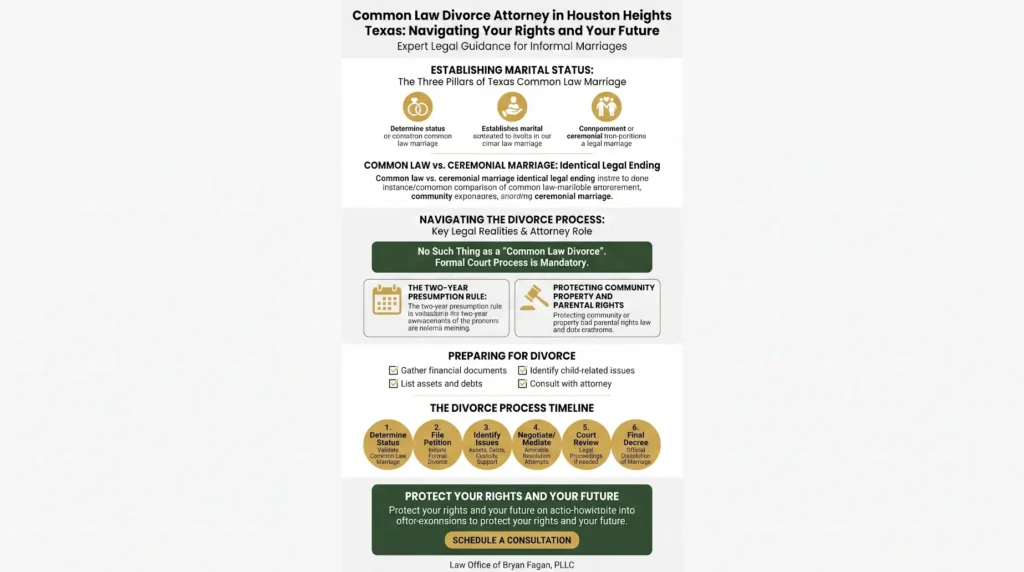
Common Law Divorce Attorney in Houston Heights Texas is a phrase people often search, but Texas law does not recognize a separate legal process called a common law divorce. If an informal marriage exists under Texas Family Code §2.401, it must be dissolved through the same divorce process as a ceremonial marriage. Once a court determines that a valid informal marriage exists, the case moves forward like any other Texas divorce, with decisions about community property, child custody, child support, conservatorship, debt allocation, and, in some cases, spousal maintenance.
The most important question is whether a legal marriage was created in the first place. Texas courts evaluate whether the couple agreed to be married, lived together as spouses, and consistently held themselves out to others as married. Evidence such as joint tax returns, shared financial accounts, insurance policies, deeds, leases, and testimony from family or friends can all influence the outcome. In straightforward situations, both parties may agree the marriage existed. In more complex common law divorce cases, one spouse may dispute the marriage, making credibility, documentation, and the burden of proof central issues.
If the court determines that an informal marriage existed, simply separating does not end the legal relationship. A Final Decree of Divorce is still required to divide property, resolve parental rights, and clarify each spouse’s financial obligations. Depending on the circumstances, the divorce may also involve retirement accounts, business interests, reimbursement claims, separate property, or estate planning considerations. After divorce, it may also be wise to review documents related to incapacity planning in Houston Heights so your decision-makers, powers of attorney, and advance directives reflect your current family situation.
Because every legal issue flows from whether an informal marriage existed, answering that question early can save significant time, expense, and uncertainty. Whether your case is resolved through negotiation, mediation, or litigation in the Harris County Family Courts, understanding your legal status provides the foundation for making informed decisions about your property, your children, and your future.
| Situation | What Texas Law Says | Practical Impact |
|---|---|---|
| You lived together for years but never agreed to be married | No informal marriage under §2.401 without agreement, cohabitation, and holding out | You can separate without a divorce, but expect the other side to argue otherwise |
| All three elements are present | A valid marriage exists; it must be dissolved by divorce | Community property is divided; you cannot remarry until the decree is final |
| You separated more than two years ago and no one filed | §2.401(b) presumes no informal marriage was ever entered | The presumption can be rebutted, but the burden shifts heavily |
| You signed a Declaration of Informal Marriage | §2.402 makes that a recorded, near-conclusive proof of marriage | Disputing the marriage becomes very difficult; plan around division instead |
The clients who come out ahead are the ones who decide their position — assert the marriage or deny it — before they say a word to the other side. Once you tell a former partner “we were never really married,” you have handed them a quote to use against you if you later need to claim a share of the house. Decide the strategy first; speak second.
The Three Elements That Create a Common Law Marriage
Common Law Divorce Attorney in Houston Heights Texas cases often begin with one question: did a legal marriage actually exist? Under Texas Family Code §2.401, an informal, or common law, marriage is created only when all three required elements are present at the same time. The couple must agree to be married, live together in Texas as spouses, and consistently represent to others that they are married. If even one element is missing, Texas law does not recognize the relationship as a valid marriage, regardless of how long the couple lived together or how committed the relationship may have been. For a more detailed explanation of these legal requirements, read our guide to what is an informal marriage in Texas and how to prove and protect your rights.
The first requirement—a present agreement to be married—is frequently misunderstood. Texas courts look for evidence that both people intended to be married immediately, not at some point in the future. An engagement, plans for a future wedding, or discussing marriage someday generally do not satisfy this requirement. In straightforward situations, both spouses acknowledge the agreement. In more complex common law divorce cases, however, one party may deny that any agreement ever existed, making witness testimony, written communications, and the overall course of the relationship especially important.
The second and third elements often generate the most litigation. Living together as spouses requires cohabitation in Texas, but there is no minimum number of years a couple must live together. “Holding out” as married means consistently presenting yourselves to the public as husband and wife through actions rather than isolated statements. Texas courts may consider joint tax returns, shared bank accounts, deeds, leases, insurance policies, beneficiary designations, employment records, and testimony from friends, relatives, or neighbors when deciding whether the couple consistently represented themselves as married.
Because every common law divorce depends on proving or disproving these three elements, gathering evidence early can make a significant difference. If the marriage itself is disputed, or if substantial assets, children, or separate property are involved, the court’s analysis becomes far more detailed. Establishing whether an informal marriage existed lays the foundation for every issue that follows, including property division, conservatorship, child support, spousal maintenance, and ultimately whether a Texas divorce is required at all.
| Element | The Test the Court Applies | What It Means for You |
|---|---|---|
| Agreement to be married | Did both of you presently agree to be married — not engaged, not someday? | Words and conduct both count; a denial by one side becomes a live dispute |
| Cohabitation in Texas as spouses | Did you live together in Texas in a marriage-like way? | No fixed time requirement; quality of the arrangement matters more than length |
| Holding out as married | Did you consistently represent to others that you were married? | This is where most cases are won or lost; gather the paper trail early |
Listen to Our Texas Family Law Podcast
Prefer listening? In this episode, we discuss common law divorce in Houston Heights, Texas, including how informal marriage is recognized, whether you may be legally married without realizing it, and what to know when ending the relationship.
The Misunderstandings That Cost People the Most
Common Law Divorce Attorney in Houston Heights Texas cases often begin with correcting common misconceptions about informal marriage. One of the biggest myths is that simply living together for a certain number of years automatically creates—or prevents—a common law marriage. Texas law has no “seven-year rule” or minimum time requirement. Under Texas Family Code §2.401, the determining factors are whether the couple agreed to be married, lived together in Texas as spouses, and held themselves out to others as married. If you’re unsure how these requirements apply to your relationship, our guide to filing a Declaration of Informal Marriage in Texas explains how formal declarations differ from proving an informal marriage through evidence.
Another costly mistake is believing that ending the relationship ends the legal consequences. If a valid informal marriage exists, separating without obtaining a divorce does not automatically resolve ownership of the home, retirement accounts, bank accounts, business interests, or other community property. Under Texas Family Code §7.001, Texas courts divide the marital estate in a manner that is “just and right,” and informal agreements made without legal documentation may leave one spouse at a significant disadvantage.
In straightforward situations, both spouses may agree on whether they were married and work toward a negotiated property settlement through mediation. In more complex common law divorce cases, one spouse may deny the marriage, dispute ownership of major assets, or claim certain property is separate rather than community property. These disagreements often require careful review of financial records, deeds, tax returns, and other evidence to determine each party’s legal rights.
Misunderstanding Texas common law marriage can have lasting financial and personal consequences. Before making decisions about moving out, selling property, or dividing assets, it is important to understand whether a legal marriage existed and how that determination affects everything from child custody and debt allocation to spousal maintenance and your long-term financial future.
If you stand to gain from the marriage existing — a share of a home, a retirement account, a business that grew during the relationship — your job is to document the “holding out” before memories fade and documents disappear. If you stand to lose, your job is to surface every instance where you filed, signed, or stated that you were single. Same facts, opposite playbooks. Knowing which side you are on is the first decision.
What Matters When the Marriage Itself Is Contested
Common Law Divorce Attorney in Houston Heights Texas cases become significantly more complex when one person claims an informal marriage existed and the other denies it. In these disputes, Texas courts look closely at whether the couple consistently held themselves out as married under Texas Family Code §2.401. While witness testimony is important, documentary evidence often carries greater weight because it was typically created before the dispute arose. Joint tax returns filed as married, deeds, leases, mortgage applications, insurance policies, beneficiary designations, and employment records can all help establish whether the relationship met the legal requirements of a common law marriage. If you are unsure how Texas defines marital status in these situations, our guide to what common law means in marital status provides additional background.
Consistency is often what separates a strong claim from a weak one. For example, if a couple filed joint tax returns for several years, introduced each other as spouses, and listed one another on insurance policies, those facts may support the existence of an informal marriage. On the other hand, consistently identifying yourselves as single, maintaining separate financial records, or using different addresses may support the opposite conclusion. In straightforward cases, the evidence points clearly in one direction. In more complex common law divorce cases, conflicting records require the court to evaluate credibility, context, and the overall pattern of the relationship.
When an informal marriage is disputed, preserving evidence is one of the most important decisions you can make. Avoid changing, destroying, or attempting to “clean up” financial records, tax filings, emails, text messages, or other documents after the dispute begins. Texas judges often place significant weight on records created during the relationship because they provide a more reliable picture of how the parties viewed their marital status before litigation started.
The outcome of this threshold issue affects every other aspect of the case. If the court determines that a valid informal marriage existed, the dispute moves forward as a Texas divorce involving community property, potential spousal maintenance, child custody, conservatorship, and other family law issues. Resolving whether a marriage existed first provides the legal foundation for every decision that follows and allows you to evaluate your rights with greater clarity and confidence.
The Two-Year Rule and Why Timing Decides Cases

Common Law Divorce Attorney in Houston Heights Texas cases often hinge on timing as much as evidence. Under Texas Family Code §2.401(b), if neither party files a legal action to prove an informal marriage within two years after separating, the law creates a rebuttable presumption that the couple never agreed to be married. This does not automatically prevent someone from proving a common law marriage, but it shifts the burden of proof to the person asserting that the marriage existed. To better understand the legal requirements that apply before and after separation, read our guide to Texas common law marriage requirements.
The two-year rule can work either for or against you depending on your circumstances. If you are trying to establish that an informal marriage existed so you can pursue community property, spousal maintenance, or other marital rights, waiting too long may make your case substantially more difficult. On the other hand, if you dispute that a common law marriage ever existed, the statutory presumption may strengthen your position. In straightforward situations, the date of separation is easy to identify. In more complex common law divorce cases, however, the parties may disagree about when the relationship actually ended, making emails, text messages, leases, financial records, and other evidence especially important.
Because the date of separation affects whether the two-year presumption applies, documenting that date early can have a significant impact on the outcome of your case. Texas courts evaluate the entire timeline of the relationship alongside evidence of cohabitation, agreement to be married, and holding out as spouses before determining whether an informal marriage existed under Texas Family Code §2.401. Resolving these issues early provides a clearer path for addressing property division, child custody, debt allocation, and any other issues that depend on whether a valid marriage existed.
Whether your case is resolved through negotiation, mediation, or litigation in the Harris County Family Courts, understanding how the two-year rule affects your rights can help you make informed decisions before valuable evidence becomes harder to obtain. Acting promptly not only preserves important documentation but also gives you a stronger foundation for protecting your financial interests and your family’s future.
The two-year presumption has quietly ended more property claims than any courtroom argument. If you separated from a partner you believe you were informally married to, and you may have a claim on a home, retirement, or a business, the time to act is now — not after the window closes and you are fighting a presumption instead of presenting your case. Book a Legal Strategy Session before the date passes.
Dividing Property When the Marriage Is Informal
Once an informal marriage is established, Texas divides everything acquired during it as community property, split in a way the court finds just and right under Texas Family Code §7.001 . “Just and right” does not mean exactly equal; courts can weigh earning capacity, fault in some circumstances, who will care for children, and the value of separate property each spouse brought in.
The recurring fight in common law cases is the start date of the marriage, because that date sets the line between separate property (yours alone, from before) and community property (shared, from during). A home one partner bought before the agreement to be married may stay separate, while its growth in value or the mortgage paid down during the marriage can create community claims. Pinning down when the marriage began is therefore not an academic exercise — it directly determines how much of the estate is divisible.
“The couple never argues about whether they lived together. They argue about the day they became married — because that one date decides who keeps the house.”
How Harris County Handles These Divorces
Common Law Divorce Attorney in Houston Heights Texas cases are filed in the same Harris County Family Courts that handle every other Texas divorce, but they often begin with one additional legal question: did a valid informal marriage exist? Before the court can divide community property, determine conservatorship, or issue a Final Decree of Divorce, it may first need to decide whether the relationship satisfied the requirements of Texas Family Code §2.401. To file for divorce, Texas Family Code §6.301 generally requires that one spouse has lived in Texas for at least six months and in Harris County for at least ninety days. If you’d like to better understand the legal requirements that create an informal marriage before the divorce process begins, our guide to Texas common law marriage requirements provides additional insight.
Once jurisdiction is established, the case generally follows the same process as any other divorce, including temporary orders when appropriate, discovery, mediation, settlement negotiations, and, if necessary, trial. In straightforward situations, both spouses agree that an informal marriage existed, allowing the case to focus on property division, child custody, child support, and other family law issues. In more complex common law divorce cases, however, one spouse may dispute the marriage itself, requiring the court to evaluate evidence such as tax returns, financial records, deeds, leases, insurance documents, and testimony before addressing any other issues.
Because the existence of the marriage affects every aspect of the case, organizing documents before filing can make a meaningful difference. Texas judges often consider the consistency of the evidence presented when determining whether an informal marriage existed, and resolving that threshold issue early provides a clearer path for negotiating or litigating the remaining disputes. This is especially important when substantial assets, retirement accounts, business interests, reimbursement claims, or children are involved.
For families in Houston Heights, Garden Oaks, Oak Forest, Timbergrove, Lazybrook, Memorial, and throughout Harris County, understanding how the local courts approach informal marriage disputes provides valuable clarity during an uncertain time. Whether your case ultimately settles through mediation or proceeds to trial, knowing how Harris County handles common law divorce cases allows you to make informed decisions and protect your family, your property, and your future.
848 Heights Blvd, Houston, TX 77007
Harris County · serving the Heights, the Greater Houston area, and clients statewide
Call 281-810-9760When Your Case Crosses County Lines

Where you file depends on residency, so a relationship that spanned the Houston metro can land your case in a different county’s courts than you expect. While Heights cases run through Harris County, partners who moved apart may trigger filing in Fort Bend County (Richmond, Sugar Land), Montgomery County (The Woodlands, Conroe), or one of the surrounding counties, each with its own family courts and local procedures.
The substance of the law does not change county to county — the three elements, the two-year presumption, and the property rules are statewide. What changes is local court procedure, scheduling, and how individual judges manage the threshold question of whether a marriage exists. If your separation crossed county lines, the first task is determining where the case properly belongs, because filing in the wrong county costs time you may not have against the two-year clock.
If your case may cross county lines, the venue question needs answering before anything is filed. Let’s map your case to the right court and the right strategy in one session.
Book a Legal Strategy SessionThe Divorce Process, Stage by Stage
A common law divorce moves through the same stages as any Texas divorce, with one added front-end question — whether the marriage exists at all. Tap through each stage below to see what happens, how long it typically takes, and what to do at that point.
How a Common Law Divorce Moves Through the Courts
Tap any stage to see what happens, how long it usually takes, and what to do at that point.
Stage 1 · Establishing the Marriage
Before anything is divided, the court has to decide whether an informal marriage exists at all. Under Texas Family Code §2.401, that means proving an agreement to be married, cohabitation in Texas as spouses, and holding out to others as married. This is the stage that makes a common law divorce different from every other divorce.
Typical timing: Resolved at the outset — sometimes as a separate threshold issue, sometimes folded into the divorce itself.
What to do: Gather the documentary record now — tax returns, leases, insurance forms, anything showing how you each identified the other. Decide whether you are asserting or denying the marriage before you speak to the other side.
Stage 2 · Filing and Residency
Once the marriage is established, the divorce is filed like any other. Texas Family Code §6.301 requires that a spouse has lived in Texas for at least six months and in the county for at least ninety days. For Heights residents, that points to the Harris County family district courts.
Typical timing: Filing starts the case; Texas imposes a 60-day minimum waiting period before a divorce can be finalized.
What to do: Confirm which county your case belongs in, especially if you and your partner now live apart. Filing in the wrong county costs time you may not have against the two-year clock.
Stage 3 · Temporary Orders
While the divorce is pending, the court can put temporary orders in place — who stays in the home, how bills and accounts are handled, and any temporary arrangements for children. These hold the situation steady until the final decree.
Typical timing: Often set within the first few weeks after filing, by hearing or agreement.
What to do: Come prepared with a clear picture of income, expenses, and the household so the temporary orders reflect reality rather than guesswork.
Stage 4 · Property Division
Property acquired during the marriage is community property, divided in a just and right manner under Texas Family Code §7.001. The fight that defines common law cases is the marriage’s start date, because it draws the line between separate property from before and community property from during.
Typical timing: The longest stage in a contested case; can run months depending on the assets and how far apart the parties are.
What to do: List every major asset acquired during the relationship — home, vehicles, retirement, any business — and pin down when the marriage began, because that date sets what is divisible.
Stage 5 · Final Decree
The case ends with a final decree of divorce that legally dissolves the marriage, divides the property, and sets any custody and support terms. Until that decree is signed, you remain legally married — unable to remarry and still exposed to claims on your income.
Typical timing: No sooner than 60 days from filing; contested cases take longer.
What to do: Read the decree closely before it is entered — it is the document that controls everything afterward. Make sure the property terms and any orders match what was actually agreed or ordered.
Your case will not move through these stages in the abstract — it turns on your facts and your dates. Let’s find where you stand.
Call 281-810-9760Every stage above turns on facts specific to your relationship. The fastest way to know where you stand is to talk it through.
Call 281-810-9760What to Do If You’re Facing a Common Law Divorce
- Decide your position first: are you asserting the marriage or denying it? Everything else follows from this.
- Write down the date you separated. The two-year presumption keys off it, so be precise.
- Pull your tax returns for every year you were together and note how you filed each one.
- Gather leases, mortgage and loan documents, and insurance forms showing how you each identified the other.
- List the major assets acquired during the relationship — home, vehicles, retirement, any business.
- Do not alter, delete, or “tidy up” old records once a dispute is live; let everything stand.
- Avoid making written or recorded statements about whether you were married until you have a strategy.
- Confirm which county your case belongs in if you and your partner now live apart.
- Note any children of the relationship; custody and support attach to the divorce.
- Book a Legal Strategy Session before the two-year window closes on any property claim.
What I Tell Every Family Who Calls About Common Law Divorce
Common Law Divorce Attorney in Houston Heights Texas consultations often begin with the same conversation: don’t focus on the label—focus on whether a legal marriage existed. Whether you called your relationship a common law marriage, an informal marriage, or simply lived together for years, the court will decide the issue by applying Texas Family Code §2.401, not by the terms you used. If the evidence shows you were legally married, your case proceeds through the same divorce process as any other Texas marriage, including property division, child custody, child support, and, when appropriate, spousal maintenance. For a broader overview of the process, see our guide to common law divorce in Texas.
Another point I emphasize is that waiting rarely improves your legal position. The two-year presumption under Texas Family Code §2.401(b) can significantly affect your ability to establish an informal marriage after separation, and valuable evidence often becomes more difficult to locate as time passes. In straightforward situations, preserving financial records, tax returns, and other documents may be enough to resolve the issue quickly. In more complex common law divorce cases, where the marriage itself is disputed or substantial assets are involved, early preparation can make a meaningful difference in how the court evaluates credibility and evidence.
I also remind families that every decision after separation has consequences. Moving out, dividing property informally, refinancing a home, changing beneficiary designations, or making statements about your relationship can all affect the outcome of a future divorce. Taking time to understand your legal rights before making major financial or parenting decisions often provides greater flexibility and helps avoid unnecessary disputes later.
If you’re separating from a partner in Houston Heights, Harris County, or the surrounding communities and you’re uncertain whether Texas would recognize your relationship as a legal marriage, resolving that question should come first. Once you understand your legal status, you can make informed decisions about protecting your property, your children, and your future with confidence rather than uncertainty.
Settle the one question that decides everything: were you married, and what does it cost you? Get a clear position and a plan in a Legal Strategy Session.
Call 281-810-9760 Book OnlineConclusion:
Every common law divorce begins with one fundamental question: were you legally married under Texas law? The answer shapes everything that follows, from property division and financial responsibilities to child custody and your family’s future. If you’re looking for a Common Law Divorce Attorney in Houston Heights Texas, understanding your rights before making important decisions can help you avoid costly mistakes and put you in a stronger position from the very beginning.
In straightforward situations, clear guidance may be all you need to resolve the issues efficiently and move forward with confidence. In more complex cases—especially if your case involves disputed common law marriage, significant assets, retirement accounts, business interests, child custody concerns, or questions about your child’s long-term stability—it becomes even more important to work with an attorney whose experience matches the complexity of your circumstances. At The Law Office of Bryan Fagan, PLLC, our goal is not simply to help clients through the legal process, but to provide the clarity, education, and strategic guidance that empower families to protect what matters most. Whether your next step is confirming whether an informal marriage existed or developing a comprehensive legal strategy for your family, we’re here to help you understand your options and move forward with confidence.
Questions Families Ask About Common Law Divorce
Yes. If a valid informal marriage exists under Texas Family Code §2.401, you end it with a formal divorce, exactly like a ceremonial marriage. There is no separate or simpler “common law divorce.” Skipping the divorce leaves you legally married, which blocks you from remarrying and keeps the property and support claims between you alive.
There is no minimum time. Texas does not use a seven-year rule or any fixed period. What matters is whether you agreed to be married, lived together in Texas as spouses, and held yourselves out as married. A couple can meet all three in a matter of months, while another can live together for years and never qualify.
If you were never informally married, you can separate freely and divide things by agreement. If you were, you have to divorce to legally end it, and the property you built together is divided as community property. The difference between those two outcomes is enormous, which is why the first question to settle is whether a marriage existed.
No. This is the most common myth I hear. Length of cohabitation by itself never creates a marriage in Texas. The three elements of §2.401 must all be present. Seven years of living together with no agreement to be married and no holding out is still not a marriage under Texas law.
You prove it with evidence of all three elements, and the documentary record usually carries the most weight. Joint tax returns filed as married, leases and mortgage documents, insurance forms naming a spouse, and testimony from people who knew you as a married couple all matter. A signed and recorded Declaration of Informal Marriage under §2.402 is close to conclusive on its own.
Yes. You disprove it by showing one of the three elements was missing — most often that there was no present agreement to be married or no consistent holding out. Filing taxes as single, signing documents as unmarried, and never referring to the other person as a spouse all undercut the claim. If more than two years have passed since separation, §2.401(b) also presumes no marriage existed.
If no one files an action to prove the marriage within two years of separating, the law presumes the couple never agreed to be married. The presumption can be rebutted with strong evidence, but it shifts the burden onto the person asserting the marriage. If you have a property claim that depends on the marriage existing, that two-year window is a deadline you cannot afford to miss.
Once the marriage is established, yes. Property acquired during the marriage is community property, divided in a just and right manner under §7.001. The hardest-fought issue is usually the marriage’s start date, because it draws the line between separate property from before and community property from during.
If the informal marriage is valid, they have the same property rights as ceremonially married spouses. That includes a community-property interest in income and assets built during the marriage. Those rights only exist if the marriage is established, which is exactly why the threshold question matters so much.
These cases add a layer most divorces do not have — proving or disproving the marriage itself — before any property gets divided. That front-end fight, combined with community-property division and the two-year clock, is difficult to navigate alone. A Legal Strategy Session is where we map your facts to a clear position and a plan. You can reach my Heights office at 281-810-9760.
You have read the framework. The next step is applying it to your facts — which is exactly what a Legal Strategy Session is for.
Book a Legal Strategy Session