
Uncontested Divorce in Houston: What It Costs, How Long It Takes, and Whether You Qualify

Most people who call my office looking for Uncontested Divorce Divorce Attorneys in Houston Heights Texas start with a variation of the same concern: “If my spouse and I aren’t fighting, how do we make sure this doesn’t hurt our kids?” It’s a question I hear all the time. Parents often assume that because they’re handling the divorce respectfully, their children will naturally adjust without much difficulty. Sometimes that’s true. Often, it isn’t. Children can struggle with changes in routine, uncertainty about the future, and the emotional stress that comes with seeing their family structure change—even when both parents are doing their best to make the process peaceful.
The challenge is that many parents focus so heavily on reaching an agreement that they overlook how the details of that agreement affect their children. I once met with parents in Harris County who agreed on every major issue in their divorce. Property division was settled. Child support was settled. Custody was settled. What they hadn’t discussed was how their new parenting schedule would affect their child’s daily routine. Within months, the child was bouncing between households with different expectations, different schedules, and little consistency. What looked like a simple uncontested divorce on paper created challenges neither parent anticipated. The legal case ended quickly. The parenting issues did not.
Texas courts understand that stability matters. Under Texas Family Code §153.002, every custody decision must be guided by the best interest of the child. That means judges look beyond whether parents agree and consider whether the arrangements they create support a child’s overall well-being. Factors such as consistency, parental involvement, communication, and long-term stability can all play an important role when determining what serves a child’s best interests.
This article explains how uncontested divorce intersects with child custody, parenting plans, and family stability in Texas. We’ll discuss how Texas courts evaluate the best interests of children, the role that custody and child support play in creating a healthy foundation after divorce, common mistakes parents make when negotiating agreed divorces, and practical steps you can take to help your child thrive during this transition. If you’re considering an uncontested divorce in Houston Heights or anywhere in the greater Houston area, understanding these issues now can help you protect both your family’s future and your child’s well-being long after the final decree is signed.
The Honest Number
In Houston, an uncontested divorce typically costs $1,000–$3,500 in attorney fees plus roughly $350–$400 in Harris County filing fees, and cannot be finalized faster than 61 days because of the mandatory waiting period under Texas Family Code §6.702 (2025). It qualifies as uncontested only if both spouses agree on every issue — property, debt, and any children — and one spouse meets the residency rule under §6.301.
Key Takeaways
- “Uncontested” means total agreement, not a friendly divorce. If even one issue is open — the house, a retirement account, a holiday schedule — the case is contested until that issue is resolved on paper.
- The 61-day floor is statewide and nearly unwaivable. Under §6.702, no Texas judge can finalize your divorce before day 61, even with full agreement.
- Residency is a hard gate. One spouse must have lived in Texas 6 months and in the county 90 days before filing (§6.301).
- Children raise the bar. A judge must find the parenting plan and child support are in the child’s best interest before signing — agreement alone isn’t enough.
- A cheap decree drafted wrong is the expensive option. Fixing a defective decree later costs far more than drafting it correctly once.

Your Family’s Future Starts Here
Don’t navigate your legal journey alone. Schedule a consultation now and get the clarity and support you deserve.
Family lawyers and attorneys advise our clients of the immediate aftermath as well as the long-term effects of Family Law related issues, such as the following:
Trust us to help you with your Family Law Attorneys in the Houston Heights in Texas. Call (281) 245-1776 or contact us online today to schedule a free consultation with your Family Law Attorney in Humble, Texas.
What an Uncontested Divorce Means in Texas
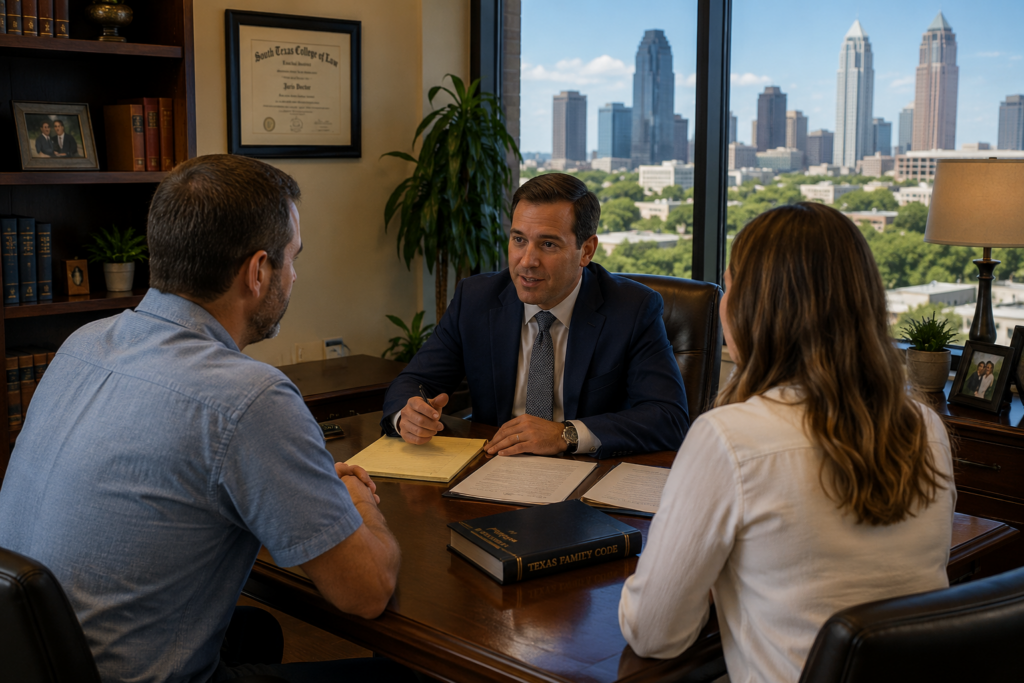
When people search for Uncontested Divorce Divorce Attorneys in Houston Heights Texas, they are usually looking for a divorce process that is faster, less expensive, and less stressful than a courtroom battle. In Texas, an uncontested divorce means both spouses agree on every issue before the divorce is finalized. Most uncontested divorces are filed under Texas Family Code §6.001, which allows a no-fault divorce based on insupportability—meaning the marriage has broken down with no reasonable expectation of reconciliation. When both spouses remain in agreement and the required paperwork is prepared correctly, the case can often move through the Harris County divorce process with minimal conflict and greater predictability.
The word “uncontested” is where many people run into trouble. Agreement must cover everything, not just the decision to end the marriage. Spouses must resolve issues involving community property, debts, child custody, visitation schedules, and child support before a judge can approve an agreed final decree of divorce. In straightforward uncontested divorces, where there are few assets and no disputes involving children, the process is often efficient and cost-effective. However, even cooperative couples can discover unexpected complications when discussions turn to retirement accounts, the family home, future parenting schedules, or long-term financial obligations.
Where disputes involve children, Texas courts focus on the child’s best interests under Texas Family Code §153.002. Judges expect parenting plans to provide consistency, stability, and clear expectations for both parents. Likewise, property division in Texas divorce cases must be thorough and precise. Leaving a retirement account, debt, vehicle, or bank account out of the final decree does not make it disappear—it often creates future legal and financial problems. Families who want a deeper understanding of the process can learn more about an uncontested divorce in Texas and the steps involved in reaching a durable agreement.
In more complex cases, disagreements over parenting schedules, child support obligations, real estate, business interests, or significant community assets can quickly turn an uncontested matter into a contested one. That is why careful planning matters. A properly drafted divorce decree does more than finalize a marriage—it creates a roadmap for life after divorce. For many Houston-area families, the goal is not simply to complete the divorce process but to reach an agreement that protects their children, finances, and long-term peace of mind for years to come.
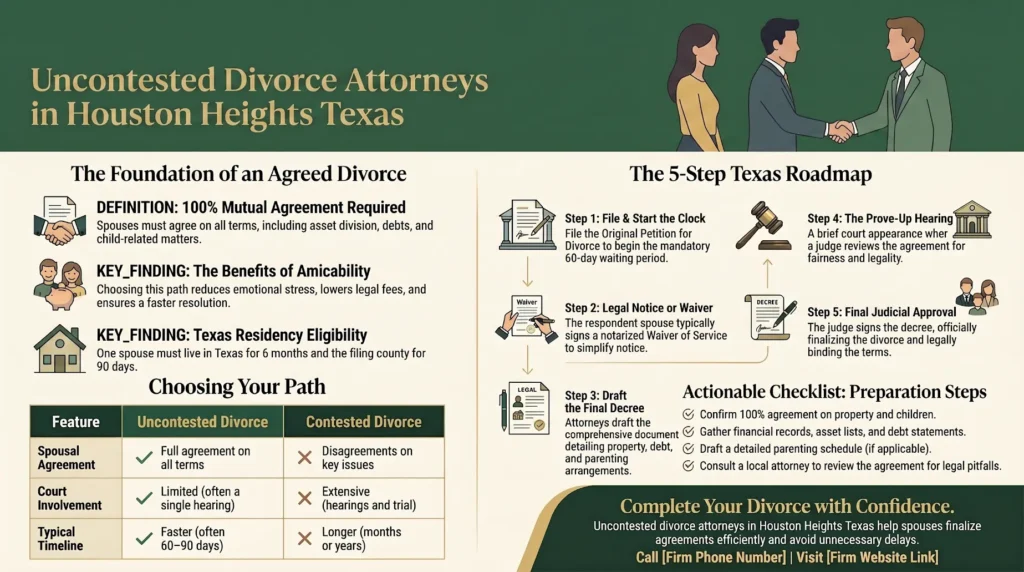
The advantage of agreement: a genuinely uncontested case skips contested hearings, discovery, and most courtroom time. That’s where the savings come from — not from skipping the lawyer, but from skipping the fight.
Who Qualifies for an Uncontested Divorce in Houston
For families searching for Uncontested Divorce Divorce Attorneys in Houston Heights Texas, the first question is often whether they actually qualify for an uncontested divorce. Under Texas Family Code §6.301, at least one spouse must have lived in Texas for the previous six months and in Harris County for at least ninety days before filing. These residency requirements are not technicalities. Filing in the wrong county can delay your case, increase costs, and potentially require you to start the process over in the correct jurisdiction. Before focusing on divorce timelines or paperwork, it is important to confirm that the court has authority to hear your case.
Residency is only the first hurdle. To qualify as uncontested, both spouses must agree on every material issue and be willing to put that agreement in writing. That includes property division, debt allocation, child support, and any child custody and uncontested divorce arrangements. In straightforward uncontested divorces, where there are no significant assets, no custody disputes, and both parties are cooperative, the process is often relatively efficient. However, when parents disagree on a parenting schedule, support obligations, or how to divide retirement accounts or real estate, the case can quickly become more complicated than it initially appeared.
Where disputes involve children, Texas courts apply the “best interest of the child” standard under Texas Family Code §153.002. Even if both parents reach an agreement, a Harris County judge must determine that the proposed parenting plan promotes stability and serves the child’s well-being. Courts routinely evaluate factors such as conservatorship rights, possession schedules, and the parents’ ability to cooperate. In more complex cases involving relocation concerns, high-conflict co-parenting, or disagreements over decision-making authority, additional legal guidance may be necessary to create an arrangement that satisfies both the court and the family’s long-term needs. Readers interested in learning more about parenting issues may find our resource on child custody in Texas helpful.
One of the most common reasons an uncontested divorce stops being uncontested is that a spouse refuses to sign a waiver of service, an agreed final decree of divorce, or other required documents. If one party will not participate, the case may move toward a default or contested proceeding, even when the parties initially believed they were in agreement. For that reason, families considering an agreed divorce Texas process should make sure all terms are fully resolved before filing. Learning more about the requirements for an uncontested divorce in Houston Heights can help you determine whether your case is truly uncontested and what steps may be necessary to move forward successfully.
| Your Status | Eligibility Test | What It Means |
|---|---|---|
| Both spouses agree on all terms | Every issue resolved in writing | Strong candidate for uncontested |
| Agree on most, one open issue | Any single disputed item | Contested until that item is settled |
| Children involved, terms agreed | Court’s best-interest finding | Judge must approve parenting plan |
| Spouse won’t sign / can’t be found | No waiver or agreed decree | Not uncontested — different path |
| Neither spouse meets residency | §6.301 not satisfied | Cannot file in Harris County yet |
Listen to Our Texas Family Law Podcast
Prefer listening? In this episode, we discuss uncontested divorce in Houston Heights, Texas, including how the process works, why it may offer a simpler path forward, and what couples should know before filing.
What an Uncontested Divorce Costs in Houston
For many families searching for Uncontested Divorce Divorce Attorneys in Houston Heights Texas, cost is one of the first concerns. In Houston and throughout Harris County, an uncontested divorce typically costs between $1,000 and $3,500 in attorney’s fees, plus approximately $350 to $400 in court filing fees. The difference in cost usually has less to do with conflict and more to do with complexity. In straightforward uncontested divorces involving limited assets, no children, and complete agreement between spouses, costs are often lower because fewer legal issues need to be addressed. However, an agreed divorce Texas case involving child custody and uncontested divorce concerns, retirement accounts, real estate, or detailed property division in Texas divorce proceedings generally requires additional drafting and planning.
As complexity increases, so does the need for precision. Where disputes involve children, courts expect parenting plans and support arrangements to satisfy the child’s best interests under Texas Family Code §153.002. If significant assets are involved, dividing retirement benefits, real estate, or business interests may require additional legal documents and careful analysis. One of the most expensive mistakes couples make is focusing only on the upfront cost while overlooking the long-term consequences of an incomplete agreement. A poorly drafted agreed final decree of divorce can lead to enforcement disputes, modification actions, or financial complications years after the divorce is finalized. Families interested in understanding the procedural requirements can review this guide to an uncontested divorce in Texas.
The goal should not simply be obtaining the lowest-cost divorce but creating an agreement that protects your family moving forward. In straightforward situations, limited legal guidance may be sufficient. In more complex cases involving children, substantial community property, or future financial concerns, investing in a carefully prepared agreement often saves significant time, expense, and stress down the road while helping preserve stability and peace of mind after the divorce is complete.
| Cost Driver | Typical Range | What Affects It |
|---|---|---|
| Harris County filing fee | ~$350–$400 | Set by the district clerk |
| Attorney fee, no children/property | ~$1,000–$1,800 | Simple decree, both spouses sign |
| Attorney fee, children or real estate | ~$2,000–$3,500 | Parenting plan, property transfer |
| Retirement account division | Add ~$300–$700 | Separate QDRO drafting |
Strategy note: the cheapest quote is rarely the cheapest outcome. A flat fee that skips the QDRO or omits a contingency for the house can leave you paying a second lawyer to reopen the case. Price the whole decree, not the filing.
How Long an Uncontested Divorce Takes in Houston

Families searching for Uncontested Divorce Divorce Attorneys in Houston Heights Texas are often relieved to learn that an uncontested divorce can move significantly faster than a contested case. However, Texas law still imposes a mandatory waiting period. Under Texas Family Code §6.702, a divorce generally cannot be finalized until at least 60 days have passed from the date the petition is filed, making day 61 the earliest a Harris County judge can sign a final decree. The countdown begins when the petition is file-stamped by the court—not when your spouse receives service or signs paperwork. For most families, this waiting period provides time to finalize agreements involving property division in Texas divorce cases, child support, and parenting arrangements.
In straightforward uncontested divorces where both spouses cooperate, all documents are signed promptly, and there are no disputes regarding children or property, many cases are completed within approximately 60 to 90 days. Delays often arise when one spouse is slow to sign documents, financial information remains incomplete, or the parties discover unresolved issues involving retirement accounts, real estate, or parenting schedules. Where disputes involve children, Harris County courts will carefully review custody provisions to ensure they satisfy the child’s best interests under Texas Family Code §153.002. Families wanting additional information about procedural requirements can review this guide to an uncontested divorce in Texas.
In more complex cases, the timeline can extend beyond the standard 60-to-90-day range. When parents disagree on custody arrangements, significant assets require valuation, or additional negotiations become necessary, the process may take longer despite the parties’ original intent to keep the divorce uncontested. The good news is that identifying potential issues early often prevents unnecessary delays later. A carefully prepared agreed final decree of divorce, supported by complete financial disclosures and clear parenting provisions, gives families the best opportunity to move through the Harris County divorce process efficiently while protecting their long-term stability and peace of mind.
Does at least one of you meet Texas residency? (6 months in Texas and 90 days in your county)
Yes Not sure — I think so No, we recently moved ← Back to startHave you and your spouse agreed on dividing all property and debt?
Yes, everything is agreed Mostly, one or two open items No, we still disagree ← BackDo you have children together under 18?
No children under 18 Yes, and we agree on the parenting plan Yes, but the parenting plan isn’t settled ← BackWill your spouse sign the divorce paperwork (a waiver or an agreed decree)?
Yes, they’ll sign Probably, we haven’t confirmed No, or I can’t reach them ← BackYour divorce looks genuinely uncontested.
You meet residency, you’ve agreed on property and any parenting terms, and your spouse will sign. That’s the profile that finalizes fastest — as early as day 61. The next step is getting a correct petition and agreed decree drafted so nothing derails the prove-up.
You’re close — one or two items stand between you and an uncontested filing.
An open issue or an unconfirmed signature keeps a case technically contested, but these often resolve quickly with the right framing. A strategy session can pinpoint the gap and map the fastest route to an agreed decree.
You may not be able to file in your county yet.
Texas requires 6 months in the state and 90 days in the county before you can file (§6.301). Filing too early can get the case dismissed. Let’s confirm your exact dates — sometimes you’re closer to eligible than you think, and we can have everything ready to file the day you qualify.
This isn’t uncontested yet, but it can still move efficiently.
An unresolved dispute or a spouse who won’t sign puts you on the contested track. That’s not a dead end — many of these settle into an agreed decree, and if your spouse won’t engage, a default path may be faster. A strategy session will map the shortest route given your specific situation.
Has CPS or a court already opened a case involving your children?
No No children involved Yes, there’s an open case“The 60 days isn’t the bottleneck. The bottleneck is a decree that wasn’t drafted to survive the judge’s review — that’s what turns a two-month case into a six-month one.”
Ready to move? We can have your petition drafted and filed this week.
Schedule a Strategy SessionMistakes That Quietly Blow Up “Simple” Cases
Most uncontested divorces that fail do so because of a drafting gap, not a fight. The decree forgets to address a retirement account, names the wrong party to refinance the house, or uses parenting language a judge won’t sign. Because the decree is a final, enforceable order, these errors surface later — when you try to sell the home, draw on a 401(k), or enforce a visitation schedule — and fixing them means reopening the case.
Warning: the most common deadline trap is the residency clock. If you’ve recently moved to Harris County and file before the 90-day mark, the court can dismiss your case — you lose the filing fee and start over. Confirm residency before anyone files.
How the Process Works in Harris County
For families searching for Uncontested Divorce Divorce Attorneys in Houston Heights Texas, understanding the Harris County divorce process can remove much of the uncertainty surrounding an agreed divorce. The process typically begins when one spouse files an Original Petition for Divorce with the Harris County District Clerk. The case is then assigned to a family court, and the mandatory waiting period under Texas Family Code §6.702 begins. During this time, the parties work to finalize all terms involving property division, debt allocation, child support, and any child custody and uncontested divorce arrangements. In straightforward uncontested divorces where both spouses cooperate and all issues are resolved early, the process can move efficiently from filing to finalization.
Once the required waiting period has passed, the court will generally require that all paperwork be complete and properly executed before granting the divorce. This typically includes the petition, a waiver of service or answer from the responding spouse, and a carefully drafted agreed final decree of divorce. Harris County judges expect agreements to be clear, enforceable, and compliant with Texas law. Where disputes involve children, courts will review parenting provisions through the lens of the child’s best interests under Texas Family Code §153.002. Even when parents agree, unclear language or incomplete provisions can delay approval and require revisions before the court signs the final order.
In more complex cases, issues involving retirement accounts, real estate, business ownership, or parenting schedules may require additional drafting and review before the case is ready for a final prove-up hearing. One of the most common mistakes couples make is assuming that agreement alone guarantees a quick divorce. In reality, the quality of the paperwork often determines how smoothly the case proceeds. Families interested in learning more about the procedural steps involved can review this guide to an uncontested divorce in Texas. Taking the time to prepare accurate and complete documents can help prevent delays, reduce stress, and create a final decree that provides lasting clarity and stability for everyone involved.
Where Procedure Differs in Surrounding Counties

The 60-day floor and the residency rule are statewide, but local procedure varies across the counties we serve — Fort Bend, Montgomery, Galveston, and Brazoria. Each county’s family courts have their own docket practices, standing orders, and prove-up preferences, and some accept remote prove-ups more readily than others. If you live in Sugar Land, The Woodlands, Katy, Spring, Pearland, or Cypress, the county where you file shapes the day-to-day handling even though the core law is identical. We file across all of these counties and tailor the paperwork to the court that will actually hear it.
61
days minimum to finalize (§6.702)
90
days county residency to file (§6.301)
$$
~$1K–$3.5K typical attorney fee range
What to Do If You’re Considering an Uncontested Divorce
1. Confirm residency. Verify 6 months in Texas and 90 days in your county before anyone files.
2. List every asset and debt. Home, vehicles, bank and retirement accounts, credit cards — write them all down.
3. Write out the actual agreement. Who gets what, who pays what, and for children, the full parenting and support plan.
4. Pressure-test the open items. If anything is “we’ll figure it out later,” it’s not agreed yet.
5. Decide who drafts. One attorney prepares the documents; the other spouse reviews and signs.
6. Check for a QDRO. If a 401(k) or pension is being divided, you’ll need a separate order.
7. File and start the 60-day clock. The earlier you file a correct petition, the sooner day 61 arrives.
8. Prepare for prove-up. Have the agreed decree finalized and signed before the court date.
Want this handled correctly the first time? Let’s draft it together.
Schedule a Strategy SessionWhat I Tell Every Client Who Calls About an Uncontested Divorce
An uncontested divorce is the best outcome available when it’s real — faster, cheaper, and far less painful than the alternative. But “uncontested” is a legal standard, not a feeling. It means every issue is settled in writing and your spouse will sign. The moment one item is open, you’re in a different process, and pretending otherwise costs you more than facing it.
The clock is the part people underestimate in both directions. You can’t finalize before day 61 no matter how agreed you are — and you can’t start that clock until a correct petition is on file. Every week you wait to file is a week added to the end. If you meet residency and you have a real agreement, the smart move is to get the petition drafted and filed now.
If you’re in Houston, Harris County, or any of the surrounding counties and you think your divorce is uncontested, bring me the facts and I’ll tell you straight whether it qualifies and what it’ll take. That’s what the strategy session is for.
Get a straight answer on your divorce — and a plan to finalize it.
Schedule a Strategy SessionConclusion:
At the end of the day, an uncontested divorce is not just about reaching an agreement—it’s about creating a foundation that allows your family to move forward with stability and confidence. The decisions you make regarding custody, parenting time, child support, and daily routines can have effects that last far beyond the day a judge signs your decree. That’s why families searching for Uncontested Divorce Divorce Attorneys in Houston Heights Texas should focus not only on ending a marriage efficiently, but also on building a plan that protects their children’s future and supports their long-term success.
In straightforward situations, where both spouses genuinely agree on every issue and are committed to working together, the process can often be faster, less stressful, and more cost-effective. In more complex cases, disagreements about parenting schedules, school stability, relocation, property division, or support obligations can require additional strategy and guidance. If your case involves children, significant assets, retirement accounts, a family business, or concerns about long-term stability, having the right level of legal support can make a meaningful difference. The Law Office of Bryan Fagan, PLLC is committed to helping Texas families understand their options, make informed decisions, and move forward with clarity. Whether your situation is simple or complex, our goal remains the same: empowering you to protect what matters most while creating a path toward greater peace of mind and a stronger future.
Questions My Clients Ask About Uncontested Divorce in Houston
Three things. One spouse must meet residency — 6 months in Texas and 90 days in the county under §6.301. Both spouses must agree on every issue: property, debt, and any children. And the respondent must either sign a waiver of service or file an answer rather than fight the case. If all three hold, you’re uncontested. If your spouse won’t sign or one issue is open, you’re not, even if the split is friendly.
The earliest is 61 days from filing, because §6.702 prohibits a judge from granting the divorce before day 60. In Harris County, most clean uncontested cases finalize in about 60 to 90 days once you factor in court scheduling and getting both signatures lined up. The waiting period can only be waived in narrow family-violence situations under §6.702(c).
Plan on roughly $1,000 to $3,500 in attorney fees plus about $350 to $400 in Harris County filing fees. The simplest cases — short marriage, no children, no real property — sit at the low end. Children, a marital home, or retirement accounts that need a separate order to divide push you toward the top of the range.
Yes, but the bar is higher. You and your spouse have to agree on conservatorship, possession, and child support, and the judge must independently find those terms are in the child’s best interest before signing the decree. Agreement gets you in the door; the court’s approval of the parenting plan is what finalizes it.
No. One attorney typically drafts the documents, and the other spouse reviews and signs. That attorney represents one party only — not both — which is why the other spouse is free to have the paperwork reviewed independently. What you should not do is have no one drafting it carefully; that’s where the costly errors come from.
Then it isn’t uncontested. You can still divorce — your spouse is served, given time to respond, and if they don’t participate the case can proceed by default. That’s a different track with different steps, and it’s worth a strategy session to map the fastest route given how your spouse is behaving.
Yes — 60 days under §6.702, starting the day after you file. The earliest a judge can sign is day 61. It applies to no-fault and fault cases alike, and the only common exception is a qualifying family-violence situation under §6.702(c).
Only once you meet §6.301: 6 months living in Texas and 90 days in Harris County. File before the county clock runs and the court can dismiss the case. If you’ve recently moved, confirm the dates before anyone files so you don’t lose the filing fee and your time.
An uncontested divorce has full agreement on every issue and no courtroom fight; it’s faster and cheaper. A contested divorce has at least one disputed issue, which brings discovery, negotiation, and possibly hearings. Cases can move between the two — a contested case often settles into an agreed decree, and a “simple” case can turn contested the moment one issue won’t resolve.
Usually a brief appearance, and sometimes less. After the waiting period, an agreed decree is presented to the court, often through a short uncontested-docket prove-up. Some Harris County courts allow this to be handled remotely or with minimal in-person time when the paperwork is complete and correct. The cleaner the documents, the shorter the appearance.
Have a question I didn’t cover here? Bring it to a Legal Strategy Session.
Schedule a Strategy Session