
Helping Your Family Grow Through Adoption in Texas

Have you ever watched your child go from confident and engaged to distracted and overwhelmed almost overnight? For many parents, that shift doesn’t begin at school—it begins at home, especially during times of change like divorce. Adoption in Richmond Texas can play a critical role in restoring stability when a child’s routine, emotional security, and academic focus have been disrupted. Under Texas Family Code §153.002, courts are required to prioritize the best interest of the child, and that includes maintaining consistency in a child’s education—something that often becomes fragile during family transitions.
At The Law Office of Bryan Fagan, PLLC, we’ve guided countless families across Houston and Fort Bend County through moments just like this. Led by Bryan Joseph Fagan, a South Texas College of Law graduate and a recognized authority in Texas divorce and custody law, our firm understands that legal decisions don’t just affect court outcomes—they shape a child’s daily life, confidence, and future success. Parents come to us concerned about slipping grades, behavioral changes, and the uncertainty their children are facing.
That’s why our mission goes beyond legal representation. We are here to empower families with clarity, compassion, and practical solutions that help restore peace of mind. Whether you are considering adoption, navigating custody, or trying to create a more stable environment after divorce, the right legal strategy can make a meaningful difference in your child’s ability to succeed.
In this article, you’ll learn how adoption and custody decisions in Richmond, Texas influence academic performance, what local courts evaluate when determining a child’s best interest, and how you can take proactive steps to support your child through one of life’s most challenging transitions.
Key Takeaways
- Adoption in Texas creates a permanent legal parent-child relationship with the same rights and responsibilities as a biological parent under Texas Family Code Chapter 162.
- Most adoptions require termination of the biological parent’s rights before the court will approve the case, whether through voluntary consent or court-ordered termination under Chapter 161.
- The timeline for adoption in Richmond Texas can range from a few months to over a year, depending on whether the case is contested and the type of adoption involved.
- A home study is required in most cases and evaluates safety, stability, and readiness to parent—though courts may waive this requirement in certain uncontested step-parent adoptions.
- Working with an experienced adoption attorney can help avoid delays, errors, and contested issues that derail the process.

Your Family’s Future Starts Here
Don’t navigate your legal journey alone. Schedule a consultation now and get the clarity and support you deserve.
Listen to Our Texas Family Law Podcast
Prefer listening? In this episode, we discuss adoption in Richmond, Texas, including how the process works, legal requirements, and what families can expect when growing their family through adoption.
The Law Office of Bryan Fagan, PLLC can represent clients in a variety of family law matters, such as the following:
As a family law firm, we recognize that clients entrust us with a deeply personal aspect of their lives. Respecting this responsibility, our firm operates with professionalism, diligence, and efficiency, while maintaining open lines of communication with our clients. Not only do we provide access to their attorney, but also a dedicated client support team capable of addressing any inquiries regarding the case, status updates, billing concerns, or any other matters that arise throughout the process. Please don’t hesitate to discover how we can be of service to you.
Contact the Law Office of Bryan Fagan, PLLC at 281-245-1907 or online.
Who Can Adopt in Texas? (Eligibility Requirements)
When families begin exploring Adoption in Richmond Texas, one of the first questions they ask is simple but important: “Am I eligible to adopt?” The good news is that Texas law provides a clear and accessible path for many individuals and families who are ready to provide a stable, loving home. Under Texas Family Code §162.001, any adult may petition to adopt a child, with most courts expecting prospective adoptive parents to be at least 21 years old and capable of meeting the child’s physical and emotional needs.
Eligibility is not just about age—it’s about readiness. Courts in Fort Bend County and throughout Texas evaluate whether a prospective parent can provide a safe, stable, and supportive environment. This includes demonstrating financial stability to meet a child’s basic needs, emotional maturity to support development, and a consistent living situation. Residency also matters, as adoption petitions must be filed in the county where the child or adoptive parent resides, which is especially relevant for families pursuing adoption locally.
Another critical component involves background checks and screenings. Texas Family Code §162.008 requires criminal history checks, fingerprinting, and a review of the child abuse and neglect registry. These safeguards are in place to ensure that every child is placed in a secure and nurturing environment. While these steps can feel overwhelming, they are designed to protect children and provide peace of mind for everyone involved.
Both single individuals and married couples can adopt in Texas. However, if a petitioner is married, both spouses are typically required to join the adoption under Texas Family Code §162.002, unless the case involves a step-parent adoption. In those situations, the process may be more streamlined, particularly when one biological parent’s rights have already been terminated or voluntarily relinquished. For a deeper look at how this works in practice, you can explore this helpful guide on step-parent adoption basics.
It’s also common for relatives—such as grandparents, aunts, uncles, or even older siblings—to pursue adoption when they have been caring for a child informally. In these cases, adoption provides permanent legal recognition and stability, ensuring the child has the support and security they need moving forward. For additional insights into how Texas courts approach family-related legal matters, you may find this Texas family law resource center helpful.
At its core, eligibility for adoption in Texas is less about fitting into a rigid mold and more about demonstrating your ability to provide a safe, stable, and loving home. With the right legal guidance, families can navigate these requirements with confidence and take meaningful steps toward building a secure future for their children.

Types of Adoption Available in Texas
Texas law provides several pathways to adoption, each with distinct procedures and common circumstances.
Table 1: Types of Adoption in Texas
| Type of Adoption | Description | Common Richmond Scenario |
|---|---|---|
| Step-Parent Adoption | Spouse of biological parent adopts their partner’s child; requires consent or termination of other parent’s rights | Most common in Richmond—formalizing existing family bonds |
| Relative (Kinship) Adoption | Grandparent, aunt, uncle, or other relative adopts child they’re raising | Grandparents seeking legal authority over grandchildren |
| Foster Care Adoption | Adoption of child placed by DFPS after biological parents’ rights are terminated | Foster parents providing permanent loving homes |
| Private Adoption | Direct arrangement with birth parents or licensed agency | Families seeking infant adoption through private channels |
| Adult Adoption | Legal adoption of a person 18 or older | Formalizing step-parent relationship with adult child |
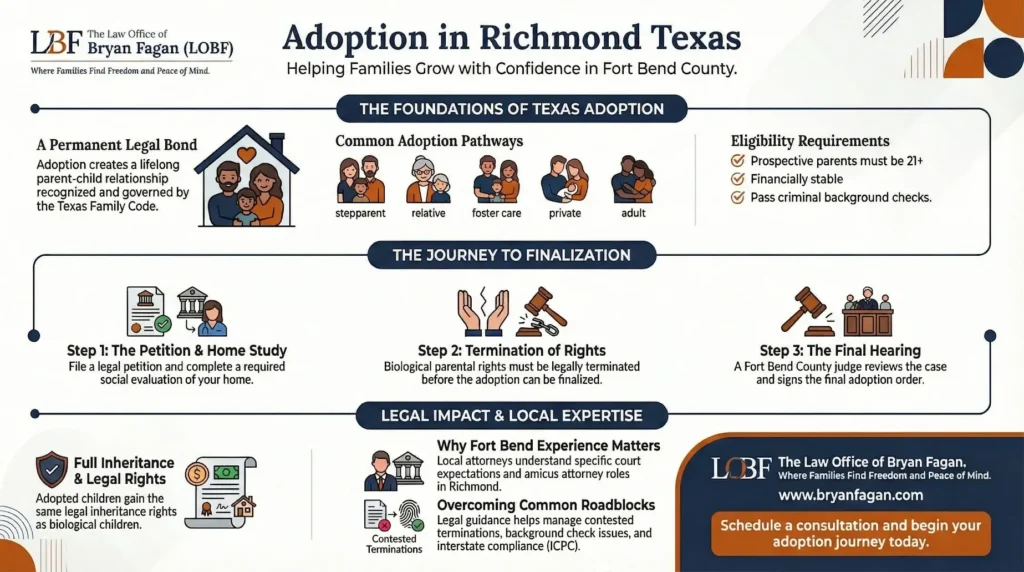
Which Type Applies to You?
If you’re married to a child’s biological parent and want to legally adopt that child, you’re pursuing step-parent adoption. If you’re raising a relative’s child and want permanent custody, relative adoption applies. Foster and adoptive families who’ve been caring for a child through DFPS typically work toward foster care adoption once parental rights are terminated.
For many families considering Adoption in Richmond Texas, one of the most stressful questions is whether the other biological parent must agree to the adoption. The answer depends entirely on the legal status of that parent’s rights and the specific facts of your case. Understanding this early can help you avoid delays and move forward with greater clarity.
Under Texas Family Code Chapter 162, an adoption generally cannot proceed unless each living parent with legal rights either consents to the adoption or has those rights legally terminated. When both biological parents still retain their parental rights, their consent is typically required. This consent must meet strict legal standards, including properly executed affidavits under Texas Family Code §161.103, to ensure that the decision is voluntary and informed.
However, Texas law also recognizes that consent is not always possible—or appropriate. Under Texas Family Code Chapter 161, courts may terminate a parent’s rights without consent if certain statutory grounds are met. These include abandonment, endangerment, failure to support the child, criminal conduct, or situations where the parent cannot be located despite diligent search efforts. In these cases, the court must find by clear and convincing evidence that termination is justified and that it serves the child’s best interest under §153.002.
In practice, this often arises in step-parent adoption cases. For example, a parent who has been absent for years, has not paid child support, and has had no meaningful contact with the child may face involuntary termination of parental rights. Once those rights are terminated, the adoption can move forward without that parent’s consent. For a deeper understanding of how these situations are handled, families can review adoption attorney services in The Woodlands, which provides insight into how experienced attorneys guide clients through these complex cases.
It’s important to remember that termination of parental rights is one of the most serious actions a Texas court can take, and it is never granted lightly. Judges carefully evaluate the evidence, the child’s circumstances, and the long-term impact of the decision. This is why having knowledgeable legal support is so important—ensuring that proper procedures are followed and that your case is presented clearly and effectively.
If you’re unsure whether consent is required in your situation, exploring additional resources like the firm’s Texas family law blog can help you better understand your options. With the right guidance, families can navigate these challenges and take meaningful steps toward creating a stable, permanent future for their child.
Legal Requirements for Adoption in Texas
Families pursuing Adoption in Richmond Texas quickly discover that the process is built on clear legal safeguards designed to protect children and ensure long-term stability. Texas law does not treat adoption as a simple paperwork exercise—it is a structured legal process governed primarily by Texas Family Code Chapters 161 and 162, requiring careful attention to detail and compliance at every stage.
One of the most important legal steps involves consent or termination of parental rights. Under Texas Family Code Chapter 161, a child’s biological parents must either voluntarily relinquish their rights through a properly executed affidavit or have those rights terminated by the court. In contested cases, termination requires “clear and convincing evidence” that statutory grounds exist—such as abandonment, endangerment, or failure to support—and that termination is in the child’s best interest. This is often one of the most complex parts of the process, especially in step-parent or custody-related situations, which is why many families benefit from reviewing resources like step-parent rights and responsibilities in custody cases to better understand how these legal principles apply.
Every adoption decision in Texas is ultimately guided by the “best interest of the child” standard under Texas Family Code §153.002. Judges in Fort Bend County carefully evaluate factors such as the child’s emotional and physical needs, the stability of the proposed home environment, existing family relationships, and—when appropriate—the child’s preferences. In many cases, courts also consider how the adoption will impact the child’s daily life, including their education, routine, and long-term development.
To further protect children, Texas law requires background checks and, in most cases, a home study under Texas Family Code §162.003. These evaluations include criminal history checks, fingerprinting, and a review of the statewide child abuse registry, along with an assessment of the home environment and financial stability. While these requirements can feel detailed, they are designed to ensure that every adoptive placement provides a safe and supportive foundation.
Finally, no adoption is complete without court approval. Under Texas Family Code §162.016 and §162.017, a judge must sign a final decree of adoption after determining that all statutory requirements have been satisfied and that the adoption truly serves the child’s best interest. This final step creates a permanent legal parent-child relationship, granting full rights and responsibilities to the adoptive parent.
For families navigating this process, having experienced legal guidance can make all the difference. Whether you are pursuing a step-parent adoption or exploring other options, working with a trusted Texas family law team helps ensure that every requirement is met and that your path forward is as smooth and secure as possible.

Step-by-Step Adoption Process in Richmond Texas
Understanding the adoption process reduces uncertainty and helps families prepare effectively.
Step 1: Determine adoption type Identify whether you’re pursuing step-parent, relative, foster care, private, or adult adoption. This determines specific requirements and procedures.
Step 2: File petition in Fort Bend County court The adoption petition must be filed in the district court where the child or adoptive parents reside. Fort Bend County cases are typically heard in the 328th, 387th, or 505th District Courts in Richmond.
Step 3: Complete home study and background checks Under Texas Family Code §162.003, most adoptions require an evaluation of the home environment, financial stability, safety, and parenting readiness. Courts may waive this requirement in uncontested step-parent cases when background checks are satisfactory.
Step 4: Obtain required consents or terminate parental rights Biological parents must sign voluntary relinquishment affidavits, or petitioners must pursue involuntary termination through the courts.
Step 5: Attend court hearings Depending on complexity, you may attend multiple hearings. Contested cases require presenting evidence; uncontested step-parent adoptions may need only one hearing.
Step 6: Final adoption decree The judge signs the adoption order, granting full parental rights to the adoptive parents. A new birth certificate can then be issued.
Where Cases Commonly Get Delayed
- Difficulty locating biological parents for service or notification
- Incomplete documentation or missing medical/genetic history reports
- Court scheduling congestion in Fort Bend County
- Contested termination when biological parents object
Adoption Process Timeline
Table 2: Adoption Timeline
| Step | What Happens | Typical Timeframe |
|---|---|---|
| Initial consultation | Meet with attorney, determine adoption type | 1–2 weeks |
| File petition | Submit paperwork to Fort Bend County court | 2–4 weeks |
| Home study | Complete evaluation, background checks | 4–8 weeks |
| Obtain consent/termination | Secure voluntary relinquishment or pursue termination | 2–6 months |
| Court hearings | Present case to judge | 4–8 weeks for scheduling |
| Final decree | Judge signs adoption order | Same day as final hearing |
Fast-track scenarios like uncontested step-parent adoptions may complete in 3–6 months. Contested cases involving involuntary termination can extend beyond 12 months.
How Long Does Adoption Take in Richmond Texas?
When families begin exploring Adoption in Richmond Texas, one of the most common concerns is timing. While every case is unique, adoption timelines in Fort Bend County are shaped by both legal requirements and the specific circumstances of each family. Under Texas Family Code Chapters 161 and 162, adoption cannot move forward until parental rights are properly addressed and all statutory steps are completed, which is why some cases move quickly while others take more time.
In straightforward situations—such as uncontested step-parent adoptions—families may see the process completed in as little as three to six months. These cases often move efficiently because one biological parent has already relinquished rights or is not contesting the adoption. If you are considering this route, reviewing resources like step-parent adoption basics in Texas can provide helpful insight into what to expect and how to prepare.
More complex cases naturally take longer. Private adoptions, particularly those involving infants, often range from six to twelve months due to the time required for matching, medical history documentation, and compliance with Texas Family Code §162.002 and §162.003 regarding consent and pre-adoptive evaluations. Foster care adoptions may extend beyond a year, especially when termination of parental rights under Chapter 161 is contested or delayed.
Several factors can influence how quickly an adoption moves forward. Cases tend to progress more smoothly when biological parents cooperate, all required documentation is complete and accurate, and the proceedings remain uncontested. On the other hand, delays are common when termination of parental rights is disputed, paperwork is incomplete, or court dockets in Fort Bend County are congested.
Texas courts must also ensure that every adoption meets the “best interest of the child” standard under Texas Family Code §153.002 before issuing a final decree under §162.016. This careful review is intentional—it protects children and ensures that the outcome provides long-term stability.
For families navigating this timeline, having experienced legal guidance can make a meaningful difference. The team at Bryan Fagan’s firm works closely with clients to anticipate delays, streamline documentation, and keep cases moving forward whenever possible. If you’re unsure where your situation falls, exploring additional insights through the firm’s Texas family law blog can help you better understand the process and prepare for what lies ahead.

Cost of Adoption in Richmond Texas
Adoption costs vary based on complexity and type.
Attorney fees range from $2,000–$5,000 for straightforward step-parent adoptions to $7,500–$15,000+ for private domestic adoptions. Contested cases with complex termination issues can reach $10,000–$25,000.
Court filing fees in Fort Bend County typically run $350–$400.
Home study costs range from $1,000–$3,000 when required, though courts may waive this in certain step-parent cases.
New birth certificate fees cost approximately $25–$70 including certified copies.
Foster care adoptions often qualify for DFPS reimbursement of non-recurring adoption expenses up to approximately $1,200 per child.
The investment in adoption creates permanent legal security that protects your family for generations.
What Is a Home Study and Why It Matters
A home study evaluates whether adoptive parents can provide safe and loving homes for children. This comprehensive process includes:
- Home visits to inspect safety, cleanliness, and space
- Interviews with all household members
- Financial documentation review
- Background checks and registry searches
- Reference checks from character witnesses
How to prepare: Ensure your home meets basic safety requirements (smoke detectors, fire extinguisher, secure medications). Gather financial records, organize documents, and be honest during interviews.
Timeline: Home studies typically take 4–8 weeks to complete.
What might disqualify a home study: Serious criminal history, unresolved child abuse findings, unsafe living conditions, or inability to demonstrate financial stability.
Don’t let this process intimidate you. Home studies exist to help children—not to create barriers for loving families.
Termination of Parental Rights
Before adoption can occur, the biological parent’s legal rights must end. Texas Family Code Chapter 161 governs this process.
Voluntary termination occurs when a biological parent signs an affidavit of relinquishment, voluntarily surrendering their parental rights. This is common in step-parent adoptions where the absent parent agrees to the adoption.
Involuntary termination requires the court to find, by clear and convincing evidence, that statutory grounds exist—abandonment, endangerment, failure to support, criminal conduct—and that termination serves the child’s best interest.
Real-life examples:
- A biological father who hasn’t contacted his child in three years may face involuntary termination for abandonment
- An unknown father who cannot be identified may have his rights terminated after proper notice procedures
The termination process significantly impacts adoption timelines. Contested terminations require multiple hearings and evidence presentation.
Common Challenges in Adoption Cases
Families pursuing Adoption in Richmond Texas often begin the process with hope and excitement, but it’s important to understand that adoption also comes with legal and emotional challenges. Texas adoption law—primarily governed by Texas Family Code Chapters 161 and 162—requires strict compliance, and even small missteps can lead to delays or complications. Knowing what to expect ahead of time can help families move forward with greater confidence and peace of mind.
One of the most common obstacles involves paperwork. Adoption requires detailed documentation, including medical and genetic history reports under Texas Family Code §162.005, properly executed consent affidavits, and accurate petition filings. Missing or incomplete information can result in rejected filings or postponed hearings. This is especially true in step-parent cases, where understanding the process in advance—through resources like how step-parent adoption works in Texas—can help families avoid unnecessary setbacks.
Consent and termination of parental rights are often the most complex aspects of any adoption case. Under Texas Family Code Chapter 161, biological parents must either voluntarily relinquish their rights or have those rights terminated by the court. When a parent is uncooperative, cannot be located, or contests the proceedings, the case can become significantly more complicated and time-consuming. Courts require clear and convincing evidence to terminate parental rights, and this process may involve multiple hearings and additional legal steps.
Delays are also common due to court scheduling realities in Fort Bend County. Adoption cases must be carefully reviewed to ensure compliance with the “best interest of the child” standard under Texas Family Code §153.002, and crowded dockets can extend timelines. While these delays can be frustrating, they reflect the court’s responsibility to ensure that each adoption creates a safe and stable outcome for the child.
Beyond the legal process, families often experience emotional stress during adoption. The waiting, uncertainty, and complexity can feel overwhelming, particularly when a child’s future is at stake. One of the most frequent misconceptions is that adoption becomes automatic once paperwork is submitted. In reality, adoption requires active participation, attention to deadlines, and ongoing communication with the court.
Another common mistake is assuming that a simple agreement or signature from a biological parent is enough. In many cases, formal legal termination under Chapter 161 is required before an adoption can proceed. Without proper legal steps, the case may be delayed or even dismissed.
For families navigating these challenges, working with an experienced Texas family law team can make a meaningful difference. By anticipating potential obstacles and guiding clients through each requirement, attorneys help ensure that the process stays on track. If you want to better understand how adoption fits within the broader landscape of Texas family law, the firm’s family law blog offers additional insights and practical guidance.
Adoption is not always simple—but with the right preparation and support, it can lead to one of the most meaningful outcomes a family can experience.

Adoption vs. Custody or Guardianship
Adoption differs fundamentally from custody or guardianship arrangements.
Adoption permanently transfers all parental rights and responsibilities. The adoptive parent becomes the legal parent in every sense—the child inherits from them, can receive benefits through them, and the original birth certificate is sealed with a new one issued.
Custody establishes living arrangements and decision-making authority but doesn’t terminate the biological parent’s legal status.
Guardianship grants authority to care for a child but remains revocable and doesn’t create a permanent parent-child relationship.
When permanence and security matter most, adoption provides what custody and guardianship cannot.
What Happens After Adoption Is Finalized?
When the judge signs the final decree, your family officially becomes permanent under Texas law.
New birth certificate: Texas issues a new birth certificate listing the adoptive parents. The original record is sealed.
Name change: If requested in the petition, the child’s name can be legally changed.
Full parental rights: Under Texas Family Code §162.017, adoptive parents receive complete rights and responsibilities—identical to biological parents.
Long-term impact: The child inherits from adoptive parents, qualifies for benefits, and enjoys full legal protection as their child.
Why Legal Guidance Matters in Adoption
Families considering Adoption in Richmond Texas often underestimate how detailed and technical the legal process can be. Adoption is governed by strict requirements under Texas Family Code Chapters 161 and 162, and even minor mistakes can lead to delays, added expense, or in some cases, dismissal of the case altogether. What may seem like a straightforward process—filing paperwork and attending a hearing—actually involves multiple legal steps that must be completed correctly and in the proper sequence.
One of the most common risks families face when handling adoption without legal guidance is filing errors. Clerks may reject petitions that are incomplete or improperly prepared, and missing required documents—such as affidavits of relinquishment under Texas Family Code §161.103 or medical history reports under §162.005—can stall progress. Issues with proper service of notice to biological parents, as required by Texas Rules of Civil Procedure and Family Code provisions, can also create significant setbacks if not handled correctly.
Termination of parental rights is another critical area where legal precision matters. Under Chapter 161, courts require clear and convincing evidence before terminating a parent’s rights, and failure to meet this standard can prevent an adoption from moving forward. In step-parent adoption cases, understanding how these requirements apply is essential, which is why reviewing resources like step-parent adoption in Texas: how it works can provide valuable clarity.
Beyond documentation, courts must ultimately determine that the adoption serves the child’s best interest under Texas Family Code §153.002 before issuing a final decree under §162.016. This means every detail—from the home environment to the stability of the proposed placement—must be presented clearly and effectively. Without experienced legal guidance, families may struggle to anticipate what the court expects or how to address potential concerns.
Working with a knowledgeable Texas family law attorney helps ensure that every requirement is met and that the process moves forward as smoothly as possible. From preparing filings and coordinating background checks to navigating Fort Bend County court procedures, experienced counsel provides both legal protection and peace of mind. If you’re looking to better understand how adoption fits within the broader framework of Texas family law, the firm’s family law resource center offers additional guidance and practical insights.
Adoption is one of the most meaningful legal steps a family can take—but it is also one of the most important to get right. With the right support, families can move through the process with confidence, knowing they are building a secure and lasting future for their child.

Checklist: Adoption in Richmond Texas
- ☐ Determine your adoption type (step-parent, relative, foster care, private, adult)
- ☐ Confirm jurisdiction (Fort Bend County if you or the child reside there)
- ☐ Identify required consents early and locate biological parents
- ☐ Gather necessary documents (financial records, identification, existing court orders)
- ☐ Complete home study and background checks
- ☐ File adoption petition with the court
- ☐ Prepare for hearings (evidence, witnesses, documentation)
- ☐ Work with an experienced adoption attorney
- ☐ Stay organized and track all deadlines
- ☐ Plan for post-finalization tasks (new birth certificate, records updates)
Conclusion
At the end of the day, what matters most isn’t just the legal outcome—it’s the life your child gets to live afterward. Stability at home creates confidence in the classroom, and when children feel secure, supported, and understood, everything else starts to fall into place. Whether that stability comes through adoption, a well-structured custody arrangement, or thoughtful co-parenting, the goal is the same: giving your child the foundation they need to succeed.
If you’re navigating divorce, considering adoption, or simply trying to make the best decisions for your child’s future, you don’t have to figure it out on your own. The right guidance can turn uncertainty into a clear path forward. Working with an experienced Texas Family Law Attorney can help you protect not only your legal rights, but also your child’s emotional well-being and academic success.
At The Law Office of Bryan Fagan, PLLC, we believe families deserve more than answers—they deserve peace of mind. If you’re ready to take the next step, whether that’s asking questions, exploring your options, or building a plan that truly supports your child, our team is here to help.
Because sometimes the biggest difference in a child’s future starts with one decision today—and the support you choose along the way.
Frequently Asked Questions
Adoption in Richmond Texas requires filing a petition in Fort Bend County district court, completing background checks and home study requirements, obtaining proper consent or termination of parental rights, and receiving court approval. The specific steps depend on your adoption type—step-parent, relative, foster care, or private.
Uncontested step-parent adoptions typically complete within 3–6 months. Private adoptions may take 6–12 months, while contested cases involving involuntary termination can extend beyond a year. Court scheduling and case complexity significantly impact timing.
While not legally required, working with an adoption attorney significantly reduces the risk of delays, errors, and case dismissal. Texas adoption law involves complex procedural requirements that an experienced attorney can navigate efficiently.
After the final decree is signed, adoption is permanent and extremely difficult to reverse. Texas law provides only very narrow grounds for challenging an adoption—typically involving fraud or coercion—and only within a short statutory window.
Not always. If one parent’s rights have been terminated, they are absent or unknown, or the court finds grounds for involuntary termination, adoption can proceed without that parent’s consent.
A home study includes home visits to assess safety, interviews with household members, review of financial documents, background checks, and reference checks. The evaluation ensures adoptive parents can provide safe and loving homes.
Yes, in certain circumstances. If the biological parent’s rights have been terminated, they cannot be located after reasonable efforts, or grounds exist for involuntary termination, adoption can proceed without their participation.
Uncontested step-parent adoptions are typically the simplest, especially when the absent biological parent voluntarily relinquishes rights. These cases often require fewer hearings and may qualify for home study waivers.
