
Mothers Rights in Richmond Texas: A Complete Guide to Protecting Your Parental Rights

Have you ever watched your child struggle with homework and wondered if something deeper was going on? For many parents in Richmond, the first signs of divorce don’t show up in the courtroom—they show up on a report card. Mothers Rights in Richmond Texas are about far more than custody schedules or legal terminology—they are about protecting your child’s sense of stability, confidence, and ability to succeed in school during one of life’s most difficult transitions.
Under Texas Family Code §153.002, every custody decision must center on the “best interest of the child,” and that includes something many parents don’t initially consider: academic performance and emotional well-being. When families begin navigating custody, they often focus on time-sharing and legal rights, but judges are also looking closely at which parent can provide consistency, structure, and support for a child’s education.
At The Law Office of Bryan Fagan, PLLC, we’ve worked with countless families who came in focused on custody, only to realize their biggest concern was their child falling behind in school, withdrawing socially, or losing focus. These challenges are not separate from the legal process—they are directly tied to it. When routines change, communication breaks down, and uncertainty enters a child’s life, their ability to learn and thrive is often one of the first things affected.
Led by Bryan Joseph Fagan, a South Texas College of Law graduate and a recognized authority in Texas family law, our firm is built on a simple but powerful mission: to help families reclaim peace of mind and move forward with clarity. We do that by combining real legal experience with compassionate guidance—because understanding your rights is only part of the solution. Knowing how those rights shape your child’s future is what truly matters.
In this guide, you’ll learn how Texas courts evaluate educational stability in custody decisions, what role mothers play in maintaining academic consistency, and how thoughtful legal strategies can protect both your parental rights and your child’s success in school. If you’re facing uncertainty, you’re not alone—and the next steps you take can make all the difference.
Key Takeaways
- Mothers and fathers have equal legal rights in Texas—courts do not favor one parent based on gender under Texas Family Code §153.003
- Custody decisions in Fort Bend County are based on the best interest of the child, not assumptions about motherhood
- A court order is often required to fully protect or enforce parental rights, even when parents agree informally
- Unmarried mothers have rights at birth, but legal action may still be necessary to establish enforceable custody arrangements and visitation rights
- Understanding your rights early can help you avoid costly mistakes and protect your relationship with your child

Your Family’s Future Starts Here
Don’t navigate your legal journey alone. Schedule a consultation now and get the clarity and support you deserve.
Listen to Our Texas Family Law Podcast
Prefer listening? In this episode, we discuss mothers’ rights in Richmond, Texas, including custody and visitation rights, how Texas law protects mothers, and what you need to know to safeguard your role in your child’s life.
The Law Office of Bryan Fagan, PLLC can represent clients in a variety of family law matters, such as the following:
As a family law firm, we recognize that clients entrust us with a deeply personal aspect of their lives. Respecting this responsibility, our firm operates with professionalism, diligence, and efficiency, while maintaining open lines of communication with our clients. Not only do we provide access to their attorney, but also a dedicated client support team capable of addressing any inquiries regarding the case, status updates, billing concerns, or any other matters that arise throughout the process. Please don’t hesitate to discover how we can be of service to you.
Contact the Law Office of Bryan Fagan, PLLC at 281-245-1907 or online.
Mothers Rights in Richmond Texas: The Short Answer
Mothers Rights in Richmond Texas refer to the full range of legal rights a mother has regarding custody, visitation, and decision-making for her child under Texas law. Whether you are already living in Richmond or considering a move, understanding how local courts handle custody is critical. For families exploring relocation, resources like moving to Richmond, Texas can provide helpful insight into the community you and your child may call home. Under the Texas Family Code, mothers and fathers are treated equally, with no legal preference based on gender. This principle is clearly established in §153.003, which prohibits discrimination based on sex or marital status in custody decisions.
In real-world terms, this means mothers have the same rights as fathers to pursue physical custody (possession), legal custody (conservatorship), and meaningful involvement in their child’s life. Texas courts—especially in Fort Bend County—focus on what arrangement best supports the child’s overall well-being. Under §153.002, the “best interest of the child” is always the guiding standard. Judges carefully evaluate which parent can provide consistency, stability, and support, including maintaining routines that benefit the child’s education and emotional health. In many situations, a formal court order is necessary to clearly define and enforce those rights, which is why having experienced legal guidance can be so important.
What Rights Do Mothers Have Under Texas Law?
Under Texas Family Code Chapter 151, mothers are granted comprehensive rights and responsibilities that shape nearly every aspect of a child’s upbringing. These include decision-making authority over education, medical care, and religious training, as well as the right to determine the child’s residence when awarded that exclusive authority under §153.134. At the same time, mothers share the responsibility to provide financial support, supervision, and protection, ensuring their child’s needs are consistently met.
Texas law continues to reflect the reality that parenting is a shared responsibility, not a gender-based role. Courts evaluate each parent based on involvement, reliability, and the ability to create a stable environment—not outdated assumptions. For a deeper look at how financial responsibilities fit into this framework, you can review this Texas child support guide to better understand how support is calculated and enforced.
At The Law Office of Bryan Fagan, PLLC, the focus is on helping families move forward with clarity and confidence. By combining a strong command of Texas law with practical experience in local courts, the firm provides guidance that is both legally sound and genuinely supportive—because protecting your rights ultimately means protecting your child’s future.

Table 1: Mothers’ Rights in Texas
| Right | What It Means | Why It Matters | Real-Life Example |
|---|---|---|---|
| Physical Possession | The right to have your child live with you | Determines where your child spends daily life | Mother designated as primary residence for school enrollment |
| Decision-Making Authority | Making choices about education, medical care, and religious training | Protects your involvement in the child’s upbringing | Deciding which school your child attends |
| Legal Representation | Acting as your child’s legal representative | Allows you to make legal decisions on their behalf | Signing consent forms for school activities |
| Financial Support | Right to receive and duty to provide support | Ensures the child’s needs are met | Receiving child support for housing and expenses |
| Access and Visitation | Spending time with your child | Maintains the parent child relationship | Weekend visits, holidays, and summer vacations |
| Moral and Religious Training | Guiding your child’s moral development | Shapes the child’s values and beliefs | Choosing religious education or activities |
Establishing and Protecting Parental Rights
Mothers have parental rights at birth, but enforceability often requires legal action through the courts. For married mothers, parental rights are automatic when the child is born. For unmarried mothers, while rights exist at birth, formal legal recognition may be needed—especially to prevent disputes with the father.
Key situations where legal action protects your rights:
- Divorce cases: Custody arrangements must be established through a Suit Affecting Parent-Child Relationship (SAPCR) or divorce decree
- Unmarried parents: When the father is not on the birth certificate, an Acknowledgment of Paternity establishes his rights—which may affect yours
- Custody disputes: Without a court order, informal agreements are not legally enforceable
A court order transforms your parental rights from legal principles into enforceable protections. Without one, the other parent could challenge your custody arrangements at any time.
Custody (Conservatorship) Rights for Mothers
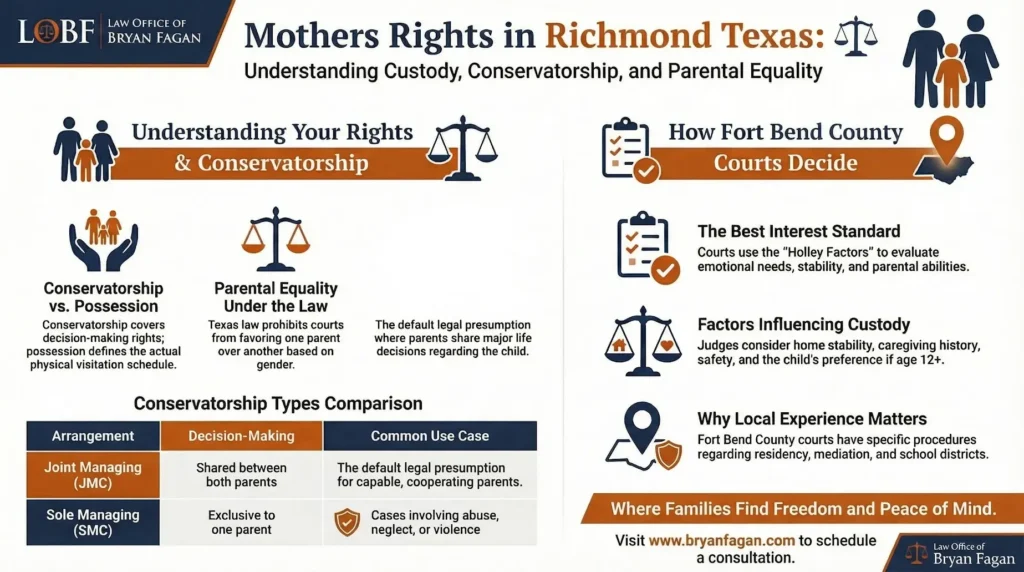
Understanding Mothers Rights in Richmond Texas begins with knowing how Texas law defines custody. Conservatorship refers to a parent’s legal rights and duties—such as making decisions about a child’s education, medical care, and overall upbringing—while possession addresses when the child is physically with each parent. This distinction is critical, especially for families navigating daily logistics like school drop-offs, extracurriculars, and even practical concerns such as transportation in Richmond, Texas, which can directly impact how parenting schedules function in real life.
In most cases, Texas courts favor Joint Managing Conservatorship (JMC). Under Texas Family Code §153.131, there is a presumption that appointing both parents as joint managing conservators is in the child’s best interest unless there is evidence that doing so would significantly impair the child’s physical health or emotional development. In a JMC arrangement, both parents share decision-making responsibilities, but one parent is typically granted the exclusive right to determine the child’s primary residence under §153.134. This designation often plays a key role in maintaining stability for the child, particularly when it comes to school continuity and daily routines.
However, there are situations where Sole Managing Conservatorship (SMC) is appropriate. Under Texas Family Code §153.004, courts may limit one parent’s rights if there is a history of family violence, substance abuse, or other safety concerns. In these cases, one parent is given primary decision-making authority to protect the child’s well-being, while the other parent’s access may be restricted or supervised. These decisions are never taken lightly and are always grounded in protecting the child’s best interest under §153.002.
Courts in Fort Bend County look closely at each parent’s level of involvement, consistency, and ability to provide a stable environment. Mothers who have served as primary caregivers can strengthen their position by presenting clear evidence of their role in the child’s daily life, including school involvement, medical care, and structured routines. For parents seeking to better understand how custody arrangements are structured and enforced, this Texas custody guide offers additional insight into how courts approach these decisions.
The team at The Law Office of Bryan Fagan approaches conservatorship cases with both legal precision and genuine empathy. By helping parents understand not just their rights but how those rights apply in everyday life, the firm empowers families to make informed decisions that support long-term stability and protect what matters most—their children.

Parenting Time and Visitation (Possession and Access)
Parenting time is separate from custody rights and determines when each parent has physical possession of the child. Under Texas Family Code Chapter 153, the Standard Possession Order (SPO) provides a default schedule for parents living within 100 miles of each other—typically including alternating weekends, Thursday evenings, and extended summer possession.
Mothers designated as the primary conservator generally have possession during school weeks, while the other parent follows the SPO schedule. However, parenting plans can be customized based on:
- The child’s age and developmental needs
- Work schedules and practical logistics
- Geographic distance between parents
- The child’s relationship with each parent
In Richmond and Fort Bend County, courts recognize that families have unique circumstances. Supervised visitation may be ordered when there are safety concerns or family violence issues. Courts may also deviate from the SPO for children under three years old.
Important: Child support and visitation rights are separate legal issues. One parent cannot withhold visitation because the other parent hasn’t paid support, and vice versa.
Custody and Parenting Process Timeline in Fort Bend County
Understanding the legal process helps you prepare for what lies ahead. Custody cases in Fort Bend County typically take between six months and two years, depending on complexity.
Table 2: Custody Process Timeline
| Step | What Happens | Typical Timeline | Where Things Go Wrong |
|---|---|---|---|
| Filing SAPCR Petition | Parent files legal documents to establish custody | Week 1 | Incomplete paperwork delays case |
| Temporary Orders Hearing | Court establishes temporary custody and support | 2-4 weeks after filing | Lack of preparation harms initial outcome |
| Mediation | Parents attempt to reach agreement with neutral mediator | 2-3 months after filing | Refusal to negotiate prolongs litigation |
| Discovery | Gathering evidence, records, and witness information | 3-6 months | Missing documentation weakens case |
| Final Trial | Judge hears evidence and makes final custody decision | 6-18 months from filing | Poor presentation of evidence affects ruling |
| Entry of Final Order | Court issues binding custody orders | Shortly after trial | Unclear terms create enforcement problems |
Fort Bend County courts have implemented Docket Control Orders that typically set trial dates approximately nine months after filing in cases involving children. Mediation is strongly encouraged and often required before trial.
Child Support and Mothers’ Rights
Mothers have the right to seek financial support for their children under Texas Family Code Chapter 154. Child support calculations in Texas follow statutory guidelines based on the obligor’s net resources—approximately 20% for one child, increasing for additional children.
Support orders may include:
- Monthly child support payments
- Medical support and health insurance coverage
- Reimbursement for uninsured medical expenses
- Educational expenses in some circumstances
Enforcement mechanisms protect mothers when the other parent fails to pay. These include wage withholding, property liens, contempt of court proceedings, and even suspension of driver’s licenses or professional licenses.
Remember: child support is about the child’s welfare, not parental visitation rights. Courts will not reduce visitation because support is unpaid, and they will not excuse support obligations because visitation is denied.
How Texas Courts Decide What’s Best for the Child
Understanding how judges make custody decisions is essential when evaluating Mothers Rights in Richmond Texas, especially for parents facing difficult or high-conflict situations. Texas courts are guided by one central principle: the best interest of the child. This standard is codified in Texas Family Code §153.002 and serves as the foundation for every custody determination, regardless of the parent’s gender, income, or background.
To apply this standard, courts rely on a set of considerations commonly known as the Holley factors, which examine the child’s emotional and physical needs, potential risks to their well-being, each parent’s abilities, and the stability of each proposed home environment. Judges also evaluate long-term plans for the child, the availability of supportive programs, and, when appropriate, the child’s own preferences if they are 12 years of age or older. These factors are not applied mechanically; instead, Fort Bend County courts carefully weigh the unique circumstances of each family to determine what arrangement will best support the child’s development and sense of security.
In more complex cases—particularly those involving allegations of violence or unsafe behavior—courts give significant weight to protecting the child from harm. Under Texas Family Code §153.004, evidence of family violence can directly impact custody outcomes, including limiting or denying conservatorship rights to one parent. For families dealing with serious concerns such as assault or threats to safety, understanding how these issues intersect with custody is critical. Resources like assault and family law considerations in Richmond can provide additional context on how these situations are handled within the legal system.
Judges also look closely at each parent’s history of involvement in the child’s daily life, including school participation, healthcare decisions, and emotional support. A parent who demonstrates consistency, reliability, and a child-focused approach is often better positioned to meet the court’s expectations. For those seeking a deeper understanding of how these factors play out in real custody cases, this Texas child custody guide offers practical insight into how courts evaluate evidence and make decisions.
At The Law Office of Bryan Fagan, PLLC, the goal is to help parents move through this process with clarity and confidence. By combining a thorough understanding of Texas law with real courtroom experience, the firm provides guidance that is both strategic and compassionate. Every case is approached with one priority in mind: helping families create stable, supportive environments where children can thrive—no matter how challenging the circumstances may be.

Modifying and Enforcing Mothers’ Rights
Custody orders can be modified when there is a material and substantial change in circumstances. Texas law requires proof that circumstances have significantly changed since the last order and that modification would serve the child’s best interest.
Common reasons for modification include:
- Relocation of one parent
- Changes in the child’s needs
- Safety concerns or family violence
- Significant changes in a parent’s living situation
- The child’s preference (if 12 or older)
Enforcement is available when the other parent violates existing court orders. Under Texas Family Code Chapter 157, mothers can file enforcement motions seeking:
- Contempt of court findings
- Makeup visitation time
- Attorney’s fees
- Fines or jail time for repeated violations
Documenting violations is essential. Keep records of missed visitation, late support payments, and communications with the other parent.
Common Misconceptions About Mothers’ Rights in Texas
Many mothers enter custody proceedings with assumptions that don’t match Texas law:
“Mothers automatically get custody” ❌ Texas law explicitly prohibits favoring one parent based on gender. Courts evaluate both parents equally under §153.003.
“If we agree, we don’t need a court order” ❌ Without a formal court order, agreements are not legally enforceable. Either parent can change their mind at any time.
“Child support controls visitation” ❌ These are separate legal issues. You cannot withhold visitation for unpaid support, and support obligations continue regardless of visitation disputes.
Understanding these realities helps you approach your case with realistic expectations and proper preparation.
Common Challenges Mothers Face in Custody Cases
Custody proceedings present real-world difficulties that extend beyond legal technicalities:
- Co-parenting conflict: Communication breakdowns make cooperation difficult
- Enforcement challenges: When the other parent ignores court orders
- Relocation disputes: Moving for work or family can trigger modification battles
- School and medical decisions: Disagreements about the child’s education or healthcare
- Documentation burdens: Proving involvement requires organized records
- Emotional stress: The fear of losing time with your child affects judgment
Working with a family law attorney helps you navigate these challenges while focusing on your child’s best interest.
Why Legal Guidance Matters for Mothers
Navigating custody and family law issues can feel overwhelming, especially when you are trying to protect both your parental rights and your child’s well-being. Understanding Mothers Rights in Richmond Texas is only part of the equation—the real challenge is applying those rights effectively within a legal system that requires strict compliance with procedures, deadlines, and evidentiary standards. The Texas Family Code outlines detailed requirements for filings, hearings, and evidence, and even small missteps can have lasting consequences. For example, courts rely heavily on properly presented evidence when applying the “best interest of the child” standard under §153.002, and procedural errors can weaken even the strongest case.
Legal guidance becomes even more critical in complex situations involving safety concerns, substance use, or criminal allegations. Under Texas Family Code §153.004, courts must consider evidence of family violence or conduct that may endanger a child’s physical or emotional welfare. Issues such as impaired driving can also influence custody determinations if they raise concerns about a parent’s judgment or stability. For families facing these challenges, understanding how criminal matters intersect with custody is essential, and resources like Richmond DWI and DUI legal considerations can provide valuable context.
Working with an experienced family law attorney in Fort Bend County offers more than just legal knowledge—it provides strategy, preparation, and peace of mind. A skilled legal team can help you gather and present evidence effectively, prepare for mediation or trial, and ensure your case aligns with the expectations of local judges. Whether it’s documenting your involvement in your child’s education or addressing concerns raised by the other parent, having the right guidance can make a meaningful difference in the outcome. For additional insight into how these cases unfold, this Texas divorce and custody resource offers a helpful overview of the process.
At The Law Office of Bryan Fagan, PLLC, the focus is on helping mothers move forward with clarity and confidence. By combining deep knowledge of Texas law with compassionate, client-centered support, the firm empowers families to make informed decisions and protect what matters most. Because in the end, safeguarding your rights is not just about legal success—it’s about creating a stable, secure future for your child.

Checklist: Protecting Your Mothers Rights in Richmond Texas
Protecting Mothers Rights in Richmond Texas starts with taking intentional, informed steps that align with both the law and your child’s best interests. While every family’s situation is unique, there are foundational actions that can help you build a strong position and create stability for your child during and after a custody case. Understanding your rights under Texas Family Code Chapters 151 and 153 is essential, as these sections outline both your legal authority and your responsibilities as a parent, including decision-making, care, and support. Courts rely heavily on these statutes—along with the best interest standard under §153.002—when evaluating custody arrangements.
Equally important is documenting your involvement in your child’s daily life. This includes attending school events, managing medical care, and maintaining consistent routines. These real-life actions often carry significant weight in court because they demonstrate your ability to provide stability. Establishing or confirming a formal custody order is another critical step, as informal agreements are not enforceable under Texas law. When preparing for hearings, organized evidence—such as school records, communication logs, and calendars—can make a meaningful difference in how your case is presented and understood by the court.
Maintaining a stable and supportive environment for your child should remain a constant priority. Courts look closely at consistency, especially when applying §153.134, which governs rights and duties in joint managing conservatorship cases, including which parent may determine the child’s primary residence. Following court orders precisely is equally important, as violations can negatively impact your credibility and future custody determinations. Keeping detailed records of parenting time and communication with the other parent can also be invaluable if enforcement becomes necessary under Chapter 157 of the Texas Family Code.
Working with a knowledgeable family law attorney familiar with Fort Bend County courts can help you navigate these steps with clarity and confidence. If you are considering meeting with a legal professional, resources like planning your visit to the Richmond office can help you take that first step with ease. For additional guidance on building a strong custody case, this Texas child custody resource offers helpful insights into how courts evaluate parental involvement and stability.
At The Law Office of Bryan Fagan, PLLC, the goal is to empower mothers with the knowledge and support needed to move forward with confidence. By focusing on preparation, consistency, and the child’s best interest, you can protect your rights while creating a foundation for your child to thrive—both now and in the future.
Conclusion
When everything feels uncertain, one thing remains steady—your role in your child’s life matters more than anything else. The decisions you make during a divorce don’t just shape custody arrangements; they shape your child’s sense of stability, their confidence, and even how they perform in school. That’s why understanding your rights and approaching this process with intention can make all the difference.
If you’re navigating questions about custody, school routines, or how to protect your child’s future, you don’t have to figure it out alone. Having the guidance of an experienced Texas family law attorney can help you avoid costly missteps and create a plan that truly supports your child’s well-being—both at home and in the classroom. At The Law Office of Bryan Fagan, PLLC, we focus on helping families move forward with clarity, not confusion, so you can make decisions with confidence.
Take a moment to think about what stability looks like for your child. Is it consistency in their school routine? Clear communication between parents? A home environment where they can focus and feel secure? Those answers can guide your next steps—and we’re here to help you put them into action.
If you’re ready to protect your parental rights while supporting your child’s success, consider reaching out to our team. Because at the end of the day, this isn’t just about legal outcomes—it’s about building a future where your child can thrive, no matter what changes come your way.
Frequently Asked Questions
No. Texas Family Code §153.003 explicitly prohibits discrimination based on sex in custody decisions. Mothers and fathers have equal legal standing, and courts evaluate both parents based on the child’s best interest.
Yes. If the other parent demonstrates they can better serve the child’s best interest, or if there are safety concerns such as child abuse, substance abuse, or domestic violence, courts may award custody to the father or limit the mother’s rights.
Unmarried mothers have parental rights at birth, but legal action may be needed to establish enforceable custody arrangements. When paternity is established, the father gains legal rights that may affect custody decisions.
Yes. Without a formal court order, informal agreements are not legally enforceable. Either parent can change the arrangement at any time without legal consequences.
Texas guideline support under Chapter 154 applies throughout Fort Bend County. Support is calculated as a percentage of net resources and can be enforced through wage withholding, contempt proceedings, and license suspensions.
Yes, but modification requires proof of a material and substantial change in circumstances since the last order. Common reasons include relocation, changes in the child’s needs, or safety concerns.
You can file an enforcement motion seeking contempt findings, makeup visitation, attorney’s fees, and other remedies under Texas Family Code Chapter 157. Document all violations carefully.
While not legally required, having an experienced family law attorney significantly reduces risks and improves outcomes. An attorney ensures correct procedures, effective evidence presentation, and protection of your rights throughout the process.
