
Helping You Build Your Family with Confidence

It started with hope. A Richmond couple had spent years trying to grow their family before finally turning to surrogacy. With careful planning, medical guidance, and a strong legal foundation, they entered into Gestational Agreements in Richmond Texas, ensuring that everything—from parental rights to financial responsibilities—was clearly defined before their child was even conceived. When their baby was born, there was no uncertainty. They were the legal parents from day one, just as they had planned.
But life doesn’t always follow the script we write for it. A few years later, that same family found themselves facing a different kind of legal challenge—divorce. The focus quickly shifted from building a family to restructuring one. Questions arose that felt just as overwhelming as the ones they faced at the beginning: Who would make important decisions? How would time be shared? And most importantly, how could they protect their child’s sense of stability through it all?
At The Law Office of Bryan Fagan, PLLC, we have guided many Texas families through both of these deeply personal chapters—family creation and family transition. Led by Bryan Joseph Fagan, a South Texas College of Law graduate and a recognized authority in Texas family law, our firm is built on a simple mission: to empower people to reclaim freedom and peace of mind during life’s hardest transitions. That means helping you understand not just the law, but how it applies to your real life, your family, and your future.
In this article, we’ll walk you through how legal decisions made at the beginning of your journey can shape what happens later, especially in custody matters. You’ll gain clarity on how Texas courts approach these situations and how thoughtful planning can help you move forward with confidence, no matter what changes come your way.
Gestational Agreements in Richmond Texas: The Short Answer
A gestational agreement is a legal contract between intended parents and a gestational carrier that establishes who will be the legal parents of a child born through assisted reproduction. Under Texas law, specifically Texas Family Code Chapter 160, Subchapter H, these agreements must receive court approval before embryo transfer takes place. When properly executed and validated, a gestational agreement ensures intended parents are recognized as the child’s legal parents from the moment of birth, protecting everyone involved in the process.
Key Takeaways
- Court approval is mandatory: Texas law requires gestational agreements to be validated by a court before any embryo transfer occurs, or the agreement may be unenforceable.
- Timing matters: The agreement must be signed at least 14 days before the embryo transfer procedure takes place.
- Independent legal counsel is required: Each party must have their own attorney to ensure everyone’s rights are protected.
- Parentage is established before birth: A validated gestational agreement allows intended parents to be listed on the birth certificate without adoption proceedings.
- The gestational carrier cannot use her own eggs: Texas law prohibits the gestational mother from providing the genetic material for the pregnancy.

Your Family’s Future Starts Here
Don’t navigate your legal journey alone. Schedule a consultation now and get the clarity and support you deserve.
Listen to Our Texas Family Law Podcast
Prefer listening? In this episode, we discuss gestational agreements in Richmond, Texas, including how they work, the legal requirements involved, and how they help protect parental rights in assisted reproduction arrangements.
The Law Office of Bryan Fagan, PLLC can represent clients in a variety of family law matters, such as the following:
As a family law firm, we recognize that clients entrust us with a deeply personal aspect of their lives. Respecting this responsibility, our firm operates with professionalism, diligence, and efficiency, while maintaining open lines of communication with our clients. Not only do we provide access to their attorney, but also a dedicated client support team capable of addressing any inquiries regarding the case, status updates, billing concerns, or any other matters that arise throughout the process. Please don’t hesitate to discover how we can be of service to you.
Contact the Law Office of Bryan Fagan, PLLC at 281-245-1907 or online.
What Is a Gestational Agreement?
Gestational Agreements in Richmond Texas are more than just legal documents—they are carefully structured plans designed to give families clarity, protection, and peace of mind from the very beginning. Under Texas Family Code § 160.752, a gestational agreement is a written contract between the intended parents, the gestational carrier (and her spouse if applicable), and any donors involved. Through this agreement, the gestational carrier agrees to carry a pregnancy created through assisted reproduction, while all parties agree that the intended parents will be the legal parents of the child at birth.
The purpose behind these agreements is simple, but incredibly important: to remove uncertainty before it ever begins. Without a properly validated agreement, Texas law generally presumes that the woman who gives birth is the child’s legal mother. A court-approved gestational agreement changes that presumption, ensuring that intended parents have clear, enforceable parental rights from day one. This early legal clarity often plays a critical role later in life, especially if families face transitions that involve child custody in Texas, where courts must evaluate stability under Texas Family Code §153.002 and §153.134.
For families in Richmond and throughout Fort Bend County, this process is not just theoretical—it’s deeply personal. Imagine a couple who has spent years trying to grow their family and finally turns to surrogacy. With the right legal guidance, their agreement is reviewed, signed, and validated by a Texas court before any medical procedures take place. When their child is born, their names are placed directly on the birth certificate, with no need for adoption and no lingering legal questions. That level of certainty is exactly what Texas law is designed to provide.
At The Law Office of Bryan Fagan, PLLC, our team regularly helps families navigate these agreements with precision and care. Whether you are beginning your surrogacy journey or thinking ahead about how life changes—like divorce or custody disputes—could impact your family, having the right legal structure in place matters. If you want to explore the legal requirements in more detail, you can review our guide on gestational agreements in Texas to better understand how these agreements protect your rights and your child’s future.

Gestational Agreements vs Traditional Surrogacy
When families begin exploring Gestational Agreements in Richmond Texas, one of the most important distinctions to understand is the difference between gestational surrogacy and traditional surrogacy. While both involve a surrogate carrying a child, the legal and practical differences between the two are significant—and they can directly impact parental rights, court involvement, and long-term family stability.
In gestational surrogacy, the gestational carrier has no genetic connection to the child. The embryo is created using the intended mother’s eggs or a donor, and then transferred to the carrier. This lack of genetic link is what allows Texas law to clearly establish intended parents as the legal parents from birth when the agreement is properly validated. This clarity becomes especially important if future issues arise involving child custody in Texas, where courts must prioritize the child’s best interest under Texas Family Code §153.002 and evaluate stability under §153.134.
Traditional surrogacy, on the other hand, presents a very different legal landscape. In that arrangement, the surrogate uses her own eggs, making her the child’s biological mother. This dual role—both genetic and gestational—creates legal complexity that Texas law intentionally seeks to avoid. Under Texas Family Code §160.754(c), gestational agreements cannot involve the carrier’s own genetic material. This restriction exists to prevent disputes over parental rights and to reduce the risk of contested custody issues later.
From a practical standpoint, this distinction is not just technical—it shapes how courts approach parentage and how families move forward after a child is born. In situations where legal clarity is lacking, families may face challenges similar to those seen in divorce in Texas cases, where courts must carefully determine parental rights and responsibilities based on the child’s best interest.
At The Law Office of Bryan Fagan, PLLC, our attorneys help families understand these differences early in the process so they can make informed decisions that align with both their goals and Texas law. Whether you are just beginning your journey or want to ensure your agreement is structured correctly, having the right legal guidance can make all the difference. For additional insight into how these agreements are handled across Texas, you can learn more by working with a gestational agreements attorney serving Austin, Texas.
Understanding these distinctions now helps protect your rights later—and creates a stronger, more secure foundation for your family moving forward.
Table 1: Gestational Agreement vs Traditional Surrogacy
| Feature | Gestational Agreement | Traditional Surrogacy |
|---|---|---|
| Genetic relationship to carrier | None | Carrier is genetic mother |
| Texas statutory framework | Covered under Chapter 160, Subchapter H | Not covered by gestational agreement statutes |
| Court validation available | Yes, before embryo transfer | No statutory validation process |
| Intended parents on birth certificate | Yes, with validated agreement | May require adoption |
| Legal risk level | Lower with proper compliance | Higher due to genetic connection |
| Parental rights clarity | Clear under Texas law | Complex and uncertain |
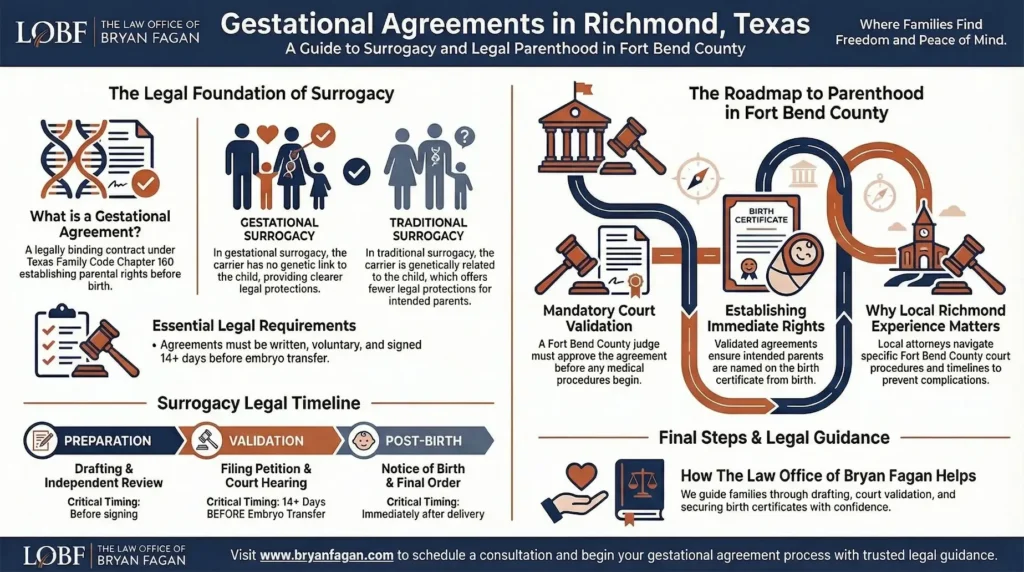
Legal Requirements for Gestational Agreements in Texas
Families considering Gestational Agreements in Richmond Texas quickly learn that Texas law provides a clear—but highly structured—framework for making these agreements legally enforceable. These requirements are not just technical rules; they exist to protect everyone involved and to ensure that parental rights are clearly defined from the very beginning.
One of the most important requirements is the marital status of the intended parents. Under Texas Family Code §160.754, the statute specifies that intended parents must be married to each other and both must be parties to the agreement. While court practices in some areas have evolved over time, the statutory language remains a key factor in how judges evaluate these agreements, especially during the validation process.
Another critical component involves genetic material. Texas law strictly prohibits the gestational carrier from using her own eggs in a gestational agreement. This requirement is designed to avoid legal complications that could arise if the carrier were also the biological mother. By clearly separating genetic and gestational roles, the law supports stability—something courts consistently prioritize under the “best interest of the child” standard in §153.002 and conservatorship considerations under §153.134, particularly if future issues involving child custody in Texas arise.
The law also requires that the gestational carrier have experienced at least one prior pregnancy and delivery. This ensures that she fully understands the physical and emotional aspects of pregnancy before entering into the agreement. In addition, a licensed physician must provide detailed medical disclosures to all parties, including information about success rates, risks, potential for multiple pregnancies, and possible psychological impacts.
Equally important is the requirement for independent legal counsel. Each party must have their own attorney to review and explain the agreement. This is not just a formality—it is a safeguard that helps ensure the agreement is fair, fully understood, and enforceable. In our experience, this step often prevents misunderstandings that could otherwise lead to disputes later.
Timing also plays a critical role. Texas law requires that the agreement be signed at least 14 days before any embryo transfer takes place. Missing this deadline can jeopardize the validity of the agreement and delay the entire process. Finally, and most importantly, the agreement must be validated by a Texas court before any medical procedures begin. Without court approval, the agreement is not enforceable, which can create significant legal uncertainty.
At The Law Office of Bryan Fagan, PLLC, our attorneys help families navigate these requirements with precision and clarity. Some situations are straightforward, while others may involve additional legal considerations that require a more strategic approach. For families looking to understand how these requirements are applied in surrounding areas, working with a gestational agreements attorney serving Montgomery, Texas can provide helpful regional insight.
Taking the time to understand and follow these legal requirements is one of the most important steps you can take to protect your rights, your child, and your peace of mind moving forward.
The Gestational Agreement Process
Navigating Gestational Agreements in Richmond Texas involves more than signing paperwork—it’s a carefully structured legal process designed to protect everyone involved from the very beginning. In Fort Bend County, courts play a central role by reviewing and validating these agreements before any medical procedures take place. This early court involvement helps prevent disputes later and ensures that parental rights are clearly established under Texas law.
The process typically starts with matching intended parents and a qualified gestational carrier who meets statutory requirements. This includes prior pregnancy history, medical clearance, and psychological evaluations. From there, families work closely with medical providers to confirm the reproductive plan, whether using the intended mother’s genetic material or working with a donor. These early steps are critical because any misstep—medical or legal—can affect whether a court will ultimately approve the agreement.
Once the foundation is in place, the legal drafting phase begins. A gestational agreement must include specific provisions required under Texas Family Code Chapter 160, including detailed disclosures from physicians, clear allocation of financial responsibilities, and defined roles for medical decision-making. Just as importantly, the agreement must establish who will be recognized as the legal parents. This level of clarity is what allows courts to later support stability for the child—something that becomes especially important if future issues arise involving divorce in Texas or child custody in Texas, where the “best interest of the child” standard under §153.002 and conservatorship considerations under §153.134 come into play.
Each party must have independent legal counsel, which ensures that everyone fully understands their rights and responsibilities before signing. In our experience, this is one of the most important safeguards in the entire process. It not only protects the enforceability of the agreement but also helps prevent misunderstandings that could lead to conflict later.
At The Law Office of Bryan Fagan, PLLC, our attorneys routinely guide families through these steps with a focus on both legal precision and real-world practicality. Whether you are just beginning your surrogacy journey or want to ensure your agreement will hold up under future legal scrutiny, having experienced counsel matters. If you’re looking to better understand how these agreements are handled in practice, you can explore additional guidance from a gestational agreement lawyer serving Humble, Texas to see how these legal protections are applied across the region.
Every family’s situation is different, and the level of legal strategy required can vary. But one thing remains constant: taking the time to get this process right at the beginning can make all the difference in protecting your family’s future.

Table 2: Steps in the Gestational Agreement Process
| Step | What Happens | Key Requirement |
|---|---|---|
| 1. Matching | Intended parents connect with gestational carrier | Carrier must have prior pregnancy and delivery |
| 2. Screenings | Medical and psychological evaluations | All parties must be medically cleared |
| 3. Legal drafting | Agreement prepared with required provisions | Independent legal counsel for each party |
| 4. Agreement signing | All parties execute the document | Must occur 14+ days before transfer |
| 5. Court filing | Petition submitted to Fort Bend County court | Complete documentation required |
| 6. Validation hearing | Court reviews eligibility and approves agreement | Must occur before embryo transfer |
| 7. Embryo transfer | Medical procedure proceeds | Only after court validation |
| 8. Pre-birth order | Court establishes parentage during pregnancy | Filed around 20-24 weeks |
| 9. Birth | Child arrives | Intended parents recognized as legal parents |
| 10. Birth certificate | Vital records updated | Lists intended parents as parents |
Establishing Parentage After Birth
Once a child is born under a validated gestational agreement, Texas Family Code § 160.756 provides that the intended parents are the legal parents. The court’s validation order, rendered before embryo transfer, declares that intended parents will have legal parentage of any child born under the agreement.
For families in Richmond Texas, this means the gestational carrier has no parental rights after birth—exactly as all parties intended when they entered the agreement. The intended parents’ names appear on the birth certificate through Fort Bend County Vital Statistics, without the need for an adoption proceeding.
During pregnancy, intended parents typically file for a pre-birth parentage order, often around 20-24 weeks. This order confirms the court’s earlier validation and ensures hospital staff and vital records personnel know exactly who should be listed as parents when the child arrives.
If an agreement was not properly validated before embryo transfer, the situation becomes significantly more complicated. Intended parents may need to pursue adoption, and there could be legal uncertainty about parental rights that takes months to resolve.
Rights and Responsibilities of Each Party
A well-drafted gestational agreement carefully balances the rights and responsibilities of everyone involved in this family law matter.
Intended parents typically bear financial responsibility for all medical expenses, surrogate compensation, incidental costs, and travel. They provide the genetic material (or arrange for donor eggs or sperm), ensure the agreement complies with Texas law, and work with legal counsel to validate the agreement before medical procedures begin. Intended parents also have the right to be recognized as legal parents upon the child’s birth.
The gestational carrier has important protections under Texas law. She retains the right to make medical decisions concerning her own health and the health of the pregnancy, as provided in § 160.754(g). She has the right to independent legal counsel to explain the agreement and advocate for her interests. The law also protects her by ensuring she voluntarily enters the agreement with full understanding of its terms.
The child benefits from legal certainty. With a validated gestational agreement, there’s no question about legal parentage, inheritance rights, or citizenship status. The child’s birth certificate accurately reflects their family structure from the beginning.
Common Challenges and Considerations
While Gestational Agreements in Richmond Texas provide a strong legal foundation for building a family, the reality is that this process involves more than simply meeting statutory requirements. Families often encounter legal, medical, financial, and emotional considerations that deserve careful attention from the very beginning.
One of the most important challenges is ensuring full legal compliance. Texas law sets strict requirements for gestational agreements, and even a minor misstep—such as improper timing, missing physician disclosures, or failure to meet eligibility criteria—can prevent a court from validating the agreement. That validation is critical, especially because Texas courts prioritize stability when determining parental rights, a principle that carries into future matters like child custody in Texas under Texas Family Code §153.002 and §153.134. When agreements are properly structured from the outset, families are better positioned to avoid disputes and protect long-term stability.
Medical considerations also play a significant role. Pregnancy, even under the best circumstances, involves risks and uncertainties. A well-drafted agreement should clearly outline how medical decisions will be handled, including scenarios involving multiple embryos, complications, or unexpected developments during the pregnancy. Without this clarity, difficult situations can quickly become stressful and legally complex.
Financial planning is another area where families often underestimate the scope of the process. Surrogacy costs in Texas can range from $100,000 to $220,000 or more, depending on compensation, medical care, agency involvement, and legal services. Insurance coverage for the gestational carrier may vary, and unexpected expenses can arise. Thoughtful financial structuring within the agreement helps reduce uncertainty and allows families to move forward with greater confidence.
Equally important are the emotional dynamics involved. The relationship between intended parents and a gestational carrier is built on trust, communication, and shared expectations. When those elements are supported by a clear legal framework, the process tends to be smoother and more positive for everyone involved. When they are not, even small misunderstandings can grow into larger challenges.
At The Law Office of Bryan Fagan, PLLC, our attorneys recognize that each family’s situation is unique. Some agreements are relatively straightforward, while others require a more strategic approach due to complex circumstances or future considerations. For families seeking additional guidance in nearby communities, working with a gestational agreements attorney in Bellaire, Texas can provide further insight into how these agreements are handled across the Houston area.
Taking the time to address these challenges early is one of the most effective ways to protect not only your agreement, but your family’s long-term stability and peace of mind.

Why Legal Guidance Is Essential
Gestational Agreements in Richmond Texas require more than good intentions—they demand precise compliance with Texas law. Under Texas Family Code Chapter 160, even a single oversight in drafting, timing, or required disclosures can prevent a court from validating the agreement. When that happens, intended parents may lose the legal certainty they believed they had, which can create serious complications if questions later arise about parental rights or responsibilities.
Working with experienced Texas family law attorneys is not just about paperwork—it’s about protecting your family’s future. In Fort Bend County, local court procedures, judicial expectations, and filing requirements can vary, and understanding those nuances can make a meaningful difference in how smoothly your agreement is approved. Our team regularly helps families navigate these steps, ensuring that agreements are properly structured and aligned with both statutory requirements and real-world court practices.
Effective legal guidance also means building an agreement that reflects your specific situation. Every family’s journey is different, and your agreement should address key issues such as financial responsibilities, medical decision-making, and contingency planning. These details are not just technical—they directly impact long-term stability, which is a central consideration under Texas Family Code §153.002 and §153.134 if future matters involving divorce in Texas or child custody in Texas arise.
Perhaps most importantly, proper legal guidance helps families avoid complications after a child is born. Without a validated agreement, intended parents may face unexpected legal hurdles, including adoption proceedings or disputes over parental rights. These situations can be stressful, time-consuming, and emotionally draining—especially when they could have been prevented with careful planning at the outset.
At The Law Office of Bryan Fagan, PLLC, we approach these cases with both precision and compassion. Some families need straightforward guidance to ensure compliance, while others require a more strategic approach due to complex circumstances or future considerations. If you are exploring your options or want to better understand how these agreements are handled across the region, you can learn more by working with a gestational agreements attorney serving The Woodlands, Texas.
Taking the time to get this process right from the beginning is one of the most important steps you can take to protect your rights, your child, and your peace of mind.
Actionable Checklist: Gestational Agreements in Richmond Texas
- ☐ Understand Texas Family Code Chapter 160, Subchapter H requirements
- ☐ Confirm eligibility requirements are met (marriage status, genetic plan, carrier qualifications)
- ☐ Select a gestational carrier who has had at least one child through prior pregnancy
- ☐ Secure independent legal counsel for all parties involved
- ☐ Ensure physician provides required medical disclosures
- ☐ Sign the agreement at least 14 days before embryo transfer
- ☐ File petition for court validation in Fort Bend County before medical procedures
- ☐ Obtain pre-birth parentage order during pregnancy
- ☐ Coordinate with hospital and vital records for birth certificate
- ☐ Maintain documentation of all legal filings and financial arrangements
Conclusion
Family journeys rarely follow a straight path. What begins with careful planning and hope—like entering into a gestational agreement—can evolve into something entirely different over time. The key isn’t avoiding change; it’s being prepared for it. When you understand how Texas law approaches parentage, custody, and stability, you put yourself in a position to make decisions that protect your child not just today, but years down the road.
If you’re facing questions about your rights, your child’s future, or how to navigate a transition like divorce after building your family, you don’t have to figure it out alone. Working with an experienced Texas family law attorney can help you create a plan that brings clarity where there’s uncertainty and structure where things feel unsettled. At The Law Office of Bryan Fagan, PLLC, our goal is to guide you through these moments with straightforward advice, thoughtful strategy, and a genuine commitment to your family’s well-being.
Sometimes the most important step isn’t having all the answers—it’s asking the right questions at the right time. When you’re ready to take that next step, whether it’s learning more, reviewing your options, or simply getting a second opinion, our team is here to help you move forward with confidence and peace of mind.
Frequently Asked Questions
A gestational agreement is a legally binding contract under Texas Family Code Chapter 160 that establishes intended parents as the legal parents of a child born through gestational surrogacy. The agreement must be validated by a Texas court before embryo transfer occurs.
Yes. Texas law requires that gestational agreements be validated by a court before the embryo transfer takes place. In Fort Bend County, these petitions are filed with the local courts and must be approved before medical procedures proceed.
When a gestational agreement is properly validated, the court declares that intended parents will be the legal parents of any child born under the agreement. After birth, a pre-birth parentage order ensures the intended parents appear on the birth certificate.
In gestational surrogacy, the carrier has no genetic connection to the child—the eggs come from the intended mother or a donor. In traditional surrogacy, the carrier provides her own eggs and is genetically related to the child. Texas gestational agreement statutes only cover gestational arrangements.
Yes. Texas law requires that each party to a gestational agreement have independent legal counsel. This ensures everyone understands the agreement’s terms and that their rights are properly protected throughout the process.
From initial matching to embryo transfer typically takes three to six months. Pregnancy adds approximately nine months, with birth certificate finalization occurring shortly after birth. The entire surrogacy journey often spans 18-24 months.
Total costs in Texas typically range from $100,000 to $220,000 or more, including surrogate compensation ($30,000-$85,000+), agency fees, medical expenses, and legal fees ($8,000-$15,000). Costs vary based on individual circumstances and medical complexity.
Once a gestational agreement is validated by the court, the intended parents have the legal right to parentage of any child born under the agreement. Texas law provides that a validated agreement is enforceable, and the gestational carrier relinquishes parental rights as specified in the agreement.
