
Richmond Texas Divorce Attorney: Your Complete Guide to Divorce in Fort Bend County

The moment often comes quietly. Maybe you’re standing in the kitchen after the kids have gone to bed, looking at the same house you’ve lived in for years, but everything suddenly feels different. Conversations have grown tense. Decisions feel heavier. The future you imagined together is no longer certain. In moments like these, many families begin searching for answers—and a Richmond Texas Divorce Attorney who can help them understand what comes next and how to protect the people and priorities that matter most.
Divorce in Texas is never just a legal procedure. It’s a life transition that affects homes, finances, parenting dynamics, and the emotional stability of everyone involved. Texas law recognizes this reality. Under Texas Family Code §153.002, courts must make decisions based on the best interest of the child, and judges often evaluate the stability and structure each parent can provide when determining custody and parenting arrangements. The legal system may focus on statutes and evidence, but for families experiencing divorce, the stakes are deeply personal.
At The Law Office of Bryan Fagan, PLLC, we understand that people seeking guidance during divorce are not simply looking for legal forms or court instructions. They want clarity during uncertainty and reassurance that someone understands the challenges they are facing. Our firm was founded by Bryan Joseph Fagan, a South Texas College of Law graduate and recognized authority on Texas divorce and custody law, with a clear mission: to empower people to reclaim freedom and peace of mind during life’s hardest transitions.
That mission reflects the belief that legal guidance should do more than resolve disputes. Through compassionate counsel, education, and innovative legal solutions that simplify complex family law issues, our team helps Texas families navigate divorce while protecting what matters most—their children, their financial security, and their ability to move forward with confidence.
In the sections that follow, we’ll explore how divorce can affect children in ways many parents do not initially anticipate, including changes in emotional well-being, routine, and academic performance. You’ll also learn how Texas courts evaluate stability in custody cases, what practical steps parents can take to support their children during divorce, and how experienced legal representation can help create a parenting structure designed for long-term success.
Key Takeaways
- Texas requires a 60-day waiting period from filing to final decree, but most divorces take longer depending on complexity and whether issues are contested.
- Property division follows the “just and right” standard, not an automatic 50/50 split—a judge considers many factors including children’s needs and each spouse’s circumstances.
- Child custody decisions center on the best interests of the child under Texas Family Code §153.002, focusing on stability, safety, and parent-child relationships.
- Temporary orders can protect you immediately by establishing custody arrangements, bill payments, and use of the family home while your case proceeds.
- Choosing the right divorce lawyer means finding someone with Texas family law experience, Fort Bend County court familiarity, and a communication style that works for you.

Your Family’s Future Starts Here
Don’t navigate your legal journey alone. Schedule a consultation now and get the clarity and support you deserve.
We offer comprehensive family law and estate planning services, including but not limited to the following:
As a family law firm, we recognize that clients entrust us with a deeply personal aspect of their lives. Respecting this responsibility, our firm operates with professionalism, diligence, and efficiency, while maintaining open lines of communication with our clients. Not only do we provide access to their attorney, but also a dedicated client support team capable of addressing any inquiries regarding the case, status updates, billing concerns, or any other matters that arise throughout the process. Please don’t hesitate to discover how we can be of service to you.
Contact the Law Office of Bryan Fagan, PLLC at 281-245-1907 or online.
Richmond Texas Divorce Attorney: The Short Answer
A Richmond Texas Divorce Attorney helps protect your legal rights when navigating divorce, child custody, and financial issues under the Texas Family Code. Divorce is more than a legal filing—it is a transition that affects your home, finances, and family relationships. Texas law requires courts to divide marital property in a manner that is “just and right” under Texas Family Code §7.001, which means judges evaluate factors such as each spouse’s earning capacity, the needs of the children, and the circumstances surrounding the end of the marriage. When children are involved, courts must prioritize the child’s best interest under Texas Family Code §153.002, ensuring that custody arrangements promote stability, safety, and meaningful relationships with both parents. A skilled attorney guides you through these legal standards while developing a strategy that protects your rights and prepares your case for negotiation, mediation, or trial in the Fort Bend County district courts.
Legal representation in a divorce often involves far more than filing documents with the court. An experienced divorce lawyer serving Richmond helps clients identify community and separate property, protect retirement accounts and other assets, and structure parenting plans that comply with Texas law. Attorneys also assist parents in navigating child support obligations governed by Texas Family Code Chapter 154, including the updated statutory guideline cap that determines how support is calculated in higher-income cases. Families who live in or are considering relocating to Richmond can also benefit from learning more about the community and local resources through the firm’s guide on moving to Richmond, Texas. Local knowledge of Fort Bend County courts, procedures, and mediation practices can help streamline the process and avoid unnecessary delays.
While experienced legal guidance provides strong advocacy, it is important to understand that no attorney can guarantee a specific result. Every divorce case depends on the unique facts, evidence, and financial circumstances involved. Judges apply the Texas Family Code to the details presented in each case, which is why preparation and informed decision-making are so important. Working with an experienced legal team gives you a trusted advocate who understands both the legal framework and the emotional realities of divorce. For families who want to better understand how courts determine financial obligations during a divorce, the firm’s resource on how child support is calculated in Texas provides helpful guidance and practical insight. With the right legal support, families can approach divorce with greater clarity, confidence, and a plan that protects their future.

Do You Really Need a Divorce Attorney in Richmond?
Whether you need a Richmond Texas Divorce Attorney often depends on the complexity of your situation and the issues involved in your case. Divorce in Texas can affect property rights, parenting responsibilities, and financial stability, and these matters are governed by specific provisions of the Texas Family Code. For example, property division is addressed under Texas Family Code §7.001, which requires courts to divide community property in a manner that is “just and right,” while conservatorship and possession decisions involving children must follow the best interest of the child standard under Texas Family Code §153.002. When families face questions involving children, significant property, or financial uncertainty, experienced legal guidance can help ensure these laws are applied correctly and fairly.
Even when a divorce appears simple at first glance, attempting a do-it-yourself approach can create serious risks. Filing errors, incomplete financial disclosures, or unclear language in a Final Decree of Divorce may lead to costly enforcement disputes later. Texas courts rely on written court orders, which means verbal agreements or informal arrangements typically carry little legal weight unless they are included in the final decree. Once a judge signs the order, modifying it may require a new legal proceeding under Texas Family Code Chapter 156. Working with experienced legal counsel can help prevent these complications by ensuring the agreement accurately reflects the law and protects your long-term interests.
Legal representation becomes especially important in situations involving shared assets, parenting responsibilities, or disagreements between spouses. For instance, couples who own homes, retirement accounts, or business interests often need detailed analysis to determine whether property is community or separate property under Texas Family Code §3.002. Parents must also address custody and visitation schedules that comply with Texas Family Code Chapter 153 and child support obligations governed by Chapter 154. These issues require careful planning to ensure the final orders support stability for children and financial fairness for both parties. Families navigating these matters can also benefit from learning more about related legal issues in their community, including information about Richmond DWI and DUI laws when criminal allegations intersect with family law concerns.
There are also situations where safety concerns or serious conflict require immediate legal guidance. Cases involving family violence, substance abuse allegations, or significant disputes over children often require temporary orders and strategic legal planning to protect the parties involved. Courts may evaluate these factors carefully when determining conservatorship and possession schedules, particularly when a child’s safety or well-being is at stake. Parents seeking additional guidance on how Texas courts address financial responsibilities after divorce may also find the firm’s resource on how child support is calculated in Texas helpful for understanding the legal framework involved.
For couples with minimal assets, no children, and full agreement on every issue, an uncontested divorce may move forward more efficiently. Even in these situations, having an experienced attorney review the proposed agreement can help ensure that the language is clear, enforceable, and consistent with the Texas Family Code. Thoughtful legal guidance provides peace of mind that the final decree protects both your rights and your family’s future, allowing you to move forward with confidence during a challenging life transition.
Texas Divorce Basics: Residency, Grounds, and Waiting Period
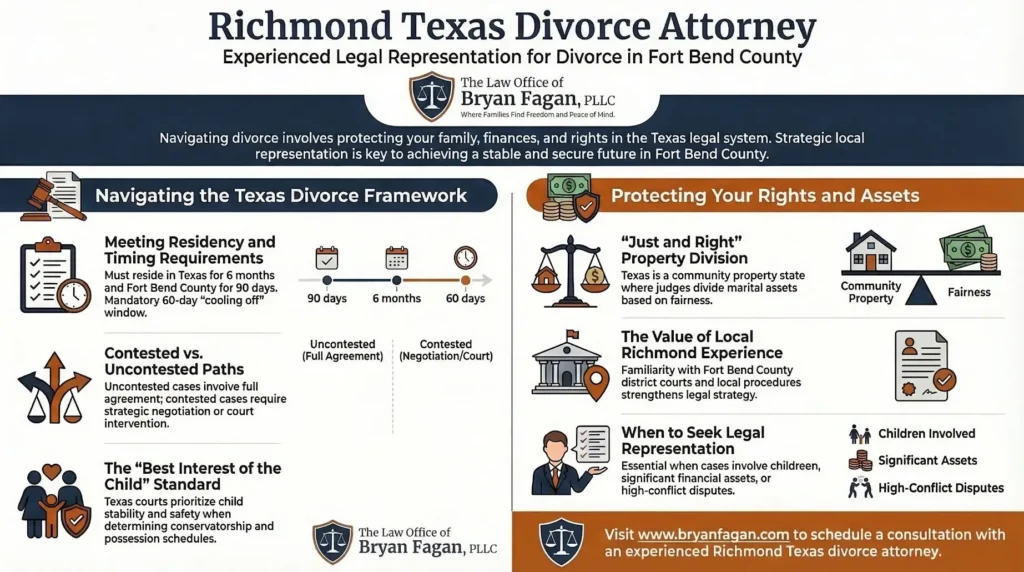
Before filing for divorce in Fort Bend County, you must meet specific residency requirements under Texas law. At least one spouse must have lived in Texas for the preceding six months and in Fort Bend County for the preceding 90 days before filing.
Texas Family Code §6.702 requires a 60-day waiting period between filing and when a court can grant your divorce. This waiting period is mandatory with only narrow exceptions involving family violence or protective orders. Don’t plan on a final decree before day 61 at the earliest.
Texas is a no-fault divorce state, meaning you don’t need to prove wrongdoing. “Insupportability”—the legal term for irreconcilable differences—is the most common ground. However, fault grounds like adultery, cruelty, abandonment, or conviction of a felony can affect property division and custody decisions.
“Uncontested” doesn’t mean “instant.” Even when both spouses agree on everything, you still wait 60 days, file proper paperwork, and attend a brief court hearing called a prove-up.
The Divorce Process Step-by-Step (What Richmond Clients Can Expect)
Most divorce cases handled by a Richmond Texas Divorce Attorney follow a structured path through the Fort Bend County district courts, but every family’s situation is unique. The process begins with a detailed consultation and planning stage, where you meet with an experienced Texas family law attorney to discuss your goals, financial circumstances, and concerns regarding children or property. During this early stage, your attorney evaluates the complexity of the case and explains how Texas law applies to your situation. For example, Texas Family Code §6.001 allows divorce on the no-fault ground of insupportability, while Texas Family Code §153.002 requires courts to prioritize the best interest of the child when making custody decisions. Understanding these legal principles early helps families make informed decisions about strategy and potential outcomes.
Once the case begins, your attorney files the Original Petition for Divorce with the appropriate Fort Bend County district court. Texas Family Code §6.403 requires the responding spouse to be properly served with the petition unless they sign a waiver of service. Shortly after filing, many families request temporary orders to establish stability while the divorce proceeds. These orders may determine who lives in the marital residence, how bills are paid, and what the temporary parenting schedule will be. Temporary orders hearings are particularly important in cases involving children because courts must ensure that any conservatorship or possession schedule aligns with the child’s best interests as outlined in Texas Family Code Chapter 153.
In contested cases, the next phase is discovery, where both spouses exchange financial documents, property records, and other evidence relevant to the divorce. This step is essential for identifying community property under Texas Family Code §3.002 and ensuring that marital assets are divided fairly under the “just and right” standard established in §7.001. Discovery may include written questions, document requests, and depositions designed to clarify the financial picture and prevent hidden assets from influencing the final outcome. Families navigating this process can also benefit from local information and services available through government resources in Richmond, Texas, which may provide helpful guidance on local offices and court-related services.
Many Fort Bend County courts encourage or require mediation before a case proceeds to trial. Mediation allows both spouses to work with a neutral mediator to negotiate agreements on property division, child custody, and financial matters. Because mediation is often less stressful and less expensive than litigation, many families resolve their disputes during this stage. When children are involved, mediation can also help parents create customized parenting plans that support stability and cooperation moving forward. For readers interested in understanding how financial responsibilities are calculated in Texas divorce cases, the firm’s resource on how child support is calculated in Texas offers additional helpful insight.
If the spouses reach an agreement, the case concludes with a brief prove-up hearing where the judge reviews and approves the settlement before signing the Final Decree of Divorce. When disputes remain unresolved, the case may proceed to trial, where the judge will evaluate evidence and make final determinations regarding property division, conservatorship, and support obligations. After the court signs the final decree, the implementation stage begins, which includes transferring titles, dividing retirement accounts through qualified domestic relations orders when necessary, updating beneficiary designations, and ensuring the custody schedule is followed according to the court’s order.
While every case is different, realistic timelines in Fort Bend County typically range from two to four months for uncontested divorces to several months or longer for contested cases involving complex financial or custody issues. Working with an experienced legal team helps ensure that each stage of the process is handled carefully and efficiently. By combining legal knowledge with compassionate guidance, attorneys at the firm help families move forward with clarity, stability, and confidence during one of life’s most challenging transitions.
Contested vs Uncontested Divorce
An uncontested divorce means both spouses agree on all major issues—property division, child custody, child support, and spousal maintenance. A contested divorce involves disagreement on one or more significant matters.
| Aspect | Uncontested Divorce | Contested Divorce |
|---|---|---|
| Definition | Both spouses agree on all terms | Disagreement on one or more major issues |
| Common Triggers | Mutual agreement, simple assets, no children or agreed custody | Property disputes, custody conflicts, hidden assets, safety concerns |
| Typical Issues | Paperwork and prove-up hearing | Discovery, temporary orders, mediation, potentially trial |
| General Timeline | 2-4 months in Fort Bend County | 6-18+ months depending on complexity |
| Recommended Next Step | Review agreement with attorney, file paperwork | Consult experienced divorce attorney immediately |
Many divorces start contested and become uncontested through negotiation and mediation. Most parents and spouses prefer settlement over trial when possible. But if your spouse won’t cooperate or you can’t reach agreement, having a tx skilled divorce attorney prepared for court protects your interests.

Property Division in Texas (Community vs Separate)
Texas is a community property state, but divorce property division is based on what the judge considers “just and right” under Texas Family Code §7.001. This doesn’t mean automatic 50/50 splits.
Community property includes most assets and debts acquired during marriage. Under Chapter 3 of the Texas Family Code, everything possessed at divorce is presumed community property. The spouse claiming otherwise must prove separate property status by clear and convincing evidence.
Separate property stays with the owning spouse. Examples include:
- Assets owned before marriage
- Gifts given specifically to one spouse during marriage
- Inheritances received by one spouse
- Personal injury recoveries (except lost wages during marriage)
The “just and right” standard means judges consider multiple factors: duration of marriage, each spouse’s earning capacity, health, contributions as homemaker, any children’s needs, and sometimes fault in the breakup. One spouse’s adultery or cruelty can shift the division.
Practical examples:
- A house purchased during marriage: equity divided as community property even if titled in one spouse’s name
- Retirement accounts: contributions and growth during marriage are community property; benefits earned before marriage are separate
- Debt: credit cards and loans incurred during marriage are typically community debt
When separate and community property mix—like using marital income to improve a premarital house—the community estate may have reimbursement rights. These situations require careful analysis.
Listen to Our Texas Family Law Podcast
Prefer listening? In this episode, we discuss divorce in Richmond, Texas, including what you need to know before you file, important legal considerations, and how to prepare for the process.
If You Have Kids: Custody, Visitation, and Child Support
When children are involved, their well being becomes the court’s primary focus. Texas Family Code §153.002 establishes the best interest of the child as the standard for all custody decisions.
Conservatorship (legal custody) determines who makes major decisions about your child’s education, healthcare, and religious upbringing. Texas courts often award joint managing conservatorship, giving both parents decision-making rights. Sole managing conservatorship gives one parent primary authority.
Possession and access (visitation) determines the schedule—when your children live with each parent. The Standard Possession Order provides a common framework, but parents can agree to different arrangements that serve the child’s best interests.
Child support follows guidelines in Chapter 154 of the Texas Family Code. The paying parent’s income, number of children, and other support obligations determine the amount. Either parent may be ordered to pay depending on circumstances.
Experienced child custody attorneys help parents focus on what matters: stability, safety, and maintaining strong relationships with both you and your children. Most parents reach custody agreements through negotiation or mediation rather than trial.
Temporary Orders: Why They Matter Early
Temporary orders provide immediate relief while your divorce case proceeds. They establish the “status quo” that often influences final outcomes.
Temporary orders can address:
- Custody schedule: Who has the children and when
- Exclusive use of home: Which spouse stays in the residence
- Temporary support: Financial support for spouse or children during the case
- Bill payments: Who pays the mortgage, utilities, insurance
- Conduct orders: Prohibitions on harassment, contact, or asset transfers
Fort Bend County courts typically schedule temporary orders hearings within weeks of filing when requested. If your spouse is hiding assets, threatening safety, or refusing to contribute to household bills, seeking temporary relief early protects your position.
Don’t let temporary arrangements go unaddressed. Courts pay attention to what’s been working during the divorce when making final decisions.
What to Bring to a Richmond Divorce Consultation
Coming prepared to your free consultation helps your attorney understand your situation and provide better guidance.
| Category | Examples | Why It Matters |
|---|---|---|
| Finances | Pay stubs, tax returns (3 years), bank statements | Establishes income and assets for support calculations |
| Debts | Credit card statements, loan documents, mortgage statements | Identifies community debts requiring division |
| Property | Deeds, vehicle titles, appraisals | Documents assets subject to division |
| Retirement | 401(k) statements, pension information | Often largest marital assets requiring special division |
| Children | School information, medical records, custody concerns | Supports custody and support planning |
| Communications | Relevant texts or emails | May document agreements, threats, or hidden assets |
Organize documents by category. Write down your questions and goals before the meeting. Be honest about everything—your attorney needs complete information to help you.
Common Mistakes That Cost People Money and Time
Avoiding common divorce mistakes can protect your legal rights, reduce stress, and help your case move forward efficiently. A knowledgeable Richmond Texas Divorce Attorney regularly helps families recognize potential pitfalls early so they can make informed decisions throughout the process. Divorce in Texas is governed by the Texas Family Code, and courts expect spouses to act responsibly once a case has been filed. For example, Texas courts often issue standing orders that restrict parties from transferring, hiding, or wasting marital assets during the divorce. These protections work alongside Texas Family Code §7.001, which requires courts to divide community property in a manner that is “just and right,” meaning fairness is evaluated based on the facts of each case. Attempting to conceal financial information or move money improperly can severely damage credibility in court and ultimately lead to an unfavorable property division.
Communication during a divorce is another area where small missteps can have large consequences. Angry text messages, hostile emails, or social media posts may seem like harmless ways to vent frustration, but in family law cases they can become powerful evidence. Courts evaluating custody matters must focus on the best interest of the child under Texas Family Code §153.002, and communications that show hostility or poor judgment may influence how a judge views a parent’s ability to foster a healthy environment for a child. Because of this, experienced attorneys often advise clients to communicate thoughtfully and keep discussions about the case respectful and focused on solutions rather than conflict.
Another frequent issue arises when spouses rely on verbal agreements instead of documented arrangements. While couples may initially trust each other’s word, Texas courts cannot enforce informal promises that are not included in written court orders. Agreements about property division, parenting schedules, or financial responsibilities must ultimately be reflected in the Final Decree of Divorce to be enforceable. Missing court deadlines or failing to respond to filings can also create serious problems, including default judgments or sanctions from the court. Divorce proceedings involve strict timelines and procedural requirements, which is why guidance from an experienced attorney can be so valuable.
Vague decree language is another mistake that can create long-term complications for families. Terms such as “reasonable visitation” or “divide assets equally” often sound simple but may lead to future disputes if expectations differ between the parties. The Texas Family Code emphasizes clear conservatorship and possession orders in Chapter 153 to ensure parents understand their rights and responsibilities. When divorce orders include precise terms for parenting schedules, financial obligations, and property division, families are far less likely to face enforcement disputes later.
Temporary orders deserve special attention as well. These orders establish the structure that governs a family while the divorce case is pending, including who remains in the marital residence, who pays certain bills, and how parenting time is handled. Because temporary arrangements can influence final outcomes, addressing them early is critical. Families in the Richmond area may also benefit from understanding local logistics and commuting considerations when structuring parenting schedules, particularly when children travel between homes or schools. Helpful community information can be found in the firm’s guide on transportation in Richmond, Texas, which can assist parents in planning practical custody arrangements that support stability for their children.
Families navigating divorce often find that knowledge is one of their greatest sources of confidence. For additional insight into how Texas courts approach financial and parenting responsibilities, readers may also find value in the firm’s resource on how child support is calculated in Texas. With thoughtful planning and experienced legal guidance, many of the most common divorce mistakes can be avoided, allowing families to move forward with clarity, fairness, and a stronger foundation for the future.

How a Richmond Texas Divorce Attorney Helps You Protect Your Future
An experienced tx divorce lawyer provides advantages that protect your long-term interests:
Strategy development: Your attorney analyzes your specific facts and develops a plan tailored to your goals—whether that’s preserving the family home, maximizing parenting time, or protecting retirement accounts.
Document and evidence planning: Knowing what evidence matters and how to gather it strengthens your position in negotiation and court.
Negotiation leverage: Attorneys with trial experience negotiate from strength. The other side knows you’re prepared if settlement fails.
Clear, enforceable decree drafting: Precise language prevents future disputes. Your attorney ensures orders are specific enough to enforce.
Court readiness: Most divorces settle, but good preparation matters in case you need a hearing. Having a board certified family law attorney ready for trial protects you if negotiation fails.
Why Choose The Law Office of Bryan Fagan, PLLC
Families searching for a Richmond Texas Divorce Attorney often want more than technical legal answers—they want guidance from a team that understands both the law and the emotional realities of divorce. Attorneys serving clients throughout Richmond and Fort Bend County bring extensive experience with the Texas Family Code and the procedures of local district courts, allowing families to navigate divorce with clarity and confidence. Texas law provides a structured framework for resolving divorce disputes, including property division under Texas Family Code §7.001, which requires courts to divide community property in a manner that is “just and right,” and custody determinations guided by the best interest of the child standard in Texas Family Code §153.002. By combining deep legal knowledge with practical strategy, the legal team helps clients understand their options while preparing each case for negotiation, mediation, or, when necessary, trial.
Compassionate communication remains central to the firm’s approach. Divorce and family law matters affect finances, parenting relationships, and emotional well-being, which is why clients receive clear explanations of the legal process and honest assessments about their case. When issues such as family violence or safety concerns arise, Texas law provides additional protections. For example, Texas Family Code Chapter 85 allows courts to issue protective orders when family violence has occurred or is likely to occur in the future. Families facing serious safety concerns in the Richmond area can also learn more about related criminal law issues through the firm’s resource on Richmond assault laws and legal considerations. Addressing these issues early in a divorce case can be essential to protecting both personal safety and parental rights.
The legal team also emphasizes strategic preparation in every case. While many divorces resolve through negotiation or mediation, successful outcomes often depend on being fully prepared for trial if necessary. This preparation includes gathering financial evidence, identifying community and separate property, and building parenting plans that comply with Texas Family Code Chapter 153. Child support obligations are addressed under Texas Family Code Chapter 154, which includes updated statutory guidelines that determine how support is calculated. For families seeking more information about financial responsibilities after divorce, the firm provides helpful guidance in its resource on how child support is calculated in Texas.
Serving families across Richmond and the broader Fort Bend County area, the firm assists clients with a wide range of family law matters, from uncontested divorces to complex disputes involving property division, custody arrangements, spousal maintenance, and protective orders. By combining legal experience with a mission centered on educating families and protecting futures, the attorneys help clients move through difficult transitions with greater clarity, stability, and confidence about the road ahead.

Checklist: Richmond Texas Divorce Attorney
Use this checklist as you prepare for divorce:
- [ ] Confirm you meet Texas residency requirements (6 months in Texas, 90 days in Fort Bend County)
- [ ] Understand the 60-day waiting period—plan accordingly
- [ ] Gather key financial documents (pay stubs, tax returns, bank statements)
- [ ] List all assets and debts with approximate values
- [ ] Consider immediate needs: children’s schedule, who stays in the home, bill payments
- [ ] Avoid major financial moves (large purchases, account transfers) without legal advice
- [ ] Keep communication with your spouse calm and in writing when possible
- [ ] Don’t post about your divorce on social media
- [ ] Prepare questions for your consultation
- [ ] Consider your mediation goals and what you’re willing to negotiate
- [ ] Consult a family law attorney early—before making major decisions
Conclusion
Divorce can feel like stepping into unfamiliar territory, especially when your biggest concern isn’t just the legal process—it’s how the changes might affect the people you love most. When children are involved, every decision carries a little more weight. Parents worry about routines, stability, emotional well-being, and whether life will eventually feel “normal” again. The reassuring truth is that with thoughtful planning, clear communication, and the right legal guidance, families can create new structures that allow children to continue growing, learning, and feeling secure.
Texas family courts recognize that children thrive when parents prioritize stability, cooperation, and thoughtful decision-making. That’s why custody arrangements, parenting plans, and support structures are designed not simply to resolve conflict between adults, but to protect a child’s best interests and long-term well-being. When those decisions are approached with care—and with guidance from someone who understands Texas family law—they can become the foundation for a healthier future for everyone involved.
At The Law Office of Bryan Fagan, PLLC, we believe that knowledge empowers families to move forward with confidence. Our team works with parents across Texas who want more than a legal outcome—they want clarity, reassurance, and a strategy that protects their children and their future. If you’re facing questions about divorce, custody, or how to create stability for your family during a difficult transition, speaking with an experienced Texas Family Law Attorney can provide the perspective and direction you need.
And if you’re feeling overwhelmed right now, remember something simple: you don’t have to figure everything out all at once. Sometimes the best next step is just a conversation—one that helps you understand your options and start building a plan that works for your family. When families feel informed and supported, even life’s toughest transitions can lead to stronger, more stable beginnings.
Frequently Asked Questions About Divorce, Custody, and Children’s Academic Stability in Texas
Divorce can create emotional stress and routine changes that may affect a child’s concentration, attendance, and motivation at school. Some children experience declining grades, behavioral changes, or difficulty focusing as they adjust to living in two households. However, many children regain stability when parents create consistent routines, maintain open communication with teachers, and reduce conflict at home.
Yes. Texas courts evaluate the best interest of the child under Texas Family Code §153.002, which allows judges to consider factors affecting a child’s well-being and stability. While grades alone do not determine custody, courts may consider school attendance, academic performance, and each parent’s ability to support the child’s education when determining conservatorship and possession schedules.
In Texas, custody is referred to as conservatorship. Parents are often appointed joint managing conservators, meaning they share decision-making responsibilities for the child’s upbringing. However, one parent may have the right to determine the child’s primary residence and school district. Courts may structure these rights differently depending on the child’s best interests.
Yes. Frequent transitions between homes, long commutes, or inconsistent homework expectations can disrupt a child’s academic routine. Texas courts often try to create possession schedules that support school stability, especially during the school week, while still maintaining meaningful time with both parents.
Parents can help maintain stability by communicating regularly with teachers, creating consistent routines in both homes, monitoring homework and grades, and encouraging open conversations about how the child is feeling. Early intervention—such as tutoring or counseling—can also help if academic struggles appear.
Child support helps ensure that children have the financial resources needed for housing, school supplies, transportation, healthcare, and other essential needs that support learning and development. Texas child support guidelines are outlined in Chapter 154 of the Texas Family Code and are designed to help children maintain stability after divorce.
If circumstances change significantly and a child’s well-being is affected, a parent may request a modification of custody or possession orders. Courts may consider evidence such as school records, attendance reports, or teacher input when determining whether a modification serves the child’s best interests.
A well-structured parenting plan may address school-night routines, transportation responsibilities, communication with teachers, extracurricular activities, and access to school records. Clear expectations between parents can reduce confusion and help children stay focused on school responsibilities.
In most cases, courts try to avoid placing children directly in the middle of parental disputes. Judges may rely on documentation, testimony from parents, or input from professionals such as teachers, counselors, or child custody evaluators rather than requiring a child to testify.
An experienced attorney can help parents develop custody arrangements that prioritize routine and stability, gather relevant school records if necessary, and advocate for parenting plans that support the child’s long-term well-being. Legal guidance can also help parents understand how Texas courts evaluate custody decisions and how to structure agreements that protect both the parent-child relationship and the child’s success in school.